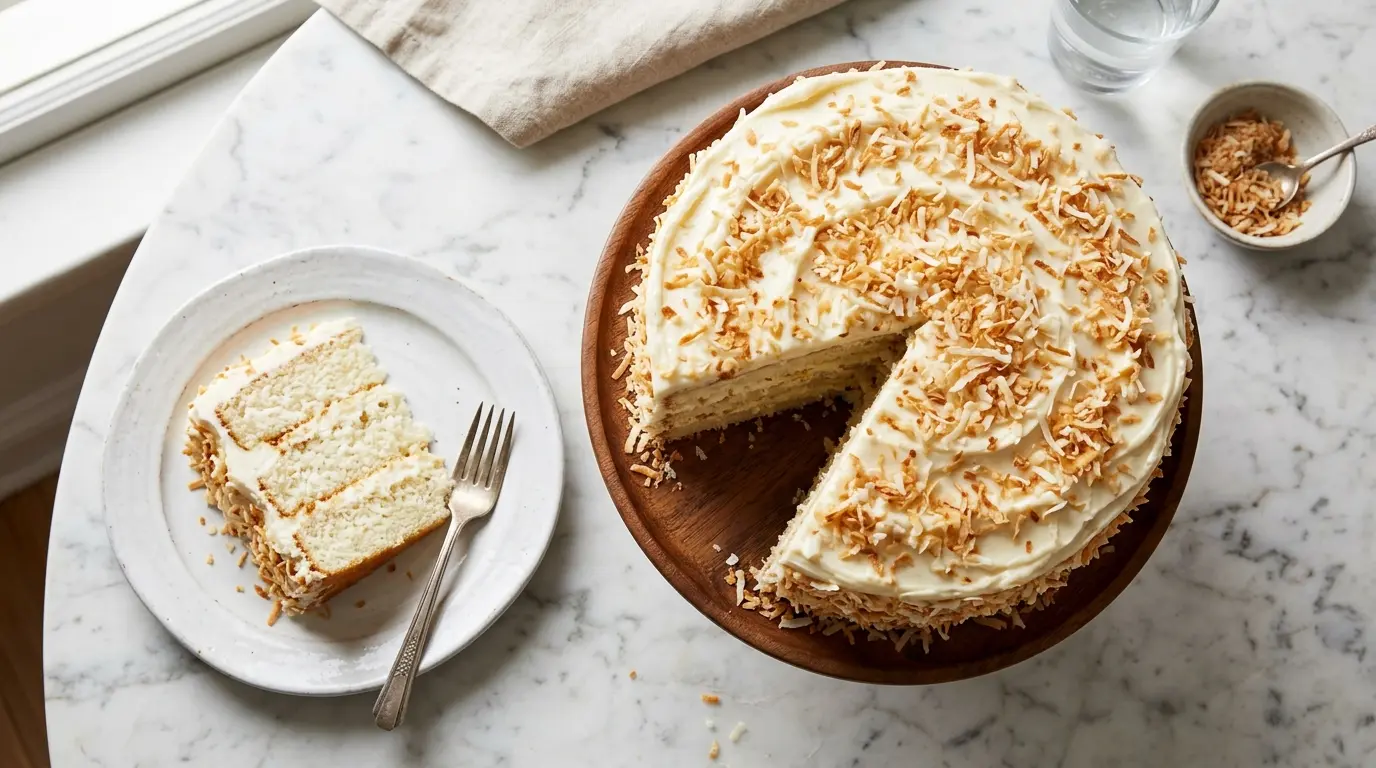
If you’ve been searching for a truly show-stopping coconut cake recipe, this is the one that will make everyone ask for seconds. This classic Southern-style coconut layer cake is built on a tender, butter-based white cake soaked with a hint of coconut, filled with a luscious coconut cream filling, and covered in a cloud-like coconut cream cheese frosting.
Every element of this recipe is intentional. The cake layers stay moist because of buttermilk and real butter working together to create a tight, fine crumb. The cream cheese frosting cuts through the sweetness of the coconut just enough to keep every bite balanced.
This isn’t the kind of cake you rush through. It’s the kind you make for Easter Sunday, a birthday party, or whenever you want something that genuinely wows a crowd.
The good news? It’s more approachable than it looks. Once you understand the building blocks — a good white cake base, a coconut-spiked filling, and a sturdy frosting — the whole thing comes together beautifully.
This cake pairs wonderfully with a scoop of Vanilla Bean Ice Cream on the side for an extra-indulgent dessert spread.

Why You’ll Love This Coconut Cake Recipe
This cake is the full package — beautiful, delicious, and surprisingly forgiving for a layer cake.
The layers are soft and pillowy without being dense. That balance comes from creaming the butter and sugar long enough to whip in real air, which is the real secret behind a light, fluffy crumb.
The coconut flavor is present without being overwhelming. Using coconut extract alongside real cream of coconut gives you depth — that warm, slightly sweet tropical note — rather than a harsh artificial flavor.
It looks impressive but follows a straightforward baking process. If you’ve made a layer cake before, you already know the hardest steps.
Here’s what makes it a go-to:
- Moist layers that stay soft even a day or two after baking
- Real coconut in every component — the cake, the filling, and the frosting
- Cream cheese frosting that holds its shape beautifully and doesn’t slide
- Customizable with different fillings like lemon curd or pineapple jam
- A stunning presentation that looks professional with minimal decorating skills
You might also enjoy: Lemon Chiffon Cake Recipe
Ingredients
This recipe uses pantry-friendly baking staples plus a few coconut-specific ingredients that are easy to find at most grocery stores. Make sure your butter and eggs are at room temperature before you begin — it makes a real difference in how the batter comes together.
For the Cake Layers:
- 3 cups (360g) all-purpose flour
- 1 tablespoon baking powder
- ½ teaspoon salt
- 1 cup (227g) unsalted butter, softened to room temperature
- 2 cups (400g) granulated sugar
- 5 large eggs, room temperature
- 1 teaspoon pure vanilla extract
- 1 teaspoon coconut extract
- 1 cup (240ml) full-fat buttermilk, room temperature
- ½ cup (120ml) cream of coconut (such as Coco López)
For the Coconut Cream Filling:
- 1½ cups (360ml) cream of coconut
- 1 cup (80g) sweetened shredded coconut
- 1 cup (240ml) heavy whipping cream
For the Coconut Cream Cheese Frosting:
- 16 oz (454g) full-fat cream cheese, softened
- 1 cup (227g) unsalted butter, softened
- 5–6 cups (600–720g) powdered sugar, sifted
- 1 teaspoon pure vanilla extract
- ½ teaspoon coconut extract
- 2–3 tablespoons heavy cream (to adjust consistency)
For Decorating:
- 2–3 cups (160–240g) sweetened shredded or flaked coconut, toasted or untoasted
Read Also: Cream Cheese Frosting Recipe
Kitchen Equipment Needed
Having the right tools makes this recipe much smoother. A stand mixer is a real advantage here because the batter and frosting both need extended beating — but a hand mixer works just as well with a little extra time.
- Stand mixer or electric hand mixer
- Three 9-inch (23cm) round cake pans
- Parchment paper
- Mixing bowls (large and medium)
- Rubber spatula
- Wire cooling racks
- Offset spatula (for frosting)
- Cake turntable (optional, but very helpful)
- Serrated knife (for leveling layers)
- Measuring cups and spoons
Read Also: Vanilla Buttercream Frosting Recipe
Recommended Products for This Recipe
These are products that genuinely make a difference in the final result, chosen based on quality and performance.
1. Coco López Cream of Coconut
Cream of coconut is not the same as coconut cream — it’s sweetened, thick, and intensely flavored. Coco López is the gold standard brand and is widely used in baking for exactly this kind of recipe. It adds moisture and a rich coconut flavor that coconut milk simply can’t replicate.
2. Nielsen-Massey Pure Coconut Extract
The extract you use matters. Nielsen-Massey uses real coconut in their extracts, and the difference in flavor compared to generic brands is noticeable. A good coconut extract gives you that authentic tropical warmth without an artificial edge.
3. Fat Daddio’s 9-Inch Round Cake Pans
Thin, cheap cake pans warp in the oven and cause uneven baking. Fat Daddio’s anodized aluminum pans distribute heat evenly so your layers bake flat and come out cleanly every time. They’re a workhorse investment for anyone who bakes cakes regularly.
4. Wilton Icing Spatula Set
A good offset spatula is essential for applying frosting smoothly and getting those clean edges. This set includes two sizes — the small one is perfect for detail work and the large one handles the outer frosting coat efficiently.
5. Bob’s Red Mill Sweetened Shredded Coconut
Quality coconut makes a difference in both texture and flavor. Bob’s Red Mill shredded coconut has a good moisture level — not too dry, not clumped — which means it stays soft in the filling rather than turning chewy.
The same technique used to build this filling works beautifully in a Pastry Cream Recipe if you want to experiment with other cake fillings.

Step-by-Step Instructions
1. Prepare Your Pans and Preheat the Oven
- Preheat your oven to 350°F (175°C). Allow the oven at least 15–20 minutes to fully come to temperature before you slide any pans in.
- Grease three 9-inch (23cm) round cake pans with butter or nonstick spray, making sure to coat the sides completely.
- Cut three circles of parchment paper to fit the bottoms of each pan. Press them into the greased pans and then lightly grease the parchment itself. This double-preparation ensures the layers release cleanly without tearing.
- Set the prepared pans aside on the counter.
2. Mix the Dry Ingredients
- In a large mixing bowl, whisk together the 3 cups (360g) of all-purpose flour, 1 tablespoon of baking powder, and ½ teaspoon of salt until evenly combined.
- Whisking the dry ingredients together before adding them to the batter ensures the baking powder and salt are distributed evenly throughout, which prevents uneven rise.
- Set this bowl aside.
3. Cream the Butter and Sugar
- Place the 1 cup (227g) of softened, room-temperature butter in the bowl of your stand mixer fitted with the paddle attachment (or use a large bowl and hand mixer).
- Beat the butter on medium speed for about 2 minutes until it becomes pale and smooth.
- Add the 2 cups (400g) of granulated sugar all at once and beat on medium-high speed for a full 4–5 minutes. The mixture should become very light, fluffy, and noticeably paler in color. Do not rush this step — this is where the air gets incorporated that gives the cake its lift.
- Scrape down the sides and bottom of the bowl with a rubber spatula every minute or so to make sure everything is being beaten evenly.
4. Add the Eggs and Extracts
- With the mixer running on low speed, add the 5 eggs one at a time, waiting until each egg is fully incorporated before adding the next. This prevents the batter from curdling.
- After all 5 eggs are in, add 1 teaspoon of pure vanilla extract and 1 teaspoon of coconut extract. Mix on low just until combined.
- Scrape down the bowl again.
5. Combine the Wet and Dry Ingredients
- In a small bowl or measuring cup, stir together the 1 cup (240ml) of buttermilk and the ½ cup (120ml) of cream of coconut until loosely combined.
- With the mixer on its lowest speed, add about one-third of the dry flour mixture to the butter mixture and mix just until a few streaks remain.
- Pour in half of the buttermilk-cream of coconut mixture and mix on low until just combined.
- Add another third of the flour mixture and mix briefly.
- Pour in the remaining buttermilk mixture and mix.
- Finally, add the last third of the flour and mix only until the flour disappears and the batter is smooth. Do not overmix — overworked gluten makes a tough, dense cake.
6. Divide the Batter and Bake
- Divide the batter evenly among the three prepared 9-inch cake pans. Each pan should receive approximately the same amount — you can use a kitchen scale for accuracy, or just eyeball it carefully.
- Use a rubber spatula or the back of a spoon to spread the batter to the edges of each pan and smooth the tops.
- Bake in the preheated 350°F (175°C) oven for 28–32 minutes. The cakes are done when the tops spring back when lightly touched in the center and a toothpick inserted into the middle comes out clean or with just a few moist crumbs.
- Start checking at the 27-minute mark since oven temperatures can vary.
7. Cool the Cake Layers
- Remove the pans from the oven and let the cakes rest in the pans on wire cooling racks for 10 minutes. Do not attempt to remove them immediately — they need time to firm up slightly.
- After 10 minutes, run a thin knife or offset spatula around the edge of each pan to loosen the cakes.
- Invert each pan onto a wire rack, lift off the pan, and peel away the parchment paper.
- Turn the layers right-side up and let them cool completely — at least 1–1.5 hours — before assembling. Frosting warm layers causes the frosting to melt and slide off.
8. Make the Coconut Cream Filling
- In a medium mixing bowl, use a hand mixer or whisk to whip the 1 cup (240ml) of heavy whipping cream to medium-stiff peaks.
- In a separate bowl, stir together the 1½ cups (360ml) of cream of coconut and 1 cup (80g) of sweetened shredded coconut until combined.
- Gently fold the whipped cream into the cream of coconut mixture using a rubber spatula, using broad, slow strokes to preserve the airiness of the whipped cream.
- Cover and refrigerate the filling until you’re ready to assemble the cake.
9. Make the Coconut Cream Cheese Frosting
- Beat the 16 oz (454g) of softened cream cheese in the bowl of your stand mixer on medium speed for 2–3 minutes until completely smooth and fluffy. There should be no lumps.
- Add the 1 cup (227g) of softened butter and beat together for another 2 minutes.
- Reduce the mixer to low and add the sifted powdered sugar 1 cup at a time, waiting until each addition is incorporated before adding the next. Start with 5 cups and taste — add the 6th cup if you’d like it sweeter or stiffer.
- Add the 1 teaspoon of vanilla extract, ½ teaspoon of coconut extract, and 2 tablespoons of heavy cream. Beat on medium-high for 2 minutes until the frosting is light, fluffy, and spreadable.
- If the frosting feels too thick, add another tablespoon of heavy cream. If too soft, add a little more sifted powdered sugar. The frosting should hold its shape when you pull the spatula away.
10. Assemble the Cake
- Place one cooled cake layer on a cake board, cake stand, or serving plate. If the layers have domed on top during baking, use a serrated knife to level them by slicing off the dome so they stack evenly.
- Spread half of the coconut cream filling evenly across the top of the first layer, leaving about ½ inch (1.25cm) of space around the edge.
- Place the second cake layer on top, pressing down gently to level it. Spread the remaining coconut cream filling on top.
- Place the third cake layer on top.
- Apply a thin, even coat of the cream cheese frosting all over the outside of the cake — top and sides — to seal in crumbs. This is called the “crumb coat.” Refrigerate the cake for 20–30 minutes until this layer sets.
- After chilling, apply a final, generous layer of the cream cheese frosting over the entire cake. Use the offset spatula to smooth it as evenly as possible.
11. Decorate with Coconut
- Immediately after applying the final frosting layer, press handfuls of the sweetened shredded or flaked coconut onto the sides and top of the cake.
- For toasted coconut: spread the coconut in a thin layer on a baking sheet and bake at 325°F (165°C) for 6–8 minutes, stirring halfway through, until golden. Let it cool completely before pressing onto the frosted cake.
- Refrigerate the finished cake for at least 30 minutes before slicing so the layers can set and the filling firms up slightly.
Read Also: Chocolate Ganache Recipe
Tips for Success
A few key techniques make the difference between a good coconut cake and a truly great one. Most of them take just a few extra minutes.
- Use room-temperature ingredients. Cold butter, eggs, or buttermilk can prevent the batter from emulsifying properly, leading to a lumpy, uneven batter and a dense cake.
- Don’t skip the crumb coat. This thin initial layer of frosting locks crumbs in place so your final coat looks smooth and clean.
- Level your layers. Even a slight dome will cause the assembled cake to lean. A serrated knife and a steady hand are all you need.
- Beat the butter and sugar long enough. Four to five full minutes of beating creates air bubbles that translate directly into a lighter crumb.
- Refrigerate between steps. Chilling the crumb-coated cake for 20–30 minutes makes applying the final frosting layer much easier and cleaner.
- Cream of coconut, not coconut cream or coconut milk. Cream of coconut (like Coco López) is sweetened and much thicker — it’s the key ingredient for flavor and moisture in both the cake and the filling.
- Toast the coconut for decoration. Toasted coconut brings a nuttier, deeper flavor to the outside of the cake and adds a beautiful golden color.
Another fantastic use for that coconut cream cheese frosting is on a Best Carrot Cake Recipe — the flavors are surprisingly complementary.
Serving Suggestions
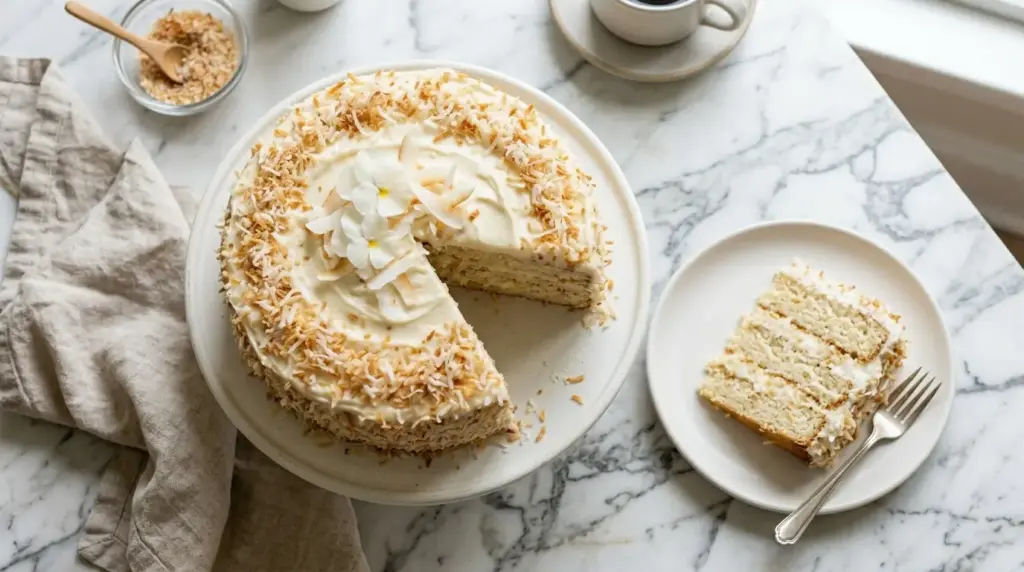
This coconut cake is the kind of dessert that stands beautifully on its own, but a few simple pairings can make it even more special.
Serve it at room temperature for the best texture and flavor — the cake and frosting both soften slightly after sitting out for 20–30 minutes from the fridge, which makes each slice more tender.
Here are some great ways to serve it:
- Alongside a scoop of Vanilla Bean Ice Cream for a classic warm-weather dessert
- With a drizzle of Fresh Strawberry Sauce over each slice for a fruity contrast
- Paired with a tropical fruit salad featuring mango, pineapple, and kiwi
- Served with hot coffee or a strong cup of tea, which balances the sweetness of the coconut frosting
- As a centerpiece dessert for Easter, Mother’s Day, or any spring celebration
- Offered alongside a slice of Lemon Cake for a dessert table that covers both tropical and citrus flavors
Variations to Try
Once you’ve made the classic version, there are plenty of directions you can take this cake depending on the occasion or your preferences.
- Lemon Coconut Cake: Add 1 tablespoon of lemon zest to the cake batter and spread lemon curd between the layers instead of the coconut cream filling. Bright, tangy, and absolutely delicious.
- Pineapple Coconut Cake (Piña Colada Cake): Fold ½ cup of crushed, drained pineapple into the coconut cream filling and add ½ teaspoon of rum extract to the batter.
- Coconut Cake with Cream of Coconut: Use the simplified version featured in the Coconut Cake With Cream of Coconut Recipe for a slightly denser, poke-cake-style variation.
- Toasted Coconut and Chocolate: Spread a thin layer of chocolate ganache between the cake layers before adding the coconut cream filling.
- Coconut Cupcakes: Use this exact batter to fill cupcake liners ⅔ full and bake at 350°F (175°C) for 18–22 minutes. Top with the cream cheese frosting and a sprinkle of toasted coconut.
- Gluten-Free Coconut Cake: Substitute a 1:1 gluten-free flour blend for the all-purpose flour. Add ½ teaspoon of xanthan gum if your blend doesn’t already contain it.
Storage and Reheating
Because of the cream cheese frosting and the whipped cream filling, this cake needs to be refrigerated. It actually tastes even better on day two after the layers have had time to settle and the filling soaks into the cake slightly.
- Refrigerator: Store the assembled cake, covered loosely with plastic wrap or in a cake carrier, in the refrigerator for up to 5 days. Always bring slices to room temperature for 20–30 minutes before serving.
- Freezer (whole or in layers): You can freeze the unfrosted cake layers individually. Wrap each layer tightly in plastic wrap and then in aluminum foil. Freeze for up to 2 months. Thaw overnight in the refrigerator before assembling.
- Freezer (assembled slices): Individual frosted slices can be frozen on a baking sheet until solid, then transferred to a zip-top freezer bag. Freeze for up to 1 month. Thaw in the fridge overnight.
- Reheating: This cake is best enjoyed at room temperature and does not need reheating. Simply remove it from the fridge and allow it to sit at room temperature for 20–30 minutes before slicing.
Read Also: Checkerboard Cake Recipe
Nutritional Facts
The following values are approximate and based on the full recipe divided into 12 equal slices. Exact values will vary based on specific brands and ingredient substitutions used.
| Nutrient | Per Serving (1 slice) |
|---|---|
| Calories | ~680 kcal |
| Total Fat | 38g |
| Saturated Fat | 24g |
| Cholesterol | 155mg |
| Sodium | 290mg |
| Total Carbohydrates | 80g |
| Dietary Fiber | 1g |
| Total Sugars | 60g |
| Protein | 7g |
Note: Nutritional information is an estimate only. For precise values, input your specific ingredients into a nutrition calculator.
You might also enjoy: Angel Food Cake Recipe for a lighter, lower-fat cake option.
Health Benefits of Key Ingredients
This cake is a treat, and it’s meant to be enjoyed as one. That said, some of the key ingredients do carry genuine nutritional value worth noting.
Coconut in all its forms — shredded coconut, cream of coconut, and coconut extract — contains medium-chain triglycerides (MCTs), a type of fat that the body metabolizes differently from long-chain fats. MCTs are absorbed quickly and used as a readily available energy source rather than being stored.
Here’s a look at the key ingredients and what they bring nutritionally:
- Eggs: A high-quality complete protein containing all nine essential amino acids. They also provide choline, which supports brain health and liver function, and lutein, which promotes eye health.
- Buttermilk: Lower in fat than regular whole milk, buttermilk also contains beneficial probiotics from the culturing process that support digestive health.
- Cream cheese: A source of fat-soluble vitamins A and D, plus small amounts of calcium and phosphorus for bone health.
- Coconut: Contains manganese (important for bone formation and metabolism), copper, and selenium. Shredded coconut also provides a small amount of dietary fiber.
- Butter: A natural source of butyrate, a short-chain fatty acid that supports gut health, as well as vitamins A, D, E, and K2.
Read Also: Strawberry Cake Recipe
Frequently Asked Questions
1. Can I make this coconut cake ahead of time?
Yes, and it actually benefits from it. You can bake the cake layers up to 2 days in advance and store them wrapped tightly at room temperature, or wrap and refrigerate them for up to 3 days. The frosting can also be made ahead and stored in an airtight container in the refrigerator for up to 5 days — just re-beat it for a minute before using. Assemble the cake the day before serving for the best texture.
2. What is the difference between cream of coconut and coconut cream?
Cream of coconut is a sweetened, thick coconut product used in baking and cocktails — Coco López is the most recognized brand. Coconut cream is the unsweetened, thick layer that rises to the top of full-fat canned coconut milk. They are not interchangeable in this recipe. Substituting coconut cream for cream of coconut will result in a significantly less sweet, less flavorful cake.
3. Can I use coconut milk instead of buttermilk?
Technically yes, but the results will differ. Buttermilk’s acidity reacts with the baking powder to create a tender, fine crumb and a slight tang that balances the sweetness. Coconut milk doesn’t have that acidity. If you want a dairy-free version, add 1 tablespoon of apple cider vinegar or lemon juice to 1 cup of full-fat coconut milk and let it sit for 5 minutes before using — this creates a coconut “buttermilk” substitute.
4. Why did my cake layers come out dense?
The most common reasons are cold butter or eggs (which don’t cream properly), not beating the butter and sugar long enough, or overmixing the batter after the flour was added. Make sure your butter is genuinely soft — it should dent easily when pressed — and mix the flour in gently, stopping as soon as no dry streaks remain.
5. Can I use a box cake mix as a shortcut?
You can use a white cake mix as a base and still get a great result. Replace the water in the box instructions with cream of coconut, add 1 teaspoon of coconut extract, and substitute melted butter for the oil called for on the box. The homemade frosting and filling in this recipe are still worth making from scratch — they’re what elevate the cake.
This method is similar to the approach used in the Coconut Pie Recipe With Cream of Coconut for an even easier coconut dessert.

Southern-Style Coconut Layer Cake

Equipment
- Stand mixer or electric hand mixer
- Three 9-inch (23cm) round cake pans
- Parchment paper
- Mixing bowls - large and medium
- Rubber spatula
- Wire cooling racks
- Offset spatula - for frosting
- cake turntable - optional, but very helpful
- Serrated knife - for leveling layers
- Measuring cups and spoons
Ingredients
- 3 cups all-purpose flour - 360g
- 1 tablespoon baking powder
- 1/2 teaspoon salt
- 1 cup unsalted butter - 227g, softened to room temperature
- 2 cups granulated sugar - 400g
- 5 large eggs - room temperature
- 1 teaspoon pure vanilla extract
- 1 teaspoon coconut extract
- 1 cup full-fat buttermilk - 240ml, room temperature
- 1/2 cup cream of coconut - 120ml, such as Coco López
For the Coconut Cream Filling
- 1 1/2 cups cream of coconut - 360ml
- 1 cup sweetened shredded coconut - 80g
- 1 cup heavy whipping cream - 240ml
For the Coconut Cream Cheese Frosting
- 16 oz full-fat cream cheese - 454g, softened
- 1 cup unsalted butter - 227g, softened
- 5-6 cups powdered sugar - 600-720g, sifted
- 1 teaspoon pure vanilla extract
- 1/2 teaspoon coconut extract
- 2-3 tablespoons heavy cream - to adjust consistency
For Decorating
- 2-3 cups sweetened shredded or flaked coconut - 160-240g, toasted or untoasted
Instructions
- Preheat oven to 350°F (175°C). Grease three 9-inch cake pans with butter or nonstick spray, line bottoms with parchment paper, then grease the parchment.
- In a large bowl, whisk together flour, baking powder, and salt until evenly combined. Set aside.
- Beat softened butter in stand mixer on medium speed for 2 minutes until pale and smooth. Add sugar and beat on medium-high for 4-5 minutes until light and fluffy, scraping down sides occasionally.
- With mixer on low, add eggs one at a time, waiting until each is fully incorporated before adding the next. Add vanilla and coconut extracts and mix until combined. Scrape down bowl.
- In a small bowl, stir together buttermilk and cream of coconut. With mixer on lowest speed, add flour mixture and buttermilk mixture alternately in thirds, starting and ending with flour, mixing just until combined. Do not overmix.
- Divide batter evenly among prepared pans and smooth tops. Bake for 28-32 minutes until tops spring back and a toothpick inserted comes out clean. Cool in pans for 10 minutes, then turn out onto wire racks to cool completely.
- Whip heavy cream to medium-stiff peaks. In a separate bowl, stir together cream of coconut and shredded coconut. Gently fold whipped cream into the coconut mixture using broad strokes to preserve airiness. Refrigerate until assembly.
- Beat cream cheese on medium for 2-3 minutes until smooth and fluffy. Add butter and beat for another 2 minutes. Reduce speed to low and add sifted powdered sugar one cup at a time. Add vanilla, coconut extract, and 2 tablespoons heavy cream. Beat on medium-high for 2 minutes until light and fluffy.
- Level cake layers with a serrated knife if needed. Place one layer on a cake stand and spread half the coconut filling on top, leaving a 1/2-inch border. Top with second layer and remaining filling. Place third layer on top.
- Apply a thin crumb coat of cream cheese frosting over the entire cake. Refrigerate for 20-30 minutes until set. Apply a final generous layer of frosting and smooth with an offset spatula.
- Press shredded coconut onto the sides and top of the cake. Refrigerate for at least 30 minutes before slicing. Serve at room temperature for the best texture.
Notes
- Room temperature ingredients: Cold butter, eggs, or buttermilk can prevent the batter from emulsifying properly, leading to a dense cake. Allow ingredients to sit out for 1-2 hours before starting.
- Cream of coconut vs. coconut cream: Cream of coconut (like Coco López) is sweetened and thick. Do not substitute coconut cream or coconut milk – they are unsweetened and will change the flavor and texture significantly.
- Don’t skip the crumb coat: This thin initial layer of frosting locks in crumbs so your final coat looks smooth and professional.
- Storage: Refrigerate the assembled cake covered for up to 5 days. Bring to room temperature for 20-30 minutes before serving for the best flavor and texture.
- Make ahead: Cake layers can be baked up to 2 days ahead and stored wrapped at room temperature. Frosting can be made ahead and refrigerated for up to 5 days – re-beat before using.
- Freezing: Unfrosted layers can be wrapped tightly and frozen for up to 2 months. Thaw overnight in the refrigerator before assembling.
- Toasted coconut: For deeper flavor, toast coconut on a baking sheet at 325°F (165°C) for 6-8 minutes, stirring halfway, until golden. Cool completely before decorating.
- Variations: Add 1 tablespoon lemon zest to the batter and replace filling with lemon curd for a Lemon Coconut Cake. Fold 1/2 cup crushed drained pineapple into the filling for a Piña Colada version.
- Level your layers: Even a slight dome will cause the assembled cake to lean. Use a serrated knife and a steady hand to trim the tops flat.
- Serving suggestion: This cake pairs beautifully with Vanilla Bean Ice Cream or a drizzle of Fresh Strawberry Sauce for an extra-indulgent dessert.
Final Thoughts
This coconut cake recipe is one of those bakes that never fails to impress. It’s the kind of cake people talk about after the party is over and ask you for the recipe.
Take your time with each step, especially the creaming and the crumb coat. Those two details are the difference between a cake that looks homemade and one that looks like it came from a bakery.
If you make this cake, leave a comment below and let me know how it turned out. Tag your photos on social media — there’s nothing better than seeing this cake done beautifully in your kitchen!
Recommended:
- White Cake Recipe
- Funfetti Cake Recipe
- Red Velvet Cake Recipe
- Marble Cake Recipe
- Tres Leches Cake Recipe
- Classic Yellow Cake Recipe
- Pound Cake Recipe
- Sour Cream Coffee Cake Recipe
- Carrot Cake With Cream Cheese Frosting Recipe
- Chocolate Buttercream Frosting Recipe