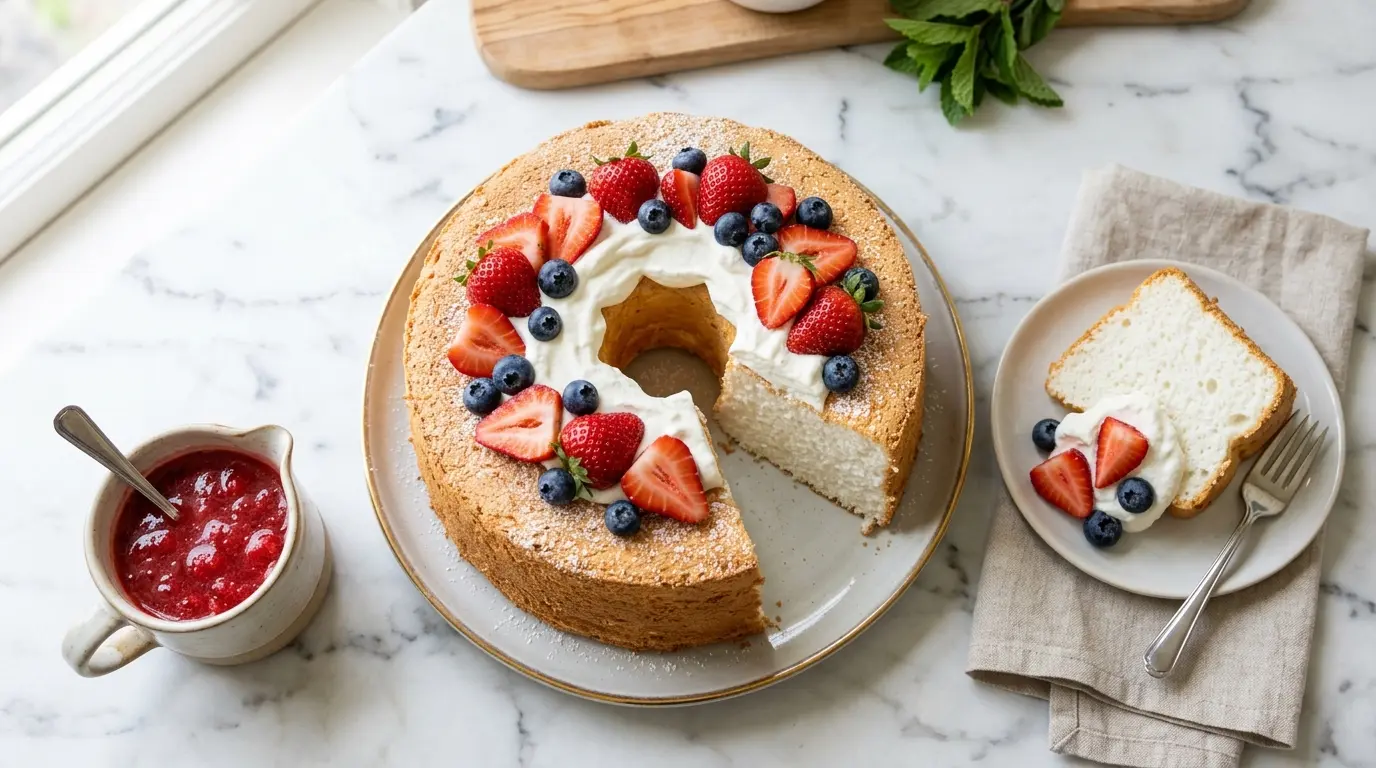
If you’ve been searching for the perfect angel food cake recipe, you’ve landed in exactly the right place. This cake is unlike any other dessert in the world — no butter, no oil, no egg yolks — just pure, cloud-like perfection built from whipped egg whites, cake flour, and sugar.
It’s the kind of cake that makes people stop mid-bite, close their eyes, and just appreciate how something so simple can taste this extraordinary.
The secret is all in the technique. Angel food cake has been a beloved American classic for well over a century, and for good reason: when made correctly, it has a tall, pillowy crumb with a slightly chewy golden crust, an ultra-light interior, and a delicate sweetness that pairs beautifully with almost anything — berries, whipped cream, lemon curd, chocolate drizzle, you name it.
This recipe walks you through every step with beginner-friendly detail, so your first homemade angel food cake turns out perfectly tall, airy, and absolutely delicious.
This is the version that appears in virtually every classic American baking cookbook: six core ingredients, whipped egg whites folded with a sifted flour-sugar mixture, baked in an ungreased tube pan and cooled upside down. No fancy shortcuts, no box mix — just the real thing.
Pair a slice with a dollop of fresh whipped cream and ripe strawberries, and you have one of the most beautiful, timeless desserts imaginable.
For those who love light, egg-based desserts, you might also enjoy this beautiful Classic Vanilla Cake for a slightly richer but equally elegant treat.

Why You’ll Love This Angel Food Cake Recipe
Angel food cake earns a permanent spot in the dessert rotation for so many reasons, and once you taste a homemade version, you’ll never reach for a store-bought one again.
It’s practically a guilt-free indulgence. With zero butter, zero oil, and zero egg yolks, this cake is remarkably low in fat and lower in calories than just about any other cake you can make from scratch.
The texture is genuinely one of a kind. No other cake delivers that pillowy, cloud-like crumb that seems to melt the moment it hits your tongue.
It’s incredibly versatile as a base. You can dress it up or keep it simple — the mild sweetness plays beautifully with nearly any topping or sauce.
It’s perfect for warm weather celebrations. Unlike dense, butter-heavy cakes, angel food cake feels light and refreshing, making it ideal for spring and summer gatherings.
Making it from scratch gives you full control. You choose the quality of your vanilla extract, the freshness of your egg whites, and the texture of your sugar — all of which make a noticeable difference in the final result.
- Zero butter, oil, or egg yolks — one of the lightest cakes you can bake
- A cloud-like crumb with a slightly chewy golden exterior
- Only 6 essential ingredients, most already in your pantry
- Endlessly customizable with toppings, sauces, and glazes
- A stunning, impressive presentation for any occasion
- Naturally dairy-free in its base form
- Stores beautifully for several days at room temperature
- A timeless, classic recipe that never goes out of style
Read Also: Moist Chocolate Cake Recipe
Ingredients
Getting each ingredient right in an angel food cake is non-negotiable — with only six components, every single one carries the weight of the final result. Here’s what you’ll need and exactly why each one matters.
Cake flour is essential because its low protein content keeps the crumb tender and fine. All-purpose flour contains too much protein and will make the cake dense and chewy in an unpleasant way. Granulated sugar gets processed into superfine sugar, which dissolves more evenly into the egg whites for the smoothest possible meringue. Cream of tartar is an acid that stabilizes the whipped egg whites so they hold their structure in the oven — without it, the cake collapses. And vanilla extract provides the only real flavor note in this otherwise neutral cake, so use a good quality pure extract.
- 1 ½ cups (300g) granulated sugar, divided
- 1 cup (120g) cake flour (sifted before measuring)
- ¼ teaspoon (1.5g) fine salt
- 12 large egg whites (approximately 1 ½ cups / 360ml), at room temperature
- 1 ½ teaspoons (7ml) cream of tartar
- 1 ½ teaspoons (7ml) pure vanilla extract
Important notes:
- Room temperature egg whites whip to a greater volume than cold ones — take them out of the fridge at least 30 to 45 minutes before you begin
- Do not use carton egg whites; they often do not whip properly to stiff peaks
- Use only a very clean, completely grease-free bowl for whipping egg whites — any trace of fat will prevent them from whipping correctly
- Do NOT grease your tube pan — the batter needs to cling to the sides as it rises
Also, if you love light and fluffy baked goods, you might love this Easy Waffle Recipe for your next weekend breakfast.
Kitchen Equipment Needed
The right tools make this recipe significantly easier and help ensure success, especially when it comes to whipping and folding the egg whites. A few of these items are non-negotiable for this particular cake.
The single most important piece of equipment is a 10-inch tube pan (also called an angel food cake pan). This tall, ring-shaped pan with a hollow center allows the batter to cling and rise upward, and most come with small feet so the pan can rest upside down during cooling. Do not substitute a bundt pan or a regular round cake pan — the cake will not release properly or maintain its height.
- Stand mixer or hand mixer with whisk attachment (essential for whipping egg whites to stiff peaks)
- 10-inch angel food cake tube pan (ungreased, non-non-stick preferred)
- Fine mesh sifter or sifter attachment
- Food processor or blender (to make superfine sugar)
- Large, completely clean and grease-free mixing bowl
- Rubber spatula (for gentle folding)
- Serrated bread knife (for slicing the finished cake without compressing it)
- Thin offset spatula or butter knife (for releasing the cake from the pan)
- Wire cooling rack
- Glass bottle or wine bottle (if your tube pan doesn’t have built-in feet, for cooling upside down)
- Measuring cups and spoons
Read Also: Boston Cream Pie Recipe
Recommended Products for This Recipe
These are products I genuinely recommend based on quality and how much of a difference they make when making angel food cake from scratch.
1. KitchenAid Stand Mixer with Whisk Attachment
Whipping 12 egg whites to stiff peaks takes sustained, high-speed beating that is very difficult to do well by hand. A stand mixer with the whisk attachment does this effortlessly and frees you up to prepare other parts of the recipe while the machine works. It’s the single biggest investment that will improve your baking across the board.
2. Chicago Metallic Angel Food Cake Pan (Uncoated)
A good-quality, uncoated (not non-stick) tube pan is absolutely essential for angel food cake. The batter must cling to the sides to rise properly, and a non-stick coating prevents this. The Chicago Metallic version is well-regarded, has removable bottom, and comes with built-in feet for upside-down cooling.
3. Bob’s Red Mill Unbleached Fine Cake Flour
Cake flour is non-negotiable in this recipe, and the quality of your cake flour directly affects the tenderness of the final crumb. Bob’s Red Mill’s cake flour is finely milled, bleached to the right protein level, and widely trusted by home bakers for exactly this type of delicate cake.
4. Nielsen-Massey Pure Vanilla Extract
Since vanilla is the primary flavor source in this otherwise neutral cake, the quality of your extract truly matters here. Nielsen-Massey is a premium, pure vanilla extract made from Madagascar Bourbon vanilla beans, and the depth of flavor it adds to angel food cake is noticeable.
5. OXO Good Grips Fine Mesh Strainer
Sifting the flour and sugar mixture multiple times is critical for the airy texture of this cake. A fine mesh strainer doubles as a sifter and is far more useful across everyday cooking than a single-purpose sifter. OXO’s version is durable, easy to tap, and available in multiple sizes.
You might also enjoy making this crowd-pleasing Fruit Tart Recipe to serve alongside your angel food cake for an elegant dessert spread.

Step-by-Step Instructions
Step 1: Prepare Your Ingredients and Equipment
- Take the egg whites out of the refrigerator 30 to 45 minutes before you begin so they can come to room temperature — room temperature egg whites whip to a significantly greater volume than cold ones.
- Separate the eggs carefully, making sure absolutely no yolk gets into your whites — even a small drop of yolk contains fat, which will prevent the whites from whipping properly. Crack each egg over a small bowl first, then transfer the white to your mixing bowl as you go.
- Ensure your mixing bowl and whisk attachment are completely clean and free of any grease or moisture — wash them with hot soapy water, rinse thoroughly, and dry completely if needed.
- Preheat your oven to 350°F (175°C) and position the oven rack on the lowest setting. This lower position helps the cake rise properly without the top browning too quickly.
- Do NOT grease your tube pan. The batter needs to cling to the sides of the pan in order to rise — a greased pan will cause it to slide down and collapse.
Step 2: Make Superfine Sugar
- Place all 1 ½ cups (300g) of the granulated sugar into a food processor or blender.
- Pulse for about 30 to 60 seconds until the sugar becomes fine and powdery — it should feel almost like very fine sand between your fingers, similar to caster sugar. This is called superfine sugar.
- Measure out ¾ cup (150g) of the superfine sugar and set it aside in a small bowl. This portion will be added to the egg whites. The remaining ¾ cup (150g) stays in the food processor.
- If you don’t have a food processor, you can purchase superfine (caster) sugar at most grocery stores or specialty baking shops.
Step 3: Prepare the Flour Mixture
- Add the 1 cup (120g) of cake flour and ¼ teaspoon (1.5g) of salt to the food processor along with the remaining ¾ cup (150g) of superfine sugar.
- Pulse the flour, salt, and sugar together a few times to combine and aerate the mixture.
- Transfer this flour-sugar-salt mixture to a bowl, then sift it through a fine mesh sifter or sifter. Repeat the sifting process four to five times total — this may sound excessive, but it is genuinely what creates the ultra-light, lump-free mixture that gives angel food cake its signature airy texture.
- Set the sifted flour mixture aside.
Step 4: Whip the Egg Whites to Stiff Peaks
- Pour the 12 room-temperature egg whites into the clean bowl of your stand mixer (or a large mixing bowl if using a hand mixer).
- Add the 1 ½ teaspoons (7ml) of cream of tartar and 1 ½ teaspoons (7ml) of pure vanilla extract directly to the egg whites.
- Begin beating on low speed until the mixture is frothy and opaque, about 1 to 2 minutes. You will see small bubbles start to form.
- Increase the mixer speed to medium and begin adding the reserved ¾ cup (150g) of superfine sugar, one tablespoon at a time. Wait approximately 15 seconds between each addition to allow the sugar to dissolve into the whites. This gradual addition is important — adding it too quickly will make the final texture grainy.
- After all the sugar has been added, increase the speed to medium-high and continue beating until the egg whites reach stiff peaks. At stiff peaks, the egg whites will be glossy and white, will hold their shape when you stop the mixer and lift the whisk, and the peak will stand straight up without drooping. This typically takes 4 to 6 minutes total from when you began beating.
- Do not over-beat the egg whites past stiff peaks — over-beaten whites become dry and lumpy and will cause the cake to bake unevenly.
Step 5: Fold in the Flour Mixture
- Using a fine mesh sifter, sift approximately ¼ cup of the flour-sugar mixture over the top of the whipped egg whites.
- Using a large rubber spatula, gently fold the flour into the egg whites using wide, slow, sweeping strokes — fold from the bottom of the bowl up and over the top, rotating the bowl as you go. The goal is to incorporate the flour without deflating the egg whites.
- Repeat this process, adding the flour mixture about ¼ cup at a time and folding gently after each addition, until all of the flour mixture has been incorporated. This should take 8 to 10 additions total.
- Take your time — this folding step is the key to maintaining the airy volume in the batter. Rushing or using a stirring motion will cause the egg whites to deflate and result in a dense cake.
Step 6: Transfer Batter to Pan and Bake
- Gently spoon the batter into your ungreased 10-inch tube pan. Do not pour — use a spoon or spatula to transfer the batter carefully so you don’t knock out air.
- Once all the batter is in the pan, use a thin knife or skewer and run it through the batter in a circular motion to pop any large air pockets that may have formed. This prevents large holes from appearing in the finished cake.
- Smooth the top of the batter gently with your spatula.
- Place the pan on the lowest oven rack and bake at 350°F (175°C) for 35 to 40 minutes, until the top is deep golden brown and springs back immediately when lightly pressed with your fingertip. A toothpick or skewer inserted into the center should come out clean.
Step 7: Cool the Cake Upside Down
- This step is absolutely critical and cannot be skipped. Remove the cake from the oven immediately when done and flip the pan upside down onto its built-in feet. If your pan does not have feet, invert it over the neck of a glass bottle or wine bottle to suspend it above the counter.
- Allow the cake to cool completely upside down for at least 1 to 1.5 hours. Cooling it upside down uses gravity to prevent the delicate structure from collapsing under its own weight — cooling it right-side-up will cause the cake to sink.
- Once fully cooled, run a thin knife or offset spatula along the outer edge of the pan and around the center tube to release the cake.
- Gently push the removable bottom up or invert the cake onto a serving plate or cake stand.
Step 8: Slice and Serve
- Use a serrated bread knife (never a smooth-edged knife) to slice the cake with a gentle sawing motion. Pressing down with a regular knife will compress the airy crumb.
- Serve slices plain, with fresh whipped cream and berries, a drizzle of strawberry sauce, or any topping of your choice.
Tips for Success
Angel food cake has a reputation for being fussy, but if you follow these tips carefully, you’ll get a tall, airy, perfectly textured cake every single time.
The most common reason angel food cake fails is improperly whipped egg whites — either under-whipped (not enough structure) or slightly contaminated with fat. Pay close attention to the stiff peak stage, and keep everything scrupulously clean.
- Use room temperature egg whites — they whip to a greater volume than cold whites, giving you more structure and lift
- Separate eggs carefully — even a tiny drop of yolk (which contains fat) will prevent the whites from whipping to stiff peaks
- Never grease the tube pan — the batter must cling to the sides to rise; greasing prevents this completely
- Sift the flour mixture multiple times — four or five sifts may feel excessive, but it’s what creates that signature light, fine crumb
- Add sugar gradually to the egg whites — adding it all at once prevents it from dissolving properly and creates a grainy texture
- Fold gently and slowly — use wide, sweeping strokes with a spatula and take your time; rushing deflates the whites
- Don’t open the oven during the first 30 minutes — temperature fluctuations can cause the cake to collapse before the structure has set
- Always cool upside down — this is non-negotiable; skipping it will result in a sunken, dense cake
- Use a serrated knife to slice — it cuts without compressing the delicate crumb
This same gentle folding technique is also key to making a perfect Pumpkin Roll Recipe.
Serving Suggestions
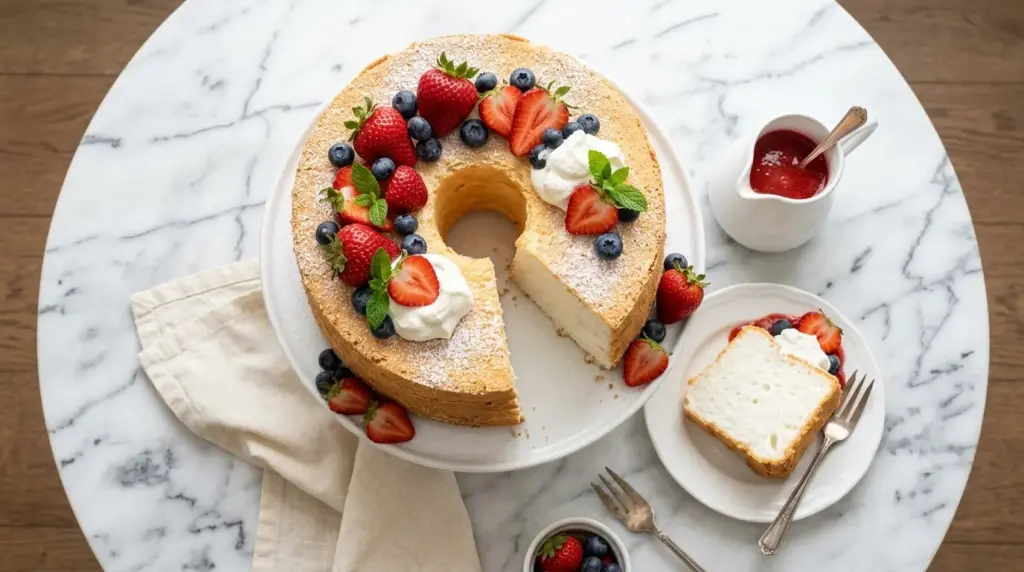
Angel food cake is one of the most beautifully versatile desserts you can make — it acts as a blank canvas that pairs with an extraordinary range of toppings and accompaniments.
The most classic and beloved way to serve it is with a generous dollop of fresh whipped cream and a pile of sliced ripe strawberries. The combination of the light, slightly sweet cake with the cream and the bright acidity of the berries is simply unbeatable. But the possibilities go far beyond that.
- Fresh Strawberry Sauce drizzled warm over slices for a glossy, beautiful presentation
- A generous drizzle of homemade Caramel Sauce for something a little richer and more indulgent
- Lemon curd (made with the leftover egg yolks from this recipe!) spread over the top and garnished with fresh blueberries
- Vanilla Buttercream Frosting piped decoratively for a more celebratory presentation
- A side of Fruit Salad for a light and refreshing dessert plate
- Vanilla ice cream served alongside for a simple but satisfying contrast in temperatures
- Sliced and layered in a trifle dish with whipped cream, berries, and lemon curd for an impressive party dessert
- Toasted under the broiler briefly and topped with a scoop of sorbet for something unexpected and delicious
Variations to Try
Once you’ve mastered the classic version, angel food cake is a wonderful base to experiment with. The neutral flavor of the original makes it easy to incorporate new flavors without overpowering the delicate texture.
All variations should maintain the core technique — properly whipped egg whites, gentle folding, and upside-down cooling — as these are what define the texture of angel food cake regardless of what flavors you add.
- Lemon Angel Food Cake: Add 2 tablespoons of fresh lemon zest and 1 tablespoon of fresh lemon juice to the egg whites along with the vanilla for a bright, citrusy variation
- Almond Angel Food Cake: Replace ½ teaspoon of the vanilla extract with ½ teaspoon of pure almond extract for a subtly nutty, elegant flavor profile
- Coconut Angel Food Cake: Fold ½ cup of unsweetened shredded coconut into the batter at the very end and top the finished cake with toasted coconut flakes
- Chocolate Marble Angel Food Cake: Sift 3 tablespoons of unsweetened cocoa powder with 2 tablespoons of sugar and fold it into half the batter, then alternate spoonfuls of vanilla and chocolate batter in the pan
- Strawberry Angel Food Cake: Fold ½ cup of finely diced fresh strawberries very gently into the finished batter just before transferring to the pan
- Orange Zest Angel Food Cake: Add 1 tablespoon of fresh orange zest and swap ½ teaspoon of the vanilla for ½ teaspoon of orange extract
Another equally elegant dessert worth exploring is this Easy Tiramisu Recipe for when you want something Italian and coffee-kissed.
Storage and Reheating
Angel food cake stores beautifully at room temperature and also freezes well, making it a great make-ahead dessert.
Avoid wrapping the cake in plastic while it’s whole — the moisture will make the exterior gummy. Instead, keep it loosely covered on the counter. Sliced portions should be wrapped individually.
- Room temperature: Place the cooled cake on a cake stand or plate and cover it loosely with a large bowl or a cake dome. It will stay fresh and airy for up to 3 to 4 days at room temperature.
- Refrigerator: Angel food cake can be refrigerated in an airtight container or loosely covered for up to 1 week. The texture remains good, though it may become slightly denser.
- Freezer: Slice the cake into individual portions, wrap each slice tightly in plastic wrap followed by a layer of aluminum foil, and store in a zip-top freezer bag. Freeze for up to 3 months. Thaw slices at room temperature for about 30 to 45 minutes before serving.
- To refresh: For slices that have lost a little of their freshness, you can toast them lightly in a toaster oven or under the broiler for 1 to 2 minutes until the exterior is warm and slightly caramelized. This is genuinely delicious.
- Note: Do not microwave angel food cake — it will turn rubbery almost instantly.
For more ideas on light and lovely baked goods, check out this Banana Pudding Recipe — another crowd-pleasing classic.
Nutritional Facts
The following nutritional values are approximate and based on one slice of plain angel food cake, assuming the cake is cut into 12 equal slices. Toppings such as whipped cream or fruit sauces will add additional calories.
| Nutrient | Per Serving (1 slice) |
|---|---|
| Calories | ~150 kcal |
| Total Fat | 0g |
| Saturated Fat | 0g |
| Cholesterol | 0mg |
| Sodium | ~115mg |
| Total Carbohydrates | ~34g |
| Dietary Fiber | 0g |
| Total Sugars | ~26g |
| Protein | ~4g |
| Calcium | ~4mg |
| Iron | ~0.1mg |
Angel food cake is one of the few genuinely low-fat cakes that doesn’t taste like it’s missing anything — the absence of butter and yolks is completely unnoticeable when the egg whites are properly whipped.
You might also enjoy the wholesome, protein-rich Easy Overnight Oats Recipe for a light and satisfying everyday breakfast.
Health Benefits of Key Ingredients
Angel food cake may be a dessert, but its unusual ingredient list means it actually carries some real nutritional value — particularly from the egg whites, which are the star of the show.
This is genuinely one of the lightest cakes you can bake from scratch, and the ingredients that make it so light are also what give it its modest nutritional advantages.
- Egg whites: The 12 egg whites in this recipe are the primary protein source. Egg whites are a complete protein containing all essential amino acids, are essentially fat-free, and contain no cholesterol. They’re one of the most bioavailable sources of protein in any food.
- No butter or oil: The complete absence of saturated fat makes this one of the lowest-fat cakes possible. For context, a standard butter cake contains anywhere from 10 to 20 grams of fat per slice; angel food cake has virtually zero.
- No egg yolks: Skipping the yolks eliminates all dietary cholesterol from this recipe, making it a better choice for those monitoring cholesterol intake.
- Sugar in moderation: While this cake does contain sugar, the total amount per slice is moderate compared to most desserts, and the absence of fats means the overall caloric load per slice is significantly lower than typical cakes.
- Cream of tartar: Beyond its structural role, cream of tartar is a natural acid (potassium bitartrate) that adds a trace of potassium to the recipe.
Read Also: Easy Lemonade Recipe
Frequently Asked Questions
1. Why does angel food cake need to cool upside down?
Angel food cake must cool upside down because the structure of the cake — built entirely from whipped egg whites — is extremely delicate when it first comes out of the oven.
If the cake cools right-side-up, gravity pulls the delicate crumb downward, causing the cake to compress and sink under its own weight. Cooling it inverted suspends the structure and allows it to set fully at the height it achieved during baking.
2. Can I use a bundt pan instead of a tube pan?
You can technically use a bundt pan in a pinch, but it’s not recommended. The main issue is that angel food cake must cool upside down, and bundt pans typically cannot be inverted and suspended effectively because of their decorative designs and closed bottom. Additionally, the intricate designs of most bundt pans make it very difficult to release the delicate cake cleanly without tearing it. A standard uncoated tube pan gives the best results by far.
3. Why can’t I use carton egg whites for angel food cake?
Carton egg whites are pasteurized through a heat process that partially denatures the proteins in the whites. This makes them much more difficult — and sometimes impossible — to whip to the stiff peaks required for angel food cake structure. Even cartons that are marketed as suitable for whipping often don’t perform as well as freshly separated whites. For the best results, separate fresh eggs by hand and bring the whites to room temperature before whipping.
4. Can I make angel food cake without cream of tartar?
Cream of tartar is the acid that stabilizes the whipped egg whites, preventing them from collapsing during and after baking. Without it, the foam structure is considerably weaker and the cake is much more likely to fall or deflate. In an absolute pinch, you can substitute 1 teaspoon of fresh lemon juice or white vinegar per ½ teaspoon of cream of tartar called for in the recipe, but neither substitute works as effectively. If you can get cream of tartar (found in the spice aisle of most grocery stores), always use it.
5. How do I know when my egg whites have reached stiff peaks?
Stiff peaks are reached when the egg whites are glossy, bright white, and hold their shape completely without drooping or falling. To test, stop your mixer and lift the whisk straight up out of the whites — the peak that forms on the tip of the whisk should stand straight up without curling over. The egg whites will also have roughly tripled in volume and look much thicker and more opaque than when you started. If the peak droops at all, you’re at soft peaks — keep beating. If the whites look dry, lumpy, or start to separate, they are over-beaten and unfortunately cannot be rescued; you’ll need to start with fresh egg whites.
For another dessert that requires precise technique, try making this beautiful Easy Creme Brulee Recipe.

Classic Angel Food Cake

Equipment
- Stand mixer or hand mixer with whisk attachment - Essential for whipping egg whites to stiff peaks
- 10-inch angel food cake tube pan - Ungreased, non-non-stick preferred; must have removable bottom for release
- Fine mesh sifter or sifter attachment - For sifting flour and sugar mixture multiple times
- Food processor or blender - To make superfine sugar from granulated sugar
- Large mixing bowl - Completely clean and grease-free for whipping egg whites
- Rubber spatula - For gentle folding of ingredients
- Serrated bread knife - For slicing the finished cake without compressing it
- Thin offset spatula or butter knife - For releasing the cake from the pan
- Wire cooling rack - For cooling the cake upside down
- Glass bottle or wine bottle - For cooling upside down if tube pan doesn’t have built-in feet (optional)
- Measuring cups and spoons
Ingredients
- 1 ½ cups granulated sugar - 300g, divided and processed into superfine sugar
- 1 cup cake flour - 120g, sifted before measuring
- ¼ teaspoon fine salt - 1.5g
- 12 large egg whites - approximately 1 ½ cups or 360ml, at room temperature; do not use carton egg whites
- 1 ½ teaspoons cream of tartar - 7ml
- 1 ½ teaspoons pure vanilla extract - 7ml
For Serving (Optional)
- fresh whipped cream - for topping
- ripe strawberries - sliced, for topping
- fresh strawberry sauce - warm, for drizzling
- lemon curd - for spreading over slices
- vanilla buttercream frosting - for piping decoratively
- fresh fruit salad - for serving alongside
Instructions
- Bring egg whites to room temperature for 30-45 minutes. Separate eggs carefully ensuring no yolk gets into whites. Ensure mixing bowl and whisk are completely clean and grease-free. Preheat oven to 350°F and position rack on the lowest setting. Do NOT grease the tube pan.
- Place all granulated sugar in a food processor and pulse for 30-60 seconds until superfine. Measure out ¾ cup (150g) for the egg whites and set aside. Keep remaining ¾ cup (150g) in the food processor.
- Add cake flour and salt to the food processor with the remaining superfine sugar. Pulse to combine. Sift the mixture through a fine mesh sifter 4-5 times. Set aside.
- Pour egg whites into mixer bowl. Add cream of tartar and vanilla. Beat on low until frothy, about 1-2 minutes. Increase to medium and add the reserved superfine sugar one tablespoon at a time, waiting 15 seconds between each. Increase to medium-high and beat until stiff, glossy peaks form (4-6 minutes total).
- Sift about ¼ cup of the flour mixture over the whipped egg whites. Fold gently with a rubber spatula using wide, slow strokes from bottom to top. Repeat with remaining flour mixture in 8-10 additions, folding gently after each.
- Spoon the batter gently into the ungreased tube pan. Run a knife through the batter in a circular motion to pop any large air pockets. Smooth the top. Bake on the lowest oven rack for 35-40 minutes until deep golden brown and springs back when touched.
- Remove from oven immediately and invert pan onto its feet or over a bottle neck. Cool completely upside down for 1 to 1.5 hours. Run a thin knife around the edges and center tube to release. Push up the bottom or invert onto a serving plate.
- Using a serrated bread knife, slice the cake with a gentle sawing motion. Serve plain or with fresh whipped cream, berries, lemon curd, or your favorite topping.
Notes
- Room temperature egg whites whip to a greater volume than cold ones — take them out of the fridge at least 30 to 45 minutes before you begin.
- Do not use carton egg whites; they often do not whip properly to stiff peaks.
- Use only a very clean, completely grease-free bowl for whipping egg whites — any trace of fat will prevent them from whipping correctly.
- Do NOT grease your tube pan — the batter needs to cling to the sides as it rises.
- Sifting the flour mixture 4-5 times is critical for creating that signature light, fine crumb.
- Add sugar gradually to the egg whites — adding it all at once prevents it from dissolving properly and creates a grainy texture.
- Fold gently and slowly; rushing deflates the whites and results in a dense cake.
- Don’t open the oven during the first 30 minutes of baking — temperature fluctuations can cause the cake to collapse.
- Cooling the cake upside down is non-negotiable; skipping it will result in a sunken, dense cake.
- Use a serrated knife to slice — it cuts without compressing the delicate crumb.
- Store at room temperature loosely covered for up to 3-4 days, or freeze individual slices wrapped tightly for up to 3 months.
Final Thoughts
Making a homemade angel food cake recipe for the first time is one of those baking milestones that genuinely feels rewarding.
The moment you invert that pan and slide a perfectly tall, golden cake onto a plate — knowing it was built from nothing but air, egg whites, sugar, and flour — is deeply satisfying.
Serve it with whatever makes you happy. Fresh berries and cream on a warm summer afternoon. A drizzle of caramel on a chilly evening. Lemon curd for something a little more tangy and sophisticated. This cake welcomes it all.
Don’t be discouraged if your first attempt isn’t perfect — even experienced bakers sometimes need a second try to get the egg white whipping and the folding technique just right. Every attempt teaches you something, and the result is always delicious regardless.
Once you make it from scratch, you’ll understand immediately why boxed versions don’t come close. The real thing is lighter, taller, more flavorful, and more beautiful in every way.
Give this recipe a try and let me know how it turns out in the comments below! I’d love to hear what toppings you chose and how your family reacted to that first slice. And if you share it on social media, tag me so I can see your gorgeous creation.
Recommended:
- Vanilla Pudding Recipe
- Best Carrot Cake Recipe
- Easy Chocolate Cake Recipe
- Lemon Cheesecake Recipe
- Easy Apple Crisp Recipe
- Checkerboard Cake Recipe
- Tres Leches Cake Recipe
- Easy Creme Brulee Recipe
- Classic Pineapple Upside Down Cake Recipe
- Fruit Cocktail Cake Recipe