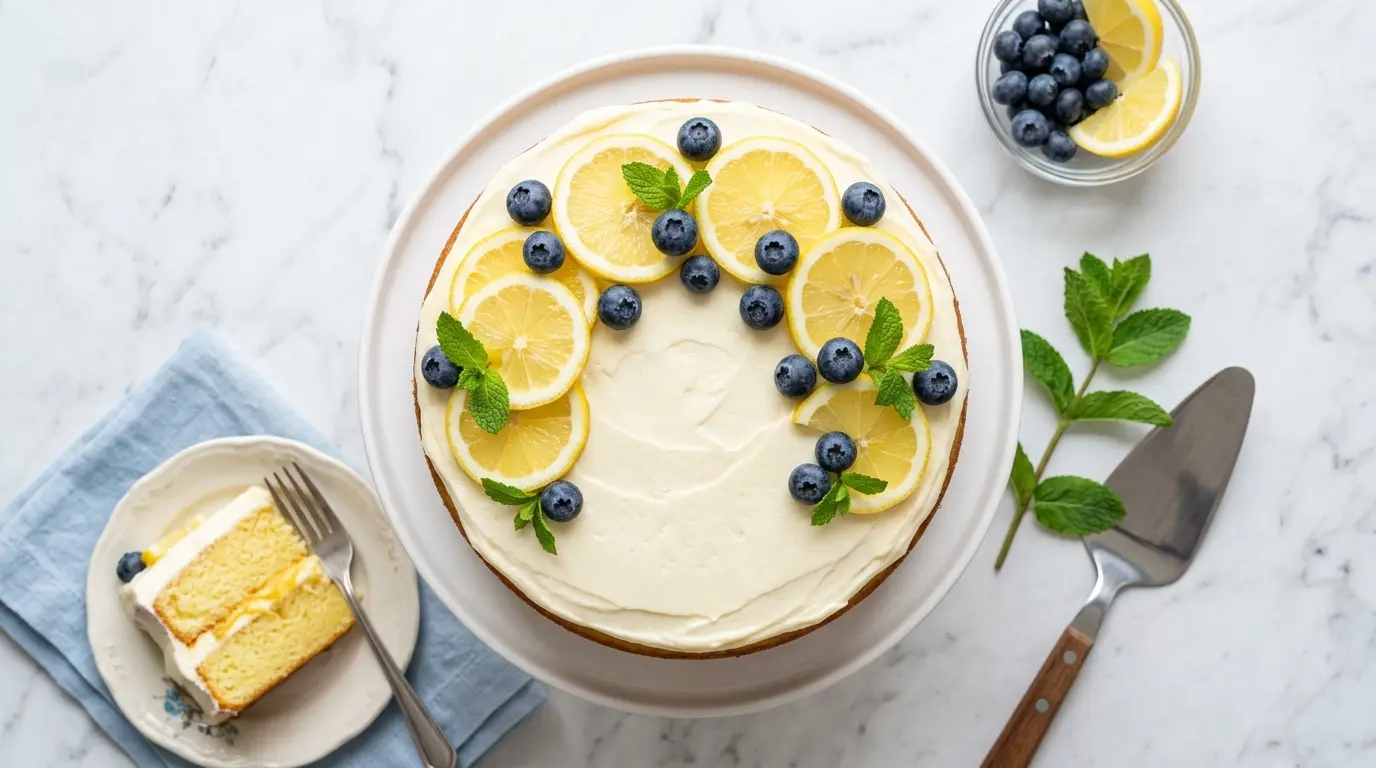
This lemon cake recipe is the one you’ll come back to every single time you need a crowd-pleaser.
It delivers everything you want from a citrus dessert: a tender, buttery crumb, a bold lemony punch that isn’t shy or subtle, and a silky lemon buttercream that pulls it all together beautifully.
What makes this version stand out is the combination of fresh lemon juice AND lemon zest in the batter. Most recipes only use one or the other, but using both gives you that layered citrus depth that tastes truly homemade.
The lemon zest carries the aromatic oils that juice alone can’t provide, while the juice delivers the bright tartness that balances all that sweetness.
This is a layered two-round cake, soft and golden, frosted generously with a lemon buttercream that sets up perfectly without being too stiff or too sweet.
It’s beautiful enough for a birthday, easy enough for a Sunday afternoon, and honestly one of the most satisfying bakes you’ll ever make from scratch.
You might also enjoy: Lemon Chiffon Cake Recipe

Why You’ll Love This Lemon Cake Recipe
This cake hits all the right notes without requiring any advanced baking skills.
The batter comes together in one bowl with a stand or hand mixer, and the results are consistently moist, fluffy, and packed with fresh lemon flavor.
Here’s why this recipe keeps getting requested at every gathering:
- Real lemon flavor: Fresh zest and juice, not extract, make the citrus taste genuine and vibrant.
- Perfectly moist crumb: Buttermilk in the batter adds tenderness and keeps the cake from drying out.
- No complicated techniques: Cream butter, add ingredients in order, bake. That’s it.
- Versatile for any occasion: Works as a birthday cake, brunch centerpiece, or holiday dessert.
- Crowd-pleasing flavor: Even people who “aren’t lemon people” love this cake.
- Customizable: Easily adapted with different frostings or fillings.
Read Also: Lemon Curd Recipe
Ingredients
You’ll need pantry staples plus plenty of fresh lemons for this recipe. Always use fresh lemons rather than bottled juice for the best flavor. The difference is immediately noticeable in the finished cake.
- 2 ½ cups (315g) all-purpose flour
- 2 ½ tsp baking powder
- ½ tsp salt
- 1 cup (225g) unsalted butter, softened to room temperature
- 2 cups (400g) granulated sugar
- 4 large eggs, room temperature
- 1 tbsp fresh lemon zest (from about 2-3 lemons)
- 3 tbsp fresh lemon juice
- 1 tsp pure vanilla extract
- 1 cup (240ml) buttermilk, room temperature
For the Lemon Buttercream Frosting:
- 1 cup (225g) unsalted butter, softened
- 4 cups (480g) powdered sugar, sifted
- 3 tbsp fresh lemon juice
- 1 tbsp fresh lemon zest
- 1-3 tbsp heavy cream (to adjust consistency)
- Pinch of salt
Optional Garnish:
- Lemon slices or lemon curls
- Fresh blueberries or raspberries
You might also enjoy: Cream Cheese Frosting Recipe
Kitchen Equipment Needed
You don’t need anything fancy to pull this cake off, but a few quality tools will make the process much smoother. A stand mixer is genuinely helpful here, as creaming cold butter or unevenly mixed batter will affect the cake’s texture.
- Stand mixer or electric hand mixer
- Two 9-inch round cake pans
- Parchment paper
- Zester or microplane
- Citrus juicer
- Large mixing bowl
- Medium mixing bowl
- Rubber spatula
- Wire cooling racks
- Offset spatula for frosting
- Cake turntable (optional but very helpful for frosting)
- Sifter for powdered sugar
- Measuring cups and spoons
Another favorite: Vanilla Buttercream Frosting Recipe
Recommended Products for This Recipe
These are products I genuinely recommend based on quality and performance. Each one addresses a common stumbling block when making a layered cake from scratch.
1. KitchenAid Tilt-Head Stand Mixer
The single most helpful tool for this recipe is a quality stand mixer. It takes the guesswork out of properly creaming butter and sugar, which is critical for a light, airy crumb. The KitchenAid handles heavy batters with ease and ensures your ingredients are evenly combined every time.
2. Microplane Premium Zester Grater
The quality of your lemon zest matters more than you might think. A Microplane zester grates only the fragrant outer layer of lemon peel without digging into the bitter white pith beneath. This makes a noticeable difference in the flavor of both the cake and the frosting.
3. Fat Daddio’s 9-Inch Round Cake Pans (Set of 2)
Even heat distribution and a straight-sided design help lemon cakes bake evenly without domed centers or overbaked edges. Fat Daddio’s anodized aluminum pans are a favorite among home bakers for exactly this reason. They also release cleanly with minimal greasing.
4. Wilton Turntable Cake Decorating Stand
Frosting a two-layer cake freehand is one of the most frustrating experiences in home baking. A rotating turntable lets you spin the cake smoothly as you apply and smooth frosting, making the whole process faster and much cleaner. It’s a small investment that completely changes how your finished cakes look.
5. Sieved Powdered Sugar (Fine Ground)
For the creamiest, lump-free buttercream, using a premium finely milled powdered sugar makes a real difference. Standard powdered sugar can have small clumps that remain gritty even after extensive mixing. A fine-milled option blends much more smoothly into the butter.
This technique also works beautifully in Pastry Cream for filled cakes and tarts.

Step-by-Step Instructions
1. Prepare Your Pans and Preheat the Oven
- Preheat your oven to 350°F (175°C). Position a rack in the center of the oven.
- Grease two 9-inch round cake pans with softened butter or baking spray, making sure to coat the sides and bottom thoroughly.
- Cut two circles of parchment paper to fit the bottom of each pan and press them in. Lightly grease the top of the parchment paper as well.
- Dust the pans lightly with flour, tapping out any excess. This double-prep ensures the cakes release cleanly without sticking.
2. Mix the Dry Ingredients
- In a medium mixing bowl, combine 2 ½ cups (315g) of all-purpose flour, 2 ½ tsp of baking powder, and ½ tsp of salt.
- Whisk together until the baking powder and salt are evenly distributed throughout the flour. Set this bowl aside.
- Do not skip sifting or whisking the dry ingredients. Pockets of baking powder in the batter lead to uneven rise and a coarser crumb.
3. Zest and Juice Your Lemons
- Use a Microplane or fine zester to zest your lemons directly over a small bowl. You’ll need about 1 tbsp of zest for the cake batter, plus an additional 1 tbsp for the frosting.
- Juice the lemons after zesting. You’ll need 3 tbsp of fresh lemon juice for the batter and 3 tbsp for the frosting, so juice about 3-4 medium lemons total.
- Set both the zest and juice aside in separate small bowls. Always zest before juicing, because it’s impossible to zest a cut lemon cleanly.
4. Cream the Butter and Sugar
- Place 1 cup (225g) of softened butter into the bowl of your stand mixer fitted with the paddle attachment, or use a large bowl with a hand mixer.
- Beat the butter on medium speed for about 2 minutes until it lightens in color and becomes fluffy.
- With the mixer running on medium, gradually add 2 cups (400g) of granulated sugar in a slow, steady stream.
- Once all the sugar is added, increase the speed to medium-high and beat for an additional 3-4 minutes. The mixture should look very pale, almost white, and feel light and airy. This step is crucial because it incorporates air that makes your cake layers rise properly.
5. Add the Eggs, Zest, and Vanilla
- Reduce the mixer speed to low. Add the 4 large eggs to the butter mixture one at a time, waiting until each egg is fully incorporated before adding the next. Scrape down the sides of the bowl with a rubber spatula between additions.
- Add 1 tbsp of fresh lemon zest and 1 tsp of pure vanilla extract to the batter. Mix on low for about 30 seconds until combined.
- The batter may look slightly curdled at this stage. This is normal. It will come back together once the dry ingredients are added.
6. Alternate Adding Dry Ingredients and Buttermilk
- This step requires patience and a light hand. Overmixing at this stage develops gluten in the flour and makes your cake dense and tough.
- With the mixer on its lowest speed, add one-third of the flour mixture to the batter. Mix just until the flour begins to disappear.
- Pour in half of the 1 cup (240ml) of buttermilk, followed by 3 tbsp of fresh lemon juice. Mix until just incorporated.
- Add another third of the flour mixture and mix briefly.
- Pour in the remaining buttermilk and mix until combined.
- Finish by adding the last third of the flour mixture. Mix only until the batter is smooth and no streaks of flour remain. Finish mixing by hand with a rubber spatula if needed to avoid overworking the batter.
7. Divide the Batter and Bake
- Use a rubber spatula to divide the batter evenly between your two prepared 9-inch pans. You can use a kitchen scale to weigh each pan for accuracy.
- Smooth the tops gently with the spatula so the batter is level. Do not press down hard.
- Bake both pans on the center rack at 350°F (175°C) for 30-35 minutes. The cakes are done when the tops are golden and a toothpick inserted into the center comes out clean or with just a few moist crumbs attached.
- Avoid opening the oven door during the first 25 minutes of baking. A sudden drop in temperature can cause the cakes to sink in the center.
8. Cool the Cake Layers
- Remove the pans from the oven and let them cool on wire racks for 15 minutes before attempting to remove the cakes.
- Run a thin knife or offset spatula around the edge of each pan to loosen the cake.
- Turn each cake out onto a wire rack, peel off the parchment paper, and flip the cakes right-side up.
- Allow the cakes to cool completely, at least 1-2 hours, before frosting. Frosting a warm cake will cause the buttercream to melt and slide off.
9. Make the Lemon Buttercream Frosting
- Place 1 cup (225g) of softened unsalted butter in the cleaned stand mixer bowl. Beat on medium speed for 2-3 minutes until pale and fluffy.
- Reduce the speed to low and gradually add 4 cups (480g) of sifted powdered sugar, about half a cup at a time. Adding it slowly prevents a powdered sugar cloud in your kitchen.
- Once all the sugar is incorporated, add 3 tbsp of fresh lemon juice, 1 tbsp of lemon zest, and a pinch of salt. Mix on low until combined.
- Increase the speed to medium-high and beat for 2-3 minutes until the frosting is light and fluffy. If it looks too thick, add heavy cream one tablespoon at a time and beat again. If it looks too thin, add a little more sifted powdered sugar.
10. Assemble and Frost the Cake
- Place one cooled cake layer, flat-side up, onto your cake board or serving plate. Place it on a turntable if you have one.
- Apply a generous dollop of lemon buttercream to the top of the first layer. Spread it out to the edges using an offset spatula, creating an even layer about ¼ inch (6mm) thick.
- Carefully place the second cake layer on top, flat-side down (this gives you a more even top surface).
- Apply a thin layer of frosting all over the outside of the cake using your offset spatula. This is called a crumb coat and it seals in any loose crumbs. Refrigerate the cake for 20-30 minutes until this layer is firm.
- Apply the final layer of frosting generously over the crumb coat. Spin the turntable slowly while holding the offset spatula at a slight angle to smooth the sides. Smooth the top in a circular motion.
- Garnish with lemon slices, lemon curls, or fresh berries if desired.
Read Also: Lemon Cheesecake Recipe
Tips for Success
Even experienced bakers can run into issues with layer cakes. These tips address the most common problems before they happen and help you get a flawless result every time.
- Use room temperature ingredients: Cold butter won’t cream properly, and cold eggs can cause the batter to curdle. Take your butter, eggs, and buttermilk out of the fridge at least 1 hour before you start baking.
- Measure flour correctly: Spoon flour into your measuring cup and level it off with a straight edge. Scooping directly from the bag compacts the flour and can add up to 20% extra, making your cake dense.
- Don’t skip the crumb coat: This thin first layer of frosting seals in crumbs and gives your final layer a much cleaner look. It only takes an extra 20-30 minutes in the fridge.
- Zest before juicing: Always grate the lemon zest before cutting and juicing the lemon. You cannot zest a juiced lemon cleanly.
- Don’t overmix once you add flour: Overmixing after the flour is added develops too much gluten and results in a rubbery, dense crumb. Mix just until the flour disappears.
- Level your layers if needed: If your cake layers have a slight dome, use a long serrated knife to trim them flat before stacking. This makes assembly easier and helps the cake look more polished.
For a fruitier twist on classic lemon desserts, this Fresh Strawberry Sauce is a stunning drizzle over a slice of lemon cake.
Serving Suggestions
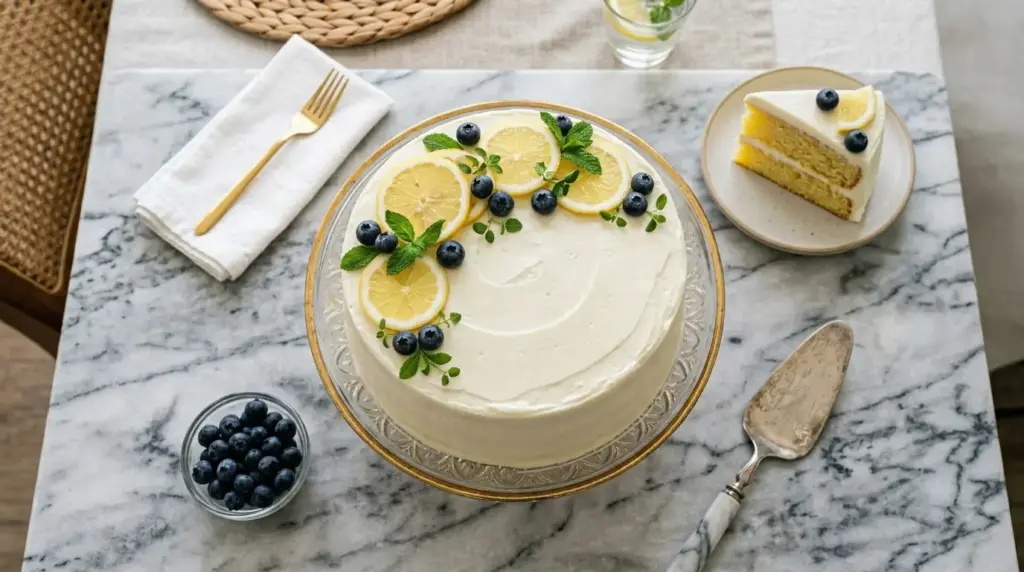
A slice of lemon cake is delicious on its own, but a few simple additions can turn it into a full dessert experience. The bright citrus flavor pairs beautifully with both creamy and fruity accompaniments.
- Vanilla ice cream: A scoop of vanilla bean ice cream alongside a slice of lemon cake is a simple but stunning pairing. The cold creaminess tempers the tartness beautifully.
- Fresh berries: Raspberries, blueberries, or strawberries served alongside or scattered on top add color and a complementary burst of fruit flavor.
- Whipped cream: A dollop of freshly whipped cream on the plate adds lightness and balances the sweetness of the buttercream.
- Lemon curd drizzle: A spoonful of lemon curd over each slice doubles down on the citrus and looks impressive with minimal effort.
- Hot tea or coffee: Lemon cake is a natural companion to Earl Grey, chamomile, or a cup of strong coffee at brunch or afternoon tea.
- Sparkling lemonade: For a coordinated dessert table, pair this cake with a pitcher of sparkling lemonade for a full lemon-themed spread.
Pairing this cake with a tall glass of Homemade Lemonade makes for a bright, cohesive lemon-themed dessert experience.
Variations to Try
Once you’ve mastered the base recipe, there are so many delicious directions you can take this cake. The lemon sponge pairs well with a wide range of fillings and frostings.
- Lemon Blueberry Cake: Fold 1 cup of fresh blueberries (tossed in 1 tbsp of flour to prevent sinking) into the batter before baking. The berries add a pop of color and flavor inside every slice.
- Lemon Poppy Seed Cake: Add 2 tbsp of poppy seeds to the batter along with the dry ingredients. This gives the cake a subtle crunch and a beautiful speckled appearance.
- Lemon Raspberry Cake: Spread a thin layer of seedless raspberry jam between the cake layers before applying the lemon buttercream. It adds a gorgeous jewel-toned filling.
- Lemon Coconut Cake: Swap the vanilla buttercream for a coconut cream frosting and press toasted coconut flakes onto the sides of the finished cake.
- Lemon Olive Oil Cake: Replace the butter in the cake layers with good-quality olive oil for a denser, moister crumb with a slightly more complex flavor.
- Lemon Cream Cheese Frosting: Substitute the lemon buttercream for a lemon-flavored cream cheese frosting for a tangier, richer finish.
Read Also: Pound Cake Recipe
Storage and Reheating
Proper storage keeps this cake tasting just as fresh on day three as it did on day one. The buttercream acts as a moisture seal over the cut surfaces, which helps more than you might expect.
- Room temperature: Store the frosted cake under a cake dome or in an airtight cake box at room temperature for up to 2 days. Keep it away from direct sunlight or heat sources.
- Refrigerator: For longer storage, keep the cake covered tightly with plastic wrap or in an airtight container in the refrigerator for up to 5 days. Let it sit at room temperature for 30-45 minutes before serving for the best texture and flavor.
- Freezer (unfrosted layers): Wrap each fully cooled, unfrosted cake layer tightly in plastic wrap and then in aluminum foil. Freeze for up to 3 months. Thaw overnight in the refrigerator before frosting.
- Freezer (frosted slices): Individual slices can be frozen. Place them on a parchment-lined sheet and freeze until the frosting is firm, then wrap individually in plastic wrap and place in a freezer bag for up to 2 months.
- Reheating: If you enjoy your cake slightly warm (particularly with ice cream), microwave a single slice for 10-15 seconds at 50% power. Avoid overheating or the frosting will melt.
Another favorite spring bake to try alongside this recipe: Sour Cream Coffee Cake Recipe
Nutritional Facts
The following values are approximate, based on a two-layer 9-inch lemon cake cut into 12 equal slices, including the lemon buttercream frosting.
| Nutrient | Per Serving (1 slice) |
|---|---|
| Calories | 560 kcal |
| Total Fat | 28g |
| Saturated Fat | 17g |
| Cholesterol | 120mg |
| Sodium | 175mg |
| Total Carbohydrates | 74g |
| Dietary Fiber | 0.5g |
| Sugars | 56g |
| Protein | 5g |
| Vitamin C | 4mg |
| Calcium | 80mg |
| Iron | 1.2mg |
Note: Nutritional values are estimates and will vary depending on ingredient brands, exact measurements, and serving size.
You might also enjoy: Angel Food Cake Recipe
Health Benefits of Key Ingredients
This lemon cake is a treat, but a few of its core ingredients genuinely bring some nutritional value to the table alongside the indulgence.
Lemons (Zest and Juice) Lemons are an excellent source of Vitamin C, a powerful antioxidant that supports immune function and skin health. The flavonoids found in lemon zest have been studied for their anti-inflammatory and antioxidant properties.
- High in Vitamin C, supporting immune defense and collagen production
- Lemon zest contains plant compounds (limonoids) with antioxidant properties
- Citric acid in lemon juice aids mineral absorption
- Naturally low in calories while adding significant flavor
Eggs Eggs provide complete protein, meaning they contain all nine essential amino acids. They also supply choline, which plays a key role in brain health, as well as fat-soluble vitamins like A, D, E, and K.
- Excellent source of high-quality complete protein
- Rich in choline, supporting brain and liver function
- Provide essential B vitamins including B12 and riboflavin
- Contribute to the cake’s structure and moisture
Buttermilk Buttermilk is a fermented dairy product that adds a mild tangy flavor while keeping the crumb tender. Its acidity reacts with baking powder to help the cake rise, and it contains probiotics that support gut health.
- Slightly lower in fat than whole milk while still adding richness
- Contains probiotics that support a healthy digestive system
- Provides calcium and phosphorus for bone health
- Reacts with leavening agents for a lighter, more tender crumb
Read Also: Lemon Shortbread Cookies Recipe
Frequently Asked Questions
1. Can I make this lemon cake recipe ahead of time?
Yes, absolutely. You can bake the cake layers up to two days in advance and store them tightly wrapped at room temperature, or up to a week in advance if stored in the freezer.
The lemon buttercream can also be made 2-3 days ahead and stored in an airtight container in the refrigerator. Let it come back to room temperature and re-whip it briefly before using.
2. Can I use lemon extract instead of fresh lemon juice and zest?
Fresh lemon juice and zest are strongly recommended and will produce a far more vibrant, authentic flavor. Lemon extract can be used in a pinch, but it often tastes artificial or one-dimensional compared to the real thing.
If you do use extract, start with ½ tsp and taste before adding more, as it can quickly become overpowering.
3. Why did my cake sink in the middle?
A sunken center is usually caused by underbaking, opening the oven door too early, or using too much leavening agent. Always test for doneness with a toothpick before removing the cake from the oven.
The toothpick should come out clean or with just a few moist crumbs, not wet batter. If the cake is browning on top but still wet inside, cover it loosely with foil and continue baking.
4. Can I make this as a sheet cake or cupcakes instead of a layer cake?
Yes. For a 9×13-inch sheet cake, use the same batter and bake at 350°F (175°C) for 30-35 minutes. For cupcakes, fill lined muffin tins two-thirds full and bake for 18-22 minutes.
Both formats work beautifully with this recipe. The lemon buttercream frosts about 24 cupcakes, so you may want to make 1.5x the frosting recipe if you prefer very generously frosted cupcakes.
5. My buttercream is too runny. How do I fix it?
If your buttercream is too loose, it’s usually because the butter was too warm when you started. Refrigerate the frosting for 15-20 minutes, then re-whip it on medium speed.
You can also add more sifted powdered sugar, about ¼ cup at a time, until the consistency firms up. For future batches, make sure your butter is softened but still cool to the touch rather than greasy or melting.
For a list of our most popular cake recipes, visit: Latest Posts

Lemon Cake

Equipment
- Stand mixer or electric hand mixer
- Two 9-inch round cake pans
- Parchment paper
- Zester or microplane
- Citrus juicer
- Large mixing bowl
- Medium mixing bowl
- Rubber spatula
- Wire cooling racks
- Offset spatula
- cake turntable - optional but very helpful for frosting
- sifter - for powdered sugar
- Measuring cups and spoons
Ingredients
- 2 ½ cups all-purpose flour - 315g
- 2 ½ tsp baking powder
- ½ tsp salt
- 1 cup unsalted butter - 225g, softened to room temperature
- 2 cups granulated sugar - 400g
- 4 large eggs - room temperature
- 1 tbsp fresh lemon zest - from about 2-3 lemons
- 3 tbsp fresh lemon juice
- 1 tsp pure vanilla extract
- 1 cup buttermilk - 240ml, room temperature
For the Lemon Buttercream Frosting
- 1 cup unsalted butter - 225g, softened
- 4 cups powdered sugar - 480g, sifted
- 3 tbsp fresh lemon juice
- 1 tbsp fresh lemon zest
- 1-3 tbsp heavy cream - to adjust consistency
- pinch of salt
Optional Garnish
- lemon slices or lemon curls
- fresh blueberries or raspberries
Instructions
- Preheat oven to 350°F (175°C) and position a rack in the center. Grease two 9-inch round cake pans with butter or baking spray, line bottoms with parchment paper, grease the paper, and dust lightly with flour.
- In a medium bowl, whisk together the flour, baking powder, and salt until evenly distributed. Set aside.
- Zest lemons into a small bowl, then juice them. You’ll need 1 tbsp zest and 3 tbsp juice for the batter, plus extra for the frosting. Always zest before juicing.
- In a stand mixer fitted with the paddle attachment, beat softened butter on medium speed for 2 minutes until fluffy. Gradually add sugar and beat on medium-high for 3-4 minutes until pale and airy.
- Reduce speed to low and add eggs one at a time, mixing until each is fully incorporated. Add lemon zest and vanilla, mixing for 30 seconds until combined.
- With mixer on low, add one-third of the flour mixture and mix until it begins to disappear. Add half the buttermilk and the lemon juice, mix briefly, then repeat with another third of flour and remaining buttermilk. Finish with remaining flour and mix just until smooth.
- Divide batter evenly between prepared pans and smooth tops. Bake on center rack for 30-35 minutes until golden and a toothpick comes out clean.
- Let cakes cool in pans on wire racks for 15 minutes. Run a knife around the edges, turn out onto racks, peel off parchment, and cool completely (1-2 hours) before frosting.
- In a clean mixer bowl, beat softened butter on medium speed for 2-3 minutes until pale and fluffy. Gradually add sifted powdered sugar, then lemon juice, zest, and salt. Beat on medium-high for 2-3 minutes until light and fluffy.
- Place one cooled cake layer on a serving plate or turntable. Spread a generous layer of buttercream on top. Add the second layer, flat-side down. Apply a thin crumb coat all over, refrigerate for 20-30 minutes, then apply final frosting layer. Garnish as desired.
Notes
- Room temperature ingredients: Take butter, eggs, and buttermilk out of the fridge at least 1 hour before baking for proper creaming and a smooth batter.
- Measure flour correctly: Spoon flour into your measuring cup and level off with a straight edge. Scooping compacts flour and can add up to 20% extra, making your cake dense.
- Don’t skip the crumb coat: This thin first layer of frosting seals in crumbs and gives your final layer a much cleaner look. It only takes an extra 20-30 minutes in the fridge.
- Zest before juicing: Always grate the lemon zest before cutting and juicing the lemon. You cannot zest a juiced lemon cleanly.
- Don’t overmix once you add flour: Overmixing after the flour is added develops too much gluten and results in a rubbery, dense crumb. Mix just until the flour disappears.
- Level your layers if needed: If your cake layers have a slight dome, use a long serrated knife to trim them flat before stacking. This makes assembly easier and helps the cake look more polished.
- Make ahead: Bake cake layers up to two days in advance and store tightly wrapped at room temperature, or freeze for up to 3 months. Buttercream can be made 2-3 days ahead and refrigerated.
- Storage: Store frosted cake under a cake dome at room temperature for up to 2 days, or refrigerate for up to 5 days. Let sit at room temperature for 30-45 minutes before serving.
- Freezing: Unfrosted layers can be wrapped and frozen for up to 3 months. Individual frosted slices can also be frozen for up to 2 months.
- Variations: Fold in 1 cup fresh blueberries, 2 tbsp poppy seeds, or add raspberry jam between layers for delicious twists on this classic recipe.
Final Thoughts
This lemon cake recipe is the kind of bake that becomes a signature in your kitchen.
Once you nail that bright, tender crumb and the smooth lemon buttercream, it becomes the cake you’ll bring to every party, every birthday, and every occasion that calls for something a little special.
The combination of fresh zest and fresh juice is the secret. Don’t shortcut it.
Give this recipe a try and let me know how it goes in the comments below. If you make it, I’d love to hear how you customized it or what you served it with.
And if you snap a photo, please share it. Seeing your versions of these recipes honestly makes my day.
Recommended:
- Lemon Meringue Pie Recipe
- Red Velvet Cake Recipe
- Best Carrot Cake Recipe
- Classic Yellow Cake Recipe
- Chocolate Cake Recipe
- Vanilla Bean Ice Cream Recipe
- Fruit Tart Recipe
- Checkerboard Cake Recipe
- Easy Lemonade Recipe
- Carrot Cake With Cream Cheese Frosting Recipe