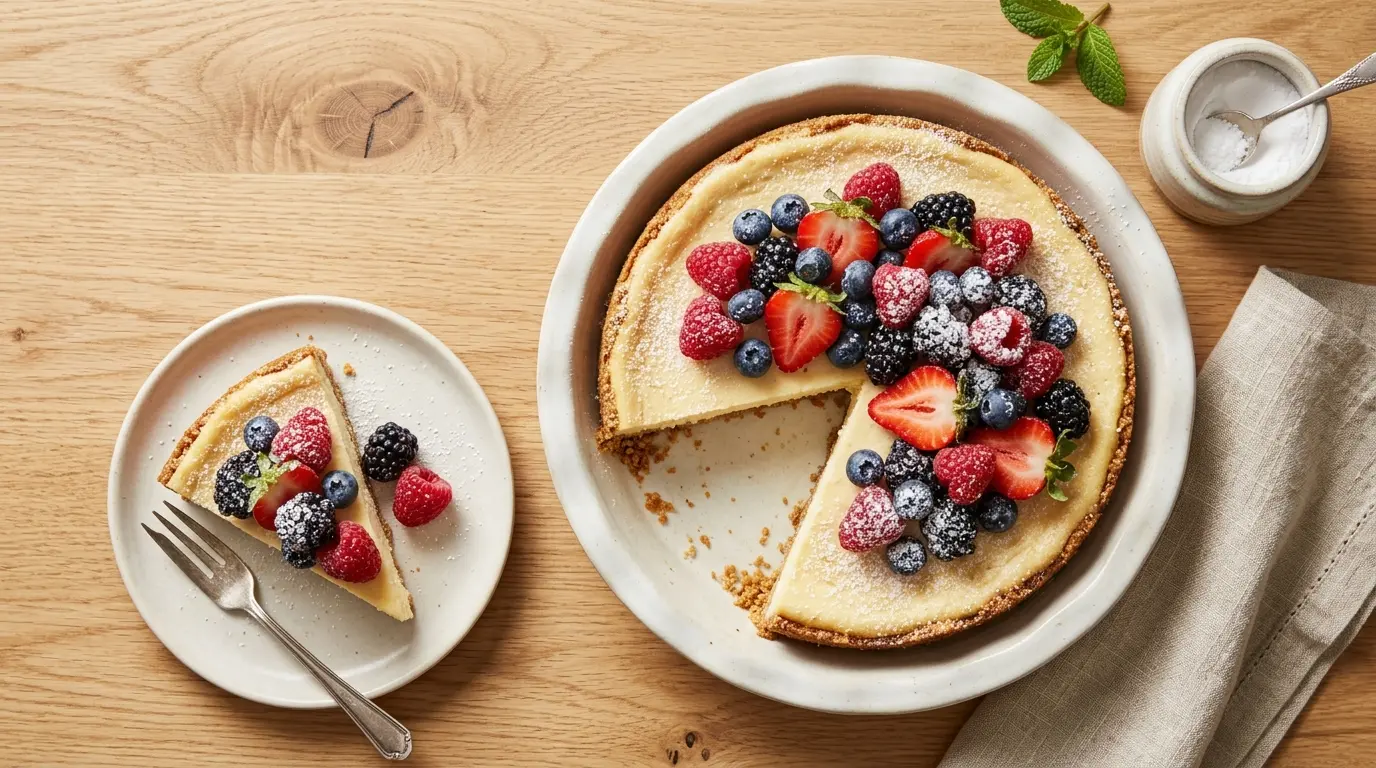
If you’ve been searching for a sugar free cheesecake recipe that doesn’t compromise on flavor or texture, you’ve come to the right place.
This is the full, indulgent cheesecake experience, creamy filling, buttery crust, and that classic tangy sweetness you know and love, just made without a single gram of refined sugar.
What makes this recipe work so well is the combination of full-fat cream cheese, a monk fruit sweetener, and a water bath during baking. Those three elements together create the silky, crack-free texture that can be hard to achieve with cheesecake.
The almond flour crust adds a subtle nuttiness that complements the creamy filling perfectly, and it happens to be gluten-free too.
Managing blood sugar, following a low-carb lifestyle, or simply cutting back on sugar, this cheesecake delivers every time.
It slices beautifully, holds its shape, and tastes like something you’d order at a fancy restaurant. Nobody will ever guess it’s sugar-free.
If you enjoy low-carb desserts, you’ll also love this Keto Cheesecake Recipe for another delicious option.
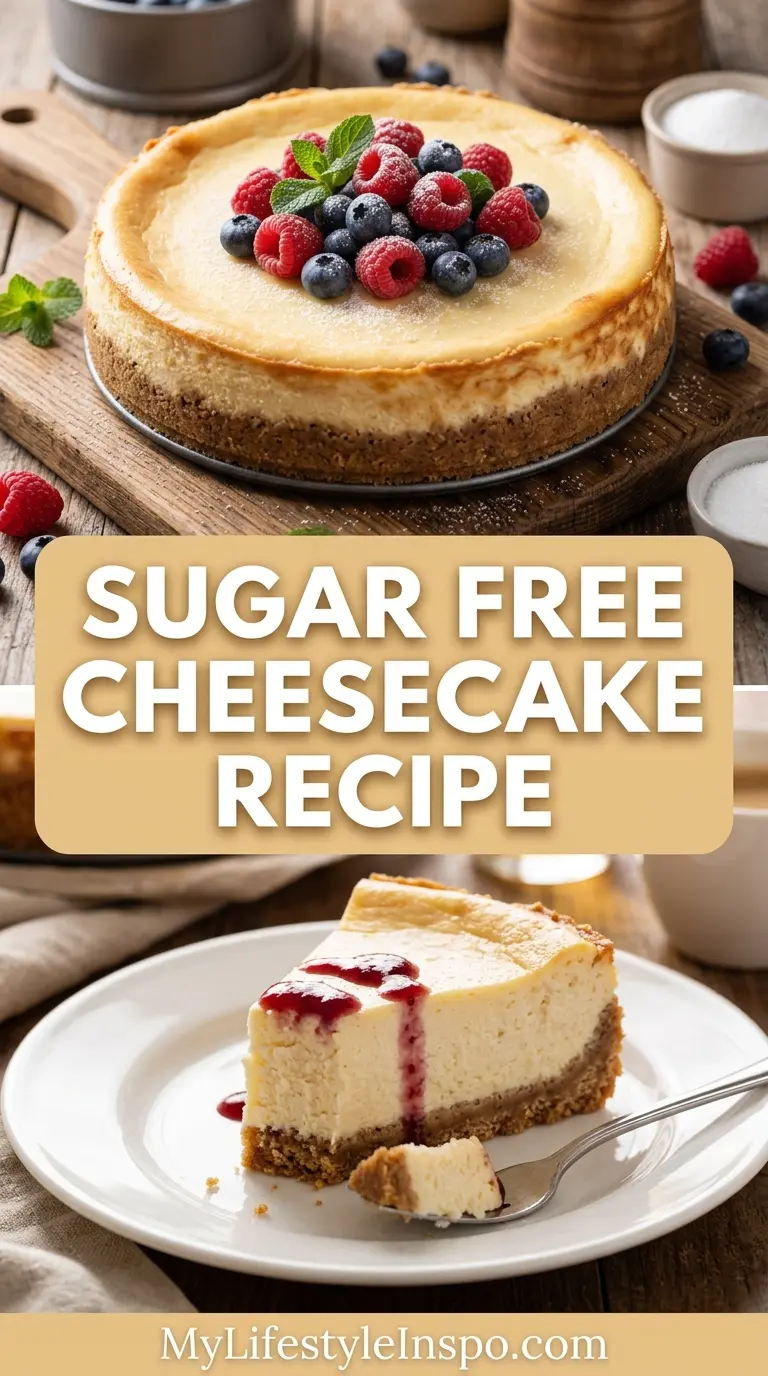
Why You’ll Love This Sugar Free Cheesecake Recipe
This is one of those recipes that checks every box for a crowd-pleasing, diet-friendly dessert.
It’s rich and creamy without being heavy, and the monk fruit sweetener dissolves smoothly into the filling so there’s no grainy texture or strange aftertaste.
The almond flour crust is naturally gluten-free, so it works for guests with gluten sensitivities too.
It’s also surprisingly easy to prepare, even if you’ve never made cheesecake before.
The water bath method, which might sound intimidating, is really just placing your pan inside a larger pan of hot water, and it makes a huge difference in preventing cracks.
This is a make-ahead dessert at its best. You bake it the day before, let it chill overnight, and it’s ready to slice and serve whenever you need it.
- No refined sugar: Sweetened entirely with powdered monk fruit sweetener, which measures just like regular sugar.
- Gluten-free crust: Made with almond flour and melted butter, no graham crackers needed.
- Baked to perfection: A low-and-slow oven temperature plus a water bath prevents cracks and over-baking.
- Make-ahead friendly: Chills overnight so it’s perfect for entertaining or meal prep.
- Versatile toppings: Top with fresh berries, a drizzle of caramel sauce, or enjoy it plain.
- Crowd-pleasing flavor: The flavor is so classic that nobody will know it’s sugar-free unless you tell them.
Another great no-oven option to try is this Philadelphia No Bake Cheesecake Recipe.
Ingredients
You’ll need pantry staples and a few specialty sugar-free swaps to make this cheesecake. Using full-fat versions of each dairy ingredient is key for achieving that dense, creamy texture that cheesecake is known for.
- For the Almond Flour Crust:
- 2 cups (200g) almond flour
- 3 tablespoons (36g) powdered monk fruit sweetener
- 1/4 teaspoon ground cinnamon
- 5 tablespoons (70g) unsalted butter, melted
- For the Cheesecake Filling:
- 24 oz (680g) full-fat cream cheese (3 blocks of 8 oz each), softened to room temperature
- 1 cup (192g) powdered monk fruit sweetener
- 3 large eggs, at room temperature
- 1/2 cup (120g) full-fat sour cream, at room temperature
- 1/4 cup (60ml) heavy whipping cream
- 2 tablespoons (30ml) fresh lemon juice
- 2 teaspoons pure vanilla extract
- 1/4 teaspoon salt
You might also enjoy browsing this No Bake Cheesecake Recipe for a fuss-free version.
Kitchen Equipment Needed
Having the right equipment makes cheesecake baking much less stressful. A springform pan is non-negotiable here because it allows you to release the cheesecake cleanly without flipping or cutting around the edges.
- 9-inch springform pan
- Stand mixer or handheld electric mixer
- Large roasting pan (for the water bath)
- Parchment paper
- Mixing bowls (large and medium)
- Rubber spatula
- Measuring cups and spoons
- Aluminum foil (heavy-duty)
- Offset spatula or the back of a spoon
- Wire cooling rack
- Fine mesh strainer (optional, for a super-smooth filling)
Read Also: Gluten Free Cheesecake Recipe
Recommended Products for This Recipe
These are products I genuinely recommend based on quality and performance. Each one makes a real difference in how your cheesecake turns out.
1. Powdered Monk Fruit Sweetener
Granular sweeteners can leave a gritty texture in no-bake or lightly-baked fillings, but powdered monk fruit dissolves smoothly and delivers clean sweetness without any aftertaste. It measures 1:1 like powdered sugar, making it incredibly easy to use. It also works beautifully in frostings and mousses if you want to reduce sugar elsewhere.
2. 9-Inch Springform Pan with Leakproof Base
A quality springform pan with a tight seal is essential for water bath baking. Cheaper pans often let water seep through, which ruins the crust and bottom layer. Look for a pan with a silicone seal around the base or use heavy-duty foil to wrap the outside.
3. Super-Fine Almond Flour
Not all almond flour is the same. Super-fine blanched almond flour creates a crust that is smooth, buttery, and holds together well, while coarser almond meal can make the crust crumbly and rough-textured. The difference in the final result is noticeable.
4. Offset Spatula for Smooth Filling
An offset spatula lets you spread the filling into the pan evenly and create a perfectly level top. It’s a small tool with a big impact on the presentation of your finished cheesecake.
You might also like: Baked Cheesecake Recipe
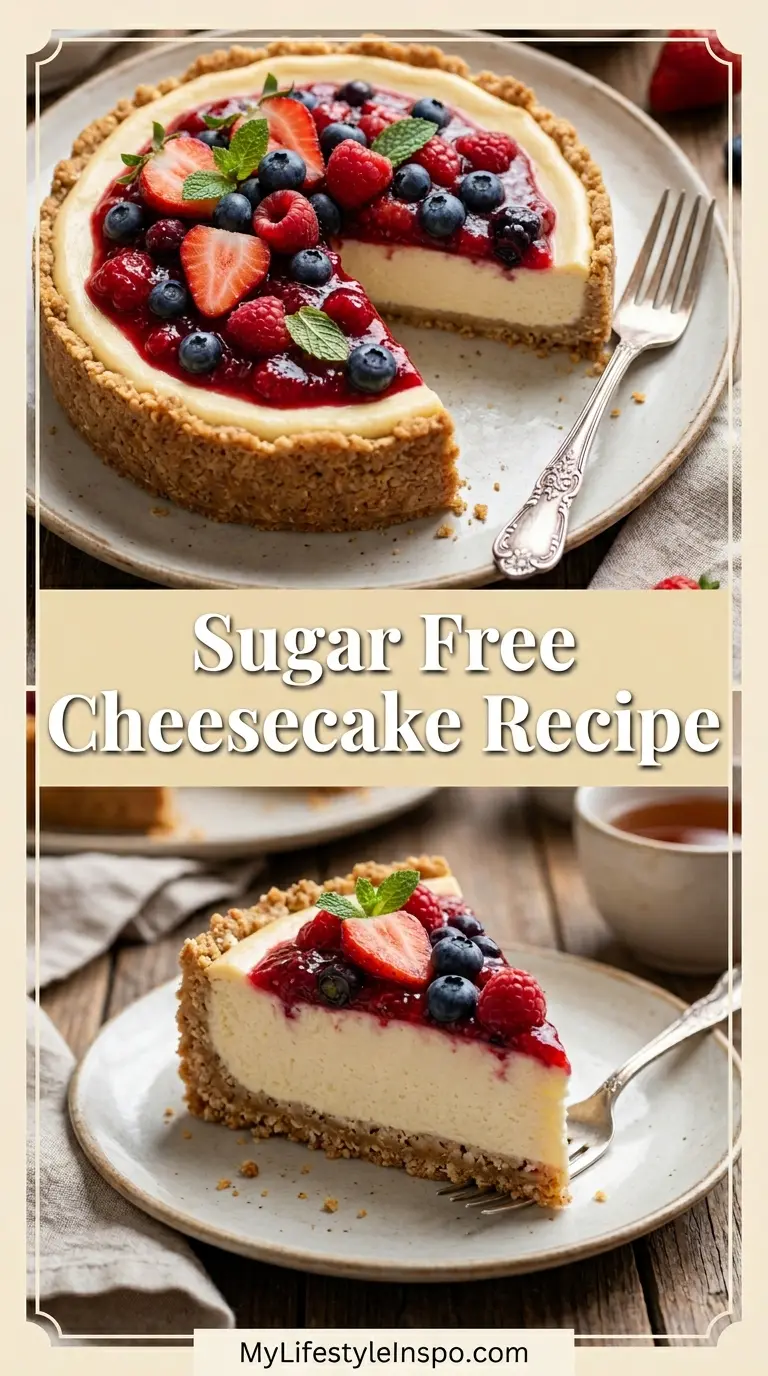
Step-by-Step Instructions
Step 1: Bring Your Dairy Ingredients to Room Temperature
- Remove all three blocks of cream cheese from the refrigerator at least 1 to 2 hours before you plan to start baking.
- Take the eggs and sour cream out of the fridge at the same time.
- Room temperature dairy is the single most important factor in achieving a smooth, lump-free filling. Cold cream cheese will not blend properly and creates a lumpy texture that no amount of mixing can fix.
- If you’re short on time, you can unwrap the cream cheese blocks, place them on a plate, and let them sit in a warm spot in your kitchen for about 45 minutes.
Step 2: Prepare the Springform Pan and Preheat the Oven
- Preheat your oven to 325°F (165°C).
- Cut a circle of parchment paper to fit the bottom of your 9-inch (23cm) springform pan.
- Lightly grease the sides of the pan with butter or non-stick spray.
- Press the parchment circle into the base and clip the sides of the springform pan closed.
- Tear off two to three large sheets of heavy-duty aluminum foil. Wrap them around the outside bottom and sides of the springform pan, pressing them tightly upward to form a waterproof seal. This prevents water from entering during the water bath step.
- Set the prepared pan aside on your counter.
Step 3: Make the Almond Flour Crust
- In a medium mixing bowl, combine the almond flour, powdered monk fruit sweetener, and ground cinnamon.
- Stir these dry ingredients together until they are evenly combined.
- Pour in the 5 tablespoons (70g) of melted unsalted butter and stir with a fork or spatula until the mixture resembles wet sand. It should clump together when pressed between your fingers.
- Tip the crust mixture into the prepared springform pan.
- Use the bottom of a flat measuring cup or the back of a spoon to press the crust firmly and evenly across the base of the pan. Press it about 1/4 inch (6mm) thick and slightly up the sides if desired.
- Place the pan in the preheated oven and bake the crust for 10 to 12 minutes, until the edges are just beginning to turn golden.
- Remove from the oven and set aside to cool slightly while you prepare the filling. Leave the oven on.
Step 4: Make the Cream Cheese Filling
- In the bowl of your stand mixer fitted with the paddle attachment (or in a large bowl using a handheld electric mixer), beat the 24 oz (680g) of softened cream cheese on medium speed for about 2 minutes, until it is completely smooth and free of lumps.
- Scrape down the sides and bottom of the bowl with a rubber spatula.
- Add the 1 cup (192g) of powdered monk fruit sweetener and mix on medium-low speed for about 1 to 2 minutes, until fully incorporated. Avoid mixing on high speed, as this incorporates too much air and can cause the cheesecake to crack.
- Add the 2 tablespoons (30ml) of fresh lemon juice, the 2 teaspoons of pure vanilla extract, and the 1/4 teaspoon of salt. Mix on low until just combined.
Step 5: Add the Eggs, Sour Cream, and Heavy Cream
- Add the 3 room-temperature eggs to the filling, one at a time, mixing on low speed after each addition just until the yellow of the yolk disappears. Do not over-mix at this stage. Over-beating after the eggs are added is one of the main reasons cheesecakes crack.
- Add the 1/2 cup (120g) of sour cream and the 1/4 cup (60ml) of heavy whipping cream.
- Mix on low speed until the filling is smooth, creamy, and uniform. Scrape the bottom of the bowl one more time to make sure there are no unmixed lumps.
- Optional: For an ultra-smooth filling, pass the batter through a fine mesh strainer into a clean bowl, using a spatula to push it through.
Step 6: Assemble and Prepare for the Water Bath
- Pour the cream cheese filling over the pre-baked almond flour crust in the springform pan.
- Smooth the top with an offset spatula so it is level and even.
- Place the foil-wrapped springform pan inside a large roasting pan or deep baking dish.
- Carefully pour hot water from a kettle or pot into the roasting pan, around the outside of the springform pan. Pour enough water to reach about 1 inch (2.5cm) up the sides of the springform pan.
- Be careful not to splash water onto the cheesecake filling as you do this.
Step 7: Bake the Cheesecake
- Carefully transfer the roasting pan with the cheesecake inside to the preheated 325°F (165°C) oven.
- Bake for 55 to 65 minutes. The cheesecake is done when the edges are set and slightly puffed, but the center (about a 2-inch / 5cm circle in the middle) still wobbles gently when you nudge the pan. It will look underdone, but it finishes cooking as it cools.
- Do not open the oven door during the first 45 minutes of baking, as a sudden change in temperature can cause cracking.
Step 8: Cool the Cheesecake Gradually
- Turn off the oven but leave the cheesecake inside with the door slightly ajar (prop it open with a wooden spoon handle).
- Allow the cheesecake to rest in the cooling oven for 1 hour. This gradual cooling is what prevents the top from cracking.
- After 1 hour, carefully remove the roasting pan from the oven. Lift the springform pan out of the water bath using oven mitts and set it on a wire cooling rack.
- Remove the aluminum foil from the outside of the pan.
- Allow the cheesecake to cool at room temperature for another 1 hour.
Step 9: Chill Overnight
- Once the cheesecake has cooled to room temperature, cover the top of the springform pan loosely with plastic wrap or foil.
- Transfer the cheesecake to the refrigerator and chill for a minimum of 6 hours, but ideally overnight (8 to 12 hours). This resting time allows the texture to fully set and the flavors to develop.
- Do not try to slice the cheesecake before it has been fully chilled. It will be too soft and will not hold its shape.
Step 10: Release and Serve
- Run a thin, clean knife or an offset spatula around the inner edge of the springform pan to loosen the cheesecake from the sides.
- Gently unclasp and remove the outer ring of the springform pan.
- Transfer the cheesecake (still on the pan base) to a serving plate or cake stand.
- Use a sharp knife dipped in hot water and wiped dry between each slice to cut clean portions.
- Top with your desired toppings and serve immediately, or return any unsliced portions to the refrigerator.
Read Also: Philadelphia Cheesecake Recipe
Tips for Success
A few small details make a big difference between a good cheesecake and a great one. Keep these in mind before you begin, and your cheesecake will come out perfectly every time.
- Always use room temperature ingredients. This is the most repeated tip for a reason. Cold cream cheese leads to lumps that mixing cannot fully smooth out.
- Mix on low speed after adding the eggs. Too much air beaten into the filling causes the cheesecake to rise and then sink, which leads to cracks.
- Don’t skip the water bath. The steam from the water creates a moist, even baking environment. It’s the difference between a silky cheesecake and a dry, cracked one.
- Use powdered, not granular, monk fruit sweetener. Granular sweetener may not fully dissolve in the filling, leaving a slightly gritty texture. Powdered dissolves completely for a smooth result.
- Cool gradually. Sudden temperature changes cause cheesecake to crack. The slow oven-cool step is not optional if you want a smooth top.
- Chill for the full time. A minimum of 6 hours in the fridge, but overnight is always better. The texture improves significantly after a full overnight chill.
- Use heavy-duty foil for the water bath. Standard foil can develop small tears that allow water to seep through. Double or triple-layer it, or use foil designed specifically for roasting.
This technique is equally useful when making a classic New York Cheesecake Recipe.
Serving Suggestions
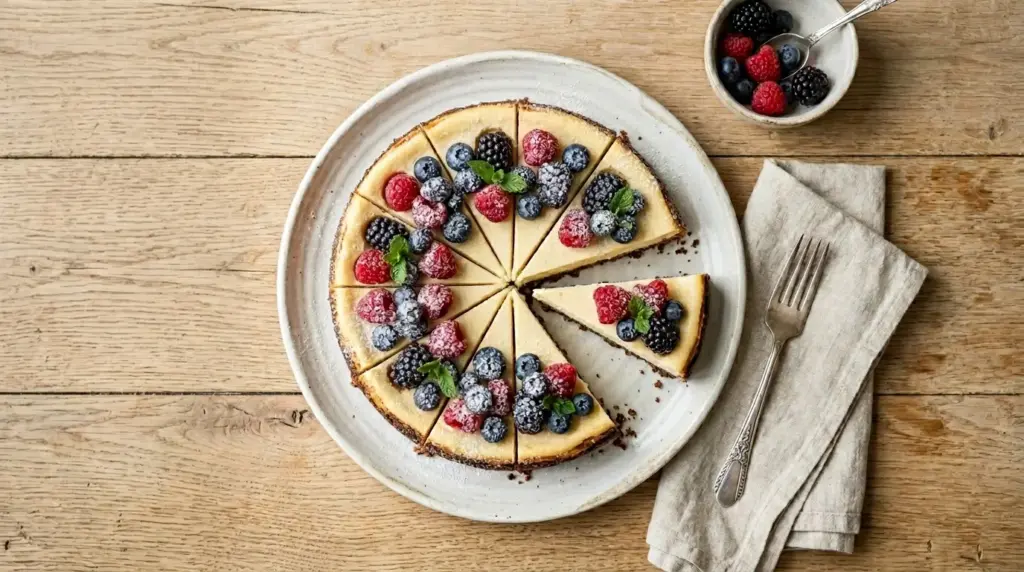
This sugar free cheesecake is delicious on its own, but it also pairs beautifully with a variety of toppings and accompaniments. Keep toppings light and fresh to complement the creamy richness of the cheesecake without overwhelming it.
Plain slices are wonderful with just a dollop of unsweetened or lightly sweetened whipped cream on top, but if you want to dress it up for a special occasion, there are so many options.
- Fresh strawberries or mixed berries: A classic pairing that adds color, natural sweetness, and a fresh contrast to the dense filling. A drizzle of Fresh Strawberry Sauce takes it to the next level.
- Lemon Curd: A spoonful of bright, tangy lemon curd spooned over each slice adds a bold citrus note that pairs beautifully with the vanilla filling.
- Sugar-free caramel drizzle: A light drizzle of sugar-free caramel sauce over the top adds warmth and indulgence.
- Vanilla Bean Ice Cream: A small scoop alongside each slice makes for a restaurant-worthy dessert.
- Toasted coconut flakes: Sprinkled over the top, toasted coconut adds a tropical flavor and a little texture.
- Sliced fresh peaches: In summer, a few slices of ripe peach on top are a simple and stunning garnish.
- Chocolate Ganache: A thin pour of sugar-free dark chocolate ganache makes this cheesecake feel extra luxurious.
You might also enjoy: Churro Cheesecake Recipe
Variations to Try
Once you’ve mastered the base recipe, there are so many ways to make it your own. These variations all work with the same fundamental method, just with a few ingredient swaps or additions.
- Lemon Sugar Free Cheesecake: Add an extra tablespoon of lemon juice and 1 teaspoon of lemon zest to the filling for a bright, citrusy version.
- Strawberry Sugar Free Cheesecake: Fold in 1/2 cup of fresh strawberry puree into the filling before pouring it into the pan.
- Chocolate Sugar Free Cheesecake: Swap 1/4 cup of the monk fruit sweetener for 1/4 cup of unsweetened cocoa powder for a rich, chocolate twist.
- Pumpkin Sugar Free Cheesecake: Add 1/2 cup of pure pumpkin puree and 1 teaspoon of pumpkin spice to the filling for a fall-inspired version similar to this Pumpkin Cheesecake Recipe.
- No-Bake Version: Skip the eggs and water bath. Use only cream cheese, heavy cream, powdered monk fruit, vanilla, and lemon juice. Mix well, pour over a chilled crust, and refrigerate for 6 to 8 hours or overnight until set.
- Mini Cheesecakes: Divide the filling among a lined muffin tin for individual portions, similar to a Mini Cheesecake Recipe. Bake at 325°F (165°C) for 20 to 25 minutes.
- Blueberry Swirl: Drop spoonfuls of fresh or thawed blueberry compote over the filling before baking, then swirl gently with a knife for a marbled effect.
Read Also: Strawberry Cheesecake Recipe
Storage and Reheating
Cheesecake stores exceptionally well, which makes it a fantastic dessert to make in advance. Proper storage keeps it creamy and delicious for several days.
Refrigerator:
- Store the cheesecake covered with plastic wrap or in an airtight container in the refrigerator for up to 5 days.
- If it’s still in the springform pan, cover the top tightly with plastic wrap or foil.
- For already-sliced cheesecake, press a small piece of plastic wrap against the exposed cut edges to prevent them from drying out.
Freezer:
- This cheesecake freezes beautifully for up to 3 months.
- Freeze the whole cheesecake or individual slices. For slices, place them on a baking sheet lined with parchment and freeze until solid (about 1 hour), then wrap each slice individually in plastic wrap followed by a layer of foil.
- Thaw in the refrigerator overnight before serving. Do not microwave to thaw as it affects the texture.
Serving from cold:
- Cheesecake is best served slightly cool but not ice-cold straight from the fridge.
- Let slices sit at room temperature for 10 to 15 minutes before serving for the creamiest texture.
Read Also: Blueberry Cheesecake Recipe
Nutritional Facts
Values are approximate and based on 12 servings per cheesecake. Exact amounts will vary depending on the brand of cream cheese, sour cream, and sweetener used.
| Nutrient | Per Serving (1 slice) |
|---|---|
| Calories | 320 kcal |
| Total Fat | 29g |
| Saturated Fat | 15g |
| Cholesterol | 115mg |
| Sodium | 220mg |
| Total Carbohydrates | 6g |
| Dietary Fiber | 1.5g |
| Net Carbs | 4.5g |
| Sugars | 2g (naturally occurring) |
| Protein | 7g |
Monk fruit sweetener contributes zero calories and zero grams of sugar, which is what makes this recipe significantly lower in sugar than a traditional cheesecake.
For a higher-protein variation, consider the cottage cheese style found in recipes like this Lemon Cheesecake Recipe.
Health Benefits of Key Ingredients
This sugar free cheesecake isn’t just lower in sugar, several of its key ingredients come with real nutritional benefits that make it a smarter dessert choice.
The swap from refined sugar to monk fruit sweetener is the foundation of this recipe’s healthier profile. Monk fruit is a natural, zero-calorie sweetener that does not raise blood sugar or insulin levels, making it suitable for people managing diabetes or following low-carb diets.
- Almond flour: A good source of vitamin E, magnesium, and healthy monounsaturated fats. It’s lower in carbohydrates than wheat flour and higher in protein and fiber, which contributes to a slower digestive response.
- Cream cheese: While rich in fat, full-fat dairy provides fat-soluble vitamins like A, D, and K2. It also supplies a small amount of protein per serving.
- Eggs: One of the most nutrient-dense foods available. Eggs provide high-quality complete protein, choline (which supports brain health), and fat-soluble vitamins.
- Sour cream: Contains beneficial bacteria (live cultures) in some varieties, and adds calcium and phosphorus to the recipe.
- Lemon juice: Provides a small amount of vitamin C and helps balance the flavor of the filling while also interacting with the cream cheese to support the set texture.
- Monk fruit sweetener: Derived from the monk fruit plant, it contains antioxidants called mogrosides. Unlike artificial sweeteners, monk fruit is natural and generally recognized as safe for most people.
Another dessert that keeps health in mind is this Cheesecake Ice Cream Cake Recipe for a frozen twist.
Frequently Asked Questions
1. Can I use a different sugar-free sweetener instead of monk fruit?
Yes, you can substitute erythritol, Swerve, or a monk fruit/erythritol blend in a 1:1 ratio with the powdered monk fruit called for in this recipe. Avoid pure stevia in large quantities as it can have a bitter aftertaste at higher amounts. Granular sweeteners should be processed in a blender or food processor until powdery before using in the filling, to ensure they dissolve properly.
2. Why did my cheesecake crack on top?
Cracks are usually caused by one of three things: over-mixing the batter after the eggs are added (which incorporates too much air), baking at too high a temperature, or cooling the cheesecake too quickly. If your cheesecake does crack, don’t worry. The flavor is unaffected, and you can cover any cracks with fresh berries, whipped cream, or a drizzle of sugar-free sauce.
3. Can I make this cheesecake without a water bath?
You can, but the results won’t be as consistent. Without the steam from the water bath, cheesecake is more likely to crack on top and can develop a slightly dry or rubbery texture around the edges. If you don’t want to use a water bath, bake the cheesecake at 300°F (150°C) instead of 325°F (165°C), and place a separate pan of hot water on the oven rack below the cheesecake to add some moisture to the oven environment.
4. Is monk fruit sweetener safe for diabetics?
Monk fruit sweetener has a glycemic index of zero and does not raise blood glucose levels, making it a popular choice for people managing diabetes or following low-glycemic diets. However, individual responses can vary, and it’s always best to consult with a healthcare provider for personalized dietary guidance. The rest of the ingredients in this cheesecake are also low in carbohydrates, making the net carb count per slice quite manageable at around 4.5g.
5. Can I use low-fat cream cheese to reduce the fat content?
Full-fat cream cheese is strongly recommended for the best texture. Low-fat or reduced-fat cream cheese contains more water and less fat, which results in a softer filling that doesn’t set as firmly. It can also make the cheesecake more prone to cracking. If you prefer a lighter version, use full-fat cream cheese for two of the three blocks and reduced-fat for one block as a compromise.
Read Also: Best Cheesecake Recipe
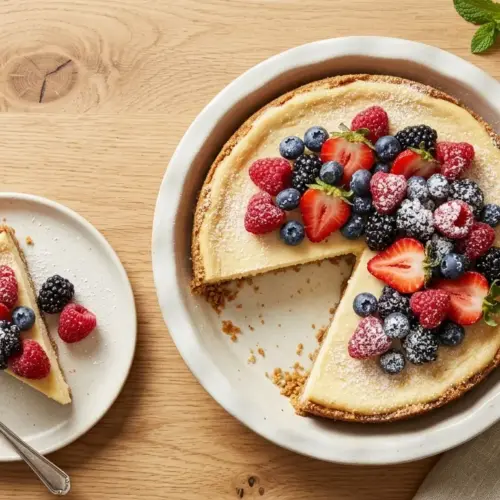
Sugar Free Cheesecake

Equipment
- 9-inch Springform Pan with Leakproof Base - essential for clean release
- Stand mixer - or handheld electric mixer
- Large roasting pan - for the water bath
- Parchment paper
- Mixing bowls - large and medium
- Rubber spatula
- Measuring cups and spoons
- Aluminum foil - heavy-duty recommended
- Offset spatula - or the back of a spoon
- Wire cooling rack
- Fine-mesh strainer - optional, for a super-smooth filling
Ingredients
- 2 cups almond flour - 200g, super-fine blanched recommended
- 3 tablespoons powdered monk fruit sweetener - 36g
- 1/4 teaspoon ground cinnamon
- 5 tablespoons unsalted butter - 70g, melted
For the Cheesecake Filling
- 24 oz cream cheese - 680g, 3 blocks of 8 oz each, softened to room temperature, full-fat
- 1 cup powdered monk fruit sweetener - 192g
- 3 large eggs - at room temperature
- 1/2 cup full-fat sour cream - 120g, at room temperature
- 1/4 cup heavy whipping cream - 60ml
- 2 tablespoons fresh lemon juice - 30ml
- 2 teaspoons pure vanilla extract
- 1/4 teaspoon salt
For Serving (Optional)
- fresh strawberries - or mixed berries
- lemon curd
- sugar-free caramel sauce
- vanilla bean ice cream - sugar-free if preferred
- toasted coconut flakes
- fresh peaches - sliced
- sugar-free dark chocolate ganache
Instructions
- Bring cream cheese, eggs, and sour cream to room temperature for 1-2 hours before starting.
- Preheat oven to 325°F. Line the bottom of a 9-inch springform pan with parchment paper, grease sides, and wrap the outside tightly with heavy-duty foil.
- Combine almond flour, monk fruit sweetener, and cinnamon. Stir in melted butter until mixture resembles wet sand.
- Press crust firmly into the prepared pan. Bake for 10-12 minutes until edges are golden. Set aside to cool.
- Beat softened cream cheese on medium speed for 2 minutes until smooth. Add monk fruit sweetener and mix until combined.
- Mix in lemon juice, vanilla extract, and salt on low speed until just combined.
- Add eggs one at a time, mixing on low after each addition until yolk disappears. Add sour cream and heavy cream, mixing until smooth.
- Pour filling over the pre-baked crust and smooth the top. Place the springform pan inside a roasting pan and fill with hot water to 1 inch up the sides.
- Bake for 55-65 minutes until edges are set but the center still wobbles gently.
- Turn off the oven and leave the cheesecake inside with the door slightly ajar for 1 hour. Remove from oven and cool at room temperature for another hour.
- Cover and refrigerate for a minimum of 6 hours, but ideally overnight.
- Run a knife around the edge of the pan, release the springform, and serve chilled with optional toppings.
Notes
- Always use room temperature ingredients for a smooth, lump-free filling. Cold cream cheese will not blend properly.
- Mix on low speed after adding the eggs to prevent incorporating too much air, which causes cracking.
- The water bath creates a moist, even baking environment that prevents cracks and ensures a silky texture.
- Use powdered, not granular, monk fruit sweetener so it dissolves completely without a gritty texture.
- Do not open the oven door during the first 45 minutes of baking, as sudden temperature changes can cause cracking.
- The cheesecake will still wobble in the center when done – it finishes cooking as it cools.
- Chill for the full 6-8 hours or overnight for the best texture and flavor development.
- Store covered in the refrigerator for up to 5 days or freeze for up to 3 months.
- For clean slices, dip a sharp knife in hot water and wipe dry between each cut.
- Let slices sit at room temperature for 10-15 minutes before serving for the creamiest texture.
Final Thoughts
This sugar free cheesecake recipe proves that cutting out refined sugar doesn’t mean giving up the desserts you love.
With its buttery almond flour crust, silky cream cheese filling, and that perfect balance of sweet and tangy, this cheesecake holds its own against any traditional version.
It’s the kind of recipe you’ll come back to again and again, for birthdays, holidays, dinner parties, or just because you deserve a really good slice of cheesecake.
Give this recipe a try and let me know how it turns out in the comments below. Did you add any toppings or try any of the variations? I’d love to hear about it, and if you make it, please share a photo!
Recommended:
- Banana Pudding Recipe
- Oreo Cheesecake Recipe
- Basque Cheesecake Recipe
- Japanese Cheesecake Recipe
- Cream Cheese Frosting Recipe
- Chocolate Pudding Recipe
- Caramel Sauce Recipe
- Vanilla Pudding Recipe
- Fruit Tart Recipe