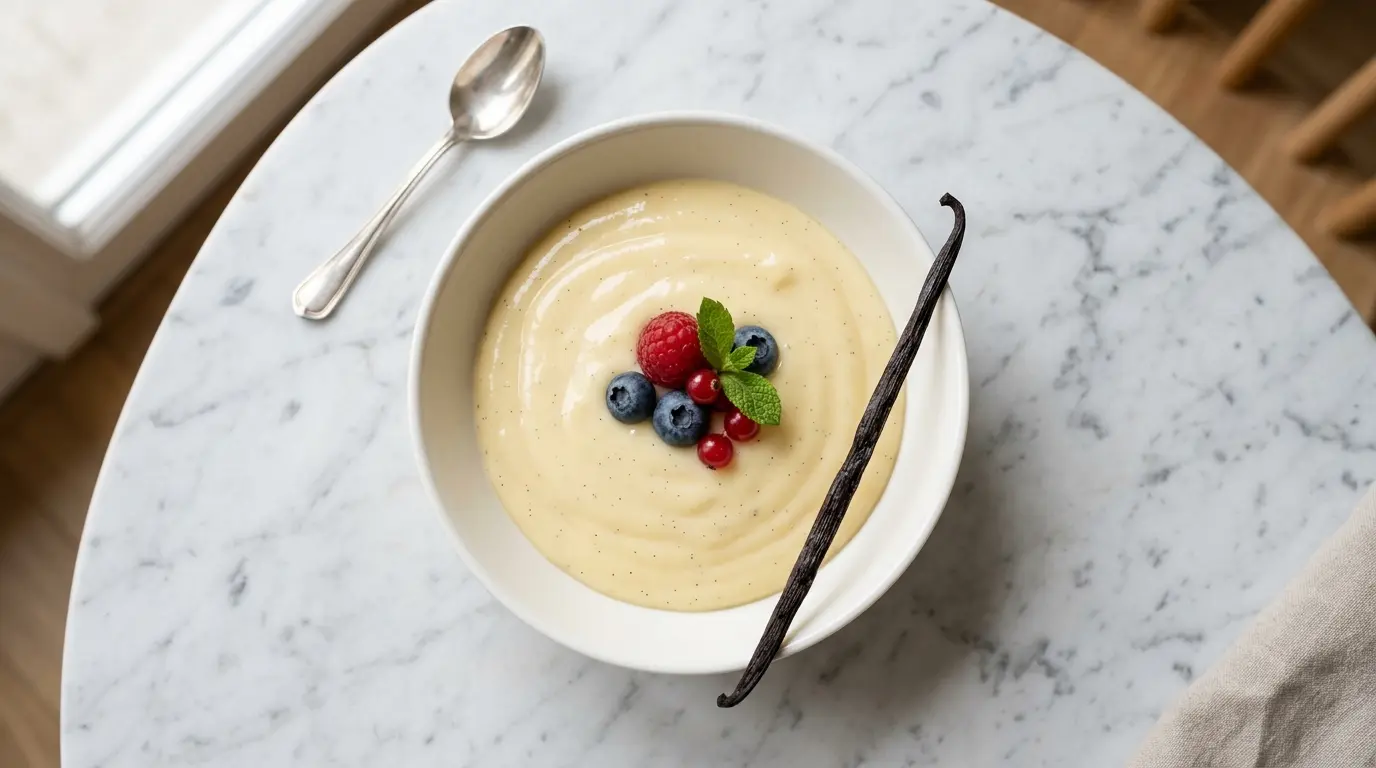
If you’ve ever bitten into a perfectly filled éclair, a dreamy cream puff, or a slice of Boston cream pie and thought “how do I make that at home?”, this pastry cream recipe is exactly what you’ve been looking for. Crème pâtissière, the French name for this luscious custard filling, is one of the most foundational preparations in the world of baking. Once you master it, you’ll realize just how many bakery-quality desserts suddenly become achievable in your own kitchen.
This recipe uses whole milk, egg yolks, sugar, cornstarch, butter, and vanilla, which is the classic, most widely recognized formula found in professional patisseries around the world. The result is a thick, smooth, glossy custard that pipes beautifully, spreads like a dream, and tastes like pure comfort.
It’s also more forgiving than you might expect. With the right technique and a few key tips, even a first-time cook can pull this off with confidence.
If you love custard-based desserts, you’ll also want to check out this Fruit Tart Recipe that uses pastry cream as its gorgeous filling.

Why You’ll Love This Pastry Cream Recipe
This pastry cream recipe earns a permanent spot in your baking rotation for so many reasons.
It’s made with just a handful of pantry staples. No specialty equipment, no hard-to-find ingredients, just milk, eggs, sugar, cornstarch, butter, and vanilla.
The texture is absolutely dreamy. Thick enough to hold its shape when piped, but still silky and luscious on the palate.
It’s a true culinary workhorse. You can use it in tarts, cakes, éclairs, cream puffs, crepes, doughnuts, and more.
Pastry cream is also incredibly versatile when it comes to flavor. Once you know the base recipe, you can customize it endlessly with chocolate, coffee, lemon, coconut, and other variations.
The technique, while slightly involved, is repeatable and reliable. Follow the steps carefully once, and you’ll be making it from memory in no time.
- Bakery-quality results at home: This tastes every bit as good as what you’d find at a French pâtisserie.
- Customizable flavors: The vanilla base is a blank canvas ready for your creativity.
- Works in dozens of desserts: From Boston Cream Pie to fruit tarts to layered cakes, the applications are endless.
- Make-ahead friendly: Pastry cream stores beautifully in the fridge for several days.
- Beginner-friendly with the right tips: The tempering step sounds intimidating but is completely manageable with a little patience.
Ingredients
This classic pastry cream recipe keeps things simple and traditional. Each ingredient plays a critical role in building the texture and flavor of the custard, so it’s worth using quality products wherever possible. Whole milk gives the base richness and body, egg yolks provide structure and that signature golden color, cornstarch acts as the primary thickener, and real vanilla is what makes the flavor sing. The finishing touch of cold butter stirred in at the end adds a gorgeous sheen and an extra layer of creaminess.
- 2 cups (480 ml) whole milk
- 4 large egg yolks
- ½ cup (100 g) granulated sugar
- 3 tablespoons (24 g) cornstarch
- ¼ teaspoon fine salt
- 2 tablespoons (28 g) unsalted butter, cold, cut into cubes
- 1 vanilla bean, split and scraped (or 2 teaspoons pure vanilla extract)
For a richer result, you can substitute up to half of the whole milk with heavy cream. This produces an even silkier custard with a more indulgent mouthfeel.
You might also enjoy this Lemon Curd Recipe as another egg-yolk-based filling to add to your repertoire.
Kitchen Equipment Needed
Having the right tools ready before you start will make the process smooth and stress-free. Pastry cream moves quickly once you’re on the stove, so you’ll want everything within arm’s reach. A heavy-bottomed saucepan is particularly important here because it distributes heat evenly and prevents the milk from scorching. A fine mesh sieve is non-negotiable for a lump-free result, and a good whisk will be your best friend throughout this recipe.
- Heavy-bottomed medium saucepan
- Fine mesh sieve
- Large heatproof mixing bowl
- Whisk
- Wooden spoon or heat-resistant silicone spatula
- Measuring cups and spoons
- Plastic wrap (for storage)
- Instant-read thermometer (optional but helpful)
- Piping bag with tips (if filling pastries or éclairs)
Read Also: Easy Crème Brûlée Recipe
Recommended Products for This Recipe
These are the products I genuinely recommend for making pastry cream at home. Each one has been chosen for quality and real-world performance in the kitchen.
1. Nielsen-Massey Madagascar Bourbon Vanilla Beans
High-quality vanilla is one of the most important flavors in this recipe, and Nielsen-Massey beans are consistently plump, moist, and full of flavor. The difference between a great vanilla bean and a dried-out one is immediately noticeable in the finished custard. Infusing the milk with a real vanilla pod produces a richer, more complex result than extract alone.
2. All-Clad Stainless Steel Saucepan with Lid
Even heat distribution is absolutely essential when making custard, and the All-Clad saucepan delivers it consistently. A pan with hot spots will scorch your milk before the eggs can be tempered, ruining the batch. This pan’s triple-ply construction makes it one of the most reliable tools in any pastry kitchen.
3. OXO Good Grips Fine Mesh Strainer
Straining your pastry cream through a fine mesh sieve is the single step that separates silky-smooth custard from lumpy disappointment. The OXO strainer has a wide bowl, sturdy frame, and ultra-fine mesh that catches every last bit of cooked egg or cornstarch. It’s also easy to clean, which is a bonus when you’re working with sticky custard.
4. Ateco Piping Bag and Tips Set
If you’re planning to use your pastry cream to fill éclairs, cream puffs, or doughnuts, a good piping bag set makes the job so much cleaner and easier. The Ateco set includes multiple tip sizes and reusable bags that are far sturdier than disposable ones. A round tip works best for filling pastries cleanly without tearing them.
5. Instant-Read Digital Kitchen Thermometer
Cooking your pastry cream to the correct temperature (around 185-200°F / 85-93°C) ensures the starch thickens fully and the eggs are cooked through. A reliable instant-read thermometer removes all the guesswork and gives you confidence that your custard is done. This is especially helpful for beginners who aren’t yet familiar with the visual cues.
For another classic French custard to try next, check out this Vanilla Pudding Recipe that uses a similar base technique.

Step-by-Step Instructions
1. Gather and Prep All Ingredients
- Pull all your ingredients out of the fridge at least 10 minutes before you start. Cold eggs can cause the mixture to seize when hot milk hits them, so having them at room temperature helps everything combine smoothly.
- Measure out your sugar (½ cup / 100 g) and cornstarch (3 tablespoons / 24 g) and add them to a large heatproof bowl. Add the salt and whisk them together until no lumps remain. Cornstarch can be stubborn and clumpy, so take your time here.
- Add the 4 egg yolks to the sugar-cornstarch mixture. Whisk vigorously for about 1 to 2 minutes until the mixture turns pale yellow and looks thick and smooth. This step is called “blanchir” in French pastry, and it coats the egg proteins with sugar and starch, giving them more protection against scrambling when the hot milk is added.
- Set a fine mesh sieve over a separate clean bowl and place it near the stove. You’ll be straining the finished custard directly through it, so having it close by is important.
- Cut your 2 tablespoons of cold butter into small cubes and set aside. Keep it cold until the very end.
2. Infuse the Milk with Vanilla
- Pour 2 cups (480 ml) of whole milk into your heavy-bottomed saucepan.
- If using a vanilla bean, use a sharp paring knife to slice the pod lengthwise down the center. Use the back of the knife to scrape out all the tiny seeds from the inside of the pod. Add both the scraped seeds and the empty pod to the milk. The pod contains flavor compounds that will continue to infuse as the milk heats.
- If you’re using vanilla extract, set it aside for now. You’ll add it after cooking to preserve its aromatic freshness.
- Place the saucepan over medium heat. Warm the milk, stirring occasionally, until small bubbles begin to appear around the edges of the pan and wisps of steam rise from the surface. You want the milk hot but not boiling. This should take about 5 to 7 minutes.
- Once the milk is hot and steaming, remove the pan from the heat and discard the vanilla bean pod if used.
3. Temper the Eggs
- Here’s the step that many home cooks fear, but it’s actually quite simple if you go slowly. Tempering means gradually raising the temperature of the egg mixture so the eggs don’t scramble when they meet the hot milk.
- While whisking the egg yolk mixture constantly with one hand, use your other hand to ladle or pour a thin, steady stream of the hot milk into the bowl. Start with just ¼ cup (about 60 ml) of milk, pouring in a slow, thin drizzle.
- Continue whisking vigorously as you slowly add more hot milk, roughly ½ cup at a time, until you’ve incorporated about half the milk into the egg mixture. At this point, the egg mixture will be warm and well-combined, and you can pour in the remaining milk more freely.
- Once all the milk has been added to the eggs and whisked together, the mixture should look smooth and pale. There should be no visible bits of egg or lumps.
4. Cook the Custard
- Pour the entire tempered egg-and-milk mixture back into the saucepan through the fine mesh sieve. This catches any egg bits that may have scrambled during tempering and ensures a smooth start.
- Place the saucepan back over medium heat. Switch from a whisk to a wooden spoon or silicone spatula, and stir the mixture constantly using a sweeping figure-eight motion, making sure to reach the bottom corners of the pan where custard can collect and scorch.
- Continue stirring over medium heat. After 3 to 5 minutes, you’ll notice the mixture beginning to thicken. Keep stirring. It will then thicken more dramatically within the next minute or two, changing from a loose liquid to a noticeably pudding-like consistency.
- When the custard reaches a full, bubbling boil and holds visible trails from your spoon, it’s done. The bubbles are important: they confirm that the starch has fully gelatinized and the eggs are fully cooked. If you’re using a thermometer, you’re looking for an internal temperature of 185-200°F (85-93°C).
- Cook for 1 minute more once it reaches a full boil, stirring constantly, to ensure the starch is fully cooked through. Undercooked cornstarch can cause the custard to thin out as it sits.
5. Finish with Butter and Vanilla
- Remove the saucepan from the heat immediately once the custard has cooked.
- Add the cold butter cubes, a few pieces at a time, stirring or whisking after each addition until fully melted and incorporated. The cold butter cools the custard quickly, stops further cooking, and emulsifies into the cream to give it a beautiful glossy finish and a richer, more supple texture.
- If using vanilla extract instead of a vanilla bean, stir in the 2 teaspoons of vanilla now. Adding it off the heat preserves its flavor compounds, which would otherwise be lost to evaporation if added while cooking.
- Taste the pastry cream at this point. It should taste rich, sweet, vanilla-forward, and smooth with no starchy or eggy aftertaste.
6. Strain and Chill the Pastry Cream
- Pour the finished pastry cream through the fine mesh sieve set over your clean heatproof bowl. Use a spatula to push it through the sieve if needed. This final straining step removes any last traces of scrambled egg or lumps, guaranteeing a perfectly smooth, silky result.
- Immediately press a piece of plastic wrap directly onto the surface of the pastry cream, making full contact with the cream. This prevents a skin from forming as it cools. Any gap between the plastic and the cream will cause a tough, rubbery skin.
- Let the pastry cream cool at room temperature for 15 to 20 minutes, then transfer it to the refrigerator. Chill for at least 2 hours, or until completely cold and set. The cream will firm up significantly as it cools.
- Before using, whisk the chilled pastry cream vigorously to loosen it back to a smooth, pipeable consistency. If it’s too thick to pipe comfortably, whisk in a small splash of milk, 1 tablespoon at a time.
This technique works wonderfully for other custard-based fillings too, like this Chocolate Pudding Recipe that follows a very similar method.
Tips for Success
Making pastry cream is a skill, and a few insider tips will help you nail it on the very first try. The most common failure points are scrambled eggs from improper tempering, starchy-tasting custard from undercooking, and a lumpy texture from not straining. All of these are completely avoidable with the right knowledge.
- Use whole milk for best results. Low-fat or skim milk will produce a thinner, less rich custard that doesn’t set as firmly.
- Never stop stirring once the mixture hits the stove. Constant stirring prevents scorching on the bottom of the pan and ensures even thickening.
- Pour the hot milk slowly when tempering. The slower you pour, the less chance there is of scrambling the eggs. Think thin stream, not a splash.
- Don’t skip the sieving step. Even a well-made pastry cream benefits from straining. It’s the difference between good and great.
- Cook it to a full boil. A lot of recipes are too cautious about this. You must cook the pastry cream until it comes to a full, visible boil and bubbles actively for at least 30 to 60 seconds. This activates the cornstarch completely and ensures stable thickening.
- Use cold butter at the end. Cold butter cools the custard rapidly and emulsifies smoothly, adding shine and richness without making the cream greasy.
- Press plastic directly onto the surface. This eliminates any air contact and keeps the cream fresh and skin-free.
Read Also: Banana Cream Pie Recipe
Serving Suggestions
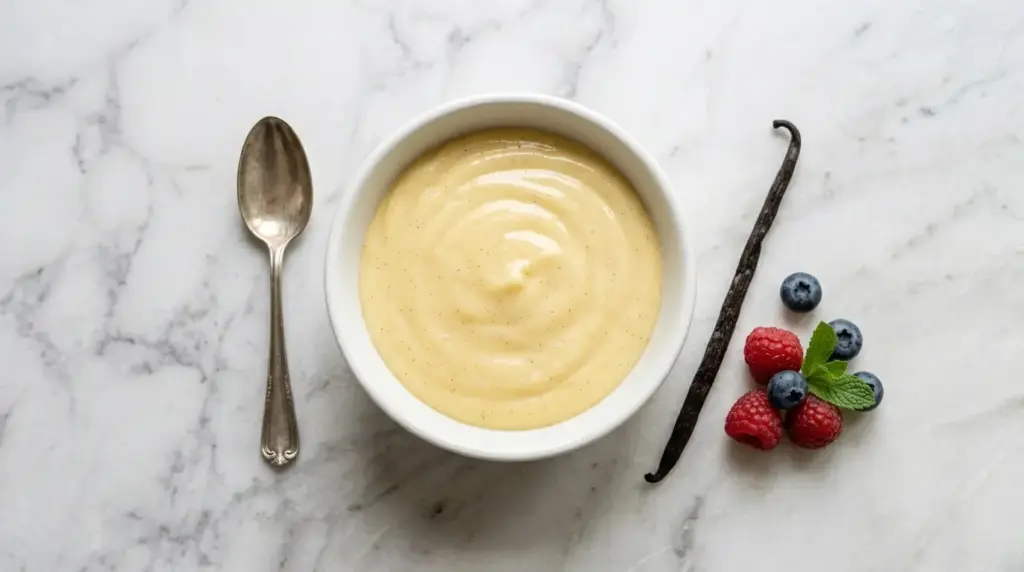
Pastry cream is one of those rare preparations that makes everything it touches taste more special.
It’s the soul of a classic French fruit tart, spread generously over a buttery tart shell and topped with fresh, glazed seasonal fruit.
Use it to fill cream puffs and éclairs for a homemade pastry spread that will genuinely impress guests.
Spoon it between layers of cake in place of buttercream for a lighter, more elegant filling. It pairs especially beautifully with this Classic Yellow Cake.
- Banana Cream Pie: Pastry cream makes an incredible pie filling layered with fresh banana slices. The custard slides right in as the main event.
- Crepes: Fill warm crepes with chilled pastry cream and serve with Fresh Strawberry Sauce for a simple yet stunning dessert.
- Trifles: Layer pastry cream with sponge cake, fruit, and Chocolate Ganache in glasses for an elegant individual dessert.
- Doughnuts: Fill yeasted or cake doughnuts with pastry cream for a bakery-style treat at home.
- Boston Cream Pie: This iconic American cake relies entirely on pastry cream as its filling.
Variations to Try
The classic vanilla pastry cream is just the beginning. Once you understand the base technique, you can take it in so many delicious directions. These variations all use the same core method, with small adjustments to the flavoring ingredients.
- Chocolate Pastry Cream: Whisk 3 oz (85 g) of finely chopped dark chocolate chips or baking chocolate into the hot custard immediately after removing from the heat, before adding the butter. Stir until fully melted and smooth.
- Lemon Pastry Cream: Omit the vanilla bean and stir in 3 tablespoons of fresh lemon juice and 1 teaspoon of lemon zest along with the butter at the end. You can also fold in a few tablespoons of lemon curd for extra citrus intensity.
- Coffee Pastry Cream: Dissolve 1 to 2 teaspoons of instant espresso powder in the warm milk before tempering the eggs. It adds a deep, roasty bitterness that balances the sweetness beautifully.
- Coconut Pastry Cream: Replace 1 cup (240 ml) of the whole milk with full-fat coconut milk and add ½ teaspoon of coconut extract along with the vanilla. This variation works beautifully in tropical fruit tarts.
- Crème Légère (Lightened Pastry Cream): Fold 1 cup (240 ml) of freshly whipped heavy cream into the chilled pastry cream. This creates a lighter, airier texture that’s perfect for éclairs, cream puffs, and mille-feuille.
- Crème Mousseline: Beat softened unsalted butter into the pastry cream using a hand mixer or stand mixer until the mixture is silky and light. This richer version is ideal for layer cakes and works wonderfully in classic French desserts.
Read Also: Hollandaise Sauce Recipe
Storage and Reheating
Pastry cream stores well and can be made ahead of time, which is one of the reasons it’s such a practical recipe for entertaining. Proper storage keeps it tasting fresh and prevents contamination or textural breakdown.
- Refrigerator: Transfer the chilled pastry cream to an airtight container with plastic wrap pressed directly on the surface, or store in the bowl it was chilled in with the plastic wrap still in place. It will keep for up to 3 to 4 days in the refrigerator.
- Freezer: Freezing is not recommended. The custard will separate and become grainy when thawed because the starch structure breaks down during freezing.
- Re-whisking: Before using refrigerated pastry cream, remove it from the fridge and whisk it vigorously to restore its smooth, creamy consistency. If it’s too stiff to work with, place it in a saucepan over very low heat and stir gently, or whisk in a small splash of milk to loosen it.
- Using chilled cream straight from the fridge: Always allow the cream to come to cool room temperature for about 15 minutes before filling pastries. This makes it much easier to pipe or spread.
- Do not reheat in the microwave without stirring: If you need to soften it slightly, microwave in 15-second intervals, stirring between each burst to prevent hot spots.
You might also enjoy: Caramel Sauce Recipe
Nutritional Facts
The following nutritional information is an estimate for one serving (approximately ¼ cup / 60 g) of classic vanilla pastry cream. Values will vary slightly depending on the specific brands and ingredients used.
| Nutrient | Per Serving (¼ cup / 60 g) |
|---|---|
| Calories | 145 kcal |
| Total Fat | 7 g |
| Saturated Fat | 3.5 g |
| Cholesterol | 115 mg |
| Sodium | 65 mg |
| Total Carbohydrates | 17 g |
| Sugars | 13 g |
| Protein | 4 g |
| Calcium | 90 mg |
Nutritional values are approximate and calculated for a recipe yielding about 8 servings.
Another favorite: Classic Tiramisu Recipe
Health Benefits of Key Ingredients
Pastry cream is a dessert component, so it’s enjoyed as a treat rather than a health food. That said, the core ingredients do bring genuine nutritional value to the table.
Egg yolks are one of nature’s most nutrient-dense foods. They are packed with fat-soluble vitamins including A, D, E, and K, along with choline, which plays a crucial role in brain health and liver function. The healthy fats in egg yolks also help your body absorb those fat-soluble vitamins more efficiently.
Whole milk contributes meaningful amounts of calcium, which supports bone density and muscle function, as well as vitamin D and phosphorus. The fat in whole milk also carries important fat-soluble nutrients and contributes to satiety.
Vanilla, particularly when using a real vanilla bean, contains small amounts of antioxidants and has been studied for its anti-inflammatory properties. While the amount used in pastry cream is modest, real vanilla also provides a natural flavor that eliminates the need for artificial additives.
- Egg yolks: Rich in vitamins A, D, E, K, and B12, as well as choline and lutein for eye health.
- Whole milk: Provides calcium, phosphorus, vitamin B2 (riboflavin), and complete protein.
- Vanilla: Contains vanillin, a natural antioxidant compound with mild anti-inflammatory properties.
- Butter: Supplies fat-soluble vitamins and short-chain fatty acids, including butyrate, which supports gut health.
For another dessert that showcases wholesome ingredients, check out this Strawberry Cheesecake Recipe.
Frequently Asked Questions
1. Why did my pastry cream turn out lumpy?
Lumpy pastry cream is almost always caused by scrambled egg bits that formed during the cooking process, or by cornstarch that wasn’t fully dissolved before being added to the milk.
The best fix for lumpy cream is to strain it through a fine mesh sieve immediately while it’s still hot. If the cream was not strained and has already set in the fridge, you can warm it gently and then pass it through the sieve. For prevention, always whisk the cornstarch and sugar together thoroughly before adding the egg yolks, and pour the hot milk in a slow, thin stream when tempering.
2. Can I make pastry cream without cornstarch?
Yes, you can substitute an equal amount of all-purpose flour or a combination of both, though the result will differ slightly.
Flour-thickened pastry cream has a more opaque appearance and a slightly starchier, denser texture. It also requires a longer cooking time to eliminate the raw flour taste. Cornstarch-thickened pastry cream is cleaner in flavor, lighter in texture, and results in a more translucent, glossy finish, which is why it’s the preferred choice in most modern recipes.
3. How do I know when pastry cream is done cooking?
Pastry cream is done when it reaches a full, active boil with visible bubbles breaking the surface, and when it has thickened to a pudding-like consistency.
A spoon dragged through the center of the pan should leave a clean trail. If you have an instant-read thermometer, look for a temperature between 185-200°F (85-93°C). Many beginners pull the custard off the heat too early, before the starch has fully gelatinized. This results in a cream that seems thick on the stove but turns watery as it cools.
4. Can pastry cream be used as a cake filling?
Absolutely, and it makes a wonderful one.
Chilled pastry cream spreads smoothly between cake layers and holds its shape well when sandwiched between sponge cake, particularly in denser or firmer cakes. For very light, tall, or frosted cakes, it’s a good idea to add a thin dam of buttercream around the edge of each layer before spreading the pastry cream inside. This prevents the filling from seeping out under the weight of additional cake layers or when the cake is sliced.
5. Why did my pastry cream become watery after refrigerating it?
This can happen for two reasons: the cornstarch was not fully cooked, or the egg yolks contained an enzyme called alpha-amylase that broke down the starch during storage.
To prevent this, always cook the pastry cream to a full, rolling boil and hold it there for at least 30 to 60 seconds with constant stirring. Heat deactivates the alpha-amylase enzyme in the egg yolks, which would otherwise break down the starch and thin out the cream over time. If your pastry cream has already thinned, you can re-heat it gently in a saucepan, whisk in a small additional amount of cornstarch dissolved in cold milk, and cook it back to a boil.
Read Also: Bechamel Sauce Recipe

Classic Pastry Cream (Crème Pâtissière)

Equipment
- Heavy-bottomed medium saucepan
- Fine-mesh sieve - Non-negotiable for lump-free result
- Large heatproof mixing bowl
- Whisk
- Wooden spoon - Or heat-resistant silicone spatula
- Measuring cups and spoons
- Plastic wrap - For storage
- Instant-read thermometer - Optional but helpful
- Piping bag with tips - Optional, for filling pastries or éclairs
Ingredients
- 2 cups whole milk - 480ml
- 4 large egg yolks
- ½ cup granulated sugar - 100g
- 3 tablespoons cornstarch - 24g
- ¼ teaspoon fine salt
- 2 tablespoons unsalted butter - 28g, cold, cut into cubes
- 1 vanilla bean - split and scraped, or 2 teaspoons pure vanilla extract
Instructions
- Whisk sugar, cornstarch, and salt in a bowl. Add egg yolks and whisk vigorously for 1-2 minutes until pale and thick.
- Heat milk with vanilla bean seeds and pod over medium heat until steaming with small bubbles around the edges. Remove from heat and discard the pod.
- While whisking the egg mixture constantly, slowly pour in a thin stream of the hot milk. Start with ¼ cup then gradually add half the milk before whisking in the remainder.
- Strain the mixture back into the saucepan and cook over medium heat, stirring constantly with a wooden spoon. Cook until it reaches a full bubbling boil and thickens to a pudding consistency, about 3-5 minutes.
- Remove from heat and whisk in cold butter cubes until melted and incorporated. Stir in vanilla extract if using instead of a bean.
- Strain the pastry cream through a fine mesh sieve into a clean bowl. Press plastic wrap directly onto the surface and chill for at least 2 hours.
Notes
- Use whole milk for the richest, most stable pastry cream. Low-fat milk will produce a thinner custard that doesn’t set as firmly.
- Never stop stirring once the custard hits the stove. Constant stirring prevents scorching on the bottom of the pan and ensures even thickening.
- Pour the hot milk slowly when tempering—a thin, steady stream prevents scrambling the eggs. Rushing this step is the most common cause of lumps.
- Don’t skip the sieving step. Even a well-made pastry cream benefits from straining; it’s the difference between good and great.
- Cook the pastry cream to a full, rolling boil and hold it there for at least 30-60 seconds. This fully activates the cornstarch and ensures a stable, thick consistency that won’t thin out later.
- Use cold butter at the end. It cools the custard rapidly, stops further cooking, and emulsifies smoothly to add shine and richness without making the cream greasy.
- Press plastic wrap directly onto the surface of the hot cream. This eliminates air contact and prevents a tough, rubbery skin from forming as it cools.
- Before using chilled pastry cream, whisk it vigorously to restore its smooth, creamy consistency. If too stiff, whisk in a small splash of milk, 1 tablespoon at a time.
- For a richer result, substitute up to half of the whole milk with heavy cream for an even silkier, more indulgent custard.
- Store pastry cream in an airtight container in the refrigerator for up to 3-4 days. Freezing is not recommended as the texture becomes grainy when thawed.
Final Thoughts
Pastry cream is one of those recipes that feels like a superpower once you have it in your back pocket. It’s endlessly versatile, genuinely delicious, and far more approachable than its French name suggests.
Once you make it the first time, you’ll find yourself reaching for this recipe again and again, whether you’re filling a tart, layering a cake, or simply spooning it into a bowl and eating it with a spoon (no judgment here).
Give this pastry cream recipe a try, and then come back and let me know how you used it! Drop a comment below sharing what dessert you filled or which flavor variation you tried. I’d love to hear about it!
Recommended:
- Pumpkin Roll Recipe
- Vanilla Buttercream Frosting Recipe
- Cream Cheese Frosting Recipe
- Chocolate Buttercream Frosting Recipe
- Croissant Recipe
- Basic Crepe Recipe
- Angel Food Cake Recipe
- Easy Royal Icing Recipe
- Best Carrot Cake Recipe
- Blueberry Cheesecake Recipe