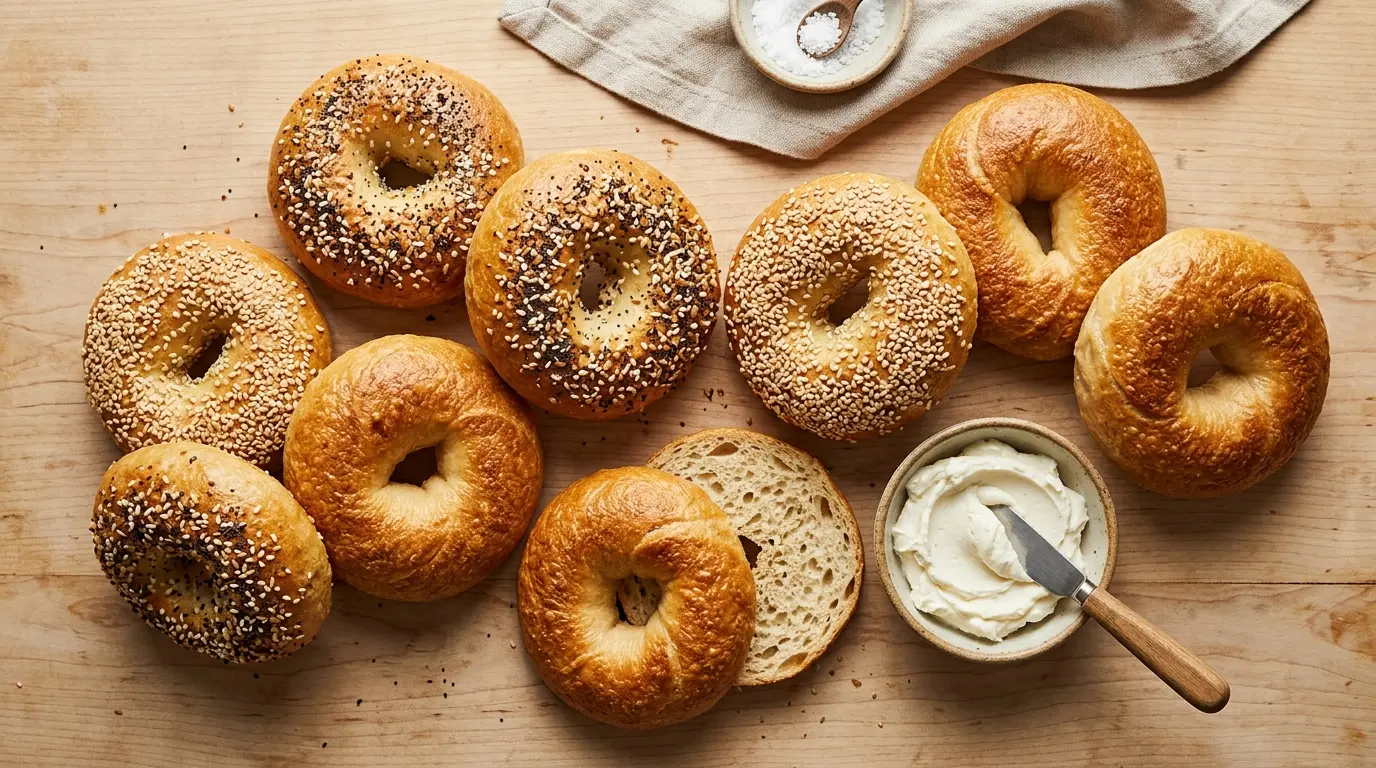
If you keep a sourdough starter, you know the struggle of what to do with all that discard. This sourdough discard bagels recipe is the answer you’ve been looking for. These bagels come out beautifully chewy on the inside, with a glossy golden crust that crackles just slightly when you press it. They taste like a proper New York-style bagel, with that mild tang from the discard giving them a depth of flavor you simply can’t get from a store-bought bag.
The best part? You don’t need to be an experienced bread baker to pull these off. The dough is a stiff, low-hydration dough that’s actually easier to handle than most bread doughs. It comes together quickly, doesn’t stick all over your hands, and shapes beautifully into those classic rings.
The secret to that iconic chewy bagel texture is the boiling step. Before they go into the oven, the shaped bagels take a quick dip in a pot of boiling water with honey (or baking soda). That brief boil sets the crust and creates the signature chew that makes bagels so satisfying. Skip it, and you just have round rolls.
A small amount of instant yeast alongside the discard keeps things reliable and same-day ready. You still get the subtle sourdough flavor without needing to wait for a full fermentation window. This recipe makes 8 generous bagels, perfect for a family batch or a week’s worth of breakfasts.
If you love baking with your discard, you’ll want to try this Sourdough Discard Bread too. It’s another reliable, everyday recipe that puts that jar of discard to delicious use.

Why You’ll Love This Sourdough Discard Bagels Recipe
This recipe checks so many boxes, it’s hard to know where to start.
First, it’s a brilliant use of discard. Instead of tossing that unfed starter down the drain, you’re turning it into something genuinely impressive.
The texture is spot-on. These bagels are dense and chewy in the best possible way, not doughy or gummy.
They hold up beautifully to toppings. Everything bagel seasoning, sesame seeds, poppy seeds, or just a sprinkle of flaky salt all cling perfectly thanks to the egg wash before baking.
You can customize them endlessly. Sweet, savory, plain, everything-style, the base dough works for all of it.
They also freeze exceptionally well. Make a full batch, freeze them, and toast directly from frozen whenever you need a quick breakfast.
Here’s a quick summary of why this recipe works so well:
- Uses up sourdough discard that would otherwise be wasted
- Requires no overnight rest or long fermentation windows
- Produces a genuinely chewy, bakery-quality texture
- Easy to customize with different toppings
- Freezer-friendly for quick weekday breakfasts
- Accessible to beginner bakers with clear steps
You might also enjoy: Sourdough Discard English Muffins
Ingredients
The ingredient list here is simple and focused. Every item plays a specific role in creating those chewy, golden, tangy bagels. Bread flour is the star because its higher protein content (around 12-14%) builds stronger gluten networks than all-purpose flour, which is what gives bagels their signature chew. Don’t substitute all-purpose if you can avoid it.
- 3 cups + 2 tablespoons (390g) bread flour, plus more for dusting
- 1 cup (100g) sourdough discard, unfed, at room temperature
- ¾ cup (180ml) warm water (around 100°F / 38°C)
- 1 tablespoon (12g) granulated sugar
- 1½ teaspoons (5g) instant yeast
- 1½ teaspoons (9g) fine sea salt
- 1 tablespoon (20g) honey, for the boiling water
- 1 tablespoon (14g) baking soda, for the boiling water
- 1 egg, beaten (for egg wash)
- Toppings of your choice: everything bagel seasoning, sesame seeds, poppy seeds, or flaky salt
This sourdough discard pancake recipe is another great weekend morning option if you have more discard to use up.
Kitchen Equipment Needed
You don’t need anything fancy to make these bagels. A stand mixer makes the kneading faster and less tiring, but the dough can absolutely be kneaded by hand if you don’t have one. The key tools are a large pot for boiling and a good baking sheet with parchment.
- Stand mixer with dough hook attachment (or a large mixing bowl for hand kneading)
- Large pot (for boiling bagels)
- Baking sheet
- Parchment paper
- Slotted spoon or spider strainer
- Kitchen scale (strongly recommended for accuracy)
- Plastic wrap or damp kitchen towel (for covering dough)
- Pastry brush (for egg wash)
- Large mixing bowl
- Bench scraper (optional but helpful for dividing dough)
Read Also: Everything Bagel Recipe
Recommended Products for This Recipe
These are products I genuinely recommend based on how much of a difference they make when baking bagels at home.
1. King Arthur Bread Flour
Bread flour with a higher protein content is non-negotiable for that classic bagel chew. King Arthur’s bread flour is consistently reliable and widely trusted by home bakers and professionals alike. It produces a stronger gluten network, which means a chewier, more satisfying bagel every time.
2. Everything Bagel Seasoning Blend
A good everything bagel seasoning blend makes a huge difference in flavor. Look for one that includes sesame seeds, poppy seeds, dried garlic, dried onion, and flaky salt in good proportions. It turns a plain bagel into something that tastes like it came straight from a New York deli counter.
3. Half Sheet Baking Pan with Wire Rack
A heavy-gauge aluminum half sheet pan distributes heat evenly, which prevents the bottoms of your bagels from over-browning before the tops are done. Pairing it with a wire rack also helps air circulate underneath when cooling, keeping the crust crisp rather than steaming soft.
4. Digital Kitchen Scale
Bagel dough is a low-hydration dough where even small variations in flour can affect the final texture. A digital scale takes the guesswork out of measuring and ensures your dough comes out exactly right every time. It’s also useful for dividing the dough into even portions so all 8 bagels bake at the same rate.
This Sourdough Discard Cinnamon Rolls Recipe is another crowd-pleasing bake that uses up discard in the most satisfying way possible.

Step-by-Step Instructions
Step 1: Activate the Yeast
- Pour the warm water (100°F / 38°C) into the bowl of your stand mixer or a large mixing bowl.
- Add the granulated sugar and stir briefly to dissolve.
- Sprinkle the instant yeast over the surface of the water.
- Let the mixture sit for 5 minutes. It should become slightly foamy, which tells you the yeast is active and ready. If nothing happens after 10 minutes, your yeast may be expired and you should start fresh.
Step 2: Add the Sourdough Discard
- Add the sourdough discard to the yeast mixture.
- Stir well with a fork or whisk until the discard is fully dissolved and the mixture looks milky and uniform.
- There should be no large lumps of starter remaining. A well-combined wet mixture ensures the discard is evenly distributed throughout the dough.
Step 3: Mix and Knead the Dough
- Add the bread flour and fine sea salt to the bowl.
- If using a stand mixer, attach the dough hook and mix on low speed for 2 minutes until the ingredients just come together into a shaggy dough.
- Increase the speed to medium and knead for 8 to 10 minutes until the dough is smooth, stiff, and slightly tacky but not sticky. Bagel dough is intentionally stiffer than most bread doughs, so don’t be alarmed if it looks dry at first.
- If kneading by hand, turn the dough out onto a lightly floured surface and knead firmly for 10 to 12 minutes, using the heel of your hand to push and fold. The dough should feel smooth and elastic when it’s ready.
- Do a windowpane test: stretch a small piece of dough between your fingers. If it stretches thin enough to see light through without tearing, the gluten is developed enough to proceed.
Step 4: First Rise
- Shape the dough into a smooth ball and place it in a lightly oiled bowl.
- Cover tightly with plastic wrap or a damp kitchen towel.
- Let the dough rise at room temperature (around 70-75°F / 21-24°C) for 1 to 1.5 hours, until it has roughly doubled in size.
- If your kitchen is cool, place the bowl in an oven with just the light on to create a slightly warmer environment.
Step 5: Divide the Dough
- Turn the risen dough out onto a very lightly floured surface.
- Use a bench scraper or a sharp knife to divide the dough into 8 equal portions. Each portion should weigh approximately 95-100g (about 3.3 oz) if you’re using a scale, which will give you medium-to-large bagels.
- For smaller bagels, divide into 10 portions.
- Cover the portions loosely with plastic wrap to prevent them from drying out while you shape.
Step 6: Shape the Bagels
- Take one portion of dough and roll it into a smooth ball by cupping it in your hand and using a circular motion against the work surface.
- Poke your index finger through the center of the ball to create a hole.
- Gently stretch the hole to about 1.5 to 2 inches (4 to 5cm) in diameter. The hole will shrink slightly during proofing and baking, so make it larger than you think you need.
- Alternatively, roll each portion into a rope about 8 inches (20cm) long and wrap it around your palm, overlapping the ends by about 1 inch and pinching firmly to seal the seam.
- Place each shaped bagel on a parchment-lined baking sheet, spaced a few inches apart.
Step 7: Second Rise (Short Proof)
- Cover the shaped bagels loosely with plastic wrap or a damp towel.
- Let them rest and puff for 20 to 30 minutes at room temperature. They won’t double in size like bread; you’re just looking for them to look slightly puffy and relaxed.
- Do not let them overproof. Overly puffy bagels can collapse when they hit the boiling water and develop a wrinkled surface.
- Float test (optional): Drop one bagel into a bowl of cold water. If it floats within 10 seconds, it’s ready to boil. If it sinks, give it another 10 to 15 minutes to proof.
Step 8: Preheat Oven and Prepare Boiling Water
- Preheat your oven to 425°F (220°C). Place the rack in the center position.
- Fill a large pot with about 4 inches of water and bring it to a rolling boil.
- Once boiling, add the honey and baking soda. Stir briefly. The baking soda helps develop that characteristic bagel crust color and chew, while the honey promotes browning.
Step 9: Boil the Bagels
- Using a slotted spoon or spider strainer, gently lower 2 to 3 bagels at a time into the boiling water. Don’t crowd the pot.
- Boil for 45 seconds on the first side, then flip and boil for another 45 seconds.
- For a chewier crust, you can boil for up to 1 minute per side.
- Remove with the slotted spoon and let them drain briefly before returning them to the parchment-lined baking sheet.
- Repeat with the remaining bagels.
Step 10: Add Egg Wash and Toppings
- Brush each boiled bagel generously with the beaten egg. Don’t be shy here; a good egg wash is what gives the bagels that glossy, deep-brown crust.
- Immediately sprinkle your chosen toppings over the top. Everything bagel seasoning, sesame seeds, poppy seeds, flaky salt, or dried garlic and onion all work beautifully.
- Press the toppings gently to help them adhere before baking.
Step 11: Bake
- Slide the baking sheet into the preheated oven.
- Bake for 20 to 25 minutes, until the bagels are deep golden brown on top and the bottoms sound hollow when tapped.
- Rotate the pan halfway through baking if your oven has hot spots.
- Let the bagels cool on the baking sheet for at least 10 minutes before slicing. They continue to set as they cool, and cutting them too soon can make the crumb gummy.
Another great sourdough bake to try next is this Sourdough Focaccia, which uses active starter for a light, airy, olive-oil-drenched loaf.
Tips for Success
A few focused tips will take your bagels from good to genuinely bakery-worthy. The most common issue beginners face is a dough that’s too soft, so keep these pointers in mind.
- Weigh your flour. Bagel dough is a low-hydration dough where even a tablespoon of extra flour can change the texture. A kitchen scale is your best tool here.
- Don’t skip the boil. It’s tempting to go straight to the oven, but the boiling step is what creates the chewy crust and prevents the bagels from puffing up too much like dinner rolls.
- Keep the dough stiff. If the dough feels soft or sticky after kneading, add flour one tablespoon at a time until it firms up. Soft dough produces bagels that spread rather than hold their shape.
- Don’t overproof. Set a timer for the second rise and check frequently. Overproofed bagels wrinkle when boiled.
- Use bread flour for best results. All-purpose flour will work in a pinch, but bread flour gives a noticeably chewier result.
- Make the hole bigger than you think. It will shrink during proofing and baking. A hole that looks too large before baking will be just right after.
Read Also: New York Style Bagel Recipe
Serving Suggestions
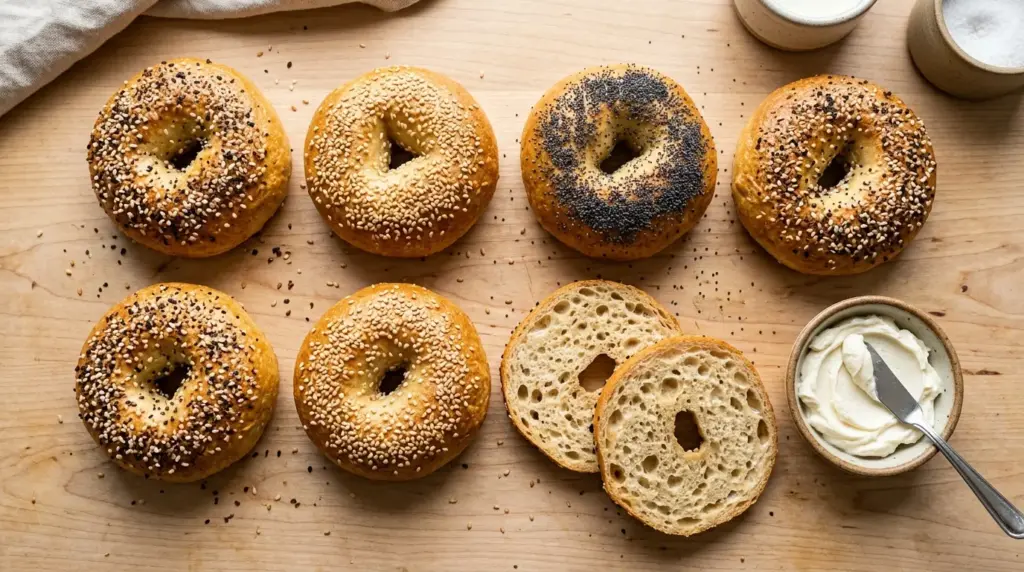
Fresh-baked sourdough discard bagels are incredibly versatile. They work equally well as a hearty breakfast, a quick lunch, or even a snack with your favorite dip. The tangy flavor from the discard pairs especially well with creamy, rich toppings.
- Classic cream cheese and smoked salmon with capers and red onion
- Toasted and spread with cream cheese frosting for a sweet treat
- Halved and used as the base for a breakfast sandwich with eggs, bacon, and cheese
- Topped with avocado, a drizzle of olive oil, and flaky salt (a step up from regular avocado toast)
- Served alongside a bowl of soup as a hearty, chewy side
- Slathered with butter and honey while still warm
- Sliced and layered for a classic deli-style sandwich with turkey, Swiss, and mustard
Variations to Try
Once you’ve mastered the base recipe, there are so many ways to customize these bagels. The same dough formula works as a canvas for sweet and savory variations alike.
- Cinnamon Raisin: Fold ½ cup (75g) of raisins and 1½ teaspoons of cinnamon into the dough during the final minute of kneading. Pair with plain cream cheese for a classic combo.
- Cheese Bagels: Press shredded sharp cheddar or Gruyere into the tops before baking instead of seeds. The cheese melts and crisps into a savory crust.
- Whole Wheat: Replace up to half of the bread flour with whole wheat flour. Add 1 to 2 extra tablespoons of water to compensate for the extra absorption.
- Blueberry Bagels: Gently fold ½ cup (75g) of dried blueberries into the dough at the end of kneading. Top with a sprinkle of sugar before baking.
- Garlic and Herb: Add 1 teaspoon of garlic powder and 1 tablespoon of dried rosemary or thyme to the dry ingredients before mixing.
- Jalapeño Cheddar: Fold in diced pickled jalapeños and shredded cheddar for a spicy, melty variation.
You might also enjoy: Sourdough Discard Pizza Dough
Storage and Reheating
These bagels keep well at room temperature and freeze beautifully, making them perfect for batch cooking.
- Room temperature: Store in an airtight bag or container for up to 2 days. The crust will soften slightly by day 2, but toasting restores it perfectly.
- Refrigerator: Not recommended. Refrigerating bagels actually speeds up staling due to the way cold temperatures affect the starch.
- Freezer: Slice the bagels in half before freezing. Store in a zip-top freezer bag with the halves separated by a piece of parchment paper. Freeze for up to 3 months.
- Reheating from frozen: Toast directly from frozen in a toaster or toaster oven at medium-high heat. No thawing required. They come out tasting nearly as good as fresh.
- Reheating from room temperature: Slice and toast for 2 to 3 minutes, or wrap in foil and warm in a 350°F (175°C) oven for 5 minutes.
Read Also: Sourdough Sandwich Bread Recipe
Nutritional Facts
Per bagel (1 of 8, plain, without toppings). Values are approximate.
| Nutrient | Amount |
|---|---|
| Calories | 230 kcal |
| Total Fat | 1.5g |
| Saturated Fat | 0.3g |
| Cholesterol | 23mg (with egg wash) |
| Sodium | 390mg |
| Total Carbohydrates | 46g |
| Dietary Fiber | 2g |
| Sugars | 3g |
| Protein | 8g |
Note: Nutritional values will vary based on the exact hydration of your sourdough discard, specific flour brand, and any toppings added.
You might also enjoy: Sourdough Discard Crackers
Health Benefits of Key Ingredients
Sourdough discard bagels aren’t a health food per se, but a few of the key ingredients do offer some genuinely worthwhile nutritional benefits worth knowing about.
The fermentation process involved in sourdough culture partially breaks down phytic acid in the flour, which can improve the bioavailability of minerals like zinc, iron, and magnesium. Even discard, which is unfed starter, contains the residual beneficial acids from fermentation that contribute to this effect.
Here’s a closer look at some of the star ingredients:
- Sourdough discard: Contains wild yeast and lactic acid bacteria. Even in discard form, these microorganisms contribute to the mild tanginess and slightly improved digestibility of the final product compared to standard yeast-leavened baked goods.
- Bread flour: Higher in protein than all-purpose flour, contributing to satiety and providing the building blocks for muscle repair and maintenance.
- Honey (in boiling water): A small amount of honey adds trace antioxidants and natural sugars that promote browning. Raw honey also contains enzymes and antimicrobial properties, though these are largely diminished by heat.
- Eggs (egg wash): Eggs are one of the most nutrient-dense foods available, providing high-quality protein, choline, B vitamins, and healthy fats.
Another good way to use your discard with a nutritious spin is this Sourdough Discard Biscuits Recipe.
Frequently Asked Questions
1. Can I make these sourdough discard bagels without yeast?
You can, but the process is quite different. Without commercial yeast, you’ll need your sourdough discard to be quite active (recently fed and at peak activity) to provide enough leavening. You’ll also need a longer bulk fermentation of 4 to 8 hours at room temperature, or an overnight cold proof in the refrigerator. The results are excellent but require more planning. For a reliable same-day bake, the small amount of instant yeast in this recipe is well worth keeping.
2. What consistency should my sourdough discard be?
The discard for this recipe should be at a 1:1 hydration ratio, meaning it was made with equal parts flour and water by weight. This is the most common starter consistency. If your discard is thicker or thinner than this, you may need to adjust the water in the recipe slightly to maintain the right dough consistency. Room temperature discard incorporates more evenly than cold discard straight from the fridge.
3. Why are my bagels wrinkled after boiling?
Wrinkled bagels are almost always a sign of overproofing. When bagels proof for too long before boiling, the gluten structure becomes weak and the bagels deflate when they hit the hot water. To avoid this, keep the second rise to 20 to 30 minutes maximum and do the float test. Also make sure your dough wasn’t too soft to begin with, as high-hydration dough is more prone to collapsing during the boil.
4. Can I make the dough ahead of time?
Absolutely. After shaping the bagels and placing them on the parchment-lined baking sheet, cover them tightly with plastic wrap and refrigerate for up to 24 hours. This cold proof actually develops the flavor even further. When you’re ready to bake, remove them from the refrigerator, bring your boiling water to a full boil, and proceed directly to the boiling step. No need to bring them to room temperature first.
5. Can I use all-purpose flour instead of bread flour?
You can use all-purpose flour, and the bagels will still be tasty. However, the texture will be noticeably less chewy and more bread-like. Bread flour has a higher protein content (around 12-14% vs. 10-11% for all-purpose), which creates a stronger gluten network. If all-purpose is all you have on hand, go ahead and use it, but try bread flour when you can for a more authentic result.
Read Also: Homemade Bagel Recipe

Sourdough Discard Bagels

Equipment
- Stand mixer with dough hook attachment - or large mixing bowl for hand kneading
- Large pot - for boiling bagels
- Baking sheet
- Parchment paper
- Slotted spoon or spider strainer
- Kitchen scale - strongly recommended for accuracy
- Plastic wrap or damp kitchen towel - for covering dough
- Pastry brush - for egg wash
- Large mixing bowl
- Bench scraper - optional but helpful for dividing dough
Ingredients
- 3 cups bread flour - 390g, plus more for dusting
- 1 cup sourdough discard - 100g, unfed, at room temperature
- ¾ cup water - 180ml, warm, around 100°F / 38°C
- 1 tablespoon granulated sugar - 12g
- 1½ teaspoons instant yeast - 5g
- 1½ teaspoons fine sea salt - 9g
- 1 tablespoon honey - 20g, for boiling water
- 1 tablespoon baking soda - 14g, for boiling water
- 1 egg - beaten, for egg wash
- toppings of your choice - everything bagel seasoning, sesame seeds, poppy seeds, or flaky salt
Instructions
- Pour warm water into the bowl of your stand mixer, add granulated sugar and stir to dissolve. Sprinkle instant yeast over the surface and let sit for 5 minutes until foamy.
- Add the sourdough discard to the yeast mixture and stir well until fully dissolved with no lumps remaining.
- Add bread flour and fine sea salt to the bowl. Mix with dough hook on low for 2 minutes until shaggy, then increase to medium and knead for 8-10 minutes until smooth, stiff, and slightly tacky but not sticky.
- Shape the dough into a smooth ball and place in a lightly oiled bowl. Cover with plastic wrap or a damp towel and let rise at room temperature for 1 to 1.5 hours until doubled in size.
- Turn risen dough onto a lightly floured surface and divide into 8 equal portions of about 95-100g each using a bench scraper or knife.
- Roll each portion into a smooth ball, then poke your finger through the center to create a hole and stretch it to about 1.5 to 2 inches in diameter. Place on a parchment-lined baking sheet.
- Cover shaped bagels loosely with plastic wrap and let them rest for 20 to 30 minutes at room temperature until slightly puffy. Perform a float test if desired.
- Preheat oven to 425°F (220°C). Fill a large pot with 4 inches of water and bring to a rolling boil. Add honey and baking soda and stir briefly.
- Using a slotted spoon, lower 2-3 bagels at a time into boiling water. Boil for 45 seconds per side, then remove and drain briefly on the baking sheet.
- Brush each boiled bagel generously with beaten egg and immediately sprinkle with chosen toppings, pressing gently to adhere.
- Bake for 20-25 minutes until deep golden brown and hollow-sounding when tapped. Let cool on baking sheet for at least 10 minutes before slicing.
Notes
- Weigh your flour for best results. Bagel dough is low-hydration and even a tablespoon of extra flour can change the texture.
- Don’t skip the boiling step – it creates the chewy crust and prevents bagels from puffing up like dinner rolls.
- Make the hole larger than you think you need, as it will shrink during proofing and baking.
- Keep the dough stiff. If it feels soft or sticky after kneading, add flour one tablespoon at a time until it firms up.
- Don’t overproof during the second rise. Overproofed bagels will wrinkle when boiled.
- Use bread flour for best results. All-purpose flour works but produces a less chewy texture.
- Store at room temperature in an airtight container for up to 2 days. Toast to refresh the crust.
- Freeze sliced bagels in a zip-top bag for up to 3 months. Toast directly from frozen.
- For a chewier crust, boil for up to 1 minute per side.
- Add-ins like raisins, cheese, or herbs can be folded into the dough during the final minute of kneading.
Final Thoughts
Making sourdough discard bagels at home is one of those baking projects that feels far more impressive than it actually is to execute.
The steps are straightforward, the ingredients are pantry basics, and the reward is a stack of chewy, golden, tangy bagels that genuinely rival anything you’d find at a bakery.
If you’ve been tossing your discard every time you feed your starter, this recipe is the push you need to start saving it.
Give this recipe a try this weekend and see just how good a homemade bagel can be. If you make them, leave a comment below and let me know what toppings you went with. And if someone in your life keeps a sourdough starter, share this recipe with them; it might just become their new favorite discard use.
Recommended:
- Sourdough Starter Recipe
- Easy Sourdough Bread Recipe
- Sourdough Discard Chocolate Chip Cookies
- Sourdough Discard Pizza Dough
- Dinner Rolls Recipe
- Sourdough Focaccia Recipe
- Breakfast Burrito Recipe
- Baked Oatmeal Recipe
- Easy Deviled Eggs Recipe
- Sourdough Discard Crackers Recipe