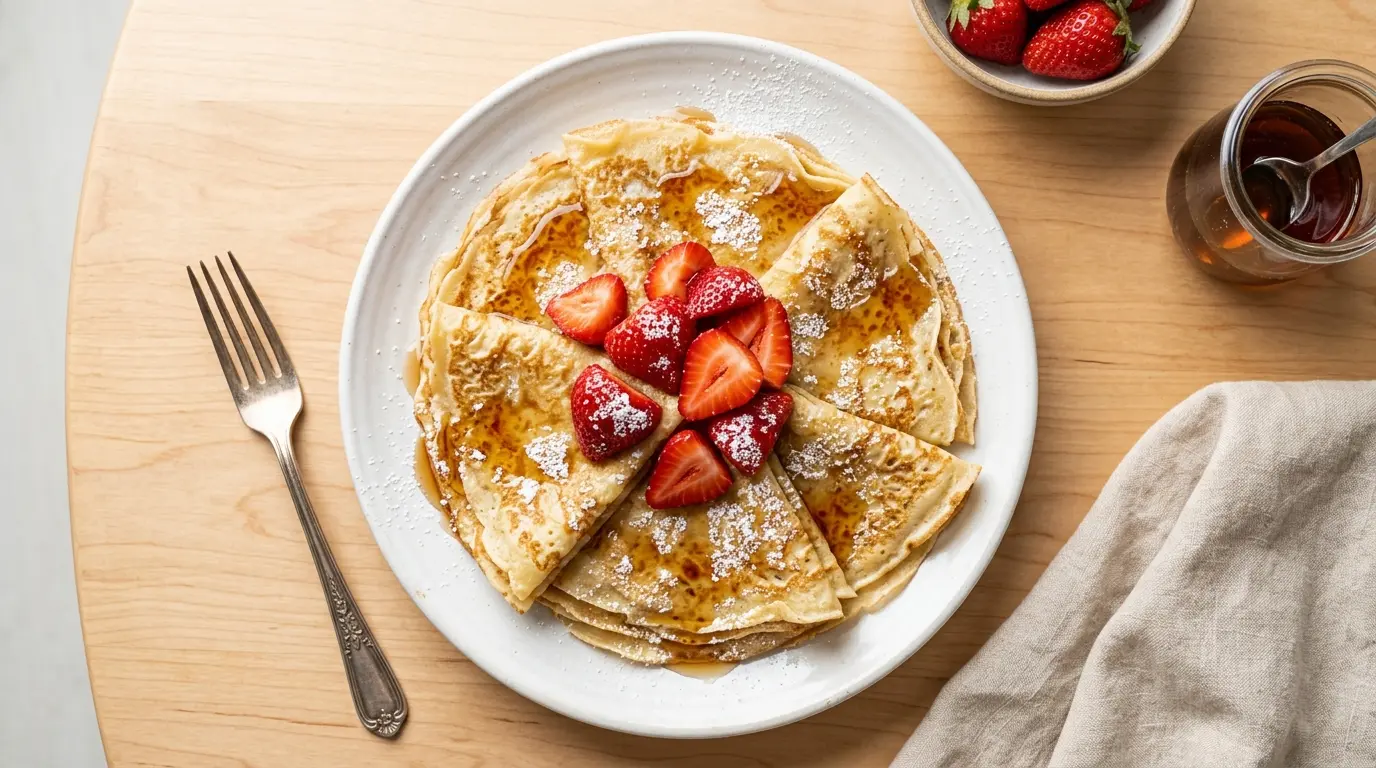
If you have a jar of sourdough discard sitting in your fridge, this sourdough discard crepes recipe is exactly what you should be making with it. These crepes are whisper-thin, lacy around the edges, and have a subtle tangy depth of flavor that regular crepes just can’t match.
They come together with a handful of pantry staples, no special equipment required, and they work beautifully for sweet or savory fillings.
The sourdough discard does something really clever here: since it’s already fermented, the gluten in the batter is relaxed right from the start. That means you skip the overnight rest that classic crepe recipes typically require, and you can go from mixing bowl to plate in well under 30 minutes.
One note before you start: the first crepe almost always tears or looks a little rough. That’s completely normal. Think of it as your test run for dialing in the heat. By the second or third crepe, you’ll have the rhythm down.
Love making things with your sourdough discard? You might also enjoy these Sourdough Discard Waffles for another easy weekend breakfast option.

Why You’ll Love This Sourdough Discard Crepes Recipe
These crepes are one of the most satisfying ways to use up sourdough discard because the results look impressive, but the process is genuinely simple.
You’re not dealing with yeasted dough or long rise times. It’s a thin, pourable batter that you make, rest briefly, and cook.
The flavor is what really sets these apart from regular crepes. That gentle sourdough tang adds a layer of complexity that pairs beautifully with both sweet toppings like Nutella and fruit and savory fillings like ham, cheese, and wilted greens.
They’re also incredibly flexible. You can make them sweet by adding a little sugar and vanilla, or leave those out entirely for a neutral, savory base.
Here’s a quick summary of why these keep making it onto the weekend menu:
- Uses sourdough discard straight from the fridge, no need to bring it to room temperature
- No overnight batter rest required because the discard has already fermented and relaxed the gluten
- Works for sweet and savory applications, from berry-filled dessert crepes to dinner-style chicken florentine crepes
- Ready in under 30 minutes from start to finish
- Easily doubled or tripled to feed a crowd
- Freezer-friendly, so you can make a big batch and save leftovers for quick weekday breakfasts
Read Also: Sourdough Discard Pancakes Recipe
Ingredients
The batter is minimal and forgiving. The key is getting the right ratio of discard to milk to eggs so the batter flows like heavy cream when you tilt the pan.
Here’s what you’ll need to make about 8 to 10 crepes (10-inch/25 cm pan):
- 1 cup (240g) sourdough discard (unfed or active starter both work)
- 2 large eggs
- 1/2 cup (120ml) whole milk
- 1/4 cup (60ml) water
- 1/2 cup (60g) all-purpose flour
- 2 tablespoons (28g) unsalted European-style butter, melted and slightly cooled, plus more for cooking
- 1/2 teaspoon fine sea salt
- 1 tablespoon (12g) granulated sugar (optional, for sweet crepes)
- 1/2 teaspoon pure vanilla extract (optional, for sweet crepes)
A note on the flour: adding a modest amount of all-purpose flour in addition to the discard gives the crepes more structure and helps them flip cleanly. If your discard is very thick (100% hydration or stiffer), you may find you need a splash more milk to thin the batter to a pourable consistency.
Another great way to use up your discard is this Sourdough Discard Banana Bread if you have a few ripe bananas on hand.
Kitchen Equipment Needed
You do not need a dedicated crepe pan to make these work. A good non-stick skillet is the most important tool, and a wide, thin spatula makes flipping much less stressful.
Here’s what to gather before you start:
- 10-inch non-stick skillet (or a dedicated crepe pan)
- Blender or large mixing bowl and whisk
- Measuring cups and spoons
- Wide rubber spatula or crepe spatula for flipping
- Ladle or 1/4-cup measuring cup for portioning the batter
- Pastry brush or paper towels for buttering the pan between crepes
- Plate or cooling rack for stacking finished crepes
You might also enjoy: Sourdough Discard French Toast Recipe
Recommended Products for This Recipe
These products are recommended based on quality and how much they improve the process of making crepes at home. Each one solves a common pain point.
1. Matfer Bourgeat Black Steel Crepe Pan
A traditional black steel crepe pan distributes heat extremely evenly, which is the single most important factor in getting perfectly thin, evenly cooked crepes. The low, sloped sides make it easy to slide a spatula under the crepe for a clean flip. With a little seasoning, it becomes naturally non-stick over time.
2. OXO Crepe Spreader and Spatula Set
If you want professional-looking crepes, a crepe spreader lets you quickly swirl the batter into a perfectly even circle right in the pan. The matching offset spatula glides under delicate crepes without tearing them. This set takes all the guesswork out of the process.
3. Vitamix Immersion Blender
An immersion blender makes mixing crepe batter completely effortless and produces a lump-free, silky-smooth result in about 30 seconds. It’s also much easier to clean than a full countertop blender. If you make batters and sauces regularly, this is one of the most useful tools in the kitchen.
4. Kerrygold Pure Irish Butter
The butter you cook crepes in matters more than it does in most recipes because the flavor is front and center. European-style butter like Kerrygold has a higher fat content and a richer, creamier taste that you can genuinely detect in the finished crepe. It also browns more beautifully in the pan, giving those characteristic golden, lacy edges.
5. Nordic Ware Crepe and Tortilla Press
If you’re making large batches or want extremely consistent crepe thickness, a lightweight press helps you portion and spread the batter quickly. It’s especially useful when cooking for a crowd and you need to move through the stack efficiently.
For another great discard project, check out this Sourdough Discard Blueberry Muffins Recipe.

Step-by-Step Instructions
Step 1: Make the Batter
- Measure out 1 cup (240g) of sourdough discard into a blender or large mixing bowl.
- Add 2 large eggs and whisk them vigorously into the discard until fully combined and no streaks of egg yolk remain. This step is important: if you add the flour before the eggs are fully incorporated, you can end up with lumps.
- Pour in 1/2 cup (120ml) whole milk and 1/4 cup (60ml) water. Stir to combine.
- Add 2 tablespoons of melted, slightly cooled butter. Make sure the butter isn’t hot enough to scramble the eggs when you add it.
- If making sweet crepes, add 1 tablespoon (12g) of granulated sugar and 1/2 teaspoon vanilla extract now.
- Add 1/2 teaspoon of fine sea salt.
- Sift or sprinkle in 1/2 cup (60g) of all-purpose flour.
- Whisk everything together until the batter is completely smooth and no flour lumps remain. Alternatively, blend everything in a countertop blender for about 30 seconds for a perfectly silky result.
- The finished batter should be thin and pourable, resembling heavy cream. If it looks too thick to swirl easily in the pan, add milk one tablespoon at a time until you reach the right consistency.
Step 2: Rest the Batter
- Pour the batter into a bowl or jug and cover loosely with plastic wrap or a clean kitchen towel.
- Let the batter rest at room temperature for 20 to 30 minutes. This step is optional when using sourdough discard (since the gluten is already relaxed), but it does deepen the tangy sourdough flavor and produces a slightly more tender crepe.
- If you want stronger sourdough flavor, you can refrigerate the batter for up to 24 hours and cook cold.
Step 3: Heat the Pan
- Set a 10-inch (25 cm) non-stick skillet or crepe pan over medium heat.
- Allow the pan to heat for 2 to 3 minutes. A properly preheated pan is essential. If the pan is too cool, the batter won’t spread before it sets. If it’s too hot, the crepe will bubble and cook unevenly.
- To test readiness, flick a few drops of water onto the surface. They should skitter and evaporate immediately.
- Add a small knob of butter (about 1/2 teaspoon) to the pan and swirl it to coat the surface evenly. The butter should foam gently and then subside. If it immediately browns and smokes, the pan is too hot. Reduce the heat slightly and wait 30 seconds before trying again.
Step 4: Pour and Swirl the First Crepe
- Lift the pan off the heat completely. This is important: pouring batter into a pan that’s sitting flat on the burner means half the batter sets before you can swirl it.
- Pour approximately 1/4 cup (60ml) of batter into the center of the lifted pan.
- Immediately tilt and rotate the pan in a circular motion so the batter spreads in a thin, even layer across the entire bottom surface. Work quickly as the batter begins to set within a few seconds.
- If there are any thin spots or gaps, you can tilt the pan a bit more to fill them. Set the pan back on the burner once the batter is evenly spread.
Step 5: Cook the First Side
- Cook the crepe over medium heat for about 1 to 2 minutes, until the edges begin to look dry and pull away very slightly from the sides of the pan.
- The surface of the crepe will transition from glossy and wet-looking to matte as it cooks. Wait for this change before attempting to flip.
- You can gently shake the pan to check if the crepe moves freely. If it sticks, give it another 20 to 30 seconds before trying again.
Step 6: Flip the Crepe
- Slide a wide, thin spatula underneath the crepe, starting from one edge and working gently toward the center.
- Lift and flip the crepe in one smooth, confident motion. Hesitating here tends to cause tearing.
- Alternatively, if you’re feeling brave, you can flick the pan handle upward with a quick wrist motion to flip the crepe without using a spatula. This takes a little practice but is very effective.
- The second side cooks faster, usually just 30 to 45 seconds. You’re looking for a few light golden spots, not full browning.
Step 7: Remove and Stack
- Slide the finished crepe onto a plate.
- Stack each subsequent crepe directly on top of the last. Crepes do not stick together when stacked, even while warm, because the surface is very thin and slightly greasy from the butter.
- Re-butter the pan lightly between each crepe. A paper towel or pastry brush works well for this. You don’t need a lot, just enough to keep the surface lightly coated.
- Repeat with the remaining batter, adjusting the heat as needed. If the crepes start browning too quickly, lower the heat slightly.
Step 8: Fill and Serve
- Lay each crepe flat and add your fillings to one half or the center.
- For the classic fold: fold the crepe in half over the filling, then fold again into a quarter triangle shape. This is the traditional French bistro presentation.
- For rolled crepes: spread filling across the lower third of the crepe, then roll it up tightly like a thin burrito.
- Serve immediately while warm. Top with powdered sugar, fresh fruit, maple syrup, or a drizzle of warm chocolate sauce.
You might also enjoy: Easy Crepe Recipe
Tips for Success
Getting crepes right is mostly about practice and heat management. These tips will help you avoid the most common problems:
Here’s what to keep in mind:
- The first crepe is almost always a throwaway. It absorbs excess butter and helps calibrate the pan temperature. Cook it, taste it, and adjust from there.
- Thin batter is key. The batter should flow and spread when you swirl the pan. If it pours like pancake batter, add more milk one tablespoon at a time until it thins out.
- Use cold discard straight from the fridge. Unlike many sourdough baked goods, crepe batter does not need to be at room temperature before using.
- Lift the pan when you pour. Removing the pan from the burner briefly before pouring gives you a couple of extra seconds to swirl the batter before it sets.
- Don’t flip too early. Wait until the surface looks fully matte and the edges are dry. Flipping a crepe that’s still wet in the center guarantees a tear.
- Keep a consistent pour size. Use a ladle or 1/4-cup measure every time to get uniform crepes.
- Lower the heat as you go. Pans tend to get hotter over time. If your later crepes are browning faster than your first few, reduce the burner to medium-low.
Read Also: Sourdough Discard Cinnamon Rolls Recipe
Serving Suggestions
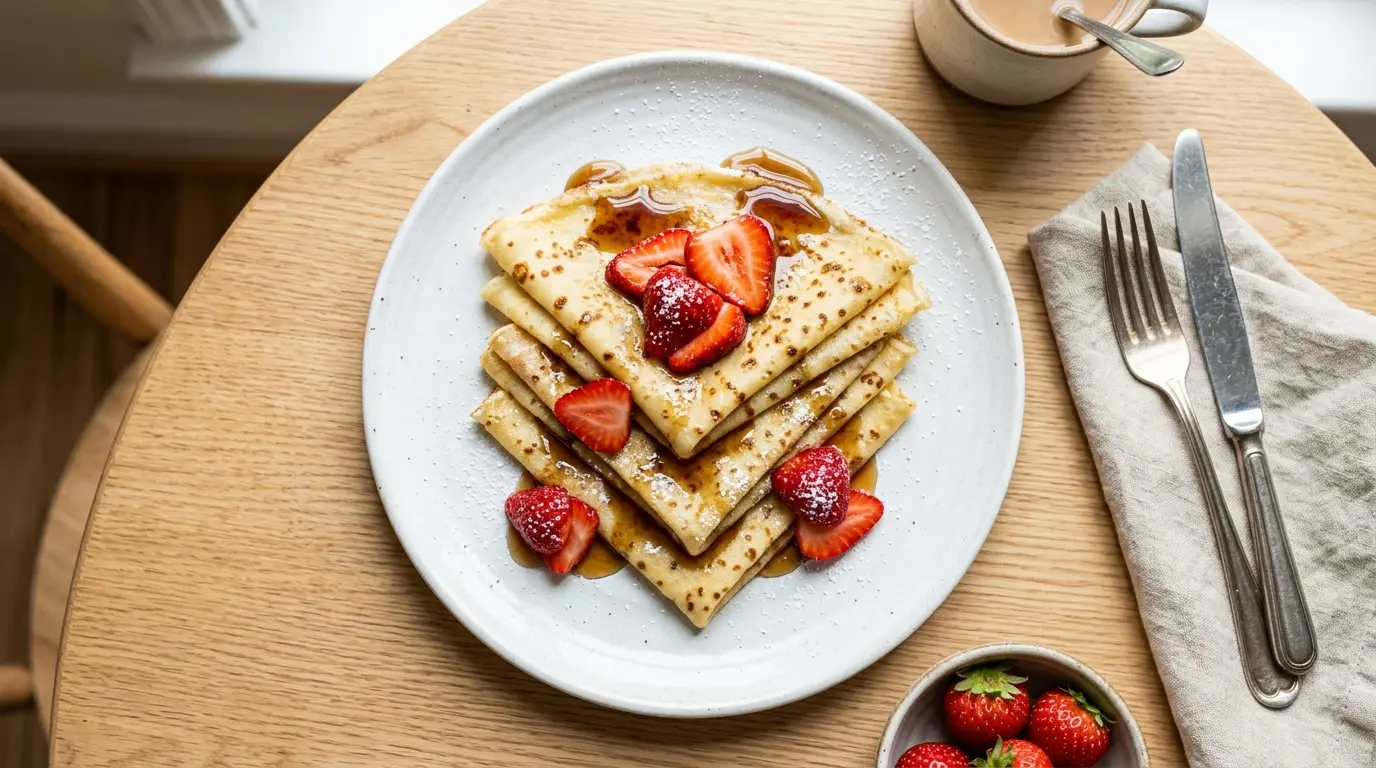
Sourdough discard crepes are one of the most versatile things you can make because they move effortlessly between sweet and savory applications depending on what you add.
For sweet presentations, they shine with simple, classic toppings. For savory meals, they become a genuinely satisfying dinner that feels a little fancy without being complicated.
Here are some of the best ways to serve them:
- Butter and maple syrup, folded into quarters for a classic, simple breakfast
- Nutella and sliced bananas, rolled up and dusted with powdered sugar for a dessert-worthy treat
- Lemon juice and granulated sugar, the traditional French style, which lets the sourdough tang sing
- Whipped cream and fresh berries, especially good with Fresh Strawberry Sauce spooned over the top
- Lemon Curd spread inside and folded into quarters for a bright, citrusy filling
- Ham, Gruyere, and a fried egg on top for a savory Breton-style galette
- Spinach, ricotta, and marinara rolled up and baked for a simple dinner, similar to the flavors in Chicken Florentine Crepes
- Smoked salmon and cream cheese with capers and thin-sliced cucumber for a brunch centerpiece
Variations to Try
The base batter is deliberately neutral so it works as a foundation for all kinds of creative spins. These are some of the most popular variations:
Try one of these approaches to change things up:
- Buckwheat crepes: Replace half the all-purpose flour with buckwheat flour for a nuttier, earthier flavor that’s particularly good with savory fillings. Buckwheat is traditional in Brittany, France, where savory galettes are a staple.
- Chocolate crepes: Add 2 tablespoons of Dutch-process cocoa powder and an extra tablespoon of sugar to the batter for thin chocolate crepes. Outstanding with hazelnut spread.
- Herb and savory crepes: Omit sugar and vanilla, and stir in 2 tablespoons of finely chopped fresh herbs (chives, parsley, or thyme) directly into the batter. Great for filling with cheese and vegetables.
- Gluten-free crepes: Substitute the all-purpose flour with an equal weight of certified gluten-free oat flour or a 1:1 gluten-free flour blend. The texture is slightly more delicate, so handle gently.
- Dairy-free crepes: Replace the milk with oat milk or almond milk and swap the butter for melted coconut oil. The crepes will be slightly less rich but still thin and delicious.
- Extra-tangy overnight crepes: Cover the prepared batter and refrigerate overnight. The extended fermentation deepens the sour flavor significantly.
For another savory flatbread project with sourdough discard, the Sourdough Discard Flatbread Recipe is worth bookmarking too.
Storage and Reheating
Crepes store beautifully, which makes them ideal for meal prep. A batch made on Sunday can supply quick breakfasts all week long.
Here’s how to store and reheat them:
- Room temperature: Stack cooled crepes on a plate and cover with plastic wrap or a clean kitchen towel. They keep well at room temperature for up to 4 hours.
- Refrigerator: Stack the crepes with a small sheet of parchment paper between each one (optional but helpful), then wrap the whole stack tightly in plastic wrap. Refrigerate for up to 3 days.
- Freezer: Layer the crepes between sheets of parchment and place them in a zip-top freezer bag. Freeze for up to 2 months. Thaw overnight in the fridge or for 20 minutes at room temperature.
- Reheating: Warm individual crepes in a dry skillet over low heat for about 30 seconds per side. Alternatively, wrap a stack of crepes loosely in foil and warm in a 300°F (150°C) oven for 8 to 10 minutes. Do not microwave for more than 15 to 20 seconds or the crepes can become rubbery.
Read Also: Sourdough Discard Crackers Recipe
Nutritional Facts
The following values are approximate and based on one plain crepe (without filling or toppings) made from the standard recipe above. Total yield is approximately 8 to 10 crepes.
| Nutrient | Per Crepe (approx.) |
|---|---|
| Calories | 95 kcal |
| Total Fat | 4g |
| Saturated Fat | 2g |
| Cholesterol | 52mg |
| Sodium | 110mg |
| Total Carbohydrates | 11g |
| Dietary Fiber | 0.5g |
| Total Sugars | 1g |
| Protein | 4g |
Values will vary depending on the hydration and flour composition of your sourdough discard, the size of your crepes, and whether optional ingredients like sugar are included.
For another breakfast option that’s equally light and easy, try the Dutch Baby Recipe, which uses a similarly simple batter but bakes into a dramatic, puffed pancake.
Health Benefits of Key Ingredients
These crepes are not just a smart way to use up discard. Some of the core ingredients bring genuine nutritional value to the table.
Here’s a closer look at why each one matters:
- Sourdough discard: The fermentation process that creates sourdough discard produces lactic acid bacteria, which have been linked to improved gut health and better digestibility of gluten. The fermentation also partially breaks down phytic acid, an antinutrient found in grains, which may improve mineral absorption.
- Eggs: Whole eggs are an excellent source of complete protein, choline (important for brain health), and fat-soluble vitamins A, D, and E. The yolks also provide lutein and zeaxanthin, antioxidants associated with eye health.
- Whole milk: Provides calcium, phosphorus, vitamin B12, and a good amount of protein per serving. Using whole milk rather than reduced-fat versions gives the crepes a more tender texture because of the higher fat content.
- Butter: Grass-fed butter contains butyrate, a short-chain fatty acid that supports gut health. It also provides fat-soluble vitamins including vitamin K2, which plays a role in calcium metabolism and bone health.
- All-purpose flour: Contributes B vitamins and a modest amount of dietary fiber, particularly when combined with the fermented discard. The fermentation process may make some of the nutrients more bioavailable compared to unfermented flour.
Another nutrient-rich breakfast made with fermented batter is the Sourdough Pancake Recipe, which shares several of these same benefits.
Frequently Asked Questions
1. Can I make these crepes without adding extra flour?
Yes, though the texture changes slightly. Some recipes use pure discard with no added flour at all, which works best with a thick, 100% hydration starter. The resulting crepes are a bit more delicate and may be harder to flip. Adding the 1/2 cup of flour gives the crepes more structure and makes them easier to handle, especially for beginners. If your discard is very thick, start with a smaller amount of flour (about 1/4 cup/30g) and adjust from there.
2. My crepes keep tearing when I flip them. What am I doing wrong?
The most common cause is flipping too early. The crepe must be fully set on the first side before it will hold together when flipped. Wait until the entire surface looks matte (not shiny or wet) and the edges have begun to pull away from the pan. A second common issue is the wrong tool. A wide, thin rubber spatula that can slide fully under the crepe before you lift gives you much better control than a narrow or thick spatula.
3. Does the discard need to be fed or active?
Neither. Cold, unfed discard straight from the fridge works perfectly in this recipe. You do not need to activate it or bring it to room temperature first. The fermentation has already done its work, which is part of what makes this recipe so convenient.
4. How do I know if my batter is the right consistency?
The batter should pour and flow like heavy cream. When you swirl the pan, it should spread immediately and thinly across the entire surface within one or two rotations. If it moves slowly or clumps in the center, it’s too thick: add milk one tablespoon at a time. If it runs all the way up the sides of the pan and drips off, it’s slightly too thin, which usually still works but produces very fragile crepes.
5. Can I make the batter ahead of time?
Yes. The batter stores very well in the refrigerator for up to 24 hours. Give it a good whisk or stir before using, as the flour may settle slightly overnight. Many bakers prefer overnight-rested batter because the flavor becomes noticeably tangier and more complex. You can even make it the night before and have crepes ready in just a few minutes the next morning.
You might also enjoy: Basic Crepe Recipe

Sourdough Discard Crepes

Equipment
- 10-inch non-stick skillet - or a dedicated crepe pan
- Blender - or large mixing bowl and whisk
- Measuring cups and spoons
- Wide rubber spatula - or crepe spatula for flipping
- Ladle - or 1/4-cup measuring cup for portioning batter
- Pastry brush - or paper towels for buttering the pan
- Plate or cooling rack - for stacking finished crepes
- Crepe spreader - optional, for swirling batter into an even circle
- Immersion Blender - optional, for lump-free batter
Ingredients
- 1 cup sourdough discard - 240g, unfed or active starter both work, straight from the fridge
- 2 large eggs
- 1/2 cup whole milk - 120ml
- 1/4 cup water - 60ml
- 1/2 cup all-purpose flour - 60g
- 2 tablespoons unsalted European-style butter - 28g, melted and slightly cooled, plus more for cooking
- 1/2 teaspoon fine sea salt
- 1 tablespoon granulated sugar - 12g, optional for sweet crepes
- 1/2 teaspoon pure vanilla extract - optional for sweet crepes
For Sweet Serving Suggestions
- Butter - for serving
- Maple syrup - for serving
- Nutella - for serving
- Bananas - sliced, for serving
- Powdered sugar - for dusting
- Lemon juice - for serving
- Whipped cream - for serving
- Fresh berries - for serving
- Lemon curd - for serving
For Savory Serving Suggestions
- Ham - for serving
- Gruyere - grated, for serving
- Fried egg - for serving
- Spinach - for filling
- Ricotta - for filling
- Marinara - for serving
- Smoked salmon - for serving
- Cream cheese - for serving
- Capers - for serving
- Cucumber - thinly sliced, for serving
Instructions
- In a blender or large bowl, combine sourdough discard and eggs. Whisk vigorously until fully combined and no streaks of egg yolk remain.
- Add whole milk, water, melted and slightly cooled butter, salt, and if making sweet crepes, sugar and vanilla. Sift or sprinkle in the all-purpose flour and whisk until completely smooth and lump-free.
- Pour batter into a bowl or jug, cover loosely, and let rest at room temperature for 20 to 30 minutes. For stronger sourdough flavor, refrigerate for up to 24 hours.
- Set a 10-inch non-stick skillet over medium heat and preheat for 2 to 3 minutes. Add a small knob of butter and swirl to coat the pan evenly.
- Lift the pan off the heat, pour approximately 1/4 cup of batter into the center, and immediately tilt and rotate the pan to spread the batter into a thin, even layer. Set the pan back on the burner.
- Cook the crepe for 1 to 2 minutes until the edges look dry and pull away slightly from the pan. The surface should turn from glossy to matte.
- Slide a wide, thin spatula underneath the crepe and flip it in one confident motion. Cook the second side for 30 to 45 seconds until lightly golden with a few spots.
- Slide the finished crepe onto a plate. Stack each subsequent crepe directly on top of the last. Lightly re-butter the pan between each crepe.
- Fill each crepe with sweet or savory fillings. Fold in half over the filling, then fold again into a quarter triangle, or roll tightly like a thin burrito. Serve immediately while warm.
Notes
- First crepe is a test: The first crepe almost always tears or looks rough. Use it to calibrate the heat and butter amount.
- Thin batter is key: The batter should flow like heavy cream. If it’s too thick, add milk one tablespoon at a time.
- Use cold discard: Unlike many sourdough recipes, crepe batter works perfectly with discard straight from the fridge.
- Lift the pan: Always lift the pan off the burner before pouring batter to give yourself extra seconds to swirl before it sets.
- Don’t flip too early: Wait until the surface looks fully matte and the edges are dry before flipping to prevent tearing.
- Adjust heat as you go: Pans tend to get hotter over time. Lower the burner to medium-low if later crepes are browning too quickly.
- Sweet or savory variations: Omit sugar and vanilla for savory crepes, or add herbs, cocoa powder, or buckwheat flour for different flavors.
- Storage: Stack cooled crepes with parchment between each layer, wrap tightly, and refrigerate for up to 3 days or freeze for up to 2 months.
- Reheating: Warm individual crepes in a dry skillet over low heat for 30 seconds per side, or wrap a stack in foil and warm in a 300°F oven for 8 to 10 minutes.
- Make-ahead batter: Prepare the batter and refrigerate overnight for an even tangier flavor. Whisk well before using.
Final Thoughts
Sourdough discard crepes are one of those recipes that feels like a reward for keeping a starter going. The discard that might otherwise get tossed turns into something genuinely delicious, and the whole process is fast enough for a weekday morning once you’ve made them a couple of times.
They’re endlessly adaptable, they store well, and they impress people far beyond what the effort level would suggest.
Give this recipe a try this weekend. Start sweet, try savory next time, and don’t be discouraged by that first crepe. It’s the baker’s tax.
If you make these, leave a comment below and let me know what you filled yours with. Sharing photos always makes my day too!
Recommended:
- Sourdough Discard Tortillas Recipe
- Sourdough Discard Naan Recipe
- Sourdough Discard Pita Bread Recipe
- Sourdough Discard Pizza Dough Recipe
- Sourdough Discard Breadsticks Recipe
- Sourdough Discard Dinner Rolls Recipe
- Sourdough Discard Biscuits Recipe
- Sourdough Starter Recipe
- Easy Sourdough Bread Recipe
- Sourdough Discard Chocolate Chip Cookies Recipe