If you have never made a dutch baby recipe before, you are in for a real treat. This magical oven-baked pancake takes just a few pantry staples and transforms them into something that looks like it came straight from a fancy brunch restaurant.
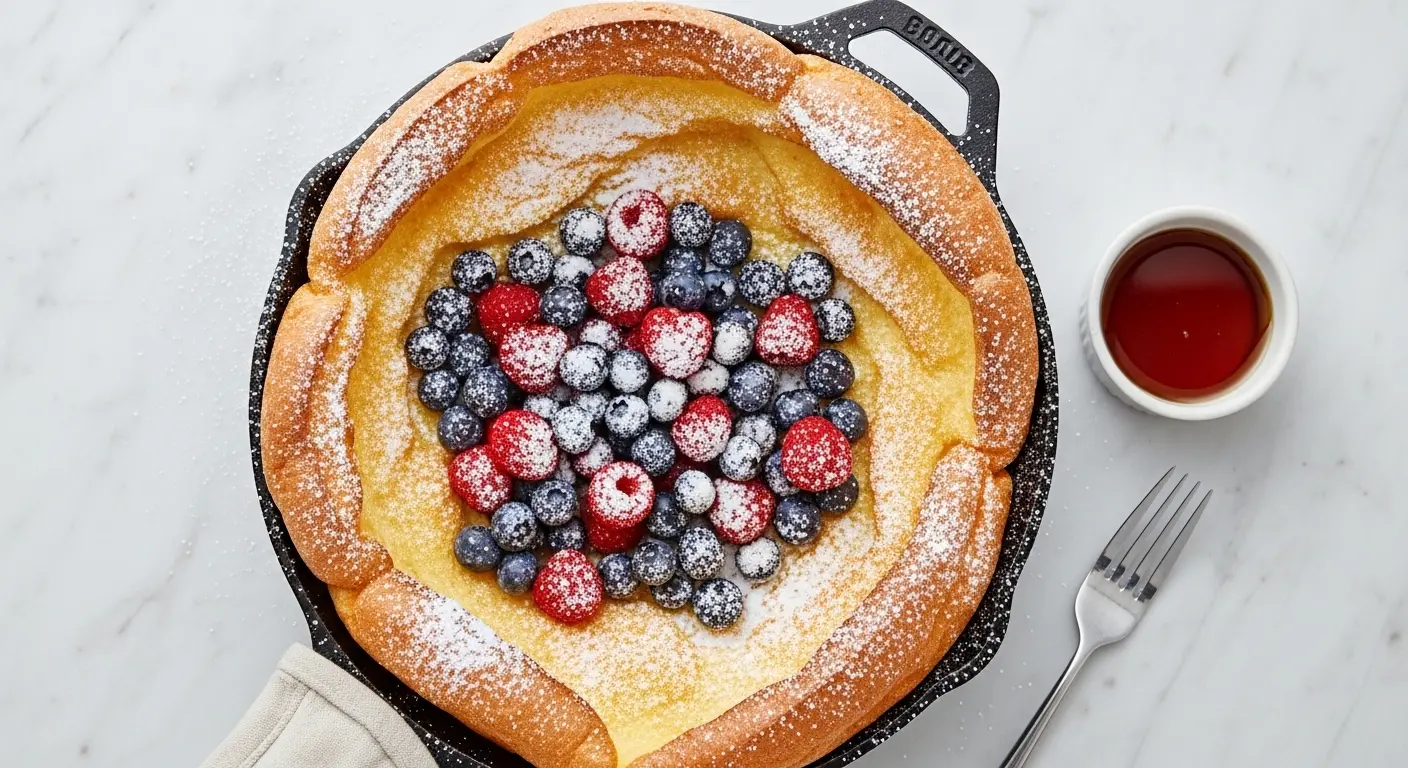
The batter is incredibly simple, but the result is nothing short of impressive. A puffy, golden, custardy pancake that puffs up dramatically around the edges and then gracefully settles into a bowl-like shape perfect for loading with toppings.
What makes this dish so special is the science behind it. There is no baking powder or leavening agent at work here. The puff comes entirely from the eggs and the steam created by the blazing hot skillet, similar to what happens with a popover or Yorkshire pudding.
The interior stays tender and almost custard-like, while the edges turn crispy and golden. You get crepe-like softness in the middle and that gorgeous, caramelized crunch on the outside all in one pan.
This recipe works just as well for a laid-back Saturday morning as it does for a holiday brunch spread when you want something that impresses your guests without spending hours in the kitchen. It comes together in about 30 minutes from start to finish, and most of that time is hands-off while the oven does all the work.
For a similarly easy and satisfying breakfast, you might also love this German Pancake Recipe which shares a lot of the same baked charm.
Why You’ll Love This Dutch Baby Recipe
This is one of those recipes that genuinely feels like a cheat code for brunch.
You blend the batter, pour it into a hot skillet, slide it in the oven, and come back to something that looks stunning. The whole thing takes less time than making a stack of traditional stovetop pancakes.
The ingredient list is laughably short. Most people already have eggs, milk, flour, butter, and vanilla in their kitchen right now.
There is virtually no skill involved once you know the two key secrets: using room temperature ingredients and preheating your skillet. Follow those two rules and you will get a dramatic puff every single time.
It is endlessly customizable. Top it with fresh berries and powdered sugar for a classic sweet version, or go savory with smoked salmon and crème fraîche. The base recipe adapts beautifully either way.
The whole family will be impressed. It looks like a soufflé, feels like a special occasion, and yet you spent about 5 minutes actually preparing it.
Here is a quick summary of why this recipe belongs in your regular rotation:
- Ready from start to finish in about 30 minutes
- Requires only 6 pantry staple ingredients
- No flipping, no standing at the stove
- Works for both sweet and savory toppings
- Naturally impressive presentation that stuns guests
- Perfect for weekends, brunch gatherings, or even breakfast for dinner
You might also enjoy making this Easy Waffle Recipe on the weekends for another easy, crowd-pleasing breakfast.
Ingredients
The standard dutch baby recipe uses a handful of everyday ingredients. The key is using the right ratios and making sure the wet ingredients are at room temperature. Cold eggs or cold milk can prevent that iconic puff.
Here is everything you need:
- 3 large eggs, at room temperature (this is non-negotiable for maximum puff)
- 1/2 cup (60g) all-purpose flour, sifted
- 1/2 cup (120ml) whole milk, at room temperature
- 1 tablespoon (12g) granulated sugar
- 1 teaspoon pure vanilla extract
- 1/4 teaspoon fine salt
- 2 tablespoons (28g) unsalted butter
For serving:
- Powdered (confectioners’) sugar, for dusting
- Fresh berries (strawberries, blueberries, raspberries)
- Maple syrup or lemon juice, to taste
Read Also: Buttermilk Pancake Recipe
Kitchen Equipment Needed
You do not need any special or expensive equipment to make a dutch baby recipe. The most important item is a proper oven-safe skillet in the right size. A 9 to 10-inch skillet is ideal because it keeps the batter concentrated enough to climb the sides and puff high.
Here is what to have ready before you start:
- 10-inch cast iron skillet (highly recommended for even heat and crispy edges; a 9-inch oven-safe skillet also works)
- Blender or large mixing bowl with a whisk
- Measuring cups and spoons
- Oven mitts (the skillet will be extremely hot)
- Spatula or butter knife for serving
- Sifter or fine-mesh strainer for the flour
- Small saucepan or microwave-safe bowl (for melting butter, if not done in the skillet)
Another favorite: Old Fashioned Pancake Recipe
Recommended Products for This Recipe
These are products I genuinely recommend based on quality and performance. They make a noticeable difference in how your dutch baby turns out.
1. Lodge 10-Inch Cast Iron Skillet
Cast iron is the gold standard for dutch baby pancakes. It holds and distributes heat more evenly than most oven-safe pans, which means the batter hits a consistently hot surface the moment you pour it in. This translates directly into a taller, more dramatic puff with those gorgeous caramelized edges.
2. Vitamix Personal Blender
A high-powered blender produces a smoother batter with no lumps. Lumpy batter can result in uneven texture and a less dramatic rise. The Vitamix blends the eggs to a frothy, aerated consistency in seconds, which actually contributes to the height of the finished pancake.
3. Nielsen-Massey Pure Vanilla Extract
Vanilla is one of only six ingredients in this recipe, so quality matters more than you might expect. Nielsen-Massey uses a cold extraction process that preserves more of the complex flavor compounds, and the difference is noticeable in a simple batter like this one.
4. OXO Good Grips Fine-Mesh Strainer
Sifting the flour before adding it to the batter prevents pockets of dry flour and helps create a more uniform, lump-free batter. This strainer is sturdy, easy to clean, and works for everything from dusting powdered sugar at the end to sifting cocoa for other baked goods.
5. Redmond Real Salt Fine Sea Salt
Salt is a flavor enhancer in baked goods. Using a high-quality, clean-tasting salt like Redmond Real Salt ensures nothing interferes with the delicate vanilla and egg flavor of your dutch baby. It is unrefined, minimally processed, and dissolves evenly into the batter.
This recipe pairs wonderfully with a side of eggs, and for another egg-based breakfast idea, check out this Shakshuka Recipe.
Step-by-Step Instructions
Step 1: Bring Your Ingredients to Room Temperature
- Remove your eggs and milk from the refrigerator at least 30 minutes before you plan to bake.
- Room temperature eggs whip to a higher volume, which directly affects how tall your dutch baby rises.
- Cold milk can cause the batter to seize slightly and prevents the eggs from blending as smoothly.
- If you are short on time, place your eggs in a bowl of warm (not hot) water for 10 minutes and warm your milk gently in the microwave for 15 to 20 seconds.
- Do not skip this step. It is the single most important trick for a dramatic, show-stopping puff.
Step 2: Preheat the Oven and Skillet
- Place your 10-inch cast iron skillet on the middle rack of your oven.
- Remove any rack above the middle position to give your dutch baby room to rise without hitting the upper rack.
- Preheat the oven to 425°F (220°C).
- Allow the skillet to heat in the oven for at least 15 to 20 minutes before you plan to pour in the batter.
- A properly preheated skillet is what creates the immediate puff. When cold batter hits a blazing hot surface, the steam activates instantly and lifts the edges dramatically.
Step 3: Make the Batter
- Place the 3 room-temperature eggs into your blender and blend on medium-high speed for about 30 to 45 seconds until the eggs are light and slightly frothy.
- Add the 1/2 cup (60g) sifted all-purpose flour, 1/2 cup (120ml) room-temperature whole milk, 1 tablespoon (12g) granulated sugar, 1 teaspoon vanilla extract, and 1/4 teaspoon fine salt.
- Blend for another 20 to 30 seconds until the batter is completely smooth and uniform. Scrape down the sides of the blender to catch any flour that sticks.
- The batter should be quite thin and pourable, similar in consistency to heavy cream. This is correct.
- If mixing by hand, whisk the flour and milk together first until completely smooth, then add the eggs, sugar, vanilla, and salt and whisk vigorously until no lumps remain.
Step 4: Rest the Batter
- Once blended, leave the batter in the blender or transfer it to a pourable measuring cup.
- Allow it to rest for 15 to 20 minutes at room temperature.
- Resting gives the flour time to fully hydrate and absorb the liquid, which results in a smoother, more tender texture and a less flour-y flavor in the final pancake.
- Do not skip the rest if you can help it. It makes a real difference in the final texture.
Step 5: Melt the Butter in the Hot Skillet
- Using oven mitts, carefully remove the preheated skillet from the oven and place it on a heat-proof surface.
- Add the 2 tablespoons (28g) of unsalted butter directly to the hot skillet.
- Swirl the skillet gently so the butter coats the entire bottom and up the sides.
- The butter will melt almost instantly and should begin to foam and bubble. This is exactly what you want.
- Act quickly. You want to add the batter before the butter begins to brown or burn.
Step 6: Pour in the Batter and Bake
- Immediately pour the rested batter into the center of the hot buttered skillet.
- Do not stir or swirl the batter. Just pour it in and let it sit.
- Carefully place the skillet back in the oven on the middle rack.
- Close the oven door and do not open it for the first 15 minutes. Opening the oven early releases steam, which can cause the pancake to deflate before it has a chance to set.
- Bake at 425°F (220°C) for 18 to 22 minutes, until the edges are puffed up dramatically, deeply golden brown, and the center looks set but still slightly tender.
- The exact time may vary depending on your oven, so begin checking at the 18-minute mark.
Step 7: Serve Immediately
- Remove the skillet from the oven using oven mitts and admire your creation. The edges should be soaring high and golden.
- Be aware that the pancake will begin to deflate within a minute or two of leaving the oven. This is completely normal and expected.
- Dust generously with powdered sugar right in the skillet.
- Scatter fresh berries over the top.
- Slice into wedges and serve directly from the skillet with maple syrup, lemon juice, or your desired toppings on the side.
- Have everyone seated at the table before you pull it from the oven so they can witness the full puffed glory.
For another impressive oven-baked breakfast, try this French Toast Casserole Recipe.
Tips for Success
A few small adjustments can make the difference between a mediocre dutch baby and a spectacular one. These are the tips that consistently produce the best results.
Keep these in mind before and during baking:
- Use room temperature eggs and milk. This is the most important tip. Cold ingredients do not blend as smoothly and result in less puff.
- Preheat your skillet for at least 15 minutes. The pan needs to be genuinely hot, not just warm. The heat shock when the batter hits the pan is what drives the initial rise.
- Use a 9- to 10-inch skillet. Larger pans spread the batter too thin. Smaller pans create the concentrated, tall walls you want.
- Do not open the oven door. Resist the urge to peek, especially in the first 15 minutes. A rush of cooler air can collapse the rise prematurely.
- Blend the batter until completely smooth. Even a few lumps of flour can result in an uneven, dense texture. Use a blender for best results.
- Rest the batter. Even 15 minutes makes a difference in the smoothness and flavor of the finished pancake.
- Serve it fast. Dutch baby pancakes deflate quickly once out of the oven. Have toppings ready and guests seated before you pull it from the oven.
Read Also: Pumpkin Pancake Recipe
Serving Suggestions
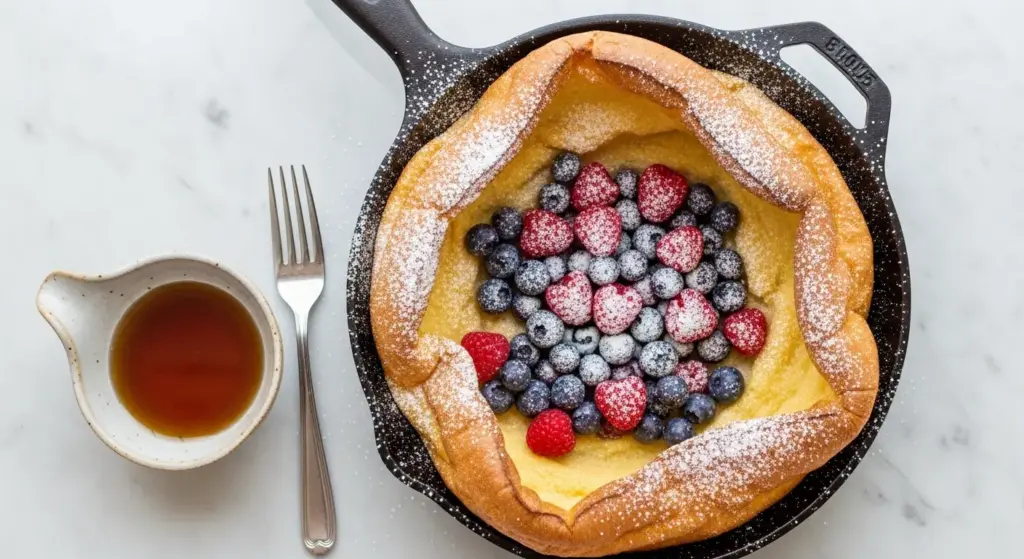
A dutch baby is a natural canvas for toppings, and it is flexible enough to go in almost any direction depending on your mood or the season.
The classic sweet combination is a generous dusting of powdered sugar, a squeeze of fresh lemon juice, and fresh berries. The tartness of the lemon cuts through the richness beautifully and highlights the delicate vanilla flavor of the pancake itself.
Here are some serving ideas to inspire you:
- Classic lemon and berry: Powdered sugar, fresh lemon juice, mixed berries
- Maple and bacon: Drizzle with warm maple syrup and serve alongside crispy bacon
- Nutella and banana: Spread a thin layer of Nutella and top with sliced banana and crushed hazelnuts
- Apple cinnamon: Sauté sliced apples in butter and brown sugar and spoon over the top
- Savory smoked salmon: Top with crème fraîche, smoked salmon, capers, and fresh dill
- Strawberry jam and whipped cream: A simple, crowd-pleasing combination that works every time
- Serve alongside Scrambled Eggs for a complete brunch spread
Variations to Try
The classic dutch baby recipe is the perfect starting point, but once you have mastered the base, the variations are endless. The simple batter adapts incredibly well to different flavor additions and topping combinations.
Here are some popular variations to explore:
- Lemon Dutch Baby: Add 1 teaspoon of fresh lemon zest to the batter and top with a squeeze of fresh lemon juice and powdered sugar after baking. The citrus amplifies the egg flavor beautifully.
- Cinnamon Apple Dutch Baby: Stir 1/2 teaspoon cinnamon and a pinch of nutmeg into the batter, and top with sautéed cinnamon apples right out of the oven.
- Savory Dutch Baby: Omit the sugar and vanilla from the batter and add a pinch of black pepper and 1/4 teaspoon garlic powder. Top with goat cheese, fresh herbs, and roasted tomatoes.
- Chocolate Dutch Baby: Add 1 tablespoon of unsweetened cocoa powder to the batter and top with whipped cream and chocolate shavings.
- Berry Dutch Baby: Scatter a small handful of fresh blueberries directly into the hot buttered skillet before pouring in the batter. They will bake right into the pancake.
- Mini Dutch Babies: Use a muffin tin instead of a skillet to make individual portions. Fill each cup about halfway and bake at 400°F (205°C) for 12 to 15 minutes.
For another versatile breakfast batter, try the Easy Crepe Recipe.
Storage and Reheating
A dutch baby is absolutely best eaten straight from the oven while it is still warm and puffy. That said, if you have leftovers they can be stored and reheated with decent results.
Here is how to store and reheat your leftovers:
- Refrigerator: Allow the dutch baby to cool completely, then cover the skillet or transfer slices to an airtight container. Refrigerate for up to 2 days.
- Freezer: Wrap individual slices tightly in plastic wrap and then in aluminum foil. Freeze for up to 1 month.
- Reheating in the oven: Place leftover slices on a baking sheet in a 300°F (150°C) oven for 5 to 8 minutes. This is the best way to restore some of the crispiness to the edges.
- Reheating in a pan: Warm slices in a non-stick pan over medium-low heat for 2 to 3 minutes per side.
- Microwave: This works in a pinch but will make the edges soft rather than crispy. Heat in 30-second intervals until warmed through.
- Important note: Do not expect a reheated dutch baby to re-puff. The dramatic rise is a one-time event. Leftovers will taste good but will have a flat, crepe-like texture.
For another easy make-ahead breakfast, try this Baked Oatmeal Recipe.
Nutritional Facts
The following values are approximate, based on 4 servings from one standard dutch baby recipe made with whole milk and unsalted butter. Toppings like powdered sugar, fruit, and syrup are not included in these numbers.
| Nutrient | Per Serving (1/4 of recipe) |
|---|---|
| Calories | ~210 kcal |
| Total Fat | 10g |
| Saturated Fat | 5g |
| Cholesterol | 160mg |
| Sodium | 190mg |
| Total Carbohydrates | 22g |
| Dietary Fiber | 0.5g |
| Total Sugars | 4g |
| Protein | 8g |
| Calcium | 80mg |
| Iron | 1.5mg |
Nutritional values are estimates and may vary based on exact ingredients, brands, and portion sizes used. For precise values, calculate using your specific ingredients with a nutrition calculator.
You might also enjoy the Egg Bake Recipe for another protein-rich breakfast option with a similar nutritional profile.
Health Benefits of Key Ingredients
While a dutch baby recipe is primarily a comfort food, several of its core ingredients bring genuine nutritional value to the table.
The protein and nutrients packed into this simple recipe make it a more nourishing breakfast than it might initially appear.
Here is a look at the key ingredients and what they bring:
- Eggs: One of the most nutrient-dense foods available. A single egg provides high-quality complete protein, choline for brain health, vitamins B12 and D, and antioxidants like lutein and zeaxanthin that support eye health. The 3 eggs in this recipe give you a strong protein foundation for the day.
- Whole milk: Provides calcium, phosphorus, and vitamin D essential for bone health. Full-fat dairy also contains conjugated linoleic acid (CLA) and fat-soluble vitamins A and D that are absorbed more effectively alongside dietary fat.
- All-purpose flour: While not a superfood, it provides carbohydrates for energy and a small amount of iron and B vitamins. For a fiber and nutrient boost, substituting up to half the flour with whole wheat flour is an easy upgrade.
- Butter: Contains fat-soluble vitamins A, D, E, and K2, as well as butyrate, a short-chain fatty acid that supports gut health. In moderation, butter from quality sources is a valuable part of a balanced diet.
- Vanilla extract: Beyond flavor, pure vanilla contains small amounts of antioxidants and vanillin, which has been studied for its anti-inflammatory properties.
For another nutritious and satisfying morning meal, the Avocado Toast Recipe is a great complement to your breakfast repertoire.
Frequently Asked Questions
1. Why did my dutch baby not puff up?
The most common reason a dutch baby fails to puff is either cold ingredients or an insufficiently preheated skillet. Make sure your eggs and milk have been sitting at room temperature for at least 30 minutes before you blend the batter.
Your skillet also needs to be truly hot, not just warm. Preheat it in a 425°F oven for at least 15 to 20 minutes before adding the butter and batter. Another common culprit is opening the oven door too early, which lets heat and steam escape before the batter has a chance to set.
2. Can I make the batter ahead of time?
Yes, you can make the batter up to 24 hours in advance. Transfer it to an airtight container and refrigerate until you are ready to bake.
There is no need to bring it back to room temperature before baking since the skillet will be so hot it will not matter much. Give the batter a quick stir before pouring to recombine any settled ingredients.
3. What size skillet is best for a dutch baby?
A 9- to 10-inch skillet is the sweet spot for the standard 3-egg recipe. A pan that is too large spreads the batter too thin, resulting in a flatter pancake with less dramatic puffing and fewer of those tall, crunchy edges.
If you are scaling up to serve more people, use a 12-inch skillet and increase the batter proportionally. Individual mini dutch babies can also be made in a standard muffin tin.
4. Do I need a cast iron skillet or can I use something else?
Cast iron is ideal because it holds and distributes heat evenly, but it is not strictly required. Any oven-safe skillet, including stainless steel, carbon steel, or an oven-safe nonstick pan, will work.
Avoid glass baking dishes and ceramic bakeware. These do not conduct heat well enough to create the right conditions for a high puff. A metal pie plate is actually a surprisingly good alternative if that is what you have on hand.
5. Can I make a savory dutch baby with this batter?
Absolutely. To make a savory version, simply omit the sugar and vanilla from the base batter and add a pinch of black pepper and a small amount of garlic powder or dried herbs if you like.
Top the baked dutch baby with ingredients like smoked salmon and crème fraîche, sautéed mushrooms and gruyère, bacon and chives, or roasted cherry tomatoes and fresh basil. The savory version is equally impressive and makes an excellent light dinner or brunch centerpiece.
Read Also: Breakfast Skillet Recipe
Final Thoughts
A good dutch baby recipe is one of those kitchen staples that earns its place in your regular rotation almost immediately after you make it the first time.
It is fast, it is forgiving, and it is genuinely impressive with minimal effort. Whether you dress it up with lemon curd and seasonal berries or keep it simple with a dusting of powdered sugar, it delivers every single time.
The keys are simple: room temperature ingredients, a properly preheated cast iron skillet, and the patience to keep the oven closed while it works its magic.
Give it a try this weekend and see for yourself why so many people consider this one of the best things to come out of a home oven. Once you make it, you will want to make it again and again.
Drop a comment below and let me know what toppings you tried! And if you share your dutch baby on social media, tag us so we can see your beautiful creation.
Recommended:
- German Pancake Recipe
- Easy Waffle Recipe
- Belgian Waffle Recipe
- Cracker Barrel Pancake Recipe
- Basic Crepe Recipe
- Easy French Toast Recipe
- Breakfast Casserole Recipe
- Egg Bites Recipe
- Gluten Free Pancake Recipe
- Easy Protein Pancakes Recipe