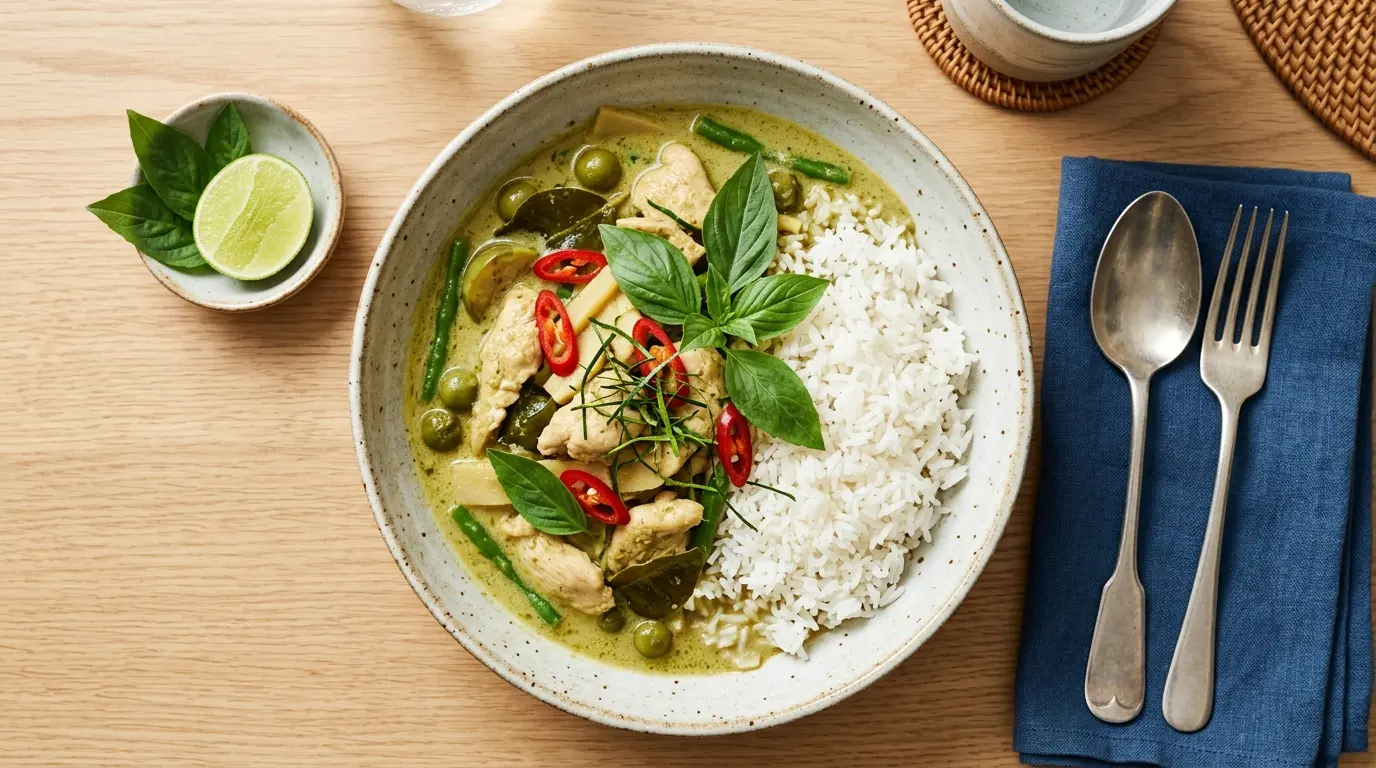
If you’ve been craving a bowl of deeply fragrant, restaurant-quality Thai Green Curry Chicken Recipe, you’re in the right place. This dish is a Central Thai classic known as gaeng kiew waan gai (แกงเขียวหวานไก่), and it’s everything you want in a weeknight dinner: boldly spiced, creamy from full-fat coconut milk, tender with juicy chicken thighs, and ready in about 35 minutes.
The secret to a great green curry isn’t complicated equipment or rare skills. It’s understanding a few key techniques: frying the curry paste until fragrant to unlock its full aroma, using full-fat coconut milk for that lush, silky sauce, and finishing with fresh Thai basil and a splash of fish sauce to balance everything out.
This recipe uses store-bought green curry paste as its base, which is what most home cooks rely on. With a few simple tricks to enhance the paste’s flavor, you’ll get a curry that tastes like it came from a proper Thai kitchen. Chicken thighs are the protein of choice here because they stay tender and juicy even after simmering, absorbing all those incredible flavors beautifully.
Keep reading for every tip, trick, and step you need to nail this recipe on the very first try.
You might also enjoy this Thai Red Curry Chicken for another vibrant, coconut-based Thai classic.

Why You’ll Love This Thai Green Curry Chicken Recipe
This is the kind of recipe that makes you wonder why you ever ordered takeout. Once you taste a homemade green curry made with quality paste and fresh aromatics, you’ll be hooked.
It comes together in about 35 minutes, which makes it completely realistic for a Tuesday night. The hands-on prep is minimal once your ingredients are cut and ready.
The flavor profile is absolutely stunning. You get heat from the green chilies in the paste, savory depth from fish sauce, subtle sweetness from coconut milk and a touch of palm sugar, and a bright, citrusy lift from kaffir lime leaves.
Chicken thighs are forgiving and nearly impossible to overcook in this sauce. If you slightly lose track of the simmering time, the thighs stay tender rather than drying out like chicken breast might.
It’s naturally gluten-free and dairy-free. This makes it a great option for guests with dietary restrictions, without any special swaps required.
The dish is endlessly customizable. You can add Thai eggplant, bamboo shoots, snow peas, zucchini, or baby spinach to bulk it up and tailor it to what you have on hand.
Leftovers taste even better the next day. Like most curries, the flavors deepen and meld overnight in the fridge.
It’s a crowd-pleaser across all spice tolerance levels. You can dial the heat up or down simply by adjusting the amount of curry paste you use.
Read Also: Coconut Curry Chicken Recipe
Ingredients
Getting the right ingredients makes all the difference in this recipe. A few specialty items are worth seeking out at an Asian grocery store or ordering online for the most authentic result.
- 1.5 lbs (680g) boneless skinless chicken thighs, cut into bite-sized pieces
- 2 tablespoons Thai green curry paste (Maeploy or Aroy-D recommended)
- 1 can (13.5 fl oz / 400ml) full-fat coconut milk
- 1 cup (240ml) unsalted chicken broth
- 1 stalk lemongrass, bruised and cut into 2-inch pieces
- 3 cloves garlic, minced
- 1 teaspoon fresh ginger or galangal, finely grated
- 5-6 kaffir lime leaves, torn (fresh or dried)
- 1 cup (about 6 oz / 170g) Thai eggplant, cut into wedges (or Japanese eggplant)
- 1 medium red bell pepper, julienned
- 1 cup (90g) snow peas or baby spinach
- 2 tablespoons fish sauce
- 1 teaspoon palm sugar or light brown sugar
- 1 cup loosely packed fresh Thai basil leaves
- 1 tablespoon coconut oil or vegetable oil
- Steamed jasmine rice, for serving
- Fresh Thai basil, sliced red chili, and lime wedges, for garnish
Read Also: Indian Curry Chicken Recipe
Kitchen Equipment Needed
You don’t need a lot of specialized tools to make this recipe. A good heavy-bottomed skillet or wok is really the most important item for even heat and easy sauteing.
- Large wok or deep skillet (12-inch or larger)
- Sharp chef’s knife and cutting board
- Wooden spoon or silicone spatula
- Measuring cups and spoons
- Can opener
- Ladle (for serving)
- Medium saucepan (for cooking rice)
Read Also: Chicken Stir Fry Recipe
Recommended Products for This Recipe
These are products I genuinely recommend based on how much of a difference they make to the final dish. Using quality ingredients and the right equipment takes this curry from good to absolutely outstanding.
1. Maeploy Thai Green Curry Paste
This is widely considered the gold standard of store-bought Thai curry pastes by food professionals and Thai cooking experts alike. It delivers a bold, fragrant punch without artificial filler flavors, and a 4-tablespoon serving gives you a beautifully complex base. It stores well in the fridge after opening.
2. Aroy-D Full Fat Coconut Milk (Paper Carton)
The coconut milk you use has a massive impact on the richness of your curry sauce. The Aroy-D brand in the paper carton is consistently thick and creamy, with a true coconut flavor that canned versions often lack. It doesn’t have the metallic aftertaste that some canned products carry.
3. Thai Holy Basil or Thai Basil (Dried)
Thai basil has a distinct anise-forward flavor that’s quite different from Italian basil, and it’s what gives green curry its authentic aromatic finish. If you can’t find it fresh locally, a high-quality dried version works well in a pinch.
4. Carbon Steel Wok (14-inch)
A well-seasoned carbon steel wok conducts heat faster and more evenly than a regular skillet, which is ideal for frying the curry paste correctly. The high sides also prevent splashing when you add the coconut milk. It’s a versatile kitchen investment that you’ll use constantly.
5. Kaffir Lime Leaves (Dried)
Fresh kaffir lime leaves can be hard to find outside of Asian grocery stores. Dried ones are a reliable pantry staple that still deliver that distinctive citrus note essential to authentic Thai curries. Keep a bag on hand and you can make this curry any time the craving hits.
Another great option to keep in your Asian pantry rotation is this Mango Chutney, which pairs brilliantly alongside curry dishes.

Step-by-Step Instructions
Step 1: Prep All Your Ingredients Before You Start Cooking
- Cut your chicken thighs into roughly 1.5-inch (4cm) bite-sized pieces. Uniform sizing ensures everything cooks at the same rate.
- If using Thai eggplant, cut it into wedges and place it in a bowl of cold water to prevent browning. Drain right before using.
- Julienne the red bell pepper into thin strips, about 2 inches (5cm) long.
- Trim the snow peas and set aside along with the baby spinach if using.
- Mince the garlic and grate the fresh ginger or galangal finely.
- Bruise the lemongrass stalk by smashing it with the flat side of your knife, then cut it into 2-inch (5cm) sections. This releases all the essential oils.
- Tear the kaffir lime leaves roughly in half to help release their aroma into the sauce.
- Measure out the fish sauce, palm sugar, and curry paste so everything is ready to go. Thai cooking moves quickly once the heat is on.
Step 2: Fry the Curry Paste to Build Deep Flavor
- Heat your wok or deep skillet over medium heat. Add 1 tablespoon of coconut oil or vegetable oil.
- Once the oil is shimmering, add the green curry paste to the skillet.
- Use a wooden spoon or spatula to stir the paste constantly and press it against the pan.
- Fry the paste for about 2 to 3 minutes. You’ll notice the paste becomes fragrant and starts to darken very slightly. This step is non-negotiable: frying the paste in fat activates fat-soluble flavor compounds that you simply can’t achieve by adding it directly to liquid.
- Add the minced garlic and grated ginger (or galangal) to the paste. Stir together for another 30 seconds until fragrant.
Step 3: Sear the Chicken Pieces
- Add the chicken pieces directly to the curry paste mixture in the wok.
- Spread the pieces out so as many surfaces as possible make contact with the hot pan.
- Cook for 2 to 3 minutes without stirring to get a light sear on the chicken. This adds a layer of savory, caramelized flavor to the meat.
- Stir and toss the chicken to coat it thoroughly with the curry paste. Cook for another 1 to 2 minutes, stirring occasionally, until the chicken is mostly opaque on the outside. It doesn’t need to be fully cooked through at this stage; it will finish cooking in the sauce.
Step 4: Add the Lemongrass and Broth
- Add the bruised lemongrass pieces to the wok.
- Pour in the cup of chicken broth and stir everything together, scraping up any paste stuck to the bottom of the pan.
- Bring the mixture to a gentle simmer over medium heat.
- Let it simmer for about 3 minutes. This allows the lemongrass to begin infusing its citrusy, floral aroma into the broth.
Step 5: Add the Coconut Milk and Kaffir Lime Leaves
- Pour in the full can of coconut milk. If the coconut cream has separated at the top of the can, that’s perfectly normal — just add all of it.
- Add the torn kaffir lime leaves to the pan and stir everything together.
- Bring the curry back up to a gentle simmer. Do not let it boil aggressively, as this can break the sauce and make it look grainy.
- Stir occasionally and let the sauce simmer for 5 minutes. You’ll notice the sauce turning a beautiful golden-green color and smelling absolutely incredible.
Step 6: Add the Eggplant and Harder Vegetables
- Add the drained Thai eggplant (or Japanese eggplant) and the julienned red bell pepper to the curry.
- Stir gently to submerge the vegetables in the sauce.
- Continue simmering over medium-low heat for 8 to 10 minutes. The eggplant should be completely tender and almost creamy when you cut into a piece. The bell pepper should be softened but still have a little bit of color.
- Check the chicken pieces: they should be fully cooked through with no pink remaining. If you have thicker pieces, add 2 to 3 more minutes of simmering time.
Step 7: Season with Fish Sauce and Sugar
- Stir in the 2 tablespoons of fish sauce and 1 teaspoon of palm sugar (or light brown sugar).
- Taste the curry carefully. The flavor balance should be savory, slightly sweet, and bright with citrus. If it tastes too salty, add a tiny pinch more sugar. If it lacks depth, add a little more fish sauce, half a teaspoon at a time.
- For extra heat, add a sliced fresh green or red chili at this point.
Step 8: Add the Snow Peas and Thai Basil
- Add the snow peas (or baby spinach) to the curry. These quick-cooking vegetables only need 1 to 2 minutes in the sauce; overcooking them makes them mushy and dull-colored.
- Turn the heat off or reduce to the lowest setting.
- Add the fresh Thai basil leaves and stir them through. The residual heat will gently wilt them without destroying their flavor. Thai basil loses its brightness quickly over high heat, so add it last.
- Remove and discard the lemongrass pieces before serving; they’re very fibrous and not pleasant to eat.
Step 9: Serve and Garnish
- Spoon the Thai green curry chicken generously over steamed jasmine rice in individual bowls.
- Garnish with extra fresh Thai basil leaves, a few slices of fresh red chili if you like it spicier, and a lime wedge on the side for squeezing over the top.
- Serve immediately while the curry is hot and fragrant.
This dish also pairs wonderfully as part of a spread with a side of Chicken Pad Thai for a full Thai-inspired feast.
Tips for Success
A few smart moves at the right moments make a big difference between a good curry and a genuinely great one. Keep these in mind from the very start.
- Use full-fat coconut milk. Low-fat versions result in a thin, watery sauce that lacks the richness and flavor depth that makes this dish so satisfying. Full-fat is non-negotiable.
- Don’t rush frying the paste. Those 2 to 3 minutes in the oil are what transform raw curry paste into something deeply aromatic and complex. Skipping or shortening this step is the single biggest mistake home cooks make.
- Use chicken thighs over chicken breasts. Thighs have more intramuscular fat, which keeps them tender during simmering. If you want to use breast meat, cut it thin and reduce the simmering time to avoid dryness.
- Taste and adjust at the end. Every brand of curry paste has a different saltiness and heat level. Always taste the finished curry before serving and balance with more fish sauce, sugar, or a squeeze of lime juice as needed.
- Add delicate ingredients last. Thai basil, spinach, and snow peas go in during the final 1 to 2 minutes. They lose their color and texture quickly if overcooked.
- Bruise your lemongrass properly. A firm smash with the flat of a knife releases the essential oils locked inside the stalk. Without this, you’ll barely taste it in the finished dish.
- Keep the simmer gentle. A vigorous boil can cause the coconut milk to separate, resulting in a greasy-looking sauce. Medium-low heat and a gentle simmer give you that beautiful, velvety consistency.
For another fantastic Asian-inspired chicken dish to add to your weeknight rotation, try this Chicken Lo Mein.
Serving Suggestions
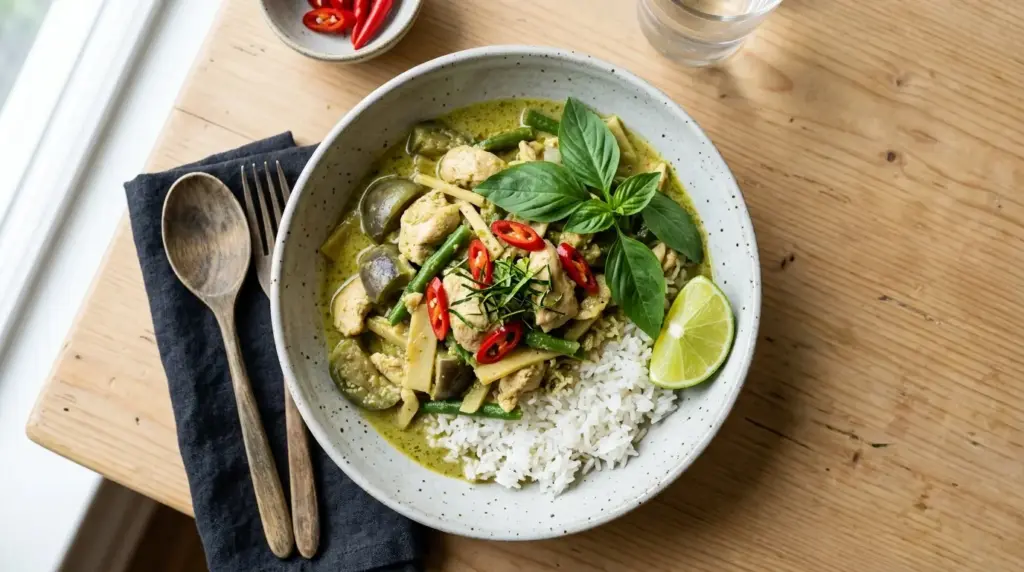
Thai green curry chicken is a complete meal on its own, but pairing it thoughtfully takes the experience to the next level.
Steamed jasmine rice is the traditional accompaniment and the perfect base for soaking up all that gorgeous sauce. The fragrant, slightly sticky grains complement the bold curry flavors perfectly.
- Serve over Jasmine or Basmati Rice for the most authentic pairing
- Pair with warm Garlic Naan Bread for scooping up the sauce
- Serve alongside a simple cucumber salad dressed with rice vinegar and sesame oil for a refreshing contrast
- Add a side of Chicken Fried Rice if you’re feeding a larger group
- Garnish with toasted coconut flakes and a sprinkle of sesame seeds for added texture
- Offer a small bowl of sliced fresh chilies in fish sauce for guests who want extra heat at the table
- Serve with a cool Cucumber Raita on the side to balance the spice
For more coconut-based inspiration, take a look at these Chicken Pad Thai ideas to round out your Thai-inspired dinner spread.
Variations to Try
Once you have the base recipe down, the variations are nearly endless. This curry sauce is an incredibly versatile foundation.
- Shrimp Green Curry: Swap the chicken thighs for large shrimp. Add the shrimp in the final 3 minutes of cooking; they cook extremely quickly and turn rubbery if overdone.
- Vegetarian Green Curry: Omit the chicken and use firm tofu cubed into 1-inch pieces. Use vegetable broth and substitute soy sauce for the fish sauce. Load it up with extra eggplant, zucchini, and bell peppers.
- Beef Green Curry: Use thinly sliced beef sirloin or flank steak in place of chicken. The simmering time will be shorter — about 4 to 5 minutes total once added to the sauce.
- Extra Spicy Version: Fry 2 to 3 sliced fresh Thai green or bird’s eye chilies with the curry paste for a serious heat boost.
- Pumpkin Green Curry: Add cubed butternut squash or kabocha pumpkin along with the eggplant. The squash adds a wonderful sweetness that balances the heat beautifully.
- Bamboo Shoot Green Curry: This is a very traditional add-in. Use canned bamboo shoots, drained and rinsed well. They add a pleasant crunch and absorb the curry flavors wonderfully.
- Creamy Spinach Version: Skip the eggplant and stir in two large handfuls of baby spinach at the end for a quicker, greens-forward version.
You might also love the bold, aromatic flavors in this Chicken Vindaloo if you enjoy curries with serious depth and spice.
Storage and Reheating
Thai green curry stores incredibly well and arguably improves with time as the flavors meld and deepen overnight.
- Refrigerator: Transfer the cooled curry to an airtight container. It keeps well in the fridge for up to 4 days. Store the rice separately to prevent it from absorbing all the sauce.
- Freezer: Green curry freezes beautifully for up to 3 months. Allow it to cool completely before transferring to a freezer-safe container or zip-lock bag. Thaw overnight in the refrigerator before reheating.
- Reheating on the stovetop: Pour the curry into a saucepan over medium-low heat. Stir occasionally and add a small splash of coconut milk or broth if the sauce has thickened too much during storage. Heat until gently simmering throughout.
- Reheating in the microwave: Transfer a portion to a microwave-safe bowl, cover loosely with a plate or microwave-safe wrap, and heat in 60-second intervals, stirring between each. This is the quickest method but can slightly change the texture of the chicken.
- Do not freeze with rice: Always store and freeze the curry and rice separately for best results.
Read Also: Chicken Curry Recipe
Nutritional Facts
The following values are estimates per serving (approximately 1.5 cups of curry, not including rice), based on 4 servings from this recipe. Exact values will vary based on the specific brands of coconut milk and curry paste used.
| Nutrient | Per Serving |
|---|---|
| Calories | ~480 kcal |
| Total Fat | 35g |
| Saturated Fat | 22g |
| Protein | 30g |
| Carbohydrates | 14g |
| Dietary Fiber | 3g |
| Sugar | 6g |
| Sodium | 890mg |
| Potassium | 680mg |
| Vitamin A | 2,200 IU |
| Vitamin C | 35mg |
| Iron | 4mg |
Note: These values are approximate. For the most precise nutritional information, input your exact ingredients into a nutrition calculator tool.
Another protein-packed Asian-inspired dish worth adding to your week is this Chicken Teriyaki.
Health Benefits of Key Ingredients
Thai green curry isn’t just a flavor powerhouse — many of its core ingredients bring meaningful nutritional benefits to the table as well.
This dish is built on a foundation of whole, minimally processed ingredients, which makes it a genuinely nourishing meal despite its indulgent flavor profile.
- Coconut milk contains medium-chain triglycerides (MCTs), a type of fat that the body metabolizes differently than long-chain fats, potentially providing a quicker energy source.
- Ginger and galangal are both rhizomes in the same botanical family. They have well-documented anti-inflammatory properties and have long been used in traditional Thai and Ayurvedic medicine to support digestion.
- Kaffir lime leaves are rich in antioxidants and have been studied for antimicrobial properties. They also contain a range of beneficial phytonutrients.
- Thai basil is a good source of vitamin K, vitamin A, and manganese. It also contains essential oils like linalool and eugenol that have anti-inflammatory and antimicrobial effects.
- Lemongrass has been used in traditional medicine for its antioxidant content and potential benefits for digestive health.
- Chicken thighs are an excellent source of high-quality protein, B vitamins (especially niacin and B6), and minerals including zinc, selenium, and phosphorus.
- Thai eggplant is low in calories and a good source of dietary fiber, folate, and potassium.
- Red bell pepper adds a significant dose of vitamin C — a single cup provides more than 100% of the daily recommended intake.
For another comforting and flavorful chicken dish with aromatic spices, this Chicken Korma is one to bookmark.
Frequently Asked Questions
1. Can I use green curry paste from a jar, and which brand is best?
Absolutely. Store-bought green curry paste works beautifully in this recipe and is what most home cooks use every day. The two most recommended brands among Thai cooking experts are Maeploy and Aroy-D. Maeploy is slightly more robustly flavored and spicier, while Aroy-D is a bit milder and more aromatic. Avoid Thai Kitchen brand, which tends to be milder and less complex than the others.
2. How spicy is Thai green curry, and how can I adjust the heat level?
Green curry is typically considered moderately spicy, similar to or slightly hotter than red curry. The heat comes primarily from the fresh green chilies in the curry paste. To make it milder, use less curry paste and add a touch more coconut milk and sugar. To turn up the heat, add extra sliced fresh green or bird’s eye chilies when you fry the paste.
3. Can I use chicken breast instead of chicken thighs?
Yes, but the method changes slightly. Cut chicken breast into thin slices rather than chunks, and marinate them in 1 tablespoon of fish sauce for 15 minutes before cooking. Add the breast meat only after the sauce is simmering, and cook for just 4 to 5 minutes. Breast meat dries out quickly, so shorter cooking time and thin slicing are key to keeping it tender.
4. What can I substitute for kaffir lime leaves?
Kaffir lime leaves have a unique citrusy, floral flavor that is genuinely hard to replicate exactly. Your best substitute is to add the zest of one lime to the sauce along with a small piece of fresh lemongrass. Lime zest won’t perfectly duplicate the flavor, but it adds a similar bright, citrus note that works well in a pinch.
5. What vegetables work best in Thai green curry?
The most traditional vegetables are Thai eggplant, bamboo shoots, and winter melon. Widely available and equally delicious options include zucchini, snow peas, baby spinach, red or yellow bell peppers, broccoli florets, and baby bok choy. Choose vegetables that hold up to simmering without turning mushy, and add softer vegetables like spinach or snow peas only in the last 1 to 2 minutes.
For a beautiful Thai-inspired noodle dish to serve alongside this curry, this Chicken Pad Thai is a wonderful pairing option.

Thai Green Curry Chicken (Gaeng Kiew Waan Gai)

Equipment
- Large wok or deep skillet (12-inch or larger)
- Sharp chef's knife
- Cutting board
- Wooden spoon or silicone spatula
- Measuring cups and spoons
- Can opener
- Ladle - For serving
- Medium saucepan - For cooking rice
Ingredients
- 1.5 lbs boneless skinless chicken thighs - 680g, cut into bite-sized pieces
- 2 tablespoons Thai green curry paste - Maeploy or Aroy-D recommended
- 1 can full-fat coconut milk - 13.5 fl oz / 400ml
- 1 cup unsalted chicken broth - 240ml
- 1 stalk lemongrass - bruised and cut into 2-inch pieces
- 3 cloves garlic - minced
- 1 teaspoon fresh ginger or galangal - finely grated
- 5-6 kaffir lime leaves - torn, fresh or dried
- 1 cup Thai eggplant - about 6 oz / 170g, cut into wedges, or Japanese eggplant
- 1 medium red bell pepper - julienned
- 1 cup snow peas or baby spinach - 90g
- 2 tablespoons fish sauce
- 1 teaspoon palm sugar or light brown sugar
- 1 cup fresh Thai basil leaves - loosely packed
- 1 tablespoon coconut oil or vegetable oil
- steamed jasmine rice - for serving
For Garnish
- fresh Thai basil leaves - for garnish
- sliced red chili - for garnish
- lime wedges - for garnish
Instructions
- Prep all ingredients: cut chicken into 1.5-inch pieces, cut eggplant into wedges and place in water, julienne bell pepper, trim snow peas, mince garlic, grate ginger, bruise lemongrass, tear lime leaves, and measure out fish sauce, sugar, and curry paste.
- Heat wok over medium heat and add 1 tablespoon coconut oil. Fry green curry paste for 2-3 minutes, stirring constantly, until fragrant and slightly darkened. Add garlic and ginger and stir for 30 seconds.
- Add chicken pieces to the wok and cook for 2-3 minutes without stirring to get a light sear. Stir and toss to coat with paste, cooking another 1-2 minutes until chicken is mostly opaque on the outside.
- Add bruised lemongrass and chicken broth to the wok. Bring to a gentle simmer and cook for about 3 minutes to infuse the lemongrass flavor.
- Pour in the full can of coconut milk and add the torn kaffir lime leaves. Bring back to a gentle simmer and cook for 5 minutes, stirring occasionally, until the sauce turns golden-green.
- Add drained eggplant and julienned red bell pepper. Continue simmering over medium-low heat for 8-10 minutes until eggplant is tender and creamy and chicken is fully cooked.
- Stir in fish sauce and palm sugar. Taste and adjust seasoning, adding more fish sauce, sugar, or a squeeze of lime as needed. Add sliced chili for extra heat.
- Add snow peas (or spinach) and cook for 1-2 minutes until just tender. Turn off heat and stir through fresh Thai basil leaves. Remove and discard lemongrass pieces before serving.
- Spoon curry generously over steamed jasmine rice. Garnish with additional Thai basil, sliced red chili, and lime wedges. Serve immediately while hot.
Notes
- Full-fat coconut milk is essential: Low-fat versions will result in a thin, watery sauce. Full-fat gives you that lush, silky texture.
- Don’t rush frying the paste: That 2-3 minutes of frying in oil is what activates all the flavor compounds and makes the curry deeply aromatic.
- Chicken thighs stay tender: They have more fat than breasts and stay juicy even after simmering. If using breast, slice it thinly and reduce simmer time to 4-5 minutes.
- Bruise your lemongrass: Smash the stalk with the flat side of your knife to release essential oils, otherwise you’ll barely taste it.
- Keep the simmer gentle: A rolling boil can cause the coconut milk to separate, giving you a greasy-looking sauce. Medium-low heat is your friend.
- Delicate ingredients go in last: Thai basil, spinach, and snow peas should only cook for 1-2 minutes at the very end to preserve color and texture.
- Taste and adjust: Every brand of curry paste has different salt and heat levels. Taste before serving and balance with more fish sauce, sugar, or lime juice.
- Storage: Refrigerate curry in an airtight container for up to 4 days. Freeze for up to 3 months (store rice separately). Leftovers taste even better the next day!
Final Thoughts
Thai Green Curry Chicken is one of those recipes that absolutely earns a permanent spot in your weekly rotation. It’s quick enough for a weeknight, impressive enough for guests, and so deeply satisfying that you’ll crave it on repeat.
The key is leaning into the ingredients: real full-fat coconut milk, quality curry paste, and that critical step of frying the paste in oil before adding anything else. Those small decisions make a big difference in the final bowl.
Give this recipe a try this week and let me know how it turns out in the comments below! If you love this dish or have your own favorite twist on green curry, share it — I’d genuinely love to hear from you.
Recommended:
- Chicken Biryani
- Chicken Tikka Masala
- Jamaican Curry Chicken
- Chicken Shawarma
- Palak Paneer
- Mulligatawny Soup
- Easy Pad Thai
- Chicken Saag
- Peanut Sauce
- Hoisin Sauce