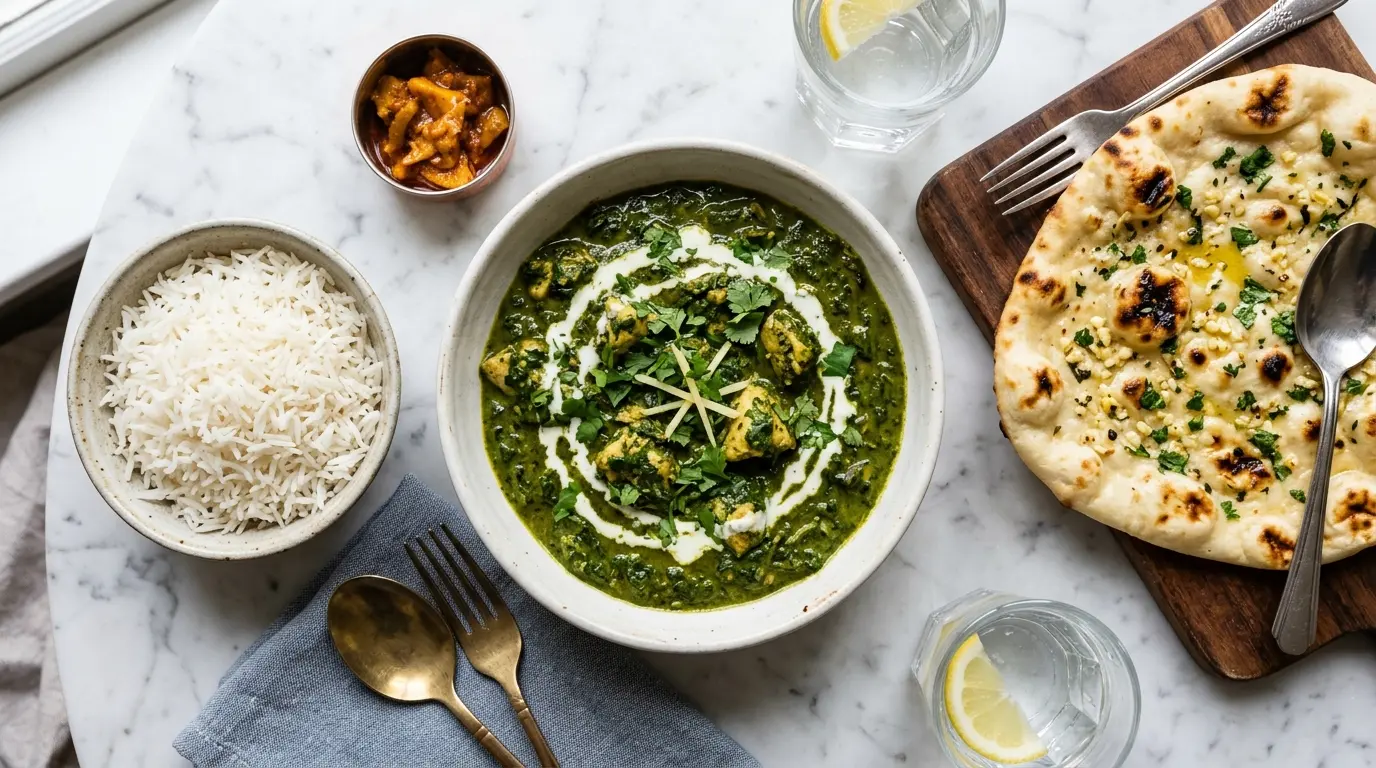
If you’ve ever sat down at an Indian restaurant and ordered a bowl of chicken saag recipe and felt like the whole world just got a little warmer, this post is for you.
This dish, a velvety spinach curry loaded with tender chicken and fragrant spices, is one of those meals that feels both indulgent and nourishing at the same time.
The magic of chicken saag lies in how something so simple, wilted spinach blended with aromatics, transforms into a deeply complex, restaurant-quality sauce.
The spice blend is what does the heavy lifting here. A combination of garam masala, turmeric, cumin, coriander, and a touch of cayenne creates that signature golden-green sauce that clings beautifully to every piece of chicken.
This recipe uses bone-in technique inspiration but delivers a faster, weeknight-friendly result using boneless chicken thighs. Thighs are preferred over breasts here because they stay juicy and tender even after simmering in the sauce for 20 minutes.
Whether it’s your first time cooking Indian food at home or your hundredth, this recipe is approachable, deeply satisfying, and virtually foolproof.
You might also enjoy: Chicken Tikka Masala Recipe

Why You’ll Love This Chicken Saag Recipe
This dish checks every box for a truly great weeknight dinner.
It is rich and creamy without being heavy, and the spinach base makes it feel genuinely nutritious rather than indulgent guilt.
The spice profile is bold but not overwhelming, making it a crowd-pleaser even for family members who shy away from very spicy food.
Everything comes together in a single pan, which means fewer dishes and more time to actually enjoy your meal.
The flavors deepen beautifully as the dish sits, making leftovers the next day even better than the original.
Here is why readers keep making this again and again:
- Packed with flavor from a classic blend of Indian spices
- Made with accessible, supermarket-friendly ingredients
- Ready in under an hour from start to finish
- Naturally gluten-free and easy to adapt for dairy-free diets
- Works beautifully for meal prep and freezes exceptionally well
- Pairs with rice, naan, or flatbread for a complete, satisfying meal
This Palak Paneer Recipe uses the same spinach base if you want a vegetarian companion dish to round out your Indian dinner spread.
Ingredients
A good chicken saag does not require a long grocery run. Most of what you need is already in your pantry, with just a few fresh ingredients to pick up.
The spinach is the star, so use the freshest baby spinach you can find, or substitute frozen spinach that has been fully thawed and squeezed dry for equally great results.
- 2 lbs (900g) boneless, skinless chicken thighs, cut into 1.5-inch chunks
- 10 oz (280g) fresh baby spinach (or 1 x 10oz frozen spinach package, thawed and squeezed dry)
- 1 large yellow onion, finely diced
- 4 cloves garlic, minced
- 1 tablespoon fresh ginger, grated (about a 1-inch piece)
- 1 large tomato, roughly chopped (or 1/2 cup canned crushed tomatoes)
- 2 tablespoons ghee (or neutral oil)
- 1/2 cup (120ml) heavy cream
- 1/4 cup (60g) full-fat plain yogurt
- 1 teaspoon garam masala
- 1 teaspoon ground cumin
- 1 teaspoon ground coriander
- 1 teaspoon turmeric powder
- 1/2 teaspoon Kashmiri chili powder (or cayenne pepper for more heat)
- 1 tablespoon kasoori methi (dried fenugreek leaves), crushed between palms
- 1 teaspoon kosher salt, plus more to taste
- 1/2 cup (120ml) water
- Fresh cilantro, for garnish (optional)
Read Also: Chicken Korma Recipe
Kitchen Equipment Needed
You do not need any fancy equipment for this recipe. A sturdy pan and a blender are really all that stand between you and a restaurant-quality curry at home.
A high-powered blender makes blending the spinach effortless, so if you have one, this is the moment to use it.
- Large heavy-bottomed skillet or Dutch oven (at least 12 inches / 30cm)
- High-powered blender or immersion blender
- Large saucepan (for blanching spinach)
- Cutting board and sharp chef’s knife
- Measuring cups and spoons
- Wooden spoon or silicone spatula
- Fine mesh strainer or colander (for draining spinach)
- Ladle (for serving)
This recipe goes beautifully alongside a bowl of Jeera Rice for a complete, restaurant-style Indian dinner at home.
Recommended Products for This Recipe
These are products I genuinely recommend based on quality and how much they improve the final dish.
1. Ghee (Clarified Butter)
Using real ghee instead of regular oil gives chicken saag that distinctive restaurant-quality richness and aroma. A high-quality grass-fed ghee has a nutty, buttery depth that regular oil simply cannot replicate. Just a couple of tablespoons makes a noticeable difference in the flavor of the finished curry.
2. Garam Masala Spice Blend
A quality, freshly blended garam masala is the backbone of this recipe’s flavor. Pre-ground spice blends that have been sitting on a shelf for two years will give you a flat, dull curry. Look for a small-batch or freshly packaged garam masala for the biggest flavor impact.
3. Kasoori Methi (Dried Fenugreek Leaves)
Kasoori methi is the secret ingredient that gives chicken saag its signature restaurant finish. It adds a slightly earthy, aromatic quality that you simply cannot replace with anything else. Crushing it between your palms before adding it to the dish releases the essential oils and doubles the flavor impact.
4. Le Creuset Enameled Cast Iron Dutch Oven
A good Dutch oven distributes heat evenly and holds temperature beautifully, which is key for developing the deep, caramelized onion base that makes this curry so good. The enameled surface makes cleanup easy and prevents the spices from sticking and burning.
5. Vitamix High-Powered Blender
Blending the spinach to a silky-smooth consistency is one of the most important steps in this recipe. A high-powered blender makes short work of this and gives you that perfectly velvety sauce texture. An underpowered blender can leave stringy bits of spinach that affect the final texture.
This Authentic Butter Chicken Recipe uses similar cooking techniques and is perfect to make on the same night if you are cooking for a crowd.

Step-by-Step Instructions
1. Blanch and Blend the Spinach
- Bring a large saucepan of water to a boil over high heat. You want at least 4-6 cups (about 1 liter) of water.
- Add the fresh baby spinach to the boiling water and blanch for just 30 to 45 seconds, until it wilts down completely. Do not over-blanch or you will lose the vibrant green color.
- Immediately transfer the wilted spinach to a bowl of ice water (2 cups ice plus 2 cups cold water) to stop the cooking. This step is what keeps the spinach sauce a beautiful, bright green rather than a dull army color.
- Let the spinach sit in the ice bath for 1 to 2 minutes, then drain completely through a fine mesh strainer or colander.
- Squeeze the spinach firmly with your hands to remove as much water as possible. Excess water will make your sauce watery and thin rather than thick and creamy.
- Transfer the squeezed spinach to a blender along with the roughly chopped tomato and 1/4 cup (60ml) of water. Blend until completely smooth, about 60 seconds. Set aside.
2. Season and Brown the Chicken
- Pat the chicken thigh chunks dry with paper towels. Dry chicken browns far better than wet chicken, giving you those golden seared edges that add depth to the dish.
- Season the chicken evenly on all sides with 1/2 teaspoon of salt and 1/4 teaspoon of turmeric powder. The turmeric also acts as a mild antibacterial agent, which is a traditional Indian technique.
- Heat 1 tablespoon of ghee in your large, heavy-bottomed skillet or Dutch oven over medium-high heat until the ghee shimmers.
- Add the seasoned chicken pieces in a single layer. Do not overcrowd the pan as this causes steaming rather than browning. Work in two batches if needed.
- Sear the chicken for 3 to 4 minutes per side without moving it, until each piece is golden brown on the outside. The chicken does not need to be fully cooked through at this stage.
- Remove the chicken from the pan and set aside on a plate. It will finish cooking in the sauce later.
3. Build the Curry Base
- Reduce the heat to medium and add the remaining 1 tablespoon of ghee to the same pan. Do not clean the pan because those browned bits left from the chicken are packed with flavor.
- Add the finely diced onion to the pan and cook for 8 to 10 minutes, stirring frequently. You are looking for the onions to turn deeply golden and caramelized, not just softened. This step is the foundation of the curry’s flavor, so do not rush it.
- Add the minced garlic and grated ginger directly to the caramelized onions. Stir constantly and cook for another 1 to 2 minutes until the raw smell disappears and the mixture is fragrant. The garlic should turn lightly golden but not burn.
- Add the ground cumin, ground coriander, and remaining 3/4 teaspoon of turmeric powder to the onion mixture. Stir and cook the dry spices into the oil and onion base for 1 minute. Toasting the spices in the fat like this is called a “bhuna” and it is what gives Indian curries their deep, rounded flavor rather than a raw spice taste.
- Add the Kashmiri chili powder and stir to combine, cooking for another 30 seconds.
4. Add the Spinach Puree and Simmer
- Pour the blended spinach and tomato puree directly into the pan with the spice and onion base. The mixture will sizzle dramatically as it hits the hot pan. Stir everything together until fully combined.
- Add the remaining 1/4 cup (60ml) of water to the blender, swirl to capture any remaining spinach puree stuck to the sides, and pour that into the pan as well.
- Bring the spinach sauce to a gentle simmer over medium heat, then reduce to medium-low. Let it cook uncovered for 5 to 7 minutes, stirring occasionally, until the sauce thickens slightly and the raw green smell of the spinach mellows into a deeper, richer aroma.
5. Return the Chicken and Finish the Sauce
- Return the seared chicken pieces and any juices that collected on the plate back into the spinach sauce. Stir to coat every piece of chicken evenly in the green sauce.
- Cover the pan and cook on medium-low heat for 15 to 18 minutes, stirring every 5 minutes, until the chicken is cooked through. The internal temperature of the chicken should reach 165°F (74°C). The chicken will also feel firm and opaque all the way through when cut.
- Stir in the heavy cream, mixing it gently through the sauce. The cream should make the sauce turn a lighter, more vibrant shade of green and give it that luxurious, silky texture you associate with restaurant-style saag.
- Add the plain yogurt next. Remove the pan from direct high heat before stirring in the yogurt, or reduce to the lowest heat setting, because high heat can cause the yogurt to curdle and separate. Stir until fully incorporated.
- Crush the dried kasoori methi (fenugreek leaves) between your palms, then scatter them into the curry and stir through. This aromatic finishing touch is the secret that gives chicken saag its unmistakable, slightly herbal restaurant-quality flavor.
- Add the garam masala and stir through. Taste the curry and adjust salt as needed.
- Let the curry simmer for 2 to 3 more minutes on low heat so all the flavors can meld together and the garam masala can bloom.
6. Garnish and Serve
- Remove the pan from heat and let the curry rest for 2 to 3 minutes before serving. This resting time allows the sauce to thicken slightly and the flavors to settle.
- Ladle the chicken saag into serving bowls or a large serving dish.
- Garnish with a drizzle of extra heavy cream if desired, a few fresh cilantro leaves, and a light sprinkle of garam masala for visual appeal.
- Serve immediately with your choice of basmati rice, naan bread, roti, or flatbread to soak up every last drop of that gorgeous green sauce.
For a complete Indian feast at home, try serving this alongside a batch of Cucumber Raita to cool things down between bites.
Tips for Success
A few focused techniques will take your chicken saag from good to genuinely great every single time.
Pay particular attention to the spinach blanching step. That ice bath is non-negotiable if you want a bright, appetizing green curry rather than a murky brown one.
- Use chicken thighs, not breasts. Thighs stay tender and juicy even after simmering in sauce for 20 minutes. Chicken breast has a much smaller window before it becomes dry and rubbery.
- Do not skip caramelizing the onions. Eight to ten minutes might feel long, but deeply golden, caramelized onions are the flavor backbone of the entire dish.
- Squeeze the spinach thoroughly. Any excess water left in the spinach will dilute your sauce and make it watery. The goal is a thick, creamy, clingy sauce.
- Toast your spices in the fat. Adding the ground spices directly to the hot ghee and onions (bhuna technique) removes any raw, dusty spice taste and gives the curry a rounded, full-bodied flavor.
- Add yogurt off the heat. High direct heat causes yogurt to split and curdle. Remove the pan from the burner or reduce to the lowest setting before stirring in the yogurt.
- Crush the kasoori methi. Rubbing dried fenugreek leaves between your palms before adding releases the essential oils and gives you up to twice the flavor impact from the same amount.
- Taste and adjust at the end. Every batch of spinach and every spice blend is slightly different. Always taste the finished curry and adjust salt, creaminess, or heat to your preference before serving.
Read Also: Tandoori Chicken Recipe
Serving Suggestions
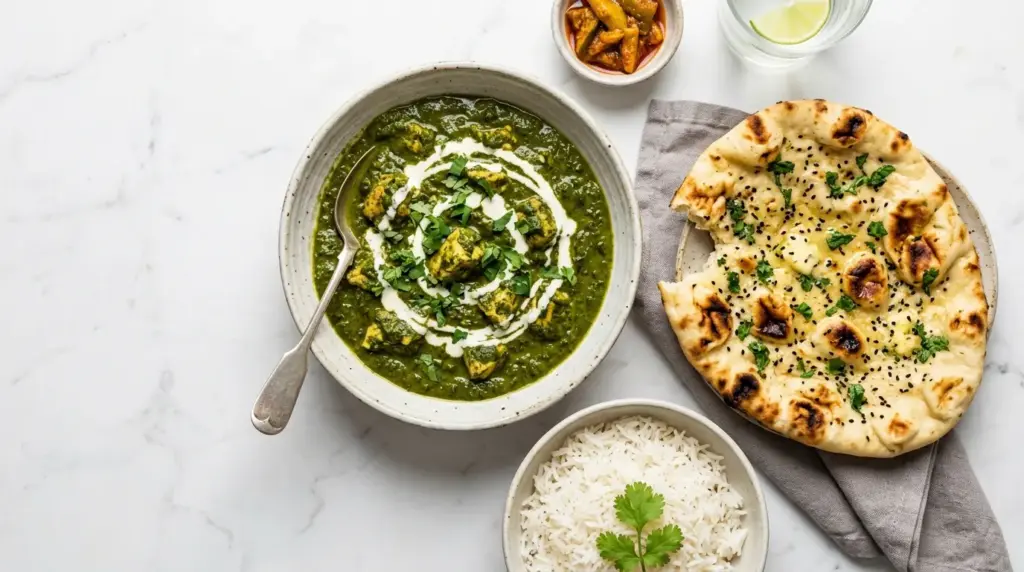
Chicken saag is a hearty, saucy curry that genuinely shines when paired with something to soak up all that beautiful green sauce.
Basmati rice is the most classic and widely loved pairing, with its long, fragrant grains soaking up the curry perfectly.
Here are the best ways to serve this dish:
- Basmati Rice as a classic, fragrant base that soaks up the green sauce beautifully
- Garlic Naan Bread for scooping and dipping into the curry sauce
- Jeera rice (cumin-flavored rice) for an extra layer of fragrant, spiced flavor
- Cucumber Raita on the side as a cooling contrast to the warm spices
- Indian Onion Salad for a bright, crunchy, acidic counterpoint
- Plain steamed jasmine rice for a lighter, neutral base
- Roti or whole wheat chapati for a wholesome, everyday pairing
- A wedge of fresh lemon or lime squeezed over the top just before eating to brighten all the flavors
Samosa Recipe makes a fantastic starter to serve before this curry for a full Indian restaurant-style dinner at home.
Variations to Try
Once you have mastered the base chicken saag recipe, there are several delicious ways to change things up.
Each variation stays true to the spirit of the original dish while bringing something new to the table.
- Lamb Saag: Replace the chicken thighs with boneless lamb shoulder cut into chunks. Lamb is incredibly traditional in saag curries and has a deeper, more robust flavor that pairs beautifully with the spinach sauce. Increase the simmering time to 35 to 40 minutes.
- Saag Paneer: Skip the chicken entirely and use 14 oz (400g) of cubed paneer instead. Lightly pan-fry the paneer in ghee until golden before adding to the sauce. This is the vegetarian classic version of the dish.
- Dairy-Free Chicken Saag: Replace the heavy cream with full-fat coconut milk and skip the yogurt entirely. Coconut milk gives the sauce a slightly sweeter, tropical richness that works beautifully with the spinach and spices.
- Spicier Version: Double the Kashmiri chili powder and add a finely diced green chili to the pan along with the garlic and ginger for a restaurant-style medium-hot curry.
- Mixed Greens Saag: Use half spinach and half mustard greens (sarson), which is technically more traditional than pure spinach saag. Mustard greens add a slightly bitter, peppery depth that is wonderfully complex.
- Slow Cooker Version: Sear the chicken and caramelize the onions on the stovetop first, then transfer everything to a slow cooker with the blended spinach. Cook on low for 6 hours, then stir in the cream and yogurt before serving.
You might also enjoy: Easy Butter Chicken Recipe
Storage and Reheating
Chicken saag is one of those dishes that genuinely gets better as it sits, making it ideal for batch cooking and meal prep.
The spices mellow and deepen overnight in the fridge, so your leftovers will taste even more complex and satisfying than the day you made it.
- Refrigerator: Store cooled leftovers in an airtight container in the refrigerator for up to 4 days.
- Freezer: Chicken saag freezes exceptionally well. Transfer to freezer-safe airtight containers or zip-lock bags in individual portions and freeze for up to 3 months.
- Thawing: Thaw frozen chicken saag overnight in the refrigerator for best results. Do not thaw at room temperature.
- Stovetop reheating: Reheat on the stovetop over medium-low heat, adding a small splash of water (2 to 3 tablespoons) to loosen the sauce as it warms. Stir frequently and heat until piping hot throughout.
- Microwave reheating: Transfer to a microwave-safe bowl, cover loosely, and heat on high in 90-second intervals, stirring between each interval, until heated through.
- Note: The sauce may thicken considerably after refrigerating. This is completely normal. Simply add a splash of water or chicken broth when reheating to bring it back to the right consistency.
This Chicken Curry Recipe follows similarly great storage rules and is another fantastic make-ahead Indian dinner.
Nutritional Facts
The following nutritional information is an estimate per serving, based on a recipe that yields 4 servings. Actual values may vary depending on the exact ingredients and quantities used.
| Nutrient | Amount Per Serving |
|---|---|
| Calories | 420 kcal |
| Total Fat | 26g |
| Saturated Fat | 12g |
| Cholesterol | 175mg |
| Sodium | 680mg |
| Total Carbohydrates | 11g |
| Dietary Fiber | 3g |
| Sugars | 4g |
| Protein | 36g |
| Vitamin A | 6,200 IU |
| Vitamin C | 28mg |
| Iron | 4.5mg |
| Calcium | 180mg |
Note: Nutritional values are estimates calculated using standard ingredient databases. Values will change if you use full-fat coconut milk instead of cream, or modify the amount of ghee used.
For more Indian-inspired weeknight dinners, check out this Chicken Biryani Recipe which is one of the most beloved rice and chicken dishes in Indian cuisine.
Health Benefits of Key Ingredients
Chicken saag is not just delicious. It is genuinely nourishing, and each key ingredient brings something meaningful to the table.
The spinach base alone makes this one of the most nutrient-dense curry dishes in Indian cooking.
Here is a closer look at what each key ingredient contributes:
- Spinach: One of the most iron-rich leafy greens available, spinach is also loaded with vitamins A, C, and K, magnesium, and folate. It supports bone health, immune function, and eye health. The blanching and cooking process makes the nutrients in spinach more bioavailable, which means your body absorbs more of the goodness.
- Chicken Thighs: A rich source of complete protein that supports muscle repair and maintenance, chicken thighs also contain selenium, phosphorus, and B vitamins including niacin and B6, which support energy metabolism.
- Turmeric: Contains curcumin, a powerful anti-inflammatory and antioxidant compound. Studies suggest curcumin may support joint health, brain function, and the immune system. Pairing turmeric with black pepper and fat (like ghee) significantly increases the bioavailability of curcumin.
- Ginger: A well-established digestive aid with anti-nausea and anti-inflammatory properties, fresh ginger also contains gingerol, which has antioxidant effects and may help support a healthy immune response.
- Ghee: Rich in fat-soluble vitamins A, D, E, and K, ghee is also a source of butyrate, a short-chain fatty acid that supports gut health. Unlike refined vegetable oils, ghee has a stable fat structure that does not oxidize easily at cooking temperatures.
- Garlic: Known for its allicin content, garlic has been linked to improved cardiovascular health, immune support, and antimicrobial properties. It is one of the most studied functional foods in the world.
Read Also: Mulligatawny Soup Recipe
Frequently Asked Questions
1. What is the difference between chicken saag and chicken palak?
The terms are often used interchangeably, but there is a subtle traditional distinction.
Chicken palak specifically refers to a dish made purely with spinach, while chicken saag can include a combination of leafy greens such as mustard greens, fenugreek leaves, or wild spinach alongside regular spinach. In practice, most restaurants and home cooks use the terms to describe the same dish.
2. Can I use frozen spinach instead of fresh?
Yes, and it works very well.
Thaw a 10 oz (280g) package of frozen spinach completely, then squeeze out every bit of moisture you can using your hands or a clean kitchen towel before blending. Skipping the blanching step saves time and the flavor result is nearly identical to using fresh spinach.
3. Can I make this recipe ahead of time?
Absolutely, and in fact many people find that the flavors improve after a night in the refrigerator.
You can cook the entire dish up to two days ahead of time, store it in an airtight container in the fridge, and simply reheat on the stovetop with a splash of water before serving. This makes it an excellent option for dinner parties or weekly meal prep.
4. What can I use if I cannot find kasoori methi?
Kasoori methi (dried fenugreek leaves) has a unique flavor, but if you truly cannot find it, the closest substitute is a small amount of celery leaves, about 1 to 2 tablespoons of finely chopped fresh celery leaves.
You can also simply leave it out. The curry will still be deeply flavorful and delicious without it. That said, kasoori methi is increasingly available in the international aisle of most large grocery stores and is also easy to order online.
5. Is chicken saag spicy?
In its most common form, chicken saag is a medium-spiced curry, similar to what you would find at a typical Indian restaurant.
The Kashmiri chili powder used in this recipe gives color and a gentle warmth rather than a fiery heat. If you prefer a very mild dish, reduce the Kashmiri chili powder to 1/4 teaspoon. If you like more heat, add a finely diced green chili or increase the cayenne to your taste. The recipe is very easy to customize to your heat preference.
Read Also: Chicken Marsala Recipe

Chicken Saag

Equipment
- Large heavy-bottomed skillet or Dutch oven - At least 12 inches (30cm)
- High-powered blender - or immersion blender
- Large saucepan - for blanching spinach
- Cutting board and sharp chef’s knife
- Measuring cups and spoons
- Wooden spoon or silicone spatula
- Fine-mesh strainer or colander - for draining spinach
- Ladle - for serving
Ingredients
- 2 lbs boneless, skinless chicken thighs - 900g, cut into 1.5-inch chunks
- 10 oz fresh baby spinach - 280g, or 1 x 10oz frozen spinach package, thawed and squeezed dry
- 1 large yellow onion - finely diced
- 4 cloves garlic - minced
- 1 tablespoon fresh ginger - about a 1-inch piece, grated
- 1 large tomato - roughly chopped, or 1/2 cup canned crushed tomatoes
- 2 tablespoons ghee - or neutral oil
- 0.5 cup heavy cream - 120ml
- 0.25 cup full-fat plain yogurt - 60g
- 1 teaspoon garam masala
- 1 teaspoon ground cumin
- 1 teaspoon ground coriander
- 1 teaspoon turmeric powder
- 0.5 teaspoon Kashmiri chili powder - or cayenne pepper for more heat
- 1 tablespoon kasoori methi - dried fenugreek leaves, crushed between palms
- 1 teaspoon kosher salt - plus more to taste
- 0.5 cup water - 120ml
- fresh cilantro - for garnish (optional)
- basmati rice - for serving
- naan bread - for serving
Instructions
- Blanch fresh spinach in boiling water for 30-45 seconds until wilted, then immediately transfer to ice water to stop cooking.
- Drain spinach thoroughly, squeeze out excess water, then blend with tomato and 1/4 cup water until completely smooth. Set aside.
- Pat chicken dry, season with salt and turmeric, then sear in hot ghee for 3-4 minutes per side until golden brown. Remove and set aside.
- Caramelize diced onion in the same pan for 8-10 minutes until deeply golden, then add garlic, ginger, and all ground spices, cooking for 1-2 minutes until fragrant.
- Pour in the spinach puree and let simmer uncovered for 5-7 minutes until the sauce thickens and the raw green smell mellows.
- Return seared chicken to the pan, cover, and simmer on medium-low for 15-18 minutes until the chicken is cooked through and tender.
- Stir in heavy cream and yogurt (off the heat to prevent curdling), then add crushed kasoori methi and garam masala. Simmer for 2-3 more minutes to meld flavors.
- Rest for 2-3 minutes, then ladle into bowls and garnish with fresh cilantro and a drizzle of cream if desired. Serve hot with rice or naan.
Notes
- The ice bath after blanching is essential for keeping the spinach sauce a vibrant green rather than a dull army color.
- Use chicken thighs rather than breasts for the juiciest results, as they stay tender even after simmering in the sauce.
- Do not rush the onion caramelization step—8 to 10 minutes develops the deep flavor foundation of the entire dish.
- Squeeze the spinach very thoroughly after blanching; any excess water will dilute the sauce and make it watery.
- Toast your spices in the hot ghee (the bhuna technique) for a rounded, full-bodied flavor without any raw, dusty spice taste.
- Always stir yogurt in off the heat or on the lowest setting to prevent it from curdling and separating.
- Crush kasoori methi between your palms before adding to release the essential oils for maximum flavor impact.
- This dish stores beautifully in the refrigerator for up to 4 days and freezes for up to 3 months—the flavors deepen overnight.
- For a dairy-free version, substitute full-fat coconut milk for the heavy cream and omit the yogurt.
- Lamb saag variation: replace chicken with boneless lamb shoulder and increase simmering time to 35-40 minutes.
Final Thoughts
Chicken saag is the kind of recipe that sounds impressive but is genuinely straightforward to make at home once you understand the steps.
The spinach base comes together quickly, the spice blend is approachable, and the chicken becomes wonderfully tender as it finishes cooking in the sauce.
This is a dish that rewards a little patience, especially in the onion-caramelizing and spinach-blanching steps, with results that genuinely rival your favorite Indian restaurant.
If you try this recipe, please leave a comment below to share how it turned out. Did you try any of the variations? Serve it with naan or rice? Your feedback and photos are always so welcome and helpful for other readers looking to cook this dish for the first time.
Recommended:
- Chicken Biryani Recipe
- Easy Naan Bread Recipe
- Garlic Naan Bread Recipe
- Jeera Rice Recipe
- Basmati Rice Recipe
- Indian Onion Salad Recipe
- Samosa Recipe
- Spinach Soup Recipe
- Shakshuka Recipe
- Creamed Spinach Recipe