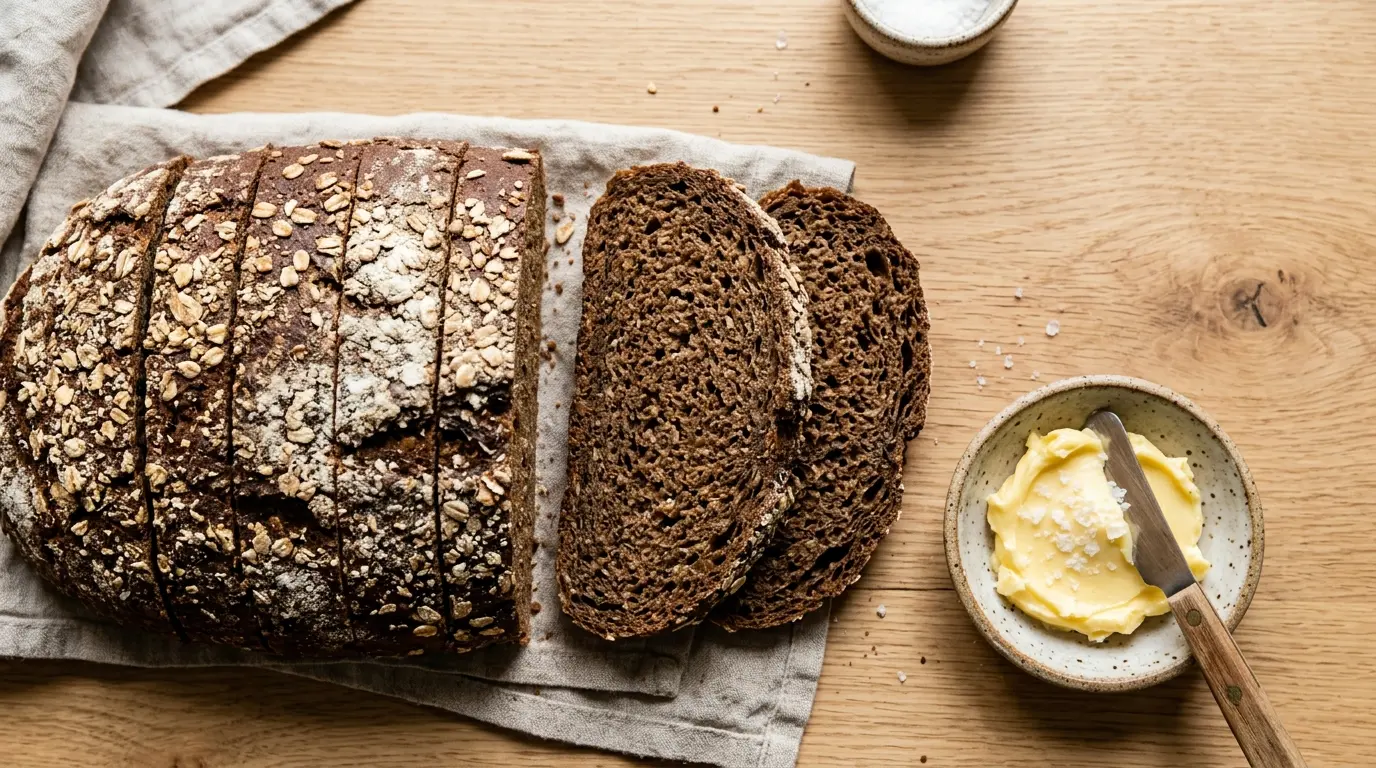
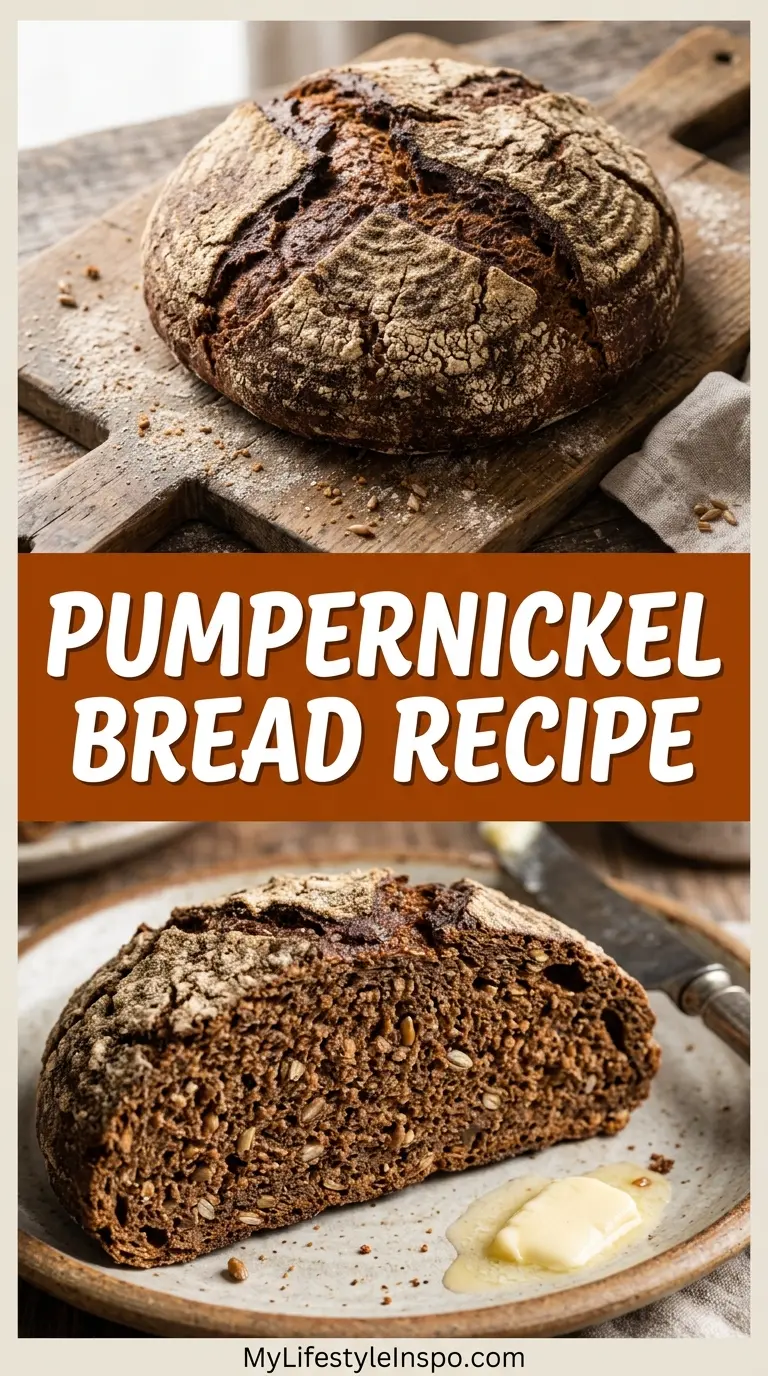
If you’ve ever sliced into a truly good pumpernickel bread recipe, you already know that this is not your average loaf. It’s dark, almost chocolatey in appearance, with a tight, dense crumb and a rich, earthy flavor that’s malty, slightly tangy, and just a touch sweet from molasses. This traditional German bread has been made for centuries, and for good reason: it’s hearty, complex, and completely unlike anything you can find on a grocery store shelf.
American-style pumpernickel (the kind sold pre-sliced in most supermarkets) is often a shortcut version made with rye flour and caramel color. Real pumpernickel, the kind this recipe is based on, relies on a long, slow bake at low temperature to develop its signature near-black crust and deeply toasted flavor. It’s a commitment, but the results are extraordinary.
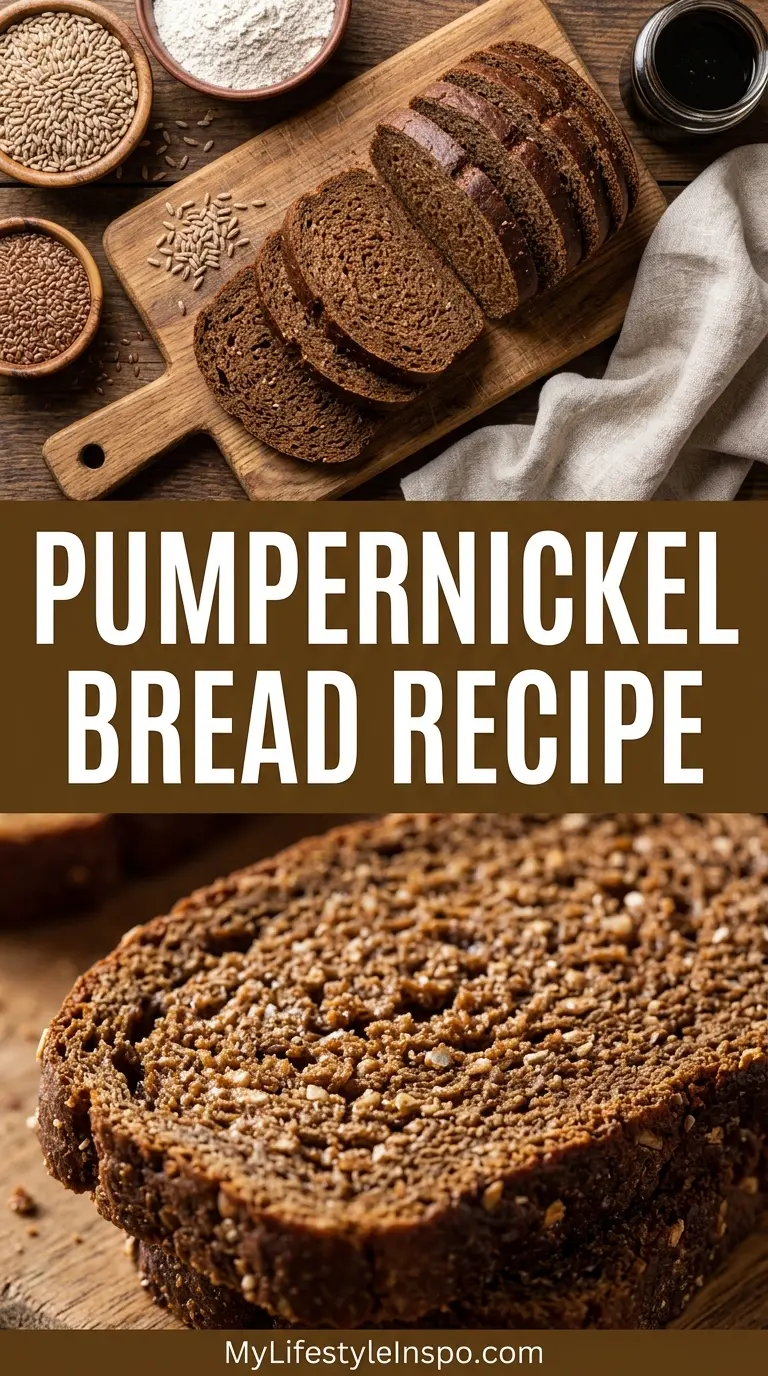
What makes this loaf so special is the combination of coarsely ground rye, a touch of unsweetened cocoa powder (a common addition in many traditional recipes to deepen the color), caraway seeds for a subtle savory note, and molasses to tie it all together. Each ingredient serves a purpose, and together they create a bread that’s deeply satisfying in every bite.
This pumpernickel bread recipe makes one tall loaf. It takes patience, but most of that time is hands-off baking. Plan ahead, and you’ll have something truly remarkable cooling on your counter by the end of the day.
If you love baking with hearty, whole-grain flours, you might also enjoy this Rye Bread Recipe, which shares a lot of the same soul as pumpernickel.
Why You’ll Love This Pumpernickel Bread Recipe
This bread earns its place on your baking list for several very good reasons. It’s deeply flavorful in a way that most homemade breads simply aren’t.
It keeps beautifully. Because of its dense, moist crumb and the preserving qualities of molasses, pumpernickel bread stays fresh for up to a week when stored properly, far longer than a typical white sandwich loaf.
It’s genuinely versatile. Pumpernickel pairs well with both savory and sweet toppings, from smoked salmon and cream cheese to butter and jam.
It’s incredibly satisfying. The high fiber content from the rye means a slice or two keeps you full for hours, making it a great choice for a substantial breakfast or lunch.
Here’s why home bakers love making this loaf:
- The flavor is complex and deeply satisfying, nothing like store-bought pumpernickel
- It’s naturally dense and moist, meaning it slices beautifully even after several days
- The long, low-temperature bake is largely hands-off, so you can go about your day while it bakes
- It makes your kitchen smell incredible
- It’s a showstopper bread that will impress anyone you serve it to
- You control every ingredient, with no artificial coloring or preservatives
Read Also: No Knead Bread Recipe
Ingredients
Traditional pumpernickel relies on a few key ingredients that you may not keep in your everyday pantry, but each one plays an important role. Dark rye flour gives the bread its signature earthy flavor and dense structure. Molasses provides deep color, subtle sweetness, and helps keep the loaf moist for days. Caraway seeds add that classic savory bite that makes this bread so distinctive.
- 2 cups (240g) dark rye flour (also called whole rye or pumpernickel flour)
- 1 cup (120g) bread flour (or all-purpose flour)
- 1 tablespoon caraway seeds
- 2 tablespoons unsweetened cocoa powder
- 1 teaspoon instant yeast
- 1 teaspoon fine salt
- 1 tablespoon sugar
- 3 tablespoons unsulphured blackstrap molasses
- 1 tablespoon vegetable oil or melted butter
- 1 cup (240ml) warm water (around 110°F / 43°C)
- 2 tablespoons apple cider vinegar (adds a subtle tang and helps the rye rise better)
- Optional: 1 tablespoon caraway or sesame seeds for topping
Read Also: Whole Wheat Bread Recipe
Kitchen Equipment Needed
This recipe doesn’t require any specialized baking equipment, but a few key tools will make the process much easier and produce a better result. A Dutch oven or a standard loaf pan both work here, though a 9×5-inch loaf pan is the most practical option for pumpernickel’s dense, brick-like shape.
- Large mixing bowl
- 9×5-inch loaf pan
- Kitchen scale (recommended for rye flour, which compresses easily when measuring by volume)
- Measuring cups and spoons
- Wooden spoon or silicone spatula
- Plastic wrap or a clean kitchen towel
- Oven thermometer (recommended, since the long low bake requires accurate temperature)
- Bread lame or sharp knife for scoring the top
- Wire cooling rack
Read Also: Artisan Bread Recipe
Recommended Products for This Recipe
These are products that genuinely make a difference when baking a dense, long-baked loaf like this one. Each is chosen for quality and performance.
1. Dark Rye Flour (Whole Grain Pumpernickel Flour)
Standard rye flour from the grocery store works, but a true dark rye or stone-ground pumpernickel flour will give you a noticeably more complex, earthy flavor. The coarser grind also adds texture to the crumb. It’s the ingredient that most affects the final taste.
2. Blackstrap Molasses (Unsulphured)
Not all molasses is created equal. Blackstrap molasses is the darkest, most intensely flavored variety, and it’s responsible for pumpernickel’s deep color and rich, bittersweet edge. Unsulphured versions have a cleaner, more natural flavor that works beautifully in bread.
3. Cast Iron Loaf Pan
A heavy cast iron loaf pan distributes heat more evenly than a lightweight aluminum pan, which is especially important for a dense loaf that bakes for a long time. It also creates a better crust. This is a long-term investment that will improve every loaf you bake.
4. Digital Oven Thermometer
Most home ovens run 15-25°F off from what the dial says. For a recipe that relies on a specific low temperature, an accurate reading matters. A simple oven thermometer takes the guesswork out and ensures your bread bakes correctly every time.
Another great bread to try from this site: Dutch Oven Bread Recipe
Step-by-Step Instructions
Step 1: Combine the Dry Ingredients
- In a large mixing bowl, add the dark rye flour and bread flour.
- Add the unsweetened cocoa powder, caraway seeds, instant yeast, fine salt, and sugar.
- Whisk or stir everything together until evenly combined. Make sure the yeast and salt are distributed throughout and not sitting directly on top of each other.
- Set the bowl aside.
Step 2: Mix the Wet Ingredients
- In a separate small bowl or measuring jug, combine the warm water, molasses, apple cider vinegar, and vegetable oil (or melted butter).
- Stir well until the molasses is fully dissolved into the water. It may take a minute since molasses is thick. The water should look dark brown.
- Check the temperature of the liquid: it should be around 110°F (43°C), warm to the touch but not hot. If it’s too hot, it can kill the yeast.
Step 3: Form the Dough
- Pour the wet ingredients into the bowl with the dry ingredients.
- Stir with a wooden spoon or sturdy spatula until a thick, sticky dough forms. Rye flour dough is not like wheat dough: it will not become smooth or stretchy. It will look and feel more like a thick, sticky batter than a conventional bread dough. This is completely normal.
- Continue mixing until all the dry flour is incorporated and the mixture is uniform. There should be no dry flour pockets remaining.
- Note: Do not add extra flour to compensate for the stickiness. The high moisture content is what keeps this dense loaf from becoming too dry.
Step 4: First Rise (Bulk Fermentation)
- Grease your 9×5-inch loaf pan thoroughly with butter, oil, or non-stick spray. Make sure to coat the sides and corners well.
- Transfer the dough into the prepared loaf pan. Use a wet spatula or wet hands to smooth the top as evenly as possible, since the dough is too sticky to shape by hand on a work surface.
- Cover the pan loosely with plastic wrap or a clean kitchen towel.
- Let the dough rise at room temperature for 1.5 to 2 hours. Because rye flour contains less gluten than wheat flour, the rise will be subtle. Do not expect the dough to double in size. You’re looking for the top to rise slightly above the rim of the pan or just level with it, and the surface to look slightly puffy.
Step 5: Preheat the Oven
- About 20 minutes before the rise is complete, preheat your oven to 375°F (190°C).
- Place an oven rack in the lower third of the oven.
- If you’re using an oven thermometer, verify that the temperature is accurate before loading the bread.
Step 6: Score and Top the Loaf
- Just before baking, use a sharp knife or bread lame to make one shallow score down the center of the loaf, about 1/4 inch (6mm) deep. This allows the bread to expand in a controlled way and prevents the top from cracking unevenly.
- If desired, sprinkle the top of the loaf with caraway seeds or sesame seeds and press them in lightly with your fingers so they adhere.
Step 7: Bake the Bread
- Place the loaf pan in the preheated oven.
- Bake at 375°F (190°C) for 35 minutes uncovered.
- After 35 minutes, loosely tent the top of the loaf with aluminum foil to prevent the crust from darkening too much. Because the bread is already very dark from the molasses and cocoa, it can be difficult to judge by color alone.
- Reduce the oven temperature to 325°F (165°C) and continue baking for another 40 to 50 minutes.
- Total bake time is approximately 75 to 85 minutes. The bread is done when a thermometer inserted into the center reads 200-205°F (93-96°C), or when the loaf sounds hollow when tapped on the bottom.
Step 8: Cool Completely Before Slicing
- Remove the bread from the oven and let it cool in the pan for 10 minutes.
- Turn the loaf out onto a wire cooling rack and allow it to cool completely, at least 2 to 3 hours, before slicing.
- This step is not optional. Rye bread continues to set as it cools, and slicing too early will result in a gummy, dense interior. The full cooling time allows the crumb to firm up and the flavors to develop fully.
For another satisfying baking project, check out this Beer Bread Recipe that uses a similarly straightforward, no-fuss method.
Tips for Success
Getting a great result from this pumpernickel bread recipe comes down to a few non-negotiable details. Rye flour behaves very differently from wheat flour, and understanding that upfront will save you a lot of frustration. The stickiness is not a mistake, and the minimal rise is not a failure. Both are features of working with rye.
- Use a scale when possible. Rye flour compresses easily in a measuring cup, and using too much will produce an overly dense, dry loaf.
- Don’t skip the cocoa powder. It doesn’t make the bread taste like chocolate. It deepens the color and adds a mild, slightly bitter complexity that is essential to authentic pumpernickel flavor.
- Use blackstrap molasses, not regular molasses. Blackstrap has a more intense, slightly bitter flavor that contributes to the bread’s character. Regular molasses will make it too sweet.
- Let the bread cool fully. The internal texture will not be set until the loaf has cooled for at least 2 hours. Cutting into it early guarantees a gummy result.
- Wet your hands or spatula when smoothing the dough into the pan. Rye dough sticks to everything, and moisture is the easiest way to manage it.
- Expect a small rise. Rye dough rises much less than wheat dough. If the surface looks slightly domed and a little puffy, you’re in great shape.
- Use an oven thermometer. The two-temperature baking method matters here, and an inaccurate oven dial will affect the result.
You might also enjoy: Sourdough Sandwich Bread Recipe
Serving Suggestions
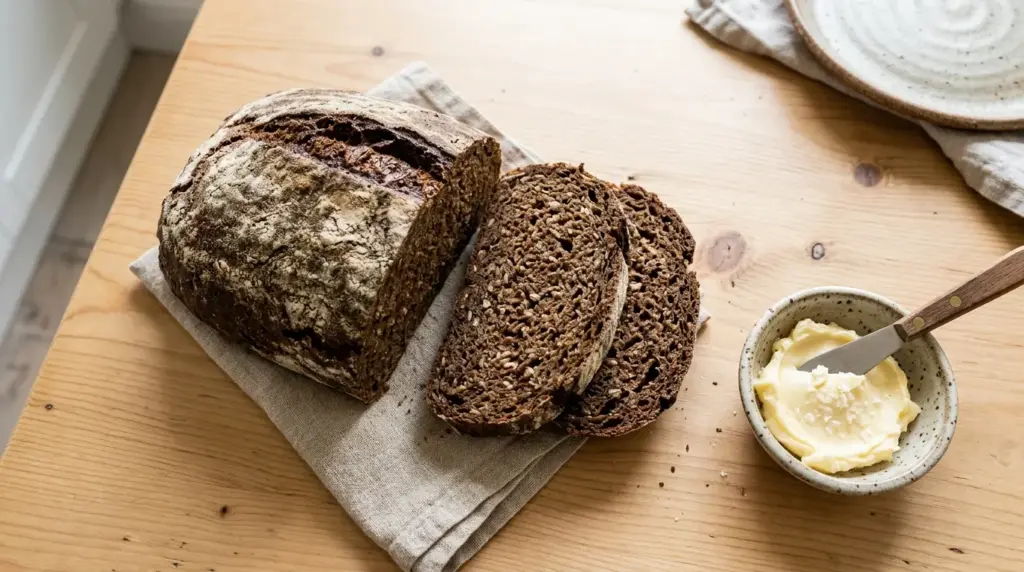
Pumpernickel bread is one of the most versatile loaves you can make. Its strong, earthy flavor holds up beautifully against rich, bold toppings that might overwhelm a lighter bread. It’s equally at home on a brunch spread or a weeknight dinner table.
Thick-sliced pumpernickel with salted butter is one of life’s simple pleasures. The combination is straightforward, but the quality of the bread makes it feel special.
Here are some of the best ways to serve this loaf:
- Spread generously with cream cheese and topped with smoked salmon, capers, and thin-sliced red onion for a classic Scandinavian-style open-faced sandwich
- Served alongside a bowl of Vegetable Soup or Potato Leek Soup for a hearty lunch
- Topped with good salted butter and a sprinkle of flaky sea salt for a simple, satisfying snack
- Used as the base for a Reuben-style sandwich with sauerkraut, Swiss cheese, corned beef, and Thousand Island dressing
- Spread with ricotta and honey for a surprisingly elegant breakfast option
- Served as part of a cheese board alongside sharp aged cheddar, brie, and sliced apple
- Toasted and topped with a fried egg and everything bagel seasoning for a hearty morning meal
Variations to Try
Once you’ve mastered the base recipe, there’s a lot of room to customize this loaf. The dense, earthy base pairs well with many add-ins, and small adjustments to the flour ratios can meaningfully change the texture. Here are some well-tested directions to take this pumpernickel bread recipe:
- Make it a sourdough pumpernickel. Replace the instant yeast and apple cider vinegar with 1/2 cup (120g) of active rye sourdough starter. Reduce the water by 1/4 cup and allow a longer first rise of 4 to 6 hours.
- Add seeds for extra texture. Stir 2 tablespoons of sunflower seeds, pumpkin seeds, or flaxseeds into the dough before the rise.
- Try fennel instead of caraway. If you find caraway too assertive, whole fennel seeds offer a milder, slightly sweeter anise flavor that works beautifully in rye bread.
- Make a darker, denser loaf. Use 100% dark rye flour with no bread flour. The loaf will be denser and more intensely flavored, closer to a traditional German Vollkornbrot.
- Add orange zest. A teaspoon of finely grated orange zest adds a subtle brightness that balances the deep, earthy bitterness of the rye and molasses.
- Herb and garlic variation. Add 1 tablespoon of fresh thyme and 1 minced garlic clove to the dough for a savory loaf that’s especially good alongside soups and stews.
Read Also: Irish Soda Bread Recipe
Storage and Reheating
One of the best things about pumpernickel bread is how well it keeps. The high rye content and molasses actually help preserve moisture and freshness far better than most wheat-based loaves. With the right storage method, a homemade pumpernickel loaf can stay good for up to a week.
- Room temperature: Wrap the cooled loaf tightly in beeswax wrap, plastic wrap, or place it in a resealable bag. Store at room temperature for up to 5 to 7 days.
- Refrigerator: Rye bread can be refrigerated, though it may firm up slightly. Store wrapped for up to 10 days.
- Freezer: Slice the loaf before freezing so you can take out individual slices as needed. Wrap slices in plastic wrap and store in a freezer bag for up to 3 months.
- Reheating from frozen: Place slices directly in the toaster from frozen, or let them thaw at room temperature for 20 to 30 minutes.
- Refreshing day-old bread: If the loaf has dried slightly, wrap it in foil and warm in a 300°F (150°C) oven for 10 to 15 minutes.
Another excellent bread that keeps well: Challah Recipe
Nutritional Facts
The following nutritional information is an estimate per slice, based on a loaf cut into 12 slices. Actual values will vary depending on the exact ingredients used.
| Nutrient | Per Slice (approx.) |
|---|---|
| Calories | 145 kcal |
| Carbohydrates | 28g |
| Protein | 4g |
| Fat | 2.5g |
| Saturated Fat | 0.4g |
| Fiber | 3.5g |
| Sugar | 4g |
| Sodium | 195mg |
| Iron | 10% DV |
| Magnesium | 8% DV |
Pumpernickel bread is notably higher in fiber than white or even standard wheat bread, and it provides meaningful amounts of minerals like iron, magnesium, and zinc from the rye flour.
You might also enjoy: Einkorn Bread Recipe
Health Benefits of Key Ingredients
Pumpernickel bread earned a reputation as one of the more nutritious bread options long before whole grain eating became trendy. Every key ingredient in this recipe serves not just a flavor purpose, but a nutritional one as well.
Here’s a closer look at what makes each ingredient genuinely good for you:
- Dark rye flour: Rye contains more dietary fiber per gram than whole wheat flour, and it has a lower glycemic index than most other grains. This means it causes a slower, steadier rise in blood sugar after eating, which supports sustained energy and satiety. Rye is also a good source of selenium, manganese, phosphorus, and B vitamins.
- Blackstrap molasses: Unlike refined sugar, blackstrap molasses is actually rich in nutrients. A single tablespoon provides meaningful amounts of iron, calcium, magnesium, potassium, and vitamin B6. It’s one of the few natural sweeteners with genuine mineral content.
- Apple cider vinegar: Beyond its role in flavor and helping the rye flour ferment slightly, apple cider vinegar may support digestion and has a mild prebiotic effect, feeding beneficial gut bacteria.
- Caraway seeds: These small seeds are surprisingly nutritious. They contain antioxidants, fiber, and compounds that may support digestive health, including relief from bloating and gas, which is relevant since rye can be slightly harder to digest for some people.
- Cocoa powder (unsweetened): Added for color and depth, unsweetened cocoa powder also brings a dose of flavonoids, which are plant compounds linked to heart health and anti-inflammatory effects.
Read Also: Seeded Miso Sweet Potato Bread Recipe
Frequently Asked Questions
1. What’s the difference between pumpernickel bread and rye bread?
All pumpernickel is rye bread, but not all rye bread is pumpernickel. Rye bread is a broad category that includes anything made with rye flour. Pumpernickel specifically refers to a loaf made with coarsely ground dark rye flour (or rye meal), traditionally baked at a very low temperature for an extended period of time to develop its signature dark color and deeply complex flavor. The molasses and cocoa powder in modern versions accelerate the color development that the long traditional bake would otherwise achieve.
2. Can I make this without yeast?
You can make a version without commercial yeast by using a rye sourdough starter instead. Combine 1/2 cup (120g) of active rye starter with the remaining ingredients, and omit the instant yeast and apple cider vinegar. Allow a longer bulk fermentation of 4 to 6 hours at room temperature. The resulting bread will have a tangier, more complex flavor.
3. Why didn’t my pumpernickel bread rise much?
This is completely expected. Rye flour contains very little gluten compared to wheat flour, and gluten is what allows bread to trap gas and rise significantly. Rye dough rises modestly, and the final loaf will be quite dense. If your bread rose slightly and still has a uniform crumb (no large holes), the recipe worked correctly.
4. Can I bake this without a loaf pan?
Pumpernickel dough is too sticky and dense to hold a free-form shape without a pan. If you don’t have a loaf pan, a round oven-safe pot or Dutch oven works as an alternative. Line it with parchment paper for easy removal, and adjust baking times accordingly since the shape will affect how quickly the center sets.
5. My bread came out gummy inside. What went wrong?
Gumminess in pumpernickel (and rye bread generally) is almost always the result of one of two things: slicing too early before the bread has fully cooled, or underbaking. Make sure the internal temperature reaches 200-205°F (93-96°C) before removing from the oven, and then allow the loaf to cool completely, at least 2 to 3 hours, before cutting. Rye starch needs time to fully gelatinize and set as the bread cools, and cutting it short results in a gummy crumb.
Read Also: Dutch Oven Sourdough Bread Recipe

Pumpernickel Bread

Equipment
- Large mixing bowl
- 9×5-inch loaf pan
- Kitchen scale - Recommended for rye flour, which compresses easily when measuring by volume
- Measuring cups and spoons
- Wooden spoon or silicone spatula
- Plastic wrap or clean kitchen towel
- Oven thermometer - Recommended, since the long low bake requires accurate temperature
- Bread lame or sharp knife - For scoring the top
- Wire cooling rack
Ingredients
- 2 cups dark rye flour - 240g, also called whole rye or pumpernickel flour
- 1 cup bread flour - 120g, or all-purpose flour
- 1 tablespoon caraway seeds
- 2 tablespoons unsweetened cocoa powder
- 1 teaspoon instant yeast
- 1 teaspoon fine salt
- 1 tablespoon sugar
- 3 tablespoons unsulphured blackstrap molasses
- 1 tablespoon vegetable oil - or melted butter
- 1 cup warm water - 240ml, around 110°F / 43°C
- 2 tablespoons apple cider vinegar - adds a subtle tang and helps the rye rise better
- 1 tablespoon caraway seeds - for topping, optional
- 1 tablespoon sesame seeds - for topping, optional
Instructions
- In a large bowl, whisk together dark rye flour, bread flour, cocoa powder, caraway seeds, instant yeast, fine salt, and sugar until evenly combined.
- In a separate bowl, combine warm water, molasses, apple cider vinegar, and vegetable oil. Stir until the molasses is fully dissolved. Check that the liquid is around 110°F (43°C).
- Pour wet ingredients into dry ingredients and stir with a wooden spoon until a thick, sticky dough forms. It will look and feel more like a thick batter than conventional bread dough. Do not add extra flour.
- Grease a 9×5-inch loaf pan thoroughly. Transfer the sticky dough into the pan, using a wet spatula or wet hands to smooth the top evenly. Cover loosely with plastic wrap or a kitchen towel.
- Let dough rise at room temperature for 1.5 to 2 hours. The rise will be subtle; look for the top to rise slightly above the rim or level with it, and the surface to look puffy.
- About 20 minutes before the rise is complete, preheat the oven to 375°F (190°C) with a rack in the lower third. Verify the temperature with an oven thermometer.
- Just before baking, use a sharp knife or bread lame to make one shallow score down the center of the loaf, about 1/4 inch (6mm) deep. Sprinkle with caraway or sesame seeds if desired, pressing them in lightly.
- Bake at 375°F (190°C) for 35 minutes uncovered. Tent the top with aluminum foil, reduce oven temperature to 325°F (165°C), and continue baking for 40 to 50 minutes more. Total bake time is 75-85 minutes.
- Bread is done when a thermometer inserted into the center reads 200-205°F (93-96°C) or when the loaf sounds hollow when tapped on the bottom. Remove from the oven and cool in the pan for 10 minutes.
- Turn the loaf out onto a wire rack and cool completely, at least 2 to 3 hours, before slicing. This allows the crumb to firm up and flavors to develop fully.
Notes
- Use a kitchen scale when possible. Rye flour compresses easily in a measuring cup, and using too much will produce an overly dense, dry loaf.
- Don’t skip the cocoa powder. It doesn’t make the bread taste like chocolate; it deepens the color and adds essential complexity.
- Use blackstrap molasses for the most intense, slightly bitter flavor. Regular molasses will make the bread too sweet.
- Do not add extra flour to compensate for the stickiness. The high moisture content is what keeps this dense loaf from becoming too dry.
- Expect a small rise. Rye dough rises much less than wheat dough. If the surface looks slightly domed and puffy, you’re in great shape.
- Wet your hands or spatula when smoothing the dough into the pan. Rye dough sticks to everything, and moisture is the easiest way to manage it.
- Use an oven thermometer. The two-temperature baking method matters here, and an inaccurate oven dial will affect the result.
- Let the bread cool fully. Cutting into it early guarantees a gummy result. The internal texture will not be set until the loaf has cooled for at least 2 hours.
- Store the cooled loaf tightly wrapped at room temperature for up to 5-7 days. For longer storage, slice and freeze for up to 3 months.
- To make a sourdough version: replace instant yeast and apple cider vinegar with 1/2 cup (120g) active rye sourdough starter. Reduce water by 1/4 cup and allow a longer first rise of 4 to 6 hours.
Final Thoughts
Making a pumpernickel bread recipe from scratch is one of those baking experiences that genuinely rewards your effort. The smell alone, that deep, toasty, slightly sweet aroma that fills your kitchen during the long bake, makes the whole process worthwhile.
This loaf is dense, complex, and satisfying in a way that store-bought pumpernickel simply cannot match. Once you taste the real thing, you’ll understand why this bread has been a staple across Northern Europe for centuries.
Give this recipe a try, and let us know in the comments how it turned out for you. Share a photo, leave a tip, or tell us what you served it with. This community loves hearing from fellow bread bakers!
Recommended:
- Rye Bread Recipe
- No Knead Bread Recipe
- Whole Wheat Sourdough Bread Recipe
- Artisan Bread Recipe
- Beer Bread Recipe
- Rosemary Focaccia Recipe
- Fresh Milled Flour Bread Recipe
- Sweet Sourdough Bread Recipe
- Gluten Free Dairy Free Bread Recipe
- Manna Bread Recipe