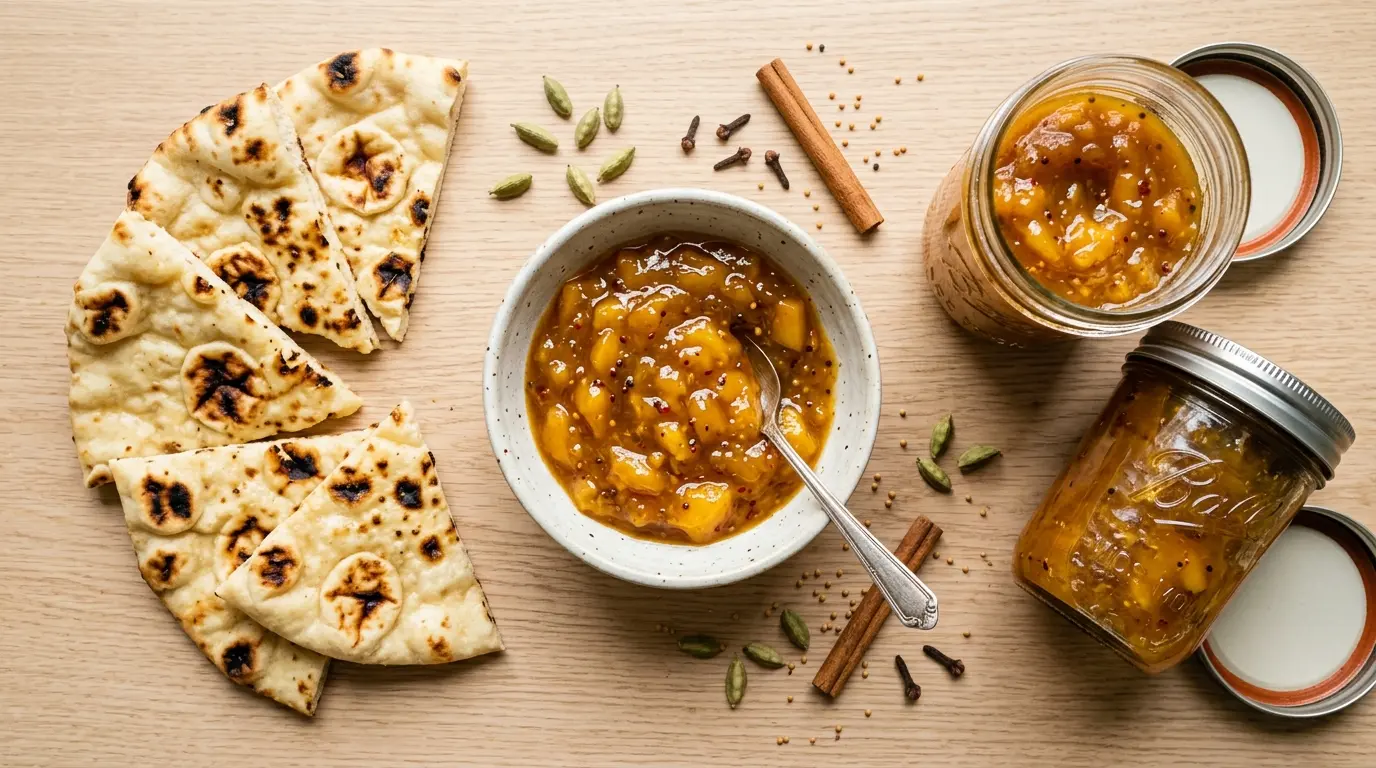
If you’ve ever had a jar of mango chutney alongside your curry and thought, “I need to make this at home,” this mango chutney recipe is exactly what you’ve been waiting for.
This classic Indian condiment is a beautiful balance of sweet ripe mangoes, warm aromatic spices, a tangy hit of vinegar, and just enough heat to keep things interesting.
It’s one of those recipes that sounds fancy but is actually incredibly simple to pull off. You cook everything down in one pot, the kitchen smells absolutely incredible the entire time, and you end up with a glossy, jewel-toned condiment that makes everything taste better.
The secret to a great mango chutney lies in two things: using ripe but still firm mangoes (so they hold a little texture as they cook), and blooming your whole spices in oil before adding anything else. That extra step takes about 60 seconds and makes a world of difference in flavor depth.
Once you’ve made a batch of this, you’ll be spooning it onto grilled chicken, spreading it on sandwiches, serving it with cheese boards, stirring it into curries, and finding every excuse to keep a jar in your fridge at all times.
This recipe makes about 2 cups of chutney and keeps beautifully for weeks. Ready to make a batch?
You might also enjoy: Chicken Tikka Masala — it’s one of the most classic pairings for homemade mango chutney.

Why You’ll Love This Mango Chutney Recipe
This chutney is one of those condiments that somehow makes everything it touches taste more exciting.
It’s sweet, tangy, spicy, and deeply aromatic all at once, and that complexity comes together in under an hour using simple pantry spices.
It’s naturally gluten-free, vegan, and requires no special equipment.
The recipe is also incredibly forgiving. Too sweet? Add more vinegar. Not spicy enough? Toss in extra chili. It adapts beautifully to your preferences.
It stores in the fridge for up to 3 weeks, so one batch gives you weeks of delicious spoonfuls on demand.
You can also freeze it for up to 3 months, making it a great make-ahead condiment for entertaining.
Here’s a quick look at what makes this recipe stand out:
- Uses fresh, whole mangoes for the best natural sweetness and texture
- Whole spices like mustard seeds and cumin bloom in hot oil for maximum flavor
- Apple cider vinegar gives a mellower, fruitier tang than white vinegar
- Brown sugar adds a deeper, more caramel-like sweetness than plain white sugar
- One pot, simple steps, and beginner-friendly from start to finish
- Customizable heat level — mild, medium, or fiery hot
The same fragrant spice profile that makes this chutney sing also works wonderfully in a bowl of palak paneer, if you’re building out an Indian-inspired meal spread.
Ingredients
You only need a handful of ingredients to make this mango chutney, and most of them are pantry staples you likely already have on hand.
- 3 large ripe mangoes (about 4 cups / 600g), peeled and cut into ½-inch cubes
- 1 tablespoon vegetable oil or coconut oil
- 1 medium yellow onion, finely diced (about 1 cup / 150g)
- 4 garlic cloves, minced
- 1 tablespoon fresh ginger, finely grated
- 1 teaspoon black mustard seeds
- 1 teaspoon ground cumin
- ½ teaspoon ground coriander
- ½ teaspoon ground turmeric
- ¼ teaspoon ground cinnamon
- ¼ teaspoon ground cardamom
- ¼ to ½ teaspoon red chili flakes (adjust to your heat preference)
- ½ cup / 120ml apple cider vinegar
- ½ cup / 100g light brown sugar, packed
- ½ teaspoon salt, or to taste
Once your basmati rice is on the stove, this chutney comes together on the side in practically no time.
Kitchen Equipment Needed
You don’t need anything fancy to make this recipe. A good heavy-bottomed pot is really the only essential piece here.
Here’s what to have ready before you start:
- Heavy-bottomed saucepan or Dutch oven (2-3 quart capacity)
- Sharp chef’s knife and cutting board
- Microplane or box grater (for grating fresh ginger)
- Wooden spoon or heat-safe silicone spatula
- Measuring cups and spoons
- Potato masher (optional, for a smoother texture)
- Glass mason jars with lids for storage
Read Also: Samosa Recipe
Recommended Products for This Recipe
These are products I genuinely recommend based on quality and the difference they can make when preparing this chutney.
1. Massel Premium Black Mustard Seeds
Whole black mustard seeds are the secret weapon in any great mango chutney. When they hit hot oil and begin to pop, they release a nutty, pungent depth that pre-ground mustard simply can’t replicate. A good-quality bag of whole seeds will last you through many batches of chutney, curries, and spice blends.
2. Bragg Organic Raw Apple Cider Vinegar
The vinegar you choose matters more than you’d think. Bragg’s raw, unfiltered apple cider vinegar brings a fruity, mellow acidity that balances the sweetness of the mangoes without any harsh bite. It’s also widely available and works beautifully in salad dressings and marinades beyond this recipe.
3. Le Creuset Enameled Cast Iron Dutch Oven
A heavy-bottomed Dutch oven is ideal for making chutney because it distributes heat evenly and prevents scorching as the mixture thickens. The enameled interior doesn’t react with the vinegar in the recipe, and cleanup is effortless even after long simmering times. It’s an investment piece that will serve you in hundreds of recipes for years to come.
4. OXO Good Grips Stainless Steel Potato Masher
If you like your chutney with a bit more texture variety — chunky in places, smoother in others — a potato masher is the tool for the job. It gives you way more control than a food processor and keeps some lovely mango pieces intact. The OXO version has a comfortable grip and is easy to clean.
5. Ball Wide Mouth Mason Jars (32 oz)
These are the gold standard for storing homemade condiments. Wide-mouth Ball jars are easy to fill, seal airtight, and display beautifully on a refrigerator shelf. They’re also perfect if you want to gift a batch of homemade chutney to friends and family.
Another favorite: Cucumber Raita — a cool, creamy companion to serve alongside your chutney and a curry spread.

Step-by-Step Instructions
Step 1: Prep Your Mangoes
- Choose mangoes that are ripe but still hold a little firmness when pressed — Ataulfo, Haden, Kent, or Alphonso varieties all work beautifully.
- Use a sharp knife to slice off both wide sides of the mango alongside the pit.
- Score the mango flesh in a crosshatch pattern (½-inch / 1.25cm squares), then scoop out the cubes using a large spoon.
- Trim any remaining flesh from around the pit and add it to the pile.
- You should have about 4 cups / 600g of mango cubes total across 3 large mangoes.
- Set the mango aside on your cutting board while you prep the aromatics.
Step 2: Prepare the Aromatics
- Peel and finely dice the yellow onion into small, even pieces about ¼ inch in size — uniformity helps everything cook at the same rate.
- Peel and mince the 4 garlic cloves as finely as possible, or use a garlic press.
- Use a microplane or the fine side of a box grater to grate the fresh ginger — you need 1 tablespoon of grated ginger.
- Measure out all your spices — ground cumin, ground coriander, turmeric, cinnamon, cardamom, and red chili flakes — into a small bowl so they’re ready to go the moment you need them. This is the mise en place step and it makes the cooking process much smoother.
Step 3: Bloom the Mustard Seeds
- Place your heavy-bottomed saucepan or Dutch oven over medium heat and add 1 tablespoon of oil.
- Once the oil is shimmering but not smoking (about 30 seconds), add the 1 teaspoon of black mustard seeds.
- Listen carefully — the seeds will start to pop and splutter within 30 to 60 seconds. This is exactly what you want. The popping releases their nutty, aromatic oils.
- Do not walk away during this step. Once you hear the popping slow down, you’re ready to move on.
- Keep the heat at medium — too high and the seeds will burn before they bloom.
Step 4: Sauté the Onion, Garlic, and Ginger
- Add the diced onion to the pot with the bloomed mustard seeds and stir to combine.
- Cook over medium heat, stirring occasionally, for 5 to 7 minutes until the onion is soft and translucent. You don’t need to brown it — just soften it.
- Add the minced garlic and grated ginger to the pot and stir everything together.
- Cook for another 1 to 2 minutes until the garlic and ginger are fragrant and slightly golden. Be careful not to burn the garlic — it should smell toasty and sweet, not sharp or bitter.
Step 5: Add the Ground Spices
- Add your pre-measured bowl of ground spices (cumin, coriander, turmeric, cinnamon, cardamom, and red chili flakes) directly to the pot.
- Stir everything together quickly to coat the onion mixture in the spices.
- Cook for 1 minute, stirring constantly. This step is called “toasting” the ground spices and it transforms them from dusty and raw to warm and aromatic.
- If the spices start sticking to the bottom of the pot, add a splash of water (1 to 2 tablespoons) to deglaze and scrape up any bits.
Step 6: Add the Mangoes, Vinegar, Sugar, and Salt
- Add the cubed mango to the pot and stir to coat the pieces in the spiced onion mixture.
- Pour in the ½ cup / 120ml of apple cider vinegar — it will sizzle when it hits the hot pan, which is normal.
- Add the ½ cup / 100g of packed light brown sugar and ½ teaspoon of salt.
- Stir everything together until the sugar begins to dissolve.
- Bring the mixture up to a gentle boil over medium-high heat, stirring a few times.
Step 7: Simmer Until Thick and Jammy
- Once the mixture reaches a boil, reduce the heat to medium-low.
- Allow the chutney to simmer uncovered for 35 to 45 minutes, stirring every 5 to 10 minutes to prevent sticking.
- As it cooks, the mango will soften and break down, the liquid will reduce, and the mixture will thicken into a glossy, jam-like consistency.
- You’ll know it’s ready when a wooden spoon dragged across the bottom of the pot leaves a clear path that holds for a second before filling in.
- If you prefer a smoother chutney, use a potato masher to gently mash some of the mango pieces during the last 10 minutes of cooking. For a completely smooth result, you can also blend a portion and stir it back in.
Step 8: Taste, Adjust, and Cool
- Remove the pot from heat and taste the chutney carefully (it will be very hot).
- Adjust salt if needed. If it tastes too sweet, stir in a splash more vinegar. If it’s too tart, add a pinch more sugar.
- Let the chutney cool in the pot for at least 15 minutes before transferring to jars.
- Spoon the chutney into clean glass mason jars using a ladle or large spoon.
- Allow to cool completely at room temperature before sealing the jars and refrigerating.
Read Also: Chicken Biryani Recipe
Tips for Success
A few small techniques go a long way toward making the most flavorful batch of mango chutney possible.
- Use ripe but firm mangoes. Overripe mangoes turn to mush too quickly and result in a flat, watery chutney. The flesh should yield slightly when pressed but hold its shape when cubed.
- Don’t rush the mustard seeds. Wait until you actually hear them popping before moving on. Under-bloomed mustard seeds taste bitter rather than nutty.
- Keep the heat at medium-low during the simmer. Too high and the sugars will scorch on the bottom of the pot before the liquid has properly reduced.
- Stir regularly but not constantly. Every 5 to 10 minutes is enough. Constant stirring can break down the mango pieces before the chutney has had time to develop depth.
- Taste before finishing. The balance of sweet, sour, salty, and spicy can vary depending on how ripe your mangoes are, so always adjust at the end.
- Let it cool before jarring. Hot chutney poured into cold jars can cause cracking. Allow it to cool slightly in the pot first.
This chutney pairs beautifully with tandoori chicken for a stunning combination of smoky, charred chicken and sweet-spicy condiment.
Serving Suggestions
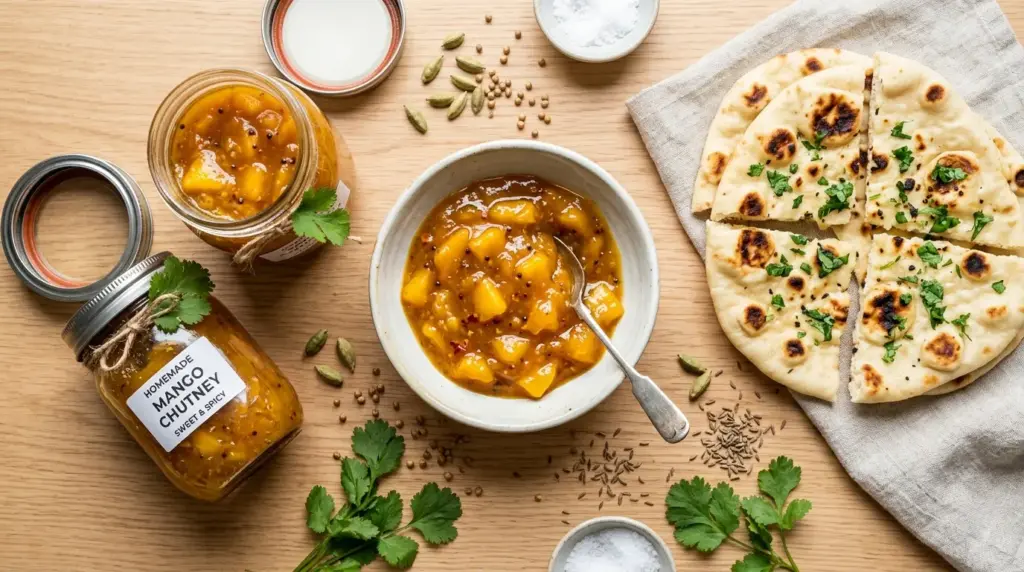
Mango chutney is one of the most versatile condiments in the kitchen — once you have a jar in the fridge, the uses are practically endless.
Here are some of the best ways to serve it:
- Alongside Chicken Curry as a classic Indian-style pairing
- Spooned over grilled or roasted chicken thighs for an easy weeknight dinner
- Spread on sandwiches and wraps in place of mustard or mayo
- Served on a cheese board alongside aged cheddar, brie, or gouda
- Used as a dipping sauce for Samosa or flatbreads
- Stirred into chicken salad for a fruity, spiced twist
- Drizzled over cream cheese with crackers as a quick appetizer
- Mixed into vinaigrette for a sweet-tangy salad dressing
For a beautiful Indian-inspired spread, serve this chutney alongside Jeera Rice and your favorite protein.
Variations to Try
The classic recipe is delicious as-is, but there are plenty of ways to put your own spin on it.
- Spicy mango chutney: Double the red chili flakes or add one finely diced fresh red chili for serious heat.
- Ginger-forward version: Increase the fresh ginger to 2 tablespoons for a more pungent, warming flavor profile.
- Green mango chutney: Use unripe (green) mangoes for a more sour, tangy chutney with bolder flavor — popular in South Indian cooking.
- Mango chutney with raisins: Stir in 3 tablespoons of golden raisins during the last 10 minutes of cooking for pops of sweetness.
- Coconut mango chutney: Add 2 tablespoons of unsweetened shredded coconut in the final 5 minutes for a tropical twist.
- Lower sugar version: Reduce the brown sugar to ¼ cup and compensate with slightly more vinegar for a tangier, less sweet result.
You might also enjoy: Chicken Korma Recipe
Storage and Reheating
Mango chutney stores exceptionally well, which is one of the many reasons it’s worth making a big batch.
Here’s everything you need to know about keeping it fresh:
- Refrigerator: Store in an airtight glass jar in the fridge for up to 3 weeks. Always use a clean spoon each time you scoop from the jar to avoid contamination.
- Freezer: Ladle cooled chutney into freezer-safe containers, leaving about ½ inch of headspace. Freeze for up to 3 months. Thaw overnight in the fridge.
- Room temperature serving: Chutney can be served cold directly from the fridge or allowed to come to room temperature for about 20 minutes before serving — it tends to have a more complex flavor when slightly warm.
- Reheating: If you want to serve it warm (lovely alongside roast meats), simply spoon it into a small saucepan and heat gently over low heat, stirring occasionally. Add a teaspoon of water if it’s become too thick.
- Canning: For shelf-stable storage of up to one year, process sealed jars in a boiling water bath for 10 minutes following standard canning safety guidelines.
Read Also: Indian Onion Salad Recipe
Nutritional Facts
The following nutritional information is an estimate based on a 2-tablespoon serving size. The full recipe yields approximately 16 servings.
| Nutrient | Per Serving (2 tbsp) |
|---|---|
| Calories | 55 kcal |
| Total Carbohydrates | 13g |
| Sugars | 12g |
| Total Fat | 1g |
| Saturated Fat | 0g |
| Protein | 0.3g |
| Fiber | 0.6g |
| Sodium | 75mg |
| Vitamin C | 15% DV |
| Vitamin A | 6% DV |
Please note these are approximate values and will vary depending on the size and ripeness of your mangoes, and any adjustments made to the sugar or vinegar quantities.
For a lighter version of this recipe, reducing the brown sugar to ¼ cup brings the calories down to approximately 38 kcal per 2-tablespoon serving.
This recipe pairs wonderfully with a cool Mango Smoothie Without Yogurt on the side for a full mango-forward meal experience.
Health Benefits of Key Ingredients
Beyond how good it tastes, this mango chutney is made with ingredients that each bring genuine nutritional value to the table.
Here’s a closer look at the standout players:
Mangoes are one of the most nutritionally rich fruits available. They’re an excellent source of Vitamin C (which supports immune function), Vitamin A (important for skin and eye health), and dietary fiber. Mangoes also contain folate, potassium, and a range of antioxidants including mangiferin, which has been studied for its anti-inflammatory properties.
Fresh ginger has been used medicinally for thousands of years. The active compound gingerol is well documented for its anti-inflammatory and antioxidant effects. Ginger also supports digestive health, may help reduce nausea, and adds a warming quality to the chutney that complements the sweetness of the mango.
Garlic is rich in allicin, a sulfur compound that has been associated with immune support, cardiovascular benefits, and antibacterial properties. Cooking garlic slightly softens its pungency while preserving much of its nutritional value.
Turmeric contains curcumin, one of the most well-researched natural anti-inflammatory compounds. Even in small culinary amounts, turmeric contributes color, warmth, and a subtly earthy flavor to this chutney.
Apple cider vinegar brings acidity that balances the sweetness, but it also contains trace amounts of potassium and beneficial acids that support digestion.
Here’s a summary of the key health highlights:
- Mangoes provide Vitamins C and A plus antioxidants
- Ginger supports digestion and has anti-inflammatory properties
- Garlic offers immune-supporting allicin
- Turmeric contributes curcumin, a powerful natural anti-inflammatory
- Apple cider vinegar supports digestive health and balances blood sugar spikes
Another great Indian-inspired dish loaded with nutritious ingredients is Chicken Saag — worth adding to your meal rotation.
Frequently Asked Questions
1. Can I use frozen mango to make mango chutney?
Yes, absolutely. Frozen mango works well in this recipe, especially when fresh mangoes are out of season or unavailable.
Make sure to fully thaw the frozen mango and drain off any excess liquid before adding it to the pot. Too much extra water will make your chutney thin and runny, so patting the thawed mango dry with paper towels is a smart step.
2. How ripe should my mangoes be for the best chutney?
Ideally, you want mangoes that are ripe but still hold some firmness. They should smell fragrant and sweet at the stem end, and yield very slightly when pressed with your thumb, without being mushy.
Overripe mangoes will break down too quickly during cooking and the chutney can lose its texture. If your mangoes are on the firm side, just allow them an extra 5 to 10 minutes of simmering time.
3. How long does homemade mango chutney last?
Stored in an airtight glass jar in the refrigerator, this chutney keeps for up to 3 weeks.
For longer storage, freeze it for up to 3 months. If you want shelf-stable chutney that doesn’t need refrigeration, process sealed jars in a boiling water canner for 10 minutes using proper canning technique.
4. Can I make mango chutney without sugar?
You can reduce or substitute the sugar, though the result will be tangier and less jammy in texture. The sugar helps the chutney thicken and also acts as a preservative.
Good substitutes include coconut sugar (which has a more caramel-like depth), honey (add it off the heat at the end to preserve its flavor), or maple syrup. Start with ¼ cup of your preferred sweetener and adjust to taste.
5. Is mango chutney spicy?
In this recipe, the heat level is mild to medium depending on how much red chili flake you use. The ¼ teaspoon called for in the base recipe delivers a gentle warmth that most people enjoy.
For a spicier chutney, increase to ½ teaspoon or add one finely minced fresh red chili. For a completely mild version suitable for kids or spice-sensitive guests, skip the chili flakes entirely — the chutney will still be beautifully flavorful.
Read Also: Chicken Shawarma Recipe

Classic Mango Chutney

Equipment
- Heavy-bottomed saucepan or Dutch oven - 2-3 quart capacity
- Sharp chef's knife
- Cutting board
- Microplane or box grater - For grating fresh ginger
- Wooden spoon or heat-safe silicone spatula
- Measuring cups and spoons
- Potato masher - Optional, for a smoother texture
- Glass mason jars with lids - For storage
Ingredients
- 3 large ripe mangoes - about 4 cups or 600g, peeled and cut into ½-inch cubes; Ataulfo, Haden, Kent, or Alphonso varieties
- 1 tablespoon vegetable oil - or coconut oil
- 1 medium yellow onion - about 1 cup or 150g, finely diced
- 4 garlic cloves - minced
- 1 tablespoon fresh ginger - finely grated
- 1 teaspoon black mustard seeds
- 1 teaspoon ground cumin
- ½ teaspoon ground coriander
- ½ teaspoon ground turmeric
- ¼ teaspoon ground cinnamon
- ¼ teaspoon ground cardamom
- ¼ teaspoon red chili flakes - adjust to your heat preference; up to ½ teaspoon for spicier
- ½ cup apple cider vinegar - 120ml
- ½ cup light brown sugar - 100g, packed
- ½ teaspoon salt - or to taste
Instructions
- Prep your mangoes by slicing off both wide sides alongside the pit, scoring in a crosshatch pattern, and scooping out cubes with a spoon. Trim remaining flesh from around the pit.
- Dice the onion, mince the garlic, and grate the fresh ginger. Measure all ground spices into a small bowl.
- Heat oil in a heavy-bottomed saucepan over medium heat until shimmering. Add mustard seeds and cook until they pop and splutter, about 30-60 seconds.
- Add diced onion and cook for 5-7 minutes until softened and translucent. Add garlic and ginger and cook for 1-2 minutes until fragrant.
- Add ground spices and toast for 1 minute, stirring constantly. If spices stick, add a splash of water to deglaze.
- Add cubed mango, apple cider vinegar, brown sugar, and salt. Stir to combine and bring to a gentle boil over medium-high heat.
- Reduce heat to medium-low and simmer uncovered for 35-45 minutes, stirring every 5-10 minutes, until thickened to a jam-like consistency. For smoother chutney, mash some mango pieces with a potato masher in the last 10 minutes.
- Remove from heat and taste. Adjust with more vinegar if too sweet, or more sugar if too tart. Cool for 15 minutes before transferring to clean mason jars.
Notes
- Use ripe but firm mangoes that yield slightly when pressed but hold their shape when cubed. Overripe mangoes become mushy and watery.
- Don’t rush the mustard seeds – wait until you actually hear them popping before moving on. Under-bloomed seeds taste bitter rather than nutty.
- Keep the heat at medium-low during the simmer to prevent the sugars from scorching before the liquid has properly reduced.
- Stir every 5-10 minutes during simmering. Constant stirring can break down the mango pieces too much before the chutney develops depth.
- Always taste before finishing – the balance of sweet, sour, salty, and spicy can vary based on mango ripeness.
- Let the chutney cool in the pot before jarring to avoid cracking glass jars from heat shock.
- Store in an airtight glass jar in the refrigerator for up to 3 weeks. Always use a clean spoon to avoid contamination.
- Freeze for up to 3 months in freezer-safe containers, leaving ½ inch headspace. Thaw overnight in the fridge.
- For a spicier version, double the red chili flakes or add one finely diced fresh red chili.
- For a tangier variation, use unripe (green) mangoes for a more sour, bold flavor popular in South Indian cooking.
Final Thoughts
Making homemade mango chutney is one of those kitchen projects that’s genuinely rewarding from start to finish.
The process is simple, the ingredient list is approachable, and the result is a jar of something truly special that store-bought versions simply can’t match.
Whether you’re spooning it over grilled chicken, pairing it with a cheese board, or serving it alongside a full Indian spread, this mango chutney recipe will earn its permanent place in your fridge.
Give it a try this weekend and taste the difference that fresh mangoes and hand-bloomed spices make. If you make a batch, leave a comment below and let me know how it turned out, or share a photo — I’d love to see your mango chutney in action!
Recommended:
- Chicken Tikka Masala Recipe
- Chicken Korma Recipe
- Chicken Vindaloo Recipe
- Mulligatawny Soup Recipe
- Garlic Naan Bread Recipe
- Easy Naan Bread Recipe
- Banana Mango Smoothie Recipe
- Chicken Biryani Recipe
- Authentic Butter Chicken Recipe
- Easy Butter Chicken Recipe