If you’ve only ever thought of bread pudding as a dessert, this savory bread pudding recipe is about to change everything. It’s rich, custardy, deeply satisfying, and endlessly adaptable, built on a base of day-old bread soaked in an egg and cream custard, layered with sautéed mushrooms, shallots, and melty Gruyère cheese.
The secret to getting the texture exactly right is starting with stale bread. Fresh bread will turn mushy when soaked; bread that has had a day or two to dry out absorbs the custard beautifully, giving you tender, pillowy centers with a golden, slightly crispy top.
This dish sits somewhere between a classic strata and a French-inspired gratin, and that’s precisely what makes it so irresistible. You can serve it for brunch, as a hearty side dish, or even as a weeknight dinner alongside a simple salad.
It also happens to be an excellent make-ahead dish. Assemble it the night before, refrigerate it overnight, and bake it fresh in the morning. The bread gets even more time to absorb the custard, which means an even creamier result.
If you love recipes that use up pantry staples and leftover bread while delivering genuinely impressive results, this one belongs in your regular rotation.
Read Also: Bread Pudding Recipe

Why You’ll Love This Savory Bread Pudding Recipe
This dish is the definition of low-effort, high-reward cooking. You’re essentially soaking bread in a rich egg custard, folding in sautéed vegetables and cheese, and letting the oven do the rest.
The Gruyère melts into the custard as it bakes, creating those irresistible pockets of gooey, nutty cheese throughout. Meanwhile, the top layer of bread cubes gets beautifully golden, giving you a satisfying contrast of textures in every bite.
It’s also incredibly forgiving. Unlike fussy pastries or precise baking projects, savory bread pudding welcomes substitutions and imprecision.
Don’t have Gruyère? Use cheddar or fontina. Out of mushrooms? Swap in spinach or roasted peppers. The core technique stays the same regardless of what you put in it.
Here’s what makes this recipe a standout:
- Uses leftover or stale bread instead of letting it go to waste
- Make-ahead friendly, perfect for entertaining or meal prep
- Customizable with seasonal vegetables, different cheeses, or added protein
- Serves a crowd from a single baking dish
- Hearty enough as a main dish or elegant enough as a brunch centerpiece
Another favorite for your brunch table: Cornbread Stuffing
Ingredients
A great savory bread pudding starts with the right bread and a well-seasoned custard. Sourdough and French bread are the top choices because they’re sturdy enough to hold up during soaking and have enough flavor to complement the savory fillings. Avoid soft sandwich bread, which turns to mush.
Here’s everything you need:
- 1 lb (450g) day-old sourdough or French bread, cut into 1-inch (2.5cm) cubes (about 8 cups)
- 6 large eggs
- 1 ½ cups (360ml) whole milk
- 1 cup (240ml) heavy cream
- 1 cup (240ml) low-sodium chicken or vegetable broth
- 1 lb (450g) cremini mushrooms, sliced
- 2 medium shallots, finely diced
- 3 cloves garlic, minced
- 2 cups (60g) fresh baby spinach
- 1 ½ cups (170g) Gruyère cheese, freshly grated, divided
- 2 tablespoons (30ml) extra virgin olive oil
- 2 tablespoons (28g) unsalted butter, divided, plus more for greasing
- 1 tablespoon fresh thyme leaves (or 1 teaspoon dried thyme)
- 1 teaspoon fresh rosemary, finely chopped
- 1 teaspoon Dijon mustard
- 1 teaspoon salt
- ½ teaspoon black pepper
- ¼ teaspoon ground nutmeg
- ¼ teaspoon red pepper flakes (optional)
- 2 tablespoons fresh flat-leaf parsley, chopped, for garnish
For a heartier version, you can also add 6 oz (170g) diced pancetta or prosciutto for an extra layer of savory, salty depth.
This pairs beautifully with a simple Roasted Broccoli side for a complete meal.
Kitchen Equipment Needed
The right baking dish matters more than you might think. A deep 9×13-inch casserole dish gives you enough room for the bread to puff up and develop that gorgeous golden crust. Avoid shallow dishes, which can lead to overflow during baking.
Here’s what you’ll need:
- 9×13-inch (23x33cm) deep baking dish
- Large mixing bowl
- Medium mixing bowl
- Large skillet or sauté pan
- Box grater or cheese grater
- Whisk
- Cutting board and chef’s knife
- Wooden spoon or silicone spatula
- Measuring cups and spoons
- Aluminum foil (for covering during the first bake)
Read Also: French Toast Casserole
Recommended Products for This Recipe
These are products selected based on quality and the difference they genuinely make in the final dish.
1. Le Creuset Enameled Ceramic Baking Dish
A high-quality ceramic baking dish distributes heat evenly, which is crucial for a bread pudding that needs to set through without burning on the edges. The Le Creuset version is deep enough to hold a generous amount of bread and filling without spilling over, and it goes straight from oven to table beautifully. It’s the kind of piece you’ll use for decades.
2. Aged Gruyère Cheese
Not all Gruyère is created equal. An aged Gruyère has a deeper, more complex nuttiness that makes every layer of this bread pudding taste richer and more layered. It also melts more smoothly than younger versions. Buying a block and grating it yourself right before use makes a noticeable difference in meltability and flavor.
3. Organic Heavy Cream
The custard is the soul of this dish, and the quality of your cream shows. A good organic heavy cream creates a silkier, richer custard that sets with a slightly luxurious, almost crème brûlée-like quality in the center. It’s one ingredient where the upgrade is immediately noticeable.
4. Lodge Cast Iron Skillet
Sautéing the mushrooms properly, letting them cook undisturbed until they’re deeply golden, requires a pan that holds and distributes heat well. A 12-inch cast iron skillet is ideal for cooking mushrooms in batches without crowding, which is the single most important tip for getting them browned rather than steamed.
You might also enjoy: Sausage Stuffing

Step-by-Step Instructions
1. Prepare and Dry the Bread Cubes
- Preheat your oven to 350°F (175°C).
- Cut the sourdough or French bread into 1-inch (2.5cm) cubes. If the bread is already a day old and quite dry, you can skip the oven-drying step. If it’s fresh, proceed to the next step.
- Spread the bread cubes in a single layer across one or two large rimmed baking sheets.
- Bake the bread cubes in the preheated oven for 10 to 12 minutes, stirring halfway through, until they feel dry and lightly toasted on the outside but not browned.
- Remove from the oven and set aside to cool. Leave the oven on at 350°F (175°C).
2. Make the Custard Base
- Crack the 6 large eggs into a large mixing bowl and whisk them together until the yolks and whites are fully combined and slightly frothy, about 30 seconds.
- Pour in the 1 ½ cups (360ml) of whole milk, 1 cup (240ml) of heavy cream, and 1 cup (240ml) of low-sodium chicken or vegetable broth.
- Add the 1 teaspoon of salt, ½ teaspoon of black pepper, ¼ teaspoon of ground nutmeg, and 1 teaspoon of Dijon mustard to the bowl.
- Whisk everything together until smooth and fully combined. The nutmeg adds a subtle warmth to the custard that you likely won’t identify by name but will definitely notice as a quiet depth in the flavor.
- Set the custard mixture aside while you prepare the filling.
3. Sauté the Mushrooms
- Heat 1 tablespoon of olive oil and 1 tablespoon of butter in a large skillet over medium-high heat until the butter is melted and the oil is shimmering.
- Add half the sliced cremini mushrooms to the skillet in a single layer. This is crucial: do not stir them for the first 4 to 5 minutes. Letting them sit undisturbed allows them to release their moisture, evaporate it, and begin to brown. If you stir too early, they’ll steam instead of sauté and will lack flavor.
- After 4 to 5 minutes, flip the mushrooms and cook for another 2 to 3 minutes until golden on both sides.
- Transfer the first batch to a plate and repeat with the remaining mushrooms, adding another splash of olive oil if needed.
- Once all mushrooms are cooked, lightly season them with salt and pepper on the plate and set aside.
4. Sauté the Shallots, Garlic, and Spinach
- In the same skillet over medium heat, add the remaining 1 tablespoon of butter.
- Add the finely diced shallots and cook, stirring occasionally, for 3 to 4 minutes until soft and translucent.
- Add the minced garlic and cook for another 60 seconds, stirring constantly, until fragrant. Be careful not to let the garlic brown, as it can turn bitter.
- Add the fresh thyme leaves, finely chopped rosemary, and optional red pepper flakes, and stir everything together for about 30 seconds to bloom the herbs in the butter.
- Add the 2 cups of fresh baby spinach to the pan and toss gently with tongs or a spatula. Cook for just 1 to 2 minutes until wilted.
- Remove from heat and set aside with the mushrooms.
5. Combine the Filling
- In a large mixing bowl, combine the toasted bread cubes, cooked mushrooms, shallot and spinach mixture, and 1 cup (115g) of the grated Gruyère (reserving the remaining ½ cup for topping).
- If you are adding pancetta or prosciutto, fold it in at this stage as well.
- Toss gently to distribute everything evenly throughout the bread cubes.
6. Assemble the Bread Pudding
- Generously butter a 9×13-inch (23x33cm) deep baking dish on the bottom and sides.
- Transfer the bread and filling mixture into the prepared baking dish and spread it out into an even layer.
- Give the custard mixture one final whisk to recombine, then pour it slowly and evenly over the bread mixture. Make sure to cover all areas of the dish.
- Press the bread cubes down gently with the back of a spoon or your hands to help them absorb the custard. You want most of the bread to be submerged or at least moistened.
- Sprinkle the remaining ½ cup (55g) of grated Gruyère evenly over the top of the bread pudding.
- Let the assembled dish rest for at least 20 minutes at room temperature before baking. This resting time is important: it gives the bread time to fully absorb the custard, which prevents dry pockets from forming.
7. Bake the Bread Pudding
- Cover the baking dish tightly with aluminum foil.
- Place the dish in the preheated 350°F (175°C) oven and bake covered for 30 minutes. The foil traps steam during the first half of baking, helping the custard set gently and evenly through the center.
- After 30 minutes, carefully remove the foil.
- Continue baking uncovered for another 20 to 25 minutes, until the top is deep golden brown and the custard is set. To test for doneness, press the center of the pudding gently with your finger; it should spring back rather than jiggle. Alternatively, a knife inserted into the center should come out clean with no liquid custard.
- If you want an extra-crispy top, turn on the broiler for the final 2 to 3 minutes, watching closely to prevent burning.
8. Rest and Garnish
- Remove the bread pudding from the oven and let it rest for 10 minutes before cutting. This resting time allows the custard to firm up slightly, making it easier to slice into neat portions.
- Sprinkle the freshly chopped flat-leaf parsley over the top before serving for a fresh, bright contrast to the richness of the dish.
- Cut into squares and serve directly from the baking dish.
Read Also: Sourdough Discard French Toast
Tips for Success
Small adjustments make a big difference with this dish. Getting the bread to the right level of dryness and giving the custard enough time to absorb are the two things that separate a good savory bread pudding from a great one.
Keep these tips in mind:
- Use stale or oven-dried bread. Fresh bread leads to a soggy, dense texture. Day-old bread or oven-toasted cubes absorb the custard properly for a creamy, not mushy, result.
- Don’t skip the resting time. Whether resting 20 minutes before baking or overnight in the fridge, this step is essential for even custard absorption.
- Sauté mushrooms in batches. Crowding them causes steaming instead of browning. Work in smaller batches with plenty of space in the pan.
- Grate the Gruyère yourself. Pre-shredded cheese contains anti-caking agents that prevent smooth melting. A freshly grated block melts far more beautifully.
- Season every component. Lightly salt the mushrooms after cooking, season the custard well, and taste the filling before assembling. A savory bread pudding that isn’t seasoned at each stage will taste flat.
- Cover during the first half of baking. The foil protects the top layer from over-browning while the center sets. Removing it for the final stretch gives you that golden, slightly crispy crust.
- Let it rest before cutting. Cutting immediately after the oven leads to crumbling and runny custard. Ten minutes of resting makes for clean, beautiful slices.
For another comforting, savory bake, check out this Slow Cooker Stuffing.
Serving Suggestions
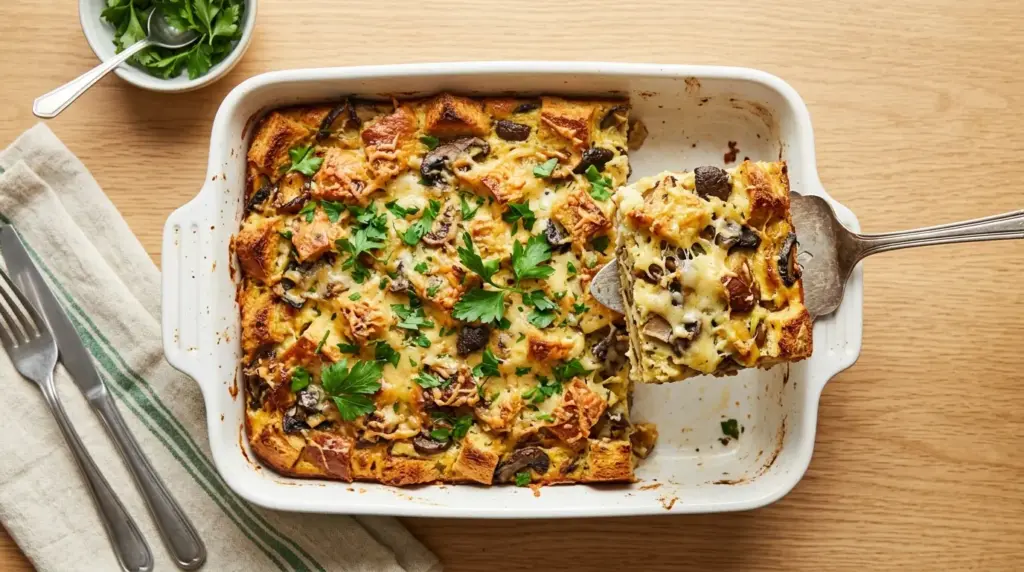
Savory bread pudding is a versatile dish that works beautifully across different meal occasions. It’s substantial enough to serve as a main course for brunch or a light dinner, and elegant enough to sit alongside a holiday spread.
Here are some of the best ways to serve it:
- For brunch: Slice and serve warm alongside a simple Fruit Salad and freshly brewed coffee for a complete and impressive spread.
- As a side dish: It makes a stunning alternative to traditional stuffing alongside roasted chicken or Baked Salmon.
- With a drizzle of sauce: A simple béchamel or a spoonful of Bechamel Sauce drizzled over each serving adds a silky richness that takes it over the top.
- With a green salad: Balance the richness of the bread pudding with a crisp, lightly dressed arugula or mixed green salad with a sharp lemon vinaigrette.
- For a holiday table: Serve it warm from the baking dish as part of a festive spread, right next to roasted vegetables and Cranberry Sauce.
- Room temperature: It slices beautifully and holds its shape well, making it an excellent choice for buffets or potluck gatherings.
Another excellent brunch option to consider: Shakshuka
Variations to Try
Once you have the basic technique down, savory bread pudding becomes a canvas for creativity. The custard base and technique stay the same; it’s the fillings that you can change to suit whatever you have on hand or the mood you’re in.
Here are some variations worth trying:
- Sausage and Cheddar: Replace the mushrooms with 8 oz (225g) of cooked, crumbled sweet Italian sausage and swap Gruyère for sharp cheddar. This version is heartier and excellent for a crowd.
- Sun-dried Tomato and Feta: Add ½ cup of chopped sun-dried tomatoes and crumbled feta in place of the Gruyère for a Mediterranean-inspired version with a bright, tangy edge.
- Ham and Swiss: Dice 6 oz (170g) of cooked ham and combine it with Swiss cheese and sautéed leeks. This is a French-inspired version that feels particularly elegant at brunch.
- Roasted Red Pepper and Goat Cheese: Fold in roasted red peppers and crumbled goat cheese instead of Gruyère for a version that’s a little sweeter and more tangy.
- Vegetarian Deluxe: Load it up with sautéed zucchini, roasted cherry tomatoes, olives, and a mix of Parmesan and mozzarella for a veggie-forward version that still feels indulgent.
- Make-ahead overnight version: Assemble everything the evening before, cover tightly, and refrigerate overnight. Pull it from the fridge 30 minutes before baking to take the chill off.
For another easy baked dish with tons of variations, try this Breakfast Casserole.
Storage and Reheating
Savory bread pudding stores and reheats exceptionally well, which makes it a genuinely practical dish for meal prep or hosting. The flavors actually deepen after a day in the fridge.
Follow these guidelines for the best results:
- Refrigerator: Cover the baking dish tightly with plastic wrap or transfer individual portions to an airtight container. It keeps well in the refrigerator for up to 4 days.
- Freezer: Allow the bread pudding to cool completely, then wrap individual portions in plastic wrap and place them in a freezer-safe bag or container. It freezes well for up to 2 months. Thaw overnight in the refrigerator before reheating.
- Reheating in the oven: Place portions in a baking dish, cover with foil, and reheat at 325°F (160°C) for 15 to 20 minutes. Remove the foil for the final 5 minutes to re-crisp the top.
- Reheating in the microwave: Place individual portions on a microwave-safe plate and cover loosely. Reheat on medium power in 60-second intervals until warmed through. Note that the microwave softens the top crust, so the oven method is preferred if you have time.
- Do not reheat from frozen. Always thaw overnight in the refrigerator first for the best texture.
This recipe is also a natural companion to Slow Cooker Pot Roast for a hearty, warming dinner menu.
Nutritional Facts
The following values are approximate for one serving, based on 8 servings per recipe and using the full Gruyère and heavy cream.
| Nutrient | Amount Per Serving |
|---|---|
| Calories | 385 kcal |
| Total Fat | 22g |
| Saturated Fat | 11g |
| Cholesterol | 195mg |
| Sodium | 580mg |
| Total Carbohydrates | 28g |
| Dietary Fiber | 2g |
| Total Sugars | 4g |
| Protein | 18g |
| Calcium | 280mg |
| Iron | 2.5mg |
Note: Nutritional values will vary based on the bread used, specific cheese, and any additional ingredients like pancetta. For a lighter version, substitute half-and-half for the heavy cream and reduce the cheese by a quarter.
Read Also: Chocolate Bread Pudding
Health Benefits of Key Ingredients
This dish is deeply comforting, and it also happens to contain several genuinely nutritious ingredients worth highlighting.
Here’s a closer look at what each key ingredient brings to the table nutritionally:
- Eggs are a powerhouse protein source and provide all nine essential amino acids. They’re also one of the few dietary sources of choline, a nutrient important for brain function and liver health.
- Cremini mushrooms are rich in B vitamins including riboflavin and niacin, and they’re a rare plant-based source of vitamin D when grown under UV light. They also contain potassium and powerful antioxidants.
- Gruyère cheese provides a significant amount of calcium and protein per serving. It also contains phosphorus and vitamin B12, making it a nutritionally worthwhile addition beyond just its incredible flavor.
- Spinach is one of the most nutrient-dense leafy greens available. It provides iron, folate, vitamin K, and lutein, a compound associated with eye health.
- Sourdough bread has a lower glycemic index compared to many other breads due to the fermentation process, which partially breaks down gluten and reduces the impact on blood sugar.
- Thyme and rosemary are both rich in antioxidants and have anti-inflammatory properties. Thyme in particular has been used historically for respiratory health.
For another nutrient-rich comfort dish, try this Roasted Butternut Squash Soup.
Frequently Asked Questions
1. Can I use fresh bread instead of stale bread?
Fresh bread can work in a pinch, but it’s not ideal. Fresh bread is too moist and tends to absorb the custard unevenly, often turning soft and dense in the center rather than creamy and custardy. The best fix is to spread fresh bread cubes on a baking sheet and dry them out in a 350°F (175°C) oven for 10 to 12 minutes before using. This mimics the texture of day-old bread and gives you consistent results.
2. What’s the best bread to use for savory bread pudding?
Sourdough and French bread are the top choices because they’re sturdy enough to hold up during soaking and have enough flavor to complement the savory fillings. Brioche and challah also work beautifully and produce a richer, more luxurious custard. Avoid soft sandwich bread, which tends to dissolve rather than absorb.
3. Can I make this recipe vegetarian?
Absolutely. Simply use vegetable broth in place of chicken broth, and skip the pancetta or prosciutto if using those. The mushrooms, cheese, spinach, and herb custard are more than enough to create a deeply flavorful dish without any meat. Make sure to select a Gruyère that’s made without animal rennet if strict vegetarian compliance is important.
4. Can I make savory bread pudding ahead of time?
This is actually one of the best make-ahead dishes you can prepare. Assemble the entire dish through the assembly step, cover it tightly with plastic wrap, and refrigerate overnight. Pull it from the fridge 30 minutes before baking to take the chill off, then bake as directed. The overnight rest actually improves the texture by giving the bread even more time to absorb the custard.
5. Why is my bread pudding soggy in the middle?
A soggy center usually points to one of three things: the bread wasn’t dry enough before soaking, the custard ratio was too high, or the baking time was too short. Start by making sure your bread is properly stale or oven-dried. Then confirm the dish is baking long enough for the custard to fully set. Press the center firmly with your finger; if it bounces back like a set custard rather than jiggling like liquid, it’s done. If still soft, cover it with foil and bake for 10 more minutes.
For more egg-based baked dishes, check out this Egg Bake.

Savory Bread Pudding with Gruyère and Mushrooms

Equipment
- 9×13-inch Deep Baking Dish - 23x33cm ceramic or glass dish works best
- Large mixing bowl
- Medium mixing bowl
- Large skillet or sauté pan - Preferably a 12-inch cast iron skillet
- Box Grater or Cheese Grater - For freshly grating the Gruyère
- Whisk
- Cutting Board and Chef’s Knife
- Wooden spoon or silicone spatula
- Measuring cups and spoons
- Aluminum foil - For covering during the first half of baking
- Rimmed baking sheets - For drying fresh bread cubes
Ingredients
- 1 lb day-old sourdough or French bread - 450g, cut into 1-inch/2.5cm cubes (about 8 cups)
- 6 large eggs
- 1 ½ cups whole milk - 360ml
- 1 cup heavy cream - 240ml, use organic if possible
- 1 cup low-sodium chicken or vegetable broth - 240ml
- 1 lb cremini mushrooms - 450g, sliced
- 2 medium shallots - finely diced
- 3 cloves garlic - minced
- 2 cups fresh baby spinach - 60g
- 1 ½ cups Gruyère cheese - 170g, freshly grated, divided (1 cup/115g for filling, ½ cup/55g for topping)
- 2 tablespoons extra virgin olive oil - 30ml, divided
- 2 tablespoons unsalted butter - 28g, divided, plus more for greasing the dish
- 1 tablespoon fresh thyme leaves - or 1 teaspoon dried thyme
- 1 teaspoon fresh rosemary - finely chopped
- 1 teaspoon Dijon mustard
- 1 teaspoon salt
- ½ teaspoon black pepper
- ¼ teaspoon ground nutmeg
- ¼ teaspoon red pepper flakes - optional
- 2 tablespoons fresh flat-leaf parsley - chopped, for garnish
Optional Additions
- 6 oz pancetta or prosciutto - 170g, diced, for a heartier version
Instructions
- Preheat oven to 350°F (175°C). Cut bread into 1-inch cubes and spread on a baking sheet. Bake for 10-12 minutes until dry and lightly toasted. Leave oven on.
- In a large bowl, whisk eggs until frothy. Add milk, cream, broth, salt, pepper, nutmeg, and Dijon mustard. Whisk until fully combined. Set aside.
- Heat 1 tablespoon olive oil and 1 tablespoon butter in a large skillet over medium-high heat. Add half the mushrooms in a single layer. Cook undisturbed for 4-5 minutes until browned, then flip and cook 2-3 minutes more. Transfer to a plate and repeat with remaining mushrooms.
- In the same skillet, add remaining butter. Cook shallots for 3-4 minutes until soft. Add garlic and cook 60 seconds until fragrant. Stir in thyme, rosemary, and red pepper flakes. Add spinach and cook 1-2 minutes until wilted. Set aside with mushrooms.
- In a large bowl, combine toasted bread cubes, cooked mushrooms, shallot-spinach mixture, and 1 cup of grated Gruyère. Fold in pancetta if using. Toss gently to distribute evenly.
- Butter the baking dish. Transfer the bread mixture to the dish and spread evenly. Whisk custard again and pour slowly over the bread, pressing down gently to help absorption. Sprinkle remaining ½ cup Gruyère on top. Let rest for 20 minutes at room temperature.
- Cover tightly with foil and bake for 30 minutes. Remove foil and bake uncovered for 20-25 minutes more until golden brown and set. The center should spring back when pressed. Broil for 2-3 minutes for extra crispness, if desired.
- Rest for 10 minutes before cutting. Garnish with fresh parsley. Serve warm from the baking dish.
Notes
- Use stale bread: Day-old or oven-dried bread is essential for a creamy texture. Fresh bread will turn soggy and dense.
- Don’t skip the resting time: Letting the assembled dish rest for 20 minutes (or overnight in the fridge) allows the bread to fully absorb the custard for even results.
- Sauté mushrooms in batches: Crowding the pan causes steaming instead of browning. Work in batches with plenty of space.
- Grate your own cheese: Pre-shredded Gruyère contains anti-caking agents that prevent smooth melting. A freshly grated block melts beautifully.
- Season every component: Lightly salt the mushrooms after cooking and season the custard well. A dish that isn’t seasoned at each stage will taste flat.
- Cover during first half of baking: Foil traps steam to help the custard set gently. Removing it for the final stretch gives you a golden, crispy crust.
- Let it rest before cutting: Resting for 10 minutes allows the custard to firm up, making clean slices possible.
- Make-ahead instructions: Assemble the entire dish through the assembly step, cover tightly, and refrigerate overnight. Pull from the fridge 30 minutes before baking.
- Storage and reheating: Refrigerate covered for up to 4 days or freeze for up to 2 months. Reheat in a 325°F (160°C) oven covered with foil for 15-20 minutes.
- Variations: Swap mushrooms for cooked sausage, sun-dried tomatoes, ham, or roasted vegetables. Try cheddar, fontina, or feta in place of Gruyère.
Final Thoughts
Savory bread pudding is the kind of recipe that doesn’t ask for much but consistently delivers something genuinely spectacular. It takes humble, everyday ingredients and transforms them into a dish that feels special enough for company but approachable enough for a Wednesday night.
What makes it truly endearing is its flexibility. Swap the mushrooms, change the cheese, add sausage or keep it vegetarian. The technique is forgiving and the result is reliably delicious every single time.
If you’ve been on the fence about trying it, this is your sign. Make it this weekend, bring it to the brunch table, and watch it disappear.
Drop a comment below to let us know how yours turned out or which variation you tried. And if you’re sharing on social media, tag us so we can see your creation!
Recommended:
- Banana Bread Pudding
- Bread and Butter Pudding
- Jamaican Bread Pudding
- Corn Pudding
- Yorkshire Pudding
- Rosemary Focaccia
- Baked Oatmeal
- Hashbrown Casserole
- Sausage Gravy
- Creamed Spinach