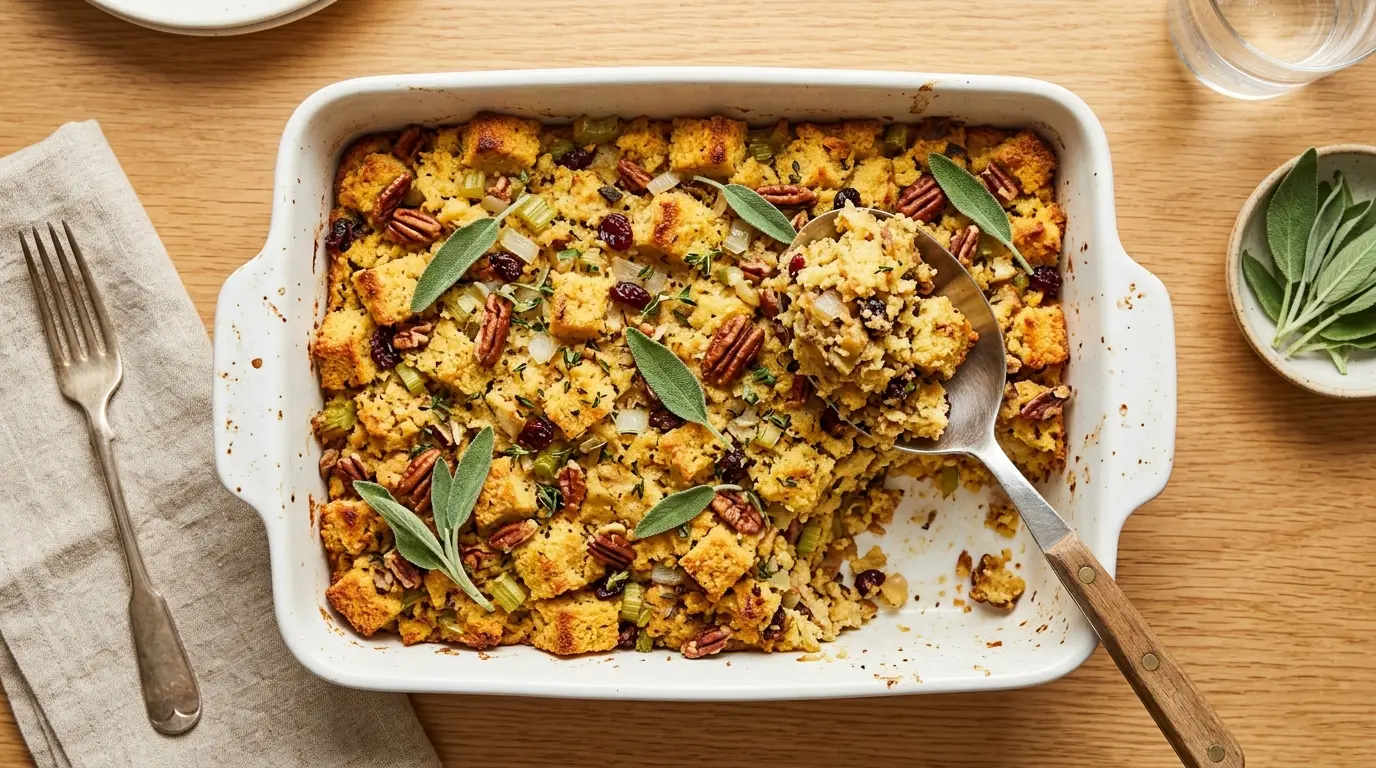
If you ask most home cooks what they look forward to most at Thanksgiving, cornbread stuffing is almost always near the top of the list. This cornbread stuffing recipe brings together crumbled cornbread, sautéed celery and onion, savory herbs, and just enough chicken broth to make every bite moist and flavorful, with golden crisp edges on top.
It is one of those dishes that fills the whole kitchen with the most inviting smell the moment it hits the oven.
Whether you call it stuffing or dressing, the method here is the same: you bake it in a casserole dish rather than inside the bird, which means it cooks more evenly, develops a beautiful crust on top, and is much easier to make ahead.
The key to getting it just right lies in a few simple techniques, starting with drying out your cornbread first. Dry cornbread soaks up all that savory broth and herb flavor far better than fresh-baked cornbread does, which is what gives this dish its rich, cohesive texture.
This is a recipe you can trust for a holiday table, a Sunday dinner, or any cozy autumn meal.
For another Southern classic to pair with your holiday spread, you might enjoy this Southern Cornbread as the base for this recipe.
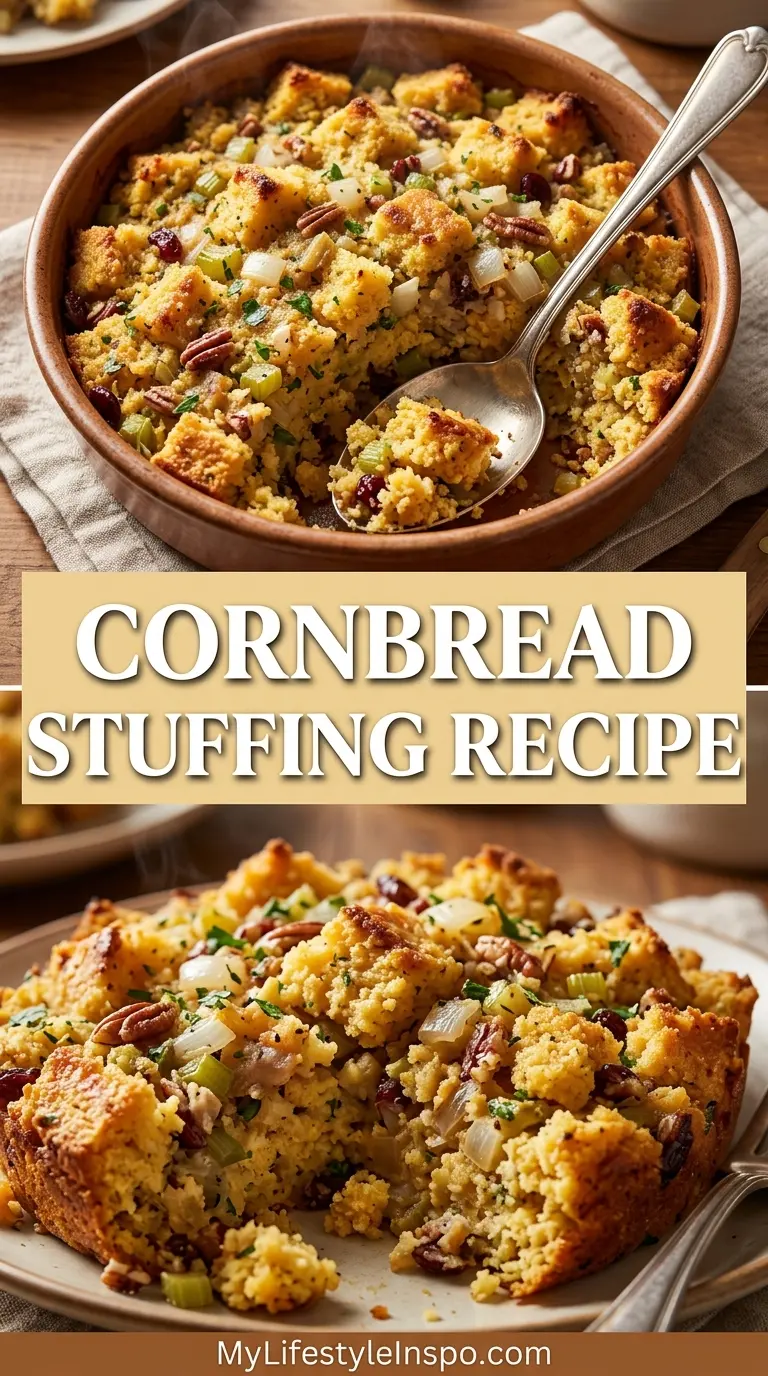
Why You’ll Love This Cornbread Stuffing Recipe
This recipe delivers everything you want from a classic stuffing, and it is genuinely easy to pull off.
The cornbread base gives the dish a slightly sweet, tender crumb that soaks up savory flavors beautifully. It is a welcome change from all-white-bread stuffing and brings a subtle richness that makes people go back for seconds.
The herbs do the heavy lifting here. Sage, thyme, and parsley create that unmistakable holiday aroma that makes your kitchen smell incredible the moment the aromatics start cooking.
You can prep this dish entirely the day before and bake it fresh on the day, which frees up your oven and your attention when it matters most.
It also scales beautifully. Double the recipe for a crowd, or halve it for a smaller gathering.
- Made with simple, pantry-friendly ingredients
- Easily customizable with sausage, mushrooms, or dried cranberries
- Make-ahead friendly for stress-free holiday cooking
- Serves a crowd with minimal effort
- Golden, crisp top with a tender, moist interior
You might also enjoy: Slow Cooker Stuffing
Ingredients
You will need a few key components to make this stuffing work. The cornbread is the star, so use a good-quality batch, either homemade or store-bought, but make sure it is fully cooled before you cube and toast it.
- 8 cups (about 1 kg) crumbled day-old cornbread, cut into 1-inch cubes
- 4 tablespoons (56 g) unsalted butter
- 1 large yellow onion, finely diced (about 1½ cups / 225 g)
- 3 stalks celery, finely diced (about 1 cup / 100 g)
- 3 cloves garlic, minced
- 2 teaspoons dried sage (or 1 tablespoon fresh)
- 1 teaspoon dried thyme
- 1 teaspoon dried parsley
- ½ teaspoon dried rosemary
- Salt and black pepper, to taste
- 2 large eggs, lightly beaten
- 2 to 2½ cups (480 to 600 ml) low-sodium chicken broth (or vegetable broth for vegetarian)
- 2 tablespoons (28 g) unsalted butter, melted, for topping
For a flavorful twist on the base recipe, try making your stuffing with Jiffy Cornbread with Creamed Corn for extra moisture and sweetness.
Kitchen Equipment Needed
You do not need any special equipment for this recipe, but having the right tools makes the process much smoother.
- Large baking dish (9×13 inch / 23×33 cm), ideally ceramic or glass
- Large skillet or cast iron skillet for sautéing the aromatics
- Large mixing bowl, at least 6-quart capacity
- Baking sheet for toasting the cornbread cubes
- Instant-read thermometer to check internal temperature
- Wooden spoon or silicone spatula for mixing
- Sharp chef’s knife and cutting board
- Measuring cups and spoons
- Aluminum foil for covering during the first part of baking
Read Also: Corn Casserole Recipe
Recommended Products for This Recipe
These are products I genuinely recommend for making this cornbread stuffing come out perfectly, chosen based on quality and how much they improve the final dish.
1. Le Creuset Enameled Cast Iron Baking Dish
A heavy, enameled baking dish distributes heat evenly across the entire surface, which means your stuffing develops a consistent golden crust rather than burning in spots. The smooth interior also makes cleanup a breeze even after a long day of cooking. It is an investment that will serve you for decades.
2. Bob’s Red Mill Stone Ground Cornmeal
If you are making your cornbread from scratch, the quality of your cornmeal matters enormously. Stone-ground cornmeal has more natural corn flavor and a coarser texture that creates a sturdier crumb, which holds up beautifully when cubed and toasted for stuffing.
3. Swanson Low-Sodium Chicken Broth
The broth is the liquid backbone of this stuffing, and using a low-sodium version gives you full control over the seasoning. Swanson is a trusted, widely available option with a clean, neutral flavor that lets the herbs shine through.
4. Fresh Herb Bundle (Sage, Thyme, Rosemary)
Using fresh herbs instead of dried elevates this stuffing noticeably, especially if you have never tried it. Fresh sage in particular has a deeper, more complex flavor than its dried counterpart. If your grocery store carries them, the difference is worth it.
Read Also: Sausage Stuffing Recipe
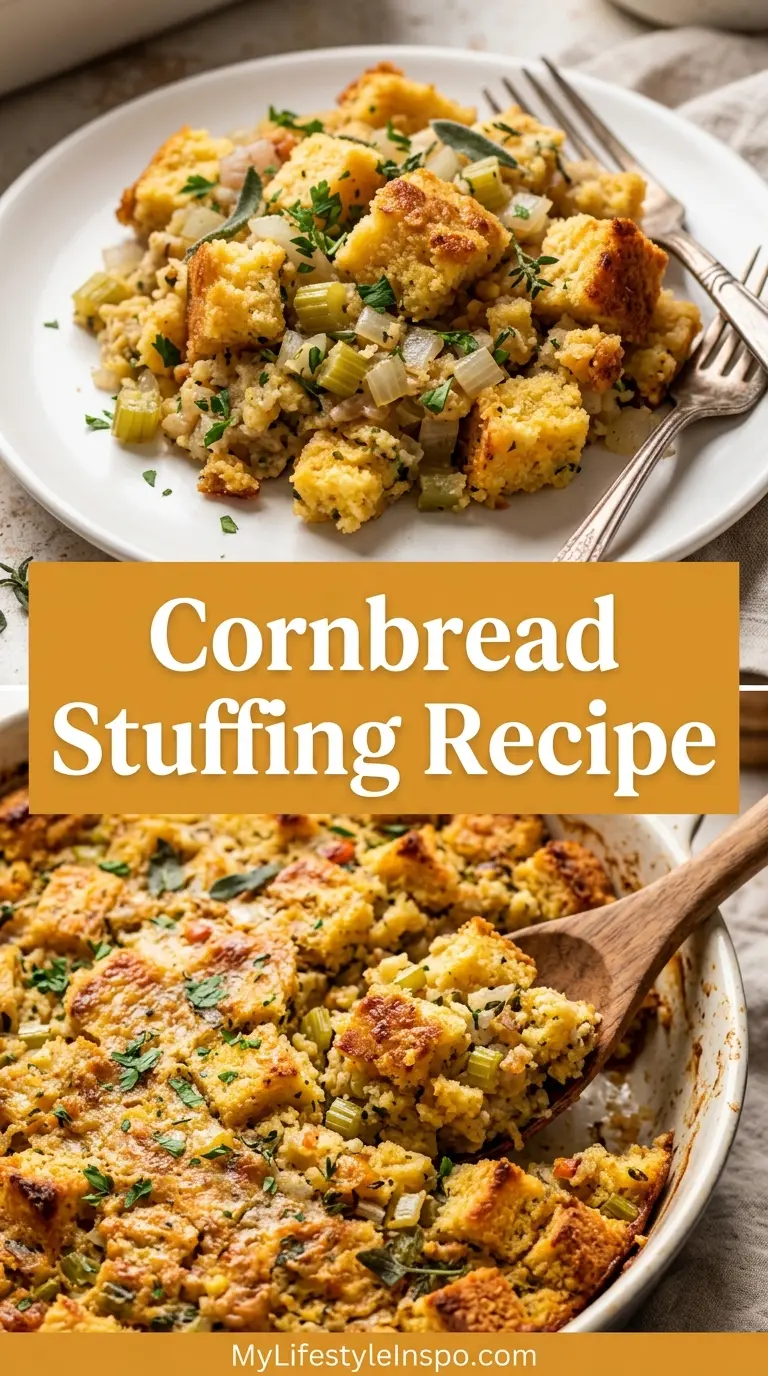
Step-by-Step Instructions
1. Dry Out the Cornbread
Moisture is the enemy of great stuffing texture. Drying the cornbread first helps it absorb the broth and egg mixture without turning mushy.
- Preheat your oven to 300°F (150°C).
- Cut or crumble your cooled cornbread into rough 1-inch (2.5 cm) cubes.
- Spread the cubes in a single layer across one or two large baking sheets, making sure they are not piled on top of each other.
- Bake for 25 to 30 minutes, tossing once halfway through, until the cubes feel dry and just lightly golden on the edges.
- Remove from the oven and let them cool completely on the baking sheets before using. They should feel firm and slightly stale, not soft or doughy.
2. Sauté the Aromatics
This step builds the savory base flavor of your stuffing. Do not rush it; letting the vegetables soften properly brings out their natural sweetness.
- Melt 4 tablespoons (56 g) of butter in a large skillet over medium heat.
- Add the diced onion and celery to the skillet.
- Cook, stirring occasionally, for 8 to 10 minutes, or until the vegetables are very soft, translucent, and just beginning to turn golden at the edges.
- Add the minced garlic and cook for another 1 minute, stirring constantly, until fragrant. Be careful not to let the garlic burn.
- Add the dried sage (or fresh, finely chopped), thyme, parsley, and rosemary directly to the vegetable mixture.
- Stir everything together and cook for 30 seconds more so the dried herbs bloom in the heat and become aromatic.
- Season generously with salt and black pepper. Remove the skillet from the heat and let the mixture cool for 5 minutes.
3. Combine the Stuffing Mixture
Now you bring all the components together. Handle the cornbread gently here; you want it to hold some texture and not turn into mush.
- Preheat your oven to 375°F (190°C).
- Grease a 9×13 inch (23×33 cm) baking dish with butter or cooking spray.
- Place the toasted cornbread cubes in a very large mixing bowl (the bigger the better, to make mixing easier).
- Pour the sautéed vegetable and herb mixture over the cornbread cubes.
- In a small bowl or measuring cup, whisk together the 2 beaten eggs and 2 cups (480 ml) of chicken broth until fully combined.
- Pour the egg and broth mixture over the cornbread and vegetables.
- Using a large spoon or your hands, gently fold everything together until the cornbread is evenly moistened. You want every cube to have some liquid contact, but you do not want to smash the bread into paste.
- Check the consistency: the mixture should be moist and hold together when you press a handful, but should not be dripping wet or soupy. If it seems too dry, add additional broth in 2-tablespoon increments up to ½ cup (120 ml) more.
- Taste the mixture and adjust seasoning with salt and pepper if needed.
4. Transfer to the Baking Dish and Add the Butter Topping
Getting the stuffing into the dish correctly sets you up for the ideal bake: moist and tender inside, golden and slightly crisp on top.
- Spoon the stuffing mixture into the prepared baking dish and spread it into an even layer.
- Press down gently with the back of the spoon so it is compact but not packed too tightly.
- Drizzle the 2 tablespoons (28 g) of melted butter evenly over the top of the stuffing. This is what creates that beautiful golden crust.
5. Bake the Stuffing
The two-stage baking method gives you the best of both worlds: a fully cooked, moist interior and a golden, lightly crunchy top.
- Cover the baking dish tightly with aluminum foil.
- Bake at 375°F (190°C) for 30 minutes covered. This steams the interior and ensures the stuffing is cooked all the way through without drying out.
- After 30 minutes, remove the foil and continue baking for an additional 20 to 25 minutes, uncovered, until the top is deep golden brown and the edges are slightly crisp.
- To check doneness, insert an instant-read thermometer into the center of the stuffing. It should read at least 165°F (74°C).
- Let the stuffing rest for 5 to 10 minutes before serving. This allows it to firm up slightly and makes it easier to scoop and serve cleanly.
This same base technique works beautifully in the How to Make Bread Stuffing Balls 1940s Recipe if you want to try a fun vintage variation.
Tips for Success
A few small details make a big difference between average stuffing and truly great stuffing. Keep these in mind as you work through the recipe.
- Dry your cornbread properly. If the cornbread is even slightly moist, the finished stuffing will be dense and gummy. Give it a full 25 to 30 minutes in the low oven.
- Do not over-mix. Once you add the liquid, fold gently. Over-mixing breaks down the cornbread too much and you lose that varied, textured bite.
- Control your broth amount carefully. Start with 2 cups and add more only if needed. It is much easier to add more liquid than to rescue a soupy stuffing.
- Season at multiple points. Salt the vegetables as they cook, then taste the combined mixture before baking. Cornbread can be sweet, and the whole dish needs enough seasoning to stay savory and balanced.
- Rest before serving. Like a good casserole, stuffing improves after 5 to 10 minutes out of the oven. It sets up, holds its shape better, and the flavors come together.
- Do not skip the butter drizzle on top. That thin layer of fat is what turns the top from just golden to properly crisp and deeply savory.
For another comforting side with a similarly golden top, check out the Corn Pudding Recipe.
Serving Suggestions
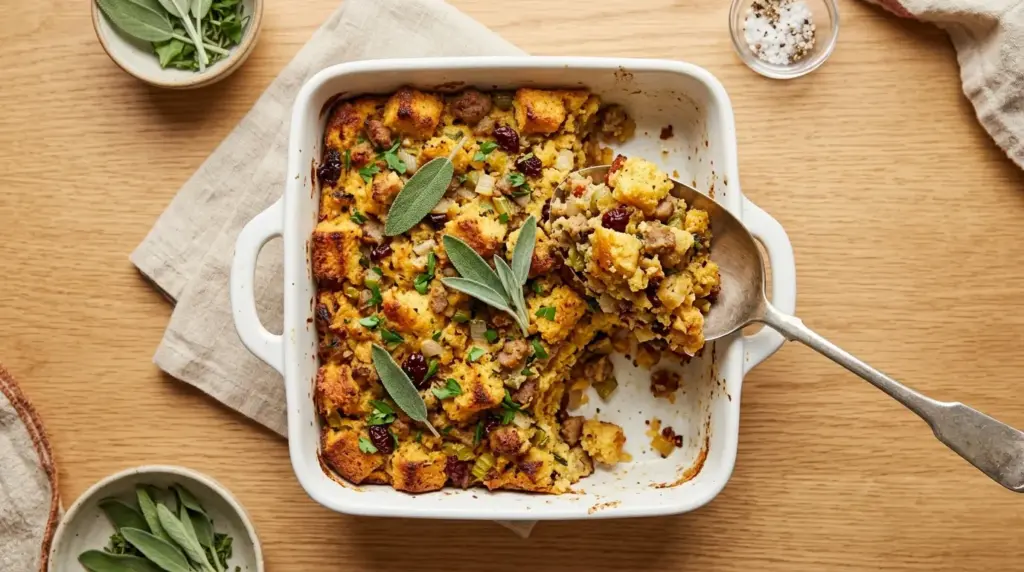
This stuffing belongs at the center of a full holiday table, but it is also wonderful alongside simpler weeknight roasts.
It is a natural partner for roasted turkey and no Thanksgiving spread feels complete without it. Serve it alongside Turkey Gravy poured generously over both the turkey and the stuffing for the ultimate bite.
- Thanksgiving Turkey as the main centerpiece
- Cranberry Sauce for a bright, tart contrast
- Green Bean Casserole as a classic companion side
- Sweet Potato Casserole for sweet balance on the plate
- Creamy Mashed Potatoes if you want to go all-out comfort
- Collard Greens for a Southern-style spread
- Dinner Rolls for soaking up every last drop of gravy
Variations to Try
Once you have the base recipe down, there are plenty of ways to customize this stuffing to suit different tastes and occasions.
- Sausage Cornbread Stuffing: Brown 8 ounces (225 g) of crumbled pork or Italian sausage in the skillet before sautéing the vegetables. Drain excess fat, then proceed with the recipe as written. The sausage adds a savory, meaty richness that many families swear by.
- Mushroom and Herb Stuffing: Add 8 ounces (225 g) of sliced cremini or shiitake mushrooms to the skillet along with the onion and celery. The mushrooms add an earthy depth that works particularly well if you are serving this without turkey.
- Cranberry Pecan Stuffing: Fold in ½ cup (60 g) of dried cranberries and ½ cup (55 g) of roughly chopped toasted pecans when you combine the ingredients. The sweet-tart and crunchy additions make the stuffing feel more festive.
- Jalapeño Cheddar Stuffing: Stir 1 finely diced jalapeño (seeds removed for mild heat) and ¾ cup (85 g) of shredded sharp cheddar into the mixture before baking. Pairs beautifully with a Jalapeño Cornbread base.
- Slow Cooker Version: After combining all ingredients, transfer the mixture to a greased slow cooker insert. Cook on low for 3 to 4 hours, or until set and cooked through. Finish under the broiler for 2 to 3 minutes if you want a crisped top.
Storage and Reheating
Properly stored, this stuffing keeps well and reheats beautifully, making it ideal for holiday meal prep.
Storing leftovers:
- Let the stuffing cool completely before covering.
- Transfer leftovers to an airtight container, or cover the baking dish tightly with plastic wrap or foil.
- Refrigerate for up to 4 days.
- To freeze, portion the cooled stuffing into freezer-safe containers and freeze for up to 3 months. Thaw overnight in the refrigerator before reheating.
Reheating:
- Oven (best method): Place stuffing in an oven-safe dish, add 2 to 3 tablespoons of broth to prevent drying, cover with foil, and bake at 350°F (175°C) for 20 to 25 minutes, or until heated through.
- Microwave: Place a portion in a microwave-safe bowl, add a splash of broth, cover loosely, and heat in 60-second intervals until warmed through.
- Avoid overheating as this causes the stuffing to dry out.
Read Also: Turkey Soup Recipe
Nutritional Facts
The following nutritional values are based on a standard serving size of approximately 1 cup of this cornbread stuffing, calculated as one of 10 servings from the recipe as written.
| Nutrient | Per Serving |
|---|---|
| Calories | 245 kcal |
| Total Fat | 10 g |
| Saturated Fat | 5 g |
| Cholesterol | 68 mg |
| Sodium | 390 mg |
| Total Carbohydrates | 32 g |
| Dietary Fiber | 2 g |
| Total Sugars | 6 g |
| Protein | 7 g |
These values are approximate and will vary based on the specific cornbread recipe or mix used, as well as any additions like sausage.
Another favorite: Corn Souffle Recipe
Health Benefits of Key Ingredients
While cornbread stuffing is a comfort food rather than a health food, several of its core ingredients do bring genuine nutritional value to the table.
The combination of whole ingredients in this dish makes it more nourishing than it might first appear.
- Cornbread (cornmeal base): Cornmeal provides complex carbohydrates for sustained energy, along with dietary fiber, iron, and B vitamins. Stone-ground cornmeal retains more of the germ and bran than refined varieties.
- Celery: One of the most underrated vegetables in cooking, celery is high in vitamin K, folate, potassium, and antioxidants, while being extremely low in calories. It also adds a natural sodium boost that helps with overall seasoning.
- Onion: Onions are rich in quercetin, a flavonoid antioxidant with anti-inflammatory properties. They also provide prebiotic fiber that supports gut health.
- Garlic: Beyond its bold flavor, garlic contains allicin, a compound associated with immune support and cardiovascular health benefits.
- Sage: Used medicinally for centuries, sage is high in antioxidants and has been studied for its potential anti-inflammatory and cognitive benefits. It also aids digestion, making it especially fitting for a rich holiday meal.
- Eggs: The eggs in this recipe bind the stuffing and contribute protein, choline, and fat-soluble vitamins A and D.
- Chicken broth (low-sodium): Provides collagen-related compounds and minerals while keeping the stuffing moist without excess fat.
You might also enjoy: Garlic Mashed Potatoes
Frequently Asked Questions
1. What is the difference between stuffing and dressing?
Technically, “stuffing” refers to a bread-based dish that is cooked inside the cavity of a turkey or chicken. “Dressing” is the same dish baked separately in a casserole dish. Since this recipe bakes in a dish, it is technically a dressing, but the two terms are used interchangeably in most home kitchens. Either way, the flavor and texture are essentially the same.
2. Can I make cornbread stuffing ahead of time?
Absolutely, and it actually benefits from being made ahead. Assemble the stuffing up to 24 hours in advance, cover the unbaked dish tightly, and refrigerate it. When ready to bake, let it sit at room temperature for 20 to 30 minutes, then bake as directed. You may need to add an extra 5 to 10 minutes of baking time since it will start cold.
3. What is the best cornbread to use for stuffing?
The best cornbread for stuffing is one that is slightly savory rather than overly sweet. Southern-style cornbread made without much sugar works beautifully. A Jiffy mix works in a pinch but will add a touch of sweetness to the final dish. Homemade is always preferred when you have the time. Regardless of which you use, make sure the cornbread is fully cooled and dried out before using it.
4. How do I know if my stuffing is too dry or too wet?
Before baking, grab a handful of the combined mixture and squeeze it gently. It should hold its shape and feel moist throughout, similar to a wet sand consistency. It should not drip liquid, but it also should not crumble apart. If it crumbles, add a little more broth. If it feels sopping wet or drips when squeezed, you have added too much liquid. Spreading it out in the dish and baking it uncovered for a longer period can help correct an overly wet stuffing.
5. Can I make cornbread stuffing gluten-free?
Yes. The only source of gluten in this recipe is the cornbread itself. Use a gluten-free cornbread recipe or a certified gluten-free cornbread mix, and ensure your chicken broth is also labeled gluten-free (most are, but it is worth checking). Everything else in the recipe is naturally gluten-free. The texture will be nearly identical to the original.
For a tested, reliable base, try the Gluten Free Cornbread as your starting point.

Classic Cornbread Stuffing

Equipment
- 9×13-inch baking dish - ceramic or glass recommended
- Large skillet - or cast iron skillet for sautéing aromatics
- Large mixing bowl - at least 6-quart capacity
- Baking sheet - for toasting cornbread cubes
- Instant-read thermometer - to check internal temperature
- Wooden spoon - or silicone spatula for mixing
- Chef’s knife
- Cutting board
- Measuring cups
- Measuring spoons
- Aluminum foil - for covering during first part of baking
Ingredients
- 8 cups day-old cornbread - about 1 kg, cut into 1-inch cubes and dried out
- 4 tablespoons unsalted butter - 56g, for sautéing
- 1 large yellow onion - about 1½ cups or 225g, finely diced
- 3 stalks celery - about 1 cup or 100g, finely diced
- 3 cloves garlic - minced
- 2 teaspoons dried sage - or 1 tablespoon fresh
- 1 teaspoon dried thyme
- 1 teaspoon dried parsley
- ½ teaspoon dried rosemary
- Salt - to taste
- Black pepper - to taste
- 2 large eggs - lightly beaten
- 2 cups low-sodium chicken broth - 480ml, or vegetable broth for vegetarian; plus up to ½ cup more if needed
- 2 tablespoons unsalted butter - 28g, melted, for topping
Optional Variations
- 8 ounces pork sausage - 225g, crumbled, for sausage cornbread stuffing
- 8 ounces cremini mushrooms - 225g, sliced, for mushroom and herb stuffing
- ½ cup dried cranberries - 60g, for cranberry pecan stuffing
- ½ cup pecans - 55g, roughly chopped and toasted, for cranberry pecan stuffing
- 1 jalapeño - finely diced with seeds removed for mild heat, for jalapeño cheddar stuffing
- ¾ cup sharp cheddar cheese - 85g, shredded, for jalapeño cheddar stuffing
Instructions
- Preheat oven to 300°F. Cut cooled cornbread into 1-inch cubes and spread in a single layer on baking sheets. Bake for 25-30 minutes, tossing once, until dry and lightly golden. Cool completely.
- Melt 4 tablespoons butter in a large skillet over medium heat. Add onion and celery and cook 8-10 minutes until soft and translucent. Add garlic and cook 1 minute until fragrant.
- Add sage, thyme, parsley, and rosemary to skillet. Cook 30 seconds until aromatic. Season generously with salt and pepper. Remove from heat and cool 5 minutes.
- Preheat oven to 375°F and grease a 9×13 inch baking dish. Place toasted cornbread cubes in a large mixing bowl. Pour vegetable mixture over cubes.
- Whisk eggs and 2 cups broth together. Pour over cornbread and fold gently until evenly moistened. Add more broth if needed. Mixture should hold together when pressed but not be soupy.
- Spoon stuffing into prepared dish and spread evenly. Press down gently with spoon. Drizzle melted butter evenly over top.
- Cover tightly with foil and bake at 375°F for 30 minutes. Remove foil and bake 20-25 minutes more until top is deep golden brown and edges are crisp.
- Check internal temperature reaches 165°F. Let rest 5-10 minutes before serving. Garnish with fresh herbs if desired.
Notes
- Drying cornbread is essential: Don’t skip this step. Moist cornbread will result in dense, gummy stuffing. If short on time, spread cubes on a baking sheet and leave out overnight to stale.
- Handle gently: Fold ingredients together carefully to keep some texture in the cornbread. Over-mixing breaks down the bread and results in a paste-like texture.
- Broth control: Start with 2 cups and add more gradually. It’s easier to add liquid than to fix a soupy stuffing. The mixture should be moist but not dripping.
- Season in layers: Salt the vegetables while cooking, then taste the combined mixture before baking. Cornbread can be sweet, so proper seasoning is crucial for balance.
- Make ahead option: Assemble the stuffing up to 24 hours in advance, cover, and refrigerate. Let sit at room temperature 20-30 minutes before baking. Add 5-10 minutes to bake time since starting cold.
- Freezing instructions: Cool completely, portion into freezer-safe containers, and freeze for up to 3 months. Thaw overnight in the refrigerator before reheating.
- Reheating best method: Place in an oven-safe dish, add 2-3 tablespoons broth, cover with foil, and bake at 350°F for 20-25 minutes until heated through.
- Vegetarian option: Use vegetable broth instead of chicken broth and omit any sausage variations. The stuffing will still be flavorful and delicious.
- Gluten-free adaptation: Use a gluten-free cornbread recipe or certified gluten-free mix. Ensure your broth is labeled gluten-free (most are).
- Slow cooker method: After combining all ingredients, transfer to a greased slow cooker. Cook on low for 3-4 hours until set. Finish under broiler for 2-3 minutes for a crispy top.
Final Thoughts
This cornbread stuffing recipe is everything a holiday side dish should be: warm, savory, comforting, and deeply satisfying.
It is the kind of recipe that earns a permanent spot in your rotation, not just for Thanksgiving, but for any meal where you want something special on the table.
Once you make this from scratch, the store-bought version will never quite measure up.
Give it a try and let us know how it goes! Leave a comment below with your favorite additions, and feel free to share this recipe with anyone who loves a great holiday side dish.
Recommended:
- Sourdough Discard Cornbread
- Sweet Cornbread
- Skillet Cornbread
- Hot Water Cornbread
- Keto Cornbread
- Turkey Chili
- Dry Brine Turkey
- Baked Beans
- Turkey Wild Rice Soup
- Cornish Hen