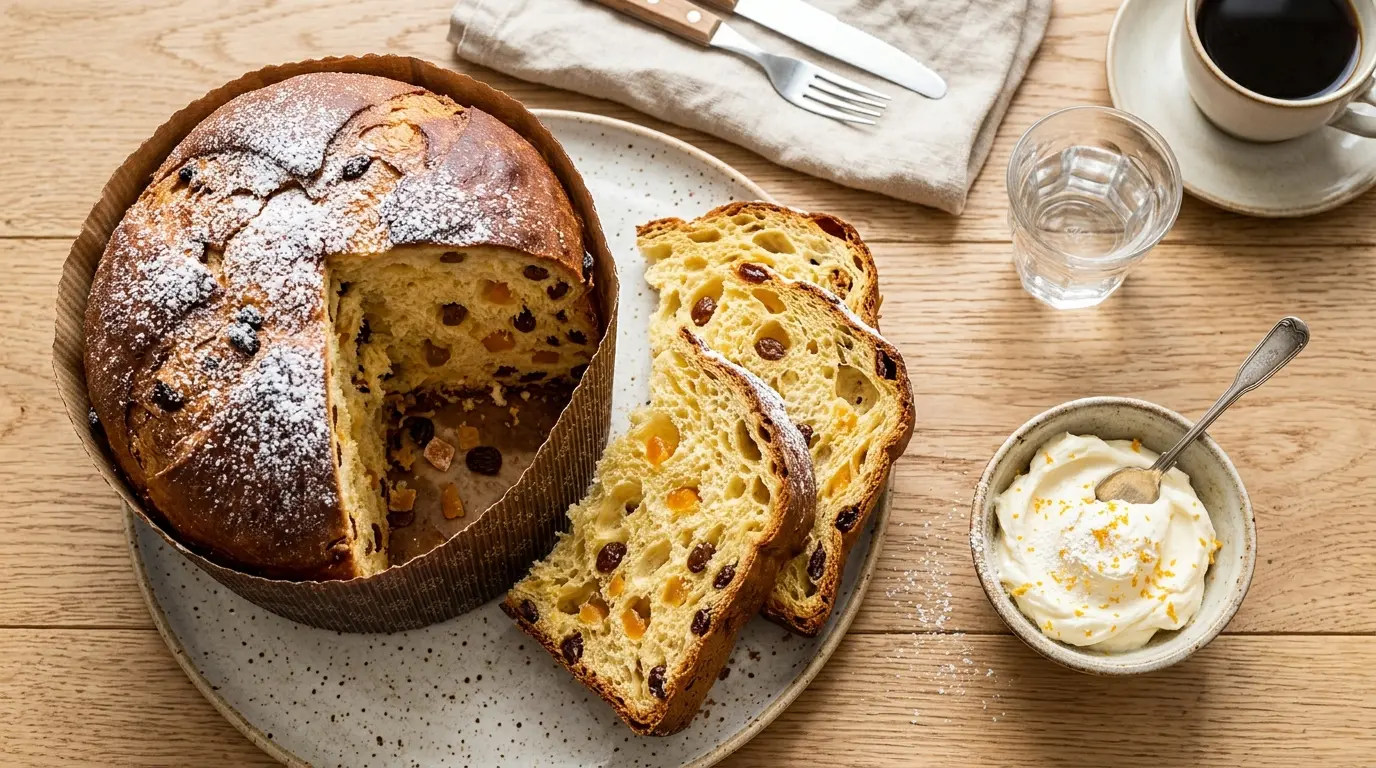
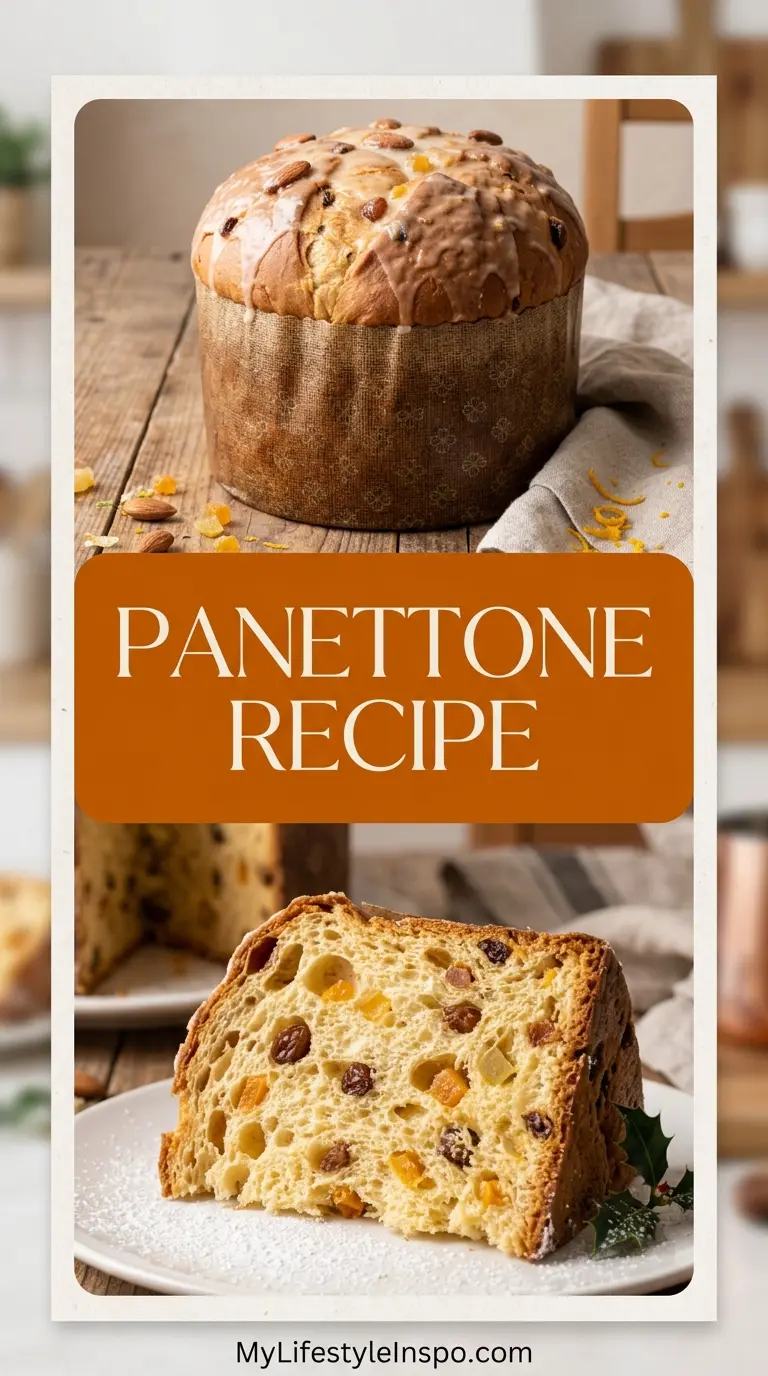
If you’ve ever unwrapped a box of panettone and thought, “I wonder if I could actually make this,” you’re not alone. This panettone recipe brings the magic of Milan’s most iconic holiday bread right into your kitchen. It’s a pillowy, golden, fragrant sweet bread studded with plump rum-soaked raisins, candied orange peel, and citrus zest, and baking it from scratch is one of the most rewarding things you can do as a home baker.
Yes, it takes patience. The dough rises three times, and the whole process spans about 24 hours. But here’s the thing: most of that time is hands-off. You’re not standing over a stove. You’re just waiting, letting yeast and butter and eggs do their slow, beautiful work.
The result is a loaf that’s soft, pillowy, and deeply aromatic, nothing like the dry, dense versions that sit on store shelves. Once you taste homemade panettone, it’s genuinely hard to go back.
This recipe uses a quick biga (an Italian pre-ferment) made with dry yeast rather than a traditional sourdough madre, which keeps the process accessible without sacrificing flavor. Bread flour is the key to the dough’s remarkable structure, giving it just enough strength to hold all that butter and fruit without collapsing.
You might also love this Authentic German Stollen for another classic European holiday bread worth adding to your festive baking list.
Why You’ll Love This Panettone Recipe
Homemade panettone is in a completely different league from anything you can buy in a tin.
The crumb is feather-light, the butter flavor comes through beautifully, and the citrus aroma that fills your kitchen while it bakes is something you’ll want to bottle.
It’s the kind of bake that makes everyone in the room stop and ask what smells so good.
Beyond the flavor, panettone is an impressive centerpiece for a holiday table or a meaningful homemade gift. Wrapped in parchment and tied with twine, it’s the kind of thing people genuinely treasure.
Here’s why this recipe works so well:
- It uses a biga starter for depth of flavor without the complexity of maintaining a sourdough starter
- Bread flour provides the protein structure needed to support the rich, buttery dough
- Rum-soaked raisins add plumpness and a subtle boozy warmth that makes every bite interesting
- Multiple rise times develop flavor and create that signature open, cloud-like crumb
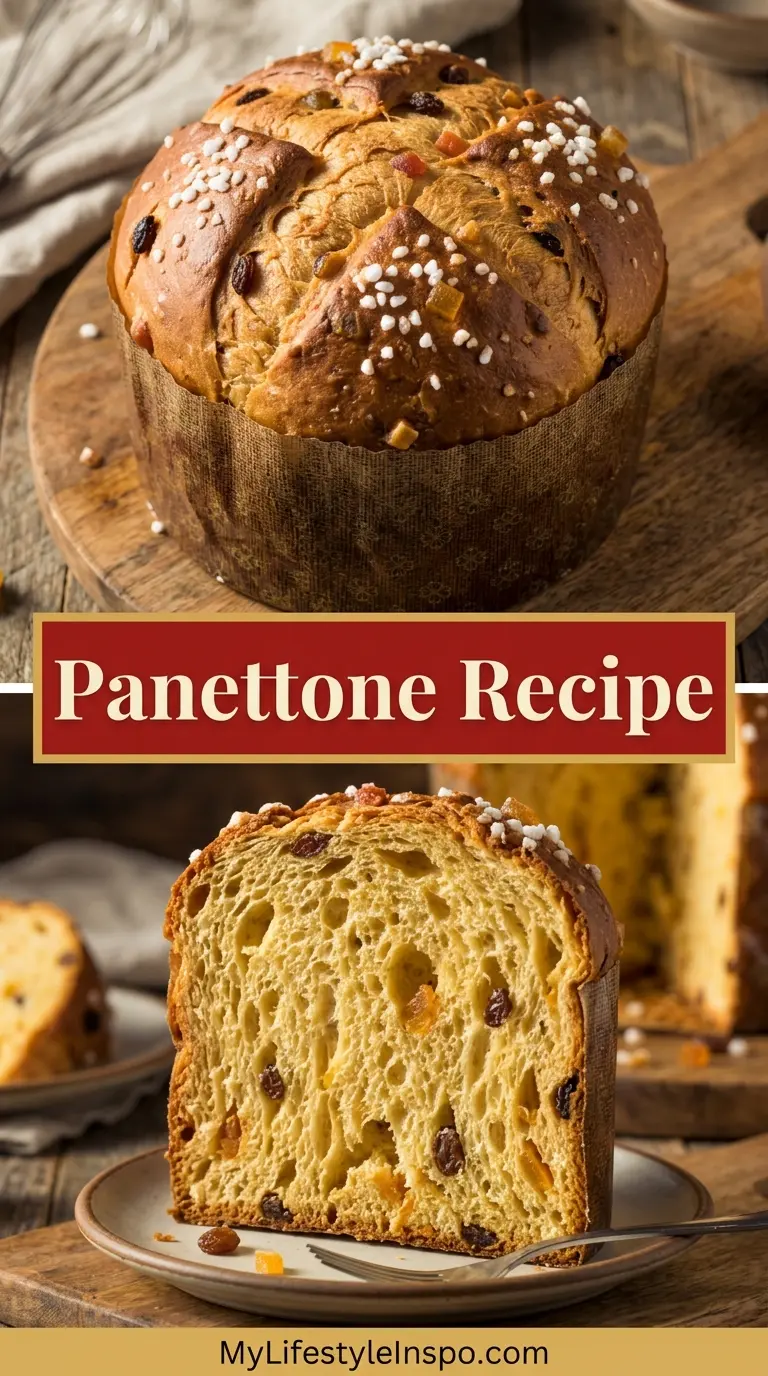
- The classic cross-scored top with a pat of butter melts into the crust during baking for a beautiful finish
- No stand mixer is required for smaller batches, though one makes the job significantly easier
Read Also: Cinnamon Babka Recipe
Ingredients
Traditional panettone uses simple pantry ingredients, but quality matters here. Use the freshest eggs you can find (yolks with a deep yellow color give the dough its signature warm hue), real unsalted butter, and good-quality candied citrus peel rather than the sugary, waxy variety.
For the Biga (Starter):
- 1/2 cup (60g) all-purpose flour
- 1/4 teaspoon (1g) instant dry yeast
- 1/4 cup (60ml) lukewarm water (around 95°F / 35°C)
For the First Dough:
- All of the biga (prepared above)
- 1/4 cup (60ml) lukewarm water
- 1 cup (130g) bread flour
- 4 large egg yolks, at room temperature
- 1/3 cup (65g) granulated sugar
- 1/4 cup (55g) unsalted butter, softened
For the Aromatic Mix:
- 2 tablespoons (40g) honey
- 1 teaspoon pure vanilla extract
- Zest of 1 large orange
- Zest of 1 large lemon
- 2 tablespoons finely chopped candied orange peel
For the Second Dough (Final Dough):
- First dough (prepared above)
- 1/2 cup (65g) bread flour
- 3 large egg yolks, at room temperature
- 1/4 cup (50g) granulated sugar
- 1/2 teaspoon fine salt
- 1/2 cup (110g) unsalted butter, softened and cut into small pieces
- 1/2 cup (75g) golden raisins, soaked in 2 tablespoons rum or warm water for 1 hour, then drained
- 1/2 cup (80g) candied orange peel, chopped into small pieces
- 2 tablespoons (25g) candied citron or additional candied orange peel
For the Top:
- 1 tablespoon (14g) cold unsalted butter, cut into a small cube
For another gorgeous enriched bread with a similar soft, pillowy crumb, check out this Chocolate Babka Recipe.
Kitchen Equipment Needed
Having the right tools makes a significant difference with panettone. The dough is extremely sticky and soft, and you’ll need equipment that can handle long kneading times without overheating.
Here’s what you’ll need:
- Stand mixer with dough hook attachment (strongly recommended, though not strictly required)
- Panettone paper mold (6.5-inch / 16.5cm diameter, 4-inch / 10cm tall)
- Large mixing bowls
- Kitchen scale (essential for accuracy in enriched bread baking)
- Plastic wrap or a clean kitchen towel for covering dough
- Instant-read thermometer (to check dough temperature and doneness)
- Sharp knife or razor blade (for scoring the top)
- Long wooden or metal skewers or dowels (for hanging the panettone upside down after baking)
- Wire cooling rack
- Heavy-duty foil (for tenting if top browns too quickly)
Read Also: Challah Recipe
Recommended Products for This Recipe
These are products that can genuinely make a difference in the quality of your finished panettone. Each one addresses a specific challenge in the baking process.
1. Panettone Paper Baking Molds
A proper panettone mold is non-negotiable. It holds the dough in the right shape as it rises dramatically above the rim during baking, creating that signature domed top. Paper molds are traditional, oven-safe, and make gifting easy since the loaf goes straight from oven to table in the mold.
2. High-Quality Candied Orange Peel
The candied orange peel you buy at a specialty store or online makes an enormous difference compared to grocery store varieties. Look for pieces that are plump, translucent, and not overly sweet, as they carry most of the citrus flavor throughout the loaf.
3. KitchenAid Stand Mixer
Panettone dough is notoriously sticky and requires extended kneading, often 20+ minutes per stage. A stand mixer with a dough hook handles this without burning out a hand mixer and keeps the dough from warming up too much from hand-kneading. This is the single tool most worth investing in for this recipe.
4. Digital Instant-Read Thermometer
Knowing the internal temperature of your panettone (you’re aiming for 94°C / 201°F at the center) removes all guesswork from doneness. This is far more reliable than tapping the bottom or checking color alone, especially with a bread this rich and dark.
5. Golden Raisins
Standard brown raisins work, but golden raisins give the panettone a more delicate sweetness and stay plumper after baking. Soaked in rum or warm water first, they become almost custardy inside the bread.
This recipe pairs beautifully with a mug of rich Hot Chocolate for the ultimate holiday treat.
Step-by-Step Instructions
Step 1: Make the Biga (The Night Before or 1-2 Hours Ahead)
- In a small bowl, combine the all-purpose flour, instant yeast, and lukewarm water.
- Stir with a fork until a shaggy, rough dough forms. It doesn’t need to be smooth.
- Cover the bowl tightly with plastic wrap and leave it in a warm spot (around 75°F / 24°C) for 1 to 2 hours if making it same-day, or 8 to 12 hours overnight in the refrigerator.
- The biga is ready when it has doubled in size and looks bubbly and slightly puffy. If you used the refrigerator, let it come to room temperature for 30 minutes before continuing.
Step 2: Prepare the Aromatic Mix and Soak the Raisins
- In a small bowl, combine the honey, vanilla extract, orange zest, lemon zest, and finely chopped candied orange peel.
- Stir everything together until well combined, then cover and set aside at room temperature. The honey will carry and intensify the citrus aromas throughout the dough.
- In a separate small bowl, place the golden raisins and pour the rum or warm water over them. Let them soak for at least 1 hour so they plump up fully, then drain them well and pat dry with a paper towel. Set aside.
Step 3: Make the First Dough
- Transfer the biga into the bowl of your stand mixer fitted with the dough hook.
- Add the lukewarm water and bread flour. Mix on low speed (setting 2 on a KitchenAid) for 2 minutes until combined.
- Add the 4 egg yolks one at a time, waiting for each to fully incorporate before adding the next. Take your time here because rushing causes the dough to break apart.
- Add the granulated sugar in two additions, mixing until absorbed each time.
- With the mixer still running on medium-low, add the softened butter a few pieces at a time, waiting for each addition to disappear into the dough before adding more. This process takes about 10 to 12 minutes total.
- Continue mixing until the dough is smooth, shiny, and pulls away from the sides of the bowl. It will still be slightly sticky and tacky, which is normal.
- Transfer the dough to a lightly buttered bowl, cover tightly with plastic wrap, and let it rise at room temperature until doubled in size, about 2 to 3 hours.
Step 4: Make the Second (Final) Dough
- Once the first dough has doubled, return it to the stand mixer bowl fitted with the dough hook.
- Add the bread flour and mix on low speed for 2 minutes to incorporate.
- Add the 3 remaining egg yolks one at a time, just as you did before.
- Add the remaining granulated sugar and the salt.
- Add the aromatic mix (honey, vanilla, zest, and candied peel) and mix until combined.
- Now add the softened butter piece by piece on medium-low speed, taking 12 to 15 minutes. The dough should become very smooth, glossy, and stretchy. This is the stage where the dough develops its signature silky texture, so don’t rush it.
- Finally, reduce the mixer to its lowest speed and add the drained raisins, chopped candied orange peel, and candied citron. Mix just until the fruit is evenly distributed throughout the dough, about 1 to 2 minutes. Over-mixing at this stage can tear the fruit apart and make the dough gray.
- The finished dough should be soft, slightly sticky, and very stretchy when pulled gently.
Step 5: First Shaping and Second Rise
- Lightly grease a clean work surface with softened butter (not flour, as flour can tighten the dough).
- Turn the dough out onto the surface and use a bench scraper or your hands to gently fold it into a smooth round ball, tucking the edges underneath to create surface tension.
- Place the shaped dough into your panettone paper mold. If using a 6.5-inch mold, the dough should come roughly halfway up the sides at this point.
- Cover loosely with a sheet of plastic wrap (not tight, as the dough needs room to expand) and let it rise until the dome of the dough is about 1 inch (2.5cm) above the rim of the mold. This second rise takes 4 to 6 hours at room temperature, depending on the temperature of your kitchen.
- Toward the end of the rise, preheat your oven to 350°F (175°C), positioning a rack in the lower third of the oven.
Step 6: Score and Bake
- Once the dough has risen above the rim, uncover it and let the surface dry out for about 15 minutes. This helps the top firm up slightly for scoring.
- Using a sharp knife or a razor blade, quickly score a shallow cross into the top of the dough, cutting about 1/2 inch (1.2cm) deep.
- Place the small cube of cold butter right in the center of the cross. As the panettone bakes, this butter will melt and pool into the scored lines, creating a beautiful, golden, glossy top.
- Bake at 350°F (175°C) for 40 to 50 minutes. Check the top after 25 minutes: if it’s already deeply golden, tent it loosely with a piece of aluminum foil to prevent burning while the inside finishes baking.
- The panettone is done when an instant-read thermometer inserted into the deepest part reads 94°C (201°F). The top should be a deep mahogany brown.
Step 7: Cool Upside Down (This Step is Crucial!)
- Remove the panettone from the oven immediately and, working quickly, push two long wooden skewers or metal knitting needles through the base of the panettone mold, crossing them to form an X. This is exactly as important as the baking itself.
- Flip the panettone upside down and hang it between two tall pots, books, or any two stable objects of equal height so it hangs freely without resting on the top.
- Let it cool completely upside down for at least 3 hours, preferably overnight. This prevents the delicate, airy crumb from collapsing under its own weight while it’s still hot and structurally fragile.
- Once fully cooled, right it upright and remove the skewers. The panettone is now ready to serve or wrap.
For another incredible enriched bread baking project, try this Brioche Recipe using a similarly rich, buttery dough technique.
Tips for Success
Panettone has a reputation for being difficult, and honestly, that reputation is a little deserved. But most failures come down to a handful of specific, avoidable issues. Keep these in mind:
- Don’t rush the butter incorporation. Adding butter too fast breaks the dough’s emulsion, leaving you with a greasy, shaggy mess. Small pieces, slowly added, on medium-low speed.
- Temperature matters. Keep your kitchen around 75 to 77°F (24 to 25°C) during rising. Too cold and the dough barely moves. Too warm and the butter can melt out of the dough during mixing.
- Use room temperature eggs and butter. Cold eggs added to the dough can cause the butter to seize and separate. Pull everything out of the refrigerator at least 1 hour before you start.
- Don’t skip the upside-down cooling. This is non-negotiable. The crumb is too delicate to support itself while warm, and panettone that cools right-side-up often develops a sunken, gummy center.
- Drain the raisins thoroughly. Excess moisture from the soaking liquid can make the dough too wet and sticky to shape properly.
- Let the surface dry before scoring. A 15-minute rest after the final rise firms up the skin just enough to cut a clean cross without deflating the loaf.
You might also enjoy: Cinnamon Swirl Bread Recipe
Serving Suggestions
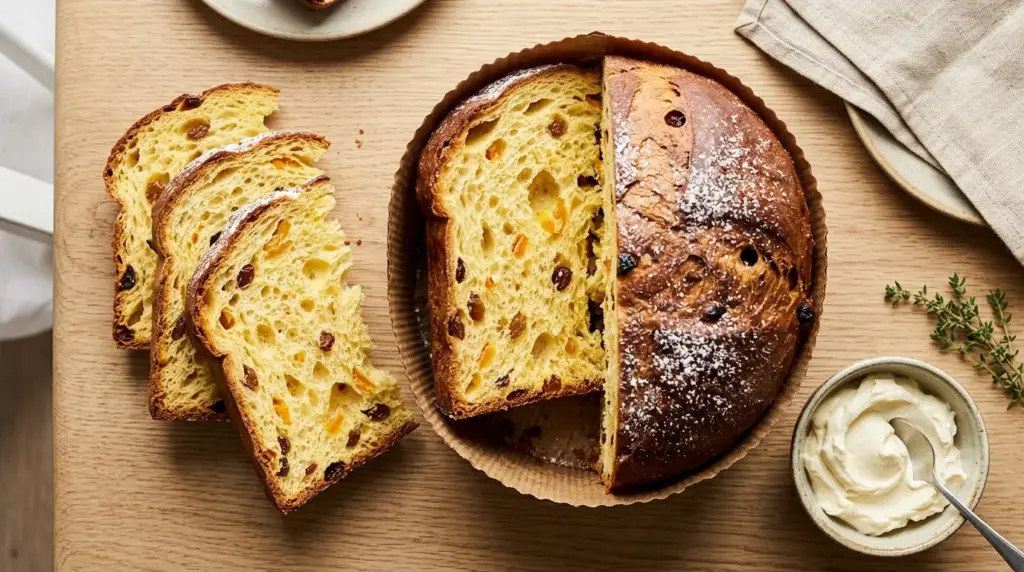
Panettone is wonderfully versatile and can be enjoyed from breakfast all the way through dessert.
In Italy, it’s most commonly sliced thick and served alongside a steamy cappuccino or espresso in the morning, often dunked right in. The buttery crumb soaks up the coffee in the most satisfying way.
Here are some favorite ways to enjoy it:
- With a glass of Moscato or Prosecco for a classic Italian holiday pairing
- Toasted with butter and a drizzle of honey for a simple, luxurious breakfast
- Sliced and used for Brioche French Toast, which becomes extraordinary with panettone’s buttery, fruit-studded crumb
- Alongside a cup of hot chocolate or warm mulled Apple Cider for a cozy winter afternoon treat
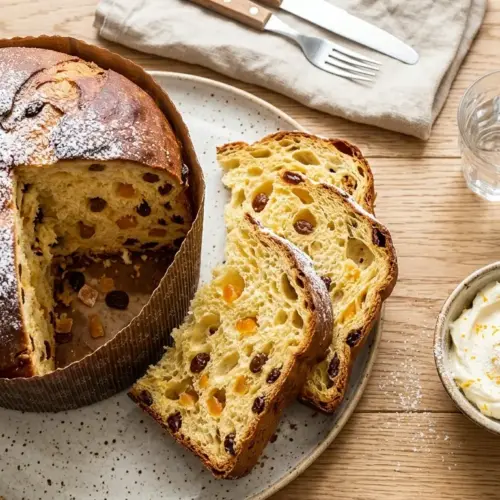
- Served as a centerpiece dessert with a bowl of lightly sweetened mascarpone cream or a drizzle of warm caramel sauce
- Gifted whole in the paper mold, wrapped in cellophane and ribbon, as a show-stopping homemade present
Read Also: Cranberry Orange Bread Recipe
Variations to Try
Once you’ve mastered the classic version, panettone is a wonderful canvas for creative swaps. The dough base stays the same; only the fillings change.
Here are some popular variations worth trying:
- Chocolate Panettone: Replace the raisins and candied peel with equal weights of dark chocolate chunks or chips. This is one of the most popular modern versions, especially among kids.
- Cranberry and White Chocolate: Swap the raisins for dried cranberries and add white chocolate chips for a festive red-and-white spin.
- Limoncello Panettone: Use limoncello instead of rum to soak the fruit, and double the lemon zest in the aromatic mix. Bright, fragrant, and genuinely beautiful.
- Pandoro-Style (Plain): Omit all the fruit and increase the vanilla and zest for a simpler, more buttery loaf. Dust generously with powdered sugar before serving.
- Dried Cherry and Almond: Replace the raisins with pitted dried cherries and fold in 1/4 cup of slivered almonds. The combination of tart cherries and toasty nuts is fantastic.
- Chocolate Chip and Hazelnut: Fold in mini chocolate chips and coarsely chopped toasted hazelnuts for a Ferrero Rocher-inspired variation.
This classic Fruitcake Recipe is another beloved holiday treat that uses a similar combination of candied fruit and spirits.
Storage and Reheating
Panettone keeps remarkably well when stored properly, and actually improves in flavor after the first day as the fruit aromas meld further into the crumb.
Here’s how to keep it fresh:
- Room temperature: Wrap the entire loaf tightly in plastic wrap or place it in a large zip-lock bag. It will stay soft and fresh for 4 to 5 days at room temperature. Do not refrigerate, as the cold will dry out the crumb quickly.
- Longer storage: Wrap tightly in a double layer of plastic wrap, then a layer of foil, and freeze for up to 3 months. Thaw overnight at room temperature, still wrapped.
- To refresh slices: Warm slices in a toaster oven at 300°F (150°C) for 3 to 4 minutes until just slightly warm. This revives the buttery aroma and softens any crumb that’s dried slightly.
- For panettone French toast: Day-old or even slightly stale panettone is ideal, as it absorbs the egg custard without falling apart.
- Gifting note: Keep the paper mold intact until serving. It acts as natural packaging and protects the shape during storage.
For another holiday bread that stores just as beautifully, try this Cinnamon Raisin Bread Recipe.
Nutritional Facts
The following is an approximate nutritional breakdown per slice, based on 12 slices per loaf. Panettone is a celebratory bread meant for the holidays, rich in butter, eggs, and sweetness, which accounts for its higher calorie count.
| Nutrient | Per Slice (approx.) |
|---|---|
| Calories | 310 |
| Total Fat | 13g |
| Saturated Fat | 7g |
| Cholesterol | 105mg |
| Sodium | 95mg |
| Total Carbohydrates | 42g |
| Dietary Fiber | 1g |
| Sugars | 18g |
| Protein | 6g |
Note: Values are estimates and will vary based on exact ingredient quantities used.
Read Also: Pizzelle Recipe
Health Benefits of Key Ingredients
Panettone is absolutely a treat, not a health food. That said, a few of its key ingredients do bring some genuine nutritional value to the table.
Here’s a look at some of the more notable ingredients:
- Eggs are one of the most nutrient-dense whole foods available. Each yolk provides fat-soluble vitamins A, D, E, and K, along with choline, which is critical for brain health and liver function.
- Raisins are a concentrated source of natural sugars for energy, plus iron, potassium, and antioxidants including resveratrol, which is associated with cardiovascular support.
- Candied citrus peel retains some of the bioflavonoids and volatile oils from the original fruit, which have antioxidant and anti-inflammatory properties.
- Orange and lemon zest deliver a significant dose of vitamin C and d-limonene, a compound in citrus oils that has been studied for its role in supporting healthy digestion and immune function.
- Butter provides fat-soluble vitamins and butyrate, a short-chain fatty acid that feeds healthy gut bacteria and supports intestinal lining health.
- Honey adds trace enzymes, antioxidants, and antimicrobial properties. Using honey instead of all refined sugar contributes a small but real nutritional benefit alongside its flavor depth.
Another Italian treat worth making during the holidays is this classic Easy Tiramisu.
Frequently Asked Questions
1. Can I make panettone without a stand mixer?
You can, but be prepared for a significant workout. The dough must be kneaded for a total of 30 to 40 minutes across two stages, and it’s very sticky. Using the stretch-and-fold method (lifting the dough and folding it over itself repeatedly on a lightly buttered surface) is the most effective way to build gluten by hand. Give yourself extra time and rest your arms between intervals. A stand mixer makes this recipe genuinely much easier, and if you plan to make panettone more than once, it’s worth the investment.
2. Why does panettone need to cool upside down?
The crumb structure of panettone is airy, delicate, and still extremely soft when it comes out of the oven. If it cools right-side-up, gravity pulls the crumb downward while it’s still setting, causing the center to sink and compact. Cooling it inverted allows the crumb to set in its fully puffed, open state without collapsing. The skewers through the base hold the paper mold suspended so the top of the loaf (now the bottom while inverted) doesn’t press against anything and deflate.
3. My dough didn’t rise enough. What went wrong?
The most common causes are yeast that’s past its prime, a kitchen that’s too cold, or dough that was over-kneaded and heated too much during mixing. Check that your yeast is fresh by proofing it in a teaspoon of warm water and a pinch of sugar before you begin. If no bubbles appear within 10 minutes, get fresh yeast. Also make sure your water for the biga is warm, not hot. Anything above 115°F (46°C) kills yeast instantly.
4. Can I make this recipe over two days?
Yes, and this is actually ideal. Make the biga the evening before and let it develop overnight in the refrigerator. The next morning, bring it to room temperature, then make the first dough. Let it rise during the afternoon, make the second dough in the evening, and let the shaped panettone do its final long rise overnight at a cool room temperature (68 to 70°F / 20 to 21°C). Bake fresh the following morning. This schedule makes the process feel very manageable.
5. What can I do with leftover panettone?
Leftover panettone is a treasure. Use thick slices for a custard-soaked French toast for the most indulgent breakfast imaginable. Cube it for a holiday bread pudding with cream and spiced custard. Tear it into pieces and layer it into a trifle with mascarpone cream and fresh berries. You can also simply toast thin slices and serve them alongside soup or cheese for something unexpected but genuinely delicious.
If you love using enriched bread in pudding-style desserts, this Banana Bread Pudding Recipe is another wonderful option to try.
Homemade Panettone

Equipment
- Stand mixer with dough hook attachment - strongly recommended, though not strictly required
- Panettone paper mold - 6.5-inch / 16.5cm diameter, 4-inch / 10cm tall
- Large mixing bowls
- Kitchen scale - essential for accuracy in enriched bread baking
- Plastic wrap - or a clean kitchen towel for covering dough
- Instant-read thermometer - to check dough temperature and doneness
- Sharp knife or razor blade - for scoring the top
- Long wooden or metal skewers - or dowels, for hanging the panettone upside down after baking
- Wire cooling rack
- Heavy-duty foil - for tenting if top browns too quickly
- Bench scraper - optional, for handling sticky dough
Ingredients
- 1/2 cup all-purpose flour - 60g
- 1/4 teaspoon instant dry yeast - 1g
- 1/4 cup lukewarm water - 60ml, around 95°F / 35°C
For the First Dough
- 1/4 cup lukewarm water - 60ml
- 1 cup bread flour - 130g
- 4 large egg yolks - at room temperature
- 1/3 cup granulated sugar - 65g
- 1/4 cup unsalted butter - 55g, softened
For the Aromatic Mix
- 2 tablespoons honey - 40g
- 1 teaspoon pure vanilla extract
- 1 large orange - zest of 1 large orange
- 1 large lemon - zest of 1 large lemon
- 2 tablespoons finely chopped candied orange peel
For the Second Dough (Final Dough)
- 1/2 cup bread flour - 65g
- 3 large egg yolks - at room temperature
- 1/4 cup granulated sugar - 50g
- 1/2 teaspoon fine salt
- 1/2 cup unsalted butter - 110g, softened and cut into small pieces
- 1/2 cup golden raisins - 75g, soaked in 2 tablespoons rum or warm water for 1 hour, then drained
- 1/2 cup candied orange peel - 80g, chopped into small pieces
- 2 tablespoons candied citron - 25g, or additional candied orange peel
For the Top
- 1 tablespoon cold unsalted butter - 14g, cut into a small cube
Instructions
- Make the biga: Combine all-purpose flour, instant yeast, and lukewarm water in a small bowl. Stir with a fork until a shaggy, rough dough forms. Cover tightly with plastic wrap and leave in a warm spot for 1 to 2 hours if making same-day, or 8 to 12 hours overnight in the refrigerator. The biga is ready when doubled in size and bubbly.
- Prepare the aromatic mix and soak raisins: In a small bowl, combine honey, vanilla extract, orange zest, lemon zest, and finely chopped candied orange peel. Stir well, cover, and set aside. In a separate small bowl, place golden raisins and pour rum or warm water over them. Soak for at least 1 hour, then drain well and pat dry with a paper towel.
- Make the first dough: Transfer the biga to your stand mixer fitted with the dough hook. Add lukewarm water and bread flour, mix on low for 2 minutes. Add egg yolks one at a time, waiting for each to incorporate. Add sugar in two additions, then add softened butter a few pieces at a time, mixing 10-12 minutes until smooth and shiny. Transfer to a buttered bowl, cover, and let rise until doubled, 2-3 hours.
- Make the final dough: Return first dough to the mixer bowl. Add bread flour and mix on low for 2 minutes. Add remaining egg yolks one at a time, then sugar, salt, and the aromatic mix. Add softened butter piece by piece on medium-low, taking 12-15 minutes until smooth and glossy. On lowest speed, add drained raisins, chopped candied orange peel, and candied citron, mixing just until distributed.
- First shaping and second rise: Lightly grease a clean work surface with softened butter. Turn the dough out and gently fold it into a smooth round ball, tucking the edges underneath. Place into your panettone paper mold. Cover loosely with plastic wrap and let rise until the dome is about 1 inch above the rim, 4-6 hours.
- Score and bake: Toward the end of the rise, preheat your oven to 350°F (175°C), rack in the lower third. Once risen above the rim, uncover and let the surface dry for 15 minutes. Score a shallow cross into the top with a sharp knife, about 1/2 inch deep. Place the small cube of cold butter in the center of the cross.
- Bake at 350°F for 40-50 minutes. Check after 25 minutes: if deeply golden, tent loosely with foil. The panettone is done when an instant-read thermometer inserted into the deepest part reads 94°C (201°F). The top should be a deep mahogany brown.
- Cool upside down: Remove from the oven immediately and push two long wooden skewers through the base of the mold, crossing them to form an X. Flip the panettone upside down and hang it between two tall pots or books so it hangs freely. Let it cool completely upside down for at least 3 hours, preferably overnight. This prevents the delicate crumb from collapsing.
- Once fully cooled, right it upright and remove the skewers. The panettone is now ready to serve or wrap.
Notes
- Don’t rush the butter incorporation. Adding butter too fast breaks the dough’s emulsion, leaving you with a greasy, shaggy mess. Small pieces, slowly added, on medium-low speed.
- Temperature matters. Keep your kitchen around 75 to 77°F (24 to 25°C) during rising. Too cold and the dough barely moves. Too warm and the butter can melt out of the dough during mixing.
- Use room temperature eggs and butter. Cold eggs added to the dough can cause the butter to seize and separate. Pull everything out of the refrigerator at least 1 hour before you start.
- Don’t skip the upside-down cooling. This is non-negotiable. The crumb is too delicate to support itself while warm, and panettone that cools right-side-up often develops a sunken, gummy center.
- Drain the raisins thoroughly. Excess moisture from the soaking liquid can make the dough too wet and sticky to shape properly.
- Let the surface dry before scoring. A 15-minute rest after the final rise firms up the skin just enough to cut a clean cross without deflating the loaf.
- To refresh slices: Warm slices in a toaster oven at 300°F (150°C) for 3 to 4 minutes until just slightly warm. This revives the buttery aroma and softens any crumb that’s dried slightly.
- Storage: Wrap the entire loaf tightly in plastic wrap or place it in a large zip-lock bag. It will stay soft and fresh for 4 to 5 days at room temperature. Do not refrigerate, as the cold will dry out the crumb quickly. Freeze for up to 3 months.
- Chocolate Panettone variation: Replace the raisins and candied peel with equal weights of dark chocolate chunks or chips.
- Cranberry and White Chocolate variation: Swap the raisins for dried cranberries and add white chocolate chips for a festive red-and-white spin.
Final Thoughts
Making panettone from scratch is one of those baking experiences that stays with you. It requires patience and attention, but it rewards you with something extraordinary: a loaf that’s soft, fragrant, deeply flavored, and completely your own.
The moment you turn it right-side-up after cooling, peel open the paper mold, and cut that first thick slice, you’ll understand exactly why Italians have been making this bread for centuries.
Give this panettone recipe a try this holiday season. If you make it, leave a comment below to let me know how it turned out, and share a photo if you’re proud of it (you should be!).
Recommended:
- Eggnog Recipe
- Figgy Pudding Recipe
- Eggnog Cake Recipe
- Classic Tiramisu Recipe
- Croissant Recipe
- Monkey Bread Recipe
- Date Nut Bread Recipe
- Rugelach Recipe
- Sicilian Fig Cookies Recipe
- Bread and Butter Pudding Recipe