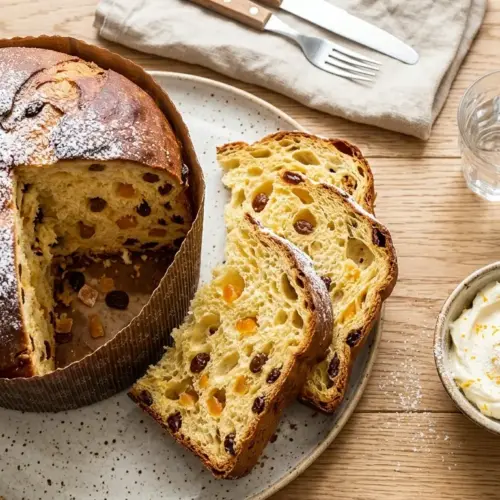
Homemade Panettone

This panettone recipe brings the magic of Milan's most iconic holiday bread right into your kitchen. It's a pillowy, golden, fragrant sweet bread studded with plump rum-soaked raisins, candied orange peel, and citrus zest, and baking it from scratch is one of the most rewarding things you can do as a home baker.
Equipment
- Stand mixer with dough hook attachment - strongly recommended, though not strictly required
- Panettone paper mold - 6.5-inch / 16.5cm diameter, 4-inch / 10cm tall
- Large mixing bowls
- Kitchen scale - essential for accuracy in enriched bread baking
- Plastic wrap - or a clean kitchen towel for covering dough
- Instant-read thermometer - to check dough temperature and doneness
- Sharp knife or razor blade - for scoring the top
- Long wooden or metal skewers - or dowels, for hanging the panettone upside down after baking
- Wire cooling rack
- Heavy-duty foil - for tenting if top browns too quickly
- Bench scraper - optional, for handling sticky dough
Ingredients
- 1/2 cup all-purpose flour - 60g
- 1/4 teaspoon instant dry yeast - 1g
- 1/4 cup lukewarm water - 60ml, around 95°F / 35°C
For the First Dough
- 1/4 cup lukewarm water - 60ml
- 1 cup bread flour - 130g
- 4 large egg yolks - at room temperature
- 1/3 cup granulated sugar - 65g
- 1/4 cup unsalted butter - 55g, softened
For the Aromatic Mix
- 2 tablespoons honey - 40g
- 1 teaspoon pure vanilla extract
- 1 large orange - zest of 1 large orange
- 1 large lemon - zest of 1 large lemon
- 2 tablespoons finely chopped candied orange peel
For the Second Dough (Final Dough)
- 1/2 cup bread flour - 65g
- 3 large egg yolks - at room temperature
- 1/4 cup granulated sugar - 50g
- 1/2 teaspoon fine salt
- 1/2 cup unsalted butter - 110g, softened and cut into small pieces
- 1/2 cup golden raisins - 75g, soaked in 2 tablespoons rum or warm water for 1 hour, then drained
- 1/2 cup candied orange peel - 80g, chopped into small pieces
- 2 tablespoons candied citron - 25g, or additional candied orange peel
For the Top
- 1 tablespoon cold unsalted butter - 14g, cut into a small cube
Instructions
- Make the biga: Combine all-purpose flour, instant yeast, and lukewarm water in a small bowl. Stir with a fork until a shaggy, rough dough forms. Cover tightly with plastic wrap and leave in a warm spot for 1 to 2 hours if making same-day, or 8 to 12 hours overnight in the refrigerator. The biga is ready when doubled in size and bubbly.
- Prepare the aromatic mix and soak raisins: In a small bowl, combine honey, vanilla extract, orange zest, lemon zest, and finely chopped candied orange peel. Stir well, cover, and set aside. In a separate small bowl, place golden raisins and pour rum or warm water over them. Soak for at least 1 hour, then drain well and pat dry with a paper towel.
- Make the first dough: Transfer the biga to your stand mixer fitted with the dough hook. Add lukewarm water and bread flour, mix on low for 2 minutes. Add egg yolks one at a time, waiting for each to incorporate. Add sugar in two additions, then add softened butter a few pieces at a time, mixing 10-12 minutes until smooth and shiny. Transfer to a buttered bowl, cover, and let rise until doubled, 2-3 hours.
- Make the final dough: Return first dough to the mixer bowl. Add bread flour and mix on low for 2 minutes. Add remaining egg yolks one at a time, then sugar, salt, and the aromatic mix. Add softened butter piece by piece on medium-low, taking 12-15 minutes until smooth and glossy. On lowest speed, add drained raisins, chopped candied orange peel, and candied citron, mixing just until distributed.
- First shaping and second rise: Lightly grease a clean work surface with softened butter. Turn the dough out and gently fold it into a smooth round ball, tucking the edges underneath. Place into your panettone paper mold. Cover loosely with plastic wrap and let rise until the dome is about 1 inch above the rim, 4-6 hours.
- Score and bake: Toward the end of the rise, preheat your oven to 350°F (175°C), rack in the lower third. Once risen above the rim, uncover and let the surface dry for 15 minutes. Score a shallow cross into the top with a sharp knife, about 1/2 inch deep. Place the small cube of cold butter in the center of the cross.
- Bake at 350°F for 40-50 minutes. Check after 25 minutes: if deeply golden, tent loosely with foil. The panettone is done when an instant-read thermometer inserted into the deepest part reads 94°C (201°F). The top should be a deep mahogany brown.
- Cool upside down: Remove from the oven immediately and push two long wooden skewers through the base of the mold, crossing them to form an X. Flip the panettone upside down and hang it between two tall pots or books so it hangs freely. Let it cool completely upside down for at least 3 hours, preferably overnight. This prevents the delicate crumb from collapsing.
- Once fully cooled, right it upright and remove the skewers. The panettone is now ready to serve or wrap.
Notes
- Don't rush the butter incorporation. Adding butter too fast breaks the dough's emulsion, leaving you with a greasy, shaggy mess. Small pieces, slowly added, on medium-low speed.
- Temperature matters. Keep your kitchen around 75 to 77°F (24 to 25°C) during rising. Too cold and the dough barely moves. Too warm and the butter can melt out of the dough during mixing.
- Use room temperature eggs and butter. Cold eggs added to the dough can cause the butter to seize and separate. Pull everything out of the refrigerator at least 1 hour before you start.
- Don't skip the upside-down cooling. This is non-negotiable. The crumb is too delicate to support itself while warm, and panettone that cools right-side-up often develops a sunken, gummy center.
- Drain the raisins thoroughly. Excess moisture from the soaking liquid can make the dough too wet and sticky to shape properly.
- Let the surface dry before scoring. A 15-minute rest after the final rise firms up the skin just enough to cut a clean cross without deflating the loaf.
- To refresh slices: Warm slices in a toaster oven at 300°F (150°C) for 3 to 4 minutes until just slightly warm. This revives the buttery aroma and softens any crumb that's dried slightly.
- Storage: Wrap the entire loaf tightly in plastic wrap or place it in a large zip-lock bag. It will stay soft and fresh for 4 to 5 days at room temperature. Do not refrigerate, as the cold will dry out the crumb quickly. Freeze for up to 3 months.
- Chocolate Panettone variation: Replace the raisins and candied peel with equal weights of dark chocolate chunks or chips.
- Cranberry and White Chocolate variation: Swap the raisins for dried cranberries and add white chocolate chips for a festive red-and-white spin.