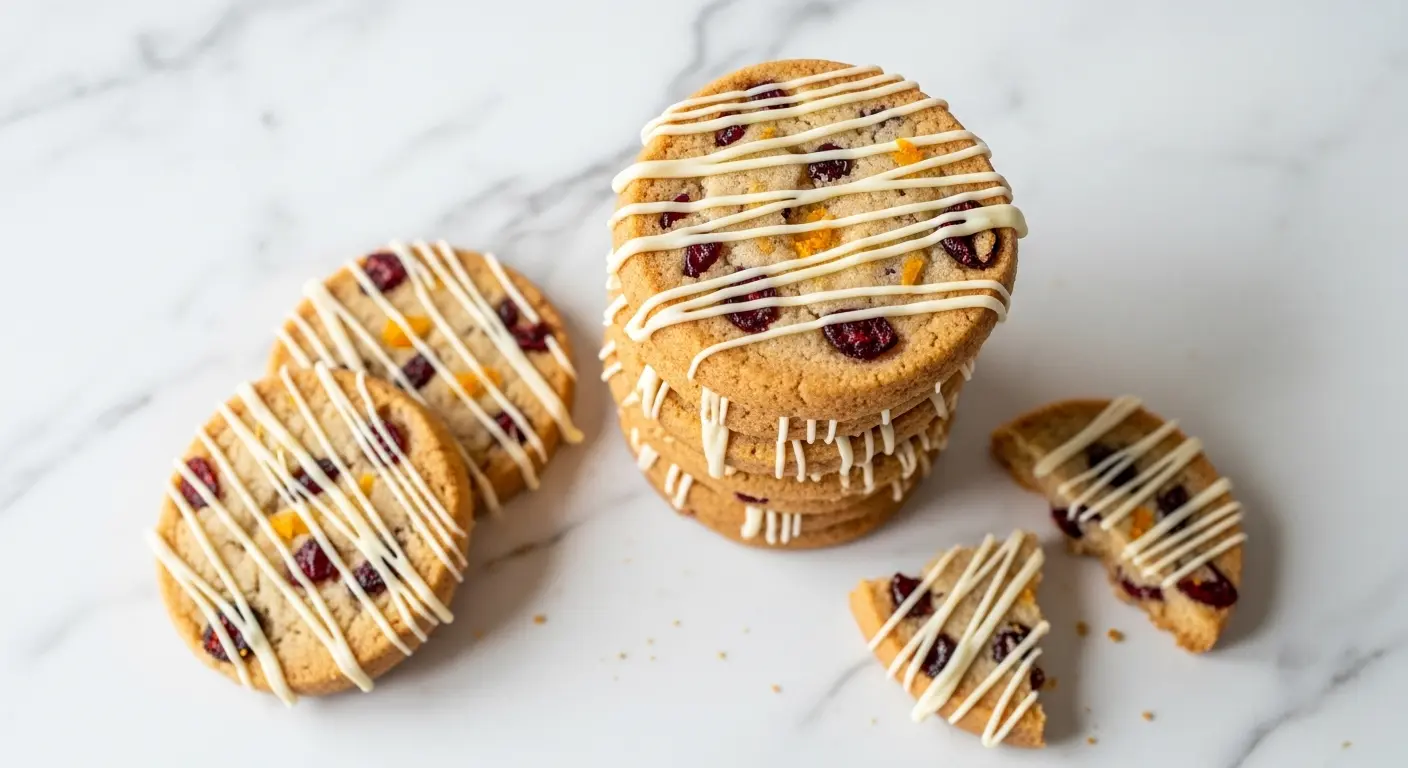
If you’ve been searching for the perfect holiday cookie, this cranberry orange shortbread cookies recipe is about to become your new go-to.
These buttery, melt-in-your-mouth cookies combine tart dried cranberries and bright, fragrant orange zest in a classic slice-and-bake shortbread base that bakes up beautifully every single time.
What makes this combination so irresistible? Orange zest contains aromatic oils that infuse every bite with vivid citrus flavor, while dried cranberries add just enough tartness to balance the richness of the butter.
The result is a cookie that’s elegant enough for a holiday cookie tray yet simple enough to whip up on a weeknight.
This recipe uses powdered (confectioners’) sugar instead of granulated sugar in the dough. That’s not an accident. Powdered sugar gives shortbread its signature tender, crumbly texture that practically dissolves on your tongue. It’s one of those small details that makes a noticeable difference.
You can make the dough a day or two ahead, keep it chilled in the fridge, and simply slice and bake when you’re ready. For a festive finishing touch, a drizzle of white chocolate or a roll in sparkling sugar before baking takes these cookies from simple to stunning.
Whether you’re baking for a cookie swap, a holiday platter, or just because you deserve something delicious, this is the recipe you’ll come back to year after year.
For another buttery classic, you’ll also love this Cranberry Shortbread Cookies Recipe that highlights the pure, jammy flavor of cranberries in every bite.
Why You’ll Love This Cranberry Orange Shortbread Cookies Recipe
Once you try these cookies, you’ll understand why they show up on every holiday baking list worth its butter.
They are everything a great shortbread should be: buttery, slightly crisp at the edges, and tender all the way through.
The cranberry and orange pairing is a classic for a reason. The bright citrus note from the zest cuts through the richness of the butter, while the dried cranberries add pops of chewy tartness throughout each slice.
No fancy equipment is required, and the dough comes together in under 15 minutes.
Because this is a slice-and-bake recipe, you can form the log, wrap it, and keep it in the fridge or freezer until you’re ready to bake. That kind of flexibility is a lifesaver during busy holiday seasons.
Here’s a quick summary of everything to love about this recipe:
- Buttery, melt-in-your-mouth texture thanks to powdered sugar and real unsalted butter
- Bright, festive flavor from fresh orange zest and tart dried cranberries
- Simple slice-and-bake method with no rolling or cookie cutters required
- Make-ahead friendly: the dough log keeps in the fridge for up to 3 days and freezes for up to 3 months
- Easily customizable with white chocolate drizzle, sparkling sugar coating, or a citrus glaze
- No leavening agents needed: shortbread relies entirely on butter and flour for its structure
- Yields approximately 24 cookies per batch, perfect for sharing
You might also enjoy: Lemon Shortbread Cookies Recipe
Ingredients
These cookies call for just a handful of pantry staples, with dried cranberries and fresh orange zest doing all the flavor work.
A note on butter: use only real unsalted butter, preferably a high-quality brand. The butter is the backbone of this recipe, so its quality directly impacts the flavor and texture of the final cookie.
- 1 cup (225g / 2 sticks) unsalted butter, softened to room temperature
- ¾ cup (90g) powdered (confectioners’) sugar, sifted
- 1 teaspoon vanilla extract
- ½ teaspoon almond extract (highly recommended; substitute additional vanilla if needed)
- 2 cups (240g) all-purpose flour
- 2 tablespoons (12g) cornstarch
- ¼ teaspoon fine sea salt
- 1 tablespoon (6g) fresh orange zest (from approximately 1 large orange; use up to 2 tablespoons for a bolder citrus flavor)
- ¾ cup (90g) dried cranberries, roughly chopped
Optional decorations:
- Turbinado sugar or sparkling sugar for rolling
- ½ cup (85g) white chocolate chips for drizzling
Read Also: Shortbread Cookie Recipe
Kitchen Equipment Needed
You don’t need a long list of tools to make these cookies, but a few key pieces will make the process much smoother.
Using a stand mixer or a hand mixer will help you cream the butter and sugar to the right consistency quickly and evenly.
- Stand mixer or hand electric mixer
- Large mixing bowl
- Medium mixing bowl
- Microplane zester or fine grater (for the orange zest)
- Rubber spatula
- Plastic wrap (for shaping the dough log)
- Sharp chef’s knife (for slicing the cookies)
- Parchment-lined baking sheet
- Wire cooling rack
- Small saucepan or microwave-safe bowl (for melting white chocolate, if using)
For another festive bake that uses similar equipment, check out this Scottish Shortbread Cookie Recipe.
Recommended Products for This Recipe
These are hand-picked products based on quality and performance that will genuinely make a difference when baking this recipe.
1. KitchenAid Stand Mixer
A stand mixer makes creaming the butter and powdered sugar effortless, giving you that perfectly smooth, creamy base every shortbread needs. The paddle attachment incorporates flour without over-mixing, which is key to tender cookies. It’s also a long-term kitchen investment you’ll use for years of baking.
2. Microplane Premium Zester
Fresh orange zest is the flavor star of this recipe, and a Microplane zester removes only the fragrant outer zest without the bitter white pith underneath. The ultra-sharp stainless steel blades make the job fast and precise. It’s a small tool that makes a genuinely big difference in flavor.
3. Nordic Ware Natural Aluminum Baking Sheet
Shortbread bakes best on a sturdy, light-colored pan that distributes heat evenly without hot spots. Nordic Ware’s natural aluminum sheets are a baker’s favorite for producing perfectly golden bottoms without burning. The rimmed edges also make handling easier.
4. Guittard White Chocolate Chips
If you’re adding the optional white chocolate drizzle, using a quality white chocolate makes all the difference in taste and texture. Guittard chips melt smoothly and have a creamy, genuine vanilla flavor that complements cranberry and orange beautifully. This is the upgrade that takes these cookies from good to unforgettable.
5. OXO Good Grips Food Scale
Measuring flour by weight (grams) rather than volume is the most reliable way to get consistent results in shortbread. Too much flour leads to crumbly, dry cookies, while too little can make them spread. A simple digital kitchen scale removes the guesswork entirely.
This technique also works wonderfully in Pecan Shortbread Cookies for another nutty, buttery holiday treat.
Step-by-Step Instructions
Step 1: Chop the Dried Cranberries
- Place the dried cranberries on a cutting board.
- Use a sharp chef’s knife to roughly chop them into smaller pieces, about half their original size.
- Chopping the cranberries ensures they distribute evenly throughout the dough and don’t create large gaps in the sliced cookies.
- Set the chopped cranberries aside.
Step 2: Zest the Orange
- Wash and dry the orange thoroughly.
- Hold the Microplane zester over a small bowl.
- Rub the orange firmly over the zester in a downward motion, rotating as you go.
- Zest only the bright orange outer layer, stopping before you reach the white pith underneath, which is bitter.
- You need approximately 1 tablespoon (6g) of zest from one large orange; for a more intense orange flavor, use up to 2 tablespoons.
- Set the zested orange aside (you can squeeze the juice for a glass of fresh OJ!).
Step 3: Whisk the Dry Ingredients
- In a medium mixing bowl, combine 2 cups (240g) of all-purpose flour, 2 tablespoons (12g) of cornstarch, and ¼ teaspoon of fine sea salt.
- Whisk together until evenly combined.
- The cornstarch is an important ingredient here: it reduces the protein structure in the dough slightly, giving the finished cookies a more tender, melt-in-your-mouth crumb.
- Set the flour mixture aside.
Step 4: Cream the Butter and Powdered Sugar
- Place 1 cup (225g) of softened unsalted butter into the bowl of your stand mixer fitted with the paddle attachment (or use a large bowl with a hand mixer).
- Add ¾ cup (90g) of sifted powdered sugar.
- Beat on medium speed for about 2 minutes, until the mixture is smooth, creamy, and well combined.
- Scrape down the sides of the bowl with a rubber spatula partway through.
- Do not over-beat at this stage. You want a smooth mixture, not an aerated, fluffy one. Over-mixing can cause the cookies to spread.
Step 5: Add the Extracts and Orange Zest
- With the mixer on low speed, add 1 teaspoon of vanilla extract and ½ teaspoon of almond extract.
- Mix for about 30 seconds until incorporated.
- Add the prepared orange zest.
- Mix on low for another 30 seconds until the zest is evenly distributed throughout the butter mixture.
- The almond extract is a subtle but important flavor enhancer. It rounds out the tartness of the cranberry and the brightness of the orange without making the cookies taste like almonds.
Step 6: Add the Flour Mixture
- With the mixer on low speed, gradually add the flour mixture to the butter mixture in two or three additions.
- Mix just until the dough begins to come together in large clumps.
- Do not over-mix: stop the mixer as soon as no streaks of dry flour remain. Over-mixing develops gluten, which can make shortbread tough instead of tender.
- The dough will look crumbly at first but should hold together when pressed firmly between your fingers.
Step 7: Fold in the Chopped Cranberries
- Add the roughly chopped dried cranberries to the dough.
- Use the rubber spatula or your hands to fold and gently press the cranberries into the dough until they are evenly distributed.
- Avoid using the mixer at this stage to prevent the cranberries from being ground up too finely.
- The dough should now look like a cohesive, slightly crumbly mass with visible red cranberry pieces throughout.
Step 8: Shape the Dough into a Log
- Tear off a large sheet of plastic wrap and lay it flat on your work surface.
- Transfer the dough onto the center of the plastic wrap.
- Using your hands and the edges of the plastic wrap to help shape it, form the dough into a uniform log approximately 10 to 12 inches (25 to 30cm) long and about 2 inches (5cm) in diameter.
- Roll the log inside the plastic wrap, pressing and smoothing as you go to remove any cracks or gaps.
- Twist the ends of the plastic wrap tightly to seal.
- A uniform log will yield evenly sized cookies that bake at the same rate.
Step 9: Chill the Dough
- Place the wrapped dough log in the refrigerator for at least 1 hour, or up to 3 days.
- The dough must be thoroughly chilled before slicing. Cold, firm dough slices cleanly without crumbling and holds its round shape.
- If you’re in a hurry, you can freeze the log for 30 to 45 minutes instead.
- You can also freeze the wrapped log for up to 3 months at this stage. Thaw it in the refrigerator overnight before slicing and baking.
Step 10: Optional: Roll the Log in Sparkling Sugar
- If you’d like a sparkling, decorative edge on your cookies, spread a thin layer of turbinado or sparkling sugar on a flat surface or a baking sheet.
- Remove the plastic wrap from the chilled log.
- Lightly brush the outside of the log with water or a beaten egg white to help the sugar adhere.
- Roll the log across the sugar, pressing gently to coat the outside evenly.
Step 11: Preheat the Oven and Prepare Baking Sheets
- Preheat your oven to 325°F (160°C).
- Line two large baking sheets with parchment paper.
- A slightly lower oven temperature is key for shortbread. It allows the cookies to bake through slowly without browning too quickly, preserving that pale, golden color and tender texture.
Step 12: Slice the Cookies
- Remove the chilled log from the refrigerator (and unwrap if you haven’t already).
- Using a sharp chef’s knife, slice the log into rounds approximately ½ inch (1.2cm) thick.
- Use a smooth, decisive downward cut rather than a sawing motion to keep the slices clean and round.
- If the log flattens slightly during slicing, gently reshape each round with your fingers before placing it on the baking sheet.
- Arrange the sliced cookies on the prepared baking sheets, spacing them about 1 inch (2.5cm) apart. Shortbread doesn’t spread much, so you can fit them reasonably close together.
Step 13: Bake the Cookies
- Bake in the preheated oven at 325°F (160°C) for 13 to 16 minutes.
- The cookies are done when the edges are just set and very lightly golden. The centers may still look slightly underdone.
- They should not be deeply golden or brown. Over-baked shortbread will be dry and crumbly rather than tender.
- Baking time may vary slightly depending on the thickness of your slices and your specific oven. Start checking at 13 minutes.
Step 14: Cool the Cookies
- Remove the baking sheets from the oven and allow the cookies to cool on the pan for 5 minutes.
- They will be very fragile when they first come out of the oven. This resting period lets them firm up enough to transfer safely.
- Transfer the cookies to a wire cooling rack and allow to cool completely before decorating or storing.
Step 15: Optional White Chocolate Drizzle
- Once the cookies are completely cool, melt ½ cup (85g) of white chocolate chips in a small saucepan over very low heat, stirring constantly, or in a microwave-safe bowl in 30-second intervals, stirring between each.
- Transfer the melted white chocolate to a small piping bag or a zip-lock bag with a tiny corner snipped off.
- Drizzle over the cooled cookies in a zigzag pattern.
- Allow the white chocolate to set completely at room temperature, or refrigerate briefly to speed up the process, before serving or storing.
Read Also: Christmas Shortbread Cookies Recipe
Tips for Success
A few simple techniques make all the difference between good shortbread and extraordinary shortbread.
Paying attention to these details will help you get perfectly tender, beautifully sliced cookies every single time.
- Use room-temperature butter. Cold butter won’t cream properly, and melted butter creates a greasy dough. Press your finger into the butter: it should leave an indent easily but still hold its shape.
- Measure flour correctly. Too much flour is the number one cause of dry, crumbly shortbread. Use a kitchen scale for accuracy, or use the spoon-and-level method: spoon flour into the measuring cup, then level the top with a flat edge.
- Don’t skip the chill time. Chilling the dough is not optional. It firms the butter back up, prevents spreading in the oven, and makes the log easy to slice cleanly.
- Use a sharp knife for slicing. A dull knife will drag and crush the dough rather than cutting cleanly, resulting in uneven, misshapen cookies.
- Don’t overbake. The cookies may look underdone when you pull them out. That’s correct. They continue to set as they cool. Pull them out when the edges are just barely golden.
- Chop cranberries finely enough. Very large cranberry pieces can cause the dough to crumble when slicing. Aim for pieces no larger than half the original dried berry.
- Use fresh orange zest. Bottled orange extract or dried zest won’t give the same vivid, aromatic citrus flavor that fresh zest provides. Fresh is worth the extra minute it takes.
For another cookie with a similar technique, try this Raspberry Shortbread Cookies Recipe.
Serving Suggestions
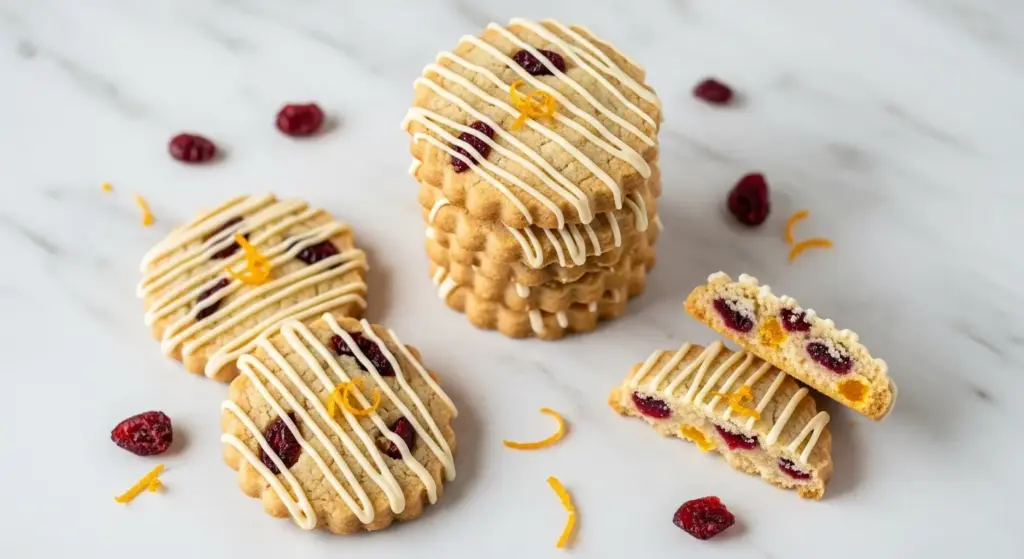
These cranberry orange shortbread cookies are wonderfully versatile and fit beautifully into so many occasions.
They’re elegant enough to plate for guests but homey enough to enjoy with a simple cup of tea on a quiet afternoon.
Here are some of the best ways to serve them:
- On a holiday cookie platter alongside Gingerbread Cookies, sugar cookies, and other festive treats for a beautiful spread
- As a gift packaged in a decorative tin or clear cookie bag tied with ribbon
- With hot drinks like tea, coffee, mulled cider, or hot chocolate, where the buttery flavor shines alongside warm beverages
- As a light dessert alongside a scoop of vanilla ice cream or a dish of lemon curd for dipping
- At a holiday brunch served on a tiered stand with other small baked goods
- Crumbled over vanilla yogurt for a festive, slightly indulgent breakfast parfait
Variations to Try
One of the best things about a shortbread base is how easily it adapts to new flavor combinations.
Once you’ve mastered the basic technique, these variations are fun and easy to explore.
- Cranberry Orange Pistachio: Add ¼ cup (30g) of finely chopped roasted pistachios to the dough along with the cranberries for added crunch and a gorgeous pop of green color. You can also try this Cranberry Pistachio Shortbread Cookies Recipe for a fully developed version.
- Lemon Cranberry: Swap the orange zest for lemon zest and replace the almond extract with an equal amount of vanilla for a brighter, more tart flavor profile.
- White Chocolate Dipped: Dip the bottom half of each cooled cookie into melted white chocolate and set on parchment until firm for a more dramatic presentation.
- Orange Glaze: Stir fresh orange juice into powdered sugar, one teaspoon at a time, until a drizzleable glaze forms. Spoon over cooled cookies for a citrusy finish.
- Cherry Almond: Replace the cranberries with chopped dried tart cherries and double the almond extract for a classic flavor pairing. You can also check out this Cherry Almond Shortbread Cookies Recipe for a dedicated version.
- Cranberry Orange Pecan: Add ¼ cup of finely chopped pecans for a nuttier, slightly richer cookie with extra crunch.
Storage and Reheating
Shortbread stores exceptionally well, making it one of the best make-ahead cookies for the holidays.
Store these cookies properly and they’ll stay delicious for well over a week.
Storing baked cookies:
- Store completely cooled cookies in an airtight container at room temperature for up to 7 days.
- If you’ve drizzled with white chocolate, layer the cookies between sheets of parchment paper to prevent sticking.
- Avoid refrigerating baked shortbread if possible, as the fridge can dry them out.
Freezing baked cookies:
- Flash freeze cooled cookies in a single layer on a baking sheet for 1 hour, then transfer to a freezer-safe bag or container.
- Freeze for up to 3 months.
- Thaw at room temperature for about 30 minutes before serving.
Freezing unbaked dough:
- The dough log can be frozen (tightly wrapped) for up to 3 months.
- Thaw overnight in the refrigerator, then slice and bake as directed.
- This is the best make-ahead method: have ready-to-bake dough on hand for the entire holiday season.
Reheating:
- These cookies are best enjoyed at room temperature.
- If desired, warm briefly in a 300°F (150°C) oven for 3 to 4 minutes to refresh the texture. Do not microwave, as this can make them tough.
Read Also: Whipped Shortbread Cookies Recipe
Nutritional Facts
Approximate values per cookie (based on 24 cookies per batch, without optional decorations):
| Nutrient | Amount Per Cookie |
|---|---|
| Calories | ~155 kcal |
| Total Fat | 9g |
| Saturated Fat | 6g |
| Cholesterol | 25mg |
| Sodium | 25mg |
| Total Carbohydrates | 17g |
| Dietary Fiber | 0.5g |
| Total Sugars | 7g |
| Protein | 1.5g |
| Vitamin C | 1mg |
Note: Nutritional values are estimates only and will vary based on specific brands of ingredients used, cookie thickness, and optional additions such as white chocolate drizzle.
For more buttery cookies to add to your repertoire, check out this Almond Shortbread Cookies Recipe.
Health Benefits of Key Ingredients
Shortbread is unquestionably an indulgent treat, but a couple of its starring ingredients do bring some genuine nutritional value to the table.
Enjoying these cookies as part of a balanced diet means you can feel good about the whole cranberry and orange situation.
Here are some notable benefits of key ingredients:
- Dried Cranberries: Cranberries are packed with antioxidants, including proanthocyanidins, which are associated with urinary tract health and anti-inflammatory effects. They also contain vitamin C, vitamin E, and small amounts of fiber.
- Orange Zest: The outer peel of oranges contains a high concentration of flavonoids, particularly hesperidin, which has been studied for cardiovascular and anti-inflammatory benefits. Orange zest is also rich in vitamin C and provides a higher concentration of aromatic citrus oils than the juice.
- Butter (in moderation): Real butter provides fat-soluble vitamins A, D, E, and K2. Conjugated linoleic acid (CLA), found naturally in butter from grass-fed cows, has been studied for potential metabolic benefits.
- Almonds (almond extract): While almond extract is used in small amounts, almonds themselves are well-known for their heart-healthy monounsaturated fats, vitamin E, magnesium, and plant protein content.
- Cornstarch: A gluten-free starch that helps tenderize baked goods, cornstarch is easy to digest and suitable for those with mild gluten sensitivities when used in small quantities.
You might also enjoy: Chocolate Shortbread Cookies Recipe
Frequently Asked Questions
1. Can I use fresh cranberries instead of dried?
You can, but it requires some adjustments and comes with trade-offs.
Fresh cranberries release moisture as they bake, which can make the dough wetter and affect the texture of the cookies. If you want to use them, roughly chop them very finely, use about ½ cup, and add 1 to 2 extra tablespoons of flour to compensate for the added moisture. Most experienced shortbread bakers prefer dried cranberries for their consistent flavor and texture results.
2. Why is my shortbread dough so crumbly?
Crumbly shortbread dough is completely normal and is not a sign that something is wrong.
Shortbread dough is naturally less cohesive than cookie doughs that contain eggs. Once you press and knead the dough gently and shape it into a log, the heat of your hands will bring it together. If it truly won’t hold together at all, add orange juice, one teaspoon at a time, until it becomes workable.
3. Can I make this dough ahead of time?
Yes, and this is actually one of the best features of a slice-and-bake recipe.
The dough log can be refrigerated for up to 3 days or frozen for up to 3 months. When freezing, wrap the log tightly in plastic wrap and then again in aluminum foil to prevent freezer burn. Thaw the frozen log overnight in the refrigerator before slicing and baking.
4. Do shortbread cookies contain baking powder or baking soda?
No, and that is intentional.
Traditional shortbread contains no leavening agents. Its texture is achieved entirely through the ratio of butter, flour, and sugar, along with the method of mixing. Adding baking powder or baking soda would change the texture and make the cookies puff up slightly, resulting in something more like a soft sugar cookie than a classic shortbread.
5. How do I know when shortbread is done baking?
Shortbread is ready when the edges look set and very lightly golden, but the tops still appear pale and slightly underdone.
This is a point where many beginners over-bake the cookies. Remember that the cookies will continue to firm up as they cool on the baking sheet. If the tops are golden or the edges are deeply browned, they have been in the oven too long and may turn out dry. Trust the process: pale and just-set is the goal.
Read Also: Strawberry Shortbread Cookies Recipe
Final Thoughts
This cranberry orange shortbread cookies recipe is the kind of bake that becomes a tradition the first time you make it.
The combination of buttery shortbread, tart cranberries, and fragrant orange zest is genuinely hard to beat, and the slice-and-bake method makes the whole process approachable for bakers of every skill level.
Whether you drizzle them with white chocolate, roll them in sparkling sugar, or keep them beautifully plain, these cookies are a guaranteed hit on any holiday table.
Give this recipe a try this season, and don’t be surprised when everyone starts asking you for the recipe.
We’d love to know how yours turned out! Drop a comment below, share your photos, or tag us so we can see your beautiful cranberry orange shortbread creations.
Recommended:
- Lavender Shortbread Cookies Recipe
- Rosemary Shortbread Cookies Recipe
- Cut Out Sugar Cookie Recipe
- Best Chocolate Chip Cookies Recipe
- Snickerdoodle Cookie Recipe
- Peanut Butter Cookie Recipe
- Oatmeal Cookie Recipe
- Cranberry Sauce Recipe
- Easy Sugar Cookie Recipe
- Gingerbread Cookie Recipe