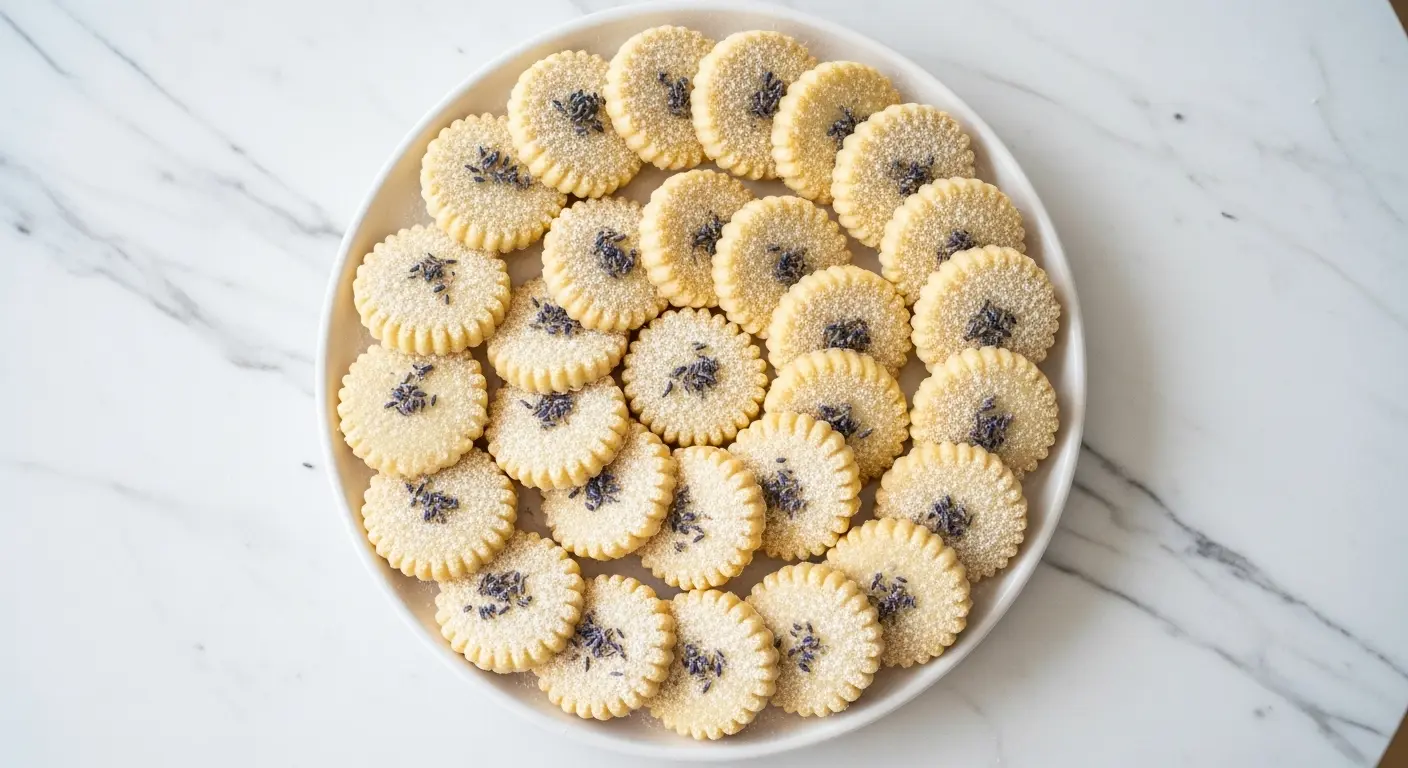
If you’ve never baked a lavender shortbread cookies recipe before, you’re in for a treat unlike any other cookie in your repertoire. These delicate, buttery shortbreads carry a gentle floral note that feels elegant without being overpowering — think a sunny afternoon tea vibe tucked into every crumbly, melt-in-your-mouth bite.
The magic here is all in the balance. Culinary-grade dried lavender buds are ground fine so their flavor blooms evenly through the dough, rather than leaving you with big, chewy petal pieces. Combined with quality butter, a little powdered sugar for tenderness, and a splash of vanilla, you get a cookie that tastes like something from a high-end bakery but comes together with just seven pantry-friendly ingredients.
What makes this recipe so satisfying is how beginner-friendly the process truly is. There’s no complicated technique to master — just creaming, chilling, and slicing. And the result? A batch of cookies that looks impressive, keeps beautifully for days, and pairs perfectly with tea, coffee, or gifting.
These are the kind of cookies you make for baby showers, Mother’s Day, spring brunches, or just because you found a jar of lavender buds at the farmers market and didn’t want them to go to waste.
If you’re also a fan of classic buttery cookies, check out the Shortbread Cookie Recipe for the foundational version that inspired this floral twist.
Why You’ll Love This Lavender Shortbread Cookies Recipe
This recipe checks all the boxes for a truly satisfying bake.
The ingredient list is short — just seven items — which means less time shopping and more time baking. Because butter is the star of the show, quality really does matter, and using a good European-style butter makes a noticeable difference in both flavor and texture.
The floral lavender flavor is present but never soapy or overwhelming. That’s the key to a great lavender cookie: using the right amount and grinding the buds finely so the flavor distributes evenly.
These cookies are endlessly versatile. They work as a simple tea-time treat, a beautiful gift box filler, a spring party dessert, or an afternoon snack alongside a warm mug of something cozy.
The slice-and-bake method means no rolling or cookie cutters are required. You simply shape the dough into a log, chill it, and slice uniform rounds — perfect for consistent, bakery-style results every single time.
The cookies also store incredibly well. They stay fresh at room temperature for up to a week, making them ideal for baking ahead.
- Only 7 ingredients needed
- Melt-in-your-mouth, crumbly texture from a combination of granulated and powdered sugar
- Subtle floral flavor that’s elegant and not overwhelming
- Slice-and-bake method for consistently shaped cookies
- Perfect for gifting, tea parties, and spring celebrations
- Freezer-friendly dough for make-ahead convenience
- No special equipment required beyond a mixing bowl or stand mixer
Another great floral-adjacent option you might love: Rosemary Shortbread Cookies are equally simple and delicious for savory-sweet cookie lovers.
Ingredients
A simple recipe like this one rewards you handsomely when you use the best quality ingredients you can get your hands on — especially when it comes to the butter and lavender.
Here’s what you’ll need to make approximately 24 cookies:
- 1 cup (227g) unsalted butter, softened to room temperature — European-style butter with a higher fat content gives these cookies a richer flavor and a more tender, crumbly crumb. Make sure it’s softened but not greasy or melted.
- 1/2 cup (60g) powdered sugar (confectioners’ sugar) — This is what gives shortbread its signature melt-away texture. Powdered sugar creates a much more delicate crumb than granulated sugar alone.
- 1/4 cup (50g) granulated sugar — Adds a touch more sweetness and a slightly crisper edge.
- 1 teaspoon vanilla extract — Rounds out the floral notes beautifully and adds warmth.
- 1 1/2 teaspoons culinary dried lavender buds — Always use food-grade or culinary lavender, never potpourri lavender. Finely ground before use for even flavor distribution.
- 2 cups (240g) all-purpose flour — The backbone of the dough. Spooned and leveled into your measuring cup for accuracy.
- 1/2 teaspoon fine sea salt — Don’t skip this. Salt balances the sweetness and deepens the overall flavor.
Read Also: Lemon Shortbread Cookies Recipe
Kitchen Equipment Needed
You don’t need a fully stocked bake shop to pull off this recipe. Most of these tools are standard kitchen staples, and a few specialty items make the process even more seamless.
- Stand mixer or hand mixer — For creaming the butter and sugars together until light and fluffy. A stand mixer is ideal but a hand mixer works just as well.
- Mortar and pestle — For grinding the dried lavender buds into a fine texture. You can also use a sharp knife to finely chop them, or pulse briefly in a spice grinder.
- Large mixing bowl — If not using a stand mixer.
- Plastic wrap or parchment paper — For wrapping the dough log before chilling.
- Sharp knife — A thin, sharp blade makes clean, even slices through the chilled dough without crumbling.
- Baking sheet — A heavy-duty, light-colored sheet pan promotes even browning without overbrowning the bottoms.
- Parchment paper or silicone baking mat — Prevents sticking and makes cleanup a breeze.
- Wire cooling rack — Essential for letting the cookies cool properly without trapping steam underneath.
- Measuring cups and spoons — Precision matters in baking.
- Rubber spatula — For scraping down the sides of the bowl.
You might also enjoy making Cranberry Shortbread Cookies with this same basic equipment setup.
Recommended Products for This Recipe
These are products I genuinely recommend based on their quality and the difference they can make in your final results.
1. Culinary Dried Lavender Buds (Food Grade, Organic)
Not all lavender is created equal. Culinary-grade lavender buds are harvested and processed specifically for cooking and baking, with a cleaner, more food-safe flavor profile than decorative varieties. Organic options are particularly great since you’re consuming the herb directly in your baked goods. Getting this ingredient right is the single most important factor in a great lavender shortbread.
2. KitchenAid Stand Mixer
Creaming butter and sugar properly — until light, pale, and fluffy — is the foundation of a great shortbread texture. A stand mixer does this more consistently and efficiently than hand-mixing, and takes all the effort out of the process. It’s a long-term investment that pays off in every baking project you tackle.
3. Granite Mortar and Pestle
Grinding your lavender buds in a mortar and pestle before adding them to the dough ensures they’re fine enough to distribute evenly without leaving gritty or unpleasant chunks. A granite set is durable, heavy-duty, and works beautifully for grinding small amounts of herbs and spices. This is a tool you’ll reach for again and again.
4. Nordic Ware Natural Aluminum Baker’s Half Sheet
Heavy-gauge aluminum baking sheets heat evenly, which is critical for shortbread cookies that need a gentle, consistent bake without over-browning on the bottom. Thin, dark-colored pans can burn the delicate edges of these cookies before the centers are fully set.
5. OXO Good Grips Silicone Baking Mat
A silicone mat creates a perfectly non-stick surface for your lavender shortbread without any greasing required. It promotes even heat distribution, protects the bottom of your cookies, and is reusable for years — a much more economical and eco-friendly choice than disposable parchment.
For more buttery cookie inspiration, you might love this Raspberry Shortbread Cookies Recipe — a beautiful fruity variation perfect for spring baking.
Step-by-Step Instructions
Step 1: Grind the Lavender Buds
- Measure out 1 1/2 teaspoons of culinary dried lavender buds and place them into your mortar and pestle.
- Grind the buds firmly and consistently until they’re broken down into a coarse, fine powder. You don’t need to grind them into dust — a rough, fine texture works perfectly. The goal is to eliminate any large petal pieces that could create an unpleasant chewy texture in the finished cookie.
- If you don’t have a mortar and pestle, place the lavender on a cutting board and chop finely with a sharp knife, or seal them in a small zip-top bag and crush with the bottom of a heavy pan.
- Set the ground lavender aside. You’ll add it to the butter mixture in the next step.
Step 2: Cream the Butter and Sugars
- Place the 1 cup (227g) of softened, room-temperature unsalted butter into the bowl of your stand mixer fitted with the paddle attachment. If using a hand mixer, use a large mixing bowl.
- Add the 1/2 cup (60g) of powdered sugar and the 1/4 cup (50g) of granulated sugar to the butter.
- Beat on medium speed for 3 to 4 minutes, stopping to scrape down the sides of the bowl halfway through. You’re looking for the mixture to turn noticeably lighter in color, increase in volume slightly, and take on a fluffy, airy consistency. This step is more important than it looks — properly creamed butter traps air, which gives the cookies their delicate, crumbly texture.
- Don’t rush this step. Under-creamed butter leads to dense, heavy shortbread.
Step 3: Add the Lavender and Vanilla
- Add the ground lavender buds to the creamed butter-sugar mixture.
- Add the 1 teaspoon of vanilla extract.
- Beat on low speed for about 30 seconds to 1 minute, just until the lavender and vanilla are fully incorporated into the butter mixture. You should be able to see fine flecks of lavender distributed evenly throughout.
- Stop the mixer and scrape down the sides and bottom of the bowl with your rubber spatula to make sure nothing is hiding at the edges.
Step 4: Add the Flour and Salt
- With the mixer on low speed, add the 1/2 teaspoon of fine sea salt and the 2 cups (240g) of all-purpose flour to the bowl. Add the flour gradually — add about a third at a time — to prevent it from flying out of the bowl and to allow it to incorporate gently.
- Mix just until no visible streaks of flour remain and the dough starts to pull together and form a cohesive mass around the paddle. This usually takes about 1 to 2 minutes total.
- Do not overmix. Once the flour is incorporated and the dough comes together, stop the mixer immediately. Overworking the dough develops gluten, which makes shortbread tough rather than tender.
- Use your rubber spatula to scrape the dough off the paddle and out of the bowl.
Step 5: Shape the Dough into a Log
- Turn the dough out onto a lightly floured clean surface or a large piece of plastic wrap.
- Gently bring the dough together with your hands and shape it into a smooth log approximately 9 to 10 inches (23 to 25cm) long and about 1 1/2 inches (4cm) in diameter. The dough will be soft but should hold its shape. Work quickly so the heat from your hands doesn’t over-soften the butter.
- Wrap the log tightly and evenly in plastic wrap, twisting the ends to seal. If the log has any flat spots or uneven areas, gently roll it on the counter while still in the plastic wrap to smooth it out into a uniform cylinder shape.
- Place the wrapped dough log in the refrigerator and chill for a minimum of 2 hours, or up to overnight. The dough must be very cold and firm before slicing — this is what gives you clean, round cookie edges without crumbling or squishing.
Step 6: Preheat the Oven and Slice the Dough
- When you’re ready to bake, preheat your oven to 325°F (163°C). Position one oven rack in the center of the oven for the most even heat. Line your baking sheet with parchment paper or a silicone baking mat.
- Remove the dough log from the refrigerator and unwrap it. Place it on a cutting board.
- Using a thin, sharp knife, slice the dough into rounds approximately 1/4 inch (6mm) thick. Use a firm, downward pressing motion rather than a sawing motion to keep the edges clean and intact. If the dough crumbles slightly at the edges as you cut, simply press the pieces back together gently — this is normal for shortbread dough.
- Space the sliced rounds about 1 inch (2.5cm) apart on the prepared baking sheet. They won’t spread much, but you want airflow around each cookie for even baking.
Step 7: Bake the Cookies
- Place the baking sheet on the center rack of your preheated oven.
- Bake for 13 to 15 minutes, rotating the pan halfway through to ensure even baking. Watch carefully during the last few minutes. The cookies are done when the edges just barely start to turn a very light, pale golden color. The centers will look slightly underdone and soft — that’s completely fine.
- Do not overbake. Shortbread should never be deeply golden or brown on top. The paleness is what signals a tender, buttery cookie rather than a crisp or hard one.
- The cookies will continue to firm up significantly as they cool on the pan, so resist the urge to leave them in the oven longer.
Step 8: Cool and Serve
- Remove the baking sheet from the oven and let the cookies rest on the pan for 5 minutes. They will be very delicate and fragile right out of the oven, so don’t try to move them immediately.
- After 5 minutes, use a thin spatula to carefully transfer the cookies to a wire cooling rack and let them cool completely — at least 20 to 30 minutes. They will firm up and set as they cool.
- Once completely cool, you can dust them lightly with powdered sugar using a fine mesh sieve for an elegant presentation, or serve them as-is. They’re equally beautiful either way.
- Store in an airtight container at room temperature for up to 7 days.
Read Also: Almond Shortbread Cookies Recipe
Tips for Success
A few small adjustments can make a big difference in how your lavender shortbread cookies turn out.
Here are the most important tips to keep in mind:
- Use culinary-grade lavender only. Decorative or potpourri lavender can have a harsh, almost chemical taste and may not be food-safe. Look for products labeled “culinary lavender” or “food-grade lavender.”
- Soften the butter properly. It should be soft enough that your finger leaves an indent when pressed, but not so warm that it’s greasy or shiny. Cold butter won’t cream properly; melted butter will make the dough too soft to hold its log shape.
- Don’t skip the chilling step. A thoroughly chilled dough log is the key to cleanly sliced, round cookies. Cutting soft dough results in misshapen rounds and ragged edges.
- Measure flour correctly. Spoon the flour into your measuring cup and level it off with the back of a knife. Scooping directly from the bag packs in too much flour and results in a dry, crumbly dough that doesn’t come together well.
- Grind the lavender finely. Whole or coarsely chopped lavender buds don’t distribute evenly and can create an unpleasant texture in the finished cookie.
- Use a sharp knife for slicing. A dull knife drags through the dough and squashes the log’s round shape. A thin, sharp blade pressed straight down creates clean, even slices.
- Bake low and slow. At 325°F (163°C), the cookies bake gently without browning too quickly. Higher temperatures tend to over-set the edges while leaving centers raw.
- Invest in good butter. For a recipe with this few ingredients, quality really shows. European-style butter with a higher fat content produces noticeably richer, more flavorful shortbread.
Another cookie worth trying: the Cherry Almond Shortbread Cookies Recipe uses a similar technique and is just as impressive.
Serving Suggestions
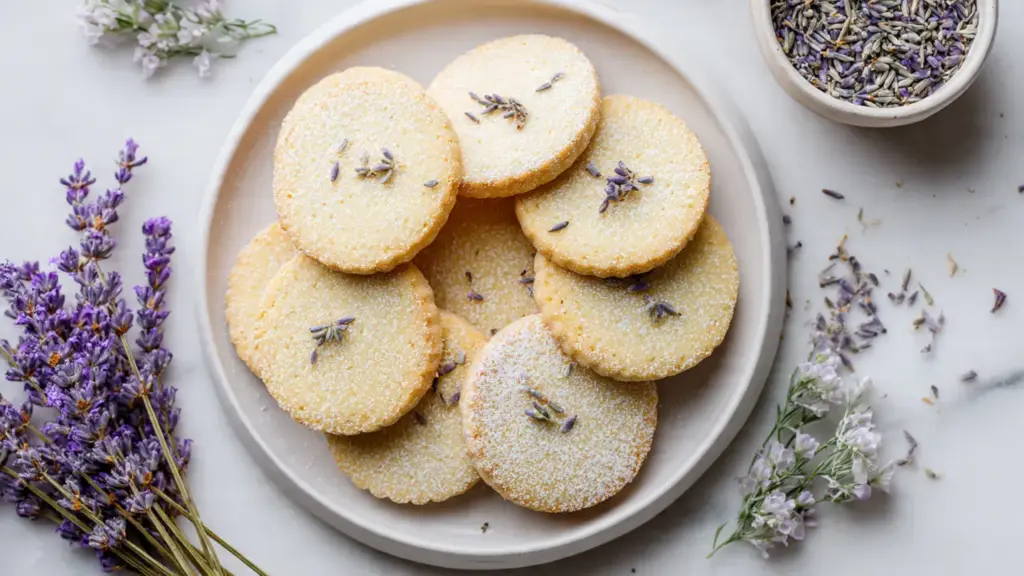
Lavender shortbread cookies are wonderfully versatile and pair beautifully with a wide range of drinks and accompaniments.
Their delicate floral flavor makes them a natural choice for elegant occasions and simple afternoon treats alike.
- Serve alongside a pot of Earl Grey or chamomile tea for a classic afternoon tea spread.
- Pair with fresh fruit and whipped cream for a light, spring-inspired dessert platter.
- Stack them in a clear treat bag tied with ribbon for a homemade gift that looks as beautiful as it tastes.
- Arrange on a dessert board alongside Classic Deviled Eggs and seasonal fruit for a bridal shower or baby shower spread.
- Serve with a scoop of vanilla bean or lavender honey ice cream for an indulgent dessert pairing.
- Crumble a few over a bowl of vanilla pudding or yogurt for a delicate, floral crunch.
- Offer them as part of a cookie tin gift alongside other homemade shortbread varieties for the holidays.
- Pair with a glass of cold lemonade or sparkling water infused with lemon and mint for a refreshing summer treat.
Variations to Try
Once you’ve mastered the base recipe, the variations are endless and easy to pull off.
Each one uses the same foundational dough, so you can experiment freely without starting from scratch:
- Lemon Lavender Shortbread: Add 1 teaspoon of fresh lemon zest to the butter and sugar when creaming. The bright citrus lifts the floral notes beautifully and adds a sunny, springtime character to every bite.
- Lavender Honey Shortbread: Replace the granulated sugar with 3 tablespoons of raw honey mixed into the softened butter. Reduce the flour by 1 tablespoon to compensate for the extra moisture. The honey adds a deep, warm sweetness that pairs perfectly with lavender.
- Lavender White Chocolate Dip: Once the cooled cookies are firm, melt 4 ounces of good-quality white chocolate and dip each cookie halfway into the chocolate. Place on a parchment-lined tray and refrigerate for 15 minutes to set. The creamy sweetness of white chocolate is a dream with lavender.
- Lavender Vanilla Bean Shortbread: Add the seeds from half a vanilla bean in addition to the vanilla extract for a more intense, complex vanilla flavor. Vanilla bean and lavender together taste incredibly luxurious.
- Lavender Earl Grey Shortbread: Add 1 teaspoon of finely ground Earl Grey tea leaves along with the lavender. The bergamot in Earl Grey echoes and deepens the floral quality of the lavender in a really beautiful way.
- Lavender Almond Shortbread: Add 1/4 teaspoon of almond extract in place of half the vanilla. Sprinkle sliced almonds on top of each cookie before baking for a lovely textural contrast.
You might also love the Pecan Shortbread Cookies Recipe for a nutty, buttery take on the classic.
Storage and Reheating
Lavender shortbread cookies store exceptionally well, which makes them a fantastic make-ahead option for parties, gifts, and holiday cookie tins.
Follow these storage guidelines to keep them fresh and delicious:
- Room temperature: Place fully cooled cookies in an airtight container, layered between sheets of parchment paper to prevent them from sticking or breaking. They’ll stay fresh for up to 7 days at room temperature in a cool, dry spot away from direct sunlight or heat.
- Refrigerator: Store in an airtight container for up to 2 weeks. Let them come to room temperature for 15 to 20 minutes before serving for the best texture.
- Freezer (baked cookies): Place completely cooled cookies in a single layer on a baking sheet and freeze until solid, about 1 hour. Then transfer to a freezer-safe bag or container with parchment between layers. Baked cookies freeze well for up to 3 months. Thaw at room temperature for 30 minutes.
- Freezer (unbaked dough log): Wrap the shaped dough log tightly in plastic wrap, then wrap again in foil or place in a freezer bag. It will keep frozen for up to 3 months. When ready to bake, transfer to the refrigerator overnight to thaw, then slice and bake as directed.
- Reheating: These cookies are best enjoyed at room temperature and don’t require reheating. If you’d like them slightly warm, place on a baking sheet in a 300°F (150°C) oven for 3 to 4 minutes. They’ll soften slightly and smell incredible.
The Chocolate Shortbread Cookies Recipe follows the same storage method and is another excellent make-ahead option.
Nutritional Facts
The following nutritional information is approximate and based on one cookie, assuming the recipe yields 24 cookies.
| Nutrient | Amount Per Cookie |
|---|---|
| Calories | 115 kcal |
| Total Fat | 8g |
| Saturated Fat | 5g |
| Cholesterol | 20mg |
| Sodium | 50mg |
| Total Carbohydrates | 10g |
| Dietary Fiber | 0g |
| Sugars | 4g |
| Protein | 1g |
Please note that nutritional values will vary depending on the specific brands of ingredients used, the exact size of each cookie slice, and any variations or additions made to the recipe. These figures are estimates intended as a general guide.
For more classic cookie nutrition comparisons, the Best Chocolate Chip Cookies Recipe includes similar per-cookie estimates.
Health Benefits of Key Ingredients
While lavender shortbread cookies are certainly an indulgent treat, a few of the key ingredients bring more to the table than just flavor.
Enjoying these cookies as part of a balanced diet means you’re not just savoring something delicious — you’re also benefiting from some genuinely wholesome ingredients.
- Lavender (Lavandula angustifolia): Lavender has long been associated with calming properties. Research suggests that its aromatic compounds may help reduce stress and anxiety, and the herb has historically been used in aromatherapy for promoting relaxation and better sleep. While the amount used in baking is small, incorporating lavender into your routine in any form is a gentle and enjoyable way to invite a little calm into your day.
- Butter: Butter made from grass-fed cows is a natural source of fat-soluble vitamins including Vitamin A, Vitamin K2, and Vitamin E. It also contains butyrate, a short-chain fatty acid that research increasingly links to digestive health and reducing inflammation.
- Vanilla Extract: Real vanilla extract contains small amounts of vanillin, an antioxidant compound that may help neutralize harmful free radicals in the body. Vanilla also has a mild mood-boosting reputation — its warm, sweet scent is associated with feelings of comfort and contentment.
- All-Purpose Flour: As the primary structural ingredient, flour provides carbohydrates for energy. If you’re looking to boost the nutritional profile, you can substitute up to half the all-purpose flour with whole wheat pastry flour, which adds fiber and a subtle nutty depth without significantly altering the texture.
Read Also: Strawberry Shortbread Cookies Recipe
Frequently Asked Questions
1. Can I use fresh lavender instead of dried?
Yes, fresh lavender can be used in this recipe. The key is to use the flowers only (not the stems or leaves), and to use roughly twice the amount of fresh lavender as dried — so about 1 tablespoon of fresh lavender flowers in place of 1 1/2 teaspoons of dried. Finely chop or grind the fresh flowers just as you would the dried ones.
Fresh lavender has a slightly milder, more delicate flavor than dried, so your cookies may have a subtler floral note. This is a lovely version for spring and early summer when lavender is in bloom.
2. What does culinary lavender taste like in cookies?
Culinary lavender has a floral, slightly herbal, and faintly sweet flavor that’s difficult to describe until you taste it. It’s in the same aromatic family as rosemary and mint but softer and more perfumed. In a shortbread cookie, the lavender reads as a gentle, elegant backdrop to the buttery richness — not soapy or overpowering when used in the right quantity.
The key is restraint. Using too much lavender can make the cookies taste like soap or bathroom products. The amount in this recipe is calibrated for a noticeable but balanced floral presence.
3. Why did my shortbread dough crack when I sliced it?
This usually means the dough is too cold and hard. If the log was in the fridge overnight or for many hours, let it sit at room temperature for 5 to 10 minutes before slicing. This softens it just enough so a sharp knife glides through cleanly without the dough cracking or crumbling at the edges.
A dull knife can also cause cracking, so make sure you’re using a thin, sharp blade and pressing straight down rather than dragging or sawing through the log.
4. Can I make the dough ahead of time?
Absolutely, and this is actually one of the best things about this recipe. The shaped dough log keeps well in the refrigerator for up to 3 days, tightly wrapped in plastic wrap. It also freezes beautifully for up to 3 months.
When you’re ready to bake from frozen, transfer the log to the refrigerator the night before and let it thaw slowly and evenly. Once thawed, slice and bake as directed. This makes it an excellent option for entertaining or holiday baking when you want to get ahead.
5. Can I make these gluten-free?
Yes, with some adjustments. Replace the all-purpose flour with a 1:1 gluten-free baking flour blend that contains xanthan gum (this ingredient is important for binding the dough in the absence of gluten). The texture may be slightly more crumbly than the traditional version, and the edges may not hold their shape quite as crisply, but the flavor will still be delicious.
It’s also worth chilling the dough for a longer period — at least 3 hours — before slicing, as gluten-free dough tends to be softer and more fragile. Slice the rounds a little thicker, about 1/3 inch, to help them hold together during baking.
For more cookie inspiration, the Cranberry Pistachio Shortbread Cookies Recipe is another crowd-pleaser that uses a similar method and is absolutely stunning on a holiday cookie tray.
Final Thoughts
A good lavender shortbread cookies recipe is one of those little culinary pleasures that feels both simple and special at the same time. You need just seven ingredients, a little patience, and about 30 minutes of active work — and in return, you get a batch of genuinely beautiful cookies with a flavor that surprises and delights anyone who tries one.
These are the cookies that prompt requests for the recipe. They’re the ones that disappear fast from a cookie plate but somehow feel fancy enough to give as a gift.
If you haven’t baked with lavender before, this is the perfect entry point. The floral note is subtle, the technique is straightforward, and the results are consistently wonderful no matter your baking experience level.
Give this recipe a try, and let me know in the comments below how they turned out! Did you try any of the variations? Share a photo or tag me — nothing makes me happier than seeing a reader’s fresh-from-the-oven batch.
Recommended:
- Whipped Shortbread Cookies
- Scottish Shortbread Cookie Recipe
- Cranberry Orange Shortbread Cookies
- Christmas Shortbread Cookies
- Easy Scone Recipe
- Classic Scone Recipe
- Cut Out Sugar Cookie Recipe
- Easy Sugar Cookie Recipe
- Fruit Tart Recipe
- Easy Tiramisu Recipe