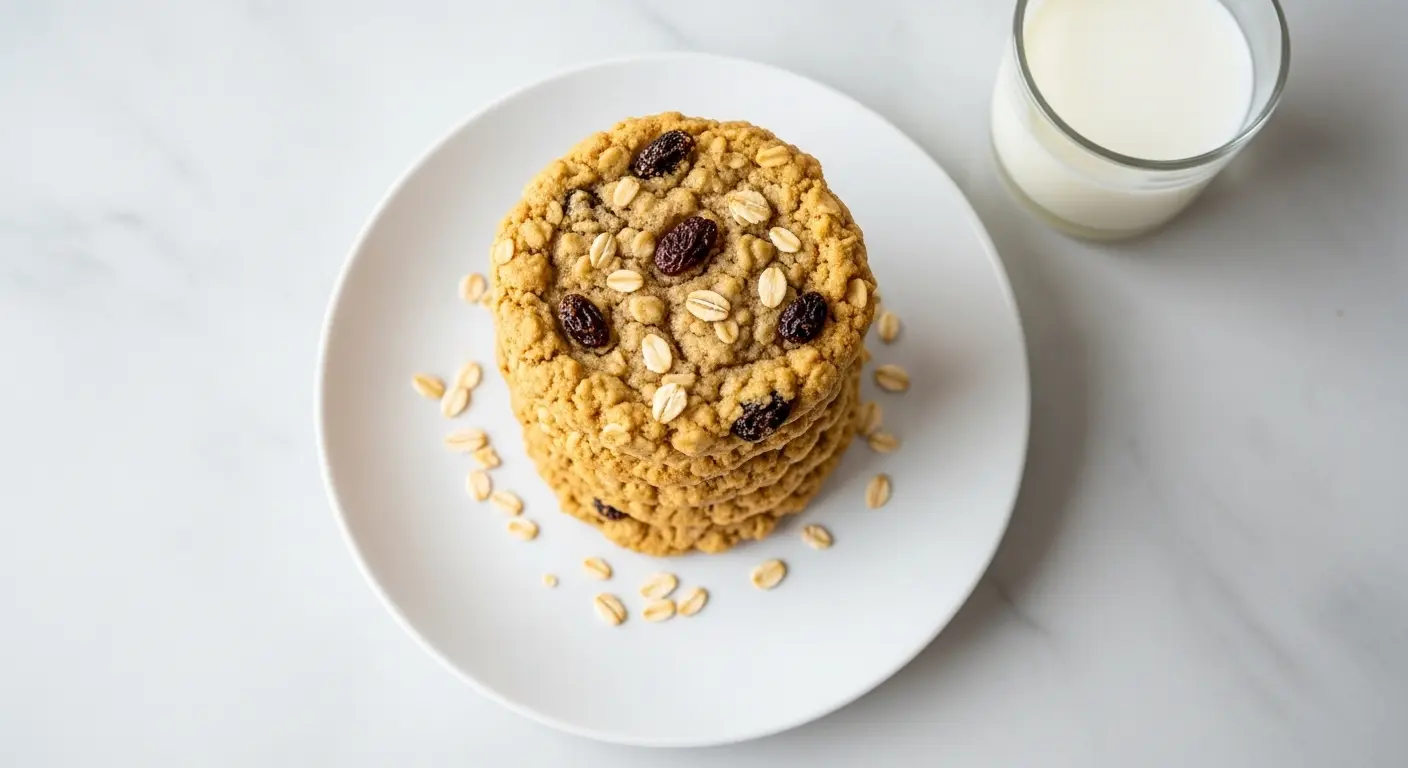
If you’ve been searching for the perfect oatmeal cookie recipe, your search ends right here.
These cookies hit every mark: crisp golden edges, a soft and chewy center, and that warm, buttery cinnamon flavor that makes you reach for a second one before the first is even finished.
What makes this recipe stand out is the ratio of brown sugar to white sugar. Brown sugar is packed with molasses, which keeps the cookie moist, adds a deep caramel-like flavor, and is the main reason these cookies stay soft for days.
The use of old-fashioned rolled oats (not quick oats) is equally important. Rolled oats give you that hearty, chewy bite that makes an oatmeal cookie feel like a real oatmeal cookie, not a thin, crispy wafer. Quick oats absorb too much moisture and produce a softer, more uniform texture, which just doesn’t have the same character.
This is the kind of recipe you’ll make once and then commit to memory. It’s simple, it’s reliable, and it turns out perfectly every single time.
Craving more classic cookie bakes? Check out this Oatmeal Raisin Cookie Recipe for a fruity twist on this same cozy base.
Why You’ll Love This Oatmeal Cookie Recipe
This oatmeal cookie recipe is genuinely one of the easiest bakes you’ll ever do.
You don’t need a stand mixer, no fancy equipment, and no dough chilling required (though chilling is an option if you prefer thicker cookies). The dough comes together in about 10 minutes, and the cookies are out of the oven in under 15.
The flavor is classic comfort food at its finest. You get that warm cinnamon-vanilla warmth in every bite, layered over a rich, brown sugar base and held together by perfectly chewy oats.
These cookies are also wonderfully versatile. The base dough is a blank canvas, ready to accept raisins, chocolate chips, chopped walnuts, or dried cranberries without missing a beat.
- Quick and easy – Ready from start to finish in under 30 minutes
- No chilling required – Bake them right away, or refrigerate the dough for up to 48 hours
- Pantry-friendly – Every ingredient is a kitchen staple
- Perfectly balanced – Crisp edges, soft centers, chewy oat texture throughout
- Endlessly customizable – Add raisins, chocolate chips, or nuts to make them your own
- Kid and crowd approved – A universally loved cookie for all ages
You might also enjoy: Monster Cookie Recipe
Ingredients
The magic of this recipe is in its simplicity. Every ingredient plays a specific role, and none of them can be swapped without affecting the final result.
Old-fashioned rolled oats are non-negotiable here. They create the chewy, hearty texture that defines a classic oatmeal cookie. Using more brown sugar than white sugar is intentional: brown sugar has a higher moisture content, which keeps the cookies soft longer and adds that rich, molasses-forward flavor.
- 1 cup (225 g) unsalted butter, softened to room temperature
- 1 cup (200 g) light brown sugar, packed
- ½ cup (100 g) granulated white sugar
- 2 large eggs, at room temperature
- 2 teaspoons pure vanilla extract
- 1 ½ cups (190 g) all-purpose flour
- 1 teaspoon baking soda
- 1 teaspoon ground cinnamon
- ½ teaspoon fine salt
- ¼ teaspoon ground nutmeg (optional, but adds warmth)
- 3 cups (270 g) old-fashioned rolled oats
Optional add-ins:
- 1 cup (160 g) raisins
- 1 cup (175 g) semi-sweet chocolate chips
- 1 cup (115 g) chopped walnuts or pecans
Read Also: Chewy Oatmeal Chocolate Chip Cookie Recipe
Kitchen Equipment Needed
You don’t need much to pull this recipe together, which is part of what makes it so approachable for bakers at every level.
A hand mixer or stand mixer is helpful for creaming the butter and sugars, but a bowl and wooden spoon work just fine if you have some elbow grease. A cookie scoop ensures uniform sizing and even baking, which is absolutely worth it.
- Large mixing bowl
- Medium mixing bowl
- Electric hand mixer or stand mixer
- Rubber spatula or wooden spoon
- Cookie scoop (1.5 tablespoon size)
- Two large baking sheets
- Parchment paper or silicone baking mats
- Wire cooling rack
- Measuring cups and spoons
This technique works beautifully in the same spirit as a Cookie Skillet Recipe if you ever want to bake the dough as one giant skillet cookie for a fun twist.
Recommended Products for This Recipe
These are personally recommended products based on quality, performance, and how they directly improve this oatmeal cookie recipe.
1. Bob’s Red Mill Old Fashioned Rolled Oats
Old-fashioned rolled oats are the backbone of any great oatmeal cookie, and Bob’s Red Mill consistently delivers a quality product with a clean, nutty flavor and the perfect thick cut. Using a premium brand here makes a noticeable difference in the chewiness and heartiness of the final cookie. They’re also minimally processed and widely available.
2. KitchenAid Classic Stand Mixer
Creaming butter and sugar properly is one of the most important steps in cookie baking, and a stand mixer does this effortlessly and consistently. A properly creamed butter-sugar mixture creates the light, airy base that gives these cookies their perfect texture. This is an investment that pays off with every batch you bake.
3. OXO Good Grips Medium Cookie Scoop
Uniform cookies bake evenly, and nothing ensures uniform sizing like a reliable cookie scoop. The OXO medium scoop releases dough cleanly without squishing it, so you get perfectly round cookies every time. It also saves significant time over hand-rolling each ball.
4. USA Pan Half Sheet Baking Pan
A good quality, light-colored baking sheet is essential for cookies. Darker pans absorb more heat and can overbrown the cookie bottoms before the centers set. The USA Pan distributes heat evenly and resists warping, giving you consistent results batch after batch.
5. Nielsen-Massey Pure Vanilla Extract
Vanilla is a supporting flavor in this cookie, but the difference between imitation vanilla and a pure extract like Nielsen-Massey is significant. The pure extract adds a genuine depth and warmth that elevates the overall flavor of the cookie without overpowering the oats and brown sugar.
Read Also: Peanut Butter Blossom Cookies Recipe
Step-by-Step Instructions
Step 1: Preheat the Oven and Prep the Baking Sheets
- Preheat your oven to 350°F (175°C). This temperature gives the cookies enough heat to spread and set without burning the edges before the centers are cooked through.
- Line two large baking sheets with parchment paper or silicone baking mats. Do not grease the pans directly, as this can cause the cookie bottoms to become overly crisp.
- Position your oven racks in the upper-middle and lower-middle positions so you can bake two sheets at a time. Set the prepared pans aside.
Step 2: Cream the Butter and Sugars
- Place the softened butter (1 cup / 225 g) into a large mixing bowl or the bowl of a stand mixer fitted with the paddle attachment.
- Make sure your butter is truly at room temperature. It should give slightly when pressed but not feel greasy or slick. Cold butter won’t cream properly; melted butter will make the cookies spread too flat.
- Add the packed light brown sugar (1 cup / 200 g) and granulated white sugar (½ cup / 100 g) to the butter.
- Beat on medium speed for 2 to 3 minutes until the mixture turns pale, light, and fluffy. This step is important: the creaming process incorporates air into the dough, which gives the cookies their ideal texture. Don’t rush it.
- Stop the mixer and scrape down the sides and bottom of the bowl with a rubber spatula to ensure everything is evenly combined.
Step 3: Add the Eggs and Vanilla
- Crack the 2 large eggs (at room temperature) into a small bowl first. Adding them one at a time from a separate bowl makes it easier to spot any shell fragments.
- Add the first egg to the butter-sugar mixture and beat on medium speed until fully incorporated, about 30 seconds.
- Add the second egg and beat again for another 30 seconds until smooth.
- Add the 2 teaspoons of pure vanilla extract and beat for another 30 seconds to combine.
- Scrape down the bowl again to ensure everything is well mixed.
Step 4: Whisk the Dry Ingredients
- In a separate medium-sized mixing bowl, add the all-purpose flour (1 ½ cups / 190 g), baking soda (1 teaspoon), ground cinnamon (1 teaspoon), fine salt (½ teaspoon), and ground nutmeg (¼ teaspoon) if using.
- Use a whisk to combine the dry ingredients thoroughly. Whisking distributes the baking soda and spices evenly throughout the flour, which ensures consistent rise and flavor in every cookie.
- This step matters more than people realize. Unevenly distributed baking soda can cause some cookies to spread more than others.
Step 5: Combine the Dry and Wet Ingredients
- With the mixer on low speed (or using a rubber spatula), gradually add the flour mixture to the butter mixture. Add it in two additions, mixing just until no dry streaks of flour remain.
- Do not overmix at this stage. Overworking the flour develops the gluten, which can make the cookies tough and dense instead of tender and chewy.
- Stop the mixer as soon as the dough comes together.
Step 6: Fold In the Oats (and Optional Add-Ins)
- Add the old-fashioned rolled oats (3 cups / 270 g) to the dough.
- Using a rubber spatula or a wooden spoon, fold the oats in by hand. This gentle approach prevents overmixing and keeps the oats intact for maximum chewiness.
- If you’re adding raisins, chocolate chips, chopped nuts, or any other mix-ins, fold them in at this stage as well.
- The dough will be thick and dense. This is completely normal and correct.
Step 7: Scoop the Dough
- Using a 1.5-tablespoon cookie scoop (or a heaping tablespoon), portion the dough into balls.
- Place the dough balls on the prepared baking sheets, spacing them about 2 inches (5 cm) apart. The cookies will spread as they bake, so they need room.
- For thick, bakery-style cookies, you can refrigerate the dough balls for 30 minutes before baking. This firms up the fat in the dough, which slows the spread in the oven and results in a taller, chewier cookie.
- For a perfectly round cookie, you can roll each dough ball briefly between your palms to smooth it out.
Step 8: Bake the Cookies
- Place the baking sheets in the preheated oven. If baking two sheets at once, place one on the upper rack and one on the lower rack.
- Bake for 10 to 12 minutes, until the edges are set and golden but the centers still look slightly underdone and glossy. This is exactly what you want.
- The cookies will continue to cook on the hot baking sheet for several minutes after coming out of the oven, so pulling them early is key to a soft, chewy center. Overbaking is the number one mistake people make with oatmeal cookies.
- If baking two sheets at once, rotate them halfway through baking (swap top to bottom and turn front to back) for even results.
Step 9: Cool the Cookies
- Remove the baking sheets from the oven and allow the cookies to cool on the pan for 5 minutes. They will be very soft and fragile right out of the oven, so leave them undisturbed during this time.
- After 5 minutes, use a flat spatula to transfer the cookies to a wire cooling rack.
- Let them cool for at least another 10 minutes before eating. The texture firms up as they cool, and the flavors deepen as well.
- Repeat the baking process with remaining dough, always starting with a cool baking sheet.
The same technique for folding in oats and mix-ins works beautifully in a No Bake Cookie Recipe if you’re looking for a quick, oven-free treat.
Tips for Success
Getting oatmeal cookies right every time comes down to a handful of simple principles.
Butter temperature is the most critical factor. If your butter is too cold, it won’t cream properly. If it’s too warm or melted, the cookies will spread into flat, greasy puddles. Room temperature butter should hold a finger indent when pressed but not leave a slick residue.
- Use old-fashioned rolled oats, not quick oats. Quick oats are pre-cut and will produce a softer, less chewy cookie with a more uniform texture. Rolled oats give you that classic hearty bite.
- Don’t overmix after adding the flour. Mix just until the dry ingredients disappear. Overworking the gluten creates tough cookies.
- Pull them from the oven when the centers still look underdone. The residual heat from the pan will finish cooking them perfectly.
- Use light-colored baking sheets. Dark pans absorb more heat and can overbrown the bottoms before the centers set.
- Use a cookie scoop for consistent sizing. Uniformly-sized cookies bake at the same rate, preventing some from being overdone while others are underbaked.
- Measure flour correctly. Spoon the flour into the measuring cup and level it off. Scooping directly from the bag compacts the flour and can result in up to 20% more flour than the recipe calls for.
- Chill the dough if you have time. Even 30 minutes in the refrigerator helps the cookies bake up thicker and chewier.
Another favorite: Snickerdoodle Cookie Recipe
Serving Suggestions
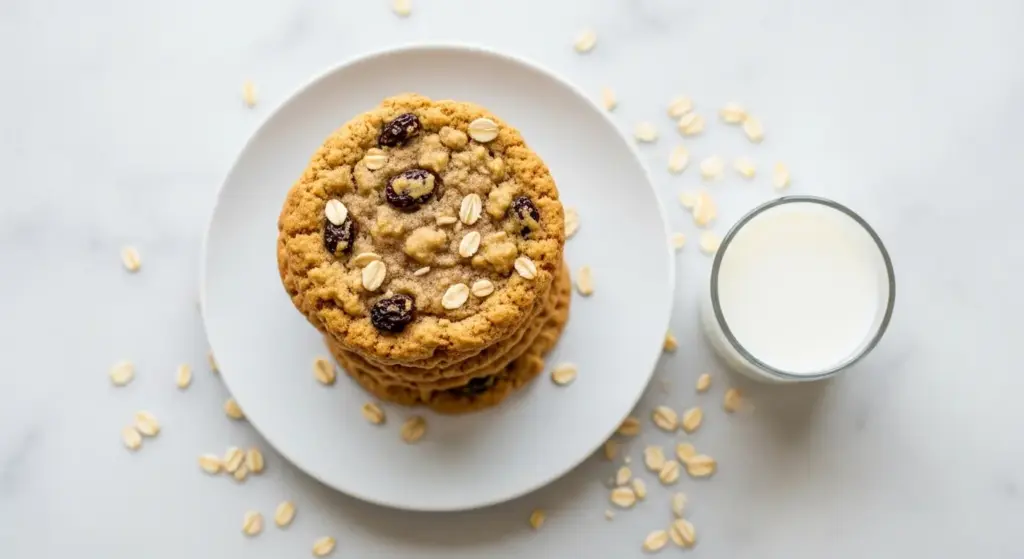
Oatmeal cookies are one of those universally beloved treats that pair well with almost anything.
The classic pairing is a cold glass of whole milk. The creaminess of the milk balances the sweet, caramelized flavors of the cookie perfectly, and softens the texture just enough for a truly satisfying bite.
- A scoop of vanilla ice cream sandwiched between two cookies for a homemade ice cream sandwich
- Warm from the oven alongside a cup of hot tea or coffee
- Crumbled over Banana Pudding as a homemade cookie topping
- Served on a dessert platter alongside Classic Deviled Eggs and Easy Apple Crisp for a casual gathering spread
- Wrapped individually in parchment and tied with a ribbon for a thoughtful homemade gift
- Crumbled over vanilla yogurt or Easy Overnight Oats for a dessert-inspired breakfast
This pairing works beautifully with Baked Oatmeal Recipe for a full oat-forward brunch spread.
Variations to Try
Once you’ve mastered the base recipe, the possibilities are endless.
The dough itself is designed to be a foundation, and it handles add-ins beautifully without becoming overloaded or falling apart. Stick to about 1 cup of mix-ins total so the dough maintains its structure.
- Oatmeal Raisin: Add 1 cup (160 g) of plump raisins. For extra juicy raisins, soak them in warm water for 10 minutes and pat dry before adding.
- Oatmeal Chocolate Chip: Fold in 1 cup (175 g) of semi-sweet chocolate chips for a dessert-level cookie.
- Oatmeal Walnut: Add ¾ cup (85 g) of roughly chopped walnuts for a nutty, slightly bitter contrast to the sweet dough.
- Cranberry Orange: Add ¾ cup dried cranberries and 1 teaspoon of fresh orange zest for a bright, fruity variation.
- Peanut Butter Oatmeal: Replace ½ cup (115 g) of the butter with creamy peanut butter for a nutty twist that pairs beautifully with chocolate chips.
- Coconut Oatmeal: Fold in ½ cup (45 g) of sweetened shredded coconut alongside the oats for extra chewiness and a tropical note.
- Spiced Brown Butter: Brown the butter before cooling and using it in the recipe. This adds a deep, nutty, almost toffee-like flavor that elevates the cookies dramatically.
Read Also: Peanut Butter Cookie Recipe
Storage and Reheating
These cookies store beautifully, which makes them perfect for baking in advance.
The key to keeping them soft is an airtight container. Exposure to air causes the cookies to dry out and become crumbly faster than anything else.
- Room temperature: Store in an airtight container with a slice of white bread. The bread helps maintain moisture in the container and keeps the cookies soft for up to 5 days.
- Refrigerator: Store in an airtight container for up to 1 week. Let them come to room temperature before serving for the best texture.
- Freezer (baked cookies): Place cooled cookies in a single layer on a baking sheet and freeze until solid, then transfer to a zip-top freezer bag or airtight container. Freeze for up to 3 months. Thaw at room temperature for 30 minutes before serving.
- Freezer (unbaked dough): Scoop the dough into balls and freeze on a baking sheet until solid. Transfer to a freezer bag and freeze for up to 3 months. Bake from frozen at 350°F (175°C), adding 2 to 3 extra minutes to the baking time.
- Reheating: To restore that fresh-from-the-oven warmth, microwave a cookie for 10 to 15 seconds or warm in a 300°F (150°C) oven for 5 minutes.
For more oat-based inspiration, try this Easy Granola Recipe
Nutritional Facts
Per cookie (based on a batch of 24 cookies, plain without add-ins)
| Nutrient | Amount |
|---|---|
| Calories | ~175 kcal |
| Total Fat | 8 g |
| Saturated Fat | 4.5 g |
| Cholesterol | 30 mg |
| Sodium | 115 mg |
| Total Carbohydrates | 24 g |
| Dietary Fiber | 1.2 g |
| Total Sugars | 13 g |
| Protein | 2.5 g |
| Iron | 1 mg |
Note: Nutritional values are estimates and will vary depending on specific brands and any add-ins used.
You might also enjoy: Easy Overnight Oats Recipe
Health Benefits of Key Ingredients
Oatmeal cookies are, admittedly, a treat first and a health food second. But several key ingredients offer genuine nutritional benefits that make this a more wholesome indulgence than most cookies.
Old-fashioned rolled oats are the star here. They’re a whole grain, packed with dietary fiber (especially beta-glucan), which has been shown to support heart health and help regulate blood sugar levels.
- Rolled oats – Rich in soluble fiber, particularly beta-glucan, which supports healthy cholesterol levels and sustained energy. They also provide manganese, phosphorus, and magnesium.
- Eggs – A source of high-quality complete protein and essential nutrients including choline, which supports brain health, and lutein, which is important for eye health.
- Cinnamon – Beyond its flavor, cinnamon contains cinnamaldehyde and antioxidants that may help regulate blood sugar and reduce inflammation.
- Walnuts (if added) – An excellent source of omega-3 fatty acids, which support heart and brain health. They also add protein, fiber, and a satisfying crunch.
- Raisins (if added) – Provide natural sugars for quick energy along with small amounts of iron, potassium, and antioxidants.
- Butter – While it should be enjoyed in moderation, butter contains fat-soluble vitamins A, D, E, and K2, along with conjugated linoleic acid (CLA).
Read Also: Baked Oatmeal Recipe
Frequently Asked Questions
1. Can I use quick oats instead of old-fashioned rolled oats?
You can, but the texture will be noticeably different. Quick oats are pre-cut into smaller pieces and absorb moisture faster, which produces a softer, more uniform cookie that lacks the chewy, hearty bite that makes an oatmeal cookie iconic.
Old-fashioned rolled oats are strongly recommended for this recipe. If quick oats are all you have, the cookies will still taste great, just with a different, less textured consistency.
2. Why are my oatmeal cookies spreading too flat?
The most common cause is butter that was too soft or even melted when you started creaming. Butter that is too warm can’t hold the air you’re incorporating, so the cookies spread out in the oven rather than holding their shape.
Other causes include too little flour (measure carefully using the spoon-and-level method), a warm kitchen, or using a hot baking sheet straight from the oven. Always bake on a cool pan, and consider chilling the dough for 30 minutes if spreading is a consistent issue.
3. How do I keep oatmeal cookies soft after baking?
The trick is storing them correctly. An airtight container is essential, and tucking a slice of plain white bread into the container is a classic baker’s trick that genuinely works. The cookies absorb moisture from the bread and stay soft for several days.
You can also slightly underbake them (pull them out when the centers still look glossy) to lock in a softer, chewier texture from the start. Cookies continue to firm up as they cool on the pan, so they’ll be perfectly chewy by the time they’re fully cooled.
4. Can I make the dough ahead of time?
Absolutely. The dough keeps well in the refrigerator for up to 48 hours when covered tightly with plastic wrap. Chilling the dough actually improves the flavor as the ingredients have more time to meld together, and it also results in thicker, chewier cookies that spread less.
You can also freeze the unbaked dough balls for up to 3 months. Pull them out and bake them directly from frozen, just add 2 to 3 extra minutes to the bake time.
5. Can I make these oatmeal cookies gluten-free?
Yes, with a couple of substitutions. Replace the all-purpose flour with a 1-to-1 gluten-free flour blend (such as Bob’s Red Mill 1:1 Baking Flour). Also make sure your rolled oats are certified gluten-free, as standard oats can be cross-contaminated during processing.
The texture may be very slightly different, but the cookies will still be soft, chewy, and delicious. Most people wouldn’t notice a difference with a quality gluten-free flour blend.
For more classic cookie inspiration, check out this Old Fashioned Chocolate Chip Cookie Recipe
Final Thoughts
This oatmeal cookie recipe is the kind of recipe that becomes a household staple almost immediately.
It’s dependable, endlessly customizable, and delivers exactly what you hope for every single time. Whether it’s your first time making homemade cookies or your hundredth, this is a recipe that respects both your time and your taste buds.
Give this oatmeal cookie recipe a try this week. Bake up a batch on a slow afternoon and see how quickly they disappear.
If you make them, drop a comment below and let me know what mix-ins you used. Sharing your results, tweaks, and photos is always welcome and genuinely makes this little corner of the internet a better place!
Recommended:
- Chewy Oatmeal Chocolate Chip Cookie Recipe
- Oatmeal Raisin Cookie Recipe
- Monster Cookie Recipe
- Best Chocolate Chip Cookies Recipe
- Chewy Chocolate Chip Cookies Recipe
- Gingerbread Cookie Recipe
- Sugar Cookies Recipe
- Cut Out Sugar Cookie Recipe
- Shortbread Cookie Recipe
- Easy Apple Crisp Recipe