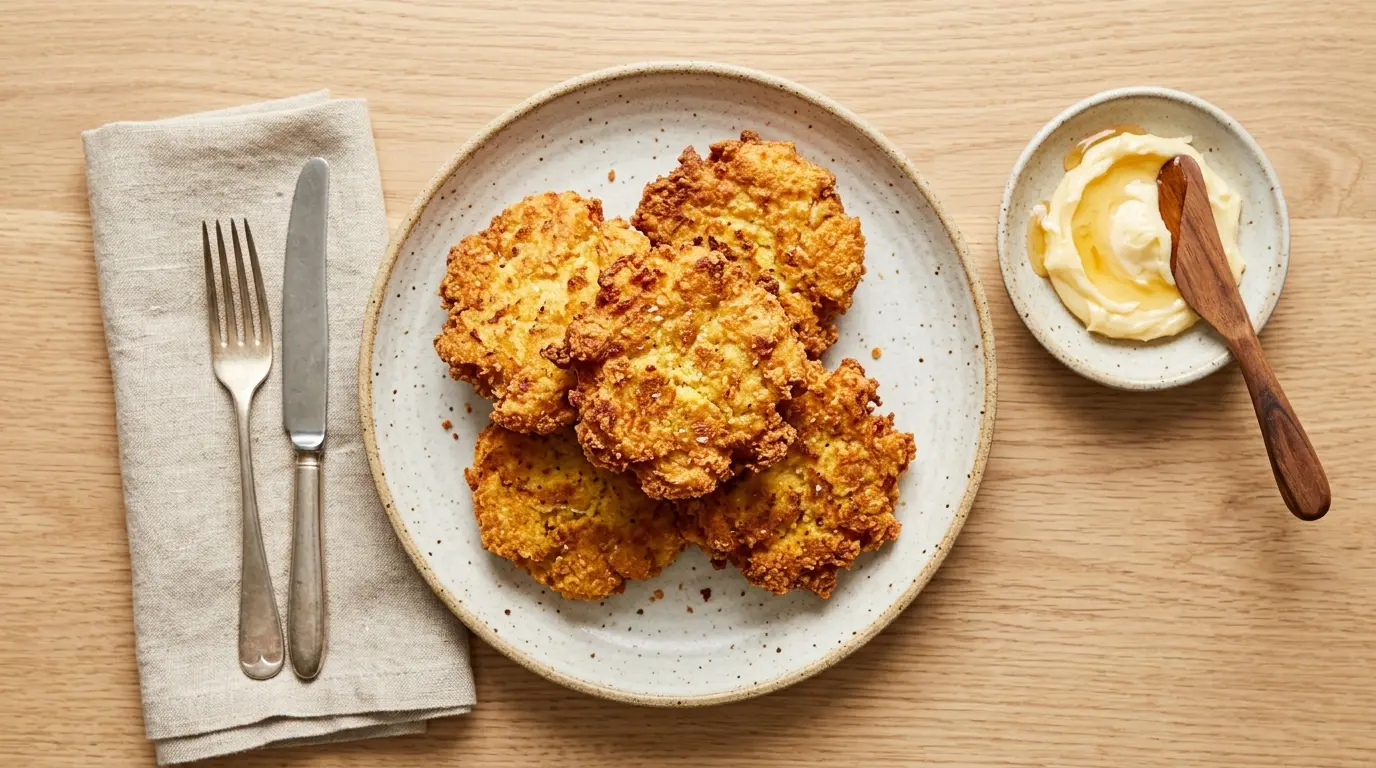
If you’ve never made a hot water cornbread recipe before, you’re in for a real treat. This old-school Southern classic is one of the simplest, most satisfying things you can fry up in a skillet. Just a handful of pantry staples, a cup of boiling water, and about 15 minutes stand between you and a plate of golden, crispy cornbread patties that are crunchy on the outside and pillowy soft inside.
This isn’t baked cornbread. It’s fried, which is exactly what makes it special.
Hot water cornbread has roots in both Native American and African American cooking traditions. It was born out of necessity, made with whatever was on hand, and it has endured for generations because it simply works. The boiling water does something magical to the cornmeal, partially cooking it and creating a thick, paste-like batter that fries up into the most irresistible little cakes you’ve ever tasted.
Once you make these, they’ll become a regular part of your dinner rotation.
If you love Southern cornbread, you might also enjoy this Southern Cornbread Recipe for a classic skillet-baked version.

Why You’ll Love This Hot Water Cornbread Recipe
Hot water cornbread checks every box for an ideal side dish. It’s quick, budget-friendly, and made with ingredients you almost certainly already have in your pantry.
The texture is truly unique. You get that deeply satisfying crunch on the outside with a moist, tender center that soaks up butter like a dream.
It’s also incredibly versatile. These little cornbread cakes go with everything from a pot of slow-cooked greens to a bowl of chili.
The recipe is beginner-friendly too. There’s no leavening to worry about, no oven to preheat, and no special technique required. If you can mix a bowl of batter and heat some oil in a skillet, you can absolutely nail this recipe.
Here’s a quick rundown of why this recipe is worth bookmarking:
- Ready in about 15 minutes from start to finish
- Only 4-5 simple ingredients that you already have at home
- No oven required, just a skillet and a stovetop
- Crispy golden exterior with a soft, pillowy center
- Naturally dairy-free when made with vegetable oil or bacon grease
- Deeply rooted in Southern food tradition, with a flavor that feels both humble and satisfying
Another favorite to try alongside this recipe: Skillet Cornbread
Ingredients
Hot water cornbread is intentionally minimal. The magic is in the technique, not a long ingredient list. Here’s what you’ll need to make about 8-10 small cornbread patties, which serves roughly 4 people.
- 1 cup (120g) self-rising cornmeal (white or yellow, both work great)
- 1/2 teaspoon salt (reduce slightly if your cornmeal mix is already salted)
- 1 teaspoon granulated sugar (optional, but adds just a touch of sweetness and helps with browning)
- 3/4 to 1 cup (180-240ml) boiling water
- 1 tablespoon bacon grease or melted butter (adds richness and flavor; optional but highly recommended)
- Vegetable oil or canola oil, for frying (enough to fill your skillet about 1/4 to 1/2 inch deep)
A note on the cornmeal: self-rising cornmeal already contains baking powder and salt, which gives the patties a slight lift during frying. If you only have plain cornmeal, you can make your own self-rising blend by combining 1 cup (120g) of plain cornmeal with 1 1/2 teaspoons baking powder and 1/2 teaspoon salt.
Read Also: Sweet Cornbread Recipe
Kitchen Equipment Needed
You don’t need much to make hot water cornbread, but the right equipment does make a difference. Here’s what to pull out before you start:
- Cast iron skillet (10 or 12 inches, preferred for even heat distribution and a better crust)
- Heatproof mixing bowl (for combining the batter with boiling water safely)
- Kettle or small saucepan (for boiling the water)
- Wooden spoon or silicone spatula (for mixing the batter)
- Deep fry thermometer (optional but helpful for monitoring oil temperature)
- Fish spatula or slotted spatula (for flipping the cornbread patties without breaking them)
- Paper towels (for draining the fried cornbread)
- Wire rack (set over a baking sheet for draining; helps keep the crust crisp)
- Measuring cups and spoons
A cast iron skillet is strongly recommended for this recipe. It holds heat exceptionally well, which means the oil stays at a consistent temperature and your cornbread gets that deep golden crust much more reliably than with a regular non-stick pan.
You might also enjoy: Jiffy Cornbread with Creamed Corn
Recommended Products for This Recipe
These are products I personally recommend based on quality and real-world performance in the kitchen. They’ll help you get the best results every time you make hot water cornbread.
1. Lodge Pre-Seasoned Cast Iron Skillet
A well-seasoned cast iron skillet is the single best tool for making hot water cornbread. It distributes heat evenly and holds a consistent frying temperature, giving you that perfectly golden crust with no cold spots. Lodge is one of the most trusted names in cast iron and comes pre-seasoned right out of the box.
2. Bob’s Red Mill Stone Ground Cornmeal
The quality of your cornmeal matters more than you might think. Stone-ground cornmeal has a slightly coarser texture and a deeper, earthier corn flavor compared to mass-produced varieties. It fries up with more character and gives the finished patties a more authentic, old-fashioned taste.
3. ThermoPro Instant Read Thermometer
Keeping your frying oil at the right temperature (around 350-375°F / 175-190°C) is the secret to perfectly crispy cornbread that isn’t greasy. A good instant-read thermometer takes the guesswork out of the equation and helps you adjust the heat as needed throughout cooking.
4. Splatter Screen for Skillet
Frying in a shallow skillet can get messy. A splatter screen lets steam escape while keeping hot oil from popping onto your stovetop (and you). It’s an inexpensive tool that makes the whole frying process much more comfortable.
Read Also: Sourdough Discard Cornbread Recipe

Step-by-Step Instructions
Step 1: Boil the Water
- Fill a kettle or small saucepan with water and bring it to a full boil.
- You’ll need approximately 3/4 to 1 cup (180-240ml) of boiling water for this recipe. It’s better to have a little extra on hand than not enough.
- Set the boiling water aside momentarily while you prepare the dry ingredients. You want to use it right away once the dry mix is ready, so timing matters here.
Step 2: Mix the Dry Ingredients
- In a heatproof medium mixing bowl, add 1 cup (120g) of self-rising cornmeal.
- Add 1/2 teaspoon of salt to the bowl.
- Add 1 teaspoon of granulated sugar if you’re using it. This is optional, but it adds just a subtle sweetness and promotes a slightly deeper golden-brown color when frying.
- Use a whisk or fork to combine the dry ingredients thoroughly, making sure everything is evenly distributed before you add the liquid.
Step 3: Add the Fat (Optional but Recommended)
- If you’re using bacon grease or melted butter, add 1 tablespoon of it directly to the dry cornmeal mixture now.
- Stir it in briefly. It won’t fully combine at this stage, but that’s okay. The boiling water will bring everything together.
- Bacon grease adds a subtle smokiness that is wonderfully traditional. Melted butter adds richness. Either option elevates the flavor significantly compared to omitting fat entirely.
Step 4: Pour in the Boiling Water
- This is the most important step of the entire recipe. Start by pouring about 3/4 cup (180ml) of the boiling water into the bowl with the cornmeal.
- Stir constantly as you pour. The hot water will begin to “cook” the cornmeal and cause the mixture to thicken quickly into a thick, paste-like consistency.
- Keep stirring until the mixture is completely smooth with no dry pockets of cornmeal remaining at the bottom.
- Assess the consistency: the batter should be thick enough to hold its shape when scooped, somewhat like a stiff mashed potato consistency, but still pliable enough to shape into a flat patty. If it feels too dry or crumbly, add more boiling water a tablespoon at a time until you reach the right texture.
- Let the batter sit for about 1-2 minutes. It will continue to thicken slightly as it cools.
Step 5: Heat the Oil
- Pour vegetable oil or canola oil into your cast iron skillet to a depth of about 1/4 to 1/2 inch (about 6-12mm).
- Place the skillet over medium to medium-high heat and allow the oil to heat up for about 3-5 minutes.
- To check if the oil is ready, drop a small pinch of the cornmeal batter into the oil. If it sizzles vigorously and floats to the surface, the oil is ready. Aim for a temperature of approximately 350-375°F (175-190°C) if you’re using a thermometer.
- Do not rush this step. Oil that isn’t hot enough will result in greasy, soggy cornbread that absorbs too much oil before crisping up. Properly heated oil seals the outside of the patty quickly, creating that signature crunch.
Step 6: Shape the Cornbread Patties
- Using a large spoon, an ice cream scoop, or your hands, scoop out portions of the batter. Each portion should be about 2-3 tablespoons in size, roughly the size of a golf ball.
- Shape each portion into a flat, round patty about 1/2 inch (1.25cm) thick and 2-3 inches (5-7.5cm) in diameter.
- If the batter is sticking to your hands, wet them lightly with water before shaping.
- Work quickly so the batter stays warm and pliable. Cold batter can become crumbly and harder to shape.
Step 7: Fry the Cornbread
- Carefully lower the shaped patties into the hot oil, placing them gently to avoid splashing.
- Do not overcrowd the skillet. Fry in batches of 3-4 patties at a time, leaving some space between each one so the oil temperature doesn’t drop too dramatically.
- Fry on the first side for about 3-4 minutes, without moving the patties, until the bottom is a deep golden-brown color.
- Use a slotted spatula or fish spatula to gently lift the edge of one patty to check the color. You want a rich golden-brown, not pale yellow.
- Once the first side is ready, carefully flip each patty and fry on the second side for another 3-4 minutes, again watching for that golden-brown color.
- The patties will puff up slightly during frying, which is a good sign. The interior is cooking through while the exterior crisps up.
Step 8: Drain and Serve
- Once both sides are deep golden-brown, remove the cornbread patties from the oil using your slotted spatula.
- Transfer them immediately to a wire rack set over a baking sheet, or to a plate lined with several layers of paper towels.
- Draining on a wire rack is preferable because it allows air to circulate around the entire patty, keeping the bottom crust crisp instead of getting soggy from steam.
- Let them cool for just a minute or two before serving. They’re best enjoyed while still hot and crispy.
- Serve immediately with butter, honey, or a sprinkle of flaky salt on top.
This pairs beautifully with a bowl of Collard Greens for the ultimate Southern comfort meal.
Tips for Success
Getting the best results from this simple recipe comes down to a few small details that make a big difference. Here’s everything you need to know to nail it on the first try.
- Use genuinely boiling water. Hot tap water won’t cut it here. You need water that’s at a full rolling boil. The boiling water partially cooks the cornmeal, which is what gives these patties their unique texture.
- Don’t skip the fat. Even just 1 tablespoon of bacon grease or butter adds significant flavor and helps the patties hold together. It also encourages better browning in the oil.
- Get the batter consistency right. It should be thick enough to shape by hand, but not so dry that it crumbles apart. Think stiff playdough. If it falls apart when you try to shape it, it’s too dry; add a bit more hot water. If it’s too loose to hold a shape, let it rest a minute or add a small amount of additional dry cornmeal.
- Let the oil reach the right temperature before adding patties. If the oil is too cool, the cornbread will absorb it and taste greasy. If it’s too hot, the outside will burn before the inside cooks through. Medium to medium-high heat on a cast iron skillet gets you right where you want to be.
- Don’t overcrowd the pan. Too many patties at once will lower the oil temperature and result in soggy bottoms. Fry in small batches and let the oil come back up to temperature between rounds.
- Leave the patties alone after placing them in the oil. Resist the urge to move them around. Let them develop a crust before you flip, or they’ll stick and fall apart.
Read Also: Gluten Free Cornbread Recipe
Serving Suggestions

Hot water cornbread is one of the most versatile side dishes in Southern cooking. It pairs beautifully with anything saucy, savory, or slow-cooked.
Serve it alongside hearty main dishes and classic Southern sides, or simply enjoy a patty on its own with a generous pat of butter melting on top. Here are some of the best pairings:
- Collard Greens — The most classic pairing. The cornbread soaks up all that wonderful pot likker.
- Fried Cabbage — Another soul food staple that loves a side of fried cornbread.
- Slow Cooker Chili — Use the cornbread patties to scoop up thick, hearty chili instead of a spoon.
- Baked Mac and Cheese — A Southern Sunday dinner dream come true.
- Southern Fried Chicken — Crispy chicken and crispy cornbread, it doesn’t get more comforting than this.
- Black Bean Soup — The cornbread is perfect for dipping into a rich, smoky bowl of beans.
- Honey Butter — For a sweet finish, serve the cornbread warm with homemade honey butter spread generously on top.
- Pinto beans or navy beans — A simple pot of seasoned beans with hot water cornbread on the side is a full, satisfying meal.
Another great pairing: Shrimp and Grits
Variations to Try
Once you’ve mastered the base recipe, it’s easy to customize hot water cornbread to suit your taste or whatever’s in your fridge. The batter takes additions beautifully.
Here are some popular variations worth exploring:
- Cheesy hot water cornbread: Stir in 1/3 cup (40g) of shredded sharp cheddar cheese into the batter before shaping. The cheese melts during frying and creates little pockets of savory, gooey goodness inside each patty.
- Jalapeño hot water cornbread: Add 1-2 tablespoons of finely diced fresh or pickled jalapeños to the batter for a spicy kick that’s absolutely addictive.
- Onion hot water cornbread: Mix in 2 tablespoons of very finely diced sweet onion. The onion softens and sweetens slightly during frying and adds great savory depth.
- Bacon hot water cornbread: Crumble 2-3 strips of cooked, crispy bacon into the batter. Combined with the bacon grease, this version is fully loaded with smoky, salty flavor.
- Sweet honey cornbread patties: Increase the sugar to 1 tablespoon and drizzle with honey immediately after frying for a sweeter, almost dessert-like version that kids especially love.
- Corn kernel cornbread: Fold in 1/4 cup (45g) of drained canned corn kernels or fresh corn cut from the cob for bursts of sweet corn flavor in every bite.
- Herb cornbread: Add 1 tablespoon of chopped fresh chives or scallions and a pinch of garlic powder for a savory, aromatic version that pairs especially well with soups.
You might also like: Cracklin Bread Recipe
Storage and Reheating
Hot water cornbread is best eaten fresh and hot, straight from the skillet. The crispy exterior softens as it cools, so if texture is important to you, try to make only as much as you’ll eat right away.
That said, leftovers are easy to store and reheat. Here’s how to handle them:
- Room temperature: If you’re serving within a couple of hours, simply leave the patties on a wire rack at room temperature. Do not cover them or they’ll steam and lose their crunch.
- Refrigerator: Store cooled leftover cornbread patties in an airtight container in the refrigerator for up to 3 days.
- Freezer: Arrange fully cooled patties in a single layer on a baking sheet and freeze until solid, about 1 hour. Then transfer to a zip-lock freezer bag and freeze for up to 2 months.
- Reheating in the oven: Preheat your oven to 375°F (190°C). Place the patties on a wire rack set over a baking sheet and bake for 8-10 minutes, flipping halfway through. This method restores most of the original crispiness.
- Reheating in an air fryer: This is the best reheating method. Air fry at 375°F (190°C) for 4-5 minutes, flipping once. The result is nearly as crispy as freshly fried.
- Reheating in a skillet: Add just a tiny bit of oil to a skillet over medium heat and warm the patties for 2-3 minutes per side. They won’t be quite as crispy as fresh, but this works well in a pinch.
- Do not microwave: Microwaving makes the patties soft and chewy rather than crispy. It’s technically edible, but nothing like the original texture.
For another comforting Southern bread side: Brunswick Stew
Nutritional Facts
The following nutritional information is an estimate based on one serving of approximately 2 cornbread patties, out of a total yield of 8-10 patties from this recipe. Values will vary depending on the amount of oil absorbed during frying.
| Nutrient | Amount Per Serving (2 patties) |
|---|---|
| Calories | 180-210 kcal |
| Total Fat | 9-12g |
| Saturated Fat | 1.5-2.5g |
| Carbohydrates | 24-26g |
| Fiber | 2g |
| Sugar | 1-2g |
| Protein | 3g |
| Sodium | 280-320mg |
| Iron | 1.2mg |
These values are based on using self-rising cornmeal, a small amount of added fat (bacon grease or butter), and shallow frying in vegetable oil. Using bacon grease will add slightly more saturated fat, while using vegetable oil or canola oil keeps the saturated fat content lower. The actual oil absorbed during shallow frying varies, but because the patties fry at the correct temperature, they absorb far less oil than deep-fried foods cooked at lower temperatures.
Read Also: Corn Pudding Recipe
Health Benefits of Key Ingredients
While hot water cornbread is certainly an indulgent comfort food, the key ingredient, cornmeal, brings some genuine nutritional value to the table.
Cornmeal and corn-based foods have been dietary staples across many cultures for good reason.
- Cornmeal is a good source of complex carbohydrates, which provide sustained energy and fuel the body more steadily than simple sugars.
- Cornmeal contains dietary fiber, which supports healthy digestion and helps keep you feeling fuller for longer after eating.
- Yellow cornmeal is rich in carotenoids, including lutein and zeaxanthin, two antioxidants particularly associated with supporting eye health.
- Cornmeal provides B vitamins including niacin (B3) and folate (B9), which support energy metabolism and healthy cell function.
- Bacon grease, when used in moderation, is a source of monounsaturated fat (similar to olive oil) and actually contains less cholesterol than butter.
- Vegetable oil used for frying provides vitamin E, a fat-soluble antioxidant that supports immune function and skin health.
- Stone-ground cornmeal retains more of the corn’s natural germ and bran, meaning it provides more fiber and nutrients than highly processed cornmeal blends.
You might also enjoy: Classic Red Beans and Rice Recipe
Frequently Asked Questions
1. What type of cornmeal works best for hot water cornbread?
Self-rising cornmeal is the most common choice and produces reliable results consistently. It contains a small amount of leavening (baking powder) that helps the patties puff up slightly during frying, giving them a lighter interior texture. You can use either white or yellow self-rising cornmeal, and both produce excellent hot water cornbread. White cornmeal tends to give a slightly more delicate flavor, while yellow cornmeal has a deeper, earthier corn taste. If you only have plain (non-self-rising) cornmeal, simply add 1 1/2 teaspoons of baking powder and 1/2 teaspoon of salt per cup of plain cornmeal.
2. Why is my hot water cornbread falling apart?
The most common reason hot water cornbread patties fall apart is that the batter is too dry. The batter needs to be thick but still cohesive enough to hold together when pressed into a patty. If your batter is crumbly and won’t stick together, add a little more boiling water, just a tablespoon at a time, and stir well after each addition. Also make sure your water is truly at a full boil, not just warm. Water that isn’t hot enough won’t properly cook and hydrate the cornmeal, which affects how the batter binds together.
3. Can I bake hot water cornbread instead of frying it?
Technically, you can bake hot water cornbread in a greased skillet or muffin tin at 400°F (200°C) for about 20-25 minutes. However, the result will be noticeably different. The defining characteristic of hot water cornbread is its deeply crunchy, fried exterior, and baking simply cannot replicate that same crispy crust. If you’re looking for a baked cornbread experience, a traditional skillet cornbread recipe would be a better fit. If you make the hot water version, commit to frying it, since that’s where all the magic happens.
4. Can I make hot water cornbread ahead of time?
Hot water cornbread is best made and eaten immediately, since the crispy crust softens as it sits. That said, you can partially prep by measuring and mixing your dry ingredients in advance. When you’re ready to cook, just boil the water and mix the batter from there. The entire process from mixing to eating takes only about 15 minutes, so it’s fast enough to make just before serving without much pre-planning. If you do have leftovers, reheat them in an air fryer or oven (not a microwave) to restore as much crispiness as possible.
5. What’s the difference between hot water cornbread and hush puppies?
Both are fried cornmeal-based foods, but they differ in a few key ways. Hot water cornbread is made by scalding the cornmeal with boiling water and shaping the resulting dough by hand into flat patties. Hush puppies are typically made with a wet batter (often including egg, buttermilk, and onion) that’s dropped by spoonfuls directly into the oil. Hot water cornbread has a more rustic, denser texture and is flatter in shape. Hush puppies are rounder, slightly lighter, and airier inside. Both are delicious, but hot water cornbread is the older, simpler, more minimal recipe of the two.
This recipe also pairs wonderfully with Salmon Croquettes Soul Food Recipe for a full Southern spread.

Hot Water Cornbread

Equipment
- Cast iron skillet - 10 or 12 inch, preferred for even heat distribution
- Heatproof mixing bowl - For safely combining batter with boiling water
- Kettle or small saucepan - For boiling water
- Wooden spoon or silicone spatula - For mixing batter
- Deep fry thermometer - Optional, for monitoring oil temperature
- Fish spatula or slotted spatula - For flipping without breaking
- Paper towels - For draining fried cornbread
- Wire rack - Set over baking sheet for draining, helps keep crust crisp
- Measuring cups and spoons
Ingredients
- 1 cup self-rising cornmeal - 120g, white or yellow; or use 1 cup plain cornmeal with 1½ tsp baking powder and ½ tsp salt
- ½ teaspoon salt - Reduce slightly if using salted cornmeal mix
- 1 teaspoon granulated sugar - Optional, adds slight sweetness and helps with browning
- ¾-1 cup boiling water - 180-240ml, at a full rolling boil
- 1 tablespoon bacon grease or melted butter - Optional but highly recommended for richness and flavor
- vegetable oil or canola oil - For frying, enough to fill skillet about ¼ to ½ inch deep
For Serving (Optional)
- butter - For serving, softened or melted
- honey - For drizzling, optional
- flaky sea salt - For sprinkling, optional
Instructions
- Bring water to a full rolling boil in a kettle or small saucepan.
- In a heatproof bowl, combine the self-rising cornmeal, salt, and sugar (if using). Whisk thoroughly to distribute evenly.
- Add the bacon grease or melted butter to the dry mixture and stir briefly. The boiling water will bring it all together.
- Pour ¾ cup of boiling water into the bowl while stirring constantly. Mix until smooth and thick, like stiff mashed potatoes. Add more hot water if needed to reach a pliable consistency. Let rest 1-2 minutes.
- Heat ¼ to ½ inch of oil in a cast iron skillet over medium-high heat until it reaches 350-375°F (175-190°C). Test with a pinch of batter – it should sizzle vigorously.
- Scoop 2-3 tablespoon portions of batter and shape into flat patties about ½ inch thick and 2-3 inches in diameter. Wet your hands with water if the batter sticks.
- Carefully place patties in hot oil without overcrowding (3-4 at a time). Fry for 3-4 minutes per side until deep golden brown and crispy. Flip gently using a slotted spatula.
- Transfer patties to a wire rack or paper towels to drain. Let cool for a minute, then serve hot with butter, honey, or a sprinkle of flaky salt.
Notes
- Use genuinely boiling water – hot tap water won’t work. The boiling water partially cooks the cornmeal, creating the signature texture.
- Don’t skip the fat. Even 1 tablespoon of bacon grease or butter adds significant flavor and helps the patties hold together.
- Get the batter consistency right – it should be thick enough to shape by hand but not so dry that it crumbles. Think stiff playdough.
- Let the oil reach 350-375°F before frying. Too cool = greasy cornbread. Too hot = burnt outside, raw inside.
- Don’t overcrowd the pan – fry in small batches to maintain oil temperature. Overcrowding leads to soggy bottoms.
- Leave the patties alone after placing them in oil. Resist moving them until they develop a golden crust, or they’ll stick and fall apart.
- Store leftovers in an airtight container in the refrigerator for up to 3 days. Reheat in an air fryer at 375°F for 4-5 minutes for best crispiness.
- To freeze, arrange cooled patties on a baking sheet and freeze until solid, then transfer to a zip-top bag for up to 2 months.
- Add mix-ins to the batter before shaping: shredded cheddar, diced jalapeños, crumbled bacon, or fresh corn kernels.
- Do not microwave leftovers – it makes the patties soft and chewy rather than crispy.
Final Thoughts
Hot water cornbread is proof that the best recipes don’t need to be complicated. A cup of cornmeal, some boiling water, a hot skillet, and a little patience is all it takes to make something truly special.
It’s the kind of recipe that connects you to a long line of cooks who made something beautiful from almost nothing. Once you try it, you’ll understand why it’s been passed down for generations.
Give this hot water cornbread recipe a try the next time you need a quick, crowd-pleasing side dish. It’ll be on the table in 15 minutes, and I promise, every single patty will disappear fast.
If you make it, drop a comment below and let me know how it turned out! I’d love to hear if you added any fun mix-ins or served it with a favorite Southern dish.
Recommended:
- Southern Cornbread Recipe
- Skillet Cornbread Recipe
- Gluten Free Cornbread Recipe
- Jiffy Cornbread Recipe with Creamed Corn
- Collard Greens Recipe
- Baked Mac and Cheese Recipe
- Slow Cooker Chili Recipe
- Corn Pudding Recipe
- Buttermilk Biscuit Recipe
- Sausage Gravy Recipe