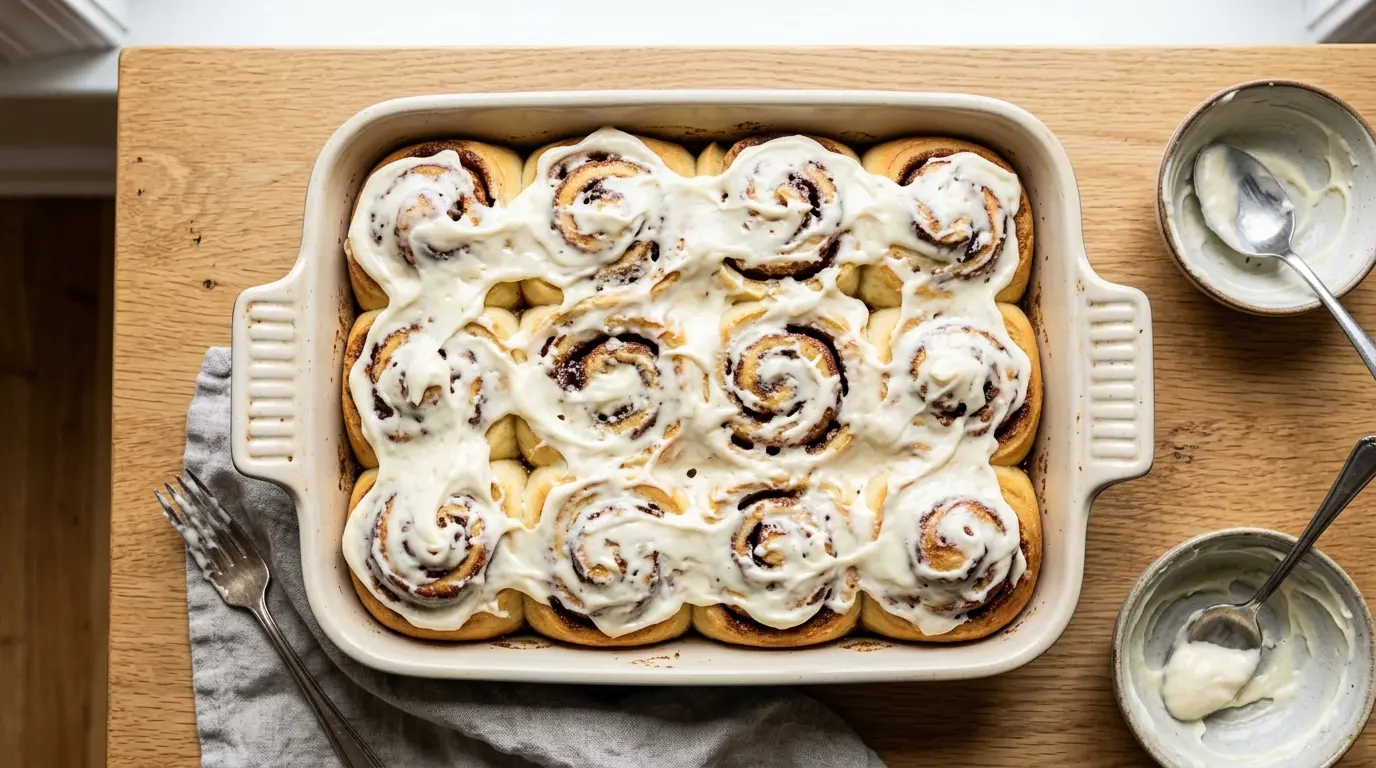
If you have a jar of sourdough discard sitting in your fridge and you’re not sure what to do with it, this Sourdough Discard Cinnamon Rolls Recipe is exactly what you need.
These rolls are soft, pillowy, and loaded with a gooey cinnamon-sugar filling, all topped with a luscious cream cheese frosting. The discard adds a subtle tang that makes them taste more complex than a standard cinnamon roll.
And here’s the thing: this recipe uses instant yeast alongside the discard, which means no waiting overnight and no long fermentation times.
You can have fresh cinnamon rolls on the table in about two and a half hours. The sourdough discard isn’t here to do the heavy lifting with the rise. It’s here for flavor. And it delivers beautifully.
Whether you bake regularly or you’re just dipping your toes into sourdough, this is the kind of recipe that makes you feel like a pro.
If you love using up your discard in creative ways, you’ll also want to check out these Sourdough Discard Chocolate Chip Cookies for another easy and indulgent treat.

Why You’ll Love This Sourdough Discard Cinnamon Rolls Recipe
This recipe hits every note you want from a homemade cinnamon roll.
The dough is enriched with butter, eggs, and whole milk, giving you that ultra-soft, tender crumb that pulls apart beautifully.
The sourdough discard adds a gentle tang that balances the sweetness of the filling perfectly. It’s subtle, but it makes the rolls taste noticeably more interesting than a one-note sugary bun.
Using instant yeast alongside the discard means the timeline is manageable. You’re not tied to a starter schedule, and you don’t need an active bubbly starter to get great results.
Here is everything you’ll love about this recipe:
- Uses up sourdough discard so nothing goes to waste
- Ready in about 2.5 hours from start to finish
- No overnight rest required, though that option is available
- Soft and fluffy texture thanks to the enriched dough
- Classic cinnamon-sugar filling with the right ratio of spice to sweetness
- Cream cheese frosting that melts into the warm rolls
- Beginner-friendly with clear, detailed steps
You might also enjoy: Sourdough Discard Crackers
Ingredients
You’ll need a handful of pantry staples for the dough, a simple spiced filling, and a creamy frosting. Make sure your discard is at room temperature before starting, as cold discard can slow down the yeast activity and affect the rise time.
For the Dough:
- 1 cup (240ml) whole milk, warmed to 110°F (43°C)
- 2 1/4 teaspoons (7g) instant yeast (one standard packet)
- 3 tablespoons (38g) granulated sugar
- 1/2 cup (120g) sourdough discard, room temperature
- 1 large egg, room temperature
- 4 tablespoons (57g) unsalted butter, melted and slightly cooled
- 1 teaspoon salt
- 3 to 3 1/2 cups (360–420g) all-purpose flour, plus more for dusting
For the Cinnamon Filling:
- 1/2 cup (113g) unsalted butter, softened to room temperature
- 3/4 cup (150g) packed light or dark brown sugar
- 2 tablespoons ground cinnamon
- 1/4 teaspoon ground nutmeg (optional but recommended)
For the Cream Cheese Frosting:
- 4 oz (113g) cream cheese, softened
- 1 1/2 cups (180g) powdered sugar, sifted
- 3 tablespoons whole milk or heavy cream
- 1 teaspoon pure vanilla extract
- Pinch of salt
Read Also: Sourdough Discard Pancakes Recipe
Kitchen Equipment Needed
You don’t need a lot of specialty tools for this recipe. A stand mixer makes the kneading much easier, but you can absolutely knead the dough by hand if you prefer. The key is getting a smooth, elastic dough, no matter how you get there.
- Stand mixer with dough hook attachment (or large mixing bowl for hand kneading)
- Large mixing bowl
- Rolling pin
- 9×13 inch baking dish or two 9-inch round cake pans
- Sharp knife or unflavored dental floss for cutting rolls
- Small mixing bowl
- Whisk
- Spatula or wooden spoon
- Pastry brush
- Plastic wrap or clean kitchen towel
- Instant-read thermometer for checking milk temperature
You might also enjoy: Sourdough Discard Pizza Dough Recipe
Recommended Products for This Recipe
These are products selected based on quality and performance that can genuinely make this recipe easier and more successful.
1. KitchenAid Artisan Stand Mixer
A stand mixer with a dough hook takes all the hard work out of kneading enriched dough. This type of dough, with its butter, eggs, and milk, can be sticky and difficult to knead by hand. A good stand mixer kneads it in about 8 to 10 minutes to the perfect smooth, elastic consistency.
2. Emile Henry Ceramic Baking Dish (9×13)
Ceramic baking dishes distribute heat evenly, which means your rolls bake consistently from edge to center. You won’t get overdone edges or underbaked middles. The light-colored interior also helps you judge doneness by color without opening the oven repeatedly.
3. OXO Good Grips Non-Stick Rolling Pin
A smooth, non-stick rolling pin makes it far easier to roll the dough into an even rectangle without tearing. Getting uniform thickness across the dough ensures all the rolls bake evenly and look beautiful.
4. King Arthur All-Purpose Flour
The quality of your flour matters more than you might think in a recipe like this. King Arthur all-purpose flour has a consistent protein content that gives you a reliable, light, and fluffy crumb every time. It’s the flour most commonly recommended by professional bakers for cinnamon rolls.
5. Thermapen Instant-Read Thermometer
Getting the milk to the right temperature (around 100 to 110°F) is critical for activating the yeast without killing it. A fast, accurate thermometer removes all the guesswork so your dough rises perfectly every time.
The same technique used to make a beautifully enriched dough here works wonders in a Sourdough Focaccia as well.

Step-by-Step Instructions
1. Warm the Milk and Combine the Wet Ingredients
- Heat 1 cup (240ml) of whole milk on the stovetop over medium-low heat or in the microwave in 20-second bursts until it reaches 100–110°F (38–43°C). Use an instant-read thermometer to verify the temperature. Too cool and the yeast won’t activate. Too hot and you risk killing the yeast entirely.
- Pour the warmed milk into the bowl of your stand mixer (or a large mixing bowl if kneading by hand).
- Sprinkle 2 1/4 teaspoons (7g) of instant yeast directly into the milk. With instant yeast, you don’t need to proof it separately. Just add it in and proceed.
- Add 3 tablespoons (38g) of granulated sugar to the bowl.
- Add 1/2 cup (120g) of room-temperature sourdough discard. Room temperature discard incorporates more easily and won’t drop the temperature of the milk significantly.
- Add 1 large room-temperature egg.
- Add 4 tablespoons (57g) of melted, slightly cooled unsalted butter. Make sure it’s not too hot or it could affect the yeast.
- Add 1 teaspoon of salt.
- Stir briefly with a spatula or whisk to combine the wet ingredients before adding the flour.
2. Mix and Knead the Dough
- Fit your stand mixer with the dough hook attachment.
- Add 3 cups (360g) of all-purpose flour to the wet mixture. Start mixing on low speed (speed 2 on a KitchenAid) for about 2 minutes, until the flour is mostly incorporated.
- Increase to medium speed (speed 4) and knead for 8 to 10 minutes. The dough should pull away from the sides of the bowl and gather around the hook. It will be slightly tacky but should not stick to your hands.
- If the dough is sticking to the sides after 4 minutes of kneading, add the remaining flour one tablespoon at a time, up to an additional 1/2 cup (60g). Avoid adding too much flour, as this will make the rolls dense rather than fluffy.
- To test if the dough is ready, perform the “windowpane test”: pinch a small piece of dough and gently stretch it between your fingers. If it stretches thin enough to see light through without tearing, the gluten is well developed and the dough is ready.
- If kneading by hand, turn the dough onto a lightly floured surface and knead firmly for 10 to 12 minutes until smooth and elastic.
3. First Rise
- Shape the dough into a ball and place it into a lightly greased large mixing bowl. Turn it once to coat all sides with a thin layer of oil or butter, which prevents the surface from drying out.
- Cover the bowl tightly with plastic wrap or a clean kitchen towel.
- Place the bowl in a warm, draft-free spot. The inside of an oven with just the light on works perfectly. Alternatively, preheat your oven to its lowest setting for a few minutes, then turn it off and place the dough inside.
- Allow the dough to rise for 1 to 1.5 hours, or until it has roughly doubled in size. Because you’re using sourdough discard (which is not an active leavener) alongside instant yeast, the rise is driven primarily by the yeast and should be reliable.
4. Make the Cinnamon Filling
- While the dough rises, prepare your filling. In a small bowl, mix together 3/4 cup (150g) of packed brown sugar, 2 tablespoons of ground cinnamon, and 1/4 teaspoon of nutmeg (if using). Stir until evenly combined. Set aside.
- Make sure your 1/2 cup (113g) of unsalted butter is softened to room temperature. It should be soft enough to spread easily but not melted. If it’s still firm, let it sit out for 20 to 30 minutes. The soft butter acts as the “glue” that holds the filling to the dough.
5. Roll Out the Dough and Add the Filling
- Once the dough has doubled, punch it down gently with your fist to release the gas.
- Turn it out onto a lightly floured surface. Dust the top of the dough and your rolling pin lightly with flour.
- Roll the dough into a large rectangle, approximately 12 inches by 18 inches (30cm x 46cm). Keep the thickness as even as possible, about 1/4 inch (6mm) thick. Use a tape measure or ruler if needed for accuracy.
- Spread the softened butter evenly over the entire surface of the dough, going all the way to the edges on three sides. Leave a 1/2-inch (1.25cm) border along one of the long edges (this will be the seam when you roll).
- Sprinkle the cinnamon-sugar-nutmeg mixture evenly over the buttered surface, pressing it gently into the butter so it adheres. Cover all the way to the buttered edges.
6. Roll, Cut, and Arrange the Rolls
- Starting from the long edge that has filling all the way to the edge (opposite the clean border), begin rolling the dough tightly toward you, like a jelly roll. Keep the roll firm and even as you go. A tighter roll gives you more defined spirals.
- When you reach the clean border, pinch the seam firmly along the full length to seal the roll closed.
- Place the log seam-side down on your work surface.
- Using unflavored dental floss or a very sharp serrated knife, cut the log into 12 equal rolls, each about 1.5 inches (4cm) thick. For dental floss: slide a length of floss under the log, cross the ends over the top, and pull tight. This method doesn’t compress the roll the way a knife can.
- Grease your 9×13 inch (23x33cm) baking dish well with butter or cooking spray.
- Arrange the 12 rolls cut-side up in the dish, placing them close together but not squished. Leave about 1/4 inch (6mm) between each roll so there is room for the second rise.
7. Second Rise
- Cover the baking dish loosely with plastic wrap or a clean kitchen towel.
- Allow the rolls to rise again in a warm place for 30 to 45 minutes. They should puff up noticeably and begin to touch each other. This second rise is what gives them that pull-apart, pillowy quality.
- During the last 15 minutes of the second rise, preheat your oven to 350°F (175°C). Make sure the oven is fully preheated before the rolls go in.
8. Bake the Rolls
- Remove the plastic wrap from the baking dish.
- Place the dish on the center rack of the preheated oven.
- Bake for 22 to 27 minutes, until the tops are golden brown and the rolls feel set when gently pressed in the center. The edges will brown first, so use the center rolls as your gauge.
- If the tops are browning too quickly before the center rolls are done, tent the dish loosely with aluminum foil for the last 5 to 10 minutes of baking.
- Remove the baking dish from the oven and place it on a wire rack. Allow the rolls to cool for 10 to 15 minutes before frosting. You want them warm but not so hot that the frosting melts completely off.
9. Make the Cream Cheese Frosting
- While the rolls cool, beat 4 oz (113g) of softened cream cheese in a medium mixing bowl with a hand mixer or whisk until completely smooth, with no lumps.
- Add 1 1/2 cups (180g) of sifted powdered sugar and mix on low speed until incorporated, then increase to medium speed and beat until smooth.
- Add 3 tablespoons of whole milk or heavy cream, 1 teaspoon of pure vanilla extract, and a pinch of salt. Beat until the frosting is silky and spreadable. If it’s too thick, add milk one teaspoon at a time. If it’s too thin, add a little more sifted powdered sugar.
10. Frost and Serve
- Spread the cream cheese frosting generously over the warm rolls directly in the baking dish, allowing it to melt slightly into the swirls.
- Serve immediately while warm for the best experience. The frosting will melt beautifully into the crevices of each roll.
Read Also: Sourdough Sandwich Bread Recipe
Tips for Success
Getting the details right makes the difference between good cinnamon rolls and truly outstanding ones. Keep these tips in mind before you start:
- Use room-temperature discard. Cold discard can lower the temperature of your dough mixture and slow down yeast activity. Pull it from the fridge at least an hour before baking.
- Don’t overheat the milk. Milk hotter than 115°F (46°C) can kill the yeast and prevent a proper rise. Use a thermometer to be sure.
- Don’t over-flour the dough. The dough should feel slightly tacky but not sticky. Too much flour results in dense, dry rolls.
- Roll the dough evenly. An uneven rectangle leads to rolls of different sizes that bake unevenly. Take your time with this step.
- Use dental floss to cut the rolls. A knife compresses the dough and flattens the spirals. Dental floss cuts cleanly without any squishing.
- Don’t skip the second rise. This is what gives the rolls their puffy, pull-apart quality. Rushing this step results in dense rolls.
- Frost while still warm. A slightly warm roll allows the frosting to melt into the swirls, creating that bakery-style gooey finish.
Another delicious treat that uses similar enriched dough techniques is this Croissant Recipe if you’re up for a weekend baking project.
Serving Suggestions
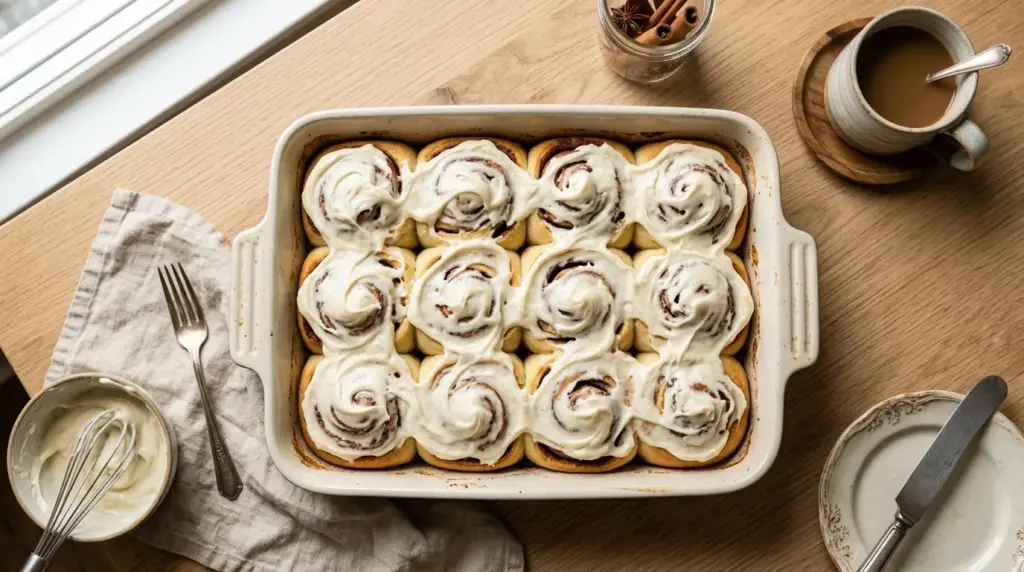
These cinnamon rolls are truly a standalone treat, but they shine even brighter when paired with the right accompaniments.
A strong cup of coffee or a creamy latte is the classic pairing. The bitterness of good coffee cuts through the sweetness of the rolls and makes each bite taste even more indulgent.
For a brunch spread, serve these alongside:
- A French Toast Casserole for a full sweet brunch table
- Fresh fruit salad with berries and citrus to balance the richness
- Scrambled eggs and crispy bacon for a sweet-and-savory contrast
- A pot of hot coffee or a Cinnamon Smoothie for a spiced, warming drink
- A small pot of Cinnamon Butter for spreading on any leftover rolls the next morning
Variations to Try
Once you’ve mastered the base recipe, there are plenty of fun directions to take these rolls. Each variation keeps the same core dough and method, just with a few swaps in the filling or frosting:
- Maple Frosting: Replace the cream cheese frosting with a simple glaze of powdered sugar, a few tablespoons of milk, and 2 tablespoons of pure maple syrup. This pairs especially well with the tangy sourdough flavor.
- Orange Cinnamon Rolls: Add 1 tablespoon of fresh orange zest to the cinnamon-sugar filling and 1 teaspoon of orange zest to the cream cheese frosting for a bright, citrusy twist.
- Nutella Filling: Spread a thin layer of Nutella over the buttered dough before adding the cinnamon sugar mixture. Rich, chocolate-hazelnut swirls take these to another level.
- Apple Cinnamon Rolls: Layer very thinly sliced or finely diced apple over the cinnamon-sugar filling before rolling up. Use Granny Smith for tartness or Honeycrisp for sweetness.
- Cardamom Rolls: Add 1 teaspoon of ground cardamom to the cinnamon-sugar filling for a Scandinavian-inspired flavor. Reduce the cinnamon slightly if you prefer a more subtle spice profile.
- Vegan Version: Substitute the milk with full-fat oat milk or coconut milk, use vegan butter throughout, swap the egg for a flax egg (1 tablespoon ground flaxseed mixed with 3 tablespoons water), and use vegan cream cheese for the frosting.
For another classic sweet roll with a similar comforting flavor profile, try this Pumpkin Roll Recipe.
Storage and Reheating
These rolls are best eaten fresh and warm, but they store and reheat very well. Follow these guidelines to keep them tasting their best:
- Room Temperature: Store unfrosted or frosted rolls covered tightly at room temperature for up to 2 days. Keep them in the baking dish covered with plastic wrap or transfer them to an airtight container.
- Refrigerator: Frosted or unfrosted rolls keep well in the refrigerator for up to 5 days. Store in an airtight container. The cream cheese frosting makes refrigeration the better option if keeping for more than 2 days.
- Freezer: Freeze baked, unfrosted rolls tightly wrapped in plastic wrap and then placed in a zip-top freezer bag for up to 2 months. Thaw overnight in the refrigerator, then reheat and frost just before serving.
- Reheating individual rolls: Place a roll on a microwave-safe plate and microwave for 20 to 30 seconds. It will taste almost fresh-baked. For the oven, cover with foil and warm at 325°F (165°C) for about 10 minutes.
- Make-Ahead Option: You can also prepare the rolls through the cutting stage, arrange them in the baking dish, cover tightly, and refrigerate overnight. In the morning, pull them out and let them come to room temperature and complete the second rise (about 1 to 1.5 hours), then bake as directed.
Read Also: Easy Sourdough Bread Recipe
Nutritional Facts
The following nutritional information is an estimate based on 12 rolls per batch with cream cheese frosting. Exact values will vary depending on specific ingredients and portion sizes.
| Nutrient | Per Roll (1 of 12) |
|---|---|
| Calories | 380 kcal |
| Total Fat | 16g |
| Saturated Fat | 9g |
| Cholesterol | 55mg |
| Sodium | 230mg |
| Total Carbohydrates | 54g |
| Dietary Fiber | 1.5g |
| Total Sugars | 25g |
| Protein | 6g |
| Calcium | 70mg |
| Iron | 2mg |
These values are estimates and should be treated as a general guide only.
If you’re looking for more inspiring ways to use sourdough, the Sourdough Starter Recipe is a wonderful place to begin.
Health Benefits of Key Ingredients
While cinnamon rolls are absolutely a treat, there are a few ingredients in this recipe that bring some genuine nutritional value to the table.
It’s worth knowing what you’re working with, especially if you bake regularly and want to make informed choices.
Here are some noteworthy benefits of key ingredients in this recipe:
- Sourdough Discard: The fermentation process that creates sourdough starter breaks down some of the phytic acid in flour, which may improve mineral absorption. Even discard (which is unfed and not actively fermenting) retains some of these properties.
- Cinnamon: Ground cinnamon is rich in antioxidants, particularly polyphenols. It has been studied for its potential to help regulate blood sugar levels and has anti-inflammatory properties.
- Whole Milk: Whole milk provides fat-soluble vitamins (A, D, E, and K), calcium for bone health, and a source of high-quality protein. The fat in whole milk also contributes to the tender, rich texture of the dough.
- Eggs: Eggs add structure to the dough through protein coagulation during baking. They also contribute lecithin, which acts as an emulsifier and helps keep the rolls moist and tender longer.
- Butter (unsalted): Butter provides fat that coats the gluten strands in the dough, resulting in a more tender crumb. It also contributes fat-soluble vitamins and adds richness to both the dough and filling.
For a lighter treat that still brings those warm spiced flavors, try this Baked Oatmeal Recipe.
Frequently Asked Questions
1. Can I use active sourdough starter instead of discard?
Yes, you can substitute an equal amount of active, fed sourdough starter for the discard. The flavor may be slightly less tangy, and the rolls may rise a little faster due to the active yeast in the starter. The instant yeast in the recipe still handles the primary rise, so the results will be very similar.
2. Do I need to feed my discard before using it?
No. This recipe is specifically designed for unfed sourdough discard. The discard provides flavor, not leavening power. The rise in this recipe comes from the instant yeast. Make sure the discard isn’t too old, though. Discard that’s more than 2 weeks old may have an overpowering sour or unpleasant smell that can affect the final flavor.
3. Why didn’t my rolls rise properly?
The most common cause is inactive or dead yeast. Check the expiration date on your yeast, and verify that your milk was not too hot (above 115°F/46°C). Another common issue is a cold proofing environment. The dough needs a warm spot to rise efficiently. If your kitchen is cool, try placing the dough inside an oven with just the light turned on, or near a warm stovetop.
4. Can I make these rolls without a stand mixer?
Absolutely. You can mix the ingredients in a large bowl with a sturdy wooden spoon or silicone spatula until a shaggy dough forms. Then turn the dough onto a lightly floured surface and knead by hand for 10 to 12 minutes until it becomes smooth and elastic. The windowpane test (stretch a small piece of dough thin enough to see light through) is your best guide for when the dough is ready.
5. Can I use bread flour instead of all-purpose flour?
Yes. Bread flour has a higher protein content than all-purpose flour, which will give you a slightly chewier, more structured roll. Many bakers actually prefer this texture. If substituting bread flour, you may need to add a tablespoon or two less than the recipe calls for since bread flour absorbs liquid differently. Keep an eye on the dough consistency during kneading.
Read Also: Same Day Sourdough Bread Recipe

Sourdough Discard Cinnamon Rolls

Equipment
- Stand mixer with dough hook attachment - or large mixing bowl for hand kneading
- Large mixing bowl
- Rolling Pin
- 9×13-inch baking dish - or two 9-inch round cake pans
- Sharp knife - or unflavored dental floss for cutting rolls
- Small mixing bowl
- Whisk
- Spatula - or wooden spoon
- Pastry brush
- Plastic wrap - or clean kitchen towel
- Instant-read thermometer - for checking milk temperature
- Hand Mixer - optional for frosting
Ingredients
- 1 cup whole milk - 240ml, warmed to 110°F (43°C)
- 2 1/4 teaspoons instant yeast - 7g, one standard packet
- 3 tablespoons granulated sugar - 38g
- 1/2 cup sourdough discard - 120g, room temperature
- 1 large egg - room temperature
- 4 tablespoons unsalted butter - 57g, melted and slightly cooled
- 1 teaspoon salt
- 3 1/2 cups all-purpose flour - 360–420g, plus more for dusting
For the Cinnamon Filling
- 1/2 cup unsalted butter - 113g, softened to room temperature
- 3/4 cup brown sugar - 150g, packed light or dark
- 2 tablespoons ground cinnamon
- 1/4 teaspoon ground nutmeg - optional but recommended
For the Cream Cheese Frosting
- 4 oz cream cheese - 113g, softened
- 1 1/2 cups powdered sugar - 180g, sifted
- 3 tablespoons whole milk - or heavy cream
- 1 teaspoon pure vanilla extract
- salt - a pinch
Instructions
- Heat milk to 100–110°F (38–43°C). In stand mixer bowl, combine warmed milk, instant yeast, sugar, sourdough discard, egg, melted butter, and salt. Stir briefly to combine.
- Add 3 cups flour and mix with dough hook on low speed for 2 minutes until incorporated. Increase to medium speed and knead for 8–10 minutes until dough pulls away from sides. Add remaining flour 1 tablespoon at a time if sticky.
- Shape dough into a ball and place in a greased bowl. Cover and let rise in a warm place for 1–1.5 hours until doubled in size.
- In a small bowl, mix brown sugar, cinnamon, and nutmeg. Set aside. Soften butter to room temperature.
- Punch down dough and roll into a 12×18 inch rectangle on a floured surface. Spread softened butter evenly over dough, leaving a 1/2-inch border on one long edge. Sprinkle cinnamon-sugar mixture over the butter.
- Starting from the long edge opposite the clean border, roll dough tightly into a log. Pinch the seam to seal. Cut into 12 equal rolls using unflavored dental floss or a sharp knife.
- Arrange rolls cut-side up in a greased 9×13 inch baking dish, about 1/4 inch apart. Cover and let rise in a warm place for 30–45 minutes until puffy and touching.
- Preheat oven to 350°F (175°C). Remove plastic wrap and bake rolls on center rack for 22–27 minutes until golden brown. Tent with foil if browning too quickly. Cool for 10–15 minutes.
- Beat softened cream cheese until smooth. Add powdered sugar and mix until incorporated. Add milk, vanilla, and salt, beating until silky and spreadable. Adjust consistency with more milk or sugar as needed.
- Spread frosting generously over warm rolls. Serve immediately while warm for the best experience.
Notes
- Use room-temperature discard to avoid slowing yeast activity. Pull it from the fridge at least an hour before baking.
- Do not overheat milk above 115°F (46°C) or it will kill the yeast. Always use a thermometer.
- The dough should be slightly tacky but not sticky. Too much flour results in dense, dry rolls.
- Use unflavored dental floss to cut rolls cleanly without squishing the spirals.
- Don’t skip the second rise — this gives the rolls their puffy, pull-apart quality.
- Frost while the rolls are still warm so the frosting melts into the swirls.
- Store unfrosted rolls covered at room temperature for up to 2 days, or refrigerate for up to 5 days.
- Freeze baked, unfrosted rolls tightly wrapped for up to 2 months. Thaw overnight and reheat before serving.
- For a make-ahead option, prepare rolls through cutting stage, cover, and refrigerate overnight. Bring to room temperature and let rise before baking.
- Try variations like maple frosting, orange zest, Nutella filling, or adding cardamom for a different flavor profile.
Final Thoughts
This Sourdough Discard Cinnamon Rolls Recipe is the kind of bake that feels special without being complicated.
The combination of enriched dough, a warm cinnamon-sugar spiral, and tangy cream cheese frosting is simply hard to beat. And knowing you turned your discard into something this good? That’s genuinely satisfying.
If you’ve been on the fence about making homemade cinnamon rolls, this is your sign to go for it. The steps are detailed, the timeline is manageable, and the result is absolutely worth it.
Give this recipe a try and let us know how your rolls turned out in the comments below. Did you add any fun variations? We would love to hear about it, and your photos and tips might inspire someone else to give it a go.
Recommended:
- Sourdough Discard Pancakes
- Sweet Sourdough Bread Recipe
- Sourdough Pancake Recipe
- Cinnamon Rolls Frosting Without Cream Cheese
- Cream Cheese Frosting Recipe
- Snickerdoodle Cookie Recipe
- Coffee Cake Without Sour Cream
- Dinner Rolls Recipe
- Dutch Baby Recipe
- Sourdough Focaccia Recipe