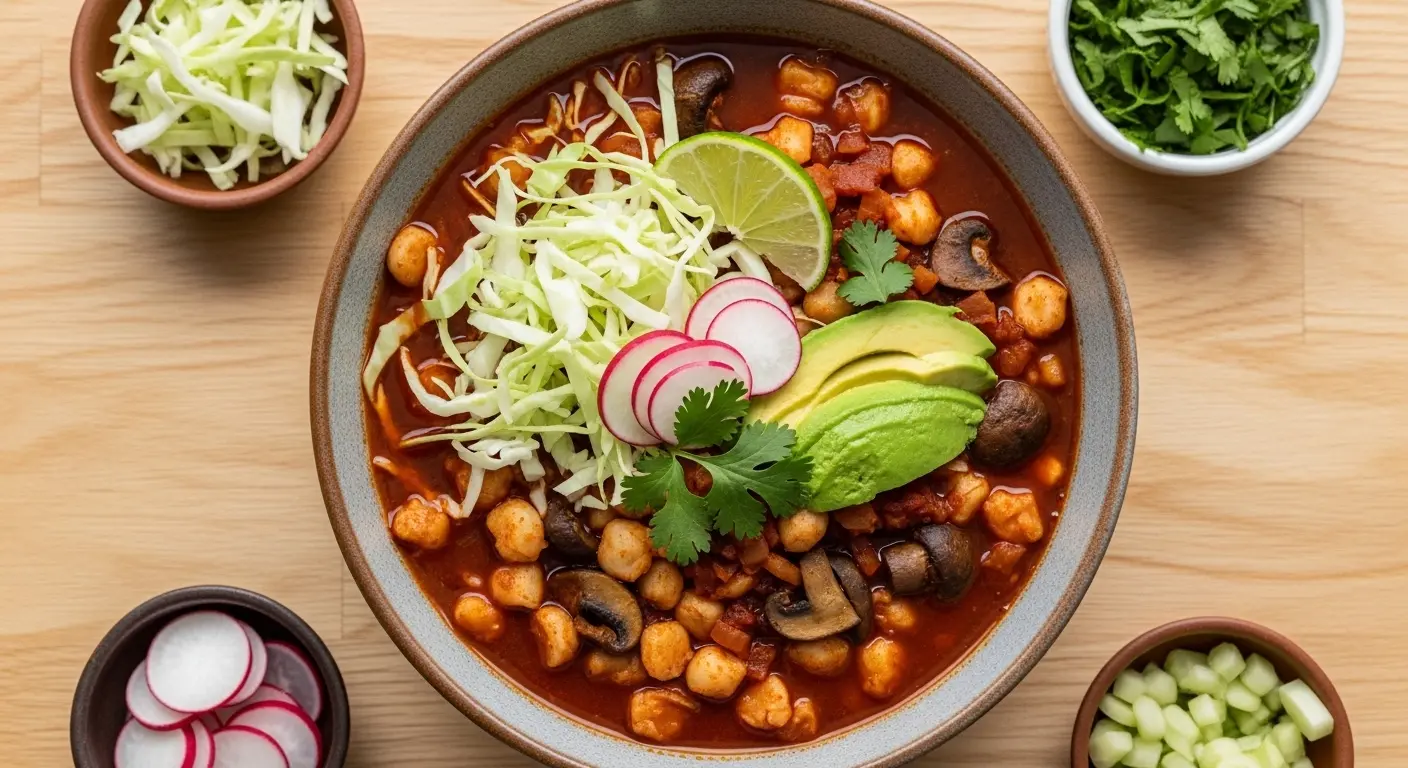
If you’ve been searching for a vegan pozole recipe that actually delivers on bold, authentic flavor, you’ve landed in the right place. This plant-based take on pozole rojo is everything the traditional version is known for: a deeply rich chile-infused broth, tender chewy hominy, and a toppings spread that makes every bowl feel like a celebration. The secret is in the dried chiles. Guajillo and ancho peppers are toasted and rehydrated to build a broth that tastes like it simmered all day, even when it comes together in about an hour on the stovetop.
Pozole is a traditional Mexican stew with deep roots in Mesoamerican culture. It has long been a dish tied to holidays, family gatherings, and special occasions. The plant-based version keeps every bit of that soul intact by leaning on umami-rich mushrooms, hearty beans, and a chile base that carries real depth. You won’t miss the meat for a second.
This recipe uses canned hominy for simplicity, which makes it totally weeknight-friendly without cutting corners on flavor. The toppings are where the magic really comes alive: shredded cabbage, sliced radishes, avocado, lime, and fresh cilantro all bring brightness and crunch that balance the earthy, smoky broth beautifully.
You might also enjoy: Red Pozole Recipe

Why You’ll Love This Vegan Pozole Recipe
This dish checks every box for a satisfying, crowd-pleasing meal. It’s rich and warming without being heavy, and it comes together with mostly pantry ingredients.
It’s also naturally gluten-free, making it a great option for a wide range of dietary needs at your table.
The customizable topping bar means everyone can build their bowl exactly how they like it. That interactive element makes it a fantastic choice for dinner parties and casual family meals alike.
The leftovers are arguably even better than the first bowl. The broth deepens overnight as the flavors meld together, making this a perfect make-ahead meal.
Here is a quick list of reasons to love this recipe:
- Built on an authentic dried-chile base for bold, complex flavor
- Made with canned hominy, so it’s accessible and weeknight-friendly
- Naturally vegan, gluten-free, and packed with fiber and plant protein
- Fully customizable with a range of traditional toppings
- Stores well and tastes even better the next day
- A true crowd-pleaser for both vegan and omnivore guests
For another hearty Mexican-inspired soup, try this Green Pozole Recipe.
Ingredients
Making this vegan pozole rojo from scratch starts with a handful of core pantry staples plus a few specialty chile peppers that are easy to find in most grocery stores or Latin markets. Every ingredient on this list plays an important role in building the flavor of the final dish.
Here is everything you need:
For the Chile Base:
- 4 dried guajillo chiles, stems and seeds removed
- 2 dried ancho chiles, stems and seeds removed
- 2 dried chiles de arbol (optional, for extra heat), stems removed
- 2 cups (480 ml) hot water for soaking
For the Soup:
- 2 tablespoons (30 ml) olive oil
- 1 large white onion, roughly chopped (about 2 cups / 300 g)
- 6 garlic cloves, minced
- 2 tablespoons (30 g) tomato paste
- 1 teaspoon ground cumin
- 1 teaspoon dried Mexican oregano
- 2 bay leaves
- 8 oz (225 g) shiitake mushrooms, sliced
- 8 oz (225 g) oyster mushrooms, torn into pieces
- 2 cans (25 oz / 710 g each) white hominy, drained and rinsed
- 1 can (15 oz / 425 g) pinto beans or red kidney beans, drained and rinsed
- 6 cups (1.4 liters) vegetable broth
- 2 tablespoons (30 ml) fresh lime juice
- Salt and black pepper to taste
Toppings (for serving):
- Shredded green cabbage
- Thinly sliced radishes
- Diced white onion
- Fresh cilantro leaves
- Sliced avocado or cubed avocado
- Lime wedges
- Dried Mexican oregano, for finishing
- Tostadas or corn tortillas on the side
Read Also: Chicken Tortilla Soup Recipe
Kitchen Equipment Needed
Nothing fancy is required to pull this pozole together. You likely already have most of these tools in your kitchen, and a few specialty items make the job noticeably easier.
Here is what you will need:
- Large Dutch oven or heavy-bottomed soup pot (at least 6-quart / 5.7-liter)
- High-powered blender or immersion blender
- Large heat-safe bowl (for soaking chiles)
- Fine-mesh strainer or sieve
- Cutting board and sharp chef’s knife
- Wooden spoon or silicone spatula
- Ladle for serving
- Measuring cups and spoons
- Can opener
Read Also: Chicken Pozole Recipe
Recommended Products for This Recipe
These products come highly recommended based on quality and performance for making vegan pozole at home. They address the most common challenges home cooks face with this recipe, from building a proper chile base to getting a silky smooth broth.
1. Whole Dried Guajillo Chiles
Guajillo chiles are the backbone of this recipe’s broth. Buying them whole rather than pre-ground gives you far more control over flavor and aroma, since you can toast them fresh before soaking. Look for chiles that are pliable and fragrant, not brittle and dusty, which indicates freshness.
2. Whole Dried Ancho Chiles
Ancho chiles add a mild, raisin-like sweetness and dark color that rounds out the guajillo’s tanginess. Using whole dried anchos gives the broth a depth that ground ancho powder simply cannot replicate. A fresh bag makes a significant difference in the final flavor of the soup.
3. Lodge Enameled Cast Iron Dutch Oven
A heavy-bottomed pot is essential for building and maintaining the low simmer that lets this pozole develop its complex flavors. The Lodge enameled cast iron Dutch oven distributes heat evenly, preventing any scorching of the chile-based broth. It also goes beautifully from stovetop to table.
4. Vitamix High-Speed Blender
Blending the rehydrated chiles into a perfectly smooth paste is one of the most important steps in this recipe. A high-powered blender, like a Vitamix, ensures the chile puree is completely silky with no tough fibrous bits, giving your broth a restaurant-quality texture and color.
5. Canned White Hominy (Pack of 4)
Hominy is the soul of pozole, and having quality canned hominy on hand means this dish can come together anytime the craving strikes. Large-kernel white hominy holds its texture beautifully during simmering and absorbs the chile broth without turning mushy.
This pairs wonderfully with a bowl of Corn Soup on the side for a full Mexican-inspired spread.

Step-by-Step Instructions
1. Toast the Dried Chiles
- Using kitchen scissors or your hands, cut or tear open the guajillo chiles and ancho chiles lengthwise.
- Remove and discard all stems and seeds, shaking out as many seeds as possible. Fewer seeds means a slightly less bitter broth.
- Heat a dry skillet over medium heat. Do not add any oil.
- Place the chile pieces flat into the hot skillet in a single layer and press them down gently with a spatula.
- Toast for about 20 to 30 seconds per side until the chiles become slightly darkened and very fragrant. Watch them carefully because chiles can burn in seconds, which will make the broth bitter.
- If using chiles de arbol for heat, toast them the same way but for just 10 to 15 seconds per side as they are much thinner.
- Transfer all the toasted chiles immediately to a large heat-safe bowl.
2. Rehydrate the Chiles
- Pour 2 cups (480 ml) of very hot or just-boiled water over the toasted chiles in the bowl.
- Make sure the chiles are fully submerged. If they float, set a small plate or bowl on top to weigh them down.
- Allow the chiles to soak for 25 to 30 minutes until they are fully softened and pliable.
- Once softened, transfer the chiles and 1 cup (240 ml) of the soaking liquid to your blender. Reserve the remaining soaking liquid in case you need to thin the puree later.
- Blend on high speed for 60 to 90 seconds until the mixture is completely smooth and forms a thick, deep red paste. If the blender struggles, add a bit more soaking liquid, a few tablespoons at a time.
- Set the chile puree aside.
3. Saute the Aromatics
- Heat 2 tablespoons (30 ml) of olive oil in your large Dutch oven or soup pot over medium heat.
- Once the oil shimmers, add the roughly chopped white onion.
- Cook the onion, stirring occasionally, for 6 to 8 minutes until it becomes soft, translucent, and starting to turn golden at the edges.
- Add the minced garlic and stir to combine.
- Cook for another 1 to 2 minutes until the garlic is fragrant. Be careful not to let it burn.
- Add the tomato paste, ground cumin, and dried Mexican oregano directly to the pot.
- Stir everything together and cook for 2 more minutes, allowing the tomato paste to caramelize slightly. This step deepens the overall flavor of the broth.
4. Add the Mushrooms
- Add the sliced shiitake mushrooms and torn oyster mushrooms to the pot.
- Stir to coat the mushrooms with the aromatics and cook for 4 to 5 minutes over medium heat.
- The mushrooms will release moisture and begin to soften. Stir occasionally and let them cook down until most of their liquid has evaporated and they start to turn golden.
- This step is important because properly cooked mushrooms add a rich, savory, meaty quality to the pozole that makes the broth so satisfying.
5. Build the Broth
- Pour the blended chile puree through a fine-mesh strainer directly into the pot, pressing it through with the back of a spoon to remove any remaining tough bits of chile skin.
- Stir the strained chile paste into the mushroom mixture and cook together for 2 minutes.
- Add the 2 bay leaves to the pot.
- Pour in the 6 cups (1.4 liters) of vegetable broth and stir everything together.
- Increase the heat to medium-high and bring the broth to a gentle boil.
- Once boiling, reduce the heat to medium-low to maintain a steady simmer.
6. Add the Hominy and Beans
- Drain and rinse both cans of white hominy under cold running water, then add them to the simmering pot.
- Add the drained and rinsed pinto beans or red kidney beans to the pot as well.
- Stir gently to combine all the ingredients in the broth.
- Continue simmering on medium-low heat, uncovered, for 25 to 30 minutes. This gives the hominy time to absorb the chile broth and the flavors time to meld together fully.
- Stir the pot every 8 to 10 minutes to prevent anything from settling and sticking to the bottom.
7. Season and Finish
- Remove and discard the 2 bay leaves from the pot.
- Add the 2 tablespoons (30 ml) of fresh lime juice to the pozole and stir to combine. The lime juice lifts and brightens the entire dish right before serving.
- Taste the broth and season with salt and black pepper as needed. Start with 1 teaspoon of salt and adjust from there based on the saltiness of your broth.
- If the pozole looks too thick, add a splash of extra vegetable broth or water to reach your preferred consistency. Pozole should be brothy but not thin like a light soup.
- Give it one final stir and your pozole is ready to serve.
8. Set Up Your Toppings and Serve
- While the pozole finishes simmering, prepare your toppings. Shred the green cabbage, slice the radishes thinly, dice the white onion, slice the avocado, and cut fresh lime wedges.
- Arrange all the toppings in individual small bowls or on a platter so everyone can customize their own bowl.
- Ladle the hot pozole into deep serving bowls, making sure each bowl gets a generous amount of hominy, mushrooms, and beans along with plenty of broth.
- Top each bowl with a handful of shredded cabbage, a few radish slices, diced onion, cilantro leaves, avocado, and a squeeze of fresh lime.
- Finish with a light sprinkle of dried Mexican oregano over the top.
- Serve immediately alongside warm tostadas or corn tortillas.
Read Also: Beef Pozole Recipe
Tips for Success
A few key tips will take your vegan pozole from good to truly great. Most of these are about understanding the chile base, which is really the heart of the entire dish.
Keep these in mind as you cook:
- Do not skip toasting the chiles. Dry-toasting them before soaking activates their natural oils and creates a roasted depth that you simply cannot get from soaking alone. Just 30 seconds per side makes a huge difference.
- Watch the chiles carefully while toasting. If they blacken or begin to smell acrid, they have burned. Burned chiles will make the entire broth bitter. When in doubt, pull them from the heat a few seconds early.
- Strain your chile puree. Running the blended chiles through a fine-mesh strainer removes the tough bits of chile skin and produces a silky, restaurant-quality broth. This step is worth the extra minute.
- Use Mexican oregano, not Italian. Mexican oregano has a distinct earthy, citrusy flavor that is much more traditional in pozole. Italian oregano has a different flavor profile that doesn’t work as well here.
- Let the pozole simmer long enough. The 25 to 30 minutes of simmering after adding the hominy is not optional. It allows the corn kernels to absorb the chile broth and the whole pot to develop cohesive, layered flavor.
- Taste and adjust right before serving. Salt levels vary greatly between different brands of broth. Always taste at the end and season accordingly before ladling into bowls.
- Make it the day before if possible. Like most brothy stews, this pozole tastes noticeably better after resting overnight in the refrigerator.
For a lighter but equally comforting bowl, try this Vegetarian Split Pea Soup.
Serving Suggestions
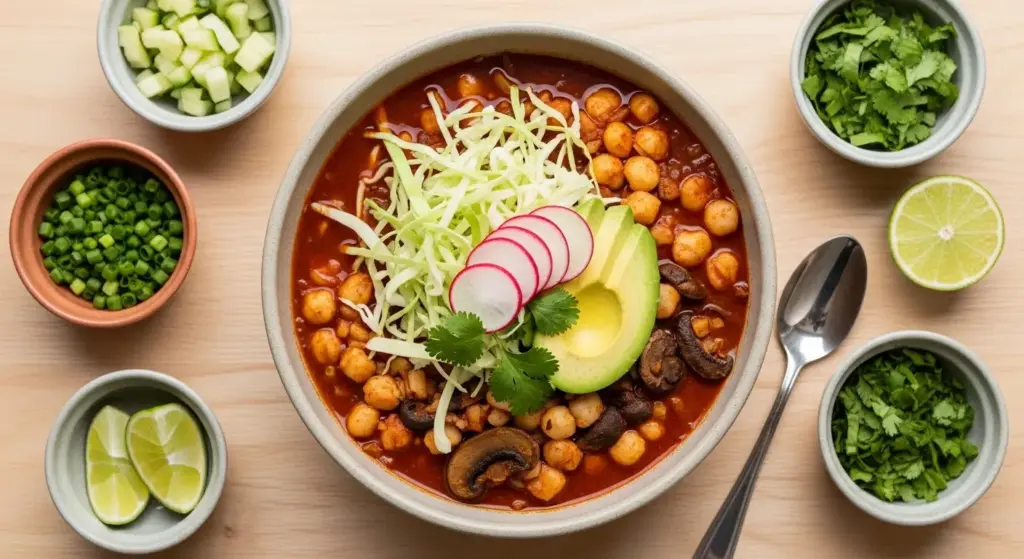
Pozole is one of those dishes that truly shines when served properly. The traditional accompaniments are not just garnishes; they are an essential part of the eating experience, adding crunch, freshness, and brightness that contrast beautifully with the earthy, smoky broth.
Here is how to serve your vegan pozole for maximum enjoyment:
- Set up a topping bar. Arrange shredded cabbage, sliced radishes, diced onion, fresh cilantro, avocado, and lime wedges in separate bowls so everyone can build their own bowl. This is the traditional way to serve pozole and makes the meal feel festive.
- Serve alongside corn tortillas or tostadas. Dipping them into the broth or using them to scoop the thick stew is an absolutely classic pairing.
- A bowl of Mexican Street Corn on the side brings a sweet, smoky contrast that complements the pozole broth perfectly.
- For a complete Mexican-inspired spread, pair the pozole with easy guacamole and fresh salsa as starters.
- A drizzle of your favorite hot sauce or a spoonful of salsa verde over the top adds a nice punch of additional heat for spice lovers.
- Serve with a tall glass of water with lime or a light hibiscus agua fresca to balance the richness of the broth.
Variations to Try
The beautiful thing about pozole is how naturally adaptable it is. Once you understand the basic formula, swapping out proteins or adjusting the chile base opens up a whole world of variations.
Here are some ideas to try:
- Pozole Verde (Green Pozole): Swap the red chile base entirely for a green sauce made from tomatillos, poblano peppers, serrano chiles, and cilantro. Blend them together and use the same method as above. The result is a bright, tangy, herbaceous stew that is just as satisfying.
- Soy Curl Pozole: Replace the mushrooms with rehydrated Butler Soy Curls. Soak them in warm vegetable broth for 10 minutes, squeeze out the excess liquid, and add them in step 4. They have a remarkably meaty, shredded texture.
- Bean-Only Pozole: Skip the mushrooms entirely and double the amount of beans. Use a combination of pinto and black beans for color, texture, and great plant-based protein.
- Chipotle Pozole: Add 1 to 2 chipotle peppers in adobo sauce to the blender along with the rehydrated chiles for a smoky, slightly spicier version of the broth.
- Slow Cooker Pozole: Complete steps 1 through 3 on the stovetop, then transfer everything to a slow cooker. Add the mushrooms, hominy, beans, broth, and strained chile puree. Cook on LOW for 6 to 8 hours or HIGH for 3 to 4 hours. Add lime juice and adjust seasoning before serving.
- Instant Pot Pozole: Saute the aromatics using the saute function, then add all remaining ingredients. Cook on HIGH pressure for 15 minutes and allow a natural pressure release for 10 minutes before opening.
Read Also: Vegan Pho Recipe
Storage and Reheating
This vegan pozole stores beautifully and is a fantastic meal-prep option. The flavors continue to develop as it sits, making it arguably better on days two and three than it is fresh.
Here is how to store and reheat it:
- Refrigerator: Allow the pozole to cool completely to room temperature before transferring it to an airtight container. Store in the refrigerator for up to 5 to 6 days. Do not add the fresh toppings before storing, as they will wilt and lose their texture.
- Freezer: This pozole freezes extremely well. Let it cool completely, then ladle it into freezer-safe containers or zip-top bags, leaving about 1 inch (2.5 cm) of headspace for expansion. Freeze for up to 3 months. Thaw overnight in the refrigerator before reheating.
- Reheating on the stovetop: Pour the desired amount of pozole into a small saucepan. Add a splash of vegetable broth or water if the stew has thickened overnight. Heat over medium heat, stirring occasionally, until warmed through, about 5 to 8 minutes.
- Reheating in the microwave: Transfer a single serving to a microwave-safe bowl. Cover loosely with a lid or damp paper towel. Microwave on HIGH in 90-second intervals, stirring between each interval, until hot throughout.
- Storage tip: Store the toppings separately in their own small containers in the refrigerator. They will keep for 1 to 2 days and are best added fresh to each reheated bowl.
For more ideas on how to use your leftovers creatively, check out this Enchilada Sauce Recipe to repurpose leftover pozole broth.
Nutritional Facts
The following nutritional information is an estimate per serving based on 6 servings and does not include optional toppings.
| Nutrient | Amount Per Serving |
|---|---|
| Calories | ~310 kcal |
| Carbohydrates | 48 g |
| Protein | 12 g |
| Total Fat | 8 g |
| Saturated Fat | 1 g |
| Fiber | 10 g |
| Sugar | 5 g |
| Sodium | 620 mg |
| Potassium | 580 mg |
| Iron | 3.5 mg |
| Vitamin C | 18 mg |
Nutritional values are estimates and will vary depending on the specific brands and quantities of ingredients used. Adding toppings such as avocado will increase healthy fat and calorie content.
You might also enjoy this equally nourishing Moroccan Lentil Soup Recipe.
Health Benefits of Key Ingredients
This vegan pozole is not just delicious; it is genuinely packed with nutrients that support overall wellness. Several of its key ingredients bring standout health benefits to every bowl.
Here are the highlights:
- Hominy: Hominy undergoes a traditional alkaline processing method called nixtamalization, which increases the bioavailability of niacin (vitamin B3) and makes its amino acids more accessible. It is a good source of complex carbohydrates and dietary fiber, which supports digestive health and sustained energy.
- Guajillo and ancho chiles: Dried chiles are rich in antioxidants including beta-carotene, capsaicin, and vitamin C, which help fight inflammation and support immune function. The capsaicin in chiles has also been studied for its potential role in supporting healthy metabolism.
- Shiitake and oyster mushrooms: Both mushroom varieties are exceptional sources of B vitamins, selenium, and ergothioneine, a powerful antioxidant. Shiitake mushrooms in particular are well-studied for their immune-boosting properties and their ability to support cardiovascular health.
- Pinto or kidney beans: Beans are one of the most nutrient-dense plant foods on the planet. They deliver a significant amount of plant-based protein, soluble fiber (which supports healthy cholesterol levels), folate, and iron in every serving.
- Garlic: Garlic contains allicin, an active compound with well-documented antimicrobial and anti-inflammatory properties. Regular garlic consumption has been linked to improvements in blood pressure and immune resilience.
- Lime juice: Fresh lime juice is a bright source of vitamin C and helps the body absorb plant-based iron from the beans and hominy more efficiently, which is particularly beneficial in a fully plant-based meal.
Read Also: Red Lentil Soup Recipe
Frequently Asked Questions
1. What is pozole?
Pozole is a traditional Mexican soup or stew that has been made for thousands of years, with origins tracing back to pre-Columbian Mesoamerican cultures. It is built around hominy, which is nixtamalized dried corn, and is traditionally made with pork or chicken in a deeply flavored chile broth. This vegan version replaces the meat with mushrooms and beans while maintaining the same essential flavor profile.
2. Where can I find hominy?
Canned hominy is widely available in most well-stocked grocery stores, typically in the Latin foods or canned vegetables aisle. Look for it near the canned beans. It is also easily found at Latin specialty markets and many large supermarkets. Online retailers carry it as well if you have difficulty sourcing it locally.
3. Can I use fresh mushrooms other than shiitake and oyster?
Absolutely. While shiitake and oyster mushrooms are particularly well-suited to this recipe because of their meaty texture and savory flavor, you can use cremini, portobello, or even a simple white button mushroom blend. Just be aware that firmer mushrooms like portobello will hold their shape better during simmering, while softer varieties may break down more.
4. Is this recipe spicy?
With just the guajillo and ancho chiles (and no chiles de arbol), this pozole falls in the mild-to-medium range. Guajillo chiles have a tangy, fruity heat that is relatively gentle, and ancho chiles are quite mild with a chocolatey, raisin-like sweetness. If you want more heat, add one or two chiles de arbol to the blender with the rehydrated chiles. If you prefer very mild, simply skip the chiles de arbol entirely and use fewer guajillos.
5. Can I make this pozole ahead of time?
Yes, this is one of those dishes that genuinely benefits from being made ahead. The flavors deepen considerably as the pozole rests overnight in the refrigerator. Make the full recipe up through the point of finishing and seasoning, let it cool, and store it covered in the fridge. Reheat it gently on the stovetop the next day with a splash of broth, prepare your fresh toppings, and serve. It is a perfect Sunday batch-cook meal for a stress-free week.
This recipe is also a great companion to a warm bowl of Caldo de Res when you’re exploring traditional Mexican soups.

Vegan Pozole Rojo

Equipment
- Large Dutch oven or heavy-bottomed soup pot (at least 6-quart / 5.7-liter)
- High-powered blender or immersion blender
- Large heat-safe bowl - for soaking chiles
- Fine-mesh strainer or sieve
- Cutting board
- Sharp chef's knife
- Wooden spoon or silicone spatula
- Ladle - for serving
- Measuring cups and spoons
- Can opener
Ingredients
- 4 dried guajillo chiles - stems and seeds removed
- 2 dried ancho chiles - stems and seeds removed
- 2 dried chiles de arbol - optional, for extra heat, stems removed
- 2 cups hot water - 480 ml, for soaking
For the Soup
- 2 tablespoons olive oil - 30 ml
- 1 large white onion - roughly chopped, about 2 cups or 300 g
- 6 garlic cloves - minced
- 2 tablespoons tomato paste - 30 g
- 1 teaspoon ground cumin
- 1 teaspoon dried Mexican oregano
- 2 bay leaves
- 8 oz shiitake mushrooms - 225 g, sliced
- 8 oz oyster mushrooms - 225 g, torn into pieces
- 2 cans white hominy - 25 oz or 710 g each, drained and rinsed
- 1 can pinto beans or red kidney beans - 15 oz or 425 g, drained and rinsed
- 6 cups vegetable broth - 1.4 liters
- 2 tablespoons fresh lime juice - 30 ml
- salt - to taste
- black pepper - to taste
Toppings (for serving)
- shredded green cabbage
- thinly sliced radishes
- diced white onion
- fresh cilantro leaves
- sliced avocado - or cubed
- lime wedges
- dried Mexican oregano - for finishing
- tostadas - or corn tortillas, on the side
Instructions
- Toast guajillo and ancho chiles in a dry skillet over medium heat for 20-30 seconds per side until fragrant. Transfer to a heat-safe bowl.
- Pour hot water over toasted chiles and soak for 25-30 minutes until softened. Transfer chiles and 1 cup soaking liquid to a blender and puree until smooth.
- Heat olive oil in a large pot over medium heat. Cook onion for 6-8 minutes until soft. Add garlic, tomato paste, cumin, and oregano; cook for 2 more minutes.
- Add mushrooms and cook for 4-5 minutes until they release liquid and start to turn golden.
- Strain chile puree into the pot and cook for 2 minutes. Add bay leaves and vegetable broth, bring to a boil, then reduce to a simmer.
- Add drained hominy and beans to the simmering pot. Cook uncovered for 25-30 minutes, stirring occasionally.
- Remove bay leaves, stir in lime juice, and season with salt and pepper to taste.
- Ladle into bowls and serve with shredded cabbage, radishes, onion, cilantro, avocado, lime wedges, and oregano on the side. Enjoy with tostadas or tortillas.
Notes
- Don’t skip toasting: Dry-toasting chiles before soaking activates their oils and creates deep roasted flavor. Just 30 seconds per side makes a huge difference.
- Watch for burning: If chiles blacken or smell acrid, they’ve burned and will make broth bitter. Remove from heat a few seconds early if needed.
- Strain for silkiness: Running the blended chiles through a fine-mesh strainer removes tough skins and creates a smooth, restaurant-quality broth.
- Use Mexican oregano: It has an earthy, citrusy flavor that’s traditional in pozole. Italian oregano has a different profile and isn’t a suitable substitute.
- Let it simmer: The 25-30 minutes after adding hominy allows the corn to absorb the chile broth and flavors to meld together fully.
- Adjust salt at the end: Broth saltiness varies by brand. Always taste and adjust right before serving.
- Make ahead: This pozole tastes even better the next day as flavors deepen overnight. Perfect for batch cooking.
- Freezer friendly: Freeze cooled pozole for up to 3 months. Thaw overnight in the fridge and reheat gently with a splash of broth.
- Topping bar: Set up bowls of all toppings so everyone can build their own bowl. Traditional and makes the meal festive.
- Spice level: With only guajillo and ancho, this is mild to medium. Add chiles de arbol for extra heat or skip them for very mild.
Final Thoughts
This vegan pozole recipe brings everything you love about the traditional dish, from the bold chile broth to the satisfying chew of hominy, in a fully plant-based package that doesn’t cut a single corner on flavor.
It is the kind of recipe that becomes a staple once you make it the first time. The process of building the broth from toasted, rehydrated dried chiles feels special, and the result is a stew that tastes like it took far more effort than it actually did.
Whether you are making it for a cozy weeknight dinner, a holiday gathering, or a big batch meal-prep session, this pozole delivers every single time. The customizable toppings make it feel fun and interactive, and it is the kind of dish that earns genuine compliments at the table.
Give this vegan pozole recipe a try and see for yourself why this dish has been beloved in Mexican culture for centuries. If you make it, I would love to hear about it in the comments below! Share what toppings you went with, any tweaks you made, or how it turned out for your family.
Recommended:
- Chicken Pozole Recipe
- Green Pozole Recipe
- Vegan Pho Recipe
- Chicken Tortilla Soup Recipe
- Mexican Fish Soup Recipe
- Black Bean Soup Recipe
- Lentil Soup Recipe
- Minestrone Soup Recipe
- Spinach Soup Recipe
- Tom Yum Soup Recipe