
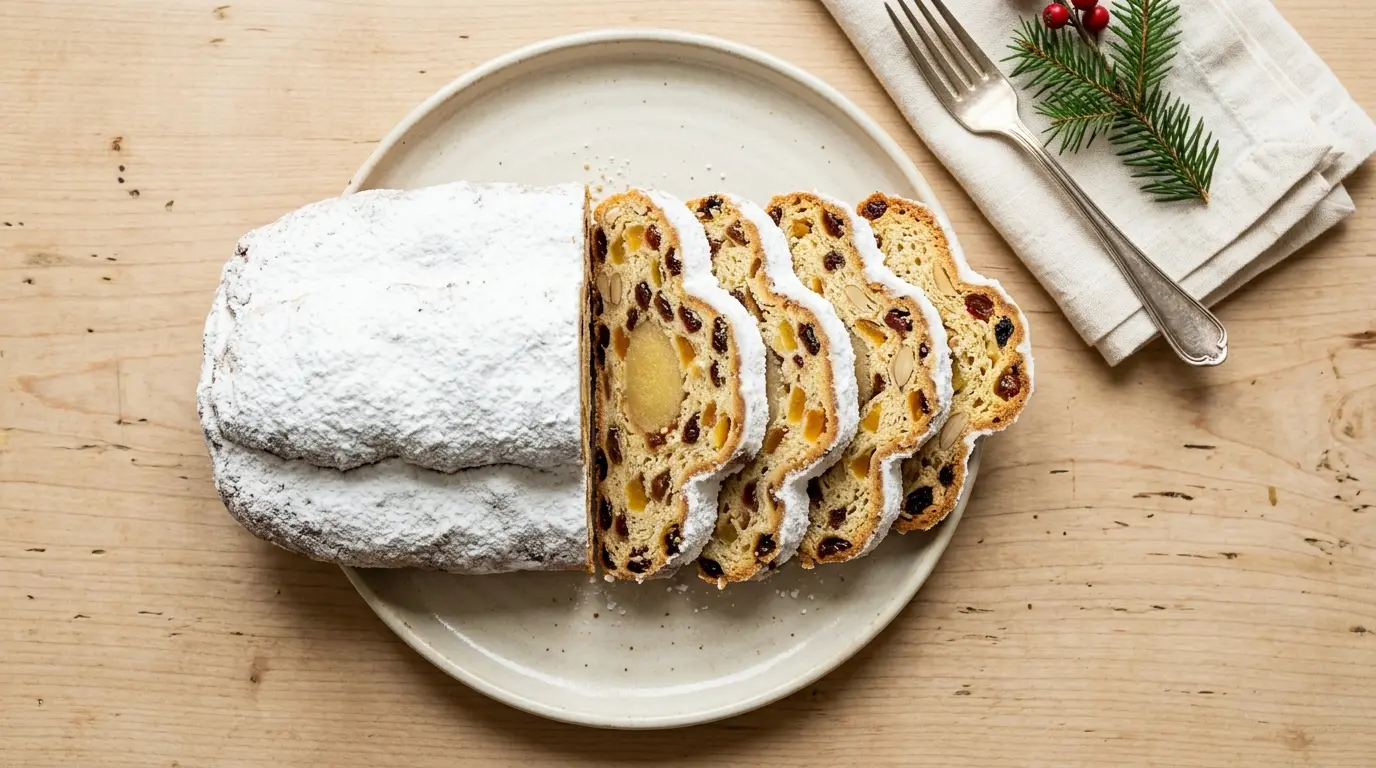
If you have been searching for an authentic German Stollen recipe that actually delivers the real thing, you are in exactly the right place. Stollen is not just a holiday bread. It is a centuries-old tradition from Dresden, Germany, baked with rum-soaked dried fruits, warming spices, and a hidden log of marzipan at its center.
What makes this recipe so satisfying to bake is the finishing technique. Right out of the oven, the hot loaf gets brushed generously with melted butter, not once but three times, then buried under a thick blanket of powdered sugar.
That coating is what gives authentic Stollen its impossibly tender crumb and its legendary shelf life. Unlike most baked goods, Stollen genuinely gets better the longer it sits.
The flavors deepen and meld over days and weeks, which is why German families traditionally bake it in late November and save it for Christmas morning.
If you have ever been put off by dense, dry fruitcake, this recipe will change your mind completely. The dough is rich and buttery, the fruits are plump from their rum bath, and every slice delivers that perfect balance of sweet, spiced, and almond-scented goodness.
This particular version follows the widely recognized Marzipanstollen approach, including a roll of soft marzipan tucked inside the loaf. This is the version most home bakers and international fans know and love.
You can make it up to two weeks ahead of serving, which makes it one of the most practical holiday baking projects around.
If you enjoy German-inspired bakes, this Stollen pairs beautifully alongside a slice of German Applesauce Cake Recipe for a full festive dessert spread.

Why You’ll Love This Authentic German Stollen Recipe
This recipe is unlike anything else on the holiday baking table.
The dough is enriched with eggs and butter, giving it a tender, close crumb that holds together beautifully when sliced thin.
The rum-soaked fruits stay plump and juicy inside the bread, adding bursts of sweetness without making the loaf soggy.
The marzipan center is a revelation if you have never tried it before. Each slice reveals a golden ring of almond filling that tastes like the bread was made by someone’s Bavarian grandmother.
Here is what makes this recipe work so well:
- Overnight fruit soak plumps the raisins and currants fully and infuses them with deep rum flavor that you can taste in every single bite.
- Gradual butter incorporation develops a tender, layered crumb rather than a heavy, dense one, because the gluten has time to build properly before the fat is added.
- A triple butter coating immediately after baking seals the loaf, keeps it moist for weeks, and adds a rich, almost caramelized quality to the outer crust.
- Generous powdered sugar dusting creates the iconic snowy appearance and adds a delicate sweetness that contrasts perfectly with the spiced interior.
- Marzipan filling melts into the crumb as the bread ages, adding a layer of almond richness that sets this apart from any store-bought version.
- Two full rises give the dough structure and ensure the finished loaf is light enough to be enjoyable without being airy or insubstantial.
Another favorite for your holiday baking lineup: Fruitcake Recipe
Ingredients
Sourcing quality ingredients makes a meaningful difference in the final loaf. The candied peel should have real citrus flavor, not just artificial sweetness. The marzipan should be soft enough to roll without cracking. The butter should be the best you can find.
For the Fruit Soak (prepare the night before):
- 1 cup (150g) golden raisins
- 1/2 cup (75g) dried currants
- 1/3 cup (50g) candied orange peel, finely chopped
- 1/3 cup (50g) candied lemon peel, finely chopped
- 1/4 cup (60ml) dark rum (or substitute with 1/4 cup orange juice plus 1 tsp rum extract)
For the Dough:
- 4 cups (500g) all-purpose flour, plus extra for dusting
- 2 1/4 tsp (7g) active dry yeast
- 1/2 cup (120ml) warm whole milk (110°F / 43°C)
- 1/2 cup (100g) granulated sugar, divided
- 2 large eggs, room temperature
- 1 cup (225g) unsalted butter, softened and cut into tablespoons
- 1/2 tsp fine salt
- 1/2 tsp ground cardamom
- 1/4 tsp ground cinnamon
- 1/4 tsp ground nutmeg
- Zest of 1 lemon
- Zest of 1 orange
- 1 tsp pure vanilla extract
- 1/2 cup (75g) blanched slivered almonds
For the Marzipan Filling:
- 7 oz (200g) marzipan
For the Topping:
- 1/2 cup (115g) unsalted butter, melted
- 1 cup (125g) powdered sugar, sifted
Read Also: Cranberry Orange Bread Recipe
Kitchen Equipment Needed
Having the right tools on hand makes this enriched dough much easier to manage and shape correctly.
- Stand mixer with dough hook attachment (or strong hands for hand kneading)
- Digital kitchen scale (strongly recommended for accurate flour measurement)
- Large mixing bowls
- Rimmed baking sheet
- Parchment paper or silicone baking mat
- Bench scraper
- Rolling pin
- Silicone pastry brush
- Fine mesh sieve or sifter (for powdered sugar)
- Instant-read thermometer
- Plastic wrap and aluminum foil (for wrapping and aging)
- Wire cooling rack
The bread technique used for this Stollen is very similar to the method in a Challah Recipe, making it a great next project if you enjoy enriched yeasted doughs.
Recommended Products for This Recipe
These are hand-picked recommendations based on quality and real impact on the final result. Each one addresses a common pain point in making Stollen at home.
1. Odense Almond Paste Marzipan
Odense is one of the most trusted brands for baking-grade marzipan. It rolls into a smooth, even log without cracking and has a balanced almond flavor that complements the fruit and spice without overpowering either. Using a quality marzipan here is genuinely the single biggest upgrade you can make to a homemade Stollen.
2. Premium Mixed Candied Citrus Peel for Baking
Low-grade candied peel can taste artificial and waxy, which will stand out in an otherwise clean-tasting loaf. A good premium candied orange and lemon peel blend has real fruit intensity and a pleasantly chewy texture that makes a noticeable difference to the finished bread. Look for peel with minimal additives and a firm, glossy appearance.
3. German Stollen Spice Mix (Stollenwürze)
Traditional German bakeries use a proprietary spice blend called Stollenwürze, which combines cardamom, cinnamon, mace, anise, and other warm spices in exactly the right proportions. Using this blend in place of individual spices gives the bread a more authentic, complex flavor profile and saves you from assembling multiple jars. It is especially useful if you plan to bake Stollen every year.
You might also enjoy: Cinnamon Raisin Bread Recipe

Step-by-Step Instructions
1. Soak the Dried Fruits
- Place the golden raisins, dried currants, chopped candied orange peel, and chopped candied lemon peel into a medium bowl.
- Pour the dark rum (or orange juice and rum extract mixture) over the fruit and stir well so everything is evenly coated.
- Cover the bowl tightly with plastic wrap and leave it at room temperature for at least 4 hours, but overnight is strongly preferred. The longer the soak, the more plump and flavorful the fruit will be.
- When you are ready to bake, drain the fruit through a fine mesh sieve. Reserve the drained fruit and discard the soaking liquid, or set it aside for another use.
2. Activate the Yeast
- Pour the warm milk (110°F / 43°C) into a small bowl. It should feel comfortably warm against your inner wrist, not hot.
- Add 1 teaspoon of the measured granulated sugar and sprinkle the active dry yeast over the milk surface.
- Stir gently once, then let the mixture stand undisturbed for 8 to 10 minutes. The yeast should become foamy and fragrant.
- If nothing happens after 10 minutes, the yeast is likely expired or the milk was too hot. Begin again with fresh yeast before moving forward.
3. Mix the Dough
- In the bowl of your stand mixer fitted with the dough hook, combine the all-purpose flour, remaining granulated sugar, fine salt, ground cardamom, ground cinnamon, ground nutmeg, lemon zest, and orange zest.
- Mix briefly on low speed just to distribute the spices and salt evenly through the flour.
- Add the eggs and vanilla extract to the flour mixture, followed by the foamy yeast-milk mixture.
- Mix on low speed for 2 to 3 minutes until a rough, shaggy dough forms. It will look messy at this stage. That is completely fine and expected.
4. Add Butter and Knead
- With the mixer running on low, add the softened butter one tablespoon at a time. Wait until each piece is mostly incorporated before adding the next.
- This entire process takes about 8 to 10 minutes. Be patient with it. Adding the butter too quickly causes the dough to break rather than absorb the fat properly.
- Once all the butter has been incorporated, increase the mixer speed to medium and knead for another 5 to 7 minutes until the dough becomes smooth, elastic, and slightly tacky.
- The dough should pull cleanly away from the sides of the bowl and feel supple when pressed. If kneading by hand, expect 12 to 15 minutes of firm, steady work on a lightly floured surface.
5. First Rise
- Shape the dough into a rough ball and transfer it to a lightly greased large bowl. Turn the dough once to coat all sides.
- Cover the bowl loosely with a clean kitchen towel or plastic wrap.
- Place the bowl somewhere warm and draft-free, such as an oven with just the oven light on. Let the dough rise for 1 to 1.5 hours, or until roughly doubled in size.
- Do not rush this rise. A slow, full rise builds flavor and gives the finished Stollen a better texture.
6. Fold in the Fruits and Almonds
- Turn the risen dough out onto a lightly floured work surface. Press it out gently into a rough rectangle.
- Scatter the drained soaked fruit and the blanched slivered almonds over the surface of the dough.
- Fold the dough over onto itself and press to incorporate, then fold again. Work through the dough gradually, pressing and folding until the fruit and almonds are evenly distributed throughout.
- If the fruit keeps slipping out, let the dough rest for 5 minutes uncovered. The gluten will relax and the fruit will incorporate more easily.
7. Prepare the Marzipan Filling
- Place the marzipan on a clean surface and knead it briefly with your hands until it softens and becomes pliable.
- Roll the marzipan into a smooth log approximately 10 inches (25cm) long and about 1 inch (2.5cm) in diameter.
- Set it aside on a plate while you shape the dough.
8. Shape the Stollen
- On a lightly floured surface, gently pat and roll the dough into an oval roughly 12 inches (30cm) long and 8 inches (20cm) wide.
- Use your rolling pin to press a shallow lengthwise groove down the center of the oval, positioned slightly off-center toward one side. This groove is where the marzipan log will sit.
- Place the marzipan log into the groove.
- Fold the larger side of dough up and over the marzipan log, bringing its edge about 1 inch (2.5cm) past the center line of the smaller half. This creates the traditional Stollen shape, which is an asymmetric fold rather than a simple half-fold.
- Press the seam gently but firmly to seal it, making sure the marzipan is completely enclosed inside the dough.
- Transfer the shaped Stollen seam-side down to a parchment-lined rimmed baking sheet.
9. Second Rise
- Cover the shaped Stollen loosely with a clean kitchen towel and let it rest at room temperature for 45 minutes to 1 hour.
- The Stollen will puff up slightly but should not double in size. You are looking for the dough to feel a little lighter and more pillowy to the touch.
- During the last 15 minutes of the second rise, preheat your oven to 350°F (175°C) and position a rack in the center.
10. Bake the Stollen
- Slide the baking sheet onto the center rack of your preheated oven.
- Bake for 45 to 55 minutes, until the Stollen is a deep, even golden brown on top and sounds hollow when you tap the bottom.
- Check the Stollen at the 30-minute mark. If the top is browning too quickly, tent it loosely with a sheet of aluminum foil for the remaining bake time.
- An instant-read thermometer inserted into the center of the loaf should read 190 to 195°F (88 to 90°C) when fully baked through.
11. Apply the Butter and Sugar Coating
- While the Stollen is still hot from the oven, use a pastry brush to coat the entire surface generously with the melted butter. Do not hold back here. The hot bread will absorb a surprising amount.
- Let the butter soak in for 2 to 3 minutes, then apply a second coat all over.
- Allow the Stollen to rest on the baking sheet for 15 more minutes, then apply a third and final coat of melted butter.
- Once the Stollen has cooled completely to room temperature, sift the powdered sugar generously over the entire surface, covering the top and all sides until the loaf looks like it has been caught in a snowstorm.
- For the best possible flavor, wrap the cooled, sugar-coated Stollen tightly in plastic wrap, then wrap again in aluminum foil. Store at a cool room temperature and allow it to rest for at least 2 days before slicing, though a full week or two is ideal.
This same enriched dough technique also applies beautifully to a Cinnamon Babka Recipe if you want to explore another classic layered holiday bread.
Tips for Success
A few key habits separate a genuinely great Stollen from one that turns out dense or dry. Keep these in mind from the very start.
- Soak your fruit the night before, no shortcuts. A quick 30-minute soak leaves the fruit underseasoned and will result in dry, shriveled pieces in the finished bread. Overnight soaking is the authentic approach for good reason.
- Use a kitchen scale to measure your flour. Cup measurements vary too much for this kind of enriched dough. Even an extra 30g of flour can tip the balance from tender to tough.
- Add the butter one tablespoon at a time. This is the most common mistake first-time Stollen bakers make. Dumping all the butter in at once prevents the dough from absorbing it properly. Patience here pays off in texture.
- Room temperature ingredients are non-negotiable. Cold butter will seize the gluten rather than incorporate smoothly. Take your eggs and butter out at least an hour before you start.
- Do not skip any of the three butter coats. Each layer adds flavor and moisture. This triple coating is what gives authentic Stollen its long shelf life and sets it apart from regular holiday bread.
- Plan for resting time before you serve it. Fresh Stollen is delicious. Stollen that has rested for 5 to 7 days is extraordinary. The cardamom and citrus mellow, the marzipan softens into the crumb, and the whole loaf becomes more cohesive.
- Wrap it airtight after the sugar coating sets. Plastic wrap followed by aluminum foil, kept in a cool spot away from direct sunlight or heat, will keep the Stollen in perfect condition for up to three weeks.
Read Also: Brioche Recipe
Serving Suggestions
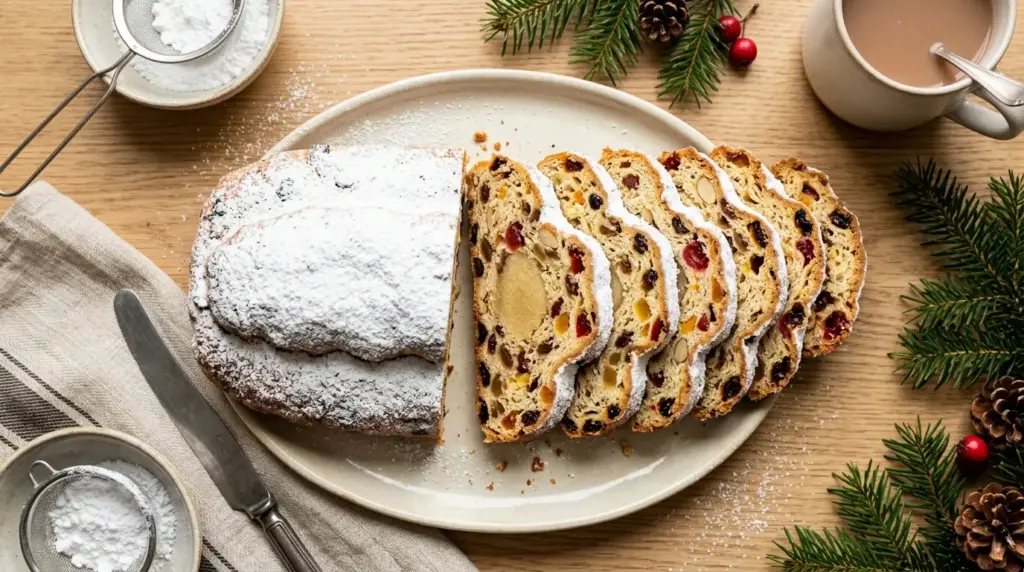
Stollen is best enjoyed in thick slices at room temperature, ideally alongside something warm to drink. The powdered sugar coating means it needs no additional toppings, but a few accompaniments can make it feel even more special.
Here are a few ways to serve it:
- Pair a thick slice with a steaming mug of Hot Chocolate or mulled wine for the full German Christmas market atmosphere.
- Dust each serving plate with a little extra powdered sugar just before slicing for a fresh, festive presentation.
- Serve alongside salted butter and a sharp knife so guests can spread a thin layer over their slice. The salt cuts through the sweetness beautifully.
- Set out slices as part of a holiday morning breakfast spread alongside fresh clementines and strong coffee.
- Arrange thin slices on a wooden board with a handful of mixed nuts, dried apricots, and a few squares of dark chocolate for a simple but impressive dessert board.
- Lightly toast day-old slices in a dry pan and spread with cream cheese for a surprisingly wonderful next-morning treat.
Variations to Try
Traditional Stollen has many well-loved variations across Germany, each with its own regional character. Once you master this base recipe, these adaptations are easy to explore.
- Mohnstollen (Poppy Seed Stollen): Replace the marzipan filling with a thick poppy seed paste made from ground poppy seeds, sugar, milk, and a touch of butter. This is especially popular in eastern Germany.
- Nussstollen (Nut Stollen): Swap the marzipan for a walnut or hazelnut filling. Toasted walnuts mixed with a little honey and cinnamon make a wonderful substitute that complements the rum-soaked fruit beautifully.
- Quarkstollen: Replace about 100g of the butter in the dough with full-fat quark or strained Greek yogurt. The result is a slightly tangier, lighter crumb that some bakers prefer.
- Mandelstollen (Almond Stollen): Skip the marzipan filling and instead fold extra whole blanched almonds and a tablespoon of almond extract into the dough itself for a more evenly almond-flavored loaf throughout.
- Mini Stollen (Stollenkonfekt): Divide the dough into 20 to 24 small portions and shape each one into a tiny individual Stollen. Bake for 20 to 25 minutes at the same temperature. These are perfect for gifting or serving at parties where individual portions are more practical.
- Non-Alcoholic Stollen: Substitute the dark rum with an equal amount of fresh-squeezed orange juice plus 1 teaspoon of vanilla extract. The fruit will still soak beautifully and the finished bread will have a brighter, more citrus-forward flavor.
Another favorite for the holiday table: German Chocolate Cake Bars Recipe
Storage and Reheating
One of the most remarkable things about authentic Stollen is how well it stores, and how much better it tastes after a few days of rest. Proper storage is essential to making the most of it.
- At room temperature: Once fully cooled and coated in powdered sugar, wrap the Stollen tightly in plastic wrap followed by a layer of aluminum foil. Store in a cool, dark spot away from any heat source. It keeps beautifully for 2 to 3 weeks this way, and the flavors improve steadily over the first 7 to 10 days.
- In the freezer: For longer storage, wrap the fully cooled Stollen tightly in plastic wrap, then a layer of foil, and place in a resealable freezer bag. Freeze for up to 3 months. Thaw overnight at room temperature before slicing.
- Reviving stored Stollen: If the cut surface of the Stollen feels slightly dry after a few days, brush it lightly with a tiny bit of melted butter and dust with a fresh layer of powdered sugar. This refreshes the coating and restores that just-baked appeal.
- Reheating individual slices: Warm individual slices in a dry skillet over low heat for 1 to 2 minutes per side, or wrap in foil and place in a 300°F (150°C) oven for about 8 minutes. Do not microwave, as it makes the texture rubbery.
If you enjoy fruit-and-nut breads that store well and improve with time, you will love this Date Nut Bread Recipe as well.
Nutritional Facts
The following values are approximate and are based on one slice, assuming the Stollen is cut into 20 slices.
- Calories: 310
- Total Fat: 14g
- Saturated Fat: 8g
- Cholesterol: 55mg
- Sodium: 70mg
- Total Carbohydrates: 42g
- Dietary Fiber: 2g
- Sugars: 21g
- Protein: 5g
Nutritional values will vary based on specific brands and exact ingredient measurements used. Stollen is an indulgent holiday treat, best enjoyed in reasonable portions as part of a festive spread.
Read Also: White Fruitcake Recipe
Health Benefits of Key Ingredients
Stollen is a celebratory bake, not a health food, but several of its core ingredients do bring genuine nutritional value to the table.
Dried fruits like raisins and currants are rich in natural antioxidants, particularly polyphenols, which help the body combat oxidative stress. They also provide iron, potassium, and a modest amount of dietary fiber that supports digestive health.
Here is a closer look at the nutritional contributions of some key ingredients:
- Blanched slivered almonds supply heart-healthy monounsaturated fats, vitamin E, and magnesium. Almonds are also a good source of protein and fiber, adding some nutritional density to an otherwise sweet loaf.
- Ground cardamom has been studied for its antioxidant and digestive properties. It contains compounds that may help reduce inflammation and support gut health, which is why it has been used in traditional medicine for centuries.
- Lemon and orange zest bring natural vitamin C and a range of beneficial flavonoids to the recipe. Citrus zest contains more concentrated nutrients than the juice alone, making it a flavorful and functional addition.
- Cinnamon is one of the most researched culinary spices, with evidence suggesting it may help moderate blood sugar response and reduce inflammation when consumed regularly as part of a balanced diet.
- Raisins provide a quick source of natural energy from their sugar content, along with boron, which supports bone health, and resveratrol, a polyphenol associated with cardiovascular benefits.
These holiday Christmas Shortbread Cookies Recipe make a wonderful addition to your festive baking tray alongside a slice of Stollen.
Frequently Asked Questions
1. Can I make Stollen without alcohol?
Absolutely. Simply replace the dark rum with an equal measure of freshly squeezed orange juice and add 1 teaspoon of rum extract to the soaking liquid. The fruits will absorb the juice overnight and the finished loaf will still have a lovely depth of flavor. The alcohol in rum actually evaporates during baking, but if you prefer to skip it entirely, the orange juice substitution works very well.
2. How far in advance can I make Stollen?
You can bake Stollen up to two weeks before you plan to serve it, and many bakers consider this the ideal approach. The flavors become more complex and harmonious with each passing day, and the butter coating preserves the loaf beautifully. Wrap it tightly in plastic wrap and foil and store it in a cool spot away from heat and light.
3. Why did my Stollen turn out dry?
The most common causes of dry Stollen are over-flouring the dough, skipping the triple butter coating after baking, or not wrapping the loaf airtight after it cools. Measuring flour by weight rather than volume, applying all three coats of melted butter generously while the bread is still hot, and wrapping thoroughly will prevent this issue in future batches.
4. Can I freeze German Stollen?
Yes, Stollen freezes exceptionally well. Wrap the fully cooled, sugar-coated loaf first in a tight layer of plastic wrap, then in aluminum foil, and seal it in a large freezer bag. It will keep for up to three months in the freezer. Thaw it overnight at room temperature and, if needed, refresh the powdered sugar coating before serving.
5. Is Stollen the same as fruitcake?
They are both holiday bakes with dried fruit, but they are quite different in texture, preparation, and flavor. Stollen is a yeasted bread, meaning it has a lighter, breadier crumb rather than the dense, compact texture of traditional fruitcake. The spice profile is different too, leaning toward cardamom and citrus rather than the clove-heavy combination associated with classic fruitcake. The marzipan filling and the thick butter-and-sugar crust are also unique to Stollen.
Another great pairing for holiday cookie boxes: Gingerbread Cookie Recipe
Authentic German Stollen (Marzipanstollen)

Equipment
- Stand mixer with dough hook attachment - Or strong hands for hand kneading
- Digital kitchen scale - Strongly recommended for accurate flour measurement
- Large mixing bowls
- Rimmed Baking Sheet
- Parchment paper - Or silicone baking mat
- Bench scraper
- Rolling Pin
- Silicone Pastry Brush
- Fine mesh sieve or sifter - For powdered sugar
- Instant-read thermometer
- Plastic wrap - For wrapping and aging
- Aluminum foil - For wrapping and aging
- Wire cooling rack
Ingredients
For the Fruit Soak (prepare the night before)
- 1 cup golden raisins - 150g
- 1/2 cup dried currants - 75g
- 1/3 cup candied orange peel - 50g, finely chopped
- 1/3 cup candied lemon peel - 50g, finely chopped
- 1/4 cup dark rum - 60ml, or substitute with 1/4 cup orange juice plus 1 tsp rum extract
For the Dough
- 4 cups all-purpose flour - 500g, plus extra for dusting
- 2 1/4 tsp active dry yeast - 7g
- 1/2 cup warm whole milk - 120ml, 110°F / 43°C
- 1/2 cup granulated sugar - 100g, divided
- 2 large eggs - room temperature
- 1 cup unsalted butter - 225g, softened and cut into tablespoons
- 1/2 tsp fine salt
- 1/2 tsp ground cardamom
- 1/4 tsp ground cinnamon
- 1/4 tsp ground nutmeg
- 1 lemon zest - from 1 lemon
- 1 orange zest - from 1 orange
- 1 tsp pure vanilla extract
- 1/2 cup blanched slivered almonds - 75g
For the Marzipan Filling
- 7 oz marzipan - 200g
For the Topping
- 1/2 cup unsalted butter - 115g, melted
- 1 cup powdered sugar - 125g, sifted
Instructions
- Combine golden raisins, dried currants, candied orange peel, and candied lemon peel in a bowl. Pour in dark rum and stir to coat. Cover and soak overnight or at least 4 hours. Drain before using.
- Combine warm milk with 1 teaspoon of sugar, then sprinkle yeast on top. Let stand for 8-10 minutes until foamy and fragrant.
- In stand mixer with dough hook, combine flour, remaining sugar, salt, cardamom, cinnamon, nutmeg, lemon zest, and orange zest. Add eggs, vanilla, and yeast mixture. Mix for 2-3 minutes until a shaggy dough forms.
- With mixer on low, add softened butter one tablespoon at a time, waiting until each piece is mostly incorporated. Once all butter is in, knead on medium for 5-7 minutes until smooth and elastic.
- Shape dough into a ball, place in greased bowl, and cover. Let rise in warm place for 1-1.5 hours until doubled in size.
- Turn dough onto floured surface. Press into rough rectangle, scatter drained fruit and almonds over top, then fold and press until evenly distributed throughout.
- Knead marzipan briefly to soften, then roll into a 10-inch log about 1 inch in diameter.
- Roll dough into 12×8 inch oval. Press a shallow groove slightly off-center. Place marzipan log in groove and fold larger side over to seal. Transfer seam-side down to parchment-lined baking sheet.
- Cover shaped Stollen and let rise for 45 minutes to 1 hour until puffed but not doubled. During last 15 minutes, preheat oven to 350°F (175°C).
- Bake for 45-55 minutes until deep golden brown and internal temperature reaches 190-195°F (88-90°C). Tent with foil if browning too quickly.
- While still hot, brush generously with melted butter. Apply 3 coats total, waiting 2-3 minutes between each. Once completely cool, sift powdered sugar heavily over entire surface.
- Wrap cooled Stollen tightly in plastic wrap then foil. Store at cool room temperature and rest at least 2 days before slicing for best flavor development.
Notes
- Fruit Soak: Overnight soaking is essential for plump, flavorful fruit. A 30-minute soak will result in dry pieces in the finished bread.
- Flour Measurement: Use a kitchen scale for accuracy. Even 30g extra flour can make the dough dense instead of tender.
- Butter Incorporation: Add butter one tablespoon at a time. Dumping it all in prevents proper absorption and affects texture.
- Room Temperature: Bring eggs and butter to room temperature at least an hour before starting for proper gluten development.
- Triple Butter Coating: Don’t skip any of the three coats. Each layer adds flavor and moisture that gives Stollen its legendary shelf life.
- Aging: Allow at least 2 days before serving, ideally 5-7 days. The cardamom and citrus mellow and the marzipan softens into the crumb.
- Storage: Wrap airtight in plastic wrap then foil and store in a cool spot away from sunlight or heat for up to 3 weeks.
- Variations: Try Mohnstollen (poppy seed filling), Nussstollen (nut filling), or Mini Stollen for gifting. For non-alcoholic version, substitute rum with orange juice plus 1 teaspoon vanilla.
- Freezing: Freeze for up to 3 months wrapped in plastic and foil inside a freezer bag. Thaw overnight at room temperature.
- Reviving: If cut surface feels dry after a few days, brush with a tiny bit of melted butter and dust with fresh powdered sugar.
Final Thoughts
Making an authentic German Stollen recipe at home is one of the most rewarding projects in all of holiday baking.
It takes a little planning, a little patience, and a willingness to let the finished loaf rest before you slice it open, but the result is something genuinely special.
The moment you slice into a well-aged Stollen and reveal that golden marzipan center surrounded by jewel-like fruit and a tender, spiced crumb, you will understand exactly why this bread has been treasured for over five hundred years.
Bake it a week before Christmas, wrap it up, and let the anticipation build. It is well worth the wait.
If you give this recipe a try, leave a comment below and let me know how it turned out. And if you share a photo, tag us so we can see your beautiful loaves.
Recommended:
- Eggnog Recipe
- Mulled Apple Cider Recipe
- Hot Chocolate Bombs Recipe
- Rugelach Recipe
- Christmas Cheesecake Recipe
- Figgy Pudding Recipe
- Eggnog Cookies Recipe
- German Pancake Recipe
- Icebox Fruitcake Recipe
- Baklava Recipe