
If you keep a sourdough starter, you already know the guilt of pouring discard down the drain. This Sourdough Discard Blueberry Muffins Recipe is the answer. It uses just half a cup of leftover starter to produce tall, bakery-domed muffins with a soft, tender crumb, juicy bursts of blueberry, and a faint tang that sets them apart from any box mix.
The discard is not doing the heavy lifting for leavening here. Baking powder and a dash of baking soda handle the rise. Instead, the discard brings moisture, depth of flavor, and a mild acidity that reacts with the leaveners to keep the crumb extra tender. That is exactly why sourdough discard muffins stay soft for days instead of turning rubbery overnight.
The high-to-low oven method is the other secret worth knowing. Starting at 425°F (220°C) for the first 5 minutes gives the tops a powerful burst of heat that forces them to dome upward quickly. Then lowering the temperature to 350°F (175°C) finishes the bake through without over-browning. You get that coffee shop look every single time.
These muffins come together in about 35 minutes with no mixer required. Whether your discard has been sitting in the fridge for a week or you fed your starter this morning and saved some back, this recipe works beautifully with either.
You’ll also want to check out the Sourdough Discard Pancakes Recipe if you’re looking for another quick, delicious way to use up your starter.

Why You’ll Love This Sourdough Discard Blueberry Muffins Recipe
These muffins hit every note you want from a breakfast bake. The texture is soft and springy with a slightly crisp sugar crust on top, and each bite has a pocket of sweet, jammy blueberry.
Using sourdough discard makes them feel intentional rather than wasteful. You’re turning something that would have been thrown away into a genuinely impressive bake.
They’re also endlessly forgiving. The batter is thick and easy to handle, the ingredient list is short, and the results are consistent even for beginner bakers.
Here’s why this recipe deserves a permanent spot in your rotation:
- Uses up discard without waste — just half a cup of starter goes a long way
- No mixer needed — a couple of bowls and a spatula are all you need
- Tall domed tops — the high-low oven technique delivers bakery-style results at home
- Soft for days — the discard’s acidity and fat content keep the crumb moist long after baking
- Bursting with blueberries — a full cup and a half of fruit means blueberry in every single bite
- Ready in 35 minutes — from cold ingredients to warm muffins, start to finish
- Customizable — easy to adapt with lemon zest, streusel, or different berries
For another fruit-forward bake that works just as well for breakfast, try the Blueberry Pie Recipe when you want to show off peak-season berries in a different format.
Ingredients
Gather these simple ingredients before you start. The discard can be anywhere from room temperature to cold, straight from the fridge, and works well in both states.
- 1 ½ cups (190g) all-purpose flour
- 1 cup (200g) granulated sugar
- 2 teaspoons baking powder
- ½ teaspoon baking soda
- ½ teaspoon fine salt
- ½ cup (113g) unsalted butter, melted and slightly cooled
- ½ cup (105g) sourdough discard, unfed (room temperature or cold from the fridge)
- ¾ cup (180g) sour cream, room temperature
- 1 large egg, room temperature
- 1 teaspoon pure vanilla extract
- 1 ½ cups (210g) fresh or frozen blueberries
- 1 tablespoon all-purpose flour (for tossing the blueberries)
- 2 tablespoons coarse sugar or demerara sugar (for topping, optional but recommended)
The sour cream is the key ingredient most home bakers skip in muffins. It adds fat and tang that work alongside the sourdough discard to produce an incredibly tender, moist crumb. Plain full-fat Greek yogurt works as a direct substitute if that’s what you have on hand.
Read Also: Sourdough Discard Cinnamon Rolls Recipe
Kitchen Equipment Needed
You don’t need anything fancy for this recipe. A standard home setup handles everything with ease.
- Standard 12-cup muffin tin
- Muffin tin liners or non-stick spray
- Large mixing bowl (for dry ingredients)
- Medium mixing bowl (for wet ingredients)
- Kitchen scale (recommended for accuracy)
- Rubber spatula or wooden spoon
- Whisk
- Ice cream scoop or muffin scoop (for even portioning)
- Measuring cups and spoons
- Wire cooling rack
A kitchen scale is especially helpful here because the hydration level of sourdough discard can vary. A thicker, more paste-like discard weighs differently than a looser, pourable one. Measuring by weight keeps your batter consistent every time.
You might also enjoy: Sourdough Discard Crackers Recipe
Recommended Products for This Recipe
These are products that make a real difference when baking these muffins, chosen for quality and consistency.
1. Nordic Ware Natural Aluminum Commercial Muffin Pan
This heavy-gauge aluminum pan heats evenly and consistently, which is critical for getting those tall, domed tops without over-browning the bottoms. Lighter, thinner pans tend to overbake the edges before the centers are done. It’s a simple upgrade that pays off in every muffin batch you ever bake.
2. OXO Good Grips Medium Cookie Scoop
Using a scoop to fill your muffin tin means every cup gets the same amount of batter, which gives you even-sized muffins that bake at the same rate. It also keeps your hands clean and makes the whole process much faster than spooning batter.
3. Nielsen-Massey Pure Vanilla Extract
Vanilla is a supporting note in these muffins, but it matters. Nielsen-Massey uses a cold-extraction process that preserves the flavor compounds that a harsh alcohol extraction destroys. A teaspoon of this in the batter makes the muffins taste noticeably more complex and bakery-quality.
4. Bob’s Red Mill Demerara Sugar
That crunchy sugar crust on top is one of the best parts of a bakery muffin. Demerara sugar has larger crystals and a light caramel flavor that stays crunchy even after the muffins cool, unlike regular granulated sugar which tends to dissolve into the top.
The same technique for achieving bakery-style texture works beautifully in the Sourdough Discard Chocolate Chip Cookies Recipe.

Step-by-Step Instructions
1. Preheat Your Oven and Prepare the Muffin Tin
- Set your oven to 425°F (220°C). This high initial temperature is what creates the tall, domed muffin tops.
- Place your oven rack in the center position so the muffins bake evenly from all sides.
- Line a standard 12-cup muffin tin with paper liners or spray each cup generously with non-stick baking spray. Paper liners make cleanup easier and help the muffins release cleanly.
- Set the prepared pan aside while you make the batter.
2. Coat the Blueberries in Flour
- Measure out 1 ½ cups (210g) of fresh or frozen blueberries into a small bowl.
- Add 1 tablespoon of all-purpose flour to the bowl and toss the blueberries gently until every berry is lightly coated.
- This flour coating does two important things: it prevents the blueberries from sinking to the bottom of the muffin as they bake, and it absorbs some of the extra juice that frozen berries release so the batter doesn’t become streaky or overly wet.
- If using frozen blueberries, do not thaw them beforehand. Adding them frozen keeps the batter from turning purple throughout, and they bake up just as well as fresh.
- Set the coated blueberries aside.
3. Mix the Dry Ingredients
- In a large mixing bowl, add 1 ½ cups (190g) of all-purpose flour, 1 cup (200g) of granulated sugar, 2 teaspoons of baking powder, ½ teaspoon of baking soda, and ½ teaspoon of fine salt.
- Whisk everything together until the leaveners and salt are evenly distributed throughout the flour. This step prevents any concentrated pockets of baking powder or baking soda in the finished muffin.
- Make a small well in the center of the dry mixture and set the bowl aside. The well makes it easier to add the wet ingredients without overworking the batter later.
4. Whisk Together the Wet Ingredients
- In a medium mixing bowl, add ½ cup (113g) of melted unsalted butter. Make sure it has cooled slightly, not completely solid, but not so hot it will cook the egg when you add it. Warm to the touch is ideal.
- Add ½ cup (105g) of sourdough discard to the melted butter and whisk until combined. It may look a little lumpy at first, which is fine.
- Add ¾ cup (180g) of sour cream (at room temperature for best results) and whisk until smooth.
- Crack in 1 large egg and add 1 teaspoon of vanilla extract. Whisk everything together until the mixture is fully smooth and glossy with no visible streaks.
- Room temperature wet ingredients incorporate more smoothly and help the batter come together with less mixing, which keeps the muffins tender.
5. Combine Wet and Dry Ingredients
- Pour the wet ingredient mixture into the well you made in the dry ingredients.
- Using a rubber spatula, fold the two together with slow, deliberate strokes. Scrape down the bottom and sides of the bowl as you go.
- Stop mixing the moment the flour streaks disappear. The batter will look thick and slightly lumpy, which is exactly right. Overmixing develops the gluten in the flour and turns muffins tough and rubbery, so resist the urge to keep stirring until it looks perfectly smooth.
- The batter should be thick enough to hold its shape when scooped, not thin and pourable.
6. Fold in the Blueberries
- Add the flour-coated blueberries to the batter all at once.
- Using your spatula, fold them in with 4 to 5 slow strokes. You want the berries distributed evenly without smashing them or mixing the batter any more than necessary.
- A few whole berries may resist going into the batter at first. Just gently press them in as you fold rather than stirring aggressively.
7. Fill the Muffin Tin
- Using an ice cream scoop or large spoon, divide the batter evenly among the 12 prepared muffin cups.
- Fill each cup to about ¾ full, mounding the batter slightly in the center. The batter is thick enough to hold that shape, which helps with doming.
- Sprinkle 2 tablespoons of demerara or coarse sugar evenly over the tops of all the muffins. You can use as much or as little as you like, but a generous pinch on each one gives the best crunchy crust.
8. Bake Using the High-Low Method
- Place the muffin tin in the preheated 425°F (220°C) oven.
- Bake at this high temperature for exactly 5 minutes without opening the oven door. The burst of heat activates the leaveners quickly and forces the tops to dome upward dramatically before the structure sets.
- After 5 minutes, without opening the oven door, reduce the oven temperature to 350°F (175°C).
- Continue baking for an additional 16 to 20 minutes, until the tops are golden and a toothpick inserted into the center of a muffin comes out clean or with just a few moist crumbs.
- Total bake time is 21 to 25 minutes. Ovens vary, so start checking at the 20-minute mark.
9. Cool the Muffins
- Remove the muffin tin from the oven and set it on a wire cooling rack.
- Let the muffins rest in the pan for 5 minutes before removing them. This brief rest lets the structure firm up so they hold together when you lift them out.
- After 5 minutes, transfer the muffins directly to the wire rack to finish cooling. Do not leave them in the pan longer than 10 minutes, or trapped steam will soften the bottoms and sides.
- They are best eaten warm, but they are still wonderful at room temperature.
This same high-low baking technique also works brilliantly in the Pumpkin Muffin Recipe if you want to try another muffin variety.
Tips for Success
Small details make a big difference with muffins. These tips cover the most common mistakes and how to avoid them.
- Do not overmix the batter. Fold until the flour just disappears. Lumpy batter is fine. Over-stirred batter leads to dense, rubbery muffins every time.
- Use room temperature wet ingredients. Cold sour cream or an egg straight from the fridge doesn’t mix as smoothly into the melted butter, which can lead to uneven batter.
- Weigh your discard. Half a cup of thick discard and half a cup of runny discard are very different amounts. Weighing at 105g ensures consistency.
- Don’t open the oven during the high-heat phase. The first 5 minutes at 425°F are critical for getting the dome. Opening the door lets cold air in and the tops may fall flat.
- Toss frozen blueberries in flour. This prevents sinking and streaking and keeps the batter from turning grey-purple.
- Fill cups to ¾ full. Under-filling gives you flat muffins. Over-filling causes them to spill over the sides.
- Check for doneness with a toothpick. Muffins that look done on top can still be underbaked in the center, especially with juicy fruit.
You’ll find the same gentle fold-and-don’t-overmix philosophy applies to the Sourdough Discard Pizza Dough Recipe as well, where handling the dough correctly is everything.
Serving Suggestions
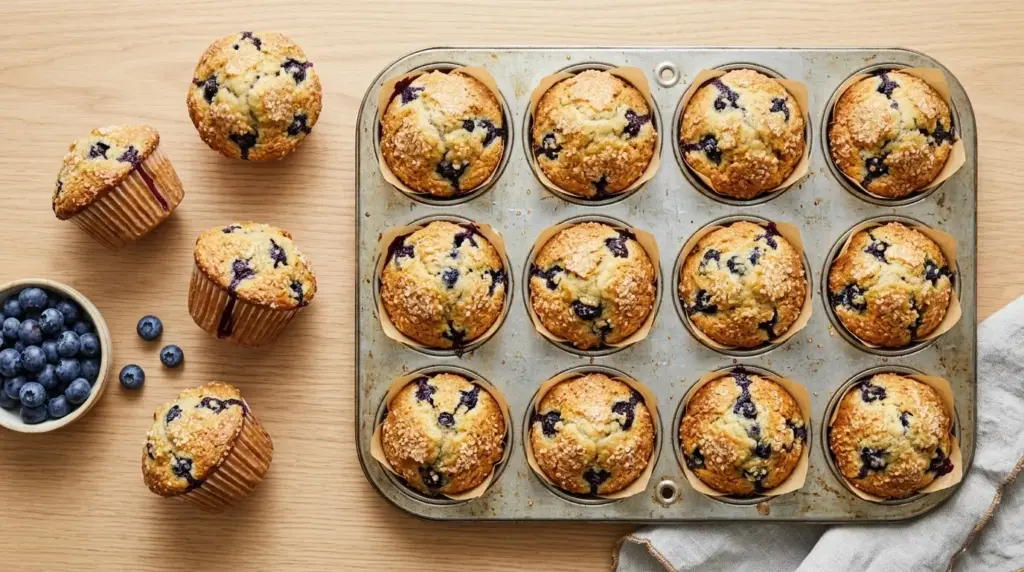
These muffins are the kind of thing people want the moment they smell them baking. They’re good enough to serve on their own, but they pair well with a few simple accompaniments.
- A pat of honey butter spread warm over a split muffin is one of the best simple pairings imaginable
- Serve alongside a bowl of Baked Oatmeal for a filling, wholesome weekend breakfast spread
- Pair with a Blueberry Banana Smoothie for a blueberry-forward breakfast that feels like something from a brunch café
- A simple smear of cream cheese takes these muffins in a slightly more savory direction, wonderful with coffee
- Set them out at a brunch table alongside a Breakfast Casserole and fresh fruit for a spread that looks like a lot of effort but isn’t
- Pack one in a lunchbox with a piece of fruit for an afternoon snack that doesn’t feel like a compromise
Read Also: Easy Scone Recipe
Variations to Try
Once you’ve made the base recipe, there are a handful of tweaks worth exploring. Each one changes the character of the muffin in a different direction.
- Lemon blueberry: Add 1 tablespoon of fresh lemon zest and 1 tablespoon of fresh lemon juice to the wet ingredients. The brightness cuts through the richness beautifully.
- Streusel topped: Mix together 3 tablespoons of flour, 3 tablespoons of sugar, 2 tablespoons of cold butter, and a pinch of cinnamon. Crumble it over the tops before baking for a bakery-style crumb topping.
- Mixed berry: Replace half the blueberries with raspberries or diced strawberries for a more complex berry flavor.
- Chocolate chip: Swap the blueberries for 1 cup of mini chocolate chips for a completely different but equally good muffin.
- Honey sweetened: Replace the granulated sugar with ¾ cup of honey, reduce the sour cream by 2 tablespoons, and reduce the oven temp to 350°F (175°C) for the full bake.
- Whole wheat: Replace half the all-purpose flour with whole wheat flour for a slightly heartier, nuttier flavor. Add 1 extra tablespoon of sour cream to compensate for the drier flour.
- Mini muffins: Fill a 24-cup mini muffin tin ¾ full and bake at 425°F for 3 minutes, then 350°F for 8 to 10 minutes.
The mixed berry variation works especially well with the flavor profile in the Sourdough Discard Chocolate Chip Cookies Recipe if you want to bake a complete batch of sourdough discard treats in the same afternoon.
Storage and Reheating
These muffins store well and stay moist for several days, making them perfect for batch baking at the start of the week.
- Store cooled muffins in an airtight container at room temperature for up to 3 days.
- For longer storage, refrigerate them for up to 5 days. Note that refrigeration can dry out muffins slightly, so a quick warm-up before eating helps restore the fresh-baked texture.
- To freeze, place cooled muffins in a single layer on a baking sheet and freeze until solid (about 1 hour), then transfer to a zip-top freezer bag. They keep well for up to 3 months.
- To reheat from room temperature, microwave for 15 to 20 seconds or warm in a 300°F (150°C) oven for 5 minutes.
- To reheat from frozen, microwave for 30 to 45 seconds, or thaw overnight at room temperature and then warm as above.
- Avoid reheating in a high-power microwave for too long, as this makes muffins rubbery rather than tender.
Another make-ahead breakfast that stores and reheats just as well is the Baked Oatmeal Recipe — a great option to prep on the same day for a full week of easy breakfasts.
Nutritional Facts
The following values are estimates per muffin, based on 12 standard-size muffins from this recipe.
| Nutrient | Per Muffin (approx.) |
|---|---|
| Calories | 240 kcal |
| Total Fat | 10g |
| Saturated Fat | 6g |
| Cholesterol | 40mg |
| Sodium | 190mg |
| Total Carbohydrates | 34g |
| Dietary Fiber | 1g |
| Sugars | 20g |
| Protein | 3g |
These values will shift slightly depending on the hydration of your sourdough discard, whether you use fresh or frozen berries, and whether you include the demerara sugar topping. Using Greek yogurt instead of sour cream lowers the fat slightly and increases protein.
Read Also: Sourdough Focaccia Recipe
Health Benefits of Key Ingredients
Beyond the pleasure of eating a warm muffin, several of the ingredients in this recipe offer some genuinely good nutrition.
Each ingredient contributes something meaningful, so here’s a quick look at why the key ones earn their spot in this recipe.
- Blueberries are among the most antioxidant-rich foods available. They’re high in vitamins C and K, manganese, and anthocyanins, the compounds that give them their deep blue color and are linked to improved cognitive function and reduced inflammation.
- Sourdough discard contains wild yeast and naturally occurring bacteria that partially break down the gluten and phytic acid in the flour, which may improve digestibility compared to conventional baked goods.
- Eggs provide complete protein, B vitamins, and choline, which supports brain health. They also give the muffins their structure and richness.
- Sour cream contributes fat-soluble vitamins and calcium, and its lactic acid content works alongside the discard to keep the crumb tender without relying on more sugar or fat.
- All-purpose flour provides the energy foundation of the muffin. Substituting half with whole wheat flour increases the fiber content considerably if that’s a priority for you.
Another way to enjoy blueberries in a nutritious, quick-to-make format is with this Blueberry Smoothie Recipe Without Yogurt.
Frequently Asked Questions
1. Can I use active sourdough starter instead of discard?
Yes, active starter works in this recipe. The muffins may have a very slightly more pronounced tang, but you won’t notice a dramatic difference. The muffins do not rely on the starter for leavening, so whether your starter is fed and bubbly or unfed discard, the baking powder and baking soda still do all the rising work.
2. My sourdough discard is very runny. Will the recipe still work?
It will work, but a very liquid discard (one that’s been sitting and separated, with liquid on top) can affect the batter consistency. Stir the discard well before measuring it by weight (105g). If you notice the batter seems too thin after combining, add 1 to 2 extra tablespoons of flour to compensate.
3. Why are my muffins flat on top instead of domed?
The most common cause is cold wet ingredients. Cold sour cream and eggs don’t emulsify well with melted butter, which can result in a dense batter that doesn’t rise as dramatically. The second most common cause is opening the oven during the first 5 minutes of baking. The sudden temperature drop prevents the initial dome from forming. Use room temperature ingredients and leave the oven door closed until the temperature drop step.
4. Can I make this recipe dairy-free?
The sour cream and butter are the two dairy ingredients. Substitute the sour cream with a full-fat coconut yogurt or a dairy-free sour cream alternative, and replace the butter with the same amount of melted refined coconut oil or a neutral dairy-free butter. The texture will be slightly different but still good.
5. How do I know if my sourdough discard is still safe to use in baking?
Discard stored in a sealed container in the fridge is generally safe to use for 1 to 2 weeks after your last feeding. It may develop a liquid layer on top (called “hooch”) and smell quite sour or even slightly alcoholic, but this is normal. Stir it before using. Discard that shows mold (fuzzy pink, orange, or black spots) or smells genuinely foul rather than just tangy should be discarded.
You might also enjoy: Sourdough Starter Recipe

Sourdough Discard Blueberry Muffins

Equipment
- Standard 12-cup muffin tin - Heavy-gauge aluminum recommended for even heating
- Muffin tin liners - Or non-stick baking spray
- Large mixing bowl - For dry ingredients
- Medium mixing bowl - For wet ingredients
- Kitchen scale - Recommended for accuracy, especially for sourdough discard
- Rubber spatula or wooden spoon
- Whisk
- Ice cream scoop or muffin scoop - For even portioning
- Measuring cups and spoons
- Wire cooling rack
Ingredients
- 1 ½ cups all-purpose flour - 190g
- 1 cup granulated sugar - 200g
- 2 teaspoons baking powder
- ½ teaspoon baking soda
- ½ teaspoon fine salt
- ½ cup unsalted butter - 113g, melted and slightly cooled
- ½ cup sourdough discard - 105g, unfed (room temperature or cold from fridge)
- ¾ cup sour cream - 180g, room temperature; plain full-fat Greek yogurt works too
- 1 large egg - room temperature
- 1 teaspoon pure vanilla extract
- 1 ½ cups blueberries - 210g, fresh or frozen (do not thaw if frozen)
- 1 tablespoon all-purpose flour - For tossing the blueberries
- 2 tablespoons coarse sugar or demerara sugar - For topping, optional but recommended
Instructions
- Preheat oven to 425°F (220°C). Place rack in center position. Line a standard 12-cup muffin tin with paper liners or spray with non-stick spray.
- Toss blueberries with 1 tablespoon flour in a small bowl until lightly coated. Set aside. This prevents sinking and absorbs excess juice from frozen berries.
- In a large bowl, whisk together flour, sugar, baking powder, baking soda, and salt until evenly distributed. Make a well in the center.
- In a medium bowl, whisk melted butter and sourdough discard until combined. Add sour cream and whisk until smooth. Add egg and vanilla, whisking until fully glossy with no visible streaks.
- Pour wet ingredients into the well of dry ingredients. Fold with a rubber spatula until just combined and flour streaks disappear. Batter will be thick and slightly lumpy — do not overmix.
- Gently fold in flour-coated blueberries with 4 to 5 slow strokes. Press any stray berries into the batter without over-stirring.
- Divide batter evenly among 12 prepared muffin cups, filling each about ¾ full and mounding slightly in the center. Sprinkle tops generously with coarse sugar.
- Bake at 425°F for exactly 5 minutes without opening the oven door. Reduce temperature to 350°F (175°C) and bake 16 to 20 minutes more, until tops are golden and a toothpick inserted in center comes out clean or with moist crumbs.
- Remove muffin tin from oven and cool on a wire rack for 5 minutes. Transfer muffins directly to the rack to cool completely. Do not leave in pan longer than 10 minutes to prevent softening from trapped steam.
Notes
- Do not overmix: Fold only until the flour streaks disappear. Lumpy batter is fine. Overmixing develops gluten, making muffins tough and rubbery.
- Room temperature ingredients matter: Cold sour cream or egg won’t incorporate smoothly, affecting texture. Bring to room temperature for best results.
- Weigh your discard: Half a cup of thick discard differs significantly from half a cup of runny discard. Weigh 105g for consistency.
- Keep oven door closed: The first 5 minutes at high heat are crucial for the dome. Opening the door lets cold air in and may cause flat tops.
- Frozen blueberries work great: Do not thaw them. Tossing in flour prevents bleeding and keeps the batter from turning grey-purple.
- Fill cups properly: Under-filling gives flat muffins; over-filling causes spillage. Fill to about ¾ full, mounding slightly in the center.
- Check doneness carefully: Muffins may look done on top but be underbaked in the center, especially with juicy fruit. Use a toothpick to test.
- Dairy-free adaptation: Substitute sour cream with full-fat coconut yogurt or dairy-free sour cream alternative. Replace butter with melted refined coconut oil or dairy-free butter.
- Storage: Store in airtight container at room temperature up to 3 days. Refrigerate up to 5 days or freeze up to 3 months.
- Reheating: Microwave 15-20 seconds from room temperature, or warm in a 300°F oven for 5 minutes. From frozen, microwave 30-45 seconds.
Final Thoughts
This Sourdough Discard Blueberry Muffins recipe is one of those rare finds that manages to be simple, practical, and genuinely impressive all at once.
The sourdough discard gives you something no other ingredient quite replicates: a depth of flavor and a softness that holds up over multiple days. Paired with the high-low oven technique and a handful of ripe blueberries, it produces muffins you’ll be proud to share.
If you try this recipe, please leave a comment below to let me know how they turned out! If you made any tweaks, like adding lemon zest or swapping the sour cream, I’d love to hear about those too. And if you share your bake on Instagram, tag the post so I can see your beautiful domed tops.
Recommended:
- Sourdough Discard Pizza Dough Recipe
- Sweet Sourdough Bread Recipe
- Same Day Sourdough Bread Recipe
- Easy Sourdough Bread Recipe
- Sourdough Sandwich Bread Recipe
- Blueberry Cheesecake Recipe
- Blueberry Pie Recipe
- Pumpkin Muffin Recipe
- Buttermilk Biscuit Recipe
- Dutch Baby Recipe