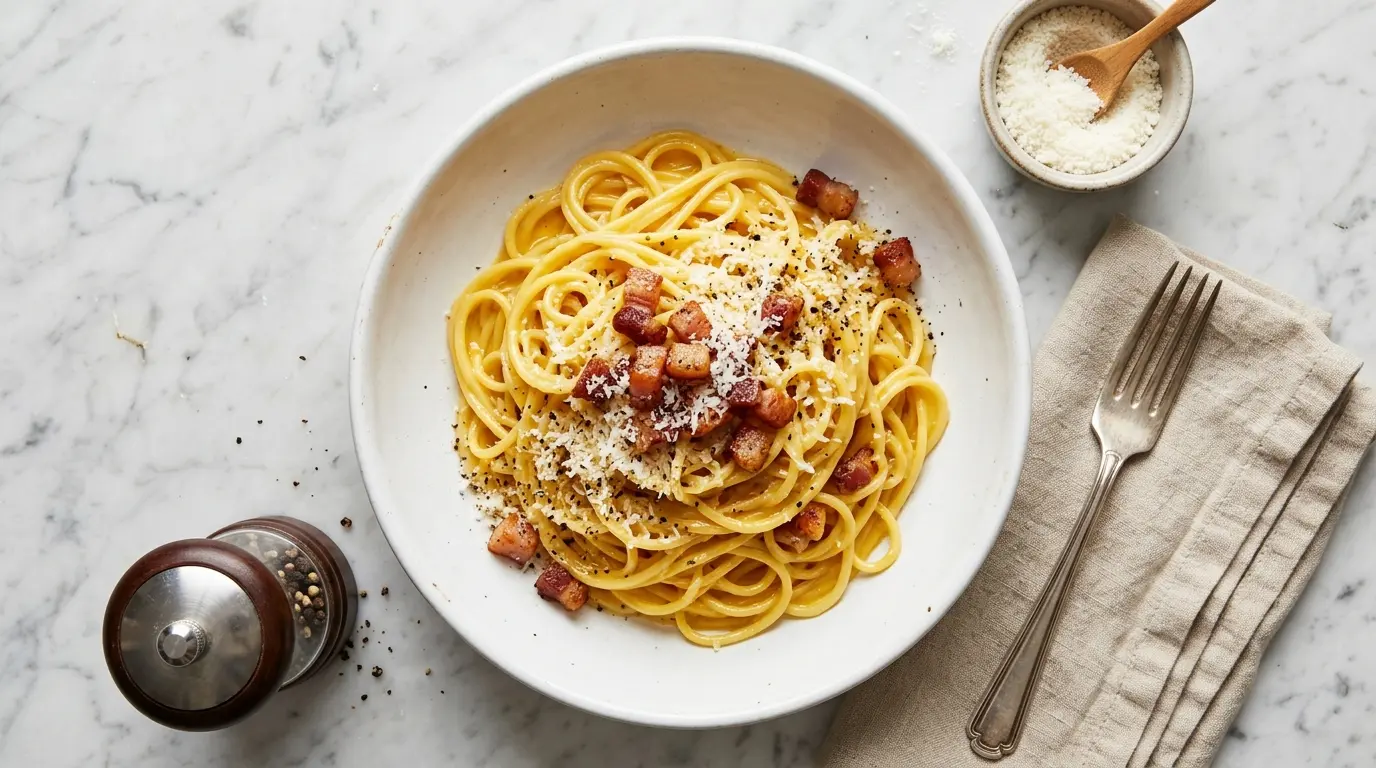
If you’ve been chasing that silky, creamy, deeply savory pasta you had at a little Roman trattoria (or desperately dreamed about), this Spaghetti alla Carbonara is it.
No cream. No shortcuts. Just five humble ingredients transformed into something extraordinary.
What makes authentic carbonara so special is the alchemy of it: egg yolks and finely grated Pecorino Romano cheese melt into the residual heat of freshly cooked pasta and rendered guanciale fat, forming a sauce that’s glossy, rich, and impossibly smooth.
The technique matters more than anything else here. Get the heat right, and you have liquid gold. Rush it or use too much direct heat, and you get scrambled eggs on pasta (which is also delicious, but not what we’re going for).
This recipe walks you through every step with the detail you need to nail it the first time, whether you’re cooking for yourself on a Tuesday night or trying to impress guests who think carbonara requires cream.
Spoiler: it absolutely does not.
If you love bold, saucy Italian pasta dishes, be sure to check out this vodka sauce recipe that’s equally rich and packed with flavor.

Why You’ll Love This Spaghetti alla Carbonara
This dish is the definition of doing more with less.
With only five ingredients, it delivers a depth of flavor that feels almost unfair.
The guanciale (cured pork jowl) renders into golden, slightly crispy nuggets that are salty, fatty, and intensely porky in the best way possible.
The Pecorino Romano brings a sharp, tangy bite that plays beautifully against the richness of the egg yolks.
There is no cream needed because the starchy pasta water and egg yolks do all the work to create a sauce that clings to every strand of spaghetti.
It comes together in about 20 to 25 minutes from start to finish, which makes it one of the fastest impressive dinners you can make.
- Minimal ingredients: Just spaghetti, guanciale, eggs, Pecorino Romano, and black pepper.
- No cream required: The egg yolk and cheese emulsion is naturally luxuriously creamy.
- Incredibly fast: Ready in under 30 minutes on a weeknight.
- Restaurant-quality results at home: Once you master the technique, this rivals anything you’d get at an Italian restaurant.
- Authentically Roman: This is the version you’d be served in Rome, not the cream-laden imitation found elsewhere.
- Endlessly satisfying: Rich, savory, and deeply comforting without feeling heavy.
You might also enjoy: One Pan Orecchiette Pasta Recipe
Ingredients
The beauty of Spaghetti alla Carbonara is its brevity. Every single ingredient earns its place, so quality matters enormously here. Use the best eggs you can find, genuine Pecorino Romano (not a generic blend), and guanciale if you can source it.
- 400g (14 oz) dry spaghetti
- 150g (5.3 oz) guanciale, cut into small cubes or thick strips (pancetta works as a substitute)
- 4 large egg yolks plus 1 whole egg
- 80g (2.8 oz / about 1 cup) finely grated Pecorino Romano cheese, plus extra to finish
- 1 teaspoon (or more) freshly cracked black pepper, plus extra to serve
- Kosher salt, for the pasta water
- Reserved pasta water (about 1/2 cup / 120ml), set aside before draining
Read Also: Baked Spaghetti Recipe with Ground Beef
Kitchen Equipment Needed
You don’t need anything fancy to make a great carbonara. What matters more than the equipment is technique: low and slow on the heat, and moving quickly once the pasta hits the pan.
- Large pot (for boiling pasta)
- Large skillet or frying pan (wide enough to toss pasta)
- Medium mixing bowl (for the egg and cheese mixture)
- Box grater or microplane (for grating Pecorino Romano finely)
- Tongs or pasta fork (for transferring pasta)
- Ladle (for scooping pasta water)
- Measuring cup (for pasta water)
- Whisk or fork (for beating the egg mixture)
- Liquid measuring cup
This pairs beautifully with a classic side like cheesy garlic bread to complete the meal.
Recommended Products for This Recipe
These are products chosen specifically for the quality and performance they bring to making an authentic carbonara at home.
1. Authentic Italian Guanciale (Cured Pork Jowl)
Guanciale is the traditional fat of carbonara and genuinely cannot be matched by pancetta or bacon for flavor. It renders more fat, has a more intense and savory taste, and gives the sauce a silkiness that other pork products just don’t deliver. Sourcing real guanciale takes this dish from great to extraordinary.
2. Aged Pecorino Romano DOP Cheese
The DOP designation means the cheese was produced and aged according to strict Italian standards in its region of origin. For carbonara, this matters: genuine Pecorino Romano has a sharper, saltier, more complex flavor than imitation blends. Buying a wedge and grating it fresh makes a visible difference in sauce consistency.
3. Pasta Pot with Built-In Strainer Lid
A large, deep pot with a locking strainer lid makes it easy to reserve pasta water before draining (a step that’s critical for carbonara sauce). Having hot, starchy pasta water ready to add to the sauce at a moment’s notice can be the difference between a creamy, glossy sauce and a dry, clumpy one.
4. Premium Microplane Grater
Finely grated cheese melts into the egg mixture far more evenly than coarsely grated, which is critical for a smooth carbonara sauce. A high-quality microplane creates an almost powdery grate that dissolves seamlessly into the pasta.
5. Spaghetti alla Chitarra (Traditional Carbonara Pasta)
Spaghettoni or spaghetti alla chitarra (square-cut spaghetti) has a slightly rougher texture than standard spaghetti, which allows the carbonara sauce to grip and cling to each strand more effectively. This style of pasta is closer to what you’d find in Rome.
Read Also: Classic Bruschetta Recipe

Step-by-Step Instructions
Step 1: Prepare the Egg and Cheese Mixture
- Separate 4 egg yolks into a medium mixing bowl, discarding or saving the whites for another use.
- Add 1 whole egg to the same bowl.
- Grate 80g (about 1 cup) of Pecorino Romano very finely using a microplane or the finest side of a box grater, and add it to the eggs.
- Add a generous amount of freshly cracked black pepper (at least 1 teaspoon, or more to taste).
- Whisk everything together until you have a thick, pale yellow paste. It should look like a slightly loose frosting. Set aside.
Step 2: Bring a Large Pot of Water to a Boil
- Fill your largest pot with water (at least 4 to 5 quarts / 4 to 5 liters).
- Place it over high heat and bring it to a full, rolling boil.
- Once boiling, add a generous pinch of kosher salt. Since guanciale and Pecorino are both very salty, you want less salt in the pasta water than usual. The water should taste mildly salty, not like the sea.
Step 3: Cook the Guanciale
- While the water heats, cut the guanciale into small cubes or thick strips, roughly 1 cm (about 1/2 inch) pieces.
- Place the guanciale into a cold, large skillet or frying pan (no oil needed; guanciale has plenty of its own fat).
- Turn the heat to medium-low and cook slowly, stirring occasionally, until the guanciale is golden brown and the fat has rendered out, about 8 to 10 minutes.
- You want the pieces to be crispy on the outside but still a little tender in the center, not completely crunchy all the way through.
- Turn off the heat and leave the guanciale and all its rendered fat in the pan. Do not drain the fat; it is essential to the sauce.
Step 4: Cook the Spaghetti
- Add the spaghetti to the boiling salted water and cook according to package directions until just al dente (firm to the bite).
- Standard spaghetti typically takes 8 to 10 minutes, but aim to pull it out about 1 minute before the package says it’s done, since it will continue cooking briefly in the pan.
- Before draining or removing the pasta, use a ladle or measuring cup to scoop out at least 1 full cup (240ml) of the starchy pasta cooking water and set it aside. This is your most important secret weapon.
Step 5: Transfer the Pasta to the Guanciale Pan
- Using tongs, transfer the spaghetti directly from the boiling water to the skillet with the guanciale. Do not rinse the pasta.
- If you don’t have tongs, drain the pasta but make absolutely sure you’ve already saved your pasta water before draining.
- Toss the spaghetti in the pan over medium-low heat for about 1 minute, coating every strand in the rendered guanciale fat. This step helps the pasta absorb the flavor of the fat.
- Add about 2 tablespoons (30ml) of the reserved pasta water to the pan and toss to loosen things up slightly.
Step 6: Add the Egg and Cheese Mixture
- This is the most critical step. Remove the pan from the heat entirely, or move it off the burner.
- Work quickly: pour the egg and cheese mixture over the hot spaghetti, and immediately begin tossing vigorously with tongs.
- The residual heat from the pasta and the pan will gently cook the eggs into a creamy sauce without scrambling them. Speed and off-heat cooking are your best friends here.
- As you toss, add the reserved pasta water a splash at a time (start with 2 to 3 tablespoons / 30 to 45ml) to help emulsify the sauce and keep it glossy and fluid.
- Continue tossing and adding pasta water as needed until the sauce coats every strand of spaghetti in a thick, silky, creamy layer. You may not need all of the reserved water.
- The sauce should flow smoothly between the strands when you tilt the pan. If it looks dry or clumpy, add more pasta water and toss again.
Step 7: Plate and Serve
- Divide the carbonara immediately between warmed pasta bowls (warming them briefly helps keep the sauce from cooling and seizing up).
- Top each serving with extra freshly grated Pecorino Romano and a generous crack of fresh black pepper.
- Serve immediately. Carbonara waits for no one; it’s best eaten right away while the sauce is silky and perfectly fluid.
The same technique for creating an emulsified sauce works beautifully in dishes like this chicken piccata with pasta as well.
Tips for Success
Carbonara has a reputation for being tricky, but once you understand the few things that can go wrong (and why), it’s actually very approachable. These tips address every common pitfall.
- Work off the heat: The single biggest mistake in carbonara is scrambling the eggs. Always remove the pan from the heat before adding the egg mixture. The residual heat from the hot pasta is exactly enough.
- Save more pasta water than you think you need: The starchy pasta cooking water is what emulsifies the sauce and keeps it creamy. A full cup set aside gives you plenty to work with.
- Grate your cheese very finely: Coarsely grated Pecorino won’t melt evenly into the eggs. A microplane or the finest grater setting produces a powdery texture that dissolves seamlessly.
- Use room temperature eggs: Cold eggs from the fridge can cause the sauce to seize up or cook unevenly. Let your eggs sit at room temperature for 20 to 30 minutes before starting.
- Don’t skip the rendered fat: The guanciale fat left in the pan is not waste; it’s the base of the sauce’s flavor. Draining it would strip the dish of much of its depth.
- Move fast during the sauce step: Once the egg mixture hits the hot pasta, you have about 30 to 45 seconds to toss and emulsify before the residual heat becomes too high. Keep moving.
- Warm your bowls: Serving carbonara in cold bowls causes the sauce to congeal and seize very quickly. A quick rinse with hot tap water or 30 seconds in a warm oven does the trick.
Read Also: Italian Meatballs Recipe
Serving Suggestions
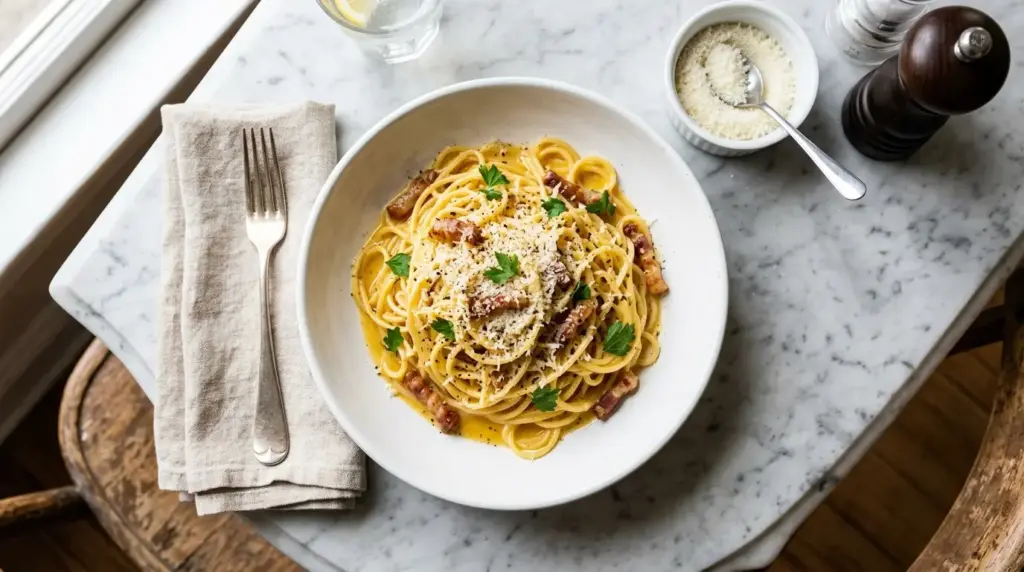
Carbonara is a complete meal all on its own, but if you’re building a fuller Italian-inspired spread, these pairings work beautifully alongside it.
A simple green salad dressed with lemon and olive oil offers a bright, acidic counterpoint to the richness of the carbonara sauce without competing with its flavors.
- A glass of dry white wine, such as a Frascati or Pinot Grigio, mirrors the flavors of Roman cuisine.
- A crisp broccoli salad on the side offers a fresh, cool contrast to the warm, rich pasta.
- A simple arugula salad with shaved Parmesan and a squeeze of lemon for freshness.
- Italian Wedding Soup as a first course for a full dinner-party-style meal.
- Tiramisu for dessert to keep the Italian theme going from start to finish.
- Roasted Broccoli as a simple, light vegetable side to balance the richness of the pasta.
The same salty-savory balance you love in carbonara also comes through brilliantly in a bowl of Zuppa Toscana.
Variations to Try
Authentic carbonara is perfect as written, but there are a handful of accepted variations and creative riffs that are worth exploring once you’ve mastered the original.
- Rigatoni Carbonara: Swap spaghetti for rigatoni, a popular Roman alternative. The ridges and hollow tubes grip the sauce exceptionally well.
- Bucatini Carbonara: Bucatini is a thick, hollow spaghetti that’s slightly chewier and soaks up more of the egg and fat mixture with every bite.
- Pancetta instead of guanciale: If guanciale is unavailable, pancetta is the closest substitute. It’s leaner and milder, but still delivers good results. Bacon also works in a pinch.
- Parmesan instead of Pecorino: If you can only find Parmigiano-Reggiano, use it. The flavor will be nuttier and slightly less sharp, but the technique stays the same.
- Pasta alla Gricia: This is essentially carbonara without the eggs, made with just guanciale, Pecorino, and black pepper. It’s older and simpler, and many Romans consider it carbonara’s parent dish.
- Egg yolks only: For an even richer, creamier sauce, use only egg yolks (no whole egg). This is the method many Roman chefs prefer for its deeper golden color and denser texture.
This technique for building pasta sauces with fat and starchy water also shines in baked ziti.
Storage and Reheating
Carbonara is genuinely best eaten fresh, right after cooking. The egg-based sauce begins to congeal and dry out within minutes of cooling, which is part of what makes it so distinct from cream-based pasta dishes. That said, if you have leftovers, here’s how to handle them without sacrificing too much.
- Refrigerating: Store leftover carbonara in an airtight container in the refrigerator for up to 2 days. Expect the sauce to firm up significantly as it cools.
- Reheating on the stovetop (recommended): Place the cold carbonara in a skillet over very low heat. Add a splash of water (2 to 3 tablespoons) and toss gently and constantly until warmed through. The added water loosens the sauce and helps restore some of its original creaminess.
- Avoid the microwave: Microwaving carbonara tends to scramble the egg sauce and creates an uneven, rubbery texture. The stovetop is always the better option for reheating.
- Do not freeze: Carbonara does not freeze well at all. The egg sauce separates and becomes grainy when frozen and thawed.
- Prevent leftovers: The best approach is simply to make just as much as you need. This recipe scales easily; halve it for two people or double it for a crowd.
For another Italian pasta dish that reheats beautifully, try this stuffed shells recipe.
Nutritional Facts
The following values are approximate and based on one serving, assuming this recipe serves 4 people.
| Nutrient | Per Serving |
|---|---|
| Calories | ~620 kcal |
| Total Fat | 28g |
| Saturated Fat | 11g |
| Cholesterol | 280mg |
| Sodium | 780mg |
| Total Carbohydrates | 68g |
| Dietary Fiber | 3g |
| Sugars | 2g |
| Protein | 24g |
| Iron | 3mg |
| Calcium | 210mg |
Nutritional values will vary depending on the specific brands and exact quantities used. Substituting pancetta for guanciale or Parmesan for Pecorino will slightly alter the fat and sodium content.
Another pasta dish worth exploring for its bold nutritional profile is this pasta fagioli recipe.
Health Benefits of Key Ingredients
This dish is not a health food by any traditional measure, but several of its key ingredients do carry genuine nutritional value worth acknowledging.
Spaghetti alla Carbonara is a high-protein meal, thanks to both the eggs and the guanciale, making it more satiating than many pasta dishes.
- Eggs: Whole eggs and egg yolks are among the most nutrient-dense foods available, providing high-quality protein, vitamins D, B12, and A, choline (essential for brain health), and healthy fats including omega-3s when sourced from pasture-raised hens.
- Guanciale (pork jowl): While high in fat, guanciale contains oleic acid (the same monounsaturated fat found in olive oil), which research has associated with heart health when consumed as part of a balanced diet. It’s also a source of B vitamins, zinc, and selenium.
- Pecorino Romano: Made from sheep’s milk, Pecorino Romano is a rich source of calcium and phosphorus, important for bone density. Sheep’s milk cheeses also tend to be higher in conjugated linoleic acid (CLA), a fatty acid with potential anti-inflammatory properties.
- Black pepper: Far more than a seasoning, freshly cracked black pepper contains piperine, a compound that has been shown to enhance the absorption of various nutrients, including curcumin from turmeric, by up to 2,000%.
- Pasta (spaghetti): A source of complex carbohydrates and B vitamins, pasta provides steady energy and is lower on the glycemic index when cooked al dente, as the firmer starch takes longer to digest.
For another egg-forward recipe with great nutritional depth, this easy garlic bread recipe makes the perfect accompaniment.
Frequently Asked Questions
1. Can I use cream in carbonara?
Authentic Spaghetti alla Carbonara contains absolutely no cream. The silky, creamy texture comes entirely from the emulsification of egg yolks, finely grated Pecorino Romano, rendered guanciale fat, and starchy pasta water. Adding cream dilutes the flavors, makes the sauce heavier and less nuanced, and moves the dish away from what Roman chefs have perfected for decades. Once you taste the real version, you’ll understand why cream is never necessary.
2. What is guanciale and can I substitute it?
Guanciale is an Italian cured meat made from pork cheek or jowl, seasoned with black pepper and herbs, then aged for several months. It has a higher fat content and a more intense, complex flavor than pancetta or bacon. If you can’t find guanciale at a specialty Italian deli or grocery store, pancetta is the closest substitute and gives good results. Bacon works too, though its smokiness will alter the flavor profile of the final dish.
3. How do I prevent the eggs from scrambling?
The key is removing the pan from direct heat before adding the egg and cheese mixture. The residual heat from the freshly cooked pasta and the warm pan is sufficient to gently cook and emulsify the eggs into a creamy sauce. Toss quickly and constantly, and add pasta water a splash at a time to regulate the temperature and keep the sauce fluid. If your pan is too hot, the eggs will seize and scramble instantly.
4. Can I make carbonara ahead of time?
Carbonara is best made and eaten immediately. The egg-based sauce does not hold well; it thickens, congeals, and dries out as it cools, and reheating it is always a partial restoration at best. If you’re entertaining, the good news is that carbonara comes together in under 25 minutes, making it ideal to cook fresh right before serving rather than in advance.
5. What pasta shapes work best for carbonara?
Spaghetti is the traditional and most widely used shape for carbonara in Rome, but other long pasta shapes work beautifully too. Rigatoni is the most popular alternative; its ridged surface and hollow interior capture the sauce inside and out. Bucatini, tonnarelli (also called spaghetti alla chitarra), and even fresh pasta like fettuccine all work well. The key is cooking whatever pasta you use just to al dente so it maintains enough firmness to hold up during the tossing stage.
Read Also: Homemade Ravioli Recipe

Spaghetti alla Carbonara

Equipment
- Large pot - for boiling pasta, 4-5 quart capacity
- Large skillet or frying pan - wide enough to toss pasta
- Medium mixing bowl - for egg and cheese mixture
- Box grater or microplane - for finely grating Pecorino Romano
- Tongs or pasta fork - for transferring pasta
- Ladle - for scooping pasta water
- Measuring cup - for pasta water
- Whisk or fork - for beating the egg mixture
- Liquid measuring cup
Ingredients
- 400 g dry spaghetti - 14 oz, spaghettoni or spaghetti alla chitarra recommended
- 150 g guanciale - 5.3 oz, cut into small cubes or thick strips; pancetta works as substitute
- 4 large egg yolks - plus 1 whole egg, room temperature
- 80 g Pecorino Romano cheese - about 1 cup, finely grated, plus extra for serving
- 1 teaspoon black pepper - freshly cracked, plus more to serve
- Kosher salt - for the pasta water
- 120 ml pasta water - about 1/2 cup, reserved before draining
Instructions
- Whisk egg yolks, whole egg, Pecorino Romano, and black pepper in a bowl until thick and pale.
- Bring salted water to a rolling boil in a large pot.
- Cook guanciale in a cold skillet over medium-low until golden and crispy, about 8-10 minutes.
- Cook spaghetti until al dente, about 1 minute less than package directions.
- Reserve 1 cup of pasta water, then transfer spaghetti directly to the guanciale pan and toss to coat in fat.
- Remove pan from heat, pour in egg mixture, and toss vigorously while adding pasta water until a creamy sauce forms.
- Serve immediately in warmed bowls with extra Pecorino and black pepper on top.
Notes
- Work off the heat: Always remove the pan from the burner before adding the egg mixture. Residual heat from the pasta is exactly enough to cook the eggs gently without scrambling.
- Save extra pasta water: Reserve at least 1 full cup. The starchy water is essential for emulsifying the sauce and keeping it creamy.
- Grate cheese very finely: Use a microplane or the finest grater setting so the Pecorino melts evenly into the eggs without clumping.
- Use room temperature eggs: Cold eggs can cause the sauce to seize. Leave them out for 20-30 minutes before starting.
- Don’t drain the guanciale fat: The rendered fat is the flavor base of the sauce. Never discard it.
- Move fast: Once the egg mixture hits the hot pasta, toss continuously for 30-45 seconds to emulsify before the residual heat fades.
- Pancetta substitution: If guanciale is unavailable, pancetta is the closest substitute. Bacon works in a pinch but adds smokiness.
- Warm your bowls: Cold bowls cause the sauce to congeal quickly. Rinse bowls with hot water or warm them in the oven for 30 seconds.
- Storage: Carbonara is best eaten fresh. Leftovers can be refrigerated for up to 2 days and reheated gently on the stovetop with a splash of water. Avoid microwaving.
- Pasta alternatives: Rigatoni, bucatini, or tonnarelli all work beautifully with this sauce.
Final Thoughts
Spaghetti alla Carbonara is one of those rare dishes that proves you don’t need a long list of ingredients or hours in the kitchen to create something truly memorable.
It’s a recipe built on trust: trust in the ingredients, trust in the technique, and trust that simplicity is enough.
Once you make it the traditional way, without cream, without shortcuts, you’ll find it hard to go back to any other version.
The moment that sauce turns glossy and silky and clings to every strand of spaghetti, you’ll feel the particular satisfaction that comes from cooking something exactly right.
Give this Spaghetti alla Carbonara a try this week, and drop a comment below letting me know how it went. Snap a photo and share it, too; seeing your kitchen wins genuinely makes my day.
Recommended:
- Spaghetti Sauce Recipe
- Easy Lasagna Recipe
- Classic Lasagna with Ricotta
- Marinara Sauce Recipe
- Pesto Tortellini Bake Recipe
- Simple Tortellini Soup Recipe
- Lasagna Soup Recipe
- Alfredo Sauce Recipe with Cream Cheese
- Homemade Alfredo Sauce Recipe
- Baked Chicken Spaghetti Recipe