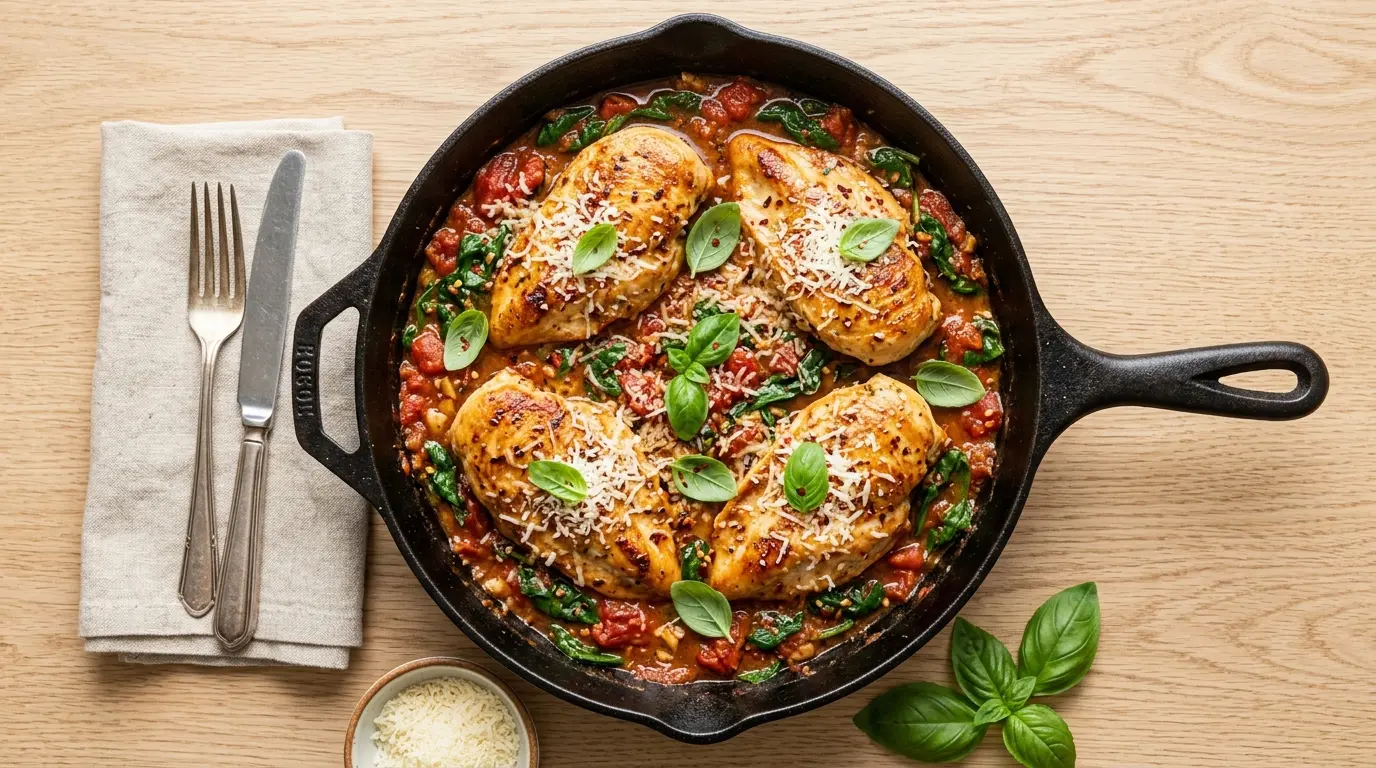
If you are searching for a dinner that feels fancy but comes together in under 40 minutes, this Italian Chicken Skillet Recipe is exactly what you need.
Golden, pan-seared chicken breasts cooked in a savory garlic, white wine, and tomato sauce — all in a single pan. It is the kind of weeknight meal that tastes like you spent hours in the kitchen, but you really didn’t.
What makes this recipe shine is the technique behind it. Searing the chicken first in olive oil locks in the juices and creates a beautiful crust, while the pan drippings form the base of an incredibly flavorful sauce. The tomatoes, garlic, spinach, and Italian herbs meld together into something that feels deeply comforting and authentically Italian.
It is a dish that works on a busy Tuesday just as well as it does when you are feeding company on the weekend. Clean-up is minimal, satisfaction is high, and the whole family tends to ask for seconds.
You might also enjoy: Quick Italian Skillet Dinner

Why You’ll Love This Italian Chicken Skillet Recipe
This recipe has earned a permanent spot in weeknight dinner rotations for good reason.
It is ready in 35 to 40 minutes from start to finish, which makes it a realistic option even on the most hectic evenings.
Everything cooks in a single skillet, which means less mess and faster cleanup. The sauce practically makes itself as you build on those golden pan drippings.
The flavor profile is bold and satisfying without being heavy. Fresh garlic, sun-dried tomatoes, Italian seasoning, and a splash of white wine work together to create a sauce that tastes restaurant-worthy.
It is also incredibly flexible. You can use chicken breasts or thighs, swap in different vegetables, or serve it over pasta, rice, or with crusty bread depending on what you have on hand.
- Ready in under 40 minutes
- One-pan cleanup
- Packed with Italian-inspired flavors
- Works with chicken breasts or thighs
- Gluten-friendly with a simple flour swap
- Crowd-pleasing for adults and kids alike
Read Also: Chicken Skillet Recipe
Ingredients
You will need mostly pantry staples and fresh produce for this recipe. The quality of your olive oil and canned or fresh tomatoes will make a noticeable difference in the final sauce.
- 4 boneless, skinless chicken breasts (about 6 oz / 170g each), pounded to even thickness
- 1 teaspoon dried oregano
- 1 teaspoon garlic powder
- 1/2 teaspoon onion powder
- 1/2 teaspoon dried basil
- 1/2 teaspoon salt
- 1/4 teaspoon black pepper
- 1/4 teaspoon crushed red pepper flakes (optional)
- 2 tablespoons all-purpose flour (for dusting)
- 3 tablespoons extra virgin olive oil
- 4 cloves garlic, minced
- 1 small yellow onion, diced
- 1/3 cup (80ml) dry white wine (such as Pinot Grigio or Sauvignon Blanc)
- 1/2 cup (120ml) low-sodium chicken broth
- 1 cup (180g) cherry tomatoes, halved (or 1 cup diced canned tomatoes)
- 1/3 cup (60g) sun-dried tomatoes, sliced (packed in oil, drained)
- 2 cups (60g) fresh baby spinach
- 1/4 cup (25g) freshly grated Parmesan cheese
- 2 tablespoons fresh basil, torn or chopped (for garnish)
- 1 tablespoon fresh lemon juice
For serving: pasta, rice, or crusty Italian bread
This pairs beautifully with a simple marinara sauce on the side if you want to double up on Italian flavor.
Kitchen Equipment Needed
The right skillet makes a real difference here. A cast iron or stainless steel skillet will give you that gorgeous golden sear that a non-stick pan often cannot fully achieve.
- Large cast iron skillet or stainless steel skillet (12 inch / 30cm)
- Meat mallet or rolling pin (for pounding chicken to even thickness)
- Sharp chef’s knife
- Cutting board
- Small mixing bowl (for seasoning mix)
- Tongs
- Wooden spoon or silicone spatula
- Measuring spoons and cups
- Instant-read meat thermometer
Read Also: Creamy Tuscan White Bean Skillet Recipe
Recommended Products for This Recipe
These are a few products that genuinely elevate this dish, based on quality and performance.
1. Lodge 12-Inch Cast Iron Skillet
A quality cast iron skillet is truly the best tool for this recipe. It retains heat evenly, giving you that perfect golden sear on the chicken that builds the flavor base for the entire sauce. Cast iron also transitions seamlessly from stovetop to oven if you need to finish the chicken.
2. Sun-Dried Tomatoes Packed in Olive Oil
The kind of sun-dried tomatoes you use truly matters. Those packed in olive oil are pliant, deeply flavored, and meld into the sauce beautifully, unlike the dried-out bagged variety. They add a concentrated sweetness and tang that takes the dish to another level.
3. Parmigiano Reggiano Block
Pre-grated Parmesan often contains anti-caking agents that affect both flavor and how the cheese melts into the sauce. A fresh block of Parmigiano Reggiano, grated right before use, gives you a nuttier, creamier finish that elevates the whole dish.
4. Instant-Read Meat Thermometer
Knowing exactly when your chicken hits 165°F (74°C) is the difference between juicy and dry. An instant-read thermometer takes all the guesswork out and ensures your chicken is perfectly cooked every single time.
Another favorite for Italian-inspired dinners: Chicken Cacciatore Recipe

Step-by-Step Instructions
Step 1: Prepare and Season the Chicken
- Place each chicken breast between two sheets of plastic wrap or inside a large zip-lock bag.
- Using a meat mallet or rolling pin, pound the thicker end of each breast to create an even thickness of about 3/4 inch (2cm). This step is critical — uneven thickness means some parts overcook while others stay underdone.
- Pat the chicken breasts completely dry with paper towels. Moisture on the surface prevents a good sear.
- In a small bowl, combine the dried oregano, garlic powder, onion powder, dried basil, salt, black pepper, and red pepper flakes (if using). Stir to mix.
- Sprinkle the seasoning evenly over both sides of each chicken breast, pressing gently so it adheres.
- Lightly dust both sides of each seasoned breast with the all-purpose flour, shaking off any excess. The flour creates a light crust when seared and later helps thicken the sauce.
Step 2: Sear the Chicken Breasts
- Place your large skillet over medium-high heat and add 2 tablespoons of the olive oil.
- Allow the oil to heat until it begins to shimmer but does not smoke. If it smokes, the heat is too high — lower it slightly before adding the chicken.
- Carefully place the chicken breasts into the skillet in a single layer. Do not crowd the pan. If your skillet is not large enough, cook in two batches.
- Sear the chicken for 4 to 5 minutes on the first side without moving it. Resist the urge to lift or shift it — leaving it undisturbed allows that golden crust to form properly.
- Flip the chicken using tongs and sear for another 4 to 5 minutes on the second side.
- Check the internal temperature with a meat thermometer. You are looking for 160°F to 163°F (71°C to 73°C) at this stage — it will carry-over cook to 165°F (74°C) when resting. If it has not reached that temperature, cook for another minute or two.
- Transfer the chicken to a clean plate and tent loosely with foil. Set aside while you build the sauce.
Step 3: Sauté the Onion and Garlic
- Reduce the heat to medium.
- Add the remaining 1 tablespoon of olive oil to the same skillet, leaving all those flavorful brown bits on the bottom — that is pure flavor.
- Add the diced onion and cook, stirring occasionally, for 3 to 4 minutes until it softens and becomes slightly translucent.
- Add the minced garlic and stir continuously for about 60 seconds until fragrant. Be careful here — garlic burns quickly and will turn bitter if left too long.
Step 4: Deglaze the Pan with White Wine
- Pour the dry white wine directly into the skillet.
- Using your wooden spoon, scrape up all the browned bits stuck to the bottom of the pan. This step, called deglazing, incorporates all those caramelized flavors directly into your sauce.
- Allow the wine to simmer and reduce by about half, which takes roughly 2 to 3 minutes. You should see it reduce visibly and the sharp alcohol smell will mellow.
Step 5: Build the Tomato Sauce
- Pour in the chicken broth and stir to combine with the wine reduction.
- Add the cherry tomatoes (or diced canned tomatoes) and the drained, sliced sun-dried tomatoes to the skillet.
- Stir everything together and bring to a gentle simmer over medium heat.
- Cook for 4 to 5 minutes, stirring occasionally, until the fresh cherry tomatoes begin to soften and release their juices. The sauce will deepen in color and flavor during this time.
- Taste the sauce and adjust seasoning if needed — a small pinch of salt can brighten all the flavors.
Step 6: Add the Spinach
- Add the fresh baby spinach to the skillet all at once.
- Stir it into the hot sauce and cook for 1 to 2 minutes just until the spinach has wilted completely. It will reduce significantly in volume — this is normal.
- The spinach adds both color and a mild earthiness that balances the acidity of the tomatoes.
Step 7: Return the Chicken and Finish the Dish
- Nestle the seared chicken breasts back into the skillet, placing them directly in the sauce.
- Drizzle the fresh lemon juice over the chicken and sauce. The lemon brightens the entire dish and cuts through the richness.
- Allow the chicken to simmer gently in the sauce for 2 to 3 minutes, turning once, so it absorbs the flavors and finishes heating through.
- Sprinkle the freshly grated Parmesan cheese over the top of the chicken and sauce.
- Scatter the torn fresh basil across the dish right before serving. Fresh basil wilts and loses its aroma quickly when overheated, so adding it last preserves its bright flavor.
- Serve immediately directly from the skillet with your choice of pasta, rice, or crusty bread.
This dish uses a similar searing-and-sauce technique you will find in the Chicken Francese Recipe.
Tips for Success
A few small adjustments can take this recipe from good to genuinely great, and most of them come down to technique rather than ingredients.
- Pound the chicken to even thickness. This single step is the most impactful thing you can do for juicy, evenly cooked chicken. Uneven breasts cook unevenly — thin ends overcook while thick centers stay underdone.
- Dry the chicken before seasoning. Paper towels absorb surface moisture, which allows the flour coating to adhere properly and the chicken to sear rather than steam.
- Do not skip the deglaze. Those browned bits on the skillet bottom are where the depth of flavor lives. Scraping them up with wine is what transforms this from a basic sauce into something extraordinary.
- Use dry white wine you would actually drink. Cooking wine is lower quality and often salted. A bottle of Pinot Grigio or Sauvignon Blanc will give you a noticeably cleaner, better flavor in the sauce.
- Use freshly grated Parmesan. Pre-grated cheese often has cellulose added to prevent clumping, which inhibits proper melting. Grating your own from a block gives you a creamier result.
- Rest the chicken briefly before serving. Even just 3 to 5 minutes of resting after the final simmer allows the juices to redistribute inside the meat, keeping each bite tender and moist.
Another great one-pan option for busy nights: One-Pan Orecchiette Pasta Recipe
Serving Suggestions
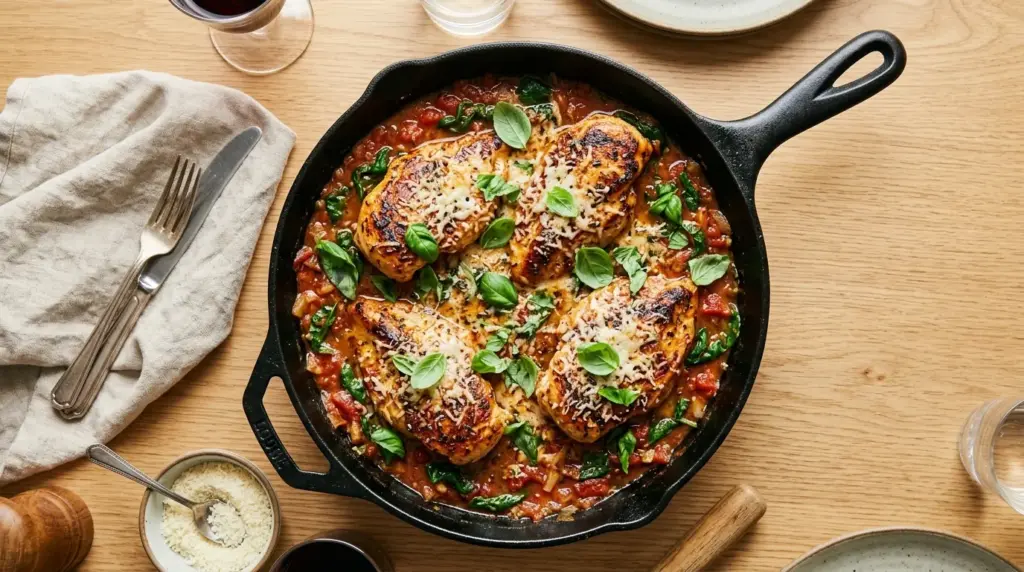
This Italian Chicken Skillet is wonderfully versatile and pairs well with a wide variety of sides.
The sauce is the star, so you want something to soak it all up. Pasta, rice, and crusty bread are the three most natural companions, and each brings a slightly different feel to the meal.
- Serve over al dente pasta for the most classic Italian dinner experience
- Spoon over fluffy basmati rice for a lighter, gluten-free option
- Pair with warm, crusty garlic bread to soak up every drop of sauce
- Serve alongside a simple green salad dressed with lemon and olive oil
- Add roasted broccoli on the side for extra vegetables and a pleasant crunch
- Pair with roasted potatoes for a hearty, comforting plate
For a beautifully balanced meal, start with a light bruschetta or Caesar salad, then serve the chicken skillet as the main event with pasta and a glass of the same dry white wine you used in the sauce.
Read Also: Simple Tortellini Soup Recipe
Variations to Try
Once you have mastered the base recipe, it is easy to riff on this dish in a dozen different directions. The core technique stays the same — it is really just the flavors and additions that shift.
- Creamy version: Stir in 1/4 cup (60ml) of heavy cream or a tablespoon of cream cheese after adding the broth for a rich, velvety sauce.
- Mushroom addition: Add 1 cup of sliced baby bella mushrooms along with the onion for an earthy, meaty depth.
- Chicken thighs: Boneless, skinless thighs are more forgiving than breasts and bring extra richness and juiciness to the dish. They may need an additional 2 to 3 minutes of cooking time.
- Add capers: A tablespoon of drained capers adds a briny, tangy pop that is very classically Italian.
- Make it spicy: Double the red pepper flakes or add a few sliced fresh chili peppers with the garlic for a bold, fiery version.
- Swap the greens: Baby kale or arugula can replace the spinach for a slightly more robust, peppery flavor.
- Olive garden style: Add a handful of sliced black olives and a pinch of dried rosemary to lean into that restaurant-style Italian profile.
You might also love the flavor profile of this Chicken Marsala Recipe as a variation to explore.
Storage and Reheating
This dish stores very well, which makes it a great candidate for meal prep or next-day lunches. The flavors actually deepen overnight as the chicken and sauce meld together in the refrigerator.
- Refrigerator: Store leftovers in an airtight container for up to 4 days. Keep the chicken and sauce together so the chicken stays moist.
- Freezer: Freeze in a sealed, freezer-safe container for up to 2 months. Thaw overnight in the refrigerator before reheating.
- Stovetop reheating (recommended): Place in a skillet over medium-low heat, add a splash of chicken broth or water (about 2 tablespoons) to loosen the sauce, cover with a lid, and warm for 5 to 7 minutes until heated through. This method keeps the chicken juicy.
- Microwave reheating: Place in a microwave-safe dish, add a small splash of broth or water, cover loosely with a microwave-safe lid or plastic wrap, and heat in 60-second intervals at medium power until hot. Avoid full power, which can dry out the chicken quickly.
- Note on spinach: The spinach will be softer and darker after storing, which is completely normal. The flavor is not affected.
Read Also: Chicken Stir Fry Recipe
Nutritional Facts
The values below are per serving based on 4 servings and do not include pasta, rice, or bread served alongside.
| Nutrient | Per Serving |
|---|---|
| Calories | ~340 kcal |
| Protein | ~42g |
| Carbohydrates | ~12g |
| Fat | ~13g |
| Saturated Fat | ~3g |
| Fiber | ~2g |
| Sodium | ~520mg |
| Vitamin A | ~35% DV |
| Vitamin C | ~25% DV |
| Calcium | ~15% DV |
| Iron | ~15% DV |
Nutritional values are estimates and will vary based on specific ingredients and portion sizes used.
For a higher-protein variation using similar ingredients, the Baked Chicken Breast Recipe is worth a look.
Health Benefits of Key Ingredients
This recipe is not just delicious — it also brings some genuinely nutritious ingredients to the table. A few highlights worth knowing about:
Each component here earns its place both for flavor and for the goodness it adds to your plate.
- Chicken breast is one of the leanest sources of high-quality protein available, supporting muscle maintenance and keeping you feeling full longer.
- Olive oil is rich in heart-healthy monounsaturated fats and contains antioxidants linked to reduced inflammation.
- Garlic contains allicin, a compound well-studied for its immune-supporting and anti-inflammatory properties.
- Tomatoes are an excellent source of lycopene, a powerful antioxidant associated with heart health, as well as vitamin C and potassium.
- Spinach is loaded with iron, vitamin K, folate, and magnesium — adding nutritional density without significant calories.
- Sun-dried tomatoes are a concentrated source of vitamin C, potassium, and iron, with a more intense nutrient profile than fresh tomatoes per serving.
- Lemon juice adds vitamin C and also helps your body absorb the non-heme iron from the spinach more efficiently.
This recipe is naturally gluten-free if you substitute the all-purpose flour with a gluten-free flour blend for dusting.
You might also enjoy the health-forward profile of this Lemon Chicken Recipe.
Frequently Asked Questions
1. Can I use chicken thighs instead of chicken breasts?
Absolutely. Boneless, skinless chicken thighs are a fantastic substitute here and are actually more forgiving to cook because they have a higher fat content.
They are less likely to dry out if slightly overcooked, and they bring a richer, more robust flavor to the sauce. Add an extra 2 to 3 minutes of searing time and check for an internal temperature of 165°F (74°C).
2. Can I make this recipe without wine?
Yes. If you prefer to skip the wine, simply substitute it with an equal amount of additional chicken broth.
You can also use a splash of white wine vinegar (about 1 teaspoon) diluted in 1/4 cup (60ml) of chicken broth to mimic some of the acidity that wine provides. The dish will still taste wonderful.
3. Why is my sauce too thin?
The sauce for this recipe is intentionally light and brothy rather than thick and heavy, which is characteristic of many Italian skillet dishes.
If you prefer a thicker sauce, whisk 1 teaspoon of cornstarch into 2 tablespoons of cold water and stir it into the simmering sauce. Let it cook for an additional minute or two and it will thicken noticeably. Alternatively, let the sauce simmer uncovered for a few extra minutes to reduce.
4. Can I make this dairy-free?
Yes, easily. Simply omit the Parmesan cheese entirely, or substitute it with a quality dairy-free Parmesan alternative or a sprinkle of nutritional yeast for a similar savory, umami finish.
The rest of the recipe is naturally dairy-free and the sauce remains delicious without the cheese, though the Parmesan does add a lovely richness.
5. How do I know when the chicken is fully cooked?
The most reliable method is using an instant-read meat thermometer inserted into the thickest part of the breast. The safe internal temperature for chicken is 165°F (74°C).
If you do not have a thermometer, cut into the thickest part of the breast — the flesh should be completely white with no pink remaining, and the juices should run clear.
Read Also: Chicken Parmesan Casserole Recipe

Italian Chicken Skillet

Equipment
- Large cast iron skillet or stainless steel skillet - 12 inch / 30cm
- Meat mallet or rolling pin - For pounding chicken to even thickness
- Sharp chef's knife
- Cutting board
- Small mixing bowl - For seasoning mix
- Tongs
- Wooden spoon or silicone spatula
- Measuring spoons and cups
- Instant-read meat thermometer - (optional but recommended)
Ingredients
- 4 boneless, skinless chicken breasts - about 6 oz or 170g each, pounded to even thickness
- 1 teaspoon dried oregano
- 1 teaspoon garlic powder
- ½ teaspoon onion powder
- ½ teaspoon dried basil
- ½ teaspoon salt
- ¼ teaspoon black pepper
- ¼ teaspoon crushed red pepper flakes - optional
- 2 tablespoons all-purpose flour - for dusting
- 3 tablespoons extra virgin olive oil - divided
- 4 cloves garlic - minced
- 1 small yellow onion - diced
- ⅓ cup dry white wine - 80ml, such as Pinot Grigio or Sauvignon Blanc
- ½ cup low-sodium chicken broth - 120ml
- 1 cup cherry tomatoes - 180g, halved, or 1 cup / 180g diced canned tomatoes
- ⅓ cup sun-dried tomatoes - 60g, sliced, packed in oil and drained
- 2 cups fresh baby spinach - 60g
- ¼ cup freshly grated Parmesan cheese - 25g
- 2 tablespoons fresh basil - torn or chopped, for garnish
- 1 tablespoon fresh lemon juice
For Serving
- pasta, rice, or crusty Italian bread - for serving
- marinara sauce - optional, on the side
Instructions
- Pound chicken breasts to ¾ inch (2cm) even thickness between plastic wrap, then pat completely dry with paper towels.
- Combine oregano, garlic powder, onion powder, basil, salt, pepper, and red pepper flakes in a small bowl. Season both sides of chicken, then lightly dust with flour, shaking off excess.
- Heat 2 tablespoons olive oil in a large skillet over medium-high heat. Sear chicken 4-5 minutes per side until golden and internal temperature reaches 160-163°F (71-73°C). Transfer to a plate and tent with foil.
- Reduce heat to medium, add remaining 1 tablespoon olive oil to the skillet. Cook onion 3-4 minutes until softened, then add garlic and cook 60 seconds until fragrant.
- Pour in white wine, scraping up browned bits from the pan bottom. Simmer 2-3 minutes until reduced by half.
- Add chicken broth, cherry tomatoes, and sun-dried tomatoes. Bring to a gentle simmer and cook 4-5 minutes until tomatoes soften.
- Add fresh spinach and stir 1-2 minutes until completely wilted.
- Nestle chicken back into skillet, drizzle with lemon juice, and simmer 2-3 minutes to heat through. Top with Parmesan and fresh basil, then serve immediately with pasta, rice, or crusty bread.
Notes
- Pound to even thickness: This single step ensures juicy, evenly cooked chicken and prevents thin ends from overcooking while thick centers stay underdone.
- Dry the chicken well: Patting the chicken completely dry with paper towels before seasoning allows the flour to adhere properly and ensures a good sear rather than steaming.
- Don’t skip the deglaze: Those browned bits on the skillet bottom are packed with flavor. Scraping them up with wine transforms a basic sauce into something extraordinary.
- Use drinkable wine: Choose a dry white wine like Pinot Grigio or Sauvignon Blanc that you’d actually enjoy drinking. Cooking wine is lower quality and often salted.
- Freshly grate your Parmesan: Pre-grated cheese contains anti-caking agents that prevent proper melting. Grating from a block gives a creamier, nuttier finish.
- Rest the chicken: Let the chicken rest for 3-5 minutes after the final simmer to allow juices to redistribute, keeping each bite tender and moist.
- Thicker sauce option: If you prefer a thicker sauce, whisk 1 teaspoon cornstarch into 2 tablespoons cold water and stir into the simmering sauce until it thickens.
- Storage: Store leftovers in an airtight container in the refrigerator for up to 4 days. The flavors deepen overnight as the chicken and sauce meld together.
- Freezing: Freeze in a sealed container for up to 2 months. Thaw overnight in the refrigerator before reheating gently on the stovetop.
- Reheating tip: Reheat in a skillet over medium-low heat with a splash of chicken broth to loosen the sauce. Cover and warm 5-7 minutes to keep the chicken juicy.
Final Thoughts
This Italian Chicken Skillet Recipe is one of those dependable dishes that earns a place in your regular rotation.
It is fast, it is flavorful, and it brings genuine Italian-inspired satisfaction to the dinner table without a lot of fuss or a long ingredients list.
The combination of golden seared chicken, garlicky tomato sauce, sweet sun-dried tomatoes, and wilted spinach is simply hard to beat — especially when it comes together in a single pan.
Give it a try this week, and do not be surprised when everyone at the table asks you to make it again. If you do, leave a comment below and let me know how it turned out. Sharing what worked (or what you changed) helps everyone cook a little better!
Recommended:
- Quick Italian Skillet Dinner
- Stuffed Chicken Marsala Recipe
- One Pot Crispy Chicken and Rice Recipe
- Chicken Parmesan Casserole Recipe
- Slow Cooker Boursin Chicken and Pasta Recipe
- Stuffed Pepper Skillet Recipe
- Baked Chicken with Alfredo Sauce Recipe
- Italian Wedding Soup Recipe
- Zuppa Toscana Recipe
- Chicken Gnocchi Soup Recipe