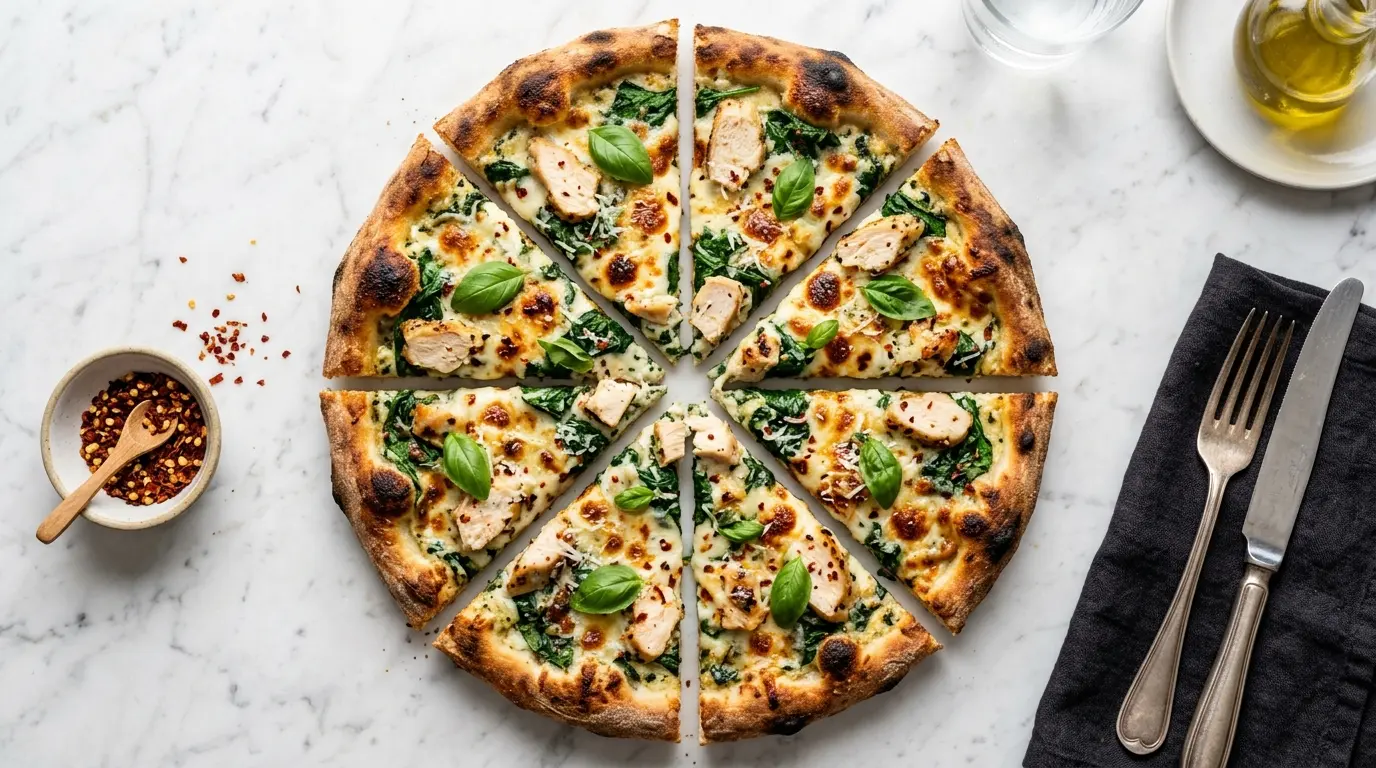
If you’ve been searching for a pizza that feels a little more elevated than your standard pepperoni, this Chicken Florentine Pizza Recipe is exactly what you need.
It brings together tender, seasoned chicken, fresh wilted spinach, and a rich, garlicky white cream sauce on a perfectly crisp crust — all finished with bubbling mozzarella and a shower of Parmesan.
This is white pizza at its finest.
The name “Florentine” comes from the culinary tradition of Florence, Italy, where spinach plays a starring role in the dish. That earthy, slightly sweet spinach paired with a creamy béchamel-style sauce and savory chicken makes every bite feel indulgent without being heavy.
And the best part? It’s surprisingly simple to pull together at home.

Why You’ll Love This Chicken Florentine Pizza Recipe
This pizza delivers a restaurant-quality experience right from your own oven.
The white garlic cream sauce is the secret weapon here — it’s silky, full of flavor, and a welcome change from tomato-based pizzas.
You get creamy ricotta layered beneath the mozzarella, which melts into the sauce and gives the pizza an almost lasagna-like richness.
Fresh spinach wilts perfectly in the oven, adding color, nutrition, and that classic Florentine character.
The chicken is seasoned simply and cooks up tender, making it easy to use rotisserie or leftover chicken if you’re short on time.
It’s a crowd-pleaser that works for a cozy weeknight dinner, a casual Friday gathering, or a date night at home.
- Unique flavor profile: The combination of garlic cream sauce, ricotta, mozzarella, and spinach creates layers of flavor that feel genuinely special.
- Flexible and forgiving: Use store-bought or homemade dough, rotisserie or freshly cooked chicken.
- Impressive but easy: Looks and tastes like something from a wood-fired pizza restaurant.
- Great for leftovers: Cold slices the next day are dangerously good.
- Customizable: Easy to adjust toppings to suit your preferences.
For another comforting chicken and spinach combination, you’ll also love this Spinach Stuffed Chicken Breast.
Ingredients
This Chicken Florentine Pizza uses simple, quality ingredients that all work together to create something truly satisfying.
The ricotta adds creaminess and body to the pizza, while the fresh garlic in the sauce makes the whole kitchen smell incredible.
- Pizza dough: 1 lb (450g) — store-bought or homemade
- Olive oil: 2 tablespoons (30ml), divided
- Garlic: 3 cloves, minced
- Unsalted butter: 2 tablespoons (28g)
- All-purpose flour: 2 tablespoons (16g)
- Whole milk: 1 cup (240ml), warmed
- Salt: 1/2 teaspoon, plus more to taste
- Black pepper: 1/4 teaspoon, plus more to taste
- Nutmeg: a small pinch (optional, but traditional in béchamel)
- Boneless, skinless chicken breast: 2 medium (about 1 lb / 450g total), cooked and sliced or shredded
- Italian seasoning: 1 teaspoon
- Fresh spinach: 3 cups (90g), loosely packed
- Ricotta cheese: 1/2 cup (125g)
- Shredded mozzarella cheese: 1 1/2 cups (170g)
- Grated Parmesan cheese: 1/4 cup (25g)
- Red pepper flakes: 1/4 teaspoon (optional, for a little heat)
- Fresh basil: a small handful, for garnish
- Cornmeal: 1 tablespoon (for dusting the pan)
You might also enjoy making a Pizza Sauce from scratch for your next pizza night.
Kitchen Equipment Needed
Having the right tools on hand makes the whole process smoother, especially when working with pizza dough.
A pizza stone or heavy baking sheet is key for getting that crisp, bakery-style crust at home.
- Pizza stone or large heavy baking sheet
- Rolling pin
- Large skillet (for making the cream sauce and cooking the chicken)
- Medium saucepan (for the béchamel)
- Whisk
- Cutting board and sharp knife
- Box grater (for freshly grating Parmesan)
- Measuring cups and spoons
- Pastry brush (for brushing the crust edges with olive oil)
- Oven mitts
Read Also: Easy Pizza Dough Recipe
Recommended Products for This Recipe
These are products that genuinely make a difference in the quality of your finished Chicken Florentine Pizza.
1. Pizza Stone
A quality pizza stone absorbs and distributes heat evenly, giving your crust that crispy, slightly charred bottom that makes homemade pizza taste like it came from a real pizza oven. It works beautifully for this recipe because the white cream sauce can make a softer dough harder to get crispy on a regular pan. The stone solves that entirely.
2. Fresh Whole-Milk Ricotta
Whole-milk ricotta creates a dramatically creamier, richer result than low-fat versions. When it’s dotted over the pizza and melts into the béchamel, you get an almost cloud-like, silky texture beneath the mozzarella. Look for a brand with just a few ingredients on the label for the best flavor.
3. Parmigiano Reggiano Wedge
Pre-grated Parmesan from a can simply cannot compete with a freshly grated wedge of real Parmigiano Reggiano. It melts better, tastes nuttier, and adds a depth of flavor that elevates this pizza from good to genuinely memorable. Grating it yourself takes an extra 60 seconds and is absolutely worth it.
4. Instant-Read Thermometer
Perfectly cooked chicken is essential here. An instant-read thermometer takes the guesswork out of knowing when your chicken breast has reached the safe 165°F (74°C) internal temperature, ensuring it stays juicy rather than dry.
This pizza is a fantastic companion to a warm bowl of Chicken Florentine Soup for a full Florentine-themed dinner spread.

Step-by-Step Instructions
1. Prepare Your Oven and Pan
- Place your pizza stone or heavy baking sheet on the middle rack of the oven.
- Preheat the oven to 450°F (230°C). Allow at least 30 minutes for the stone to fully heat through — this is critical for a crispy crust.
- While the oven heats, dust your pizza pan or peel lightly with cornmeal. This prevents sticking and adds a little crunch to the bottom of the crust.
2. Cook the Chicken
- Pat your chicken breasts dry with paper towels. Dry chicken browns better and cooks more evenly.
- Season both sides generously with 1 teaspoon Italian seasoning, 1/4 teaspoon salt, and 1/8 teaspoon black pepper.
- Heat 1 tablespoon of olive oil in a large skillet over medium-high heat. When the oil shimmers, add the chicken.
- Cook for 5 to 6 minutes per side, until the exterior is golden and the internal temperature reads 165°F (74°C) on an instant-read thermometer.
- Transfer to a cutting board and let the chicken rest for 5 minutes before slicing thinly or shredding into bite-sized pieces. Resting allows the juices to redistribute so the chicken stays moist.
3. Make the Garlic Cream Sauce (Béchamel)
- In a medium saucepan over medium heat, melt 2 tablespoons of unsalted butter.
- Add the minced garlic and cook, stirring constantly, for about 60 seconds — just until fragrant. Don’t let the garlic brown, as it will turn bitter.
- Sprinkle in 2 tablespoons of all-purpose flour and whisk vigorously for 1 to 2 minutes. This cooks out the raw flour taste and forms a roux, which is the base of your creamy sauce.
- Gradually pour in 1 cup of warmed whole milk, whisking constantly to prevent lumps. Adding warm milk rather than cold helps the sauce come together smoothly and quickly.
- Continue whisking and cooking over medium heat for 3 to 4 minutes until the sauce thickens enough to coat the back of a spoon.
- Season with 1/4 teaspoon salt, 1/8 teaspoon black pepper, and a small pinch of nutmeg if using. The nutmeg is subtle but adds a warmth that makes the sauce taste distinctly Italian.
- Remove from heat and set aside.
4. Wilt the Spinach
- In the same large skillet used for the chicken (no need to clean it), add the remaining 1 tablespoon of olive oil over medium heat.
- Add the 3 cups of fresh spinach and a pinch of salt. Toss the spinach with tongs and cook for just 1 to 2 minutes, until it has wilted down significantly.
- Remove the spinach from the pan and press it gently between a few paper towels to remove excess moisture. This step is important — watery spinach will make the pizza soggy.
- Set the wilted spinach aside.
5. Shape the Pizza Dough
- On a lightly floured surface, let your pizza dough sit at room temperature for 10 to 15 minutes if it was refrigerated. Cold dough is stiff and difficult to stretch.
- Using a rolling pin or your hands, roll or stretch the dough into a roughly 12-inch (30cm) circle or oval, about 1/4 inch (6mm) thick.
- If the dough keeps springing back, let it rest for 5 more minutes and try again. The gluten just needs to relax.
- Transfer the shaped dough to your cornmeal-dusted pan or peel.
6. Assemble the Pizza
- Spread the garlic cream sauce evenly over the dough, leaving about a 1-inch (2.5cm) border around the edge for the crust.
- Drop spoonfuls of ricotta cheese evenly across the sauced dough. Use about 1/2 cup total, distributed in roughly 8 to 10 small mounds. These will melt and spread during baking.
- Scatter 1 cup of the shredded mozzarella cheese evenly over the surface.
- Distribute the wilted spinach evenly across the pizza.
- Arrange the sliced or shredded cooked chicken over the spinach layer.
- Top with the remaining 1/2 cup of shredded mozzarella and all of the grated Parmesan.
- Sprinkle with red pepper flakes if using.
- Brush the exposed crust edges lightly with olive oil. This gives the crust a beautiful golden color as it bakes.
7. Bake the Pizza
- Carefully slide the pizza onto the preheated stone or place the baking sheet in the oven.
- Bake at 450°F (230°C) for 12 to 15 minutes, until the crust is deep golden at the edges, the cheese is fully melted, and you can see light golden-brown spots on top of the cheese.
- If your oven has a broiler setting, you can switch it on for the final 1 to 2 minutes for extra cheese browning. Watch it closely so it doesn’t burn.
8. Garnish and Serve
- Remove the pizza from the oven and allow it to cool for 3 to 4 minutes before slicing. Cutting too early causes the cheese to slide off.
- Scatter fresh basil leaves over the top just before serving. The heat from the pizza will release the basil’s aroma.
- Slice into 8 pieces and serve immediately.
Read Also: Chicken Florentine Recipe
Tips for Success
A few small techniques make a big difference in getting the very best result from this recipe.
Mastering these will have you making restaurant-quality pizza at home every single time.
- Use room-temperature dough. Cold dough from the fridge is tight and will snap back when you try to stretch it. Give it at least 15 minutes on the counter before shaping.
- Dry the spinach thoroughly. Excess moisture from the spinach is the number one cause of a soggy pizza. Press it well between paper towels after wilting.
- Don’t overload the toppings. It’s tempting, but too many toppings will make the center of the pizza wet and the crust floppy. Stick to the amounts listed.
- Preheat your stone or pan. A cold surface going into a hot oven is the reason so many homemade pizzas have a pale, soft bottom. Give your stone at least 30 minutes to heat fully.
- Use freshly grated Parmesan. Pre-shredded cheeses contain anti-caking agents that prevent them from melting as smoothly. Grating your own takes seconds and makes a real difference.
- Let the pizza rest before slicing. Three to four minutes of resting time gives the cheese a chance to set slightly so it doesn’t all slide off with the first cut.
- Warm the milk before adding it to the roux. Cold milk hits the hot roux and can cause lumps. Warm milk blends in smoothly every time.
Another great chicken dinner worth trying is this Chicken Parmesan Casserole for another Italian-inspired comfort meal.
Serving Suggestions

This Chicken Florentine Pizza is satisfying enough to stand alone, but it pairs beautifully with a few simple sides.
A light, acidic salad balances the richness of the creamy white sauce perfectly.
- Simple arugula salad: Toss fresh arugula with lemon juice, olive oil, salt, and shaved Parmesan. The peppery bite of arugula is a natural partner for this creamy pizza.
- Creamy Coleslaw: A cold, crisp slaw adds great textural contrast alongside a warm, cheesy slice.
- Garlic Bread: Extra bread might seem like overkill, but garlic bread and white pizza is one of life’s true pleasures.
- Roasted Broccoli: A sheet pan of simply seasoned roasted broccoli is quick to throw together while the pizza bakes.
- Broccoli Salad: A cool, hearty broccoli salad with crunchy bacon and a creamy dressing is a wonderful companion.
- A glass of white wine: A crisp Pinot Grigio or Sauvignon Blanc complements the garlic cream sauce beautifully.
Variations to Try
Once you’ve mastered the classic version, there are so many delicious directions you can take this pizza.
Each of these tweaks keeps the Florentine spirit alive while adding a new twist.
- Mushroom Chicken Florentine Pizza: Add 1 cup of sliced sautéed cremini mushrooms along with the spinach. The mushrooms add earthiness and a meaty texture.
- Sun-Dried Tomato Florentine Pizza: Scatter 1/4 cup of chopped oil-packed sun-dried tomatoes over the pizza before baking. Their sweet-tangy intensity pairs beautifully with the creamy sauce.
- Artichoke Florentine Pizza: Add 1/2 cup of canned or jarred artichoke hearts (drained and roughly chopped) along with the spinach for a more traditional Florentine flavor.
- Pesto Florentine Pizza: Swirl 2 tablespoons of basil pesto into the white sauce before spreading it. It adds an herbaceous, nutty layer.
- Spicy Florentine Pizza: Double the red pepper flakes and add a drizzle of hot honey right after the pizza comes out of the oven.
- No-Yeast Dough Version: Use the No-Yeast Pizza Dough for a quicker, same-day crust that skips the proofing time.
- Whole Wheat Crust: Swap the standard dough for whole wheat pizza dough for extra fiber and a slightly nuttier flavor.
Read Also: Hummus Pizza Recipe
Storage and Reheating
Leftover Chicken Florentine Pizza stores and reheats really well, making it a great option for meal prep or next-day lunches.
The crust may soften slightly in the fridge, but the right reheating method will bring it right back.
- Refrigerator: Store leftover slices in an airtight container or wrapped tightly in plastic wrap for up to 3 days.
- Freezer: Freeze individual slices on a baking sheet until solid, then transfer to a zip-lock bag. Freeze for up to 2 months.
- Oven (best method): Reheat slices on a baking sheet in a 375°F (190°C) oven for 8 to 10 minutes. This restores the crust’s crispiness beautifully.
- Skillet: Heat a slice in a dry skillet over medium-low heat, covered with a lid, for 4 to 5 minutes. The bottom crisps up while the cheese melts from the trapped steam.
- Microwave (quickest): Microwave on a microwave-safe plate for 60 to 90 seconds. The crust will be soft, but it works in a pinch.
- Avoid reheating from frozen in the microwave: It makes the crust rubbery. Let frozen slices thaw in the fridge overnight before reheating in the oven.
You might also enjoy: Baked Chicken with Alfredo Sauce
Nutritional Facts
The following estimates are based on one slice of an 8-slice pizza, using the ingredients listed in this recipe. Actual values may vary based on specific brands and portion sizes.
| Nutrient | Per Slice (approx.) |
|---|---|
| Calories | ~320 kcal |
| Total Fat | ~14g |
| Saturated Fat | ~6g |
| Protein | ~24g |
| Total Carbohydrates | ~26g |
| Dietary Fiber | ~1.5g |
| Sugar | ~2g |
| Sodium | ~490mg |
| Calcium | ~220mg |
| Iron | ~2mg |
Note: This is a home-cooked meal and these values are estimates. For precise tracking, enter your specific ingredients into a nutrition calculator.
Another favorite: Italian Chicken Skillet
Health Benefits of Key Ingredients
This Chicken Florentine Pizza packs some real nutritional value underneath all that melted cheese.
Each key ingredient brings something beneficial to the table.
- Fresh Spinach: Spinach is one of the most nutrient-dense leafy greens available. It’s rich in iron, vitamin K, folate, and powerful antioxidants. Even wilted down, it retains a significant amount of its nutritional value.
- Chicken Breast: Lean chicken breast is an excellent source of high-quality protein with relatively little fat. Protein is essential for muscle repair, immune function, and keeping you feeling full.
- Garlic: Garlic contains allicin, a compound with well-documented antimicrobial and anti-inflammatory properties. It also adds extraordinary flavor without extra calories.
- Ricotta Cheese: Ricotta provides a good dose of calcium and protein. Compared to many other cheeses, it tends to be lower in sodium, making it a smart creamy addition.
- Olive Oil: Extra-virgin olive oil is rich in heart-healthy monounsaturated fats and polyphenols that have anti-inflammatory effects.
- Mozzarella: Mozzarella offers calcium, phosphorus, and protein. Choosing part-skim mozzarella reduces the saturated fat content slightly without sacrificing much in terms of melting quality.
Read Also: Chicken Florentine Soup Recipe
Frequently Asked Questions
1. Can I use store-bought pizza dough for this Chicken Florentine Pizza?
Absolutely. Store-bought refrigerated pizza dough works wonderfully in this recipe and significantly cuts down on prep time. Look for a dough that lists simple ingredients — flour, water, yeast, salt, and oil. Let it come to room temperature before shaping for the best results.
2. Can I use frozen spinach instead of fresh?
Yes, frozen chopped spinach works well. Thaw it completely, then squeeze out as much moisture as possible using a clean kitchen towel or several paper towels. Excess water from frozen spinach will make the pizza soggy if not properly drained, so be thorough here.
3. What is the best way to cook the chicken for this pizza?
The easiest approach is to use a rotisserie chicken — just shred it and season it with a little Italian seasoning. Freshly cooked chicken breast as described in the instructions works perfectly too. Either way, make sure the chicken is cooked through and cut into small, even pieces so it heats uniformly on the pizza.
4. Can I make this pizza ahead of time?
You can prepare the components ahead of time. Make the béchamel sauce, cook the chicken, and wilt the spinach up to 24 hours in advance. Store each separately in the fridge, then assemble and bake when ready. Assembled, unbaked pizza is best cooked fresh.
5. Why does my homemade pizza always have a soggy center?
A soggy center is usually caused by one or more of three things: too much sauce, too many wet toppings, or a crust that wasn’t baked on a properly preheated surface. For this recipe, make sure the spinach is well-pressed to remove moisture, don’t overspread the sauce, and always preheat your pizza stone or baking sheet before sliding the pizza in.
This Classic Chicken Parmesan Recipe is another Italian classic that’s well worth having in your regular rotation.

Chicken Florentine Pizza

Equipment
- Pizza stone or large heavy baking sheet
- Rolling Pin
- Large skillet - For making the cream sauce and cooking the chicken
- Medium saucepan - For the béchamel
- Whisk
- Cutting board
- Sharp knife
- Box grater - For freshly grating Parmesan
- Measuring cups
- Measuring spoons
- Pastry brush - For brushing crust edges with olive oil
- Oven mitts
- Instant-read thermometer - (optional) For perfectly cooked chicken
Ingredients
- 1 lb pizza dough - 450g, store-bought or homemade
- 2 tablespoons olive oil - 30ml, divided
- 3 cloves garlic - minced
- 2 tablespoons unsalted butter - 28g
- 2 tablespoons all-purpose flour - 16g
- 1 cup whole milk - 240ml, warmed
- 1/2 teaspoon salt - plus more to taste
- 1/4 teaspoon black pepper - plus more to taste
- nutmeg - a small pinch (optional but traditional in béchamel)
- 2 medium boneless skinless chicken breasts - about 1 lb / 450g total, cooked and sliced or shredded
- 1 teaspoon Italian seasoning
- 3 cups fresh spinach - 90g, loosely packed
- 1/2 cup ricotta cheese - 125g
- 1 1/2 cups shredded mozzarella cheese - 170g
- 1/4 cup grated Parmesan cheese - 25g, preferably freshly grated
- 1/4 teaspoon red pepper flakes - optional, for a little heat
- fresh basil - a small handful, for garnish
- 1 tablespoon cornmeal - for dusting the pan
Instructions
- Preheat oven to 450°F (230°C) with pizza stone or heavy baking sheet on middle rack. Dust pizza pan with cornmeal.
- Season chicken breasts with Italian seasoning, salt, and pepper. Cook in skillet with olive oil over medium-high heat until golden and internal temperature reaches 165°F (74°C). Rest 5 minutes then slice or shred.
- Melt butter in saucepan over medium heat. Add garlic and cook 60 seconds until fragrant. Whisk in flour and cook 1-2 minutes. Gradually whisk in warm milk until smooth. Cook 3-4 minutes until thickened. Season with salt, pepper, and nutmeg. Remove from heat.
- In same skillet, heat remaining olive oil. Add spinach and a pinch of salt, cooking 1-2 minutes until wilted. Press between paper towels to remove excess moisture.
- On floured surface, stretch or roll dough into 12-inch circle. Transfer to cornmeal-dusted pan.
- Spread cream sauce over dough leaving 1-inch border. Dot with ricotta. Sprinkle with 1 cup mozzarella. Distribute spinach and chicken evenly. Top with remaining mozzarella and Parmesan. Sprinkle with red pepper flakes and brush crust with olive oil.
- Bake 12-15 minutes until crust is golden and cheese is bubbly with brown spots. Broil 1-2 minutes for extra browning if desired.
- Cool 3-4 minutes before slicing. Garnish with fresh basil and serve immediately.
Notes
- Dough temperature: Let refrigerated dough sit at room temperature for 10-15 minutes before shaping to prevent spring-back.
- Spinach moisture: Press wilted spinach thoroughly between paper towels — excess moisture is the number one cause of a soggy pizza.
- Don’t overload: Stick to the listed topping amounts to avoid a wet, floppy center.
- Preheat is key: Give your pizza stone or baking sheet at least 30 minutes to heat fully for a crisp bottom crust.
- Freshly grated Parmesan: Pre-shredded cheeses contain anti-caking agents that prevent smooth melting — grate your own for best results.
- Rest before slicing: Let the pizza rest 3-4 minutes after baking so the cheese sets and doesn’t slide off.
- Storage: Refrigerate leftovers in an airtight container for up to 3 days. Freeze individual slices for up to 2 months.
- Reheat: Oven reheating at 375°F for 8-10 minutes gives the best crispy crust. A dry skillet over medium-low heat also works well.
- Make ahead: Prepare the cream sauce, cook the chicken, and wilt the spinach up to 24 hours in advance. Store each separately in the fridge.
- Variations: Try adding sautéed mushrooms, sun-dried tomatoes, or artichoke hearts for different flavor profiles.
Final Thoughts
This Chicken Florentine Pizza Recipe is the kind of dish that earns a permanent spot in your weekly dinner lineup.
It has all the comfort of your favorite pizza night combined with flavors that feel genuinely special.
The garlic cream sauce, the creamy ricotta pockets, the wilted spinach, the tender chicken — it all comes together on that golden crust in a way that feels both effortless and impressive.
Give it a try this week, and don’t be surprised when your household declares it a new favorite.
If you make it, drop a comment below — I’d love to hear how it turned out. And if you’ve added your own twist, please share it. Happy cooking!
Recommended:
- Easy Pizza Dough Recipe
- No-Yeast Pizza Dough Recipe
- Chicken Florentine Recipe
- Pizza Sauce Recipe
- Stuffed Chicken Marsala Recipe
- Italian Wedding Soup Recipe
- Spaghetti alla Carbonara Recipe
- Creamy Tuscan White Bean Skillet Recipe
- Pesto Tortellini Bake Recipe
- Baked Ziti Recipe