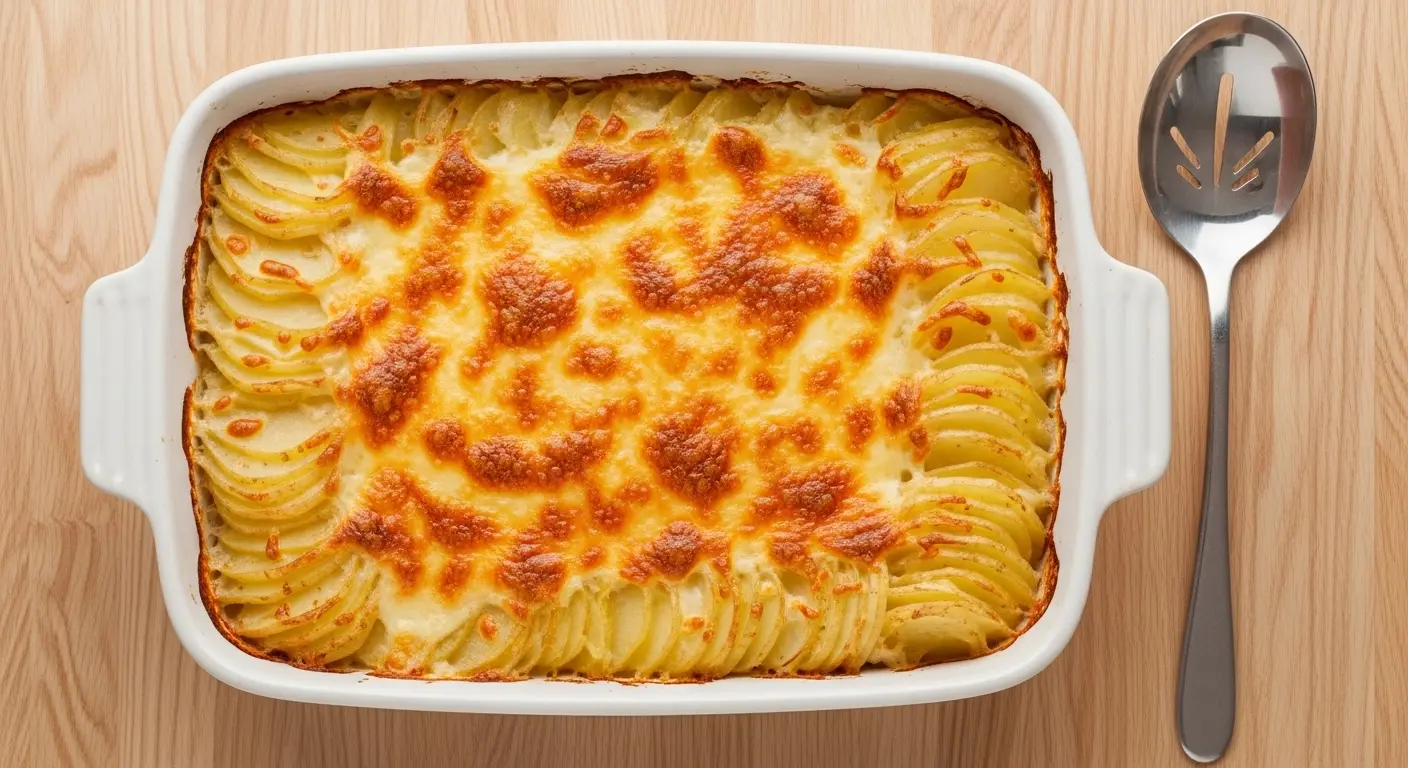
If you’ve been searching for the perfect au gratin potatoes recipe, you’ve found it. This is the dish that turns a simple weeknight dinner into something memorable, and makes holiday tables look like they belong in a food magazine. Layers of thinly sliced potatoes, a velvety cream sauce, and bubbling, golden cheese on top. It’s rich, it’s comforting, and it’s the kind of side dish that gets people coming back for seconds before they’ve even finished their first helping.
What makes this version stand out is the combination of Gruyere and sharp cheddar. Gruyere melts beautifully and brings a slightly nutty depth to the sauce, while cheddar adds that bold, familiar cheesiness everyone loves. Together, they create a flavor that’s far more complex than a single-cheese version. The addition of fresh garlic and a touch of thyme rounds everything out without overpowering the natural richness of the cream.
This isn’t a quick weeknight shortcut. It takes about an hour and a half from start to finish, but almost all of that time is hands-off baking. Once it goes into the oven, you’re free to focus on the rest of your meal. And the result? Perfectly tender potatoes, a creamy sauce that slowly oozes with every spoonful, and a golden, slightly crisp cheese crust on top.
If you love hearty, comforting potato sides, you’ll also want to check out this Cheesy Potatoes Recipe for another crowd-pleasing option.

Why You’ll Love This Au Gratin Potatoes Recipe
This dish is the definition of comfort food done elegantly. It looks impressive on the table, but it’s built on pantry staples and straightforward technique.
It’s deeply satisfying to make and even more satisfying to eat. The layering process is almost meditative, and the smell that fills your kitchen as it bakes is incredible.
- Rich, layered flavor: The combination of heavy cream, Gruyere, and sharp cheddar creates a sauce that tastes complex without being complicated.
- Perfect texture: Thinly sliced Russet potatoes absorb the cream as they cook, becoming impossibly tender while the sauce thickens into something luxurious.
- A true crowd-pleaser: Kids love it. Adults love it. It disappears at every gathering, from casual family dinners to holiday feasts.
- Make-ahead friendly: You can assemble this dish a day ahead and bake it when needed, making it ideal for entertaining.
- Versatile pairing: It goes well with just about any protein, from roast chicken and grilled steak to glazed ham and pork roast.
- Beginner-friendly: The steps are simple enough for a first-time cook, yet the results taste like something a professional made.
- No boxed mix needed: Once you make au gratin potatoes from scratch, you’ll never want the convenience version again.
Another excellent option for your potato rotation is this Funeral Potatoes Recipe, which is equally comforting and beloved at gatherings.
Ingredients
Making au gratin potatoes at home requires just a handful of quality ingredients. The key is using fresh cheese you grate yourself, since pre-shredded cheese contains anti-caking agents that can prevent smooth melting.
- 2.5 lbs (1.13 kg) Russet potatoes, peeled and thinly sliced (about 1/8 inch / 3mm thick)
- 1 medium yellow onion, finely diced
- 4 cloves garlic, minced
- 3 tablespoons (42g) unsalted butter
- 3 tablespoons (24g) all-purpose flour
- 1 cup (240ml) whole milk
- 1 cup (240ml) heavy cream
- 1.5 teaspoons (9g) kosher salt, divided
- 1/2 teaspoon (1g) freshly ground black pepper
- 1/4 teaspoon (0.5g) dried thyme (or 1/2 teaspoon fresh thyme leaves)
- 1/4 teaspoon (0.5g) garlic powder
- 1.5 cups (170g) Gruyere cheese, freshly grated, divided
- 1 cup (113g) sharp cheddar cheese, freshly grated, divided
- 2 tablespoons (28g) unsalted butter, softened (for greasing the dish)
- Fresh parsley, chopped (optional, for garnish)
This dish pairs beautifully alongside the flavors in a Loaded Potato Soup Recipe if you’re planning a full potato-themed menu for the week.
Kitchen Equipment Needed
You don’t need any specialized gadgets for this recipe, though a mandoline slicer makes the potato slicing much faster and ensures perfectly even cuts that cook uniformly.
- 9×13 inch (23×33 cm) baking dish or 2-quart casserole dish
- Mandoline slicer (highly recommended for even potato slices)
- Large saucepan or heavy-bottomed pot
- Whisk
- Sharp chef’s knife and cutting board
- Box grater or food processor with a grating attachment
- Wooden spoon or silicone spatula
- Measuring cups and spoons
- Aluminum foil
Read Also: Twice Baked Potato Recipe
Recommended Products for This Recipe
These are tools and ingredients that genuinely make a difference in the quality of your finished dish. Each one solves a common challenge or elevates the results.
1. Le Creuset Enameled Baking Dish
A high-quality baking dish distributes heat evenly, preventing hot spots that can cause uneven cooking. The smooth interior surface makes cleanup much easier after baking, even with bubbled-on cheese around the edges. This is a piece you’ll reach for constantly in the kitchen.
2. OXO Good Grips Mandoline Slicer
Thinly and uniformly sliced potatoes are the single most important factor in getting a great au gratin. This mandoline adjusts for different thicknesses and includes a hand guard to keep your fingers safe. It cuts the prep time dramatically compared to slicing by hand.
3. Imported Gruyere Cheese Block
Pre-shredded cheese contains anti-caking agents that prevent clean melting. Starting with a quality block of imported Gruyere and grating it yourself makes a significant difference in how smooth and creamy your sauce turns out. The flavor is also noticeably more complex.
4. All-Clad Stainless Steel Saucepan
A heavy-bottomed saucepan is essential for making a smooth, lump-free roux. This pan distributes heat evenly at the base, which prevents the flour from scorching before it has a chance to cook properly. The results are a consistently silky cheese sauce every time.
You might also enjoy: Scalloped Potatoes Recipe

Step-by-Step Instructions
1. Preheat the Oven and Prepare the Baking Dish
- Preheat your oven to 350°F (175°C). Give it at least 15 minutes to fully reach temperature before the dish goes in.
- Use the 2 tablespoons of softened butter to thoroughly grease the bottom and all sides of your 9×13 inch baking dish. Make sure you coat every corner, as the cream sauce will bubble up the sides as it bakes.
- Set the greased dish aside while you prepare the remaining components.
2. Slice the Potatoes
- Peel the Russet potatoes and rinse them under cold water.
- Using a mandoline slicer set to 1/8 inch (3mm) thickness, or a sharp knife, slice the potatoes into even, thin rounds. Consistent thickness is crucial here: thicker slices won’t cook through properly, while thinner slices may disintegrate.
- As you slice, place the potato rounds into a large bowl of cold water. This removes excess surface starch, prevents browning, and helps the potatoes hold their shape better when layered.
- Once all potatoes are sliced, drain them and pat them thoroughly dry with clean kitchen towels or paper towels. Removing excess moisture is important so the sauce doesn’t become watery.
- Season the dried potato slices evenly with 1 teaspoon of the kosher salt and set aside.
3. Make the Cheese Sauce
- In a large saucepan over medium heat, melt the 3 tablespoons of unsalted butter.
- Add the finely diced onion and cook, stirring often, for 5 to 7 minutes until the onion is soft and translucent. Don’t rush this step; properly softened onion blends seamlessly into the sauce.
- Add the minced garlic and cook for an additional 1 minute, stirring constantly. The garlic will become very fragrant. Watch carefully so it doesn’t burn.
- Sprinkle the flour over the butter-onion-garlic mixture and whisk continuously for 1 to 2 minutes to cook out the raw flour taste. The mixture will look thick and slightly paste-like. This step is called making a roux and it’s what gives your sauce its body.
- Reduce the heat to medium-low and slowly pour in the whole milk, whisking constantly as you add it to prevent lumps from forming.
- Slowly pour in the heavy cream while continuing to whisk.
- Add the remaining 1/2 teaspoon of salt, the black pepper, dried thyme, and garlic powder. Stir to combine.
- Bring the mixture to a gentle simmer over medium heat, stirring frequently. Cook for 3 to 4 minutes, or until the sauce has thickened enough to coat the back of a spoon.
- Remove the saucepan from heat. Add 1 cup of the grated Gruyere and 3/4 cup of the sharp cheddar to the hot sauce. Stir until the cheese is completely melted and the sauce is smooth and glossy. Taste and adjust seasoning if needed.
4. Layer the Potatoes and Sauce
- Arrange half of the dried, seasoned potato slices in an even layer in the bottom of the buttered baking dish. Slightly overlap the edges like roof tiles for a nice presentation, and so the layers hold together when served.
- Pour half of the cheese sauce evenly over the first potato layer, spreading it gently with a spoon or spatula to ensure all the potato edges are coated.
- Add the remaining potato slices in another overlapping layer on top.
- Pour the remaining cheese sauce over the second potato layer, again spreading to coat evenly.
5. Add the Cheese Topping and Cover
- Sprinkle the reserved 1/2 cup of Gruyere and 1/4 cup of sharp cheddar evenly over the top of the entire dish.
- Cover the baking dish tightly with aluminum foil. This is important for the first phase of baking: it traps steam and moisture, ensuring the potatoes cook through without the top layer drying out before the interior is tender.
6. Bake Covered, Then Uncovered
- Place the covered dish in the preheated 350°F (175°C) oven.
- Bake covered for 60 minutes. At this point, the potatoes should be tender when pierced with a sharp knife or fork. If there’s still significant resistance, cover again and return to the oven for an additional 10 to 15 minutes.
- Remove the foil and increase the oven temperature to 400°F (200°C).
- Bake uncovered for an additional 20 to 25 minutes, until the cheese topping is deeply golden and bubbling at the edges. The cream sauce should be thick, not watery, when you tilt the dish.
7. Rest and Serve
- Remove the au gratin potatoes from the oven and allow them to rest for at least 10 to 15 minutes before serving. This resting time is critical: it allows the sauce to thicken up further and set, so portions come out neatly rather than running all over the plate.
- Garnish with freshly chopped parsley if desired, then serve directly from the baking dish using a large spoon or spatula.
Read Also: Potato Casserole Recipe
Tips for Success
Following these tips will give you restaurant-quality au gratin potatoes every single time, even if it’s your first attempt.
- Use Russet potatoes: Russets have high starch content and lower moisture than Yukon Golds, which means they absorb the cream sauce beautifully and help the sauce thicken naturally as it bakes.
- Slice evenly: Inconsistent potato thickness is the number one cause of undercooked au gratin potatoes. A mandoline ensures every slice is exactly the same, which means every piece cooks at the same rate.
- Grate your own cheese: Always grate cheese from a block right before using it. Pre-shredded bags contain cellulose or potato starch to prevent clumping, both of which can make your sauce grainy and less smooth.
- Dry the potatoes thoroughly: After soaking the slices in cold water, pat them completely dry. Wet potatoes release water into the sauce as they bake, which can make the finished dish thin and watery.
- Don’t skip the rest: Allowing the dish to rest after baking for a full 10 to 15 minutes makes an enormous difference in the final texture and serving experience.
- Cover tightly with foil: A snug foil cover during the first hour of baking creates a steaming environment that cooks the potatoes through without drying them out prematurely.
- Taste and season the sauce: Before pouring the sauce over the potatoes, taste it and adjust the salt. Potatoes need more seasoning than you’d expect, and the sauce is your main opportunity to add it.
Another favorite: Hashbrown Casserole Recipe
Serving Suggestions
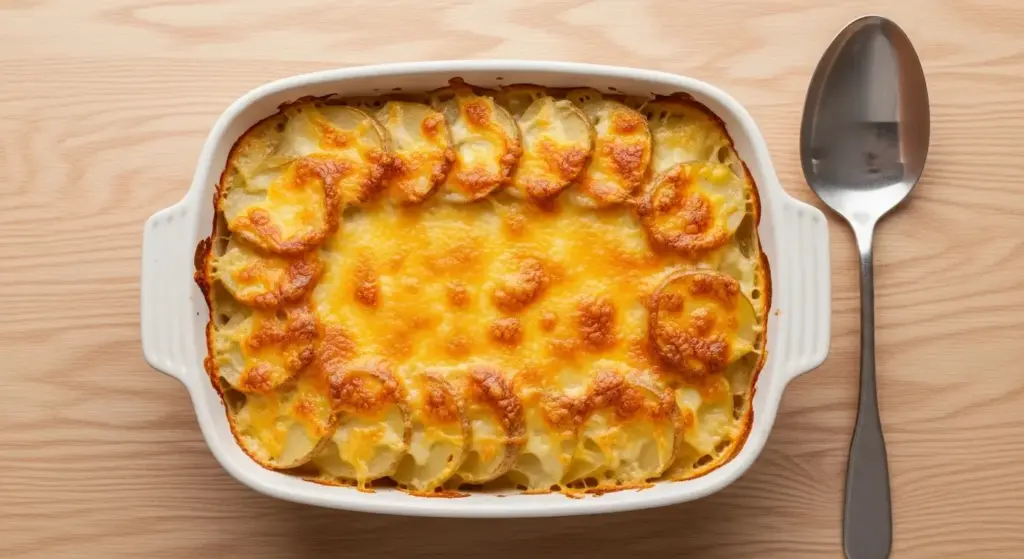
Au gratin potatoes are a rich, indulgent side dish, so they pair best with proteins that can stand up to their bold flavor without competing with it.
They’re a natural fit for the holidays, but honestly, they elevate any dinner they show up at.
- Roast chicken or turkey: The savory cream sauce complements the mild flavor of roasted poultry perfectly.
- Prime rib or beef tenderloin: The richness of the potatoes matches the indulgence of a special-occasion roast beautifully.
- Glazed ham: The slight sweetness of a honey or brown sugar-glazed ham is a classic pairing with the savory, cheesy potatoes.
- Grilled or pan-seared steak: Serve alongside a simple steak for a steakhouse-quality meal at home.
- Pork roast or pork tenderloin: The creaminess of the dish balances the lean, slightly earthy flavor of pork.
- A crisp green salad: A light, acidic salad with a vinaigrette helps cut through the richness of the dish and rounds out the meal.
- Roasted Broccoli: The caramelized edges and slightly bitter flavor of roasted broccoli make it a fantastic contrast to the creamy potatoes.
Variations to Try
Once you’ve mastered the classic version, there are plenty of ways to customize au gratin potatoes to suit different tastes or occasions.
- Smoked Gouda and bacon: Replace the Gruyere with smoked Gouda and scatter cooked, crumbled bacon between the potato layers for a smoky, hearty twist.
- Caramelized onion au gratin: Cook the onions low and slow for 30 to 40 minutes until deeply caramelized before building the sauce. The sweetness is spectacular against the rich cream.
- Herb-forward version: Add fresh rosemary, fresh thyme, and a pinch of nutmeg to the sauce for a more aromatic, French-leaning flavor profile.
- Spicy version: Stir a pinch of cayenne pepper and a teaspoon of Dijon mustard into the cheese sauce for a little heat and sharpness.
- Lighter version: Substitute half of the heavy cream with chicken or vegetable broth to reduce the richness slightly without losing too much of the flavor.
- Ham and potato au gratin: Layer thin slices of deli or leftover ham between the potato layers for a one-dish meal that needs nothing else alongside it.
- Sweet potato au gratin: Replace half of the Russet potatoes with thinly sliced sweet potatoes for a slightly sweet, vibrant variation that’s beautiful for fall and holiday menus.
Read Also: Breakfast Potatoes Recipe
Storage and Reheating
Au gratin potatoes store beautifully, making leftovers something to genuinely look forward to.
- Refrigerator: Allow the dish to cool completely, then cover it tightly with plastic wrap or transfer portions to an airtight container. Refrigerate for up to 4 days.
- Freezer: Cover the cooled dish tightly with a layer of plastic wrap followed by aluminum foil. Freeze for up to 2 months. Thaw overnight in the refrigerator before reheating.
- Oven reheating (best method): Cover the dish or individual portion with foil and reheat at 325°F (163°C) for 20 to 25 minutes until heated through. Remove the foil for the last 5 minutes to re-crisp the top.
- Microwave reheating: Transfer a portion to a microwave-safe plate, add a small splash of cream or milk, and cover loosely. Reheat on medium power in 90-second intervals, stirring between each, until hot.
- Make-ahead tip: Assemble the entire dish up to 24 hours in advance, cover tightly, and refrigerate unbaked. Add 10 to 15 extra minutes to the covered baking time when cooking straight from the refrigerator.
For a lighter option, try: Air Fryer Baked Potato Recipe
Nutritional Facts
The following nutritional estimates are based on 8 servings from a standard 9×13 inch dish.
| Nutrient | Per Serving (Approx.) |
|---|---|
| Calories | 420 kcal |
| Total Fat | 29g |
| Saturated Fat | 18g |
| Cholesterol | 95mg |
| Sodium | 480mg |
| Total Carbohydrates | 29g |
| Dietary Fiber | 2g |
| Sugars | 3g |
| Protein | 14g |
| Calcium | 310mg |
| Potassium | 580mg |
Note: Nutritional values are estimates and may vary depending on specific brands and portion sizes used.
Read Also: Baked Potato Recipe
Health Benefits of Key Ingredients
While au gratin potatoes are an indulgent dish, several of the core ingredients do carry genuine nutritional value.
It’s a comfort food, yes, but it’s made with real, whole ingredients that offer more than just great flavor.
- Potatoes: Russet potatoes are a good source of potassium, vitamin C, and vitamin B6. They provide complex carbohydrates for sustained energy and contain fiber (especially in the skin). They’re also naturally fat-free and cholesterol-free on their own.
- Gruyere cheese: Gruyere is a rich source of calcium, which supports bone density and muscle function. It also provides protein and phosphorus, both of which are important for cellular health.
- Sharp cheddar cheese: Cheddar is packed with calcium and protein, and it provides vitamin K2, which plays a role in bone metabolism.
- Garlic: Fresh garlic contains allicin, a compound studied for its immune-supportive and anti-inflammatory properties. It also adds meaningful flavor without adding calories.
- Whole milk and heavy cream: These dairy products contribute calcium, vitamin D, and fat-soluble vitamins like A and E. The fat in cream also helps the body absorb these fat-soluble nutrients effectively.
- Thyme: This herb contains antioxidants including thymol and carvacrol, both of which have been researched for their antimicrobial and anti-inflammatory properties.
Read Also: Smashed Potatoes Recipe
Frequently Asked Questions
1. What is the difference between au gratin potatoes and scalloped potatoes?
The main difference is cheese. Both dishes feature thinly sliced potatoes baked in a creamy sauce, but scalloped potatoes traditionally use a flour-thickened milk or cream sauce without cheese. Au gratin potatoes always include cheese, both mixed into the sauce and melted over the top. The word “gratin” itself is a French culinary term referring to any dish with a browned, crispy topping of cheese or breadcrumbs.
2. Which potatoes work best for au gratin?
Russet potatoes are the most commonly recommended choice for au gratin potatoes. Their high starch content helps thicken the sauce naturally as they bake, and they become beautifully tender without falling apart. Yukon Gold potatoes are a popular alternative with a slightly creamier flavor and a buttery color. Avoid waxy potatoes like red potatoes, as they don’t absorb the sauce as readily.
3. Why are my au gratin potatoes watery?
Watery au gratin potatoes are almost always caused by one of two things. Either the potatoes weren’t dried thoroughly after soaking (raw potato moisture releases into the sauce during baking), or the sauce wasn’t thick enough before it went into the oven. Make sure to pat the potato slices completely dry and cook the sauce until it’s thick enough to coat the back of a spoon before assembling the dish.
4. Can I make au gratin potatoes ahead of time?
Absolutely. You can assemble the entire dish up to 24 hours in advance, cover it tightly with plastic wrap, and refrigerate until you’re ready to bake. When baking straight from the refrigerator, add about 10 to 15 extra minutes to the covered baking time to account for the cold start. You can also fully bake the dish, let it cool, refrigerate it, and simply reheat it covered in a 325°F (163°C) oven before serving.
5. Can I use a different cheese?
Yes, the cheese in this recipe can be customized to your taste. Sharp cheddar and Gruyere is a classic, crowd-pleasing combination, but fontina, Parmesan, smoked Gouda, or Emmental are all excellent options. The most important rule is to grate the cheese yourself from a block, regardless of which variety you choose. Bags of pre-shredded cheese contain anti-caking agents that prevent smooth melting and can make the sauce grainy.
Read Also: Garlic Mashed Potatoes Recipe

Classic Au Gratin Potatoes

Equipment
- 9×13 inch (23×33 cm) baking dish or 2-quart casserole dish
- Mandoline slicer - Highly recommended for even potato slices
- Large saucepan or heavy-bottomed pot
- Whisk
- Sharp chef's knife
- Cutting board
- Box grater or food processor with a grating attachment
- Wooden spoon or silicone spatula
- Measuring cups and spoons
- Aluminum foil
Ingredients
- 2.5 lbs Russet potatoes - 1.13 kg, peeled and thinly sliced to 1/8 inch (3mm) thick
- 1 medium yellow onion - finely diced
- 4 cloves garlic - minced
- 3 tablespoons unsalted butter - 42g, for the sauce
- 3 tablespoons all-purpose flour - 24g
- 1 cup whole milk - 240ml
- 1 cup heavy cream - 240ml
- 1.5 teaspoons kosher salt - 9g, divided
- 0.5 teaspoon black pepper - 1g, freshly ground
- 0.25 teaspoon dried thyme - 0.5g, or 1/2 teaspoon fresh thyme leaves
- 0.25 teaspoon garlic powder - 0.5g
- 1.5 cups Gruyere cheese - 170g, freshly grated, divided
- 1 cup sharp cheddar cheese - 113g, freshly grated, divided
- 2 tablespoons unsalted butter - 28g, softened, for greasing the dish
- Fresh parsley - chopped, optional for garnish
Instructions
- Preheat the oven to 350°F (175°C). Grease a 9×13 inch baking dish with 2 tablespoons of softened butter.
- Peel and slice the Russet potatoes into 1/8 inch (3mm) thick rounds. Place slices in cold water to remove starch, then drain and pat completely dry. Season with 1 teaspoon of salt.
- Melt 3 tablespoons of butter in a large saucepan. Cook the diced onion for 5-7 minutes until soft. Add garlic and cook for 1 minute until fragrant.
- Add the flour and whisk continuously for 1-2 minutes to make a roux. Slowly pour in the milk and heavy cream while whisking constantly to prevent lumps.
- Add the remaining salt, black pepper, dried thyme, and garlic powder. Simmer gently for 3-4 minutes until the sauce thickens enough to coat the back of a spoon.
- Remove from heat and stir in 1 cup of Gruyere and 3/4 cup of sharp cheddar until melted and smooth.
- Arrange half of the potato slices in the prepared dish. Pour half of the cheese sauce over them. Repeat with remaining potatoes and sauce.
- Sprinkle the reserved 1/2 cup Gruyere and 1/4 cup cheddar over the top. Cover tightly with aluminum foil.
- Bake covered for 60 minutes, until potatoes are tender. Remove the foil, increase temperature to 400°F (200°C), and bake uncovered for 20-25 minutes until golden and bubbling.
- Rest for 10-15 minutes before serving. Garnish with fresh parsley if desired.
Notes
- Russet potatoes: Their high starch content helps thicken the sauce naturally as they bake. Avoid waxy varieties.
- Even slicing: A mandoline ensures every slice is exactly the same thickness for even cooking.
- Grate your own cheese: Pre-shredded bags contain anti-caking agents that prevent smooth melting and can make the sauce grainy.
- Dry the potatoes thoroughly: Wet potatoes release water into the sauce, making the finished dish watery.
- Don’t skip the rest: Letting the dish rest for 10-15 minutes allows the sauce to set for clean portions.
- Make-ahead: Assemble up to 24 hours in advance, refrigerate unbaked, and add 10-15 minutes to the covered baking time.
- Storage: Refrigerate covered for up to 4 days. Freeze for up to 2 months; thaw overnight in the refrigerator before reheating.
- Reheating: Cover with foil and reheat at 325°F (163°C) for 20-25 minutes. Remove foil for the last 5 minutes to re-crisp the top.
- Cheese variations: Fontina, Parmesan, smoked Gouda, or Emmental are all excellent substitutes or additions.
- Flavor additions: Add a pinch of cayenne pepper or Dijon mustard for heat and sharpness, or fresh herbs like rosemary for a more aromatic profile.
Final Thoughts
Au gratin potatoes are one of those recipes that never loses its magic.
Every time this dish comes out of the oven, golden and bubbling, it draws people in from across the room. It’s the kind of recipe that becomes a family tradition without anyone planning it. People just keep requesting it.
Give this au gratin potatoes recipe a try the next time you want a side dish that truly impresses without requiring any professional kitchen skills.
If you make it, leave a comment below letting me know how it turned out, and don’t hesitate to share it with anyone who would love a reliably spectacular potato dish in their recipe collection!
Recommended:
- Twice Baked Potato Recipe
- Roasted Potatoes Recipe
- Potato Salad Recipe
- Ham and Potato Soup Recipe
- Baked Potato Soup Recipe
- Sweet Potato Casserole Recipe
- Creamy Mashed Potatoes Recipe
- Corn Casserole Recipe
- Green Bean Casserole Recipe
- Tater Tot Casserole Recipe