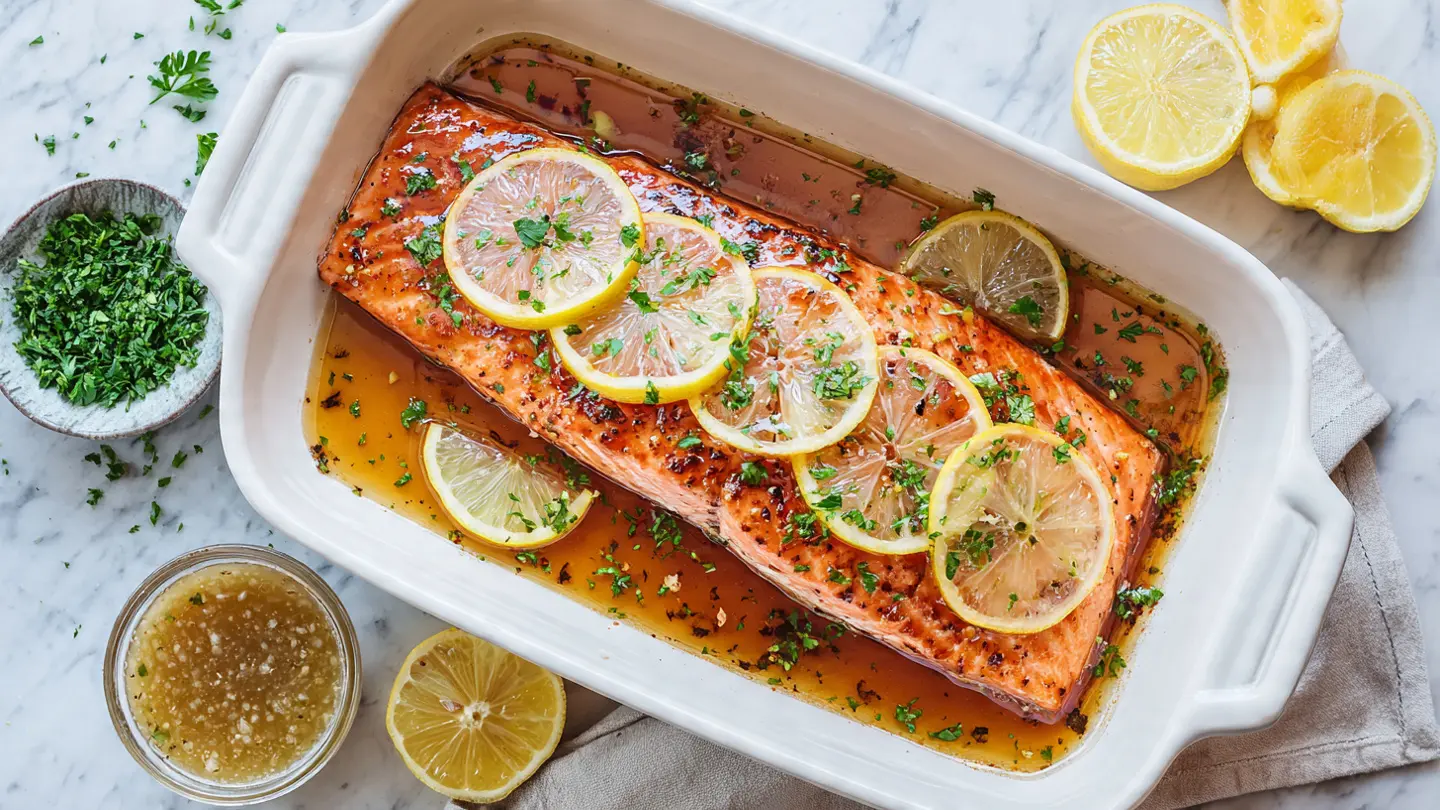
If you’ve been searching for the perfect baked salmon recipe, your search ends right here. This is the one that produces a perfectly flaky, tender, and flavorful fillet every single time — no fancy equipment, no complicated techniques, and no dry, sad salmon.
The secret lies in a simple garlic butter glaze with lemon and Dijon mustard. These three ingredients together do something magical: the butter keeps the fish moist and rich, the lemon brightens everything up, and the Dijon acts as a binder while adding a subtle tangy depth that elevates the whole dish.
This recipe comes together in about 20 minutes from start to finish, making it ideal for both busy weeknights and relaxed weekend dinners.
It works equally well with a full side fillet or individual portions, and the results are impressive enough to serve to guests.
For an equally easy weeknight seafood option, check out this Baked Cod Recipe — simple, light, and just as satisfying.
Why You’ll Love This Baked Salmon Recipe
This recipe earns a permanent spot in your dinner rotation for more reasons than one.
It requires just a handful of pantry staples, yet delivers restaurant-quality flavor every time.
The garlic butter glaze keeps the salmon unbelievably moist, so there’s no risk of that dry, chalky texture that puts so many people off fish.
You only need one baking sheet and one small bowl, which means cleanup is genuinely quick and painless.
- Ready in 20 minutes from prep to plate
- One pan, minimal cleanup for easy weeknight cooking
- Works for all skill levels — if you’ve never cooked fish before, this is the perfect starting point
- Highly versatile — pair it with almost any side dish, grain, or salad
- Naturally gluten-free and low-carb for those following specific dietary guidelines
- Great for meal prep — leftovers reheat well and work beautifully in salads and grain bowls
You might also enjoy: Air Fryer Salmon Recipe
Ingredients
You don’t need a long shopping list for this recipe. Most of these items are already in your kitchen, and the star of the show — the salmon — does most of the heavy lifting on its own.
- 1.5 to 2 lbs (680–900g) salmon fillet, skin-on, pin bones removed
- 3 tablespoons (45g) unsalted butter, melted
- 4 cloves garlic, minced (about 1.5 teaspoons)
- 2 tablespoons fresh lemon juice (from about 1 lemon)
- 1 tablespoon Dijon mustard
- 1 teaspoon garlic powder
- 1/2 teaspoon smoked paprika
- 1/2 teaspoon salt (or to taste)
- 1/4 teaspoon black pepper
- 1 lemon, thinly sliced, for topping
- 2 tablespoons fresh parsley, chopped, for garnish
Read Also: Air Fryer Salmon Bites Recipe
Kitchen Equipment Needed
Nothing specialized required here — just basic kitchen tools that get the job done.
- Rimmed baking sheet — the raised edges keep drips contained
- Aluminum foil — for lining the pan and easy cleanup
- Small mixing bowl — for whisking together the glaze
- Pastry brush or spoon — for applying the glaze to the salmon
- Instant-read thermometer — the most reliable way to check doneness
- Paper towels — for patting the salmon dry before seasoning
- Sharp knife — for slicing lemon
- Cutting board — for prepping garlic and lemon
- Oven mitts — because safety first
This recipe pairs brilliantly with Air Fryer Bacon Wrapped Asparagus as a side dish, making for a complete, impressive meal.
Recommended Products for This Recipe
These are products I genuinely recommend based on quality and performance for getting the best results with this recipe.
1. Wild-Caught Atlantic Salmon Fillet
The quality of your salmon matters more than any other single ingredient here. Wild-caught salmon has a deeper, more complex flavor, firmer texture, and higher omega-3 content than farmed alternatives. It makes a noticeable difference in the final dish.
2. Le Creuset Enameled Cast Iron Baking Dish
This baking dish distributes heat incredibly evenly, which means no hot spots and perfectly cooked salmon from edge to edge. The enameled interior is naturally non-stick and makes cleanup a breeze even after a glazed fish recipe. It’s a lifetime investment that will serve every dish you make.
3. Maille Dijon Originale Mustard
Not all Dijon mustards are created equal. Maille’s original formula has a smooth, balanced tang that blends seamlessly into the glaze without overpowering the salmon. It has been a professional kitchen staple for good reason.
4. Thermapen ONE Instant-Read Thermometer
Overcooked salmon is the number one mistake people make. The Thermapen ONE reads internal temperature in about one second, so you can pull the fish at the perfect moment every time. It’s the most reliable kitchen tool for fish, steak, and chicken alike.
5. Nordic Ware Natural Aluminum Half Sheet Baking Pan
This heavy-gauge aluminum pan heats evenly and doesn’t warp at high oven temperatures. Its natural finish promotes even browning, and the rimmed edges make it safe to maneuver with glazed fish. A must-have for any home cook.
For more delicious salmon ideas, try this Salmon Skillet Recipe for a quick stovetop alternative.
Step-by-Step Instructions
Step 1: Bring the Salmon to Room Temperature
- Remove the salmon from the refrigerator 20 to 30 minutes before baking.
- Letting it sit at room temperature ensures it cooks evenly all the way through, rather than remaining cold in the center while the outside overcooks.
- Do not skip this step — it makes a real difference, especially for thicker fillets.
- While the salmon rests, this is a great time to prep your garlic, slice your lemon, and preheat the oven.
Step 2: Preheat the Oven and Prepare the Baking Sheet
- Preheat your oven to 400°F (200°C).
- Line a rimmed baking sheet with a large piece of aluminum foil, making sure it’s large enough to fold up the sides slightly around the salmon (this creates a moisture barrier).
- Lightly spray or brush the foil with a neutral cooking oil or cooking spray so the salmon doesn’t stick.
- Set aside while you prepare the glaze and the fish.
Step 3: Pat the Salmon Dry
- Place the salmon fillet on the prepared baking sheet, skin-side down.
- Using paper towels, gently pat the surface of the salmon completely dry.
- This is a critical step: excess moisture on the surface of the fish will steam rather than roast, which prevents the glaze from adhering properly and creates a soggy exterior instead of a slightly caramelized crust.
- Run your fingers over the flesh to check for any remaining pin bones and remove them with tweezers or your fingertips if you find any.
Step 4: Make the Garlic Butter Glaze
- In a small bowl, combine the 3 tablespoons of melted unsalted butter, 4 cloves of minced garlic, 2 tablespoons of fresh lemon juice, and 1 tablespoon of Dijon mustard.
- Whisk everything together until fully combined and smooth.
- In a separate small bowl or directly on the salmon, mix together the 1 teaspoon garlic powder, 1/2 teaspoon smoked paprika, 1/2 teaspoon salt, and 1/4 teaspoon black pepper.
- This dry spice mix will be applied to the fish first to create a flavor base before the wet glaze goes on.
Step 5: Season and Glaze the Salmon
- First, sprinkle the dry spice mixture (garlic powder, smoked paprika, salt, and pepper) evenly over the entire surface of the salmon.
- Using a pastry brush or the back of a spoon, generously spread the garlic butter glaze over the top and sides of the fillet, making sure to get full coverage.
- Reserve about one-third of the glaze in a clean small bowl — you will use this to brush on halfway through baking for an extra layer of flavor.
- Lay the thin lemon slices across the top of the salmon, spacing them evenly so they cover most of the surface.
Step 6: Bake the Salmon
- Place the baking sheet on the center rack of your preheated 400°F (200°C) oven.
- Bake for 10 minutes, then remove the pan and brush the reserved glaze over the salmon once more.
- Return to the oven and bake for an additional 3 to 7 minutes, depending on the thickness of your fillet.
- As a general rule, salmon takes approximately 4 to 6 minutes per half-inch (1.25 cm) of thickness.
- Total bake time for a 1-inch (2.5 cm) thick fillet is typically 12 to 15 minutes.
Step 7: Check for Doneness
- The most reliable method is using an instant-read thermometer inserted into the thickest part of the fillet.
- The USDA recommends an internal temperature of 145°F (63°C) for fully cooked salmon.
- For a slightly more tender, medium result, pull the fish at 125°F to 130°F (52°C to 54°C) — it will continue cooking slightly as it rests.
- If you don’t have a thermometer, gently press the flesh with a fork. Fully cooked salmon should flake easily and the flesh should appear opaque throughout, not translucent.
- Avoid overcooking — salmon goes from perfectly done to dry very quickly.
Step 8: Rest and Garnish
- Remove the salmon from the oven and allow it to rest on the baking sheet for 3 to 5 minutes before serving.
- Resting allows the juices to redistribute throughout the fillet, resulting in a moister, more flavorful bite.
- Scatter the 2 tablespoons of fresh chopped parsley over the top just before serving.
- Add a fresh squeeze of lemon juice from a wedge if desired for extra brightness.
- Serve immediately directly from the pan, or carefully transfer to a serving platter.
For a completely different preparation with the same great fish, the Air Fryer Frozen Salmon Recipe is an excellent weeknight backup when you forget to thaw ahead.
Tips for Success
A few simple habits separate good baked salmon from truly great baked salmon.
- Always pat the salmon dry before seasoning. This single step improves glaze adhesion and helps the surface develop color rather than steam.
- Don’t skip resting the fish before and after cooking. Letting it come to room temperature before baking promotes even cooking, and resting after baking keeps it juicy.
- Use a thermometer. Guessing doneness by eye alone is how overcooked salmon happens. A thermometer eliminates the guesswork entirely.
- Go wild-caught when possible. Wild-caught salmon has a firmer texture and richer flavor than farmed, and it holds up better in the oven.
- Apply the glaze in two rounds. Brushing half before baking and half at the midpoint creates a more layered, complex flavor.
- Don’t overcrowd the pan. If you’re making individual fillets, leave at least an inch of space between each piece so heat circulates properly.
- Foil is your friend. Lining the pan with foil not only makes cleanup effortless, but it also reflects heat back up toward the fish, speeding up cooking and keeping moisture in.
You might also enjoy: Old Fashioned Salmon Patties Recipe
Serving Suggestions
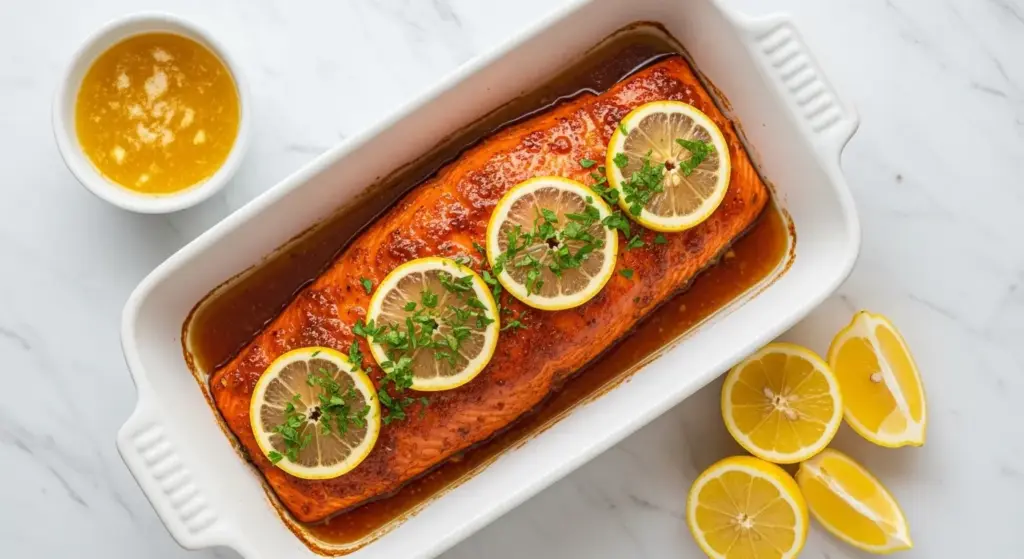
Baked salmon is one of the most versatile main dishes you can make. It pairs beautifully with a wide range of sides, sauces, and salads.
Here are some of the best ways to round out this meal:
- Roasted Potatoes — crispy on the outside and fluffy inside, a natural pairing with the rich buttery salmon
- Garlic Mashed Potatoes — creamy, comforting, and perfect for soaking up extra glaze
- Creamed Spinach — an elegant steakhouse-style side that matches the richness of baked salmon perfectly
- Roasted Broccoli — simple, healthy, and oven-ready alongside your salmon
- Broccoli Salad — crunchy, tangy, and a wonderful contrast to the soft, flaky fish
- Fruit Salad — a light, refreshing counterpoint to the savory glaze
- A drizzle of Hollandaise Sauce turns this into a truly indulgent dinner
- A spoonful of Tzatziki Sauce adds a cool, herby Mediterranean contrast
Read Also: Creamy Mashed Potatoes Recipe
Variations to Try
Once you’ve mastered the base recipe, there are so many delicious directions to take it.
The garlic butter glaze is a fantastic base that works well with a variety of flavor add-ins and swaps.
- Honey Garlic Salmon: Add 1 tablespoon of honey to the glaze for a sweet, caramelized finish that’s absolutely irresistible.
- Teriyaki Salmon: Substitute the butter glaze with a mix of soy sauce, honey, sesame oil, minced ginger, and garlic for a Japanese-inspired version.
- Lemon Herb Salmon: Swap the Dijon for fresh chopped dill, thyme, or rosemary for a lighter, more aromatic take.
- Spicy Sriracha Salmon: Stir 1 to 2 teaspoons of sriracha into the garlic butter glaze for a gentle heat that plays beautifully off the lemon.
- Brown Sugar Glazed Salmon: Replace the Dijon with brown sugar and a pinch of cayenne for a sweet-savory Southern-style glaze.
- Foil Packet Salmon: Wrap the seasoned salmon in foil completely to trap steam, resulting in an ultra-moist texture — great for very thick fillets.
- Cedar Plank Style: Bake the salmon on a soaked cedar plank set on the baking sheet for a subtle smoky flavor reminiscent of outdoor grilling.
For a quick seafood fix that’s even easier, the Air Fryer Salmon Patties Recipe is a brilliant way to use up any leftover baked salmon.
Storage and Reheating
Baked salmon stores and reheats quite well when handled correctly.
- Refrigerator: Store leftover salmon in an airtight container and refrigerate for up to 3 days. Let it cool completely before sealing.
- Freezer: You can freeze cooked salmon, but the texture will change slightly, becoming softer and occasionally more “fishy” in flavor. Freeze in an airtight container for up to 2 months and thaw overnight in the refrigerator before using.
- Reheating in the oven: Place the salmon on a foil-lined baking sheet, cover loosely with foil, and warm at 275°F (135°C) for 10 to 15 minutes until just heated through. This low-and-slow method prevents it from drying out.
- Reheating in the microwave: Use 50% power in 30-second increments to avoid overcooking. Cover the fish with a damp paper towel to trap steam.
- Cold leftovers: Honestly, cold leftover salmon is delicious. Flake it over a salad, stuff it into a wrap, or mix it into a grain bowl for an easy next-day lunch.
This pairs wonderfully with a bowl of Salmon Chowder Recipe if you want to repurpose your leftovers into a completely new meal.
Nutritional Facts
Based on a 6 oz (170g) serving of baked salmon with garlic butter glaze. Values are approximate.
| Nutrient | Amount Per Serving |
|---|---|
| Calories | 340 kcal |
| Protein | 34g |
| Total Fat | 20g |
| Saturated Fat | 6g |
| Carbohydrates | 3g |
| Fiber | 0g |
| Sugar | 1g |
| Sodium | 370mg |
| Omega-3 Fatty Acids | 2,000–3,000mg |
| Cholesterol | 110mg |
| Vitamin D | 570 IU |
| Potassium | 860mg |
Note: Nutritional values will vary depending on the specific type and size of salmon used, as well as any modifications to the glaze.
Read Also: Salmon Croquettes Soul Food Recipe
Health Benefits of Key Ingredients
This baked salmon recipe isn’t just delicious — it’s genuinely one of the healthiest dinners you can put on the table.
Each ingredient plays a role not only in flavor, but in supporting your overall wellbeing.
- Salmon is one of the richest natural sources of omega-3 fatty acids (EPA and DHA), which are strongly linked to heart health, reduced inflammation, improved brain function, and better mood. A single serving provides more omega-3s than most people get in an entire week.
- Garlic contains allicin, a powerful sulfur compound with antimicrobial and anti-inflammatory properties. Regular garlic consumption has been associated with lower blood pressure and improved cholesterol levels.
- Lemon juice is an excellent source of vitamin C, which supports immune function, collagen production, and iron absorption. The acidity also brightens the flavor of the fish without adding calories.
- Dijon mustard is low in calories but packs a punch of antioxidants and anti-inflammatory compounds, particularly from the mustard seed. It also contains selenium, which supports thyroid function.
- Smoked paprika provides a dose of vitamin A and antioxidant carotenoids, including beta-carotene and capsanthin, which support eye health and immune function.
- Butter (in moderation) contains fat-soluble vitamins A, D, E, and K2, which support bone health, vision, and immune function.
For a complete protein-rich seafood dinner, pair this salmon with a cup of Seafood Chowder as a starter.
Frequently Asked Questions
1. What temperature should I bake salmon at?
The most popular and reliable oven temperature for baked salmon is 400°F (200°C). This temperature is high enough to cook the fish through in about 12 to 15 minutes while still allowing the glaze to caramelize without burning. Some recipes call for 425°F (220°C) for a slightly quicker cook with more surface browning, or 375°F (190°C) for a slower, gentler result.
The best approach is to use a thermometer regardless of the temperature you choose, aiming for an internal temperature of 125°F to 145°F (52°C to 63°C) depending on your preferred doneness.
2. How long does it take to bake salmon?
A general rule of thumb is about 4 to 6 minutes per half-inch (1.25 cm) of thickness at 400°F (200°C). A 1-inch thick fillet will typically take 12 to 15 minutes total.
Thinner fillets (like sockeye) may be done in as few as 8 to 10 minutes, while a very thick king salmon fillet could take up to 20 minutes. Always check with a thermometer rather than going purely by time.
3. Should I bake salmon with the skin on or off?
Skin-on is highly recommended for baked salmon. The skin acts as a natural barrier between the fish flesh and the hot pan, which means the meat cooks more gently and evenly without drying out.
The skin also makes it easy to lift the fillet off the pan intact since you can slide a spatula between the skin and the foil. After baking, the skin peels away easily if you don’t want to eat it — though crispy salmon skin is quite delicious.
4. How do I know when salmon is done?
The most reliable indicator is an instant-read thermometer inserted into the thickest part of the fillet. Aim for 145°F (63°C) for fully cooked, or 125°F to 130°F (52°C to 54°C) for medium.
Without a thermometer, look for these signs: the flesh has turned from translucent dark pink to opaque lighter pink throughout, and it flakes easily when you gently press it with a fork. Avoid the “poke and guess” method until you’ve developed a feel for it.
5. Can I use frozen salmon for this recipe?
Yes, but you should thaw it completely before baking. The best method is to thaw overnight in the refrigerator. For a quicker option, place the sealed salmon in a bowl of cold water and change the water every 30 minutes until thawed — typically 1 to 2 hours.
Never thaw salmon in warm water or at room temperature, as this promotes bacterial growth. Once thawed, pat the salmon thoroughly dry and proceed with the recipe as written. Avoid baking from frozen, as it will release excess water, dilute the glaze, and cook unevenly.
Read Also: Easy Tartar Sauce Recipe
Final Thoughts
This baked salmon recipe has earned its place as a true weeknight hero. It takes almost no time to prepare, relies on ingredients you likely already have, and produces results that feel far more impressive than the effort required.
The garlic butter, lemon, and Dijon glaze is a combination that has been tested and loved by home cooks for good reason — it works every single time.
Whether you’re making this for a quiet family dinner or serving it to guests on the weekend, it delivers the kind of clean, satisfying flavor that makes people reach for seconds.
If you give this recipe a try, I’d love to hear how it went. Drop a comment below with any tweaks you made, and don’t forget to share it with someone who needs a reliable salmon recipe in their life!
Recommended:
- Air Fryer Salmon Bites Recipe
- Air Fryer Frozen Salmon Recipe
- Salmon Skillet Recipe
- Salmon Chowder Recipe
- Salmon Croquettes Soul Food Recipe
- Air Fryer Salmon Patties Recipe
- Lobster Bisque Recipe
- Lemon Chicken Recipe
- Hollandaise Sauce Recipe
- Homemade Tartar Sauce Recipe