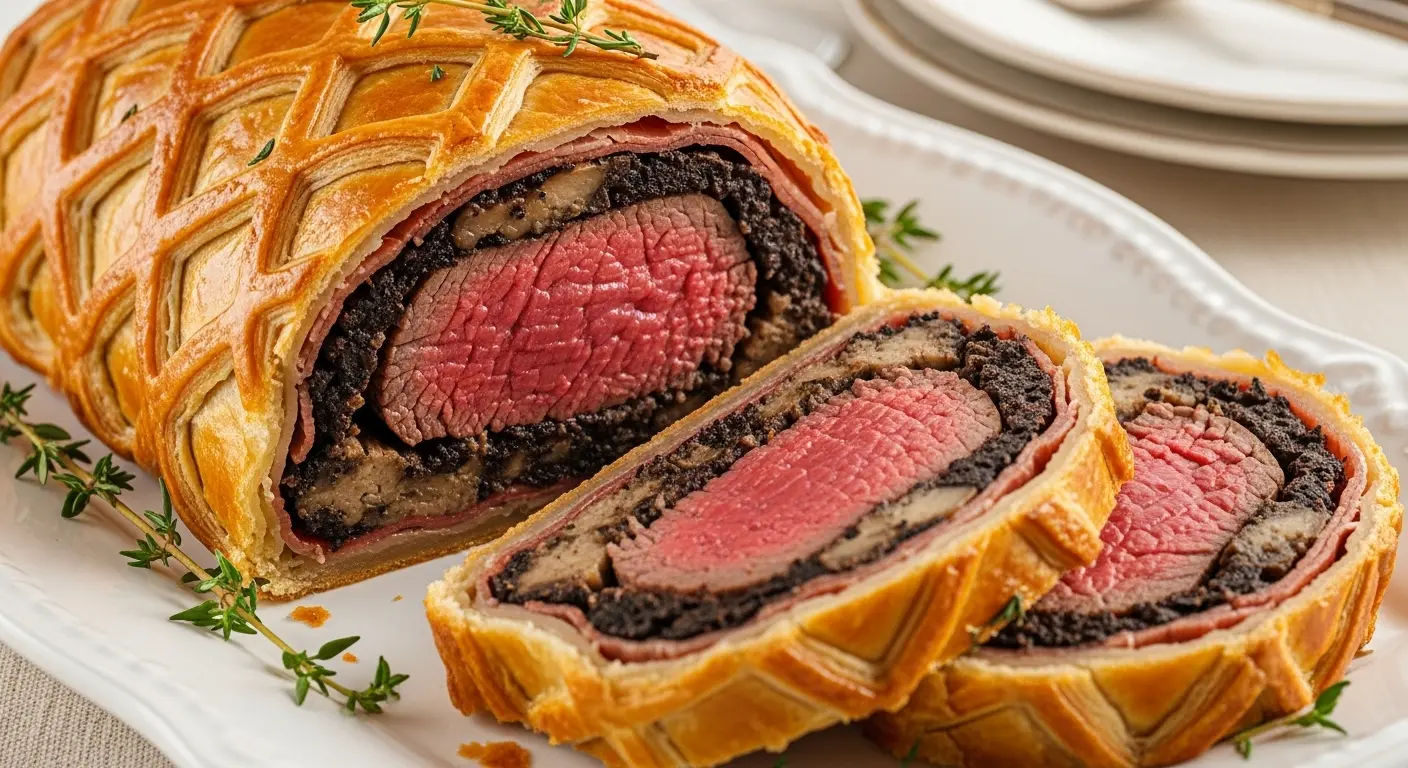
If you’ve ever wanted to make a show-stopping beef Wellington recipe that looks like it came straight out of a fine-dining kitchen, you’re in the right place. This classic British dish wraps a beautifully seared beef tenderloin in savory mushroom duxelles, a layer of prosciutto, and golden, flaky puff pastry for a result that’s as stunning as it is delicious.
The magic of Beef Wellington lies in its layered construction. Each component plays a specific role: the mustard coating protects the beef and adds depth, the prosciutto acts as a moisture barrier so the pastry stays crisp, and the mushroom duxelles delivers an earthy, umami-packed punch that ties everything together.
Yes, it takes some time and patience. But once you slice into that golden crust and reveal the perfectly pink tenderloin inside, you’ll understand exactly why this dish has stayed on dinner party menus for decades.
This recipe is detailed, beginner-friendly, and walks you through every single step so you can pull it off with confidence, even on your very first try.
For another elegant dinner centerpiece with equally rich, layered flavors, check out this Beef Bourguignon.
Why You’ll Love This Beef Wellington Recipe
This dish is the definition of a special-occasion meal, and once you taste it, you’ll want to make it again and again.
The contrast of textures is what makes it so irresistible: the crisp, buttery pastry gives way to the tender, juicy beef in the center, with the savory mushroom layer binding everything together in between.
It’s a make-ahead friendly recipe, which is a huge advantage when you’re entertaining. You can prep the wrapped Wellington the night before and simply bake it right before dinner.
The flavors are deeply complex and satisfying, yet each component is made from fairly accessible ingredients you can find at most grocery stores.
- A truly impressive centerpiece for holiday dinners, birthdays, or anniversaries
- The mushroom duxelles adds a rich, savory depth that elevates every single bite
- Make-ahead friendly: assemble the night before and bake fresh
- The prosciutto layer keeps the pastry from getting soggy, ensuring a crisp finish
- It looks far more complicated than it actually is, making you look like a culinary genius
- Works beautifully for both small and large dinner parties
Read Also: Prime Rib Recipe
Ingredients
For the best results, you need a center-cut beef tenderloin of even thickness. An uneven roast will cook unevenly, giving you some overdone sections. Ask your butcher to trim and tie the tenderloin for you if you want to save prep time.
For the Beef:
- 2 lbs (900g) center-cut beef tenderloin, trimmed
- 1 tablespoon olive oil
- 2 tablespoons Dijon mustard
- 1 teaspoon kosher salt
- 1/2 teaspoon freshly ground black pepper
For the Mushroom Duxelles:
- 1 lb (450g) cremini or baby bella mushrooms
- 2 shallots, finely chopped
- 3 garlic cloves, minced
- 2 tablespoons unsalted butter
- 2 teaspoons fresh thyme leaves
- 1/2 teaspoon kosher salt
- 1/4 teaspoon black pepper
For Assembly:
- 6–8 thin slices prosciutto di Parma (about 4 oz / 115g)
- 1 sheet (14 oz / 400g) all-butter puff pastry, thawed if frozen
- 2 large egg yolks
- 1 tablespoon water
- Flaky sea salt, for finishing
For the Red Wine Sauce (Optional but Recommended):
- 2 shallots, finely sliced
- 1 garlic clove, smashed
- 1 sprig fresh thyme
- 1 cup (240ml) dry red wine
- 1 cup (240ml) beef stock
- 1 tablespoon unsalted butter
For a similarly elegant beef preparation, this Air Fryer Beef Tenderloin Recipe is another excellent option when you want incredible results with less fuss.
Kitchen Equipment Needed
Having everything ready before you start will make the process smooth and stress-free. The plastic wrap is especially important here since it’s used twice in the wrapping process to shape and tighten the Wellington.
- Large oven-safe skillet or heavy-bottomed pan (for searing)
- Food processor (for the mushroom duxelles)
- Large non-stick or stainless-steel pan (for cooking duxelles)
- Plastic wrap (cling film), for shaping
- Rolling pin
- Pastry brush
- Baking sheet lined with parchment paper
- Instant-read meat thermometer
- Sharp knife or serrated knife, for slicing
- Cutting board
- Small mixing bowl (for egg wash)
You might also enjoy: Filet Mignon Recipe
Recommended Products for This Recipe
These are products selected based on quality and performance that will genuinely help you make a better Beef Wellington.
1. All-Butter Puff Pastry
Using an all-butter puff pastry rather than a vegetable-shortening-based one makes a significant difference in the final flavor and flakiness. The butterier layers puff up more beautifully and deliver a richer, more golden crust that enhances the overall dish. Look for brands like Dufour or Trader Joe’s all-butter variety.
2. Prosciutto di Parma (Thinly Sliced)
High-quality prosciutto does double duty here: it adds a salty, savory layer of flavor and acts as a critical moisture barrier between the duxelles and the pastry. Thin, premium prosciutto wraps cleanly around the beef and melds into the crust beautifully during baking.
3. Instant-Read Meat Thermometer
The single most important tool for a perfect Beef Wellington is a reliable meat thermometer. Pulling the tenderloin at exactly the right internal temperature (125°F/52°C for medium-rare after resting) is the difference between a showstopper and a disappointment. A quality thermometer removes all the guesswork.
4. Food Processor
A food processor makes creating the mushroom duxelles dramatically faster and more even. Finely mincing 1 pound of mushrooms by hand is tedious; a food processor does it in about 10 seconds, giving you a consistent paste that cooks down evenly.
5. Heavy-Bottomed Stainless Steel Skillet
Searing the tenderloin properly requires a pan that can handle extremely high heat without warping or creating hot spots. A heavy-bottomed stainless steel or cast iron skillet gives you the even, intense heat you need for a deep, caramelized crust on the outside of the beef in just 60 to 90 seconds per side.
Another favorite: Lobster Bisque Recipe
Step-by-Step Instructions
Step 1: Prepare the Beef Tenderloin
- Pat the beef tenderloin completely dry with paper towels. Moisture on the surface will prevent a good sear, so this step is critical.
- Season generously on all sides with 1 teaspoon kosher salt and 1/2 teaspoon black pepper, pressing the seasoning firmly into the meat.
- Heat 1 tablespoon of olive oil in a large heavy-bottomed skillet over high heat until the oil is shimmering and just beginning to smoke.
- Place the tenderloin in the pan and sear for 60 to 90 seconds per side, turning it to brown all sides and both ends. The goal is a deep, mahogany-brown crust, not cooked meat.
- Transfer the seared beef to a plate and immediately brush all surfaces with 2 tablespoons of Dijon mustard while it is still warm. The mustard coating helps the prosciutto adhere and adds a subtle sharpness that enhances the final flavor.
- Wrap the mustard-coated beef tightly in plastic wrap, twisting both ends like a candy wrapper to form a firm, compact cylinder.
- Refrigerate for at least 30 minutes, or up to overnight. This chilling step helps the beef hold its shape during wrapping.
Step 2: Make the Mushroom Duxelles
- Place the cremini mushrooms in a food processor and pulse 10 to 15 times until they are very finely minced, almost paste-like in texture. Do not add liquid.
- Melt 2 tablespoons of unsalted butter in a large skillet or non-stick pan over medium-high heat until foaming.
- Add the finely chopped shallots and cook for 2 to 3 minutes, stirring frequently, until softened and translucent.
- Add the minced garlic and cook for another 30 seconds, stirring constantly, until fragrant.
- Add all of the minced mushrooms to the pan along with the 2 teaspoons of fresh thyme leaves, 1/2 teaspoon salt, and 1/4 teaspoon pepper.
- Cook over medium-high heat, stirring frequently, for 10 to 15 minutes. The mushrooms will release a large amount of liquid. Continue cooking until all of that liquid has evaporated and the mixture has dried out into a dark, paste-like consistency. This is your duxelles.
- The duxelles must be completely dry before you use it. Any excess moisture will make the pastry soggy during baking.
- Spread the duxelles on a plate and let it cool completely to room temperature before proceeding.
Step 3: Assemble the Wellington Roll
- Lay a large sheet of plastic wrap (about 18 inches / 45cm long) flat on your work surface.
- Arrange the prosciutto slices on the plastic wrap, overlapping them slightly, to form a rectangle roughly as long as your beef tenderloin and wide enough to wrap all the way around it (approximately 8 by 10 inches / 20 by 25cm).
- Spread the cooled mushroom duxelles evenly over the prosciutto in a thin, uniform layer, leaving a 1-inch / 2.5cm border on the long edges.
- Remove the chilled beef from the refrigerator and unwrap it from the plastic.
- Place the beef at the bottom edge of the prosciutto rectangle and use the plastic wrap underneath to roll the prosciutto tightly around the beef, encasing it completely like a log.
- Twist the ends of the plastic wrap firmly to compress and tighten the roll into a neat cylinder.
- Refrigerate for at least 30 minutes. This chilling step ensures the prosciutto roll holds together and doesn’t unravel when you add the pastry.
Step 4: Wrap in Puff Pastry
- Preheat your oven to 425°F (220°C) and line a baking sheet with parchment paper.
- In a small bowl, whisk together 2 egg yolks with 1 tablespoon of water to make the egg wash.
- On a lightly floured surface, roll out the puff pastry sheet into a rectangle large enough to completely wrap around the Wellington log, approximately 12 by 14 inches / 30 by 35cm.
- Place the cold prosciutto-wrapped beef roll at the lower third of the pastry sheet, positioning it parallel to the long edge.
- Brush all the exposed edges of the pastry generously with the egg wash using a pastry brush.
- Fold the bottom edge of the pastry up and over the beef, then roll the beef away from you to wrap it in the pastry completely. Press the seam firmly to seal.
- Press and tuck the ends of the pastry underneath the Wellington, sealing them tightly with your fingers. Trim off any excess pastry if there is too much overlap.
- Transfer the wrapped Wellington seam-side-down onto the prepared parchment-lined baking sheet.
- Brush the entire surface generously with egg wash.
- Using the tip of a sharp knife, gently score a decorative diagonal pattern across the top of the pastry. Be careful to cut only about halfway through the pastry, not all the way through.
- Refrigerate for 15 minutes. This final chill relaxes the pastry and helps it puff up properly in the oven.
Step 5: Bake the Wellington
- Remove the Wellington from the refrigerator and brush the entire surface once more with egg wash for an extra glossy, deep-golden finish.
- Sprinkle the top lightly with flaky sea salt.
- Place the Wellington in the center of the preheated oven (425°F / 220°C).
- Bake for 20 to 25 minutes until the pastry is deep golden brown all over.
- Begin checking the internal temperature at the 18-minute mark using your instant-read thermometer inserted into the center of the beef.
- For medium-rare, remove the Wellington when the internal temperature reads 120 to 125°F (49 to 52°C). The temperature will continue to rise to about 130°F (54°C) as it rests.
- For medium, pull it at 130°F (54°C), targeting a final resting temp of 140°F (60°C).
Step 6: Make the Red Wine Sauce (Optional)
- While the Wellington bakes, heat a small saucepan over medium heat and add a drizzle of olive oil.
- Add the 2 sliced shallots and the smashed garlic clove. Cook for 3 to 4 minutes, stirring often, until softened and lightly golden.
- Add the sprig of fresh thyme and pour in the 1 cup (240ml) of dry red wine.
- Increase the heat to medium-high and let the wine bubble until it has reduced by half, about 5 minutes.
- Pour in the 1 cup (240ml) of beef stock and continue reducing until the sauce has reduced by half again and is slightly syrupy in consistency, about 8 to 10 more minutes.
- Remove from heat, fish out the thyme sprig, and swirl in 1 tablespoon of cold unsalted butter for richness and shine.
- Season to taste with salt and pepper. Keep warm until ready to serve.
Step 7: Rest and Slice
- Remove the Wellington from the oven and transfer it to a cutting board. Do not cut into it immediately.
- Let the Wellington rest uncovered for 10 minutes. This resting time allows the internal juices to redistribute and the temperature to equalize for a perfectly pink, evenly cooked center.
- Using a sharp serrated knife, cut the Wellington into slices approximately 1 to 1.5 inches (2.5 to 4cm) thick using smooth, deliberate strokes.
- Serve immediately with the red wine sauce drizzled alongside each slice.
This technique for searing and building a pastry-wrapped filling also works wonderfully in dishes like this Cottage Pie Recipe, which uses a similar layered approach with savory meat and a crust.
Tips for Success
Getting a perfect Beef Wellington comes down to a few key principles that experienced cooks follow every single time. Following them closely will prevent the most common pitfalls.
- Dry the duxelles completely. This is the most important rule. If the mushroom mixture retains any moisture, it will steam the pastry from the inside during baking, leaving you with a soggy, undercooked bottom crust.
- Keep everything cold. The puff pastry should stay cold right up until it goes into the oven. Cold pastry = good puff. Warm pastry = flat, greasy result.
- Use a meat thermometer. Do not try to guess doneness by time alone. Every oven and every tenderloin is different. The thermometer is non-negotiable.
- Chill between steps. Each chilling rest in the recipe is there for a reason. Don’t skip them. They help the Wellington hold its shape and ensure clean slices.
- Sear quickly on very high heat. You want color and crust on the exterior of the beef without cooking the interior at all. A blazing hot pan and under 2 minutes total searing time is the goal.
- Score the pastry gently. The decorative scoring allows steam to escape and gives the Wellington a professional finish. Just make sure you don’t cut all the way through the pastry.
- Rest before slicing. A full 10-minute rest is essential. Cutting too early causes the juices to run out onto the board instead of staying in the meat.
Read Also: Slow Cooker Pot Roast Recipe
Serving Suggestions
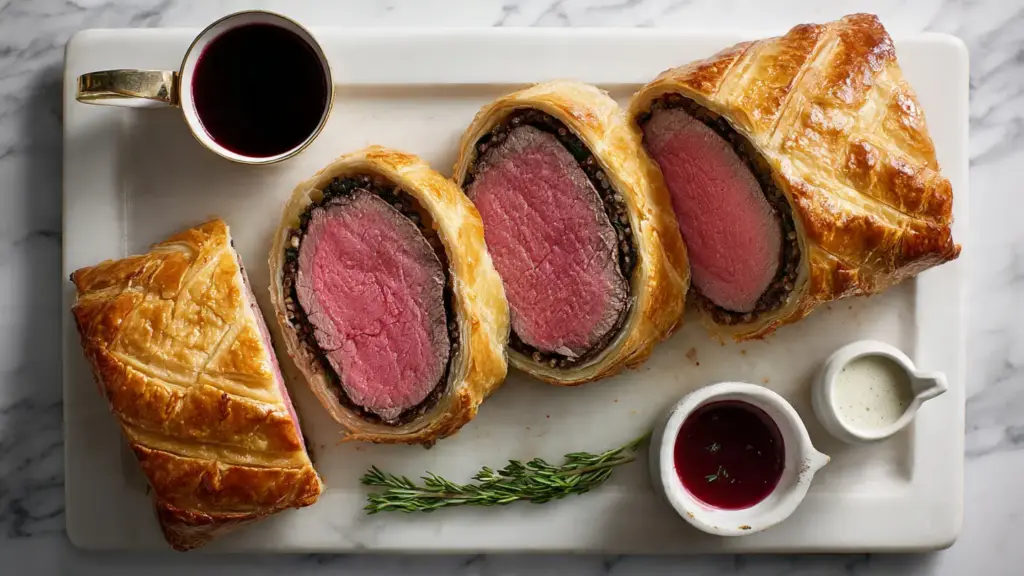
Beef Wellington is a rich, indulgent centerpiece that pairs beautifully with classic, simple sides that complement rather than compete with the pastry and beef.
Think of it this way: the Wellington is the star, so the sides should play a supporting role. Earthy, creamy, or lightly bitter sides work exceptionally well to balance the richness of the dish.
- Creamed Spinach for a classic pairing that balances the richness
- Garlic Mashed Potatoes for a creamy, comforting base
- Roasted Potatoes for a crispier, rustic alternative
- Yorkshire Pudding for a deeply traditional British pairing
- Roasted Broccoli for a simple vegetable side with light charred edges
- Roasted Brussels Sprouts with Bacon for a savory, slightly bitter contrast
- Honey Roasted Carrots for a touch of sweetness on the plate
- A crisp arugula salad dressed with lemon vinaigrette to cut through the richness of the pastry
Another favorite: Maple Glazed Carrots Recipe
Variations to Try
Once you’ve mastered the classic version, there are some wonderful ways to put your own spin on the Wellington format. Each variation keeps the same fundamental technique while changing up the filling or protein.
- Individual Beef Wellingtons: Instead of one large roast, use individual 6 oz (170g) filet mignon steaks. Bake for only 15 to 18 minutes. These are ideal for dinner parties since everyone gets their own perfectly portioned Wellington.
- Mushroom Wellington (Vegetarian): Replace the beef with a large portobello mushroom cap or a block of firm tofu. Double the duxelles and add spinach for extra filling. It’s a stunning meat-free alternative.
- Add Liver Pâté: The truly traditional British version sometimes includes a thin layer of chicken liver pâté spread over the duxelles before wrapping. It adds a deeply savory, old-school richness.
- Salmon Wellington: Replace the beef tenderloin with a thick, skinless salmon fillet. Use a spinach and cream cheese filling instead of mushroom duxelles. Bake at 400°F (200°C) for 20 to 25 minutes.
- Swap the Prosciutto for Serrano Ham: A Spanish spin on the prosciutto layer. Serrano ham has a slightly more intense, nuttier flavor that pairs beautifully with the earthy mushrooms.
You might also enjoy: Beef Stroganoff Recipe
Storage and Reheating
Beef Wellington is unquestionably best on the day it’s baked. The pastry loses its crispness the longer it sits, so plan to serve it fresh from the oven if at all possible.
That said, leftovers can be stored and enjoyed the next day with only a small sacrifice in texture.
- Refrigerating: Place leftover slices in an airtight container and refrigerate for up to 3 days.
- Freezing (uncooked): Wrap the fully assembled, unbaked Wellington tightly in plastic wrap, then foil, and freeze for up to 2 months. Thaw overnight in the refrigerator before baking as directed, adding 5 to 10 minutes extra baking time.
- Reheating in the oven (recommended): Place slices on a parchment-lined baking sheet and reheat at 350°F (175°C) for 10 to 15 minutes until warmed through. The oven will restore some of the pastry’s crispness.
- Avoid the microwave: Microwaving will make the pastry soft and soggy. Always reheat in the oven for the best results.
- Avoid refreezing cooked Wellington: Once baked, do not refreeze leftover slices as the texture deteriorates significantly.
Read Also: Crockpot Beef Stew Recipe
Nutritional Facts
Based on 1 serving (approximately 1/6 of recipe, not including red wine sauce). Values are approximate.
| Nutrient | Per Serving |
|---|---|
| Calories | 580 kcal |
| Total Fat | 34g |
| Saturated Fat | 14g |
| Cholesterol | 155mg |
| Sodium | 790mg |
| Total Carbohydrates | 28g |
| Dietary Fiber | 1g |
| Sugars | 1g |
| Protein | 38g |
| Iron | 4mg |
Note: Nutritional values will vary depending on the exact size of the tenderloin, specific brand of puff pastry used, and how much egg wash is absorbed during baking.
For another hearty, protein-rich beef dish, try this Crock Pot Beef Short Ribs Recipe.
Health Benefits of Key Ingredients
While Beef Wellington is undeniably a special-occasion indulgence rather than an everyday meal, several of its core ingredients carry genuine nutritional value worth knowing about.
Understanding what you’re eating can make you appreciate the dish even more, and it’s a great reminder that quality ingredients have real benefits beyond just flavor.
- Beef tenderloin is one of the leanest cuts of beef, offering a high-quality, complete protein source with all essential amino acids, along with significant amounts of zinc, iron, and B vitamins, particularly B12 and niacin.
- Cremini mushrooms (duxelles) are rich in B vitamins including riboflavin and niacin, and contain powerful antioxidants like ergothioneine and selenium that support immune function and cellular health.
- Garlic has well-documented anti-inflammatory and antimicrobial properties. The compound allicin in garlic has been linked to cardiovascular health benefits and immune system support.
- Shallots are a good source of quercetin, a flavonoid antioxidant, along with fiber, potassium, and vitamins A and C.
- Puff pastry provides carbohydrates for energy. All-butter varieties contain small amounts of fat-soluble vitamins A and E from the butter content.
- Dijon mustard contributes minimal calories while adding a burst of selenium, a trace mineral important for thyroid function and antioxidant defense.
- Thyme is a potent herb with significant amounts of vitamin C and vitamin K, along with antimicrobial properties from its thymol content.
This Mushroom Soup Recipe is a wonderful way to get the same nutritional benefits of cremini mushrooms in a lighter, everyday format.
Frequently Asked Questions
1. Can I make Beef Wellington ahead of time?
Yes, and it’s actually encouraged. You can complete the full assembly (through the pastry-wrapping stage) and refrigerate the Wellington overnight, up to 24 hours before baking.
Just take it out of the refrigerator 15 minutes before baking to take the chill off slightly and add about 5 minutes to your baking time since it will be starting colder.
2. What internal temperature should Beef Wellington reach?
For medium-rare, which is the most popular and traditional doneness for this dish, aim for a final internal temperature of 125 to 130°F (52 to 54°C) after resting.
Since the Wellington continues to cook while resting, pull it from the oven when your thermometer reads 120 to 125°F (49 to 52°C) and let it rest for 10 minutes to reach that perfect medium-rare range.
3. Why did my Beef Wellington come out soggy on the bottom?
The most common cause is excess moisture in the mushroom duxelles. The duxelles must be cooked down completely until it is paste-like and completely dry before being used in the recipe.
Another common cause is skipping the chilling steps, particularly between assembling the prosciutto roll and wrapping it in pastry. A warm assembly will start cooking the pastry from the inside before it even reaches the oven.
4. Can I use a different cut of beef?
The dish is traditionally made with center-cut beef tenderloin (also called chateaubriand) because of its tenderness, uniform shape, and relatively lean profile.
You could use a beef sirloin roast as a budget-friendly alternative, but it will be slightly less tender and may require adjusted cooking times due to different thickness and density.
5. How do I prevent the pastry from puffing up unevenly?
Scoring the top of the pastry lightly with a knife allows steam to escape evenly during baking, which helps control where and how the pastry puffs.
Keeping all components cold right up until the Wellington goes into the oven is also critical, since warm butter in the pastry layers will leak rather than create steam for a proper puff.
For more classic comfort recipes perfect for entertaining, check out this Classic Shepherd’s Pie Recipe.
Final Thoughts
Beef Wellington is one of those recipes that earns its reputation not just for its elegant appearance, but for the deeply satisfying experience of making it from scratch.
Every step has a purpose, from the sear that builds flavor, to the mustard coating that bridges the beef and prosciutto, to the perfectly dried duxelles that keeps the pastry golden and crisp.
Once you follow this recipe and slice into that gorgeous golden crust to reveal the pink, juicy tenderloin inside, you’ll feel a genuine sense of pride.
This is a dish worth making. It’s the kind of meal that turns an ordinary evening into a memory.
Give this Beef Wellington recipe a try for your next special occasion and let us know how it went in the comments below. Tag us in your photos or share this recipe with a friend who loves to cook something truly impressive.
Recommended:
- Dinner Rolls Recipe
- Hollandaise Sauce Recipe
- Worcestershire Sauce Recipe
- Braised Short Ribs Recipe
- Roasted Acorn Squash Recipe
- Bechamel Sauce Recipe
- Chicken Marsala Recipe
- Quiche Lorraine Recipe
- Classic Deviled Eggs Recipe
- Corn Pudding Recipe