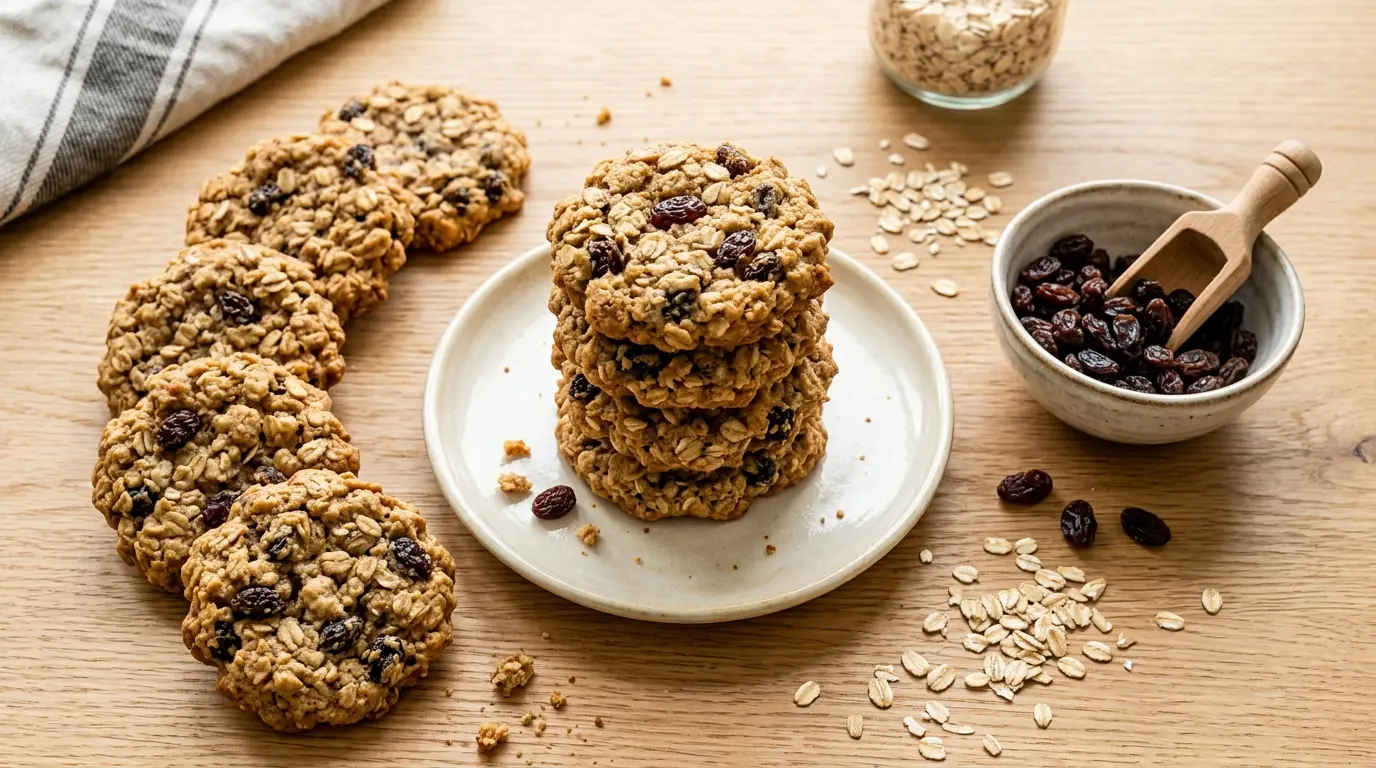
If you’ve been looking for a way to use up that jar of sourdough discard sitting in your fridge, this sourdough discard oatmeal cookies recipe is exactly what you need. These cookies are soft, chewy, and warmly spiced with cinnamon, and the discard adds a subtle depth of flavor you just can’t get from a standard oatmeal cookie. They come together quickly, bake up beautifully, and taste like something from a bakery case.
The magic here is in the combination of rolled oats, brown sugar, and a good handful of raisins, all brought together with a bit of sourdough tang. That slight acidity from the discard cuts through the sweetness in the best way possible.
You don’t need a starter that’s actively bubbling. Cold discard straight from the fridge works perfectly here, since you’re relying on baking soda and baking powder for lift, not fermentation.
If you love using up your discard in sweet treats, you’ll want to bookmark our Sourdough Discard Chocolate Chip Cookies too.

Why You’ll Love This Sourdough Discard Oatmeal Cookies Recipe
This recipe checks every box a good cookie should. The texture is the real standout: thick, chewy centers with lightly crisp edges that hold up beautifully at room temperature.
The sourdough discard doesn’t make these taste “sour.” Instead, it adds a complexity that makes these cookies feel more interesting than a standard batch.
They’re also wonderfully flexible. Raisins are the classic mix-in, but you can swap them for chocolate chips, dried cranberries, or chopped walnuts based on what you have.
Even better, this is a one-bowl recipe (mostly). You’ll dirty fewer dishes and have cookies cooling on a rack in under 30 minutes.
Here’s a quick list of reasons these cookies earn a permanent spot in your baking rotation:
- Uses up sourdough discard so nothing goes to waste
- Soft and chewy texture with gently crisp edges
- Warm cinnamon and nutmeg spices in every bite
- No chilling required (though chilling deepens flavor if you have time)
- Crowd-pleasing enough for kids and adults alike
- Stores well for days without drying out
- Easily customizable with your favorite mix-ins
Read Also: Sourdough Discard Granola Recipe
Ingredients
Most of what you need is already in your pantry. The discard and rolled oats are the stars; everything else is classic cookie-baking staples.
A quick note on the oats: use old-fashioned rolled oats, not instant. Instant oats are too fine and will make the cookies dense and cakey rather than chewy. Quick oats can work in a pinch, but rolled oats deliver the best texture.
- 1 cup (227g) unsalted butter, softened to room temperature
- 1 cup (200g) packed light brown sugar
- ½ cup (100g) granulated white sugar
- 2 large eggs, at room temperature
- 1 cup (240g) sourdough discard (unfed, at any hydration level)
- 2 teaspoons pure vanilla extract
- 1½ cups (190g) all-purpose flour
- 1 teaspoon baking soda
- 1 teaspoon baking powder
- 1½ teaspoons ground cinnamon
- ½ teaspoon ground nutmeg
- ½ teaspoon fine sea salt
- 3 cups (270g) old-fashioned rolled oats
- 1 cup (150g) raisins (or sub chocolate chips or dried cranberries)
You might also enjoy our Oatmeal Cookie Recipe for a classic version without the discard.
Kitchen Equipment Needed
Nothing fancy required here. Standard baking tools are all you need to turn out a beautiful batch of these cookies.
A stand mixer or hand mixer makes creaming the butter and sugars easy, but a wooden spoon and some elbow grease will absolutely work if that’s what you have.
- Stand mixer or hand electric mixer
- Large mixing bowl
- Medium mixing bowl for dry ingredients
- Whisk
- Rubber spatula
- Cookie scoop (2-tablespoon size recommended)
- 2 large rimmed baking sheets
- Parchment paper or silicone baking mats
- Wire cooling rack
- Measuring cups and spoons
- Kitchen scale (optional but recommended for accuracy)
Read Also: Sourdough Discard Brownies Recipe
Recommended Products for This Recipe
These are products chosen for quality and performance that can genuinely improve your results with this recipe.
1. Old-Fashioned Rolled Oats (Bob’s Red Mill)
Thick-cut rolled oats from Bob’s Red Mill absorb moisture at the right rate, giving you that signature chewy center without turning dense. They hold their texture beautifully even after baking and cooling. Using quality oats is one of the simplest ways to upgrade your cookie game.
2. KitchenAid Stand Mixer
Creaming softened butter and two types of sugar properly is the foundation of a great chewy cookie, and a KitchenAid stand mixer makes that effortless. It ensures your butter-sugar base is light and fluffy before anything else goes in. The paddle attachment is ideal for cookie doughs of all kinds.
3. OXO Good Grips Cookie Scoop
Uniformly sized cookies bake evenly and look professional on any plate. A 2-tablespoon OXO cookie scoop portions the dough consistently so every cookie finishes at the same time. The spring-loaded mechanism also prevents sticky hands and speeds up the process significantly.
4. USA Pan Half Sheet Baking Pan
Thick, aluminized steel baking sheets like USA Pan distribute heat evenly so cookies brown on the bottom without burning. They’re warp-resistant and large enough to fit a full batch in two rounds. A quality baking sheet really is one of the most impactful tools in a home baker’s kitchen.
5. Silpat Non-Stick Baking Mat
A reusable silicone baking mat means you’ll never have to worry about cookies sticking or parchment paper sliding around the pan. Silpat mats also slightly moderate the bottom heat, which helps cookies bake gently and evenly. They’re a sustainable, long-lasting alternative to disposable parchment.
Another favorite for using your discard: Sourdough Discard Coffee cake Recipe

Step-by-Step Instructions
1. Preheat Your Oven and Prepare the Baking Sheets
- Set your oven to 350°F (175°C). Allow it to fully preheat before you put any cookies in; an under-heated oven is one of the most common reasons cookies spread too much or bake unevenly.
- Line two large baking sheets with parchment paper or silicone baking mats. Set aside.
2. Mix the Dry Ingredients
- In a medium bowl, add the all-purpose flour, baking soda, baking powder, ground cinnamon, ground nutmeg, and fine sea salt.
- Whisk everything together thoroughly until well combined. This step distributes the leaveners and spices evenly so you don’t end up with pockets of baking soda or clumps of spice.
- Set the bowl aside.
3. Cream the Butter and Sugars
- Place the softened butter, packed brown sugar, and granulated white sugar in the bowl of your stand mixer (or a large mixing bowl if using a hand mixer).
- Beat on medium-high speed for 3 to 4 minutes, until the mixture is noticeably lighter in color and looks fluffy. This step is important: properly creamed butter and sugar creates tiny air pockets that contribute to the cookie’s texture.
- Scrape down the sides of the bowl with a rubber spatula at least once during mixing.
4. Add the Eggs and Vanilla
- With the mixer running on low, add the eggs one at a time. Let each egg incorporate fully before adding the next.
- Add the vanilla extract and mix until just combined.
- Scrape down the sides of the bowl again to make sure everything is evenly mixed.
5. Mix In the Sourdough Discard
- Add the sourdough discard to the bowl.
- Mix on low speed until just incorporated. The discard may look slightly streaky at first; that’s fine. Mix until the batter looks uniform and there are no visible streaks of discard.
- Don’t worry if your discard is on the thicker or more liquid side. Both work well; a thicker discard may make the dough slightly stiffer, while a thinner discard makes it a touch softer.
6. Add the Dry Ingredients
- With the mixer on the lowest speed, gradually add the dry ingredient mixture in two or three additions.
- Mix until just combined. Stop as soon as you no longer see streaks of flour. Overmixing at this stage develops the gluten and can lead to tough, dense cookies.
- Scrape down the sides and bottom of the bowl.
7. Fold In the Rolled Oats and Raisins
- Switch from the mixer to a rubber spatula.
- Add the rolled oats and fold them in by hand with a few large sweeping strokes. This prevents the oats from being over-processed.
- Add the raisins (or your mix-in of choice) and fold them in gently until evenly distributed throughout the dough.
- The dough will be thick and slightly sticky. This is exactly what you want.
8. Portion the Dough
- Using a 2-tablespoon cookie scoop or a rounded tablespoon, portion the dough into balls.
- Place them on the prepared baking sheets, spacing them about 2 inches (5cm) apart to allow for spreading.
- If you prefer flatter cookies, gently press each dough ball down slightly with the palm of your hand. If you like thicker cookies, leave them as balls.
9. Bake the Cookies
- Place one baking sheet on the center rack of the preheated oven.
- Bake for 11 to 13 minutes, until the edges are lightly golden and set, but the centers still look slightly underdone.
- This is intentional. The cookies will continue to firm up on the hot pan after coming out of the oven. Pulling them out when the centers look barely set is the key to achieving that soft, chewy texture rather than a crisp or dry cookie.
10. Cool on the Pan, Then Transfer
- Remove the baking sheet from the oven and let the cookies rest on the pan for 5 to 10 minutes. Do not move them during this time; they are still setting up.
- After resting, use a thin spatula to transfer them to a wire cooling rack.
- Allow them to cool completely before stacking or storing.
For another fantastic discard baking project, check out these Sourdough Discard Waffles.
Tips for Success
Getting these cookies right is mostly about technique. A few small adjustments can be the difference between a good cookie and a great one.
The single biggest tip: don’t overbake. Oatmeal cookies with sourdough discard retain moisture well, and they firm up as they cool. If they look done in the oven, they will be overdone once cool.
- Use room temperature butter. Cold butter won’t cream properly with the sugars. Room temperature butter should indent when you press a finger into it but not be greasy or melted. About 30 minutes on the counter is usually enough.
- Use room temperature eggs. Cold eggs can seize up the creamed butter and make the batter look curdled. Room temp eggs incorporate more smoothly.
- Measure flour correctly. Spoon the flour into your measuring cup and level it off with a straight edge. Scooping directly from the bag packs in too much flour and will make dry, crumbly cookies.
- Don’t skip the nutmeg. It’s a small amount but it adds warmth and complexity that makes these taste more like classic oatmeal cookies.
- Chill the dough for deeper flavor. If you have the time, cover the dough and refrigerate it for 30 minutes to an hour (or overnight). Chilling hydrates the oats more fully and allows the discard flavor to develop.
- Rotate the pan halfway through baking if your oven has hot spots. This ensures even browning.
- Use a light-colored baking sheet. Dark pans absorb more heat and can over-brown the bottoms of the cookies before the centers are done.
Another sourdough discard treat worth trying: Sourdough Discard Cinnamon Rolls
Serving Suggestions
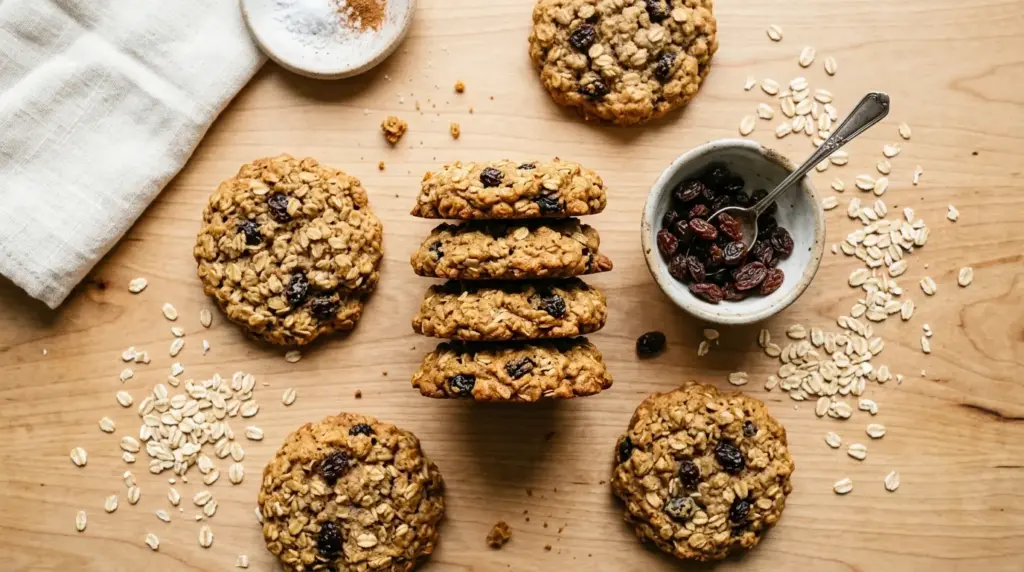
These cookies are wonderful on their own, but a few simple pairings make them feel even more special.
They’re a natural match for a cold glass of milk, but they also shine alongside a strong cup of coffee or a chai latte, where the spice in the drink plays off the cinnamon in the cookie.
Here are some of the best ways to enjoy them:
- Sandwiched with a scoop of Vanilla Bean Ice Cream for a simple homemade ice cream sandwich
- Crumbled over a bowl of Baked Oatmeal for a fun textural contrast at breakfast
- Plated with a drizzle of warm caramel sauce for a more dessert-forward presentation
- Packed into lunchboxes or picnic baskets since they travel beautifully
- Arranged on a holiday cookie tray alongside other spiced baked goods
- Served warm with a dusting of powdered sugar for a simple, elegant touch
Variations to Try
Once you’ve made the base recipe, it’s very easy to customize. These cookies are a flexible canvas.
The raisins are classic, but they’re completely optional. Swapping them out for something else changes the cookie entirely.
- Chocolate chip sourdough oatmeal cookies: Replace the raisins with semi-sweet or dark chocolate chips. The chocolate and sourdough tang are a fantastic combination.
- Dried cranberry and white chocolate: Swap raisins for dried cranberries and white chocolate chips for a festive, slightly tart twist.
- Walnut oatmeal cookies: Fold in 1 cup (100g) of roughly chopped walnuts for crunch and a buttery nuttiness.
- Peanut butter oatmeal discard cookies: Add ¼ cup (65g) of creamy peanut butter along with the butter. Reduce the butter by 2 tablespoons to compensate.
- Coconut oatmeal cookies: Add ½ cup (45g) of toasted shredded coconut along with the oats for a tropical, chewy variation.
- Brown butter version: Brown the butter on the stovetop before creaming. This adds a deep, nutty caramel flavor that takes the cookies to another level entirely.
- Overnight fermented cookies: After portioning the dough balls, place them on a parchment-lined tray and refrigerate uncovered overnight. This long-ferment method deepens the sourdough tang and creates an even chewier texture.
You might also love these Sourdough Discard Muffins for another easy discard bake.
Storage and Reheating
These cookies store well, which makes them ideal for baking ahead of time.
Room temperature storage is the best option for the first few days. The cookies actually get chewier on day two as the oats continue to absorb moisture from the other ingredients.
- Room temperature: Store cooled cookies in an airtight container at room temperature for up to 5 days. Place a small piece of bread in the container to help retain moisture.
- Freezing baked cookies: Lay cooled cookies in a single layer on a baking sheet and freeze until solid (about 1 hour), then transfer to a freezer-safe zip-lock bag or container. They keep for up to 3 months.
- Freezing cookie dough: Portion the dough into balls, freeze on a lined baking sheet until firm, then transfer to a freezer bag. Bake from frozen at 350°F (175°C) for 13 to 15 minutes, adding 1 to 2 minutes to the bake time.
- Reheating: Place a cookie on a microwave-safe plate and heat for 10 to 15 seconds for a warm, just-baked feel. You can also warm them in a 300°F (150°C) oven for 4 to 5 minutes.
Read Also: Sourdough Discard Banana Bread Recipe
Nutritional Facts
The following is an approximate nutritional estimate per cookie, based on a batch that yields 30 cookies using the standard ingredient amounts listed above.
| Nutrient | Amount Per Cookie |
|---|---|
| Calories | 165 kcal |
| Total Fat | 7g |
| Saturated Fat | 4g |
| Cholesterol | 28mg |
| Sodium | 80mg |
| Total Carbohydrates | 24g |
| Dietary Fiber | 1.5g |
| Total Sugars | 13g |
| Protein | 2.5g |
Note: Nutritional values are estimates and will vary based on the specific brands you use, the hydration level of your sourdough discard, and any mix-in substitutions.
Another great discard treat to explore: Sourdough Discard Pumpkin Muffins
Health Benefits of Key Ingredients
While these are absolutely a treat, a few of the key ingredients do come with some genuine nutritional upside.
Sourdough discard, unlike its active starter counterpart, still contains the byproducts of fermentation, including organic acids that may support gut health and improve the digestibility of grains.
Here’s a closer look at a few of the notable ingredients:
- Rolled oats: A rich source of beta-glucan, a soluble fiber associated with lower LDL cholesterol levels and steadier blood sugar response. Oats also provide iron, magnesium, and B vitamins.
- Raisins: A concentrated source of natural sugars, fiber, and potassium, as well as antioxidants including resveratrol and flavonoids.
- Cinnamon: One of the most antioxidant-rich spices available. It has been studied for its potential role in blood sugar regulation and anti-inflammatory effects.
- Eggs: Provide complete protein as well as choline, an essential nutrient important for brain and liver health.
- Sourdough discard: The fermentation process partially breaks down phytic acid in the flour, which may improve mineral absorption compared to unfermented flour-based baked goods.
For another wholesome bake, try these Sourdough Discard Zucchini Bread cookies.
Frequently Asked Questions
1. Can I use active sourdough starter instead of discard?
Yes, absolutely. Active, fed starter works just as well as discard in this recipe. The cookies won’t rise more because of it (the baking soda and baking powder handle leavening here), but the flavor will be slightly milder and less tangy. Both versions produce delicious cookies.
2. Does sourdough discard need to be at room temperature before using?
It’s not strictly necessary, but it helps. Cold discard straight from the fridge can firm up the butter when mixed in. If you’re in a hurry, cold discard still works fine. For the smoothest, most evenly mixed dough, let your discard sit out for 15 to 30 minutes before baking.
3. Why are my cookies flat?
A few things can cause flat cookies. The most common culprits are butter that was too soft or melted, too little flour (from improper measuring), or a baking sheet that’s too warm from a previous batch. Always let your baking sheets cool completely between rounds, and make sure your butter is soft but still holds its shape.
4. Can I skip the raisins?
Absolutely. Raisins are the traditional mix-in for oatmeal cookies, but they are completely optional. You can replace them with chocolate chips, dried cranberries, walnuts, pecans, sunflower seeds, or simply leave the mix-ins out entirely for a plain oatmeal cookie. The base dough is delicious on its own.
5. How do I make these cookies chewier?
A few techniques guarantee a chewier result. Use more brown sugar than white sugar (brown sugar has more moisture). Make sure you’re using old-fashioned rolled oats, not quick oats. Pull the cookies from the oven while the centers still look slightly underdone. And chilling the dough for at least 30 minutes before baking allows the oats to hydrate, which leads to a noticeably chewier texture.
Read Also: Oatmeal Raisin Cookie Recipe

Sourdough Discard Oatmeal Cookies

Equipment
- Stand mixer or hand electric mixer - For creaming butter and sugars
- Large mixing bowl
- Medium mixing bowl - For combining dry ingredients
- Whisk
- Rubber spatula
- Cookie scoop - 2-tablespoon size recommended
- Large Rimmed Baking Sheets - 2 sheets
- Parchment paper or silicone baking mats
- Wire cooling rack
- Measuring cups and spoons
- Kitchen scale - Optional but recommended for accuracy
Ingredients
- 1 cup Unsalted Butter - 227g, softened to room temperature
- 1 cup Light Brown Sugar - 200g, packed
- ½ cup Granulated White Sugar - 100g
- 2 Large Eggs - At room temperature
- 1 cup Sourdough Discard - 240g, unfed, at any hydration level
- 2 teaspoons Pure Vanilla Extract
- 1½ cups All-Purpose Flour - 190g
- 1 teaspoon Baking Soda
- 1 teaspoon Baking Powder
- 1½ teaspoons Ground Cinnamon
- ½ teaspoon Ground Nutmeg
- ½ teaspoon Fine Sea Salt
- 3 cups Old-Fashioned Rolled Oats - 270g
- 1 cup Raisins - 150g, or substitute chocolate chips, dried cranberries, or chopped walnuts
Instructions
- Preheat oven to 350°F (175°C). Line baking sheets with parchment paper or silicone mats.
- In a medium bowl, whisk together flour, baking soda, baking powder, cinnamon, nutmeg, and salt.
- Beat softened butter, brown sugar, and granulated sugar on medium-high until light and fluffy (3-4 minutes). Scrape bowl often.
- Mix in eggs one at a time, then vanilla. Add sourdough discard and mix until uniform.
- Gradually add dry ingredients on low speed just until no flour streaks remain.
- Fold rolled oats and raisins (or chosen mix-in) into the dough with a spatula until evenly distributed.
- Scoop rounded tablespoons of dough (2-tablespoon cookie scoop) onto prepared sheets, spacing 2 inches apart.
- Bake one sheet at a time on center rack for 11-13 minutes, until edges are golden and centers appear slightly underdone.
- Let cookies rest on the baking sheet for 5-10 minutes before transferring to a wire rack to cool completely.
Notes
- Don’t overbake: Pull cookies when centers are still slightly underdone—they continue to set as they cool on the pan for a perfectly soft and chewy texture.
- Room temperature ingredients: Use softened butter and room temperature eggs for proper creaming and a smooth dough.
- Measure flour correctly: Spoon flour into the measuring cup and level with a straight edge for accurate amounts.
- Customize mix-ins: Swap raisins for chocolate chips, dried cranberries, chopped walnuts, or even toasted coconut.
- Chill for deeper flavor: Refrigerate the dough for 30 minutes to overnight for a more developed sourdough tang and chewier texture.
- Make brown butter version: Brown the butter on the stovetop, let it cool and solidify slightly, then proceed with the recipe for a nutty caramel flavor.
- Storage: Keep baked cookies in an airtight container at room temperature for up to 5 days. Add a piece of bread to retain moisture.
- Freezing dough: Portion cookie dough balls, freeze on a tray, then transfer to a bag. Bake from frozen at 350°F for 13-15 minutes.
- Freezing baked cookies: Freeze cooled cookies in a single layer on a baking sheet, then transfer to a freezer bag for up to 3 months.
- Use any discard: Cold discard straight from the fridge works perfectly; no need to feed or bring to room temperature.
Final Thoughts
This sourdough discard oatmeal cookies recipe is one of those recipes you come back to again and again. It’s the kind of baking project that feels both practical and indulgent at the same time.
You’re using up something that would otherwise get tossed, and in return you get a batch of warmly spiced, soft, chewy cookies that disappear fast.
The recipe is forgiving, flexible, and genuinely delicious with a wide range of mix-ins and adaptations.
If you give these a try, leave a comment below and let us know how they turned out. Did you stick with raisins, or did you go for chocolate chips? We’d love to see your bakes, so share a photo and tag us if you make them!
Recommended:
- Sourdough Discard Shortbread Recipe
- Sourdough Discard Crepes Recipe
- Sourdough Discard Donuts Recipe
- Sourdough Discard Carrot Cake Recipe
- Sourdough Discard Lemon Loaf Recipe
- Sourdough Discard Pumpkin Bread Recipe
- Sourdough Discard Pancakes Recipe
- Chewy Oatmeal Chocolate Chip Cookie Recipe
- No Bake Cookie Recipe
- Snickerdoodle Cookie Recipe