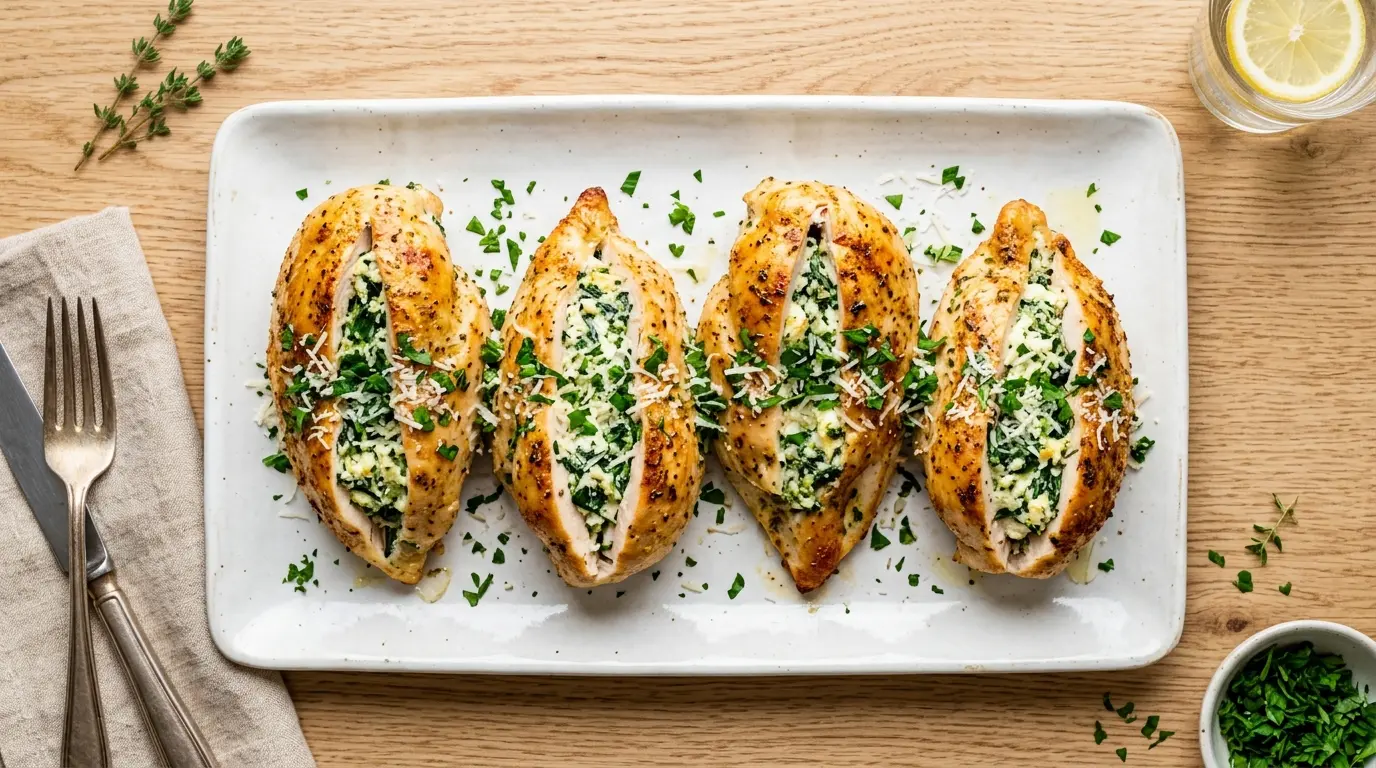
If you’re looking for a dinner that feels restaurant-worthy but is totally doable on a weeknight, this Stuffed Chicken Florentine Recipe is exactly what you need.
Juicy chicken breasts are filled with a creamy, garlicky spinach and ricotta mixture, seared to golden perfection, and finished in the oven until cooked through.
The filling is rich without being heavy, and the whole dish comes together with pantry-friendly ingredients that pack a serious flavor punch.
Florentine-style cooking originates from Florence, Italy, and is defined by the prominent use of spinach. In this stuffed version, spinach isn’t just a garnish. It’s the heart of the filling, blended with ricotta, mozzarella, and Parmesan for a creamy, cheesy stuffing that stays beautifully intact during cooking.
The result is a chicken dinner that looks impressive, tastes indulgent, and is far easier to pull off than it looks.
For another elegant spinach-stuffed chicken option, you might also love this Spinach Stuffed Chicken Breast that takes a slightly different approach to the filling.

Why You’ll Love This Stuffed Chicken Florentine Recipe
This dish earns a permanent spot in your dinner rotation for good reason.
It strikes the perfect balance between elegant and approachable, making it ideal for both a casual Thursday night and a dinner party main course.
The creamy spinach filling stays locked inside the chicken as it cooks, so every slice reveals that gorgeous cheesy center.
Here’s why this recipe consistently wins over home cooks:
- It’s a one-pan dinner. After searing, the chicken finishes right in the oven, meaning fewer dishes and less cleanup.
- The filling is incredibly versatile. The ricotta-spinach mixture can be customized with sun-dried tomatoes, artichoke hearts, or different cheeses to suit your taste.
- It’s meal-prep friendly. You can stuff and secure the chicken breasts up to 24 hours in advance and simply bake when ready.
- It’s naturally low-carb. The protein-forward filling and lean chicken make this a satisfying option that fits a range of dietary goals.
- It feeds a crowd with minimal effort. Doubling or tripling the recipe is straightforward, and the presentation always wows guests.
- The flavors are classic but layered. Garlic, spinach, creamy cheese, and well-seasoned chicken work together in a way that feels familiar and exciting at the same time.
You might also enjoy this Chicken Florentine for a non-stuffed weeknight version of the classic.
Ingredients
The ingredients are simple, but the quality of each one matters. Fresh spinach wilts down beautifully and adds a bright flavor that frozen spinach can’t quite replicate. Similarly, whole-milk ricotta creates a creamier, more stable filling than part-skim varieties.
Here’s everything you’ll need:
For the Stuffed Chicken:
- 4 large boneless, skinless chicken breasts (about 8 oz / 225g each)
- 1 teaspoon garlic powder
- 1 teaspoon onion powder
- 1 teaspoon Italian seasoning
- 1/2 teaspoon paprika
- 1/2 teaspoon salt
- 1/4 teaspoon black pepper
- 2 tablespoons olive oil
For the Florentine Filling:
- 2 cups (60g) fresh baby spinach, roughly chopped
- 3/4 cup (185g) whole-milk ricotta cheese
- 1/2 cup (50g) shredded mozzarella cheese, plus extra for topping
- 1/4 cup (25g) freshly grated Parmesan cheese
- 3 cloves garlic, minced
- 2 tablespoons cream cheese, softened
- 1/4 teaspoon red pepper flakes (optional)
- Salt and pepper to taste
For Finishing:
- 2 tablespoons shredded mozzarella (for topping)
- Fresh parsley or basil, chopped, for garnish
For another comforting chicken dish perfect for busy nights, check out this Chicken Florentine Pasta that uses a similar flavor profile.
Kitchen Equipment Needed
Having the right tools makes the stuffing process much smoother. A sharp knife is non-negotiable here since you’ll need to cut a clean pocket into each chicken breast without piercing through the other side.
Here’s what to gather before you start:
- Oven-safe skillet or cast iron pan (10 to 12 inches / 25 to 30 cm)
- Meat thermometer
- Sharp boning or paring knife
- Cutting board
- Meat mallet or rolling pin
- Toothpicks or kitchen twine (to secure the chicken)
- Mixing bowl (medium-sized)
- Measuring cups and spoons
- Wooden spoon or spatula
- Aluminum foil (for resting)
Read Also: Chicken Florentine Soup Recipe
Recommended Products for This Recipe
These are products chosen for genuine quality and their ability to make this recipe easier and more successful.
1. Lodge 10.25-Inch Cast Iron Skillet
A good cast iron skillet is essential for getting that deep, golden sear on the outside of the chicken before it goes into the oven. Cast iron retains heat evenly, which means consistent browning across the entire surface of each breast. It also transitions seamlessly from stovetop to oven, making this a true one-pan meal.
2. Thermapen Instant-Read Thermometer
Stuffed chicken breasts can be tricky to judge for doneness visually since the filling insulates the center. An instant-read thermometer removes all guesswork by giving you an accurate internal temperature reading in seconds. You’re aiming for 165°F (74°C) at the thickest part for perfectly safe, juicy chicken every time.
3. Whole Milk Ricotta Cheese
The quality of your ricotta directly affects the texture of the filling. Whole-milk ricotta is noticeably creamier and less grainy than part-skim versions, which means the filling holds together better and tastes richer. It’s worth seeking out for this recipe.
4. Kitchen Twine
Toothpicks work fine for securing the chicken pockets, but kitchen twine gives you a little more control and is easier to remove cleanly after baking. It’s inexpensive and useful for dozens of other cooking tasks, from trussing poultry to tying herb bundles for broth.
Another great stuffed chicken option worth bookmarking: Stuffed Chicken Marsala

Step-by-Step Instructions
Step 1: Prepare the Filling
- In a medium mixing bowl, combine the ricotta cheese, softened cream cheese, shredded mozzarella, and grated Parmesan.
- Add the minced garlic and stir until all the cheeses are evenly combined into a smooth, cohesive mixture.
- Add the roughly chopped fresh baby spinach and fold it in gently. The spinach will look like a lot at first, but it compresses into the mixture as you fold.
- Season the filling with salt, pepper, and the optional red pepper flakes. Taste and adjust seasoning as needed.
- Set the filling aside at room temperature while you prep the chicken. This helps the mixture stay pliable when stuffing.
Step 2: Prepare the Chicken Breasts
- Lay each chicken breast flat on a cutting board. If any breast is significantly thicker on one end than the other, use a meat mallet wrapped in plastic wrap to gently pound the thicker portion until the breast is relatively even, roughly 1 inch (2.5 cm) thick throughout.
- Using a sharp boning knife or paring knife, cut a horizontal pocket into the thickest side of each breast. Insert the knife about 1/2 inch (1.3 cm) from the edge and cut into the center of the breast, stopping about 1/2 inch (1.3 cm) from the opposite edge and the top and bottom edges. You want a deep pocket, but the breast should remain intact on three sides.
- Take care not to pierce all the way through the chicken, as this will cause the filling to leak during cooking.
- Pat the inside of each pocket dry with a paper towel to help the filling adhere.
Step 3: Season the Chicken
- In a small bowl, mix together the garlic powder, onion powder, Italian seasoning, paprika, salt, and black pepper.
- Drizzle a small amount of olive oil over each chicken breast and rub it evenly over all surfaces, including the inside of the pocket.
- Sprinkle the seasoning mixture generously over the outside of each chicken breast, patting it in gently to help it adhere. Don’t season the inside of the pocket as the filling already provides plenty of flavor.
Step 4: Stuff the Chicken
- Spoon the filling into each chicken pocket, dividing it evenly among the four breasts. Use about 3 to 4 tablespoons of filling per breast, depending on the size of the pocket.
- Press the filling in firmly but gently so it reaches to the back of the pocket without overflowing.
- Pinch the open edge of each pocket shut and secure it with 2 to 3 toothpicks or a short length of kitchen twine. This prevents the filling from bubbling out during the sear and bake.
- If a little filling is at risk of escaping at the opening, you can fold the thin flap of chicken over the opening and secure it with an extra toothpick.
Step 5: Sear the Chicken
- Preheat your oven to 400°F (200°C) and position a rack in the center.
- Place your oven-safe skillet over medium-high heat and add the remaining olive oil. Heat the oil for 1 to 2 minutes until it shimmers and a drop of water flicked into the pan sizzles immediately.
- Carefully place the stuffed chicken breasts in the pan, pocket-side up if possible to reduce filling leakage. You may need to do this in two batches if your pan is smaller.
- Sear the chicken for 3 to 4 minutes without moving it, until the bottom is deeply golden brown and releases easily from the pan.
- Flip the chicken carefully using tongs and sear the other side for an additional 2 to 3 minutes until golden. Don’t press down on the chicken as this can squeeze the filling out.
Step 6: Finish in the Oven
- If you seared in batches, return all the chicken breasts to the skillet now.
- Sprinkle the extra shredded mozzarella over the top of each chicken breast.
- Transfer the skillet to the preheated oven and bake for 18 to 22 minutes, or until the internal temperature of the chicken reaches 165°F (74°C) when tested with a meat thermometer inserted into the thickest part (not into the filling).
- If the cheese on top begins to brown too quickly before the chicken is cooked through, tent the pan loosely with aluminum foil and continue baking.
Step 7: Rest and Serve
- Remove the skillet from the oven and let the chicken rest for 5 minutes before serving. This allows the juices to redistribute throughout the meat, keeping it moist and flavorful when sliced.
- While the chicken rests, remove all toothpicks or twine carefully. Count them out to make sure none get left behind.
- Garnish with fresh chopped parsley or basil and serve immediately. The filling will be very hot, so allow guests a moment before cutting in.
This dish pairs beautifully with the creamy richness of Creamed Spinach as a side, tying the Florentine flavors together from plate to plate.
Tips for Success
A few key techniques make the difference between good and exceptional results with this recipe.
The most important is the pocket-cutting step. Take your time with it and use a sharp knife. A ragged or uneven pocket can tear during stuffing, causing the filling to leak while the chicken cooks.
Here are additional tips to get the best results every time:
- Don’t skip the sear. The golden crust that forms during searing not only adds flavor but also helps seal the pocket and keep the filling inside during baking.
- Use room-temperature filling. Cold filling straight from the fridge is stiffer and harder to pack into the pocket evenly. Let it sit for 10 to 15 minutes before stuffing.
- Don’t overfill. It’s tempting to pack in as much filling as possible, but overstuffing causes the pocket to split during cooking. Aim for a generous but manageable amount.
- Let the chicken rest after baking. Cutting into it too soon lets all the juices run out and can cause the filling to ooze before it has set properly.
- Use fresh spinach when possible. Frozen spinach releases significantly more water, which can make the filling watery. If you must use frozen, thaw it completely and wring it out in a clean towel until very dry.
- Check temperature, not time. Ovens vary, and so do chicken breast sizes. An instant-read thermometer is the only reliable way to know when the chicken is safely cooked through.
For another impressive stuffed chicken option to add to your repertoire, try the Olive Garden Stuffed Chicken Marsala.
Serving Suggestions

Stuffed Chicken Florentine is hearty enough to stand on its own, but the right side dishes turn it into a truly memorable meal.
Because the filling is rich and creamy, it pairs best with sides that add lightness or textural contrast, like something crisp, bright, or gently acidic.
Great serving ideas include:
- Garlic Mashed Potatoes to soak up any cheesy filling that spills onto the plate
- Roasted Broccoli for a simple, slightly charred vegetable that cuts through the richness
- Cilantro Lime Rice for a fresh, bright grain option
- Baked Potato for a classic, crowd-pleasing pairing
- Crusty bread or garlic bread for mopping up any filling that oozes onto the pan
- A simple arugula salad dressed with lemon juice and olive oil for something fresh and peppery alongside
- Green Beans lightly sauteed in butter and garlic, which echo the Italian flavors in the dish
Variations to Try
Once you’ve mastered the basic recipe, it’s easy to riff on the filling and preparation method.
The Florentine framework is flexible, and small swaps in the cheese blend or added mix-ins can completely transform the dish without changing the technique.
Here are some crowd-pleasing variations:
- Sun-dried tomato and goat cheese: Replace the cream cheese with goat cheese and stir in 2 tablespoons of finely chopped oil-packed sun-dried tomatoes. The tanginess of the goat cheese and the sweetness of the tomatoes create a beautiful contrast.
- Artichoke Florentine: Add 1/4 cup (60g) of finely chopped canned artichoke hearts (drained and squeezed dry) to the filling for added texture and a slightly briny flavor.
- Mushroom and Swiss stuffed chicken: Saute 1/2 cup (75g) of finely diced mushrooms with garlic until their moisture evaporates, then mix into the filling with Swiss cheese instead of mozzarella.
- Spicy Florentine: Add 1/2 teaspoon of crushed red pepper flakes and a dash of hot sauce to the filling for a gentle heat that plays nicely against the creamy cheese.
- Pesto twist: Stir 2 tablespoons of basil pesto into the ricotta mixture before folding in the spinach for a bright, herby filling.
- Baked-only version: Skip the sear and bake the stuffed chicken at 425°F (220°C) for 25 to 30 minutes for an even simpler preparation, though you’ll lose some of the golden crust.
Read Also: Chicken Florentine Pizza Recipe
Storage and Reheating
This recipe stores well and reheats beautifully, making it a great option for meal prep or planned leftovers.
The filling stays creamy after reheating as long as you use gentle heat rather than blasting it in the microwave at full power.
Storage and reheating guidelines:
- Refrigerator: Store fully cooked stuffed chicken breasts in an airtight container for up to 3 days. Let them cool completely before storing to prevent condensation from making the exterior soggy.
- Freezer: Wrap each cooked chicken breast individually in plastic wrap, then place in a freezer-safe bag. Freeze for up to 2 months. Thaw overnight in the refrigerator before reheating.
- Reheating in the oven: Place the chicken in a baking dish with a splash of chicken broth, cover tightly with foil, and reheat at 325°F (165°C) for 15 to 20 minutes or until warmed through. This method keeps the filling creamy and the chicken moist.
- Reheating in the microwave: Cover the chicken loosely and reheat at 50% power in 90-second intervals, checking after each interval. Full power tends to dry out the chicken and can cause the filling to separate.
- Meal prep tip: You can stuff and secure the raw chicken breasts up to 24 hours in advance and keep them covered in the refrigerator. Add 3 to 5 minutes to the oven time since they’ll go in cold.
For another chicken recipe that reheats well and works great for meal prep, try this Baked Chicken Breast.
Nutritional Facts
The following values are approximate per serving, based on one stuffed chicken breast (recipe makes 4 servings). Actual values may vary based on the size of the chicken breasts and the specific brands of cheese used.
| Nutrient | Amount Per Serving |
|---|---|
| Calories | 420 kcal |
| Protein | 52g |
| Total Fat | 20g |
| Saturated Fat | 9g |
| Carbohydrates | 5g |
| Fiber | 1g |
| Sugar | 1g |
| Sodium | 680mg |
| Calcium | 280mg |
| Iron | 2mg |
| Vitamin A | 1,800 IU |
Note: Values are estimated using standard nutritional databases and should be used as a general guide.
You might also enjoy this Italian Chicken Skillet for another protein-rich weeknight dinner option.
Health Benefits of Key Ingredients
This dish isn’t just satisfying, it’s genuinely nourishing. Each key ingredient brings something valuable to the nutritional table.
Chicken breast is one of the leanest protein sources available, making it excellent for muscle repair, satiety, and maintaining stable energy levels throughout the day.
Here’s what the other key ingredients bring to the table:
- Spinach is a nutritional powerhouse, rich in iron, vitamin K, vitamin A, folate, and antioxidants. The heat from cooking actually increases the bioavailability of some nutrients, making cooked spinach particularly beneficial.
- Ricotta cheese provides a good source of calcium, phosphorus, and whey protein. It’s lower in sodium than many aged cheeses, making it a gentler option for those watching their salt intake.
- Parmesan cheese contributes significant calcium and a solid hit of protein. A small amount goes a long way in terms of flavor, so you get the nutritional benefits without overdoing the saturated fat.
- Garlic contains allicin, a compound with well-documented anti-inflammatory and antimicrobial properties. It also supports cardiovascular health when consumed regularly.
- Olive oil provides heart-healthy monounsaturated fats and polyphenols that have been linked to reduced inflammation and improved cholesterol levels.
- Mozzarella cheese adds calcium, protein, and phosphorus, and whole-milk mozzarella also provides fat-soluble vitamins A, D, E, and K.
Read Also: Chicken Florentine Soup Recipe
Frequently Asked Questions
1. Can I use frozen spinach instead of fresh?
Yes, frozen spinach works in a pinch, but there’s an important step you can’t skip. Thaw the spinach completely and then squeeze out as much liquid as possible using your hands or a clean kitchen towel. Frozen spinach holds a surprising amount of water, and if you don’t remove it, the filling will be loose and watery, making it harder to keep inside the chicken during cooking.
2. How do I keep the filling from leaking out?
The two most effective techniques are not overfilling the pocket and properly securing the opening. Use 2 to 3 toothpicks to pinch the edges of the pocket shut, and make sure you sear the chicken with the pocket-side facing up first. A well-sealed pocket combined with a good sear creates a barrier that keeps the filling where it belongs.
3. Can I prepare this recipe ahead of time?
Absolutely. You can stuff and secure the chicken breasts up to 24 hours ahead and keep them covered in the refrigerator. When you’re ready to cook, let them sit at room temperature for about 15 minutes before searing. This takes the chill off the meat and helps it cook more evenly. Just add a few extra minutes to the oven time since they’re starting cold.
4. What internal temperature should stuffed chicken reach?
The safe internal temperature for chicken is 165°F (74°C), measured with an instant-read thermometer inserted into the thickest part of the breast, not into the filling. The filling itself will be significantly hotter than the surrounding meat, so always check the chicken itself. Resting the cooked chicken for 5 minutes allows the temperature to equalize slightly before serving.
5. Can I make this recipe dairy-free?
You can adapt it with some modifications. Replace the ricotta with a dairy-free ricotta alternative (cashew-based versions work particularly well), use a dairy-free mozzarella shred, and omit the cream cheese or use a vegan cream cheese substitute. The filling won’t be quite as rich or stretchy as the original, but the flavor will still be excellent, especially if you lean into the garlic and seasonings.
For a related dish that also highlights classic Italian flavors, try this Spaghetti alla Carbonara as a complementary pasta course for a dinner party.

Stuffed Chicken Florentine

Equipment
- Oven-safe skillet or cast iron pan - 10 to 12 inches (25 to 30 cm)
- Meat thermometer
- Sharp Boning or Paring Knife
- Cutting board
- Meat mallet or rolling pin
- Toothpicks or Kitchen Twine
- Mixing bowl - Medium-sized
- Measuring cups and spoons
- Wooden spoon or spatula
- Aluminum foil
Ingredients
- 4 boneless, skinless chicken breasts - large, about 8 oz or 225g each
- 1 teaspoon garlic powder
- 1 teaspoon onion powder
- 1 teaspoon Italian seasoning
- 1/2 teaspoon paprika
- 1/2 teaspoon salt
- 1/4 teaspoon black pepper
- 2 tablespoons olive oil
For the Florentine Filling
- 2 cups fresh baby spinach - 60g, roughly chopped
- 3/4 cup whole-milk ricotta cheese - 185g
- 1/2 cup shredded mozzarella cheese - 50g, plus extra for topping
- 1/4 cup Parmesan cheese - 25g, freshly grated
- 3 cloves garlic - minced
- 2 tablespoons cream cheese - softened
- 1/4 teaspoon red pepper flakes - optional
- salt and pepper - to taste
For Finishing
- 2 tablespoons shredded mozzarella - for topping
- fresh parsley or basil - chopped, for garnish
Instructions
- In a medium mixing bowl, combine the ricotta, cream cheese, mozzarella, Parmesan, and minced garlic until smooth. Gently fold in the chopped spinach and season with salt, pepper, and optional red pepper flakes.
- Lay the chicken breasts flat on a cutting board. Use a mallet to pound them to an even thickness of about 1 inch. Cut a deep horizontal pocket into the thickest side of each breast, being careful not to pierce through the other side.
- In a small bowl, mix the garlic powder, onion powder, Italian seasoning, paprika, salt, and pepper. Drizzle the chicken with olive oil and rub the seasoning mixture generously over the outside of each breast.
- Evenly divide the filling among the chicken pockets (about 3-4 tablespoons per breast). Pinch the open edges shut and secure with 2-3 toothpicks or kitchen twine.
- Preheat oven to 400°F (200°C). Heat olive oil in an oven-safe skillet over medium-high heat. Sear the stuffed chicken breasts, pocket-side up, for 3-4 minutes per side until deeply golden brown.
- Sprinkle the extra mozzarella on top of the chicken and transfer the skillet to the oven. Bake for 18-22 minutes, or until the internal temperature reaches 165°F (74°C).
- Let the chicken rest for 5 minutes after baking. Remove toothpicks or twine, garnish with fresh parsley or basil, and serve.
Notes
- Don’t skip the sear: The golden crust that forms during searing not only adds flavor but also helps seal the pocket and keep the filling inside during baking.
- Use room-temperature filling: Cold filling straight from the fridge is stiffer and harder to pack into the pocket evenly. Let it sit for 10 to 15 minutes before stuffing.
- Don’t overfill: It’s tempting to pack in as much filling as possible, but overstuffing causes the pocket to split during cooking. Aim for a generous but manageable amount.
- Check temperature, not time: Ovens vary, and so do chicken breast sizes. An instant-read thermometer is the only reliable way to know when the chicken is safely cooked through.
- Use fresh spinach when possible: Frozen spinach releases significantly more water, which can make the filling watery. If you must use frozen, thaw it completely and wring it out in a clean towel until very dry.
- Make-Ahead Tip: You can stuff and secure the raw chicken breasts up to 24 hours in advance and keep them covered in the refrigerator. Add 3 to 5 minutes to the oven time since they’ll go in cold.
- Storage: Store fully cooked stuffed chicken breasts in an airtight container in the refrigerator for up to 3 days. Reheat in the oven with a splash of broth to keep the filling creamy.
- Variations: Try adding sun-dried tomatoes, artichoke hearts, or sauteed mushrooms to the filling. You can also replace the mozzarella with Swiss cheese or add pesto for a bright, herby twist.
Final Thoughts
This Stuffed Chicken Florentine Recipe is one of those dishes that earns its place in your permanent recipe rotation.
It looks like something you’d order at a white-tablecloth Italian restaurant, but it’s genuinely achievable on any given weeknight with ingredients you can find at any grocery store.
The creamy spinach and cheese filling is the kind of thing people talk about after dinner, and the golden seared exterior gives you that satisfying contrast of textures with every bite.
Give it a try the next time you want to make dinner feel a little more special without spending hours in the kitchen. If you make it, drop a comment below and let us know how it turned out. Did you add anything to the filling? Swap out a cheese? Serve it with something unexpected? We love hearing how readers make these recipes their own.
Recommended:
- Chicken Florentine Pasta
- Chicken Cordon Bleu
- Air Fryer Chicken Cordon Bleu
- Chicken Marsala
- Crockpot Chicken Marsala
- Stuffed Acorn Squash
- Baked Honey Mustard Chicken
- Classic Chicken Parmesan
- Chicken Cacciatore
- Stuffed Shells