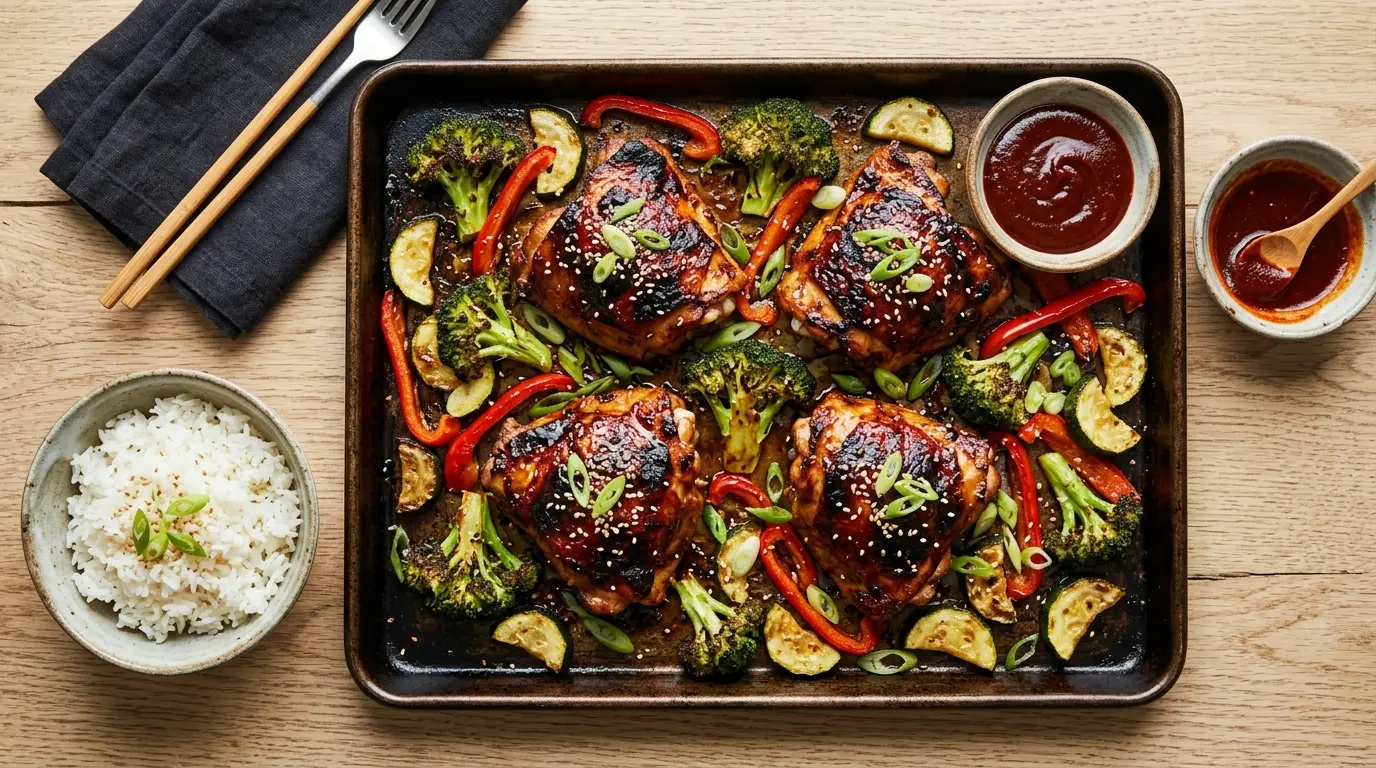
If you’ve been sleeping on Korean-inspired weeknight dinners, this Gochujang Chicken Sheet Pan Dinner is about to wake you right up.
This one-pan meal brings together juicy, caramelized chicken thighs slathered in a bold, umami-packed gochujang marinade, roasted alongside tender vegetables until everything is gloriously sticky and golden.
It’s the kind of dish that smells incredible in the oven and looks even better on the table.
Gochujang, the fermented Korean chili paste, is the MVP here. It delivers heat, sweetness, and deep savory complexity that you simply cannot replicate with any other ingredient.
The sheet pan format means minimal prep, minimal cleanup, and maximum flavor, which makes it ideal for busy weeknights and laid-back weekend cooking alike.
If you love bold, globally inspired flavors that come together without a lot of fuss, this recipe is going to become a regular in your rotation. And if you enjoy Teriyaki Chicken Sheet Pan Dinner, you’ll love this Korean-inspired spin on the same easy formula.

Why You’ll Love This Gochujang Chicken Sheet Pan Dinner
This dish checks so many boxes, it’s almost hard to know where to start.
The marinade does the heavy lifting. Gochujang, soy sauce, honey, sesame oil, garlic, and ginger combine into a sauce that is simultaneously sweet, spicy, salty, and deeply savory.
It clings to the chicken beautifully during roasting and caramelizes into something extraordinary.
Everything cooks on a single pan, which means you spend less time cleaning and more time enjoying your dinner.
Bone-in, skin-on chicken thighs are used in this recipe because they stay juicy even at high roasting temperatures, unlike chicken breasts which can dry out quickly.
Here’s what makes this recipe worth coming back to again and again:
- Big flavor with minimal effort – The marinade takes about 5 minutes to whisk together, and the oven does the rest.
- One pan, easy cleanup – Everything roasts together, so you’re not dealing with multiple pots and pans.
- Adaptable vegetables – Swap in whatever you have on hand; broccoli, bell peppers, zucchini, or baby potatoes all work beautifully.
- Kid-friendly heat level – You can control the spice by adjusting how much gochujang you use.
- Meal prep-friendly – Leftovers keep well and reheat beautifully, making lunch the next day something to look forward to.
- Naturally gluten-free friendly – Just swap the soy sauce for tamari.
This recipe is also a wonderful gateway into Korean-inspired cooking if you’re newer to those flavors. You might also enjoy: Skillet Chicken Bulgogi Recipe
Ingredients
This recipe calls for everyday pantry staples combined with a few Korean-inspired ingredients that are increasingly easy to find at most grocery stores. Gochujang is now widely available at Asian grocery stores, Whole Foods, Trader Joe’s, and even many standard supermarkets. Here’s everything you’ll need to pull this together:
- 4 bone-in, skin-on chicken thighs (about 2 lbs / 900 g total)
- 3 tablespoons gochujang paste (adjust to your heat preference)
- 2 tablespoons soy sauce (or tamari for gluten-free)
- 1 tablespoon honey
- 1 tablespoon rice vinegar
- 1 tablespoon toasted sesame oil
- 2 tablespoons olive oil, divided
- 4 garlic cloves, minced
- 1 teaspoon fresh ginger, grated
- 1 head of broccoli, cut into florets (about 3 cups / 270 g)
- 1 red bell pepper, sliced into strips
- 1 medium zucchini, sliced into half-moons
- Salt and black pepper, to taste
- 2 scallions, thinly sliced (for garnish)
- 1 teaspoon toasted sesame seeds (for garnish)
Read Also: Orange Chicken Sheet Pan Dinner
Kitchen Equipment Needed
You don’t need any special gadgets for this recipe. Everything comes together with basic kitchen tools you likely already own. That said, a good quality sheet pan makes a significant difference in how evenly the chicken and vegetables roast. Here’s what to have ready:
- Large rimmed sheet pan (18 x 13 inches / 46 x 33 cm)
- Parchment paper or aluminum foil (for easy cleanup)
- Large mixing bowl
- Small mixing bowl or measuring cup (for the marinade)
- Whisk
- Knife and cutting board
- Microplane or box grater (for the ginger)
- Garlic press or mincer
- Basting brush or spoon
- Meat thermometer (to confirm safe internal temperature)
This pairs perfectly with a simple Cilantro Lime Rice on the side, cooked while the chicken roasts.
Recommended Products for This Recipe
These are products I recommend based on quality and performance, chosen to make your Gochujang Chicken Sheet Pan Dinner as delicious and effortless as possible.
1. CJ Haechandle Gochujang Hot Pepper Paste
This is one of the most widely used and trusted gochujang brands, offering a balanced heat that’s not overwhelmingly spicy but still packs a punch. It has the right consistency for marinating chicken, clinging well to the meat during roasting. It’s available in mild, medium, and hot varieties so you can pick your comfort level.
2. Nordic Ware Natural Aluminum Baker’s Half Sheet
A quality sheet pan is non-negotiable for even roasting. This Nordic Ware pan resists warping at high temperatures and distributes heat consistently, so your chicken skin crisps up instead of steaming. It’s a kitchen workhorse that will last for years.
3. Kikkoman Toasted Sesame Oil
The toasted sesame oil adds an incredible nutty depth to the marinade that raw sesame oil simply cannot replicate. Kikkoman’s version is consistently aromatic and rich, and a little goes a long way in bringing the whole marinade together.
4. OXO Good Grips Instant Read Thermometer
Knowing when your chicken has reached 165°F (74°C) internally takes all the guesswork out of roasting. This thermometer is fast, accurate, and easy to read, making it one of the most useful tools in the kitchen for any home cook.
Another great sheet pan option that pairs well with this recipe is the BBQ Chicken Sheet Pan Dinner.

Step-by-Step Instructions
1. Make the Gochujang Marinade
- In a small mixing bowl or large measuring cup, combine the gochujang paste, soy sauce, honey, rice vinegar, toasted sesame oil, minced garlic, and grated ginger.
- Whisk everything together until you have a smooth, uniform sauce. It should be thick enough to coat the back of a spoon.
- Taste the marinade and adjust as needed. If you want more heat, add an extra half tablespoon of gochujang. If you prefer a little more sweetness, add a touch more honey.
- Set aside approximately 2 tablespoons of the marinade in a small separate bowl. This reserved portion will be brushed onto the chicken partway through cooking for an extra layer of caramelized flavor.
2. Marinate the Chicken
- Pat the chicken thighs completely dry with paper towels. This step is crucial because excess moisture on the skin will prevent it from crisping properly in the oven.
- Season the chicken lightly on both sides with salt and black pepper.
- Place the chicken thighs in a large mixing bowl or a zip-lock bag.
- Pour the marinade (minus the reserved 2 tablespoons) over the chicken. Use your hands or a spoon to make sure every piece is completely coated.
- For best results, let the chicken marinate in the refrigerator for at least 30 minutes and up to 4 hours. If you’re short on time, even 15 minutes at room temperature will help the flavors penetrate the meat. The longer the marinating time, the more deeply flavored the final dish will be.
3. Preheat the Oven and Prepare the Pan
- Preheat your oven to 425°F (220°C). This high temperature is key to getting the skin on the chicken thighs properly crispy and developing caramelization on the vegetables.
- Line your large rimmed sheet pan with parchment paper or aluminum foil. This makes cleanup dramatically easier and prevents sticking.
- Drizzle 1 tablespoon of olive oil over the lined sheet pan and spread it around lightly.
4. Prepare the Vegetables
- Cut the broccoli into evenly sized florets, roughly 1 to 1.5 inches (2.5 to 4 cm) each, so they cook at the same rate.
- Slice the red bell pepper into strips, approximately 0.5 inches (1.2 cm) wide.
- Slice the zucchini into half-moons, about 0.5 inches (1.2 cm) thick.
- Place all the cut vegetables in a large mixing bowl.
- Drizzle the remaining 1 tablespoon of olive oil over the vegetables and season with a pinch of salt and black pepper.
- Toss everything together until the vegetables are evenly coated in oil.
5. Arrange Everything on the Sheet Pan
- Place the marinated chicken thighs skin-side up on one side of the prepared sheet pan, leaving space between each piece so the heat can circulate properly.
- Spread the seasoned vegetables in a single layer on the other side and around the chicken. Do not overcrowd them; crowded vegetables will steam instead of roast, which means you lose that delicious caramelized edge.
- If your sheet pan feels too full, use a second sheet pan for the vegetables. Giving them room is worth the extra pan.
6. Roast the Chicken and Vegetables
- Place the sheet pan on the middle rack of your preheated oven.
- Roast for 20 minutes without disturbing the pan. During this time the chicken skin will begin to render and crisp, and the vegetables will start to soften and develop color.
- After 20 minutes, remove the pan from the oven. Brush the reserved marinade over the tops of the chicken thighs using a basting brush or spoon.
- Toss the vegetables gently with tongs or a spatula to encourage even browning.
- Return the pan to the oven and continue roasting for another 15 to 20 minutes.
7. Check for Doneness and Serve
- The chicken is done when the skin is deeply golden and caramelized, and the internal temperature reads at least 165°F (74°C) when measured at the thickest part of the thigh, away from the bone.
- The vegetables should be tender with lightly charred edges, especially the broccoli tips.
- If the chicken is cooked through but you want extra caramelization on the skin, switch the oven to the broil setting and broil for 2 to 3 minutes, watching closely to prevent burning.
- Remove the pan from the oven and let the chicken rest for 5 minutes before serving. This allows the juices to redistribute so every bite stays moist.
- Plate the chicken and vegetables together and garnish with sliced scallions and toasted sesame seeds. Serve immediately.
For more one-pan inspiration, the Chicken Thigh Sheet Pan Dinner is another easy weeknight winner.
Tips for Success
A few small details make a big difference in this recipe. Taking note of these tips before you start will set you up for the best possible result. Here’s what to keep in mind:
- Dry the chicken before marinating. Patting the chicken thighs dry with paper towels before adding the marinade ensures the skin crisps up instead of steaming in its own moisture.
- Don’t skip the reserved marinade. Brushing on a second coat of sauce halfway through cooking creates that gorgeous lacquered, caramelized exterior that makes this dish so craveable.
- Give the vegetables space. Overcrowding the pan is the number one reason vegetables steam instead of roast. Use two sheet pans if needed.
- Use bone-in, skin-on thighs. The bone adds flavor and insulation, keeping the meat juicy even at high heat. The skin crisps up into something absolutely delicious.
- Adjust the gochujang to your spice preference. Different brands and even different batches of gochujang can vary in heat intensity. Start with 2 tablespoons if you’re heat-sensitive, and work up from there.
- Marinate longer when possible. Even an extra 30 minutes of marinating time deepens the flavor significantly.
- Finish under the broiler for extra caramelization. Those last few minutes under the broiler transform the chicken skin from golden to deeply caramelized and sticky.
Read Also: Lemon Chicken Sheet Pan Dinner
Serving Suggestions
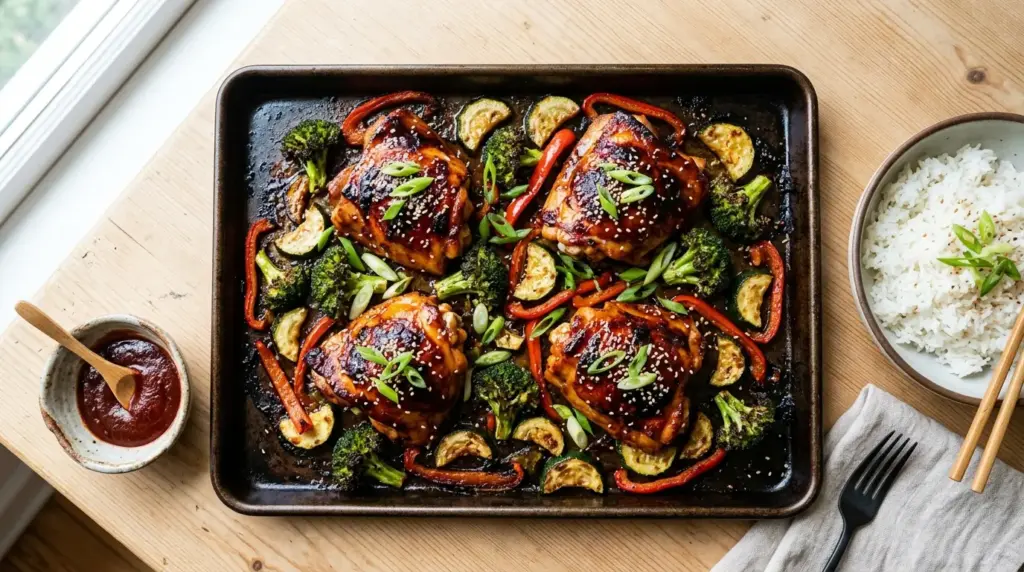
This dish is satisfying on its own, but pairing it thoughtfully really rounds out the meal. The bold, spicy-sweet gochujang sauce pairs best with mild, neutral accompaniments that soak up the extra pan juices without competing with the flavors.
Steamed or lightly seasoned white rice is the most natural pairing, acting like a sponge for all that incredible sauce. Jasmine rice, short-grain rice, and brown rice all work beautifully, as does cauliflower rice for a lower-carb option.
- Cilantro Lime Rice – the brightness of lime and cilantro complements the rich gochujang glaze perfectly
- Chicken Fried Rice – for a heartier rice option with great texture
- Bibimbap – a full Korean-inspired bowl that pairs beautifully with gochujang-marinated chicken
- Asian Chicken Salad – a crisp, refreshing salad to serve alongside the warm chicken
- Roasted Broccoli – if you want even more vegetables on the side
- Quick-pickled cucumber ribbons – thin slices of cucumber marinated in rice vinegar, sugar, and chili flakes make a cooling contrast to the spice
- Butter lettuce leaves – for wrapping leftover chicken into fresh, handheld bites
Variations to Try
Once you have the base recipe down, it’s easy to riff on it in all kinds of directions. The gochujang marinade is incredibly versatile and works with a variety of proteins and vegetables. Here are some ideas to inspire your next batch:
- Chicken breast version: Swap bone-in thighs for boneless, skinless chicken breasts. Pound them to an even thickness of about 0.5 inch (1.2 cm) and reduce the cooking time to 20 to 22 minutes total to prevent them from drying out.
- Shrimp version: Use the same marinade on large shrimp. Roast at 425°F (220°C) for just 8 to 10 minutes until the shrimp are opaque and the edges are caramelized.
- Tofu version: Press extra-firm tofu, cube it, and toss it in the marinade. Roast for 25 to 30 minutes, flipping halfway through, until crispy on the outside.
- Potato add-in: Toss halved baby potatoes in olive oil, salt, and pepper, and add them to the sheet pan for the full 40 minutes of cooking time. They absorb the chicken drippings beautifully.
- Milder version: Reduce the gochujang to 1.5 tablespoons and increase the honey to 2 tablespoons for a sweeter, less fiery result.
- Extra smoky version: Add 1 teaspoon of smoked paprika to the marinade for an additional layer of smoky depth.
- With noodles: Serve the finished chicken and vegetables over cooked glass noodles or soba noodles tossed with a drizzle of sesame oil and soy sauce.
You might also enjoy: Hawaiian Chicken Sheet Pan Dinner
Storage and Reheating
This dish stores and reheats really well, which makes it perfect for meal prep. Here’s how to handle leftovers so they taste as good the next day as they did fresh from the oven:
- Refrigerator storage: Store leftover chicken and vegetables in an airtight container in the refrigerator for up to 4 days. Keep them together so the chicken juices continue to flavor the vegetables.
- Freezer storage: The cooked chicken freezes well on its own for up to 2 months. Place thighs in a single layer in a freezer-safe bag, press out the air, and freeze. The vegetables do not freeze as well and are best consumed fresh.
- Oven reheating (best method): Place leftovers on a sheet pan and reheat at 350°F (175°C) for 12 to 15 minutes, or until heated through. This method keeps the skin from becoming rubbery.
- Skillet reheating: Reheat chicken and vegetables in a skillet over medium-low heat with a splash of water or chicken broth, covered, for 5 to 7 minutes.
- Microwave reheating: Works in a pinch, but covers the chicken to prevent drying and reheat in 1-minute intervals until warmed through.
Read Also: Mediterranean Chicken Sheet Pan Dinner
Nutritional Facts
The following nutritional estimates are based on a single serving (1 chicken thigh with a generous portion of roasted vegetables), assuming 4 servings total. Values may vary depending on the specific size of your chicken thighs and the exact vegetables used.
| Nutrient | Per Serving |
|---|---|
| Calories | ~420 kcal |
| Protein | 34 g |
| Total Fat | 22 g |
| Saturated Fat | 5 g |
| Carbohydrates | 18 g |
| Fiber | 4 g |
| Sugar | 9 g |
| Sodium | 720 mg |
This recipe is naturally high in protein and provides a good balance of healthy fats from the sesame oil and olive oil, along with fiber and micronutrients from the vegetables. To reduce the sodium content, use a low-sodium soy sauce or reduce the amount used in the marinade.
For another filling, protein-rich dinner idea, try the Chicken Breast Sheet Pan Dinner.
Health Benefits of Key Ingredients
This recipe isn’t just delicious. It’s also built on a foundation of genuinely nutritious ingredients that offer real health benefits.
Beyond the flavor, each component brings something valuable to your plate, making this a dish you can feel good about eating regularly.
- Gochujang: Fermented foods like gochujang support gut health by introducing beneficial bacteria. Capsaicin, the compound responsible for gochujang’s heat, has been studied for its potential anti-inflammatory and metabolism-boosting properties.
- Chicken thighs: Dark meat chicken is a rich source of complete protein, along with iron, zinc, and B vitamins including B6 and B12, which support energy metabolism and immune function.
- Broccoli: One of the most nutrient-dense vegetables available, broccoli is loaded with vitamin C, vitamin K, folate, and fiber. It also contains sulforaphane, a compound linked to reduced inflammation and cellular protection.
- Bell peppers: Red bell peppers are exceptionally high in vitamin C, providing more per ounce than citrus fruit. They also contain beta-carotene, which the body converts to vitamin A.
- Garlic: Fresh garlic contains allicin, a sulfur compound with well-documented antimicrobial and cardiovascular-supportive properties. It also adds a depth of flavor that no garlic powder can match.
- Sesame oil: Toasted sesame oil contains sesamol and sesamin, antioxidants that may help reduce oxidative stress. It also provides healthy monounsaturated and polyunsaturated fats.
- Ginger: Fresh grated ginger is a well-known anti-nausea remedy and contains gingerol, a bioactive compound with powerful anti-inflammatory and antioxidant effects.
The Chicken and Broccoli Recipe is another great option if you want a lighter, saucier take on this classic combination.
Frequently Asked Questions
1. What is gochujang and where can I buy it?
Gochujang is a fermented Korean chili paste made from red chili powder, glutinous rice, fermented soybeans, and salt. It has a complex flavor that is simultaneously spicy, sweet, savory, and slightly smoky.
It’s widely available at Asian grocery stores, Whole Foods, Trader Joe’s, and most major supermarkets with international food sections. You can also find it easily online.
2. Can I use chicken drumsticks or chicken breasts instead of thighs?
Drumsticks work beautifully in this recipe with roughly the same cooking time as bone-in thighs. Boneless, skinless chicken breasts can be used but cook faster; pound them to an even thickness and check for doneness around the 20-minute mark.
Bone-in, skin-on thighs are recommended because they stay the juiciest at high roasting temperatures and the skin crisps up perfectly.
3. How spicy is this dish?
That depends largely on the brand of gochujang you use and how much you include. At 3 tablespoons, the heat level is moderate, noticeable but not overwhelming for most palates.
If you’re heat-sensitive, start with 1.5 to 2 tablespoons and taste the marinade before coating the chicken. You can always add more, but you can’t take it away.
4. Can I make this recipe ahead of time?
Absolutely. The marinade can be made up to a week in advance and stored in the refrigerator in an airtight container.
The chicken can be marinated in the refrigerator for up to 4 hours before cooking. The vegetables can be cut and stored in the fridge up to a day ahead, then pulled out when you’re ready to roast.
5. What can I substitute for gochujang if I can’t find it?
If gochujang is truly unavailable, the closest substitute is a mixture of sriracha and a small amount of white miso paste in roughly a 2:1 ratio. This mimics some of the heat and fermented depth of gochujang.
However, the flavor profile will be noticeably different, and if you can find gochujang even online, it’s worth using the real thing for an authentic result.
Another great Asian-inspired dinner to explore is the Pork Chop Stir Fry Recipe.

Gochujang Chicken Sheet Pan Dinner

Equipment
- Large rimmed sheet pan - 18 x 13 inches / 46 x 33 cm
- Parchment paper - or aluminum foil
- Large mixing bowl
- Small mixing bowl - or measuring cup
- Whisk
- Knife
- Cutting board
- Microplane - or box grater for the ginger
- Garlic press - or mincer
- Basting brush - or spoon
- Meat thermometer - to confirm safe internal temperature
Ingredients
- 4 bone-in, skin-on chicken thighs - about 2 lbs or 900 g total
- 3 tablespoons gochujang paste - adjust to your heat preference
- 2 tablespoons soy sauce - or tamari for gluten-free
- 1 tablespoon honey
- 1 tablespoon rice vinegar
- 1 tablespoon toasted sesame oil
- 2 tablespoons olive oil - divided
- 4 cloves garlic - minced
- 1 teaspoon fresh ginger - grated
- 1 head broccoli - cut into florets, about 3 cups or 270 g
- 1 red bell pepper - sliced into strips
- 1 medium zucchini - sliced into half-moons
- Salt - to taste
- Black pepper - to taste
- 2 scallions - thinly sliced, for garnish
- 1 teaspoon toasted sesame seeds - for garnish
Instructions
- Whisk gochujang, soy sauce, honey, rice vinegar, sesame oil, garlic, and ginger until smooth. Reserve 2 tablespoons for later.
- Pat chicken dry, season with salt and pepper, and coat with marinade. Refrigerate for at least 30 minutes or up to 4 hours.
- Preheat oven to 425°F (220°C). Line a sheet pan with parchment paper and drizzle with 1 tablespoon olive oil.
- Toss broccoli, bell pepper, and zucchini with remaining olive oil, salt, and pepper.
- Arrange chicken skin-side up on one side of the pan and spread vegetables in a single layer on the other side.
- Roast for 20 minutes, then brush chicken with reserved marinade and toss vegetables. Return to oven for 15-20 more minutes.
- Cook until chicken reaches 165°F (74°C) and vegetables are tender. Broil for 2-3 minutes for extra caramelization if desired.
- Rest chicken for 5 minutes, then garnish with scallions and sesame seeds. Serve immediately.
Notes
- Dry the chicken: Patting the chicken thighs dry with paper towels before adding the marinade ensures the skin crisps up instead of steaming.
- Don’t skip the reserved marinade: Brushing on a second coat of sauce halfway through cooking creates a gorgeous lacquered, caramelized exterior.
- Give vegetables space: Overcrowding the pan causes vegetables to steam instead of roast. Use two sheet pans if needed.
- Adjust the gochujang: Different brands vary in heat intensity. Start with 2 tablespoons if you’re heat-sensitive and work up from there.
- Marinate longer: Even an extra 30 minutes of marinating time deepens the flavor significantly.
- Storage: Store leftovers in an airtight container in the refrigerator for up to 4 days. Reheat in the oven at 350°F for 12-15 minutes for best results.
- Substitutions: Swap chicken thighs for boneless skinless breasts (reduce cooking time to 20-22 minutes) or use drumsticks with similar cooking time.
- Make it milder: Reduce gochujang to 1.5 tablespoons and increase honey to 2 tablespoons for a sweeter, less fiery result.
- Make it ahead: Marinade can be made up to a week in advance. Vegetables can be cut up to a day ahead and stored in the refrigerator.
Final Thoughts
This Gochujang Chicken Sheet Pan Dinner is one of those recipes that feels like a restaurant-quality dinner with the ease of a weeknight staple.
The combination of deeply savory, spicy, and slightly sweet flavors from the gochujang marinade, the caramelized skin on the chicken, and the beautifully roasted vegetables all coming together on a single pan is just hard to beat.
It’s a dish that’s easy enough to make on a Tuesday but impressive enough to serve to friends on a Friday night.
If you try this recipe, I’d love to hear how it turned out for you. Drop a comment below with your thoughts, any swaps you made, or questions you have. And if someone else in your life would love this recipe, please share it with them!
Recommended:
- Chicken Sheet Pan Dinner
- Sheet Pan Chicken and Veggies Dinner
- Greek Chicken Sheet Pan Dinner
- Parmesan Crusted Chicken Sheet Pan Dinner
- Chicken Sausage Sheet Pan Dinner
- Sheet Pan Tacos Recipe
- Chicken Stir Fry Recipe
- Asian Ground Beef Noodle Bowls
- Tom Yum Soup Recipe
- Kimchi Stew Recipe