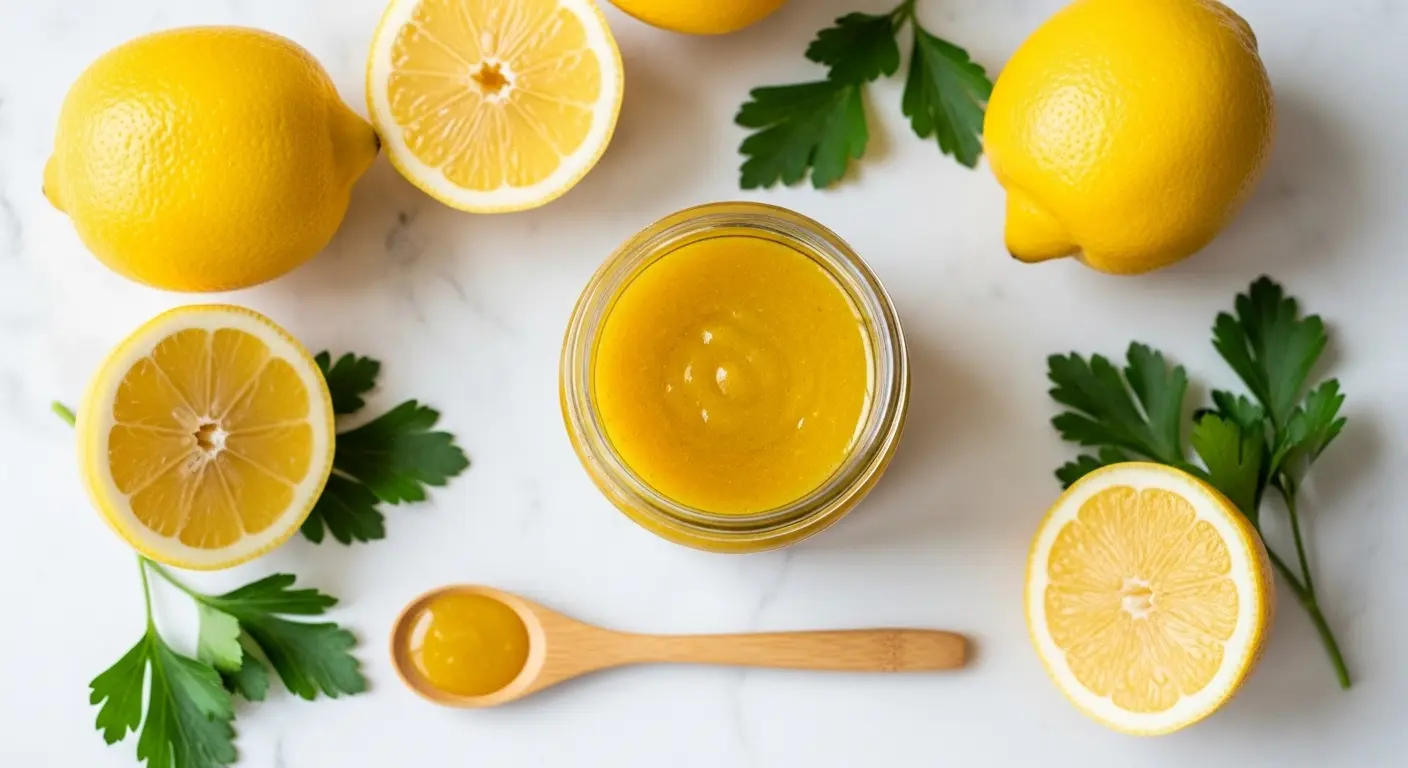
If you’ve ever wanted to bottle up pure sunshine and pour it over your food, this Sunshine Sauce Recipe is about as close as it gets.
It’s bright, tangy, and irresistibly smooth — a citrusy emulsified sauce built on fresh lemon juice, extra virgin olive oil, honey, Dijon mustard, and garlic that comes together in about 10 minutes flat.
This sauce has quietly become one of those recipes people ask for every time it shows up at the table.
It works over grilled chicken, drizzled on roasted vegetables, tossed with pasta, spooned onto fish, or used as a bold dipping sauce for just about everything.
The secret to what makes it so good is the emulsification process: when the olive oil and lemon juice are whisked together with the mustard acting as a binder, they create a creamy, cohesive sauce that clings to food instead of sliding off.
Fresh lemon zest, added along with the juice, cranks up the citrus aroma dramatically because it releases the essential oils from the skin.
And honey balances the tartness without making the sauce sweet — it’s a seasoning tool here, not a sweetener.
Once you make this, you’ll find yourself reaching for it constantly. You might also love the Comeback Sauce Recipe for another versatile, all-purpose condiment that’s just as quick to pull together.
Why You’ll Love This Sunshine Sauce Recipe
This sauce earns a permanent spot in your condiment rotation from the very first batch.
It takes less than 10 minutes from start to finish, with zero cooking required.
The ingredient list is short and practical — everything here is a pantry or refrigerator staple that most home cooks already keep on hand.
Here’s exactly why this recipe stands out:
- Incredibly versatile — works as a marinade, dipping sauce, salad dressing, pasta sauce, or a drizzle over grain bowls
- No cooking needed — just whisk or shake and it’s done
- Made from scratch with real ingredients — no preservatives, no mystery additives
- Naturally gluten-free — safe for gluten-sensitive households
- Customizable — adjust the heat, citrus, herbs, or sweetness to suit your taste
- Stays fresh for up to 2 weeks — make a batch on Sunday and use it all week long
- Crowd-pleasing flavor — the bright, tangy profile appeals to almost everyone
Another favorite: Vodka Sauce Recipe
Ingredients
This Sunshine Sauce Recipe keeps things simple. Each ingredient has a specific purpose, and none of them are interchangeable without affecting the final texture or flavor.
The Dijon mustard is particularly important here — it acts as an emulsifier, chemically bonding the oil and lemon juice so they don’t separate into a watery, broken sauce.
- 3 tablespoons (45 ml) fresh lemon juice (about 1 large lemon)
- 1 teaspoon lemon zest
- 1/4 cup (60 ml) extra virgin olive oil
- 1 tablespoon Dijon mustard
- 1 tablespoon raw honey
- 2 cloves garlic, minced
- 1/4 teaspoon crushed red pepper flakes (optional, for a subtle kick)
- 2 tablespoons fresh parsley, finely chopped
- 1/4 teaspoon kosher salt (or to taste)
- 1/4 teaspoon freshly ground black pepper
This recipe makes about 3/4 cup (180 ml) of sauce, which serves 6 at approximately 2 tablespoons per serving.
This pairs beautifully with Baked Salmon for a complete, restaurant-quality weeknight dinner.
Kitchen Equipment Needed
You don’t need any specialized equipment to pull this sauce off.
A simple mason jar and an immersion blender will give you the creamiest, most emulsified result, but a bowl and a whisk work perfectly well if that’s what you have.
- Medium mixing bowl or a wide-mouth mason jar
- Immersion blender (preferred for silky texture) or a standard whisk
- Microplane zester for the lemon zest
- Citrus juicer to extract maximum juice from the lemon
- Sharp knife and cutting board for mincing the garlic and parsley
- Measuring spoons and cups
- Airtight glass jar or container for storage
Read Also: Hollandaise Sauce Recipe
Recommended Products for This Recipe
These are products I genuinely recommend based on quality, performance, and how much of a difference they make when making this sauce.
1. Microplane Classic Zester Grater
Lemon zest is non-negotiable in this recipe, and a quality zester is what separates clean, fragrant zest from bitter white pith. The Microplane glides effortlessly over citrus skin, capturing only the flavorful oils. It’s one of those kitchen tools that pays for itself after the first use.
2. KitchenAid Hand Blender (Immersion Blender)
The jar-shake method works well, but an immersion blender takes this sauce to the next level. It creates an exceptionally smooth, creamy emulsion in seconds and requires almost no cleanup afterward. If you make sauces, soups, or dressings regularly, this tool is worth having.
3. Pompeian Organic Extra Virgin Olive Oil
The quality of your olive oil directly affects the flavor of this sauce. A good extra virgin olive oil with a fruity, peppery profile adds depth and complexity that neutral vegetable oils simply can’t replicate. This is the fat base of the entire recipe, so don’t skimp here.
4. Ball Wide Mouth Mason Jars
These are ideal for storing this sauce and for shaking it directly in the jar as a low-effort alternative to whisking. The wide mouth makes it easy to pour cleanly, and the lids seal tightly so the sauce stays fresh in the refrigerator for up to two weeks.
5. Maille Dijon Originale Mustard
Not all Dijon mustards are created equal, and this classic French variety has a smooth, sharp, properly tangy flavor that makes the emulsification in this sauce seamless. It adds the right amount of bite without overpowering the citrus.
You might also enjoy: Teriyaki Sauce Recipe
Step-by-Step Instructions
1. Prepare Your Citrus
- Roll the lemon firmly on the counter with the palm of your hand before cutting — this breaks down the internal membranes and dramatically increases how much juice you get.
- Use your Microplane zester to zest the lemon over a small bowl, grating only the bright yellow outer skin and stopping before you hit the white pith underneath. Aim for 1 teaspoon (about 2 g) of packed zest.
- Cut the lemon in half and use your citrus juicer to extract the juice. You need 3 tablespoons (45 ml) of fresh juice. If your lemon is small, juice a second one and measure.
- Set the zest and juice aside in the same small bowl so they’re ready to go.
2. Mince the Garlic
- Peel 2 cloves of garlic and place them on your cutting board.
- Use the flat side of your knife to smash each clove firmly — this loosens the skin and starts breaking down the cell walls for easier mincing.
- Mince the garlic as finely as possible. The finer the mince, the more evenly the garlic distributes through the sauce without any harsh chunks.
- If you want a milder garlic flavor, you can grate it on the Microplane instead — this creates an almost paste-like texture that blends completely invisible into the sauce.
3. Chop the Parsley
- Pick 2 tablespoons worth of fresh flat-leaf parsley leaves off the stems. Flat-leaf (Italian) parsley has a stronger, more herbaceous flavor than curly parsley, so it’s the better choice here.
- Gather the leaves into a tight pile on your cutting board and chop through them with a rocking motion until finely minced.
- Set aside. The parsley goes in last to preserve its color and fresh flavor.
4. Combine the Base Ingredients
- Add the fresh lemon juice, lemon zest, Dijon mustard, and honey to your mixing bowl or mason jar.
- Whisk these together first (or seal the jar and shake) until the honey is fully dissolved into the lemon juice. This step ensures the honey won’t clump when the oil is added.
- Add the minced garlic, crushed red pepper flakes (if using), kosher salt, and black pepper to the bowl.
- Stir briefly to combine.
5. Emulsify with the Olive Oil
- This is the most important step. If you’re using a whisk: drizzle the olive oil in very slowly — start with just a few drops at a time while whisking constantly. As the sauce starts to thicken and become creamy, you can increase the stream slightly, but keep whisking the entire time.
- If you’re using an immersion blender: add all ingredients to a wide-mouth jar, position the blender at the bottom, and blend for 20–30 seconds while slowly pulling the blender upward through the mixture. This creates a perfectly emulsified sauce in seconds.
- If you’re using the jar-shake method: add everything to a mason jar, seal it tightly, and shake vigorously for 45–60 seconds. The mustard will help hold the emulsion. This is the quickest but least stable method — the sauce may separate faster in storage.
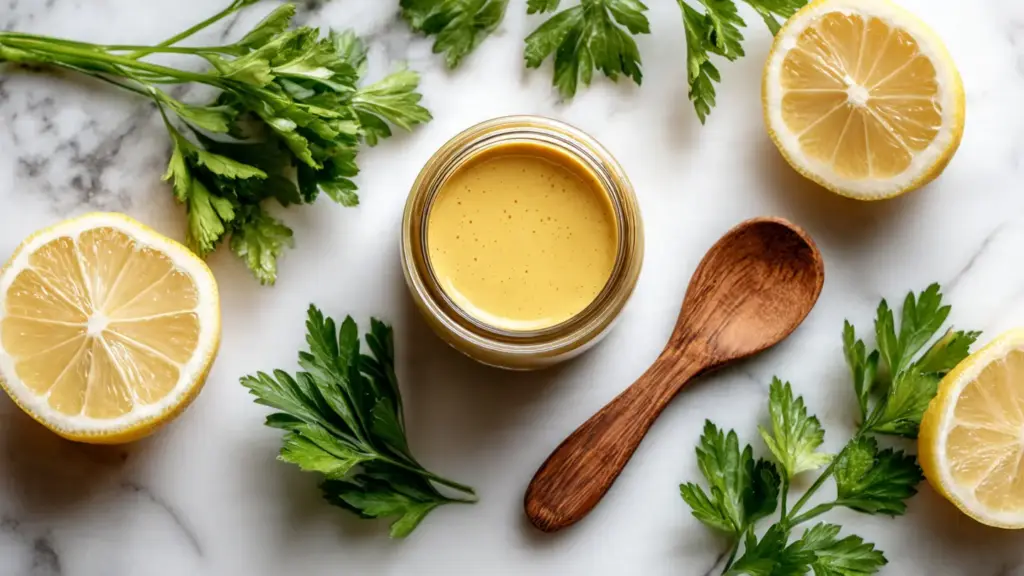
- You’ll know the emulsification worked when the sauce turns from a thin, oily mixture into a smooth, creamy, uniformly pale-yellow sauce with a consistency similar to a thick vinaigrette.
6. Finish with Parsley and Taste
- Stir in the freshly chopped parsley.
- Taste the sauce and adjust the seasoning. If it’s too tart, add a small drizzle more of honey. If it’s too sweet, add a few more drops of lemon juice. If it needs more depth, add a small pinch of salt and stir.
- The flavors will continue to meld and develop as the sauce sits, so letting it rest for 5–10 minutes before serving makes a noticeable difference.
7. Serve or Store
- Transfer the finished sauce to a clean glass jar or airtight container.
- Serve at room temperature for the best flavor — cold sauce dulls the citrus notes significantly.
- If the sauce has been refrigerated and the oil has solidified, let it sit at room temperature for 10 minutes, then stir or shake well before serving.
This same emulsification technique used here works wonderfully for making Homemade Alfredo Sauce from scratch if you enjoy making sauces at home.
Tips for Success
Getting the most out of this sauce comes down to a few key technique points that make a genuine difference in the final result.
Keep these in mind before you start:
- Always use fresh lemon juice — bottled lemon juice has a flat, slightly metallic flavor that dulls the entire sauce. Fresh is non-negotiable for this one.
- Don’t skip the lemon zest — the zest contains aromatic essential oils that give the sauce its distinctive “sunshine” quality. The juice provides tartness; the zest provides fragrance.
- Use room-temperature ingredients — cold olive oil emulsifies more reluctantly. If your olive oil has been stored in a cool cabinet, let it sit at room temperature for a few minutes before making the sauce.
- Add the oil slowly when whisking — pouring it in all at once causes the sauce to break (separate into oily and watery layers). Slow and steady creates the creamy emulsion.
- Taste as you go — the balance between tart, sweet, and savory is everything in this sauce. Adjust before you serve.
- Let it rest — five to ten minutes of resting time allows the garlic and herbs to infuse more deeply into the oil.
- Shake or stir before each use — even a properly emulsified sauce will separate slightly in the refrigerator. A quick stir or shake brings it right back together.
Read Also: Bang Bang Sauce Recipe
Serving Suggestions
This sauce is remarkably adaptable, and it genuinely improves nearly everything it touches.
The bright citrus notes cut through rich, fatty proteins while the honey rounds out the sharpness, making it work as both a contrast and a complement to a huge range of dishes.
Here are some of the best ways to use it:
- Grilled or baked chicken — drizzle generously over the top just before serving or use as a finishing sauce after cooking
- Fish and seafood — particularly excellent with Air Fryer Salmon, baked cod, and shrimp
- Roasted vegetables — toss warm roasted broccoli, carrots, zucchini, or asparagus with a spoonful right after they come out of the oven
- Grain bowls and rice bowls — use in place of a salad dressing over quinoa, farro, or brown rice with roasted proteins
- Pasta — toss cooked pasta with a few tablespoons of this sauce and a splash of pasta water for a simple weeknight dinner
- Dipping sauce — serve alongside Air Fryer Chicken Tenders, spring rolls, or raw vegetable crudités
- Salad dressing — works beautifully over mixed greens, arugula, or chopped salads
- Sandwich spread — use in place of mayo on wraps, burgers, or grain bowls
- Marinade — coat chicken, fish, or tofu and let it sit for at least 30 minutes before cooking
Variations to Try
Once you’ve nailed the base recipe, the fun really starts.
This sauce is built to be customized, and small adjustments completely change its personality:
- Spicy Sunshine Sauce — double the red pepper flakes and add 1/2 teaspoon of cayenne pepper for a fiery kick
- Creamy Sunshine Sauce — whisk in 2 tablespoons of Greek yogurt or sour cream for a richer, tangier, thicker consistency
- Herby Sunshine Sauce — replace or supplement the parsley with fresh dill, cilantro, basil, or chives for a different herbal dimension
- Asian-Inspired Sunshine Sauce — substitute half the lemon juice with lime juice, add 1 teaspoon of fresh grated ginger and 1 teaspoon of rice vinegar
- Orange Sunshine Sauce — substitute 1 tablespoon of the lemon juice with freshly squeezed orange juice for a sweeter, slightly floral variation that’s stunning on pork or roasted carrots
- Smoky Sunshine Sauce — add 1/2 teaspoon of smoked paprika and a tiny splash of liquid smoke for a BBQ-adjacent twist
- Garlic-Forward Sunshine Sauce — increase garlic to 4 cloves and roast them first for a mellow, deeply savory flavor
You might also enjoy: Alabama White Sauce
Storage and Reheating
This sauce stores exceptionally well, which makes it perfect for batch cooking and weekly meal prep.
A single batch made on a Sunday can last you through the entire week:
- Refrigerator storage — transfer to an airtight glass jar and refrigerate for up to 2 weeks. Always use a clean, dry spoon to avoid introducing bacteria.
- Room temperature — this sauce should not be left out at room temperature for more than 2 hours due to the fresh garlic and parsley.
- Freezing — not recommended. Oil-and-acid emulsions typically break upon freezing and thawing, resulting in a separated, grainy texture.
- Reheating — if the sauce has solidified in the refrigerator (which the olive oil will do when cold), remove it from the fridge 10–15 minutes before serving and let it come to room temperature naturally. Stir or shake well before using.
- Reviving a separated sauce — if the sauce breaks (separates), add 1 teaspoon of water and whisk vigorously, or re-blend briefly with the immersion blender to bring it back together.
Read Also: Creole Sauce Recipe
Nutritional Facts
The following values are approximate and based on a 2-tablespoon serving. Total yield is approximately 6 servings.
| Nutrient | Per Serving (2 tbsp) |
|---|---|
| Calories | ~95 kcal |
| Total Fat | 9 g |
| Saturated Fat | 1.3 g |
| Carbohydrates | 4 g |
| Sugar | 3 g |
| Protein | 0.2 g |
| Sodium | 105 mg |
| Fiber | 0.1 g |
| Vitamin C | ~6 mg (7% DV) |
The majority of calories come from the heart-healthy monounsaturated fats in olive oil. The natural sugars come almost entirely from the honey, which is present in a very small quantity per serving.
Another favorite: Stir Fry Sauce Recipe
Health Benefits of Key Ingredients
Every ingredient in this sauce does more than add flavor — each one brings meaningful nutritional value to the table.
Understanding what’s going into your food makes using it liberally feel even better:
- Extra virgin olive oil — one of the most studied fats in the world, associated with reduced inflammation and improved cardiovascular health. Its oleocanthal compound functions similarly to ibuprofen as an anti-inflammatory agent.
- Fresh lemon juice — a strong natural source of vitamin C, which supports immune function, collagen synthesis, and iron absorption. The acidity also acts as a natural preservative in the sauce.
- Lemon zest — contains flavonoids and limonene, plant compounds linked to antioxidant activity and potential cancer-protective effects. The zest is arguably more nutritionally dense than the juice itself.
- Raw honey — contains trace enzymes, antioxidants, and antimicrobial properties not found in processed sugar. Used in small amounts, it provides sweetness without a significant blood sugar spike.
- Garlic — one of the most well-documented functional foods, garlic contains allicin, a compound with proven antibacterial, antiviral, and cardiovascular benefits. Fresh minced garlic has higher allicin content than pre-minced or powdered versions.
- Fresh parsley — an underrated nutritional powerhouse that’s rich in vitamin K, vitamin C, and folate. It also contains compounds that may support bone health and reduce inflammation.
Read Also: Peanut Sauce Recipe
Frequently Asked Questions
1. Can I use bottled lemon juice instead of fresh?
Fresh lemon juice is strongly recommended for this recipe. Bottled lemon juice has a noticeably flat, metallic taste that dulls the bright citrus character the sauce is built around.
Fresh juice takes about 30 seconds to squeeze and makes a significant difference in flavor. If fresh lemons aren’t available, bottled juice will work in a pinch, but the result won’t have the same vibrancy.
2. Why did my sauce separate?
Sauce separation happens when the emulsion breaks, usually because the oil was added too quickly, the ingredients were at very different temperatures, or the sauce was agitated after sitting in the refrigerator.
To fix it, add 1 teaspoon of room-temperature water and whisk vigorously, or use an immersion blender to bring it back together in seconds.
3. Can I make this sauce ahead of time?
Absolutely — this sauce actually improves with a little resting time as the garlic and herbs infuse more deeply into the oil. You can make it up to 2 weeks ahead and store it in an airtight glass jar in the refrigerator.
Just let it come to room temperature and give it a good shake or stir before using it.
4. Is this sauce vegan?
The standard recipe contains honey, which makes it not strictly vegan. To make it fully vegan, substitute the honey with an equal amount of agave nectar or pure maple syrup.
Maple syrup adds a subtle caramelized note that’s actually quite lovely with the lemon, so it’s a worthwhile swap even if you’re not avoiding honey.
5. What is the best way to use this as a marinade?
Pour the sauce over your protein of choice in a resealable bag or shallow dish and refrigerate for at least 30 minutes for fish, or up to 4 hours for chicken. Because the sauce contains lemon juice (an acid), marinating for longer than 4–6 hours can start to break down the texture of delicate proteins like fish.
Pat the protein dry before cooking to ensure proper browning and avoid steaming instead of searing.
This sauce pairs particularly well as a marinade for Air Fryer Chicken Breast — the citrus and olive oil keep the meat incredibly moist.
Final Thoughts
This Sunshine Sauce Recipe is the kind of recipe that sounds almost too simple to be worth writing down — until you make it and realize it changes the way you cook.
It takes ten minutes, uses ingredients you already have, and makes everything it touches taste more alive.
Whether you’re drizzling it over weeknight chicken, tossing it with leftover vegetables, or keeping a jar in the refrigerator for spontaneous moments of flavor, this sauce consistently delivers.
Give it a try this week — one batch, and I’m confident it’ll earn a permanent place in your kitchen.
If you make it, leave a comment below and let me know what you served it with. Sharing how you used the sauce is one of the best parts of this community, and I genuinely love hearing about your kitchen experiments.
Recommended:
- Comeback Sauce Recipe
- Tomato Sauce Recipe
- Worcestershire Sauce Recipe
- Caramel Sauce Recipe
- Cheese Sauce Recipe
- Buffalo Sauce Recipe
- Burger Sauce Recipe
- Yum Yum Sauce Recipe
- Pizza Sauce Recipe
- BBQ Sauce Recipe