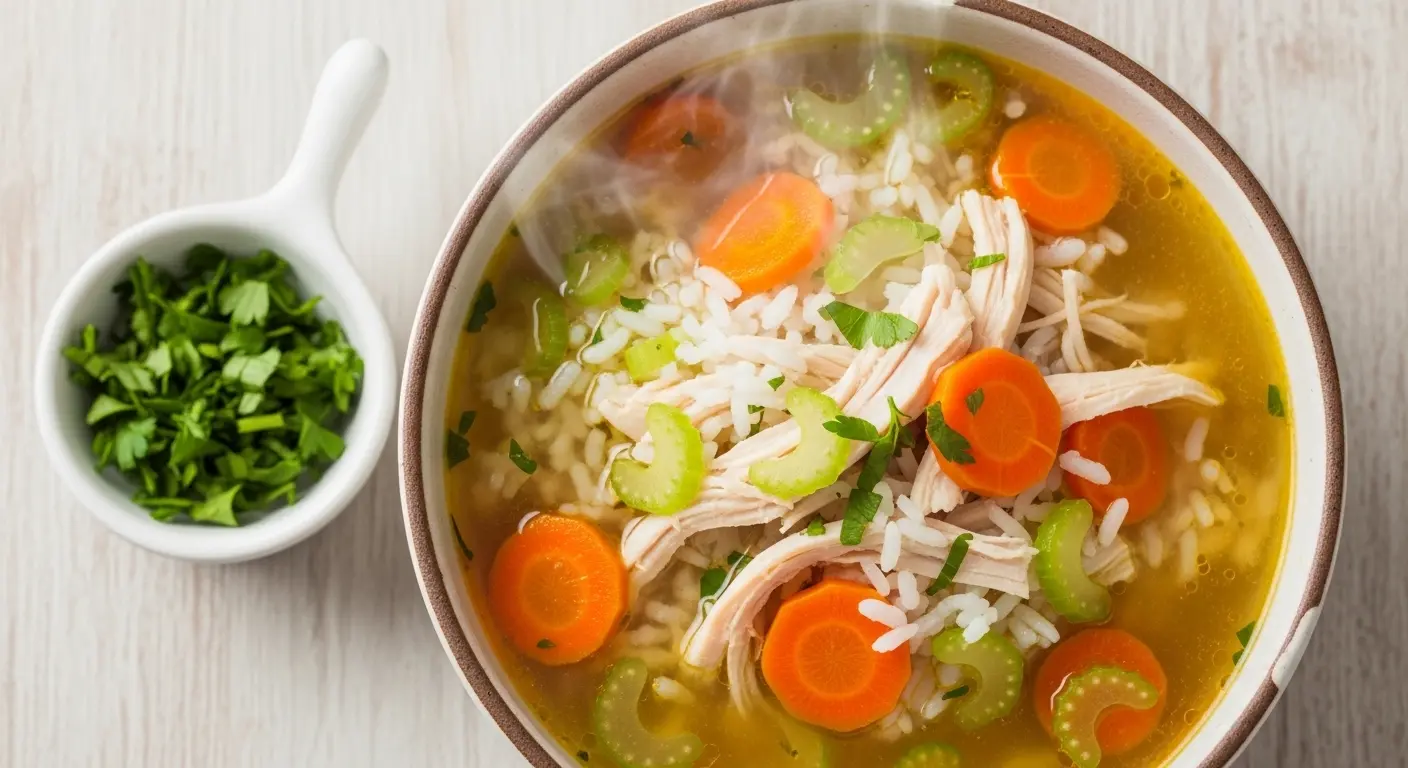
Few soups hit quite like a homemade chicken rice soup recipe made from scratch. It’s the kind of meal that fills your kitchen with the most inviting aroma, wraps you in warmth from the first spoonful, and tastes like it’s been simmering all day even when it hasn’t.
This recipe uses a simple but powerful combination: bone-in chicken thighs simmered in a rich, golden broth with the classic mirepoix of onion, carrots, and celery, then finished with long-grain white rice that soaks up all that savory flavor as it cooks.
What makes this version stand out from the rest is technique. Cooking the chicken directly in the broth rather than adding pre-cooked chicken is the secret to a soup with real depth. The chicken releases its juices and natural gelatin into the liquid, building a broth that’s impossibly rich without any extra effort.
This is a one-pot wonder that comes together in about 45 minutes and serves the whole family with ease. It’s also naturally gluten-free and dairy-free, making it a universally crowd-pleasing bowl that suits most dietary needs without any swaps needed.
If you love cozy chicken soups, you’ll also want to check out this Chicken Tortilla Soup Recipe for another warming, weeknight-friendly option.
Why You’ll Love This Chicken Rice Soup Recipe
This soup has earned a permanent spot on the weekly rotation for good reason.
It’s genuinely simple to make, even for beginner cooks. There are no complicated techniques here, just basic knife skills, one pot, and a little patience while things simmer.
The ingredients are budget-friendly and almost always already in your fridge and pantry. Chicken thighs, a few vegetables, a box of broth, and a cup of rice is all it takes.
It’s the ultimate make-ahead meal. This soup tastes even better the next day as the flavors continue to develop overnight in the fridge.
The broth is golden, clear, and deeply flavored thanks to cooking raw chicken directly in it. You’ll never want canned chicken soup again.
It’s endlessly customizable. Add kale, peas, lemon juice, or extra herbs depending on what you have on hand.
This recipe is naturally gluten-free and dairy-free, so it works for a wide range of eaters without any modification.
It freezes beautifully. Make a big batch, freeze individual portions, and you’ll have a ready-to-go comforting meal any time you need one.
You might also enjoy: Chicken Vegetable Soup Recipe
Ingredients
This chicken rice soup recipe relies on simple, quality ingredients that work together to build a flavorful and satisfying bowl. Don’t skip the bone-in chicken thighs if you can help it as they add far more richness to the broth than boneless, skinless chicken breast.
- 1.5 lbs (680g) bone-in, skin-on chicken thighs
- 1 tablespoon olive oil
- 1 medium yellow onion, diced (about 1 cup / 150g)
- 3 medium carrots, peeled and sliced into rounds (about 1 cup / 130g)
- 3 stalks celery, sliced (about 1 cup / 100g)
- 4 cloves garlic, minced
- 1 cup (185g) long-grain white rice, uncooked
- 6 cups (1.4 liters) low-sodium chicken broth
- 2 cups (480ml) water
- 1 teaspoon dried thyme
- 1 teaspoon dried parsley
- 1/2 teaspoon dried oregano
- 1 bay leaf
- 1 teaspoon salt, plus more to taste
- 1/2 teaspoon black pepper, plus more to taste
- Fresh parsley, for garnish (optional)
Read Also: Chicken Soup Recipe
Kitchen Equipment Needed
You don’t need any fancy equipment to pull this soup together. Most of what you need is probably already in your kitchen, but having the right tools does make the process smoother and more enjoyable.
- Large Dutch oven or heavy-bottomed soup pot (at least 6 quarts / 5.7 liters)
- Chef’s knife and cutting board
- Vegetable peeler
- Wooden spoon or silicone spatula
- Ladle
- Two forks for shredding chicken
- Measuring cups and spoons
Recommended Products for This Recipe
These are products I genuinely recommend based on quality and how much of a difference they make in this recipe.
1. Large Enameled Cast Iron Dutch Oven
A good enameled cast iron Dutch oven distributes heat evenly from the bottom and up the sides, which means your vegetables soften uniformly and your broth simmers gently rather than scorching. It’s the kind of pot that makes soups taste like they came from a restaurant kitchen. The enamel interior also doesn’t hold onto flavors, so cleanup is a breeze.
2. Low-Sodium Organic Chicken Broth
The broth is the backbone of this soup, so quality matters. A low-sodium organic chicken broth lets you control the salt level without sacrificing flavor. Brands that use real chicken and no artificial additives produce a noticeably cleaner, more savory base.
3. Long-Grain White Rice
Using a high-quality long-grain white rice makes a difference in texture. Long-grain varieties hold their shape during simmering and don’t turn mushy as quickly as short-grain or medium-grain alternatives. Look for aged long-grain rice for the best results.
4. Immersion Blender (Optional)
If you want a slightly thicker broth, an immersion blender lets you blend a small portion of the soup right in the pot. This is an optional step, but it’s a great tool to have for soups and sauces in general.
This technique also works beautifully in a Chicken Mushroom Soup if you’re looking to expand your soup repertoire.
Step-by-Step Instructions
Step 1: Prep Your Vegetables
- Peel and slice the carrots into rounds about 1/4 inch (0.6 cm) thick. Even slices ensure they cook at the same rate.
- Dice the onion into medium pieces, roughly 1/2 inch (1.3 cm). No need to be precise here.
- Slice the celery stalks at a similar size to the onion so everything cooks evenly.
- Mince the garlic finely. Fresh garlic is strongly preferred here over jarred, as it adds a brighter, more pungent flavor to the soup base.
- Set everything aside in small prep bowls so you can work quickly once the pot is hot.
Step 2: Sear the Chicken Thighs
- Heat 1 tablespoon of olive oil in your Dutch oven or large soup pot over medium-high heat.
- Pat the chicken thighs dry with a paper towel. This step is important because moisture on the surface of the chicken will cause it to steam instead of sear.
- Place the chicken thighs skin-side down in the hot oil. You should hear a sizzle immediately.
- Sear for 3 to 4 minutes without moving them. You’re looking for a golden-brown crust on the skin side.
- Flip and sear the other side for 2 minutes. The chicken won’t be cooked through at this point, and that’s fine.
- Remove the chicken from the pot and set it aside on a plate. Leave the rendered fat in the pot; it’s full of flavor.
Step 3: Sauté the Aromatics
- Reduce the heat to medium. Add the diced onion, sliced carrots, and sliced celery to the same pot where you seared the chicken.
- Stir to coat the vegetables in the remaining fat and chicken drippings.
- Sauté for 4 to 5 minutes, stirring occasionally, until the onion becomes translucent and the vegetables just start to soften.
- Add the minced garlic and stir constantly for 1 minute. Garlic burns quickly, so don’t walk away during this step.
- You should smell the garlic become fragrant and slightly golden at the edges.
Step 4: Build the Broth
- Return the seared chicken thighs to the pot, nestling them in among the vegetables.
- Pour in the 6 cups (1.4 liters) of chicken broth and 2 cups (480ml) of water. The liquid should nearly cover the chicken.
- Add the dried thyme, dried parsley, dried oregano, bay leaf, 1 teaspoon of salt, and 1/2 teaspoon of black pepper. Stir gently to combine.
- Raise the heat to high and bring the soup to a full boil.
Step 5: Simmer the Chicken
- Once boiling, reduce the heat to medium-low to maintain a gentle simmer. You want small, lazy bubbles breaking the surface, not a rolling boil.
- Cover the pot with a lid, leaving it slightly ajar to allow some steam to escape.
- Simmer for 20 to 25 minutes, until the chicken is fully cooked through and very tender. You can check by inserting an instant-read thermometer; it should read 165°F (74°C).
Step 6: Remove and Shred the Chicken
- Use tongs to carefully lift the chicken thighs out of the pot and transfer them to a cutting board or large bowl.
- Allow the chicken to cool for 3 to 5 minutes so it’s easier to handle.
- Remove and discard the skin and bones. The chicken meat should pull apart very easily at this stage.
- Use two forks to shred the chicken into bite-sized pieces. Aim for pieces that are about 1 to 1.5 inches (2.5 to 4 cm) in length so they’re easy to eat with a spoon.
- Set the shredded chicken aside.
Step 7: Cook the Rice
- With the soup still at a gentle simmer, add the 1 cup (185g) of uncooked long-grain white rice to the pot.
- Stir to distribute the rice evenly throughout the broth.
- Keep the pot simmering, uncovered, for 15 to 18 minutes, stirring every 5 minutes to prevent the rice from clumping or sticking to the bottom of the pot.
- The rice is done when it’s tender all the way through but still holds its shape and hasn’t turned mushy.
Step 8: Add the Chicken Back and Finish the Soup
- Add the shredded chicken back into the pot and stir to distribute it evenly through the soup.
- Remove and discard the bay leaf.
- Taste the soup carefully and adjust seasoning with more salt and black pepper as needed. The right amount of salt is what takes this soup from good to outstanding.
- Ladle the soup into bowls and garnish with a little fresh chopped parsley if desired.
- Serve immediately while hot.
Read Also: Lemon Chicken Orzo Soup Recipe
Tips for Success
A few small details make a big difference between a decent chicken rice soup and an absolutely incredible one. Keep these in mind before you start cooking.
- Use bone-in chicken thighs. The bones and skin release collagen and fat as they cook, giving your broth a richer, more satisfying body. Boneless skinless chicken breast is leaner and produces a thinner broth.
- Don’t skip searing the chicken. The browning reaction (known as the Maillard reaction) creates dozens of new flavor compounds that simply dissolve into the broth as the soup simmers. It adds a savory depth you cannot achieve by just adding raw chicken to the liquid.
- Add rice at the right time. Add it after the chicken has already simmered and been removed. This way the rice doesn’t overcook while you’re waiting on the chicken, and it cooks directly in the flavorful broth for maximum flavor absorption.
- Season in layers. Add a baseline of salt at the start, but always taste and adjust at the end. Chicken broth brands vary widely in sodium content, so you may need more or less than the recipe calls for.
- Keep the simmer gentle. Boiling the soup vigorously at high heat will make the chicken tough and cloudy your broth. A lazy, gentle simmer keeps the broth clear and the chicken tender.
- Make it ahead without the rice. If prepping in advance, cook the soup without the rice and store them separately. Add the rice to individual portions at serving time to prevent it from soaking up all the broth overnight.
You might also enjoy: Chicken Gnocchi Soup Recipe
Serving Suggestions
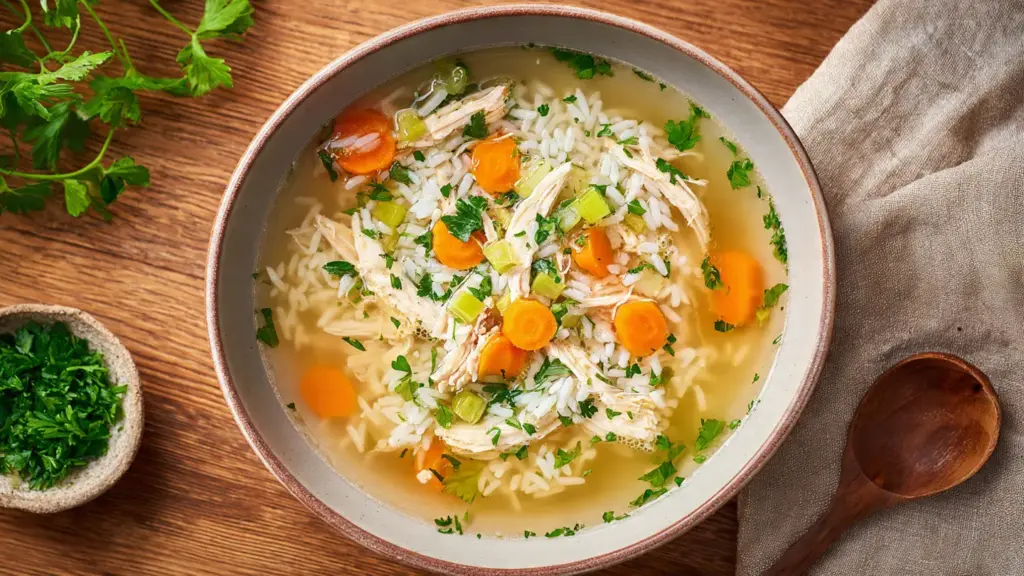
Chicken rice soup is a complete meal in a bowl, but pairing it with the right sides takes the whole experience up a notch.
A thick slice of crusty bread or a warm Dinner Roll is the classic companion for a reason. You’ll want something to drag through the bottom of the bowl once the chicken and rice are gone.
- Warm, crusty artisan bread or sourdough
- Buttermilk Biscuits for a Southern-inspired pairing
- A simple green salad with a light vinaigrette to cut through the richness of the broth
- Classic Deviled Eggs as a protein-rich starter before the soup
- Easy Garlic Bread for an irresistible dipping option
- A simple cucumber and tomato salad dressed with olive oil and lemon for a fresh contrast
Variations to Try
This recipe is a rock-solid base that takes well to all kinds of additions and tweaks. Once you’ve made the original version, consider exploring some of these ideas.
- Lemon chicken rice soup: Add the juice of one fresh lemon and a teaspoon of lemon zest at the very end of cooking. The brightness of the citrus lifts the whole dish and gives it a Greek-inspired feel similar to avgolemono.
- Creamy chicken rice soup: Stir in 1/2 cup (120ml) of heavy cream or full-fat coconut milk during the last 5 minutes of cooking for a velvety, richer version.
- Wild rice chicken soup: Swap out the long-grain white rice for wild rice or a wild rice blend. Wild rice takes longer to cook (about 45 minutes) so add it earlier in the process.
- Slow cooker version: Add all ingredients except the rice to a slow cooker. Cook on low for 6 to 7 hours or on high for 3 to 4 hours. Shred the chicken, return it to the pot, then stir in the rice and cook on high for another 20 to 30 minutes until tender.
- Add leafy greens: Stir in a couple of handfuls of fresh baby spinach or chopped kale right at the end of cooking. They’ll wilt quickly and add a boost of nutrition.
- Herby upgrade: Add a sprig of fresh rosemary and a few fresh thyme sprigs to the broth while simmering. Remove before serving for a more aromatic, complex soup.
For another hearty chicken and rice combination, try the Chicken Broccoli Rice Casserole Recipe.
Storage and Reheating
This soup keeps well and actually improves after a night in the fridge, making it a smart choice for meal prep. Just be aware that the rice will continue to absorb broth during storage, so the leftovers will be noticeably thicker than when freshly made.
- Refrigerator: Transfer cooled soup to an airtight container and refrigerate for up to 4 days.
- Freezer: Cool the soup completely, then transfer to freezer-safe bags or containers. Freeze for up to 3 months. For best results when freezing, store the rice separately from the soup.
- Reheating on the stovetop: Transfer the desired amount to a small saucepan over medium heat. Add a splash of chicken broth or water to loosen the consistency before heating, as the rice will have absorbed liquid during storage. Stir occasionally and heat until hot throughout, about 5 to 7 minutes.
- Reheating in the microwave: Place the soup in a microwave-safe bowl and add a splash of broth or water. Cover loosely and heat on high in 90-second increments, stirring between each, until thoroughly hot.
- Tip for meal prep: Cook the soup base without the rice and store them separately. This prevents the rice from becoming overly soft during storage.
Read Also: Matzo Ball Soup Recipe
Nutritional Facts
The following is an estimate per serving based on 6 servings from this recipe. Actual values will vary depending on exact ingredient brands and portion sizes.
| Nutrient | Amount Per Serving |
|---|---|
| Calories | 310 kcal |
| Protein | 26g |
| Carbohydrates | 28g |
| Fat | 9g |
| Saturated Fat | 2g |
| Fiber | 2g |
| Sugar | 3g |
| Sodium | 620mg |
| Cholesterol | 75mg |
| Vitamin A | 4,500 IU |
| Vitamin C | 6mg |
| Calcium | 45mg |
| Iron | 1.5mg |
This soup is a naturally well-balanced meal providing a solid combination of lean protein, complex carbohydrates from the rice, and micronutrients from the vegetables.
Another nutritious and comforting option worth exploring is the Moroccan Lentil Soup Recipe.
Health Benefits of Key Ingredients
This chicken rice soup isn’t just comfort food; it’s genuinely nourishing. Each major ingredient contributes meaningful benefits to your overall health and wellbeing.
The combination of chicken, vegetables, and rice provides a complete, balanced meal that supports energy levels, immune function, and overall wellness in one satisfying bowl.
- Chicken thighs are an excellent source of high-quality protein, which supports muscle maintenance and repair. They also contain zinc, selenium, and B vitamins including B6 and B12, all of which play important roles in immune function and energy metabolism.
- Carrots are packed with beta-carotene, which your body converts into vitamin A. Vitamin A is essential for eye health, immune function, and healthy skin. Carrots also provide dietary fiber to support digestive health.
- Celery is extremely low in calories but provides a useful amount of vitamin K, potassium, and antioxidants. It also contains compounds called phthalides, which have been studied for their potential to support cardiovascular health.
- Garlic contains allicin, a bioactive compound that has well-documented antimicrobial and anti-inflammatory properties. Regular consumption of garlic has been associated with improved immune response and cardiovascular health.
- Chicken broth provides collagen from the chicken bones, which supports joint health and gut lining integrity. It also contributes minerals including calcium, magnesium, and phosphorus.
- Long-grain white rice is an easily digestible source of energy. It’s gentle on the digestive system, which is part of why chicken soup with rice has long been a go-to when someone is feeling under the weather.
For another vegetable-forward soup with impressive nutritional credentials, explore this Spinach Soup Recipe.
Frequently Asked Questions
1. Can I use chicken breast instead of chicken thighs?
Yes, boneless skinless chicken breasts can be used in place of thighs. Be aware that chicken breast is leaner and can dry out more easily if overcooked. Add it directly to the broth without searing and simmer just until the internal temperature reaches 165°F (74°C), which typically takes about 15 to 18 minutes depending on the size of the breasts. Remove and shred immediately to prevent overcooking.
2. Why does my chicken rice soup get too thick after storing it?
Rice continues to absorb liquid even after the soup is removed from heat. As it sits in the refrigerator, the rice swells and soaks up the surrounding broth, transforming a nicely balanced soup into something closer to a thick porridge. The easy fix is to add a generous splash of warm chicken broth or water when reheating, stirring it in until the soup reaches your preferred consistency.
3. Can I make this in a slow cooker?
Absolutely. Add all the ingredients except the rice to your slow cooker. Cook on low for 6 to 7 hours or on high for 3 to 4 hours. Remove the chicken, shred it, and return it to the pot. Then add the uncooked rice, switch to the high setting, and cook for an additional 20 to 30 minutes until the rice is tender. You may need to add a bit more broth at this stage.
4. What type of rice works best for chicken rice soup?
Long-grain white rice is the best choice for this recipe. It holds its shape during simmering without becoming mushy too quickly, and it absorbs broth beautifully without falling apart. Brown rice can be used but requires roughly twice the cooking time, so it would need to be added at an earlier stage. Wild rice is another great option but similarly requires a longer cooking time. Avoid short-grain rice as it tends to become sticky and gummy in soup.
5. Can I make this soup gluten-free?
This recipe is naturally gluten-free as written, provided you use a certified gluten-free chicken broth. Many store-bought broths contain trace amounts of gluten from processing, so always check the label if you are cooking for someone with celiac disease or a serious gluten intolerance.
Read Also: Chicken And Dumplings Recipe
Final Thoughts
This chicken rice soup recipe is one of those timeless dishes that earns its place in the regular rotation because it genuinely delivers every single time.
It’s humble in ingredients but generous in flavor, nourishing, and flexible enough to work on a busy weeknight or a slow Sunday afternoon.
If you’ve been waiting for a reason to make it, this is it. Give it a try, make it your own with your favorite add-ins, and don’t forget to come back and share how it turned out in the comments below.
Sharing this recipe with someone who needs a little comfort today would mean the world, too.
Recommended:
- Chicken Soup Recipe
- Chicken Tortilla Soup Recipe
- Chicken Sopas Recipe
- Chicken Tinola Recipe
- Cuban Chicken Soup Recipe
- Jamaican Chicken Soup Recipe
- Carrabbas Chicken Noodle Soup Recipe
- Avgolemono Soup Recipe
- Italian Wedding Soup Recipe
- Minestrone Soup Recipe