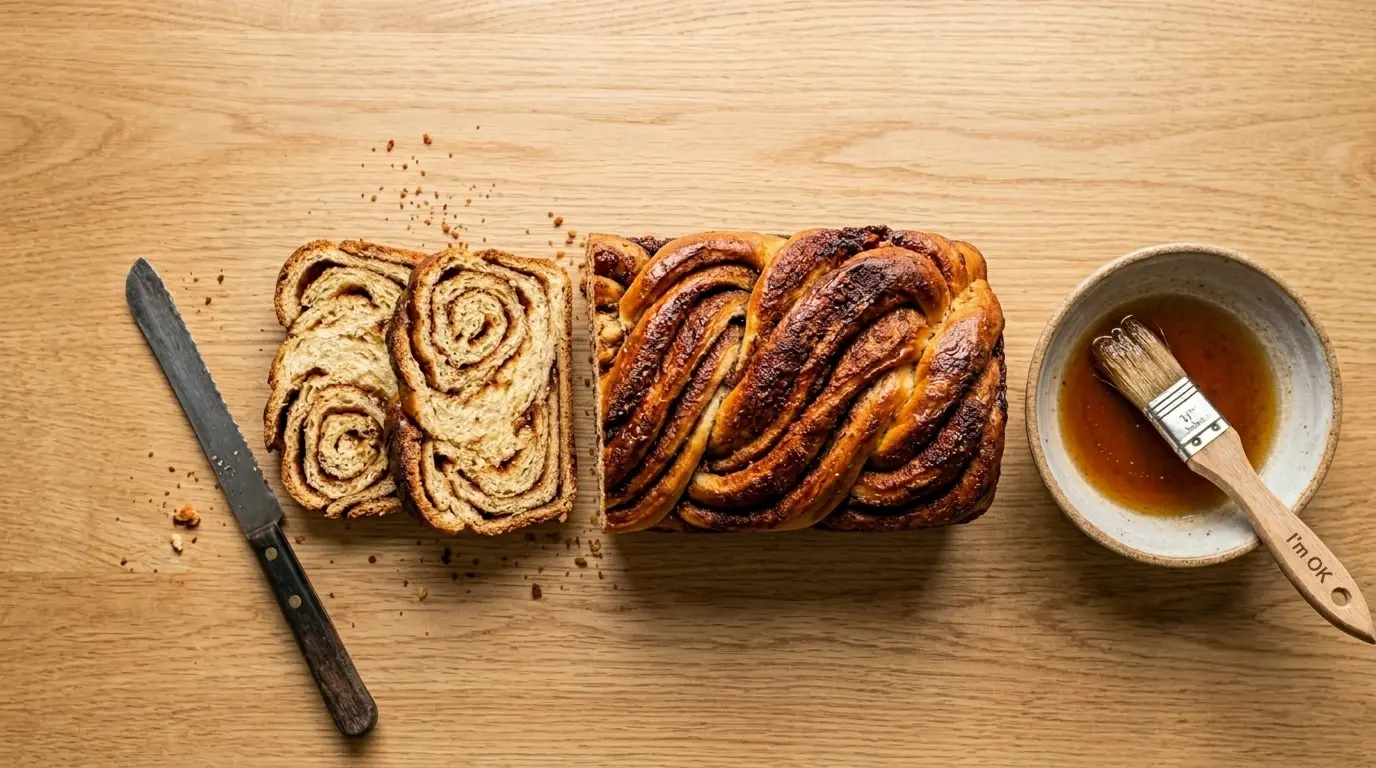
Few baked goods stop people in their tracks quite like a freshly sliced cinnamon babka recipe. That tender, buttery crumb swirled with ribbons of sweet cinnamon-brown sugar filling is the kind of thing that makes your kitchen smell absolutely incredible and your whole morning feel a little more special.
Babka is a traditional Eastern European sweet bread, deeply rooted in Jewish baking culture, and it has been winning hearts at breakfast tables and brunch spreads for generations. The dough sits somewhere between challah and brioche: rich from eggs and butter, slightly sweet, and incredibly soft. When filled with a spreadable cinnamon-sugar paste and twisted into that signature swirl, it bakes into something that looks genuinely impressive and tastes even better.
What makes this version special is the sugar syrup brushed on right after baking. It soaks into the warm loaf, keeping everything moist for days and giving the top a beautiful, bakery-worthy sheen.
Yes, babka takes a little time. The dough needs a proper rise, the shaping takes a bit of patience, and the whole process spans a few hours. But none of the individual steps are actually difficult, and the result is something you will be incredibly proud to pull out of the oven.
You might also enjoy: Chocolate Babka Recipe if you want to try the equally beloved chocolate version side by side.
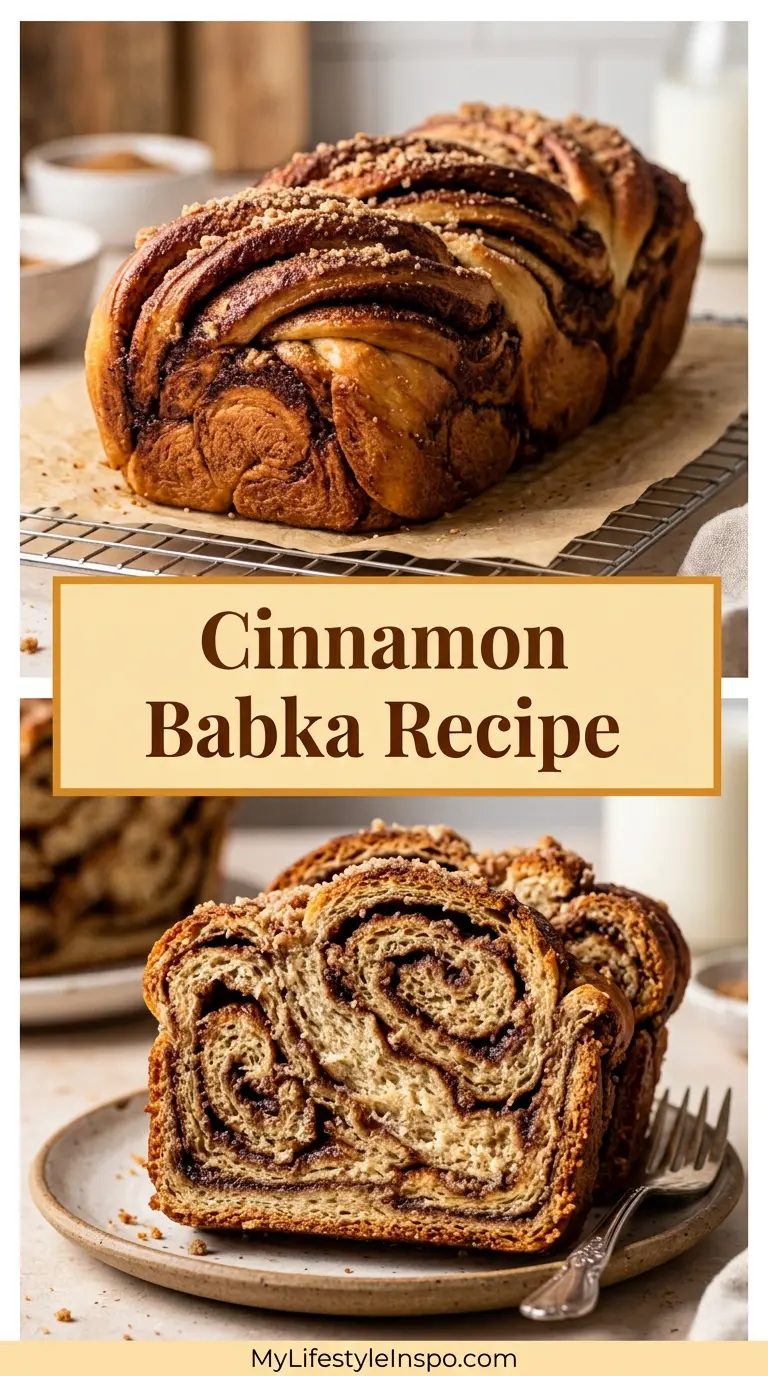
Why You’ll Love This Cinnamon Babka Recipe
This recipe delivers a loaf that is soft and pillowy on the inside with just the right amount of sticky-sweet filling in every bite.
The dough itself is enriched with butter, eggs, and milk, which gives it that ultra-tender texture that holds up beautifully to all those cinnamon swirls without becoming dense.
The filling is a buttery brown sugar and cinnamon paste, which spreads evenly and stays put during baking instead of leaking out the sides.
A simple sugar syrup brushed over the hot loaf right out of the oven locks in moisture and adds a gorgeous lacquered finish.
This is a great make-ahead bake: you can prep the dough the night before and refrigerate it for a slower, more flavorful rise.
And perhaps best of all, it turns stale bread into the best French toast you have ever made.
- Bakery-style results at home with beginner-friendly steps
- Rich brioche-like dough that stays soft for days
- Deep cinnamon-sugar filling with a brown sugar base for caramel undertones
- Optional streusel topping for extra crunch
- Perfect for brunches, gifting, or a slow weekend morning
- Impressive enough to wow guests, approachable enough for a weekday project
If you love swirled cinnamon breads, you will also want to bookmark this Cinnamon Swirl Bread Recipe for a quicker weekday option.
Ingredients
The ingredients here are straightforward pantry staples, but using good quality butter and fresh cinnamon makes a real difference. Softened (not melted) butter is essential for both the dough and the filling. If your butter is too cold, it will not incorporate smoothly into the dough, which can lead to overworking and a tough texture.
For the Dough:
- 3 1/2 cups (440g) all-purpose flour, plus more for dusting
- 2 1/4 teaspoons (7g) active dry yeast (1 standard packet)
- 1/3 cup (65g) granulated sugar
- 1/2 teaspoon salt
- 1/2 cup (120ml) whole milk, warmed to 110°F (43°C)
- 2 large eggs, at room temperature
- 1 egg yolk, at room temperature
- 1 teaspoon pure vanilla extract
- 7 tablespoons (100g) unsalted butter, softened and cut into cubes
For the Cinnamon Filling:
- 6 tablespoons (85g) unsalted butter, softened
- 2/3 cup (130g) light brown sugar, packed
- 2 tablespoons (15g) powdered sugar (helps the filling hold together and not run)
- 2 tablespoons (16g) ground cinnamon
For the Sugar Syrup:
- 1/4 cup (50g) granulated sugar
- 1/4 cup (60ml) water
For the Optional Streusel Topping:
- 1/4 cup (30g) all-purpose flour
- 3 tablespoons (35g) granulated sugar
- 2 tablespoons (28g) cold unsalted butter, cubed
- 1/2 teaspoon ground cinnamon
Another enriched bread worth exploring alongside this one is Challah, which uses a very similar dough technique and pairs beautifully with weekend brunch spreads.
Kitchen Equipment Needed
Having the right tools on hand makes the process much smoother. A stand mixer is the most important piece of equipment here because the dough requires several minutes of sustained kneading to develop enough gluten for a soft, structured loaf. You can knead by hand, but it will take 15 to 20 minutes of effort.
- Stand mixer with dough hook attachment (strongly recommended)
- Large mixing bowl for the first rise
- Plastic wrap or a clean kitchen towel
- Rolling pin
- 9×5-inch loaf pan
- Parchment paper
- Offset spatula or butter knife for spreading the filling
- Sharp knife or bench scraper for cutting the log
- Small saucepan for the sugar syrup
- Pastry brush for applying the syrup
- Instant-read thermometer (optional but very useful for checking internal temperature)
- Wire cooling rack
Read Also: Brioche Recipe
Recommended Products for This Recipe
These are products that genuinely make a difference when baking enriched dough like babka, chosen for quality and performance rather than anything else.
1. KitchenAid 5-Quart Tilt-Head Stand Mixer
Babka dough requires sustained kneading to develop enough gluten structure, and doing this by hand for 15 to 20 minutes is genuinely tiring. A stand mixer does the hard work for you and produces a smooth, well-developed dough every time. It is one of the best investments you can make if you bake bread or enriched doughs regularly.
2. USA Pan Aluminized Steel Loaf Pan
The material and construction of your loaf pan directly affects how evenly your babka bakes. Aluminized steel conducts heat evenly and prevents hot spots that can burn the bottom of your loaf before the center is done. The natural non-stick surface also makes it easy to remove the babka cleanly after baking.
3. Saigon Cinnamon (Vietnamese Cinnamon)
Not all cinnamon is created equal. Saigon cinnamon, also called Vietnamese cinnamon, has a significantly higher oil content than standard grocery store cinnamon, which means it is much more fragrant and flavor-forward. Using it in the filling of your babka takes the whole loaf to a noticeably different level.
4. Ateco Offset Spatula Set
Spreading the cinnamon filling evenly across the rolled-out dough is much easier with a small offset spatula than with a regular butter knife. An even layer of filling means better swirls and more consistent flavor throughout every slice. A set gives you multiple sizes for different tasks around the kitchen.
5. OXO Digital Instant-Read Thermometer
Knowing when your babka is fully baked comes down to internal temperature. A fully baked babka should read around 190°F (88°C) at the center. This takes the guesswork out of it entirely and prevents both underbaked (raw center) and overbaked (dry, crumbly) results.
For another rich, buttery enriched bread worth trying, the Hokkaido Milk Bread Recipe is one of the softest loaves you will ever make.
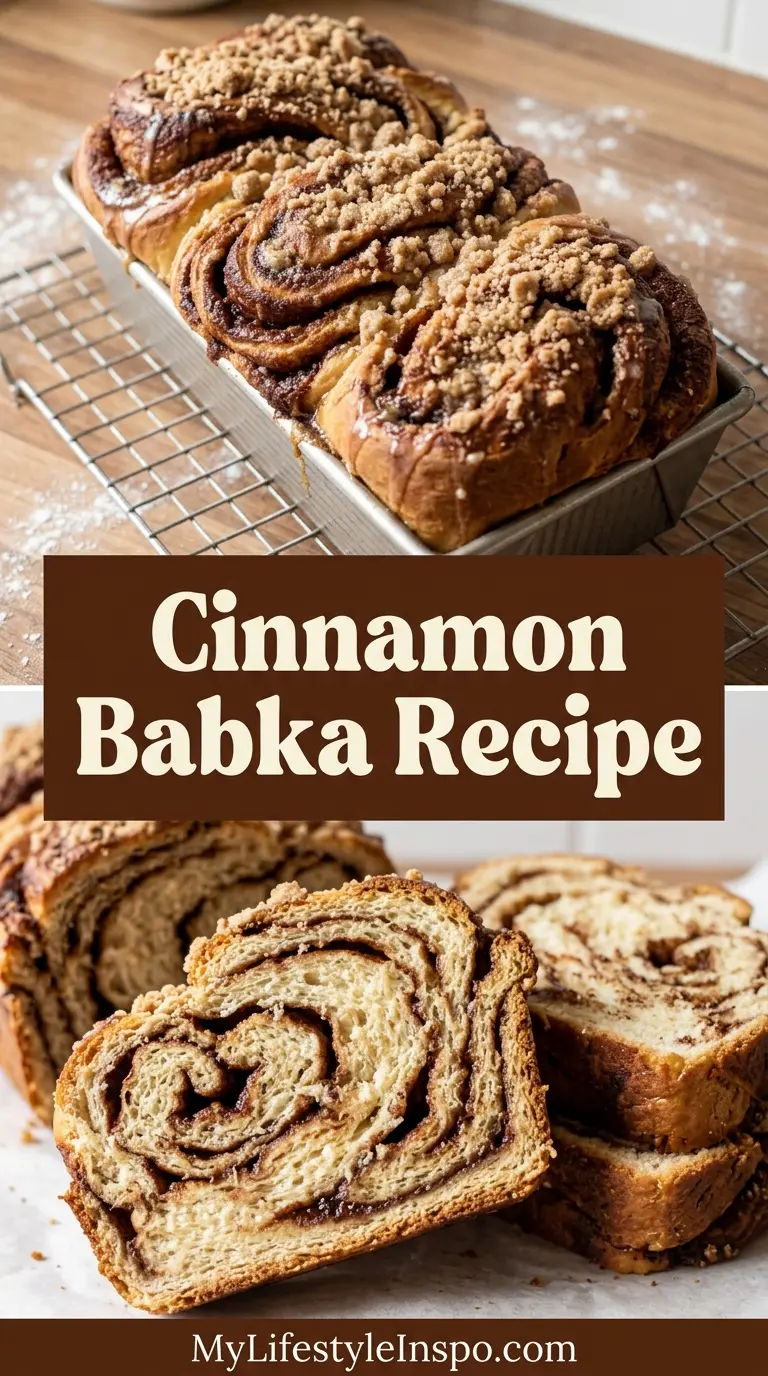
Step-by-Step Instructions
Step 1: Proof the Yeast
- Pour the warm milk (110°F / 43°C) into the bowl of your stand mixer.
- Add 1 teaspoon of the measured granulated sugar to the milk and sprinkle the active dry yeast on top.
- Stir gently with a spoon and let the mixture sit for 8 to 10 minutes undisturbed.
- After 10 minutes, the surface should look foamy and slightly puffed up. This confirms the yeast is alive and active.
- If the yeast does not foam, it may be expired or the milk was too hot or too cold. Discard and start again with fresh yeast and milk at the correct temperature.
Step 2: Make the Dough
- Add the all-purpose flour, the remaining granulated sugar, and the salt to the yeast mixture in the mixer bowl.
- Attach the dough hook and mix on low speed for about 30 seconds to combine.
- Add the 2 whole eggs, the egg yolk, and the vanilla extract to the bowl.
- Continue mixing on low speed until everything starts to come together, about 2 minutes. The dough will look shaggy at this stage, and that is completely normal.
- Increase speed to medium-low and knead the dough for about 5 minutes, until it begins to look smoother.
Step 3: Add the Butter
- With the mixer running on medium-low speed, add the softened butter one cube at a time, waiting for each piece to fully incorporate before adding the next.
- This process takes about 5 to 8 minutes. The dough may look like it is falling apart initially as you add the butter, but it will come back together as it is kneaded.
- Once all the butter is incorporated, increase the speed to medium and knead for another 5 to 7 minutes, until the dough is smooth, elastic, and pulls cleanly away from the sides of the bowl.
- The dough will still feel slightly tacky but should not be sticky enough to cling heavily to your fingers. Resist adding more flour, as this will make the final loaf denser.
Step 4: First Rise
- Lightly grease a large bowl with neutral oil or softened butter.
- Shape the dough into a ball, place it in the greased bowl, and turn it once to coat the surface.
- Cover the bowl tightly with plastic wrap or a clean kitchen towel.
- Let the dough rise at room temperature for 1.5 to 2 hours, until it has doubled in size.
- Alternatively, you can place the covered bowl in the refrigerator and let it rise overnight (at least 8 hours). A cold rise develops more flavor and also makes the dough much easier to roll out and shape. If you refrigerate overnight, take the dough out and let it sit at room temperature for 30 to 60 minutes before shaping.
Step 5: Make the Cinnamon Filling
- While the dough is rising, prepare the filling so it is ready to go.
- In a medium bowl, combine the softened butter, light brown sugar, powdered sugar, and ground cinnamon.
- Mix with a fork or a hand mixer until the mixture forms a smooth, spreadable paste. It should have the consistency of soft frosting.
- Set aside at room temperature. If your kitchen is very warm, refrigerate the filling briefly so it firms up just slightly, which makes it easier to spread without it sliding off the dough.
Step 6: Make the Streusel (Optional)
- In a small bowl, combine the flour, granulated sugar, and ground cinnamon.
- Add the cold cubed butter and use your fingers or a fork to work it into the flour mixture until you have coarse, sandy crumbs with some pea-sized pieces remaining.
- Refrigerate the streusel until you are ready to use it so the butter stays cold and the topping stays crumbly during baking.
Step 7: Roll and Fill the Dough
- Once the dough has risen, turn it out onto a lightly floured surface. Gently punch it down to release the gas.
- Using a rolling pin, roll the dough into a rectangle approximately 12 x 18 inches (30 x 46cm). Work from the center outward and try to keep the thickness as even as possible.
- Spread the entire cinnamon filling over the surface of the dough using an offset spatula, leaving a 1-inch (2.5cm) border along one of the long edges. Getting an even layer all the way to the edges (except that border) ensures consistent swirls throughout the loaf.
Step 8: Roll, Chill, and Cut
- Starting from the long edge opposite the bare border, roll the dough tightly into a log. Use your fingertips to keep the roll tight as you go. When you reach the bare border, press it gently against the log to seal.
- If the log feels soft and floppy, wrap it in plastic wrap and place it in the freezer for 15 to 20 minutes. This firms the dough slightly and makes the next step much cleaner.
- Place the log on a cutting board with the seam side down.
- Using a sharp knife or bench scraper, cut the log in half lengthwise, from one end to the other, so you have two long pieces with the swirls visible on the cut sides.
Step 9: Twist and Shape
- Place the two cut pieces next to each other with the cut (swirl) sides facing up.
- Cross one piece over the other, then continue crossing them over each other in a loose twist, keeping the cut sides facing up as much as possible throughout. This is what creates that beautiful exposed-swirl pattern on the top of the loaf.
- Pinch both ends firmly to seal.
- Line your 9×5-inch loaf pan with parchment paper, leaving some overhang on the sides for easy removal.
- Carefully transfer the twisted loaf into the prepared pan. Tuck any stray ends underneath.
Step 10: Second Rise
- Cover the pan loosely with plastic wrap or a clean kitchen towel.
- Let the babka rise at room temperature for 1 to 1.5 hours, until it has puffed up noticeably and fills the pan. It does not need to double; just look for a puffy, risen loaf that domes slightly above the rim.
- About 20 minutes before baking, preheat your oven to 350°F (175°C).
- If using the streusel, scatter it evenly over the top of the risen loaf.
Step 11: Bake the Babka
- Bake the babka in the preheated oven for 40 to 45 minutes, until the top is deep golden brown and the internal temperature at the center reads 190°F (88°C) on an instant-read thermometer.
- If the top of the babka is browning too quickly before it is fully baked inside, tent it loosely with a piece of aluminum foil for the last 10 to 15 minutes of baking.
- Remove from the oven and set on a wire rack. Do not remove from the pan yet.
Step 12: Make and Apply the Sugar Syrup
- While the babka is baking (or immediately when it comes out of the oven), combine the granulated sugar and water in a small saucepan.
- Bring to a boil over medium heat, stirring until the sugar dissolves completely, about 2 to 3 minutes.
- Remove from the heat and let it cool slightly.
- As soon as the babka comes out of the oven, brush the entire top generously with the warm sugar syrup. It will soak into the hot bread, adding moisture and sweetness. The loaf may look saturated, but it absorbs quickly.
- Let the babka cool in the pan for at least 20 minutes before lifting it out by the parchment paper and transferring to a wire rack to cool further.
- Slice and serve warm or at room temperature.
Leftover cinnamon babka makes extraordinary Brioche French Toast, so do not throw away any stale slices.
Tips for Success
Small details make a big difference with enriched doughs like babka. The time invested in getting these right pays off in a loaf that is noticeably better in texture and flavor than one where shortcuts were taken.
- Warm your milk to the right temperature. Too hot (above 115°F / 46°C) and you will kill the yeast. Too cool and the yeast will not activate properly. A thermometer takes the guesswork out of it entirely.
- Do not rush the butter addition. Adding cold butter all at once or adding it too quickly causes the dough to break down. Soft, room-temperature butter added slowly allows it to emulsify into the dough properly.
- Chill the dough before shaping if it feels sticky. Enriched dough is naturally tacky. If it is sticking to everything, 30 to 60 minutes in the fridge will firm it up significantly and make rolling and cutting much cleaner.
- Keep the cut sides facing up when twisting. This is what creates the beautiful exposed swirl pattern on the top of the finished loaf. Turning the pieces over as you twist defeats the purpose.
- Do not skip the sugar syrup. It might seem like an extra step but it is what keeps babka moist for several days and gives it that professional bakery sheen.
- Use the streusel topping. It is optional in the ingredient list but genuinely transforms the texture contrast of the finished loaf. The buttery, crumbly bits on top balance the softness of the bread inside.
- Measure your flour correctly. Spoon flour into the measuring cup and level it off rather than scooping directly from the bag. Scooping can pack in up to 20% more flour than the recipe intends, which leads to a denser dough.
For another beautifully swirled cinnamon bread that is a little more hands-off, try this Cinnamon Raisin Bread Recipe.
Serving Suggestions
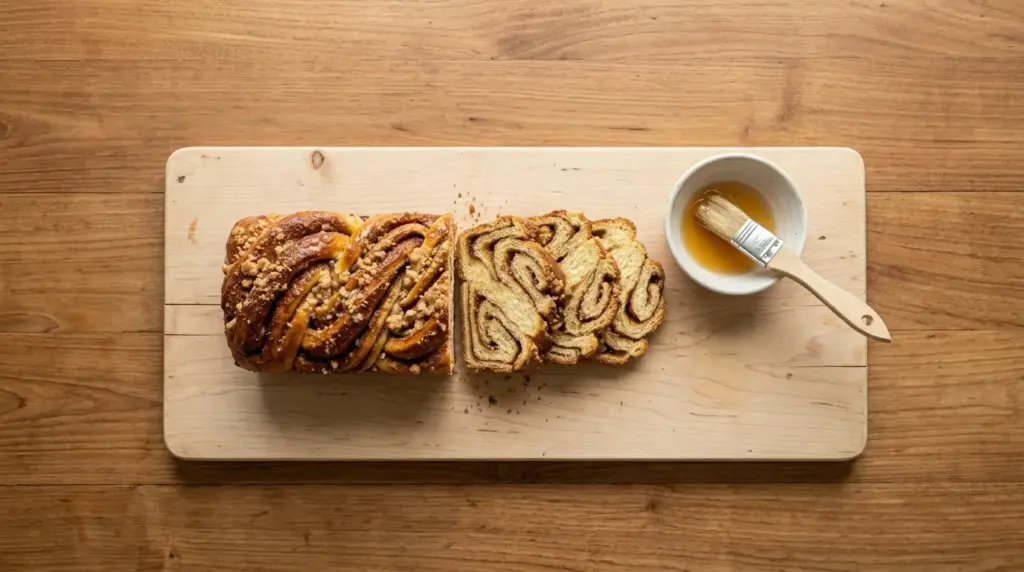
Cinnamon babka is genuinely wonderful on its own, but a few simple serving ideas can make it feel even more special depending on the occasion.
Serve it warm from the oven with your morning coffee or tea for the simplest possible pleasure. The cinnamon filling stays soft and gooey for the first hour after baking.
For brunch, arrange slices on a board alongside fresh fruit, a small bowl of whipped cream cheese, and a drizzle of honey. The cream cheese in particular pairs beautifully with the sweet cinnamon filling.
Day-old babka slices make extraordinary French toast. Thick-cut slices soaked in a vanilla custard and cooked in butter become deeply caramelized on the outside from the sugar in the dough.
For a dessert presentation, warm individual slices briefly in the microwave or oven and serve with a scoop of vanilla ice cream or a drizzle of caramel sauce.
- Serve warm slices with softened butter and honey for a simple breakfast
- Pair with whipped cream cheese for a brunch spread
- Use thick slices for Sour Cream Coffee Cake inspired layered desserts
- Make French toast using day-old slices
- Wrap individual slices in wax paper and ribbon as a homemade gift
- Serve alongside fresh berries and a bowl of Greek yogurt for a weekend brunch
Variations to Try
Once you have mastered the base recipe, there are so many ways to play with it. The dough itself is incredibly versatile and works as a canvas for all kinds of fillings.
- Chocolate Babka: Replace the cinnamon filling with a mixture of dark chocolate, butter, and powdered sugar for the most classic babka pairing.
- Cardamom and Rose: Substitute ground cardamom for half the cinnamon and add a teaspoon of rose water to the filling for a floral, aromatic variation.
- Nutella Swirl: Spread a thin layer of Nutella over the dough before adding the cinnamon filling for an extra rich, hazelnut-chocolate layer.
- Cinnamon Raisin: Scatter a handful of plump raisins over the cinnamon filling before rolling to add texture and natural sweetness.
- Brown Butter Babka: Brown your butter before using it in both the dough and the filling for a deeper, nuttier flavor that elevates the whole loaf.
- Smaller Individual Babkas: Divide the dough into individual portions and bake in a muffin tin for single-serving twists that are perfect for gifting.
- Cream Cheese Swirl: Spread a thin layer of sweetened cream cheese on the dough before adding the cinnamon filling for a tangy contrast to all that sweetness.
Another beautiful spiced bread variation to explore next is Apple Cinnamon Bread, which pairs the warmth of cinnamon with tender apple pieces for a quick, no-yeast loaf.
Storage and Reheating
Babka actually improves slightly on day two as the flavors meld, making it an ideal make-ahead bake. Proper storage keeps it soft and fresh-tasting for several days.
- Room temperature: Wrap the cooled babka tightly in plastic wrap or store in an airtight container. It keeps well at room temperature for up to 3 days.
- Refrigerator: Babka can be refrigerated for up to 5 days but will dry out slightly. Warm slices before serving to restore softness.
- Freezer: Wrap the fully cooled loaf (whole or pre-sliced) tightly in plastic wrap, then in a layer of aluminum foil or place in a zip-top freezer bag. Freeze for up to 2 months.
- To reheat from room temperature: Warm individual slices in a 300°F (150°C) oven for 5 to 8 minutes, or microwave on medium power for 20 to 30 seconds.
- To reheat from frozen: Thaw the loaf overnight at room temperature, still wrapped, then warm in a 300°F (150°C) oven for 10 to 15 minutes.
- Do not reheat at high temperatures: A high oven temperature will dry out the exterior before the interior warms through.
Another pull-apart sweet bread that stores and reheats beautifully is Monkey Bread, and it is a great one to have in your rotation alongside babka.
Nutritional Facts
The following is an approximate estimate per slice, based on a loaf cut into 10 servings, including the sugar syrup and streusel topping.
| Nutrient | Per Slice (1/10 of loaf) |
|---|---|
| Calories | ~320 kcal |
| Total Fat | 14g |
| Saturated Fat | 8g |
| Cholesterol | 75mg |
| Sodium | 130mg |
| Total Carbohydrates | 44g |
| Dietary Fiber | 1g |
| Total Sugars | 20g |
| Protein | 5g |
These values are estimates only and will vary depending on exact measurements, ingredient brands, and loaf size. Babka is an indulgent treat best enjoyed as part of a balanced diet rather than as an everyday staple.
Read Also: Multigrain Bread Recipe
Health Benefits of Key Ingredients
While babka is certainly a treat rather than a health food, a few of its core ingredients do offer real nutritional value worth noting.
Cinnamon is more than just a flavoring. It contains significant amounts of antioxidants, particularly polyphenols, and has been studied for its potential role in supporting blood sugar regulation and reducing inflammation.
Eggs, used generously in the dough, are a complete protein source containing all essential amino acids. They also supply B vitamins, choline, and fat-soluble vitamins like A and D.
Brown sugar, while still a refined sweetener, retains a small amount of molasses compared to white sugar. Molasses contains trace minerals including calcium, potassium, iron, and magnesium.
Whole milk contributes calcium, phosphorus, and vitamin D to the dough, all of which support bone health and muscle function.
- Cinnamon: Contains antioxidants, may help support healthy blood sugar levels, and has natural anti-inflammatory properties
- Eggs: A complete protein source that also supplies choline, essential for brain health and liver function
- Butter: Provides fat-soluble vitamins A, D, E, and K2, along with short-chain fatty acids that support gut health in moderate amounts
- Whole milk: A reliable source of calcium, phosphorus, and B vitamins for energy metabolism
- All-purpose flour: Provides carbohydrates for energy and a small amount of plant-based protein, and some B vitamins
Another traditional Jewish baked good with a beautiful history is Rugelach, a crescent-shaped pastry filled with sweet fillings that is worth exploring if you love babka.
Frequently Asked Questions
1. Can I make cinnamon babka without a stand mixer?
Yes, you can absolutely make babka by hand. The process is the same, but you will need to knead the dough by hand for 15 to 20 minutes, which takes real effort because of the high butter content. Use a slapping and folding technique: slap the dough against the work surface, fold it over itself, rotate it a quarter turn, and repeat. The dough is ready when it is smooth, elastic, and passes the windowpane test, meaning you can stretch a small piece thin enough to see light through it without it tearing.
2. Why is my babka dough so sticky?
Enriched dough is naturally stickier than lean bread dough because of the eggs, butter, and milk. If your dough seems impossibly sticky, do not automatically add more flour. Instead, chill it in the refrigerator for 30 to 60 minutes. Cold dough is significantly easier to handle and roll out. Adding too much flour during the process makes the final loaf dense rather than soft and pillowy.
3. Can I make the dough the night before?
Yes, and many bakers prefer this method. After the first rise at room temperature (even just an hour), punch the dough down, wrap it tightly in plastic wrap, and refrigerate overnight. The cold temperature slows the yeast and allows for a longer, more flavorful fermentation. The next day, remove the dough and let it warm up for 30 to 60 minutes before rolling and shaping. Proceed with the second rise at room temperature as directed.
4. Why did my babka filling leak out during baking?
This happens most often when the filling contains too much butter or is too warm when you spread it. Using powdered sugar in the filling (as this recipe does) helps because the cornstarch in powdered sugar acts as a mild thickener and reduces how much the filling runs. It also helps to keep the filling at a cool room temperature rather than letting it sit somewhere warm before you use it. Making sure you leave a 1-inch border on one long side when spreading also helps keep the filling contained.
5. How do I know when the babka is fully baked?
The most reliable method is an instant-read thermometer: the center of the loaf should read 190°F (88°C). If you do not have a thermometer, the loaf should be deeply golden brown on top and sound hollow when tapped on the bottom after removing from the pan. Insert a thin skewer into the center: if it comes out clean with no raw dough clinging to it, the babka is done. Avoid underbaking as the center will collapse as the loaf cools.
You might also enjoy: Sourdough Discard Cinnamon Rolls Recipe for another deeply satisfying cinnamon-filled bake.
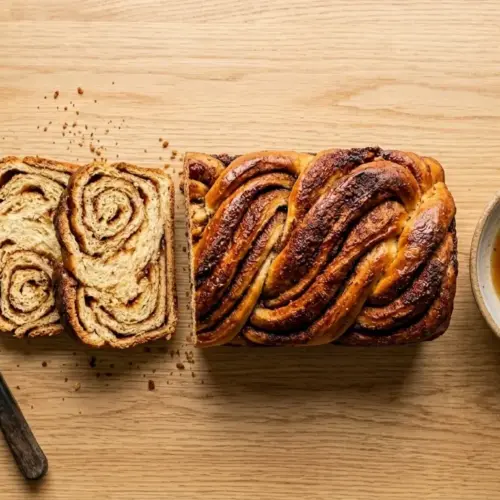
Cinnamon Babka

Equipment
- Stand mixer - with dough hook attachment (strongly recommended)
- Large mixing bowl
- Plastic wrap
- Rolling Pin
- 9×5-inch loaf pan
- Parchment paper
- Offset spatula - or butter knife for spreading the filling
- Sharp knife - or bench scraper for cutting the log
- Small saucepan - for the sugar syrup
- Pastry brush - for applying the syrup
- Instant-read thermometer - optional but very useful for checking internal temperature
- Wire cooling rack
- Clean kitchen towel
Ingredients
- 3 1/2 cups all-purpose flour - 440g, plus more for dusting
- 2 1/4 teaspoons active dry yeast - 7g, 1 standard packet
- 1/3 cup granulated sugar - 65g
- 1/2 teaspoon salt
- 1/2 cup whole milk - 120ml, warmed to 110°F (43°C)
- 2 large eggs - at room temperature
- 1 egg yolk - at room temperature
- 1 teaspoon pure vanilla extract
- 7 tablespoons unsalted butter - 100g, softened and cut into cubes
For the Cinnamon Filling
- 6 tablespoons unsalted butter - 85g, softened
- 2/3 cup light brown sugar - 130g, packed
- 2 tablespoons powdered sugar - 15g, helps the filling hold together and not run
- 2 tablespoons ground cinnamon - 16g
For the Sugar Syrup
- 1/4 cup granulated sugar - 50g
- 1/4 cup water - 60ml
For the Optional Streusel Topping
- 1/4 cup all-purpose flour - 30g
- 3 tablespoons granulated sugar - 35g
- 2 tablespoons cold unsalted butter - 28g, cubed
- 1/2 teaspoon ground cinnamon
Instructions
- Proof the yeast by combining warm milk, a teaspoon of sugar, and yeast in the mixer bowl. Let sit until foamy, about 10 minutes.
- Add the flour, remaining sugar, and salt to the yeast mixture. Mix with the dough hook on low, then add eggs, yolk, and vanilla. Knead until combined.
- With the mixer running, add the cubed butter one piece at a time, waiting for each to incorporate. Knead until the dough is smooth and pulls away from the bowl.
- Place the dough in a greased bowl, cover, and let rise at room temperature until doubled in size, about 1.5 to 2 hours. (Or refrigerate overnight for better flavor).
- While the dough rises, mix softened butter, brown sugar, powdered sugar, and cinnamon together to form a spreadable paste for the filling.
- If using the streusel, combine flour, sugar, and cinnamon in a bowl, then cut in cold butter until crumbly. Refrigerate until ready to use.
- Punch down the risen dough and roll it into a 12×18-inch rectangle. Spread the cinnamon filling evenly over the dough, leaving a 1-inch border on one long edge.
- Roll the dough tightly into a log starting from the opposite long edge. Chill in the freezer for 15-20 minutes if it becomes too soft, then cut the log in half lengthwise.
- Place the two halves with the cut sides facing up, cross them over each other in a twist, and pinch the ends to seal. Transfer the twist to a parchment-lined 9×5-inch loaf pan.
- Cover the pan and let the babka rise at room temperature until puffy and domed, about 1 to 1.5 hours. Meanwhile, preheat the oven to 350°F (175°C).
- Scatter the streusel over the risen loaf, if using. Bake for 40 to 45 minutes until deep golden brown and the internal temperature reaches 190°F (88°C).
- While the babka bakes or immediately after, boil the sugar and water together to make a simple syrup. Brush the hot loaf generously with the warm syrup as soon as it comes out of the oven.
- Let the babka cool in the pan for 20 minutes, then transfer to a wire rack to cool completely before slicing and serving warm or at room temperature.
Notes
- Milk Temperature: Use an instant-read thermometer to ensure your milk is between 105°F and 115°F (40-46°C). Too hot will kill the yeast; too cool will prevent it from activating.
- Butter Addition: Do not rush adding the butter. Adding it slowly in cubes allows it to emulsify properly into the dough, ensuring a tender crumb rather than a greasy one.
- Chilling the Dough: If the dough feels sticky or difficult to roll, refrigerate it for 30-60 minutes. Chilling firms up the butter and makes shaping significantly easier.
- Filling Tips: Keep the cut sides facing up while twisting to ensure the beautiful swirl pattern is exposed on the top of the loaf.
- Syrup is Key: Do not skip the sugar syrup. It’s what gives babka its characteristic moist texture and glossy sheen, keeping it fresh for days.
- Make-Ahead: Prepare the dough the night before and let it have its first rise in the refrigerator. The next day, bring it to room temperature and proceed with shaping.
- Storage: Store leftover babka at room temperature for up to 3 days or freeze for up to 2 months. Reheat slices gently in a low oven to restore softness.
- Variations: Swap cinnamon for cardamom, add chocolate chips, or swirl in a layer of Nutella for a delicious twist on the classic recipe.
- Day-Old Uses: Stale babka makes incredible French toast. Soak thick slices in a vanilla custard and pan-fry until golden for a decadent breakfast.
- Measuring Flour: Spoon flour into your measuring cup and level it off to avoid packing in too much flour, which can make the dough dense.
Final Thoughts
Making a cinnamon babka from scratch is one of those baking projects that genuinely pays off in every way. The process is rewarding, the kitchen smells incredible the entire time, and the finished loaf is something you will want to make again and again.
It is worth every minute of rising time and every careful step of shaping. Once you pull it from the oven and brush it with that glossy sugar syrup, you will understand why babka has been beloved for centuries.
Give this cinnamon babka recipe a try this weekend and see for yourself. Leave a comment below to share how it turned out, or tag a photo so others can see your beautiful swirls.
Recommended:
- Chocolate Chip Bread Recipe
- Date Nut Bread Recipe
- Apple Fritter Bread Recipe
- Cranberry Orange Bread Recipe
- Lemon Blueberry Bread Recipe
- Blackberry Bread Recipe
- Sweet Potato Bread Recipe
- Pineapple Quick Bread Recipe
- Croissant Recipe
- Baklava Recipe