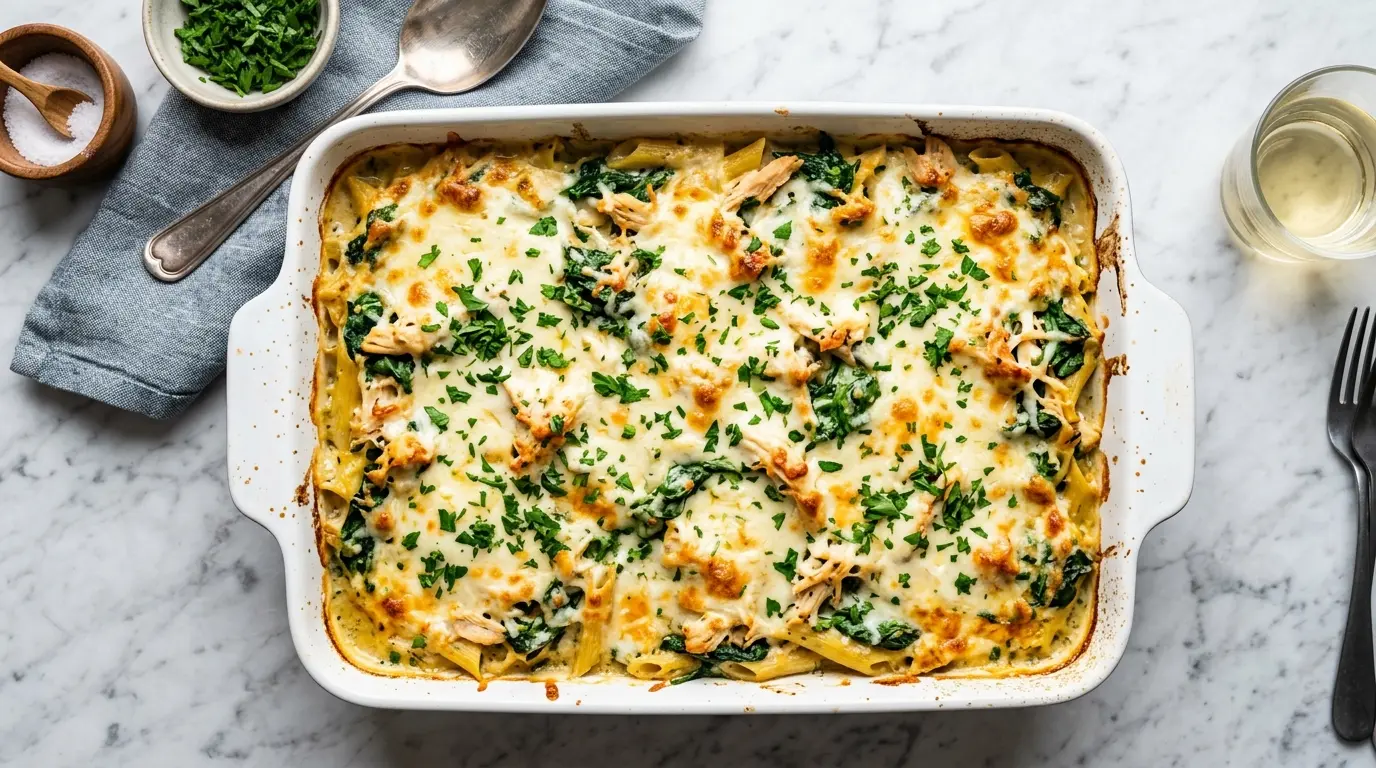
If you’re looking for a dinner that feels indulgent but comes together with minimal fuss, this Chicken Florentine Casserole Recipe is exactly what you need.
Inspired by the classic French-Italian “Florentine” tradition, where dishes are built on a bed of spinach and wrapped in a creamy white sauce, this casserole takes all those beloved flavors and bakes them into one bubbling, golden dish.
Tender chicken sits atop a layer of sautéed baby spinach and mushrooms, blanketed in a rich cream sauce made with garlic, Parmesan, and cream of mushroom soup, then finished with a generous layer of melted mozzarella.
It’s hearty enough to be a full weeknight meal, impressive enough to serve guests, and easy enough that you won’t feel exhausted putting it together.
The real magic here is in the layering. Sautéing the spinach and mushrooms first removes excess moisture, which prevents the casserole from turning watery, and it builds a deeply savory base that carries through every single bite.
If you love dishes that feel restaurant-worthy but actually cook in a regular oven on a weeknight, this one absolutely delivers.
You might also enjoy: Chicken Florentine Pasta Recipe

Why You’ll Love This Chicken Florentine Casserole Recipe
This is the kind of recipe that earns a permanent spot in your dinner rotation after the very first try.
It combines the creamy, savory character of classic Chicken Florentine with the ease and comfort of a baked casserole, so you get all the flavor without standing at the stove.
The sauce is built on a base of cream of mushroom soup and sour cream, enriched with garlic and Parmesan, which means incredible depth of flavor with almost no extra work.
The mozzarella on top melts into a golden, stretchy layer that makes every serving look like it came out of an Italian kitchen.
It’s also incredibly versatile. You can use leftover rotisserie chicken, swap in frozen spinach, or prep the whole dish the night before and simply bake it when you’re ready.
Here’s a quick summary of why this recipe is a keeper:
- Big flavors, simple technique – No fancy skills required; just layer, mix, and bake
- One-dish cleanup – Everything goes into a single baking dish
- Family-friendly – Kids and adults alike love the creamy, cheesy result
- Great for meal prep – Assembles the night before without sacrificing quality
- Uses pantry staples – Most ingredients are things you likely already have
- Spinach done right – The sauté step keeps the greens flavorful and not soggy
Read Also: Spinach Stuffed Chicken Breast Recipe
Ingredients
This recipe keeps things achievable while still producing a casserole that tastes like you put in real effort. Using boneless, skinless chicken breasts ensures the meat stays lean and cooks evenly; fresh baby spinach wilts beautifully and has a brighter flavor than frozen (though frozen works in a pinch); and full-fat sour cream gives the sauce its signature richness without the need for heavy cream.
- 2 lbs (900g) boneless, skinless chicken breasts, pounded to even thickness
- 1 teaspoon kosher salt, divided
- 1/2 teaspoon black pepper, divided
- 1/2 teaspoon garlic powder
- 2 tablespoons olive oil
- 3 cups (90g) fresh baby spinach, roughly chopped
- 1 cup (90g) white mushrooms, sliced
- 3 cloves garlic, minced
- 1 can (10.5 oz / 298g) condensed cream of mushroom soup
- 1 cup (240ml) sour cream
- 1/2 cup (120ml) chicken broth
- 1/2 cup (50g) freshly grated Parmesan cheese, plus 2 tablespoons for topping
- 1 teaspoon Italian seasoning
- 1/4 teaspoon crushed red pepper flakes (optional)
- 1.5 cups (170g) shredded mozzarella cheese
- 1 tablespoon unsalted butter (for greasing the dish)
- Fresh parsley, chopped, for garnish
This dish pairs beautifully with the creamy sauce in Chicken Florentine Soup Recipe if you want to serve a complete Florentine-themed dinner.
Kitchen Equipment Needed
Having the right tools makes this recipe even more streamlined. A heavy-bottomed oven-safe skillet or a sturdy 9×13 baking dish is non-negotiable for even heat distribution; thin pans tend to cause hot spots that dry out the chicken before the cheese properly melts. A good meat mallet helps pound the chicken to an even thickness, which is the single most effective trick for ensuring it cooks through at the same time as the topping.
- 9×13 inch baking dish (glass or ceramic preferred)
- Large skillet or sauté pan
- Meat mallet or rolling pin
- Medium mixing bowl
- Wooden spoon or silicone spatula
- Sharp chef’s knife and cutting board
- Cheese grater or box grater
- Measuring cups and spoons
- Aluminum foil (for covering during the first part of baking)
- Oven mitts
Read Also: Chicken Cordon Bleu Casserole Recipe
Recommended Products for This Recipe
These are products I genuinely recommend based on quality and performance, each chosen to make this recipe easier or better.
1. HIC Kitchen Rectangular Baking Dish (9×13)
A heavy ceramic baking dish distributes heat far more evenly than a thin metal pan, which means your chicken cooks through without drying out while the cheese melts to a perfect golden color. Ceramic also retains heat beautifully, so the casserole stays warm longer on the table. It goes straight from oven to table without losing its appeal.
2. OXO Good Grips Silicone Flexible Turner
A wide, flexible silicone turner is the best tool for lifting whole chicken pieces cleanly from the baking dish without breaking them apart. It’s also heat-safe up to 600°F and won’t scratch ceramic dishes. Once you use one of these for casseroles, it’s hard to go back to a regular spatula.
3. Microplane Premium Classic Zester/Grater
Freshly grated Parmesan melts more smoothly and tastes significantly better than the pre-grated variety, which often contains anti-caking agents that affect both texture and flavor. A Microplane produces ultra-fine ribbons of cheese that melt seamlessly into the sauce. It’s one of those small upgrades that makes a noticeable difference.
4. Ninja Foodi NeverStick Premium Skillet
A high-quality nonstick skillet makes sautéing the spinach and mushrooms quick and easy with minimal sticking. The even heat distribution ensures the mushrooms brown properly rather than steaming, which is key to building deep flavor in the base layer. This particular skillet is also oven-safe if you prefer to do everything in one pan.
5. Cuisinart 12-Piece Professional Knife Set
A sharp chef’s knife makes a real difference when slicing mushrooms, mincing garlic, and trimming chicken. Dull knives slow you down and are actually less safe to use. A quality knife set is an investment that pays off every single time you cook.
This casserole is equally satisfying as Chicken Parmesan Casserole Recipe if you want another crowd-pleasing bake in your collection.

Step-by-Step Instructions
1. Preheat the Oven and Prepare the Baking Dish
- Preheat your oven to 375°F (190°C) and allow it to fully come to temperature before the dish goes in.
- Rub 1 tablespoon of softened butter all over the interior of your 9×13 baking dish, making sure to coat the bottom and sides completely. This prevents sticking and adds a subtle richness to the edges.
- Set the greased dish aside while you prepare the remaining components.
2. Season and Sear the Chicken
- Place the chicken breasts between two sheets of plastic wrap or in a large zip-lock bag. Use a meat mallet or rolling pin to pound them to an even thickness of about 3/4 inch (2 cm). This step is important because uneven chicken will cook unevenly, leaving thin parts dry before thick parts are done.
- Remove the chicken from the plastic and pat it thoroughly dry with paper towels. Moisture on the surface prevents proper browning.
- Season both sides of each piece with 1/2 teaspoon of the kosher salt, 1/4 teaspoon of black pepper, and the garlic powder.
- Heat 2 tablespoons of olive oil in a large skillet over medium-high heat until it shimmers.
- Place the seasoned chicken breasts in the hot skillet in a single layer, without crowding. Sear for 3 to 4 minutes on each side until golden brown. The chicken does not need to be cooked through at this stage; it will finish in the oven.
- Transfer the seared chicken to a plate and set aside.
3. Sauté the Spinach and Mushrooms
- In the same skillet you used for the chicken (do not wipe it out; those browned bits are full of flavor), add the sliced white mushrooms.
- Sauté the mushrooms over medium-high heat for 4 to 5 minutes, stirring occasionally, until they have released their moisture and are beginning to turn golden at the edges. Avoid salting them at the start, as salt draws out water and causes steaming instead of browning.
- Add the minced garlic to the pan and stir for 30 to 45 seconds until fragrant. Be careful not to let the garlic burn, as it will turn bitter.
- Add the chopped baby spinach to the pan in two or three batches, turning it with tongs or a spatula as it wilts. This takes 2 to 3 minutes total.
- Season the spinach and mushroom mixture with the remaining 1/2 teaspoon salt and 1/4 teaspoon black pepper.
- Remove the skillet from the heat and spread the spinach-mushroom mixture evenly across the bottom of the prepared baking dish.
4. Make the Cream Sauce
- In a medium mixing bowl, combine the condensed cream of mushroom soup (straight from the can, do not dilute it), sour cream, chicken broth, 1/2 cup of freshly grated Parmesan, Italian seasoning, and optional crushed red pepper flakes.
- Stir vigorously until the mixture is fully smooth and uniform. Taste the sauce at this point and adjust seasoning if needed. The sauce should be savory, slightly tangy from the sour cream, and well-seasoned.
- Set the sauce aside while you assemble the casserole.
5. Assemble the Casserole
- Lay the seared chicken breasts in a single layer directly on top of the spinach and mushroom layer in the baking dish. Arrange them so they sit flat and cover most of the vegetable base.
- Pour the cream sauce evenly over the top of the chicken, using a spatula to spread it so every piece of chicken is well-coated.
- Scatter the shredded mozzarella evenly over the top of the sauce.
- Sprinkle the remaining 2 tablespoons of Parmesan over the mozzarella layer for an extra savory, golden top.
6. Bake the Casserole
- Cover the baking dish tightly with aluminum foil. This traps steam and ensures the chicken finishes cooking through without the top burning before the center is done.
- Place the covered dish in the preheated 375°F (190°C) oven and bake for 25 minutes.
- After 25 minutes, carefully remove the foil. The sauce should be bubbling around the edges.
- Return the dish to the oven, uncovered, for an additional 15 to 20 minutes until the cheese is melted, golden in spots, and the sauce is actively bubbling. The internal temperature of the chicken should register 165°F (74°C) on an instant-read thermometer.
- Remove from the oven and allow the casserole to rest for 5 to 10 minutes before serving. This resting time allows the sauce to thicken slightly and makes the chicken much easier to serve cleanly.
7. Garnish and Serve
- Sprinkle freshly chopped parsley over the top of the casserole just before serving. This adds a bright, fresh note that contrasts the richness of the dish.
- Use a wide spatula to lift each chicken breast with its accompanying sauce and vegetables onto individual plates.
- Spoon extra sauce from the bottom of the dish over each serving for maximum flavor.
The layered technique used here is similar to what makes Chicken Broccoli Rice Casserole Recipe so reliably delicious, if you want another easy casserole method to master.
Tips for Success
Getting a casserole like this right comes down to a handful of technique details that make the difference between “good” and “absolutely extraordinary.” The biggest ones involve moisture control and proper seasoning at each layer rather than relying on the sauce to do all the work.
- Pound the chicken evenly. Uneven thickness is the most common reason chicken in casseroles turns out dry in some parts and undercooked in others. A uniform 3/4-inch thickness cooks perfectly in the given time.
- Sear before baking. That golden crust adds texture and seals in juices. Skipping this step produces noticeably blander, softer chicken.
- Dry the spinach well. If using fresh spinach, squeeze out as much excess moisture as possible after wilting. If using thawed frozen spinach, wring it in a clean kitchen towel until almost completely dry. Extra water will dilute and thin your sauce.
- Don’t skip the rest time. Five to ten minutes of resting after the oven is essential. The sauce firms up, the chicken relaxes, and the whole dish becomes easier to serve.
- Use a thermometer. Visual cues aren’t as reliable as a quick temperature check. Pull the dish when the thickest piece of chicken reads 165°F (74°C) internally.
- Cover for the first bake. The foil creates a steaming environment that gently finishes cooking the chicken while keeping the top from over-browning too early.
- Season each layer. Season the chicken before searing, season the vegetables while sautéing, and taste-test the sauce before it goes over the top. Building flavor in layers is the foundation of a great casserole.
For another creamy, oven-baked dinner that uses the same layering principles, the Cauliflower Alfredo Bake Recipe is a great next recipe to try.
Serving Suggestions
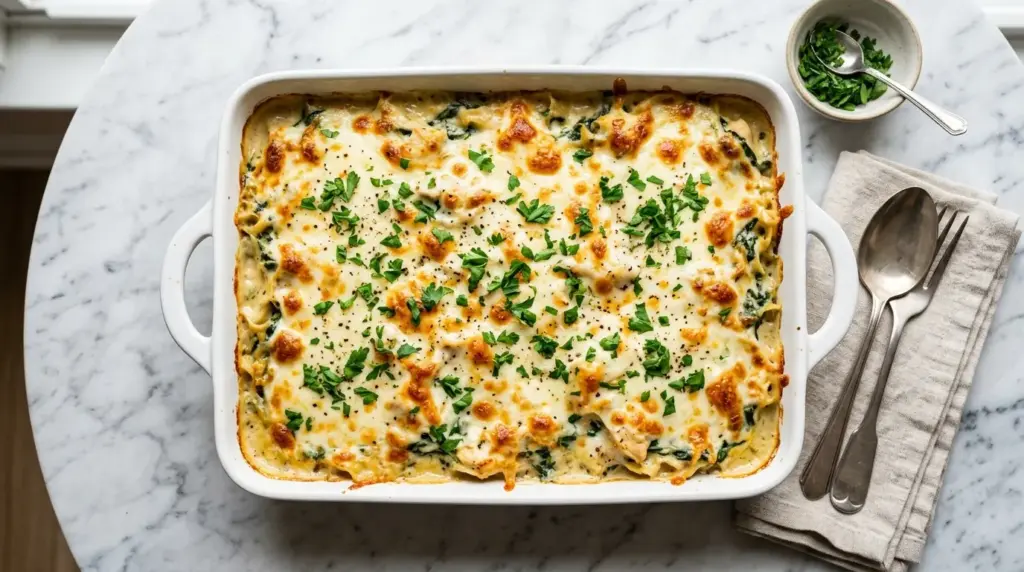
Chicken Florentine Casserole is rich and substantial on its own, but a simple side or two rounds the meal into something truly complete. The sauce is creamy and savory, so lighter, slightly acidic sides tend to work best as contrast.
Here are the best ways to serve it:
- Crusty bread or garlic bread – Use it to scoop up the extra sauce from the dish; Cheesy Garlic Bread is particularly good here
- Steamed or roasted vegetables – Roasted Broccoli or green beans add freshness without competing with the sauce
- Simple green salad – A lightly dressed arugula or romaine salad with lemon vinaigrette cuts through the richness beautifully
- Pasta or rice – Serve over plain buttered pasta or steamed white rice if you want to stretch the portions further
- Mashed potatoes – Creamy Mashed Potatoes work wonderfully as a base for the sauce to pool into
- Sautéed asparagus – A quick skillet of asparagus with olive oil and lemon is a sophisticated, easy pairing
Variations to Try
Once you’ve made this recipe once and understand the structure, it becomes incredibly easy to adapt. The base of chicken, spinach, creamy sauce, and melted cheese is a framework that accommodates all kinds of creative swaps depending on what’s in your fridge or what your family prefers.
- Use rotisserie chicken. Skip the searing step entirely by using pre-cooked, shredded rotisserie chicken. Layer it directly over the spinach, pour the sauce over, and bake. It reduces active cook time significantly.
- Add pasta. Cook 2 cups of elbow macaroni or penne until just al dente, toss it through the sauce before assembling, and bake as directed. This stretches the casserole to serve a larger crowd.
- Swap the cheese. Gruyère or Swiss cheese can replace or supplement the mozzarella for a more classic Florentine flavor profile. Fontina is another excellent option.
- Make it low-carb. Omit any pasta additions, use a homemade cream sauce instead of condensed soup, and serve over cauliflower rice. The core flavors remain completely intact.
- Add sun-dried tomatoes. Stir 1/4 cup of oil-packed sun-dried tomatoes (drained and roughly chopped) into the sauce before assembling. They add a sweet, concentrated tomato flavor that brightens everything up.
- Try artichoke hearts. Add a drained and roughly chopped can of artichoke hearts to the spinach and mushroom layer for a richer, more complex vegetable base.
Read Also: Chicken Florentine Pizza Recipe
Storage and Reheating
This casserole stores exceptionally well, and many people find it tastes even better the next day once the flavors have had time to meld fully overnight in the refrigerator. Proper storage ensures the texture stays just as satisfying on day two or three.
- Refrigerator: Allow the casserole to cool completely before covering. Store tightly covered with plastic wrap or in an airtight container in the refrigerator for up to 4 days.
- Freezer: This casserole freezes very well. Portion into individual servings, wrap tightly in plastic wrap followed by a layer of foil, and freeze for up to 3 months. Thaw overnight in the refrigerator before reheating.
- Reheating individual portions: Place a serving in a microwave-safe dish, add a small splash of chicken broth or water over the top, cover loosely with a damp paper towel, and microwave on medium power in 60-second intervals until heated through. The added liquid prevents the sauce from drying out.
- Reheating the whole casserole: Cover the dish with foil and reheat in a 350°F (175°C) oven for 20 to 25 minutes until the internal temperature reaches 165°F (74°C) throughout.
- Make-ahead option: Assemble the entire casserole (including the sauce and cheese), cover tightly, and refrigerate for up to 24 hours before baking. Add an extra 10 minutes of covered baking time when cooking from cold.
Another great make-ahead baked dinner is the Pesto Tortellini Bake Recipe, which follows a very similar prep-ahead approach.
Nutritional Facts
The following is an estimate per serving based on the recipe as written, divided into 6 servings. Values will vary depending on the exact brands used, particularly for the condensed soup and sour cream.
| Nutrient | Per Serving (approx.) |
|---|---|
| Calories | ~385 kcal |
| Protein | ~42g |
| Total Fat | ~20g |
| Saturated Fat | ~9g |
| Carbohydrates | ~8g |
| Fiber | ~1g |
| Sugar | ~3g |
| Sodium | ~720mg |
| Calcium | ~280mg |
| Iron | ~2mg |
This is a high-protein, moderate-fat meal that fits comfortably into a balanced diet. The carbohydrate count is naturally low given the absence of pasta in the base recipe, making it a solid option for those managing their carb intake without sacrificing satisfaction.
For more protein-forward chicken dinners, the Chicken Cordon Bleu Recipe is another excellent choice with a similarly satisfying nutritional profile.
Health Benefits of Key Ingredients
This casserole isn’t just delicious; its core ingredients each bring genuine nutritional value to the table. Understanding what makes each one beneficial makes this feel less like an indulgence and more like a genuinely good choice.
The combination of lean chicken, iron-rich spinach, immune-supporting garlic, and antioxidant-rich mushrooms means every bite is actually working for you, not just tasting good.
Here’s a closer look at what each key ingredient contributes:
- Chicken breast – One of the leanest, highest-quality protein sources available. A 4oz (115g) serving provides roughly 26g of protein, which supports muscle repair, satiety, and metabolic health.
- Baby spinach – Rich in iron, folate, vitamins K, A, and C, and powerful antioxidants like lutein and zeaxanthin. Spinach also provides meaningful amounts of magnesium, which supports nerve and muscle function.
- Mushrooms – A natural source of B vitamins (particularly B2 and B3), selenium, and ergothioneine, a unique antioxidant that is linked to cellular protection and anti-inflammatory benefits.
- Garlic – Contains allicin, a sulfur compound with well-documented antibacterial and immune-boosting properties. Even small amounts in a cooked dish contribute health benefits.
- Parmesan cheese – A concentrated source of calcium and protein. Because it’s so strongly flavored, you get significant nutritional benefit without needing large amounts.
- Olive oil – Rich in oleocanthal and oleic acid, both of which support cardiovascular health and have demonstrated anti-inflammatory effects in research.
The Creamed Spinach Recipe is a great standalone side dish if you want to lean into spinach’s nutritional benefits even further alongside this casserole.
Frequently Asked Questions
1. Can I use frozen spinach instead of fresh?
Yes, absolutely. Frozen spinach works well in this recipe, but the most important step is to thaw it completely first, then squeeze out as much water as possible using a clean kitchen towel or paper towels. Frozen spinach holds a remarkable amount of liquid, and if that water isn’t removed, it will dilute your sauce significantly and make the bottom layer of the casserole soggy. Once properly dried, it can go directly into the baking dish.
2. Can I make this casserole ahead of time?
Yes, this is one of the best things about this recipe. You can fully assemble the casserole, cover it tightly with plastic wrap, and refrigerate it for up to 24 hours before baking. When you’re ready to cook, simply remove it from the refrigerator, let it sit at room temperature for 15 minutes, and bake as directed, adding about 10 extra minutes of covered baking time to account for the cold start.
3. How do I know when the chicken is fully cooked?
The most reliable method is an instant-read meat thermometer. Insert it into the thickest part of the largest chicken breast; when it reads 165°F (74°C), the chicken is safely cooked through. Visually, the chicken should show no pink when you cut into it, and the juices should run clear. Given the covered baking at 375°F, the chicken almost always finishes properly, but a thermometer removes all doubt.
4. Can I use chicken thighs instead of chicken breasts?
Yes, boneless skinless chicken thighs are actually a wonderful swap here. They’re naturally higher in fat, which means they stay juicy and flavorful even if slightly overcooked. They don’t need to be pounded as aggressively as breasts, but trimming any large fat deposits before seasoning is a good idea. The cooking time remains roughly the same; just verify with a thermometer to confirm 165°F (74°C).
5. What can I substitute for cream of mushroom soup?
If you prefer to avoid condensed soup, you can make a simple homemade cream sauce instead. Melt 3 tablespoons of butter in a saucepan, whisk in 3 tablespoons of flour, cook for 1 minute, then slowly whisk in 1.5 cups of whole milk or half-and-half until smooth and thickened. Season it well with salt, pepper, garlic powder, and a pinch of nutmeg. This sauce replaces the condensed soup and gives the casserole a lighter, more from-scratch character without changing the overall structure of the dish.
Read Also: Chicken Florentine Recipe
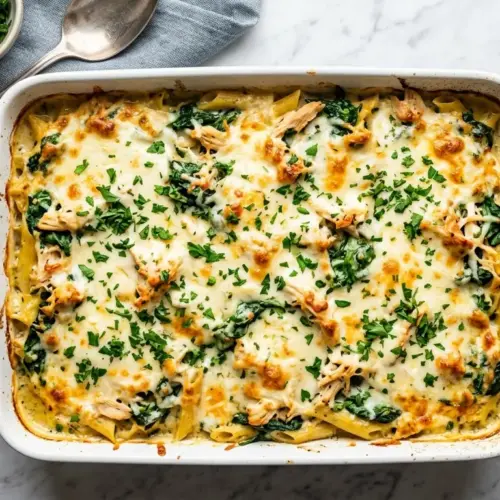
Chicken Florentine Casserole

Equipment
- 9×13-inch baking dish - glass or ceramic preferred
- Large skillet or sauté pan
- Meat mallet or rolling pin
- Medium mixing bowl
- Wooden spoon or silicone spatula
- Chef’s Knife and Cutting Board
- Cheese grater or box grater
- Measuring cups and spoons
- Aluminum foil - for covering during the first part of baking
- Oven mitts
- Instant-read meat thermometer - optional but recommended
- Clean kitchen towel - optional, for drying spinach
Ingredients
- 2 lbs chicken breasts - 900g, boneless, skinless, pounded to even thickness
- 1 tsp kosher salt - divided
- 1/2 tsp black pepper - divided
- 1/2 tsp garlic powder
- 2 tbsp olive oil
- 3 cups baby spinach - 90g, roughly chopped
- 1 cup white mushrooms - 90g, sliced
- 3 cloves garlic - minced
- 1 can condensed cream of mushroom soup - 10.5 oz / 298g, undiluted
- 1 cup sour cream - 240ml, full-fat recommended
- 1/2 cup chicken broth - 120ml
- 1/2 cup Parmesan cheese - 50g, freshly grated, plus 2 tablespoons for topping
- 1 tsp Italian seasoning
- 1/4 tsp crushed red pepper flakes - optional
- 1.5 cups mozzarella cheese - 170g, shredded
- 1 tbsp butter - unsalted, for greasing the dish
- fresh parsley - chopped, for garnish
Instructions
- Preheat oven to 375°F (190°C). Grease a 9×13 baking dish with 1 tablespoon of butter.
- Pound chicken breasts to 3/4 inch thickness, pat dry, and season with 1/2 teaspoon salt, 1/4 teaspoon pepper, and garlic powder.
- Heat olive oil in a large skillet over medium-high heat. Sear chicken for 3-4 minutes per side until golden brown. Transfer to a plate.
- In the same skillet, sauté mushrooms for 4-5 minutes until golden. Add garlic and cook 30-45 seconds until fragrant.
- Add spinach in batches and cook until wilted, 2-3 minutes. Season with remaining 1/2 teaspoon salt and 1/4 teaspoon pepper.
- Spread the spinach-mushroom mixture evenly in the bottom of the prepared baking dish.
- In a mixing bowl, combine cream of mushroom soup, sour cream, chicken broth, 1/2 cup Parmesan, Italian seasoning, and red pepper flakes if using. Stir until smooth.
- Lay seared chicken breasts over the spinach mixture. Pour the sauce evenly over the chicken.
- Top with shredded mozzarella and remaining 2 tablespoons of Parmesan.
- Cover with foil and bake for 25 minutes. Remove foil and bake uncovered for 15-20 minutes until cheese is golden and bubbling.
- Let rest 5-10 minutes, then garnish with fresh parsley before serving.
Notes
- Pound chicken evenly: An uneven thickness is the most common reason for dry or undercooked chicken. Aim for a uniform 3/4-inch thickness for the best results.
- Dry the spinach well: If using fresh spinach, squeeze out excess moisture after wilting. If using thawed frozen spinach, wring it in a clean kitchen towel until almost completely dry. Extra water will thin your sauce.
- Don’t skip the rest time: Allow the casserole to rest for 5-10 minutes after baking. This lets the sauce thicken and makes serving much easier.
- Use a thermometer: The most reliable way to know your chicken is done is to check that the thickest part reaches 165°F (74°C) internally.
- Make-ahead option: Assemble the entire casserole, cover, and refrigerate for up to 24 hours. Add 10 minutes to the covered baking time when cooking from cold.
- Substitute for cream of mushroom soup: Make a homemade sauce by melting 3 tablespoons butter, whisking in 3 tablespoons flour, then slowly adding 1.5 cups of whole milk until thickened. Season with salt, pepper, garlic powder, and nutmeg.
- Storage: Store covered in the refrigerator for up to 4 days. Freeze individual portions for up to 3 months.
- Reheating: For individual portions, add a splash of chicken broth and microwave in 60-second intervals. For the whole casserole, cover with foil and reheat at 350°F for 20-25 minutes.
- Swap the cheese: Gruyère, Swiss, or Fontina work beautifully in place of or alongside the mozzarella for a more classic Florentine flavor.
- Add pasta: To stretch this to feed a crowd, stir 2 cups of cooked pasta (elbow macaroni or penne) into the sauce before assembling.
Final Thoughts
This Chicken Florentine Casserole Recipe is the kind of dish that quietly becomes a household favorite without you even planning for it.
The first time you pull that bubbling, golden-topped casserole out of the oven and the whole kitchen fills with the smell of garlic, roasted cheese, and savory cream sauce, you’ll understand exactly why Florentine-style cooking has endured for centuries.
It hits every note: satisfying, comforting, nutritious, and deeply flavorful, all from one dish that fits easily into a weeknight schedule.
Give it a try this week, and feel free to make it your own with the variations above. Drop a comment below to let me know how it turned out, and if you share it on social media, tag me so I can see your beautiful casserole!
Recommended:
- Chicken Florentine Soup Recipe
- Chicken Cordon Bleu Pasta Recipe
- Slow Cooker Chicken Enchilada Casserole Recipe
- Hamburger Rice Casserole Recipe
- Green Bean Casserole Recipe
- Chicken Casserole Recipe
- Tuna Noodle Casserole Recipe
- Slow Cooker Cowboy Casserole Recipe
- Baked Chicken with Alfredo Sauce Recipe
- Italian Chicken Skillet Recipe