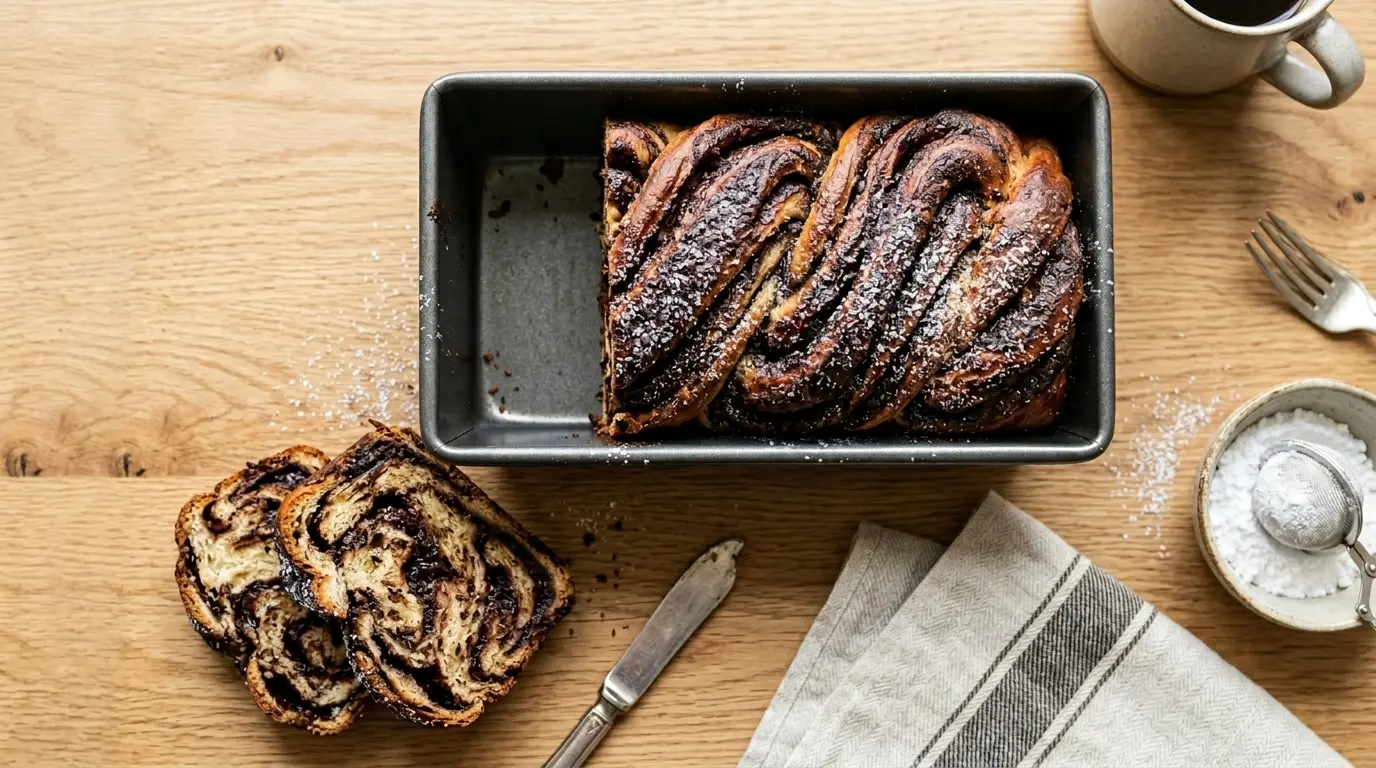
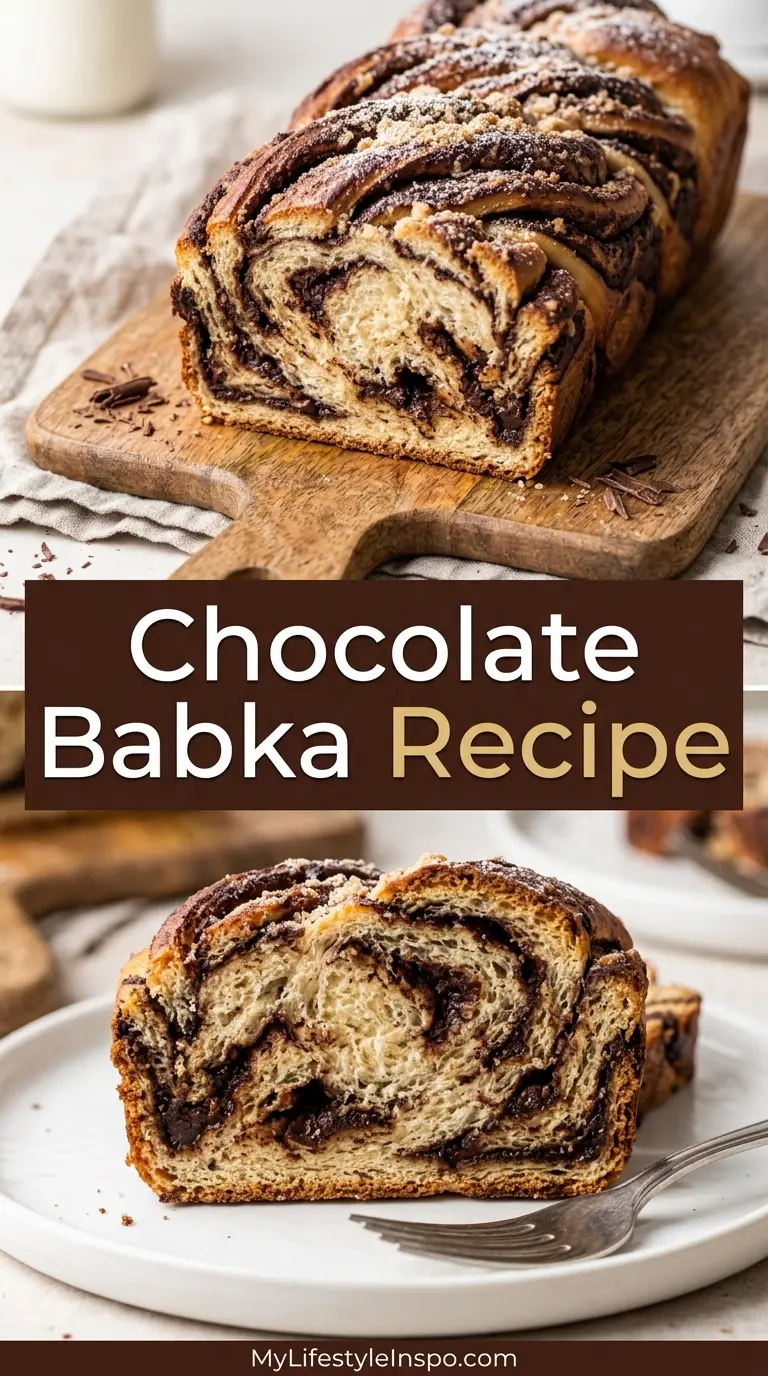
If you’ve been putting off making a chocolate babka recipe at home because it looks intimidating, today is the day to change that. Babka is a braided, enriched bread with stunning swirls of chocolate filling running through every single slice. It originated in the Jewish communities of Eastern Europe, where resourceful grandmothers would use leftover challah dough, spread it with a sweet filling, roll it up, and bake it into something extraordinary.
The name “babka” literally means “grandmother” in Polish and Yiddish, and that warmth comes through in every bite.
What makes this recipe so approachable is that most of the time involved is hands-off. You mix the dough, refrigerate it overnight, fill it, shape it, and bake it. The result is a golden, glossy loaf with layers of buttery dough and deep chocolate that tastes like it came straight from a bakery counter.
This recipe follows the most widely celebrated version: a soft, brioche-style dough filled with a homemade chocolate filling made from real dark chocolate, cocoa powder, and butter, then finished with a simple sugar syrup glaze. It is the version that most cookbook authors, professional bakers, and home bakers agree is the gold standard.
If you have ever stood in a bakery line debating between cinnamon and chocolate babka, this recipe will settle the debate for good.
If you love enriched, sweet breads as much as this one, check out this Challah Recipe for another beautifully braided classic from the same tradition.
Why You’ll Love This Chocolate Babka Recipe
This is one of those bakes that impresses everyone without requiring professional skill.
The dough is enriched with eggs and butter, which gives it a tender, almost cake-like crumb that stays soft for days.
The chocolate filling is made from scratch using real dark chocolate and unsweetened cocoa powder, so it tastes genuinely rich rather than overly sweet.
The braid-and-twist shaping technique sounds tricky but is actually quite forgiving. Even a slightly imperfect twist bakes up beautifully.
The simple sugar syrup glaze is brushed on right out of the oven, giving the loaf that gorgeous, shiny finish you see in bakery windows.
It works as breakfast, brunch, dessert, or a thoughtful homemade gift.
- Showstopping appearance with dramatic chocolate swirls visible in every slice
- Bakery-quality flavor from real dark chocolate in both the filling and the dough
- Make-ahead friendly since the dough rests overnight in the fridge, spreading the work across two days
- Freezer friendly, so you can bake two loaves and save one for later
- Endlessly customizable with filling variations like cinnamon sugar, Nutella, or nuts
For another show-stopping loaf that pairs chocolate and bread beautifully, try this Chocolate Chip Bread Recipe for a quicker, no-yeast option.
Ingredients
Making babka from scratch requires just a handful of pantry and baking staples. The quality of your chocolate matters here. Use a good dark chocolate bar (60 to 70% cacao) rather than chocolate chips for the smoothest, most luscious filling possible.
For the Dough:
- 3 1/2 cups (440g) all-purpose flour, plus more for dusting
- 1/4 cup (50g) granulated sugar
- 2 1/4 teaspoons (7g) instant yeast (1 packet)
- 1/2 cup (120ml) whole milk, warmed to 110°F/43°C
- 3 large eggs, room temperature
- 1 teaspoon fine sea salt
- 1/2 cup (113g) unsalted butter, softened and cut into cubes
For the Chocolate Filling:
- 4 oz (113g) dark chocolate (60-70% cacao), finely chopped
- 3 tablespoons (45g) unsalted butter
- 1/4 cup (25g) unsweetened Dutch-processed cocoa powder
- 1/2 cup (60g) powdered sugar, sifted
- 1/2 teaspoon cinnamon
- 1 pinch of fine sea salt
For the Simple Syrup Glaze:
- 1/4 cup (60ml) water
- 1/4 cup (50g) granulated sugar
This recipe makes 1 large loaf (9×5 inch pan), serving approximately 10 to 12 slices.
You might also enjoy this Cinnamon Swirl Bread Recipe if you love the idea of swirled fillings in a soft, enriched loaf.
Kitchen Equipment Needed
You do not need any specialty equipment to make babka, though a stand mixer with a dough hook makes the process considerably easier. The long kneading time needed to build gluten in an enriched dough is much more manageable with a machine.
- Stand mixer with dough hook attachment (or large mixing bowl for hand kneading)
- 9×5 inch loaf pan
- Parchment paper
- Rolling pin
- Sharp chef’s knife or bench scraper
- Offset spatula
- Medium heatproof bowl (for chocolate filling)
- Small saucepan
- Pastry brush (for the syrup glaze)
- Instant-read thermometer (optional but helpful)
- Plastic wrap or a clean kitchen towel
Read Also: Brioche Recipe
Recommended Products for This Recipe
These are products that are genuinely worth picking up to make the best possible babka. Each one addresses a common pain point in the recipe and makes a real difference in the final result.
1. Valrhona or Guittard Dark Chocolate Baking Bar
The quality of your chocolate is the single biggest factor in how the filling tastes. Premium baking bars from brands like Valrhona or Guittard melt far more smoothly than chips and deliver a richer, more complex flavor. Look for 60 to 70% cacao content for the ideal balance of bittersweet depth.
2. KitchenAid Stand Mixer with Dough Hook
Enriched doughs like babka require extended kneading to fully incorporate butter and build structure. A stand mixer does this effortlessly in about 10 minutes, whereas kneading by hand can take 20 minutes or more. This is the one kitchen investment that makes enriched baking feel truly enjoyable.
3. USA Pan 9×5 Loaf Pan (Aluminized Steel)
A heavy, light-colored aluminized steel loaf pan promotes even heat distribution and prevents the bottom and sides from over-browning before the interior is fully cooked. Dark nonstick pans can cause babka to over-bake on the edges. This pan produces a beautifully golden, evenly baked loaf every time.
4. Dutch-Process Cocoa Powder
Dutch-process cocoa is alkalized, which gives it a deeper, richer chocolate flavor and a darker color compared to natural cocoa. In the filling, it makes the difference between a mild chocolate taste and a genuinely intense, bakery-quality one. Brands like Droste or Cacao Barry are excellent options.
5. Offset Spatula (Small, 4.5 inch)
Spreading the chocolate filling evenly all the way to the edges of the dough rectangle is crucial for consistent swirls in every slice. An offset spatula lets you control the thickness of the layer with precision, which matters more here than in most recipes. It is a small tool that makes a big difference.
For a quicker chocolate bake that uses similar pantry ingredients, this Moist Chocolate Cake Recipe is another crowd-pleasing option when you’re short on time.
Step-by-Step Instructions
Step 1: Activate the Yeast and Mix the Dough
- Pour the warm milk (110°F/43°C) into the bowl of your stand mixer.
- Sprinkle the instant yeast and 1 tablespoon of the measured granulated sugar over the milk.
- Let it sit for 5 minutes until the mixture looks slightly foamy. This confirms your yeast is alive and active.
- Add the remaining sugar, all-purpose flour, eggs, and fine sea salt to the bowl.
- Attach the dough hook and mix on low speed (speed 2) for about 2 minutes until a shaggy dough forms and most of the flour is incorporated.
Step 2: Add the Butter
- With the mixer running on medium-low speed, add the softened butter one or two cubes at a time. Wait until each addition is mostly absorbed before adding the next.
- This step will take about 5 minutes. Do not rush it. Adding butter too quickly can prevent it from fully incorporating into the dough.
- Once all the butter is added, increase the speed to medium and knead for 8 to 10 minutes until the dough is smooth, elastic, and just slightly tacky when you press it.
- The dough will pull away cleanly from the sides of the bowl. If it is very sticky, add flour one tablespoon at a time, but avoid adding too much or the babka will be dense.
Step 3: First Rise (Overnight Refrigeration)
- Lightly oil a large bowl and transfer the dough to it, turning once to coat all sides.
- Cover tightly with plastic wrap.
- Refrigerate for at least 8 hours, or up to 24 hours. The cold temperature slows the rise and makes the dough much easier to work with. It also develops flavor.
- Do not skip this step. A properly chilled dough rolls out smoothly and holds its shape when you twist it.
Step 4: Make the Chocolate Filling
- Combine the finely chopped dark chocolate and the unsalted butter in a medium heatproof bowl.
- Set the bowl over a saucepan of barely simmering water (double boiler) and stir gently until both are completely melted and smooth.
- Remove from heat.
- Add the sifted powdered sugar, Dutch-processed cocoa powder, cinnamon, and pinch of salt to the melted chocolate mixture.
- Stir until a thick, spreadable paste forms. It should be the consistency of a thick frosting.
- Set aside at room temperature to cool slightly while you prepare the dough. The filling should be spreadable but not runny. If it becomes too firm, gently warm it back over the simmering water.
Step 5: Prepare the Pan and Roll the Dough
- Grease a 9×5 inch loaf pan generously with butter or nonstick spray.
- Line the bottom and long sides with a strip of parchment paper, leaving an overhang on both sides. This makes it easy to lift the baked babka out of the pan.
- Remove the chilled dough from the refrigerator and place it on a lightly floured surface.
- Using a rolling pin, roll the dough out into a large rectangle approximately 12 inches wide by 16 inches long (30cm x 40cm). Work quickly so the dough stays cool.
- If the dough springs back, let it rest for 5 minutes and then continue rolling.
Step 6: Spread the Filling and Roll the Log
- Using an offset spatula, spread the chocolate filling evenly over the entire surface of the dough rectangle, leaving a 1/2 inch (1.25cm) border on the two short sides only.
- Make sure the layer is as even as possible. Uneven filling means uneven swirls.
- Starting from the long edge closest to you, roll the dough tightly into a log, just as you would for cinnamon rolls.
- Pinch the seam gently to seal it.
- The log should be approximately 16 inches long.
Step 7: Cut and Twist the Babka
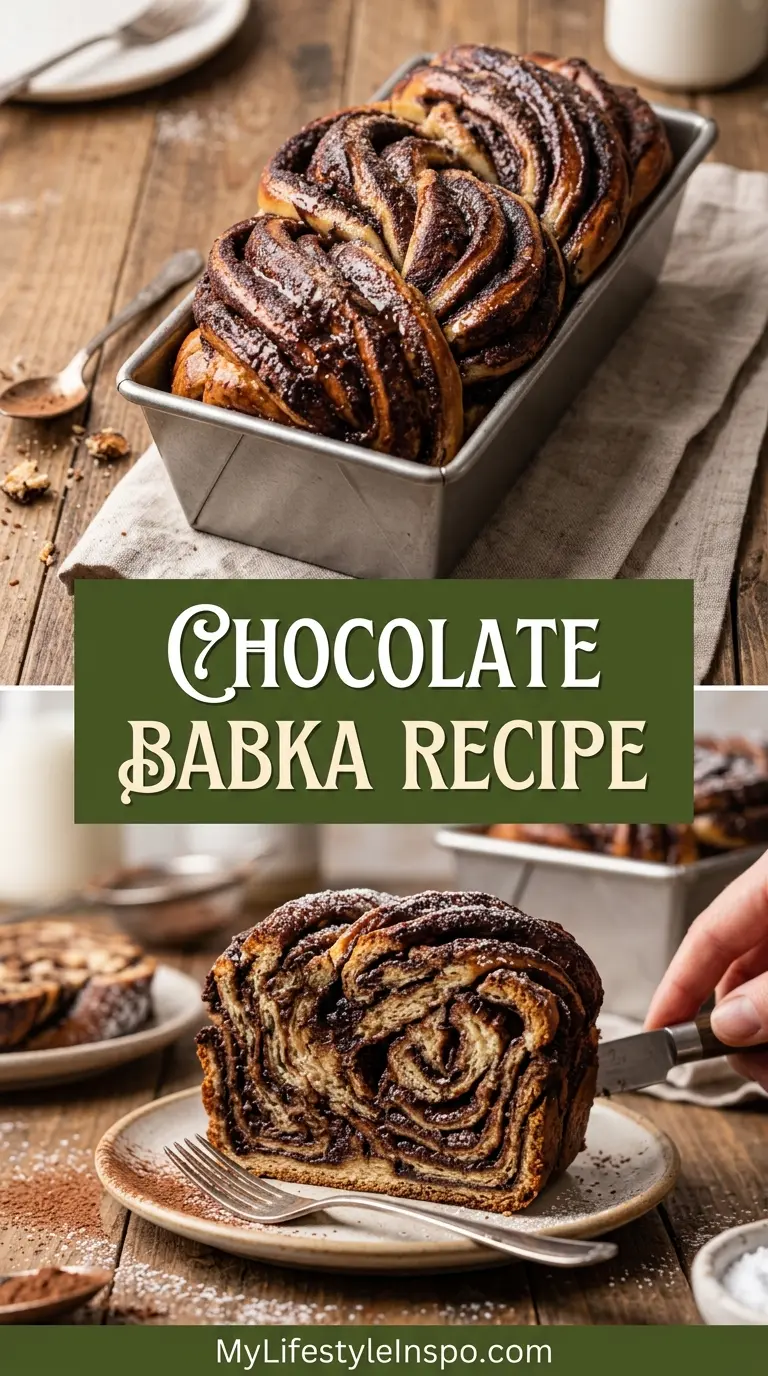
- Using a sharp chef’s knife, cut the dough log in half lengthwise. This is the key step that creates all those beautiful swirls.
- You will now have two long strands, each with visible chocolate layers exposed on the cut side.
- Turn both strands so the cut sides are facing up.
- Starting at the top, cross the right strand over the left strand, then cross the left over the right. Continue this twisting pattern all the way to the bottom.
- Pinch the ends together to secure.
- Carefully transfer the twisted babka into the prepared loaf pan. Tuck and nestle it gently so it fills the pan from end to end.
Step 8: Second Rise
- Cover the loaf pan loosely with plastic wrap or a clean kitchen towel.
- Let the babka rise at room temperature for 1.5 to 2 hours. The loaf will puff up noticeably, though enriched doughs do not double in size the way lean bread doughs do.
- Toward the end of the rise time, preheat your oven to 350°F (175°C) and position a rack in the center.
Step 9: Bake the Babka
- Bake the babka in the preheated oven for 35 to 45 minutes until the top is a deep golden brown.
- If the top is browning too quickly before the inside is cooked through, tent the pan loosely with aluminum foil after about 25 minutes.
- The babka is done when an instant-read thermometer inserted in the center reads 190°F to 200°F (88°C to 93°C). If you do not have a thermometer, insert a skewer into the center. It should come out clean and the loaf should sound hollow when tapped on the bottom.
Step 10: Make and Apply the Simple Syrup Glaze
- While the babka bakes, combine the 1/4 cup water and 1/4 cup granulated sugar in a small saucepan.
- Heat over medium heat, stirring, until the sugar completely dissolves. This takes about 2 minutes.
- Remove from heat and set aside.
- As soon as the babka comes out of the oven, brush the entire top generously with the warm simple syrup.
- This glaze is not optional. It adds a gorgeous sheen, keeps the loaf moist, and adds just the right touch of sweetness to the crust.
- Let the babka cool in the pan for 20 minutes, then use the parchment overhang to lift it onto a wire rack. Cool for at least 30 minutes before slicing.
This same enriched dough technique works beautifully in a Cinnamon Raisin Bread Recipe if you want to try another classic sweet loaf.
Tips for Success
Even experienced bakers run into trouble with enriched doughs. These tips will help you avoid the most common mistakes and get consistently beautiful results every time.
- Use room temperature eggs and butter. Cold eggs can cause the dough to seize when they hit the mixer, and cold butter won’t incorporate properly. Take both out of the fridge 30 to 60 minutes before you start.
- Don’t skip the overnight chill. The refrigerator rest is what makes this dough workable. Warm, buttery dough is sticky and difficult to roll. Cold dough rolls cleanly and holds its shape when you cut and twist.
- Check your yeast temperature. Milk that is too hot (above 120°F/49°C) will kill the yeast. Too cool and the yeast won’t activate. Use a thermometer or test it by feel: it should feel warm, not hot, on your wrist.
- Spread filling to the edges. Leaving large borders without filling means the end slices of your babka will have very little chocolate. Spread all the way to the edges on the long sides.
- Don’t skip the simple syrup. It might seem unnecessary after baking, but it is what gives babka that soft, moist interior and shiny exterior that distinguishes a great babka from a good one.
- Let it cool before slicing. Cutting into a warm babka causes the swirls to compress and the filling to run. Give it at least 30 minutes on a rack for clean, beautiful slices.
Read Also: Monkey Bread Recipe
Serving Suggestions
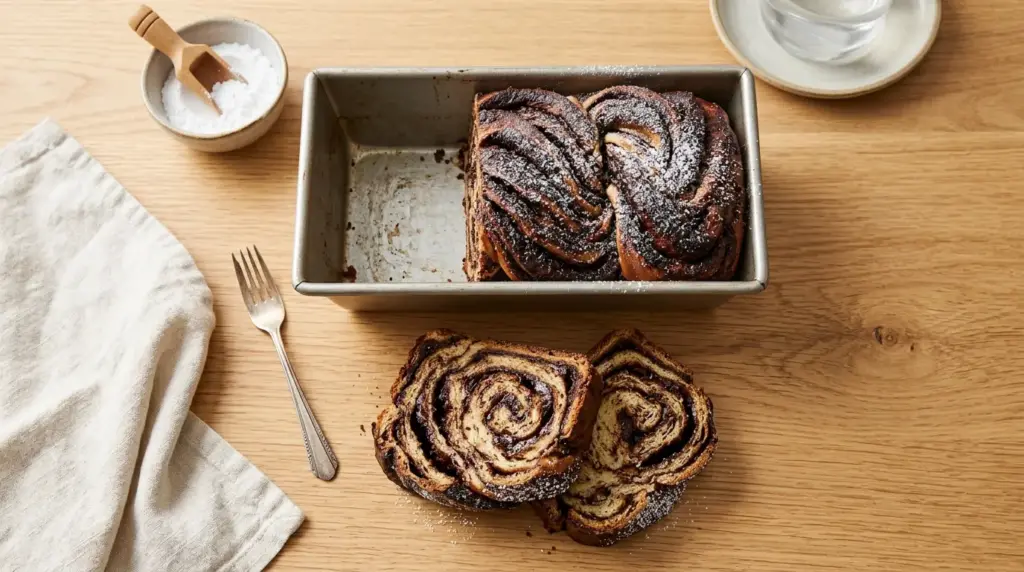
Chocolate babka is spectacular on its own, but a few simple pairings make it even better.
Serve thick slices at room temperature alongside a strong cup of coffee or tea. The slight bitterness of the coffee balances the richness of the chocolate filling perfectly.
For a special brunch treat, toast individual slices lightly in a toaster and top with a thin spread of salted butter. The warm chocolate filling becomes fudgy and irresistible.
Try serving babka alongside Brioche French Toast for a brunch spread that your guests will talk about for weeks.
- A mug of Hot Chocolate for an especially decadent pairing on a cold morning
- A scoop of vanilla ice cream or softly whipped cream alongside a warm slice for dessert
- Fresh berries (strawberries or raspberries) to cut through the richness with a touch of acidity
- Drizzle of salted caramel sauce for an elevated dessert plating
Variations to Try
Once you have mastered the standard chocolate babka, the dough is a fantastic base for all kinds of variations. The brioche-style dough is incredibly versatile, and bakers around the world put their own spin on it.
- Cinnamon Babka: Replace the chocolate filling entirely with a mixture of 4 tablespoons softened butter, 1/2 cup brown sugar, and 2 teaspoons cinnamon. This is the classic alternative filling, and many argue it rivals chocolate.
- Nutella Babka: Swap the homemade chocolate filling for 1/2 cup (140g) Nutella spread directly over the dough. Sprinkle chopped hazelnuts over the Nutella for extra texture and flavor.
- Chocolate Orange Babka: Add 1 tablespoon of finely grated orange zest to the chocolate filling. The bright citrus cuts through the richness and adds a sophisticated flavor dimension.
- Pistachio Chocolate Babka: Mix 1/4 cup (30g) finely chopped pistachios into the chocolate filling before spreading. The nuts add crunch and a subtle savory edge.
- Streusel-Topped Babka: Before baking, mix 2 tablespoons flour, 2 tablespoons sugar, 1 tablespoon cold butter (cut into pea-sized pieces), and a pinch of cinnamon with your fingers until crumbly. Sprinkle over the top of the loaf for a coffee-cake-style finish.
Another classic Jewish pastry worth adding to your baking rotation is this Rugelach Recipe, which uses cream cheese dough and a similar chocolate or cinnamon filling.
Storage and Reheating
Babka stores and reheats exceptionally well, which is one of the reasons it is such a popular make-ahead bake.
- Room temperature: Wrap the cooled babka tightly in plastic wrap or store in an airtight container. It will stay fresh and moist for up to 3 days. The simple syrup glaze helps it retain moisture longer than most enriched breads.
- Refrigerator: If you need to keep it longer than 3 days, wrap tightly in plastic wrap and refrigerate for up to 5 days. Bring it to room temperature or warm it slightly before serving, as cold babka can feel dense.
- Freezer: Wrap the fully cooled babka tightly in two layers of plastic wrap, then a layer of aluminum foil, and freeze for up to 2 months. Thaw overnight in the refrigerator or at room temperature for several hours.
- Reheating individual slices: Place a slice on a baking sheet and warm in a 300°F (150°C) oven for 5 to 7 minutes, or microwave for 15 to 20 seconds. Both methods revive the soft, fudgy texture beautifully.
If you end up with leftover babka that has gone slightly stale, it is absolutely perfect in a Chocolate Bread Pudding Recipe where the rich chocolate layers become even more luscious after soaking.
Nutritional Facts
The following is an approximate nutritional breakdown per slice, based on the recipe making 12 slices. These values will vary depending on the specific brands of ingredients you use.
| Nutrient | Per Slice (approx.) |
|---|---|
| Calories | 310 kcal |
| Total Fat | 16g |
| Saturated Fat | 9g |
| Cholesterol | 75mg |
| Sodium | 115mg |
| Total Carbohydrates | 38g |
| Dietary Fiber | 2g |
| Total Sugars | 15g |
| Protein | 6g |
| Iron | 2.5mg |
| Calcium | 40mg |
Please note these are estimates only. For precise counts, use a nutritional calculator with the exact brands and quantities you used.
Another baked treat with a rich chocolate profile worth checking out is this Chocolate Souffle Recipe.
Health Benefits of Key Ingredients
While chocolate babka is certainly an indulgent treat, several of its key ingredients do carry genuine nutritional value when consumed as part of a balanced diet.
It is always worth knowing what is going into your food, even when you are baking something celebratory.
- Dark Chocolate (60-70% cacao): Dark chocolate is a meaningful source of flavonoids, which are antioxidants linked to cardiovascular health. Studies suggest that moderate dark chocolate consumption can support healthy blood pressure and improve blood flow. The higher the cacao percentage, the more antioxidants and the less added sugar.
- Eggs: Eggs contribute high-quality complete protein to the dough, along with essential vitamins including B12, D, and choline. The lecithin in egg yolks also acts as a natural emulsifier, which is part of why the babka dough has such a tender, uniform crumb.
- Whole Milk: Whole milk adds calcium, vitamin D, and healthy fats to the dough. The fat content in whole milk is what contributes to the soft, pillowy texture of the finished loaf. Lower-fat alternatives can be used but may result in a slightly less tender crumb.
- Unsweetened Cocoa Powder: Cocoa powder is rich in flavanols and minerals including magnesium and iron. Dutch-processed cocoa powder specifically is less acidic than natural cocoa, making it easier on the digestive system while still delivering all the same micronutrients.
- Butter: Quality unsalted butter provides fat-soluble vitamins A, E, and K2. The fat is also what creates the layered, flaky texture in the dough, so it plays a structural as well as nutritional role.
For another baked good with a similar warming spice profile, try the Apple Cinnamon Bread Recipe.
Frequently Asked Questions
1. Can I make chocolate babka without a stand mixer?
Yes, you can make babka by hand, though it requires patience and effort.
Mix the dough together in a large bowl using a wooden spoon until it comes together, then turn it out onto a lightly floured surface and knead by hand for 15 to 20 minutes. Add the butter gradually as you knead, folding it in a few cubes at a time. The dough should eventually become smooth and elastic, though it may feel quite sticky initially.
2. Why does my babka feel dense or gummy inside?
This usually means the babka was underbaked.
Because the dough is so enriched with eggs, butter, and milk, it takes longer to fully cook through than a standard bread loaf. Always check the internal temperature with an instant-read thermometer. It should read between 190°F and 200°F (88°C to 93°C) before you pull it from the oven. If the top is getting too dark before the center is done, tent it loosely with foil.
3. Can I make the babka dough without refrigerating overnight?
You can, but it is not recommended.
The overnight chill is what makes the buttery dough manageable to roll and shape. Without it, the dough will be too soft and sticky to work with properly, and the filling may leak out during shaping. If you’re short on time, a minimum of 4 hours in the refrigerator will help, though 8 to 12 hours produces the best results.
4. Can I freeze the babka dough before baking?
Yes, the shaped, unbaked loaf can be frozen.
After twisting the dough and placing it in the loaf pan, cover it tightly with plastic wrap and freeze for up to 1 month. When ready to bake, transfer it to the refrigerator the night before and let it thaw and complete its second rise at room temperature for 2 to 3 hours before baking.
5. My chocolate filling hardened after I made it. What should I do?
This happens if the filling cools too much before you use it.
Place the bowl back over the saucepan of barely simmering water and stir gently for 1 to 2 minutes until it loosens to a spreadable consistency again. You want it to be thick enough to stay in place when you roll the dough but soft enough to spread without tearing the dough.
Read Also: Croissant Recipe
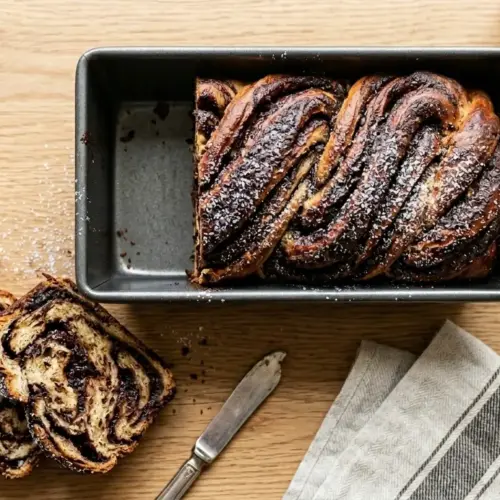
Homemade Chocolate Babka

Equipment
- Stand mixer with dough hook attachment - or large mixing bowl for hand kneading
- 9×5-inch loaf pan
- Parchment paper
- Rolling Pin
- Sharp chef's knife - or bench scraper
- Offset spatula - small, 4.5 inch
- Medium heatproof bowl - for chocolate filling
- Small saucepan
- Pastry brush - for syrup glaze
- Instant-read thermometer - optional but helpful
- Plastic wrap - or clean kitchen towel
Ingredients
- 3 1/2 cups all-purpose flour - 440g, plus more for dusting
- 1/4 cup granulated sugar - 50g
- 2 1/4 teaspoons instant yeast - 7g, 1 packet
- 1/2 cup whole milk - 120ml, warmed to 110°F/43°C
- 3 large eggs - room temperature
- 1 teaspoon fine sea salt
- 1/2 cup unsalted butter - 113g, softened and cut into cubes (for dough)
For the Chocolate Filling
- 4 oz dark chocolate - 113g, 60-70% cacao, finely chopped
- 3 tablespoons unsalted butter - 45g
- 1/4 cup unsweetened Dutch-processed cocoa powder - 25g
- 1/2 cup powdered sugar - 60g, sifted
- 1/2 teaspoon cinnamon
- 1 pinch fine sea salt
For the Simple Syrup Glaze
- 1/4 cup water - 60ml
- 1/4 cup granulated sugar - 50g
Instructions
- Pour warm milk into stand mixer bowl, sprinkle yeast and 1 tablespoon sugar over it, and let sit 5 minutes until foamy. Add remaining sugar, flour, eggs, and salt, then mix on low speed for 2 minutes until shaggy dough forms.
- With mixer on medium-low, add softened butter one or two cubes at a time, waiting until each is mostly absorbed. Once all butter is added, knead on medium for 8-10 minutes until smooth, elastic, and slightly tacky.
- Transfer dough to a lightly oiled bowl, cover tightly with plastic wrap, and refrigerate for at least 8 hours or up to 24 hours.
- Melt chopped dark chocolate and butter in a heatproof bowl over simmering water, stirring until smooth. Remove from heat and stir in sifted powdered sugar, cocoa powder, cinnamon, and salt until a thick spreadable paste forms.
- Grease a 9×5 inch loaf pan and line with parchment paper with overhang. On a lightly floured surface, roll chilled dough into a 12×16 inch rectangle.
- Spread chocolate filling evenly over the dough rectangle, leaving a 1/2 inch border on the short sides. Roll tightly from the long edge into a 16-inch log and pinch the seam to seal.
- Cut the log in half lengthwise, exposing the chocolate layers. Cross the right strand over the left, then left over right, continuing the twist to the bottom. Transfer to the prepared loaf pan.
- Cover loosely with plastic wrap and let rise at room temperature for 1.5 to 2 hours until puffed. Near the end, preheat oven to 350°F (175°C).
- Bake for 35-45 minutes until deep golden brown and internal temperature reaches 190-200°F (88-93°C). Tent with foil after 25 minutes if browning too quickly.
- While baking, combine water and sugar in a small saucepan and heat until sugar dissolves. Brush hot babka generously with the syrup, cool in the pan for 20 minutes, then transfer to a wire rack to cool for at least 30 minutes before slicing.
Notes
- Use room temperature ingredients: Take eggs and butter out of the fridge 30-60 minutes before starting for proper incorporation and dough consistency.
- Don’t skip the overnight chill: This step makes the buttery dough manageable to roll and shape – warm dough will be sticky and hard to work with.
- Check yeast temperature: Milk should be 110°F (43°C) – too hot kills the yeast, too cool won’t activate it. Test by feeling it on your wrist; it should be warm, not hot.
- Spread filling evenly: Use an offset spatula to reach the edges on the long sides. Uneven filling means uneven swirls and less chocolate in some slices.
- The syrup glaze is essential: It gives babka its signature glossy sheen, keeps the loaf moist, and adds the perfect touch of sweetness to the crust.
- Cool before slicing: Wait at least 30 minutes on a wire rack. Cutting warm babka compresses the swirls and causes the filling to run.
- Substitution option: If you don’t have Dutch-process cocoa powder, use natural cocoa powder but note the filling will have a slightly lighter color and milder flavor.
- Make ahead: Shape the unbaked loaf, freeze for up to 1 month, then thaw overnight in the refrigerator and complete the second rise at room temperature before baking.
- Storage: Wrap tightly in plastic wrap and store at room temperature for up to 3 days, refrigerate for 5 days, or freeze for up to 2 months.
- Reheating: Warm individual slices in a 300°F (150°C) oven for 5-7 minutes or microwave for 15-20 seconds to revive the fudgy texture.
Final Thoughts
Homemade chocolate babka is one of those bakes that feels genuinely special every single time you make it.
The combination of pillowy brioche-style dough and rich, deeply chocolatey filling is hard to beat.
If you have been hesitating because it looks complicated, the step-by-step instructions here should give you the confidence to go for it.
Most of the work happens the night before, which means on baking day, all you’re really doing is shaping, letting it rise, and sliding it into the oven.
Give this chocolate babka recipe a try this weekend, and let me know how it goes in the comments below. Did you stick with the classic filling or try one of the variations?
Share a photo, leave a rating, or tag a friend who deserves a warm slice of this right now.
Recommended:
- Challah Recipe
- Brioche Recipe
- Cinnamon Swirl Bread Recipe
- Monkey Bread Recipe
- Rugelach Recipe
- Banana Bread Pudding Recipe
- Bread Pudding Recipe
- Date Nut Bread Recipe
- Lemon Blueberry Bread Recipe
- Sourdough Discard Cinnamon Rolls Recipe