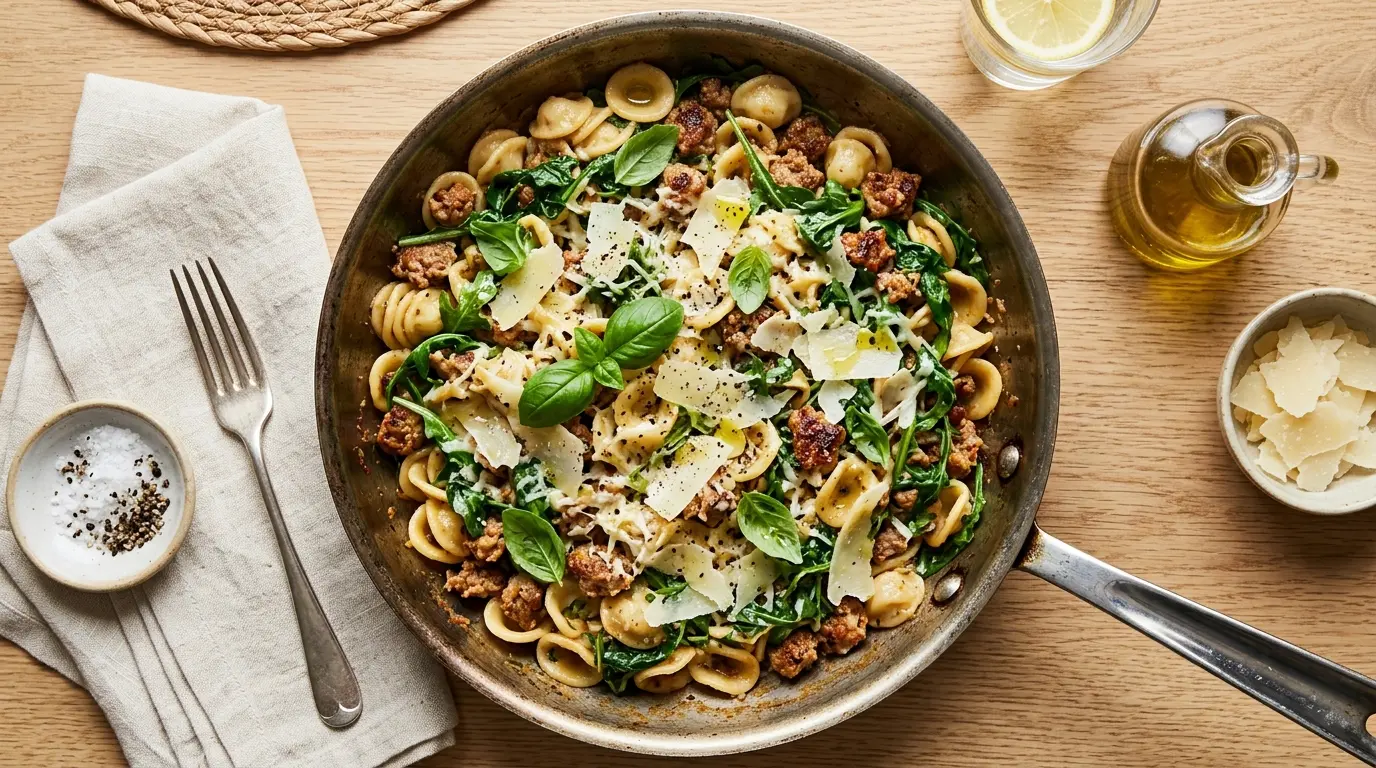
If you’ve been searching for a dinner that delivers big flavor with barely any cleanup, this One Pan Orecchiette Pasta Recipe is exactly what your weeknight rotation has been missing. Every ingredient — from the Italian sausage to the pasta itself — cooks in a single skillet, with the starchy broth transforming into a glossy, savory sauce as everything comes together.
Orecchiette, which translates to “little ears” in Italian, is one of the smartest pasta shapes for one-pan cooking. Its small, concave shape catches the sauce beautifully, meaning every single bite is coated in that rich, garlicky pan liquid. Add in peppery arugula, salty Parmigiano-Reggiano, and golden sausage, and you have a complete, restaurant-worthy meal in under 35 minutes.
This is the kind of recipe you come back to again and again. It’s comforting and deeply satisfying, but not so heavy that you feel weighed down afterward. The pasta cooks right in the broth, absorbing all of that savory sausage-and-garlic flavor from the very start.
For another Italian-inspired skillet dinner the whole family will love, check out this Creamy Tuscan White Bean Skillet.

Why You’ll Love This One Pan Orecchiette Pasta Recipe
This recipe is a weeknight lifesaver for so many reasons.
First, you’re only washing one pan — and that alone is worth celebrating. No separate pot for boiling water, no colander, no extra sauce pan.
The flavor payoff is enormous for such minimal effort. Browning the sausage directly in the pan creates a layer of caramelized bits on the bottom that get scraped up and dissolved into the broth, adding incredible depth to the sauce.
The pasta soaks up everything as it cooks, so it’s not just plain boiled noodles sitting in a puddle of sauce. It tastes integrated and cohesive in a way that regular pasta dishes often don’t.
The arugula wilts into the hot pasta at the very end, adding a subtle peppery bite that balances the richness of the sausage and cheese perfectly.
This dish is also endlessly adaptable. Swap the sausage, change the greens, add a squeeze of lemon — the base method works with so many variations.
- Ready in about 30 to 35 minutes from start to finish
- Uses one pan for both cooking and serving
- Packed with protein and flavor from Italian sausage and Parmesan
- Works with mild or spicy sausage depending on your preference
- No need to pre-boil the pasta — it cooks right in the broth
- Easy enough for beginners, impressive enough for guests
You might also enjoy: Lasagna Soup Recipe
Ingredients
You only need a handful of simple, pantry-friendly ingredients to make this dish truly shine. The key is using a good-quality Italian sausage, since it’s the primary flavor driver — everything else builds on top of it.
- 2 tablespoons (30 ml) olive oil
- ½ medium yellow onion, finely diced (about ¾ cup / 115 g)
- 8 oz (225 g) Italian sausage, casings removed (mild or spicy)
- 4 cloves garlic, minced
- ½ teaspoon red pepper flakes (optional, reduce or omit for mild heat)
- 3½ cups (830 ml) low-sodium chicken broth, divided
- 1¼ cups (225 g) orecchiette pasta, dry
- ½ teaspoon salt, plus more to taste
- ¼ teaspoon black pepper
- ½ cup (15 g) fresh arugula, loosely packed
- ¼ cup (25 g) Parmigiano-Reggiano cheese, freshly grated, plus more for serving
- Fresh basil or flat-leaf parsley, for garnish (optional)
Read Also: Minestrone Soup Recipe
Kitchen Equipment Needed
No special tools are required here, which is part of what makes this recipe so appealing. A good wide skillet is the most important piece of equipment — you want enough surface area for the sausage to brown properly and enough depth to hold the broth and pasta.
- Large deep skillet or sauté pan (at least 12 inches / 30 cm wide and 3 inches deep)
- Wooden spoon or silicone spatula for stirring and scraping up browned bits
- Sharp chef’s knife for dicing the onion and mincing garlic
- Cutting board
- Measuring cups and spoons
- Box grater or Microplane for grating the Parmesan
- Ladle or tongs for serving
The Pasta Fagioli Recipe uses a similar one-pot Italian approach and is another great weeknight option.
Recommended Products for This Recipe
These are products that can genuinely make a difference in how this recipe turns out, selected based on quality and performance.
1. Orecchiette Pasta (Bronze-Die Cut)
Bronze-die cut pasta has a slightly rough surface texture that holds onto sauces far better than smooth, factory-cut pasta. For a one-pan dish where the sauce clings to every piece, this upgrade makes a noticeable difference in every bite.
2. Parmigiano-Reggiano Block (Aged 24 Months)
Pre-grated Parmesan often contains anti-caking agents that prevent it from melting smoothly into the sauce. A block of aged Parmigiano-Reggiano, freshly grated right into the pan, creates a creamier, more cohesive finish with a much richer flavor.
3. All-Clad 12-Inch Stainless Steel Skillet
A wide, heavy-bottomed skillet distributes heat evenly so the sausage browns without burning, and there’s plenty of room to stir the pasta as it cooks. This is the most important tool in this recipe, and a quality pan makes the job significantly easier.
4. Italian Chicken Broth (Low Sodium)
Since the pasta cooks entirely in the broth, its quality matters a lot. A good low-sodium chicken broth gives you control over the salt level while adding savory depth that plain water simply cannot replicate.
Read Also: Italian Wedding Soup Recipe

Step-by-Step Instructions
Step 1: Prep Your Ingredients
- Dice the half onion finely so it cooks evenly and softens completely before the sausage goes in.
- Mince the garlic cloves with a sharp knife or use a garlic press — fresh garlic gives the best flavor here.
- If using sausage links, run a knife along the casing and squeeze the meat directly into a bowl; discard the casing.
- Measure out the broth: keep 1½ cups (355 ml) ready in one measuring cup and the remaining 2 cups (475 ml) in another. You’ll add them in stages.
- Grate the Parmigiano-Reggiano and set it aside in a small bowl so it’s ready to add at the end.
- Wash and dry the arugula and set it aside.
Step 2: Sauté the Onion
- Place your large, deep skillet over medium heat and add the 2 tablespoons of olive oil.
- Once the oil shimmers (about 1 minute), add the diced onion.
- Season lightly with a pinch of salt to help draw out moisture.
- Cook the onion, stirring occasionally, for 4 to 5 minutes, until it turns translucent and the edges begin to soften.
- Don’t rush this step — softened onion adds a subtle sweetness to the base of the sauce.
Step 3: Brown the Sausage
- Add the Italian sausage to the pan, breaking it apart with a wooden spoon as it cooks.
- Spread the crumbled sausage out in an even layer and let it sit undisturbed for 1 to 2 minutes before stirring — this helps it develop golden-brown color rather than just steaming.
- Continue cooking and stirring for 5 to 7 minutes total, until the sausage is fully browned and cooked through with no pink remaining.
- You should see golden bits forming on the bottom of the pan — this is flavor, not burning, and it will deglaze beautifully in the next step.
Step 4: Add the Garlic and Red Pepper Flakes
- Push the sausage to one side of the pan and add the minced garlic directly to the cleared space.
- Let the garlic cook for 30 to 60 seconds, stirring constantly, until fragrant. Do not let it brown or it will turn bitter.
- Add the red pepper flakes at this point if using, and stir everything together so the sausage, onion, and garlic are well combined.
Step 5: Deglaze with Broth and Add the Pasta
- Pour the first portion of broth (1½ cups / 355 ml) into the pan.
- Use your wooden spoon to immediately scrape up all the browned bits stuck to the bottom — this is the flavor foundation of the sauce and should not be left behind.
- Bring the broth to a boil over medium-high heat, about 2 minutes.
- Add the dry orecchiette pasta directly into the pan.
- Stir to ensure the pasta is submerged as much as possible in the liquid.
Step 6: Cook the Pasta in the Broth
- Reduce the heat to medium so the liquid maintains a steady, active simmer — not a rolling boil, which can cause the broth to reduce too quickly.
- Cook the pasta, stirring every 1 to 2 minutes, for about 10 minutes.
- As the broth absorbs into the pasta, add the remaining broth (2 cups / 475 ml) gradually — about half a cup at a time — whenever the liquid level drops and threatens to dry out before the pasta is tender.
- This gradual addition is what builds the starchy, silky sauce.
- The pasta is done when it is al dente — cooked through but with a very slight chew. Taste a piece to check.
Step 7: Finish with Arugula and Parmesan
- Once the pasta is al dente and a small amount of liquid remains in the pan (about 3 to 4 tablespoons — this becomes the sauce), reduce the heat to low.
- Add the fresh arugula and stir it gently into the hot pasta. It will wilt within 30 to 60 seconds.
- Remove the pan from heat and stir in the grated Parmigiano-Reggiano. Toss everything together vigorously so the cheese melts evenly into the sauce.
- Taste and adjust salt and pepper to your preference.
Step 8: Serve Immediately
- Spoon the pasta into warm bowls or plates.
- Top with additional freshly grated Parmesan and fresh basil or flat-leaf parsley if using.
- Serve right away — this dish is best eaten fresh, while the sauce is loose and the pasta is perfectly al dente.
For another comforting pasta dish you can make entirely in one pot, try this Baked Ziti Recipe.
Tips for Success
A few smart techniques will take this dish from good to genuinely great. Most of them are about timing and heat control, which are especially important in one-pan pasta cooking.
- Don’t skip browning the sausage properly. Those golden bits on the bottom of the pan (called fond) are packed with flavor. When the broth goes in, they dissolve and become the sauce. If the sausage only steams rather than browns, the dish will taste flat.
- Stir the pasta frequently. Because it’s cooking in a shallow amount of liquid rather than a big pot of water, it can stick to the bottom if left unattended. Stirring every minute or two keeps everything moving and cooking evenly.
- Add broth gradually. Adding all the liquid at once risks having it reduce too quickly before the pasta is done. Adding it in stages gives you more control and builds a better sauce.
- Taste before adding salt. Italian sausage and chicken broth both carry sodium. Always taste the finished dish before reaching for the salt shaker.
- Pull from heat slightly before the pasta is fully done. Residual heat will continue cooking the pasta once you add the cheese and arugula. If you wait until it’s fully cooked in the pan, it may be slightly overdone by the time it reaches the table.
- Use freshly grated cheese. Pre-shredded Parmesan contains anti-caking agents that prevent smooth melting. A block of Parmigiano-Reggiano grated fresh will create a creamier, more integrated sauce.
Another easy Italian skillet dinner worth bookmarking: Chicken Marsala Recipe.
Serving Suggestions
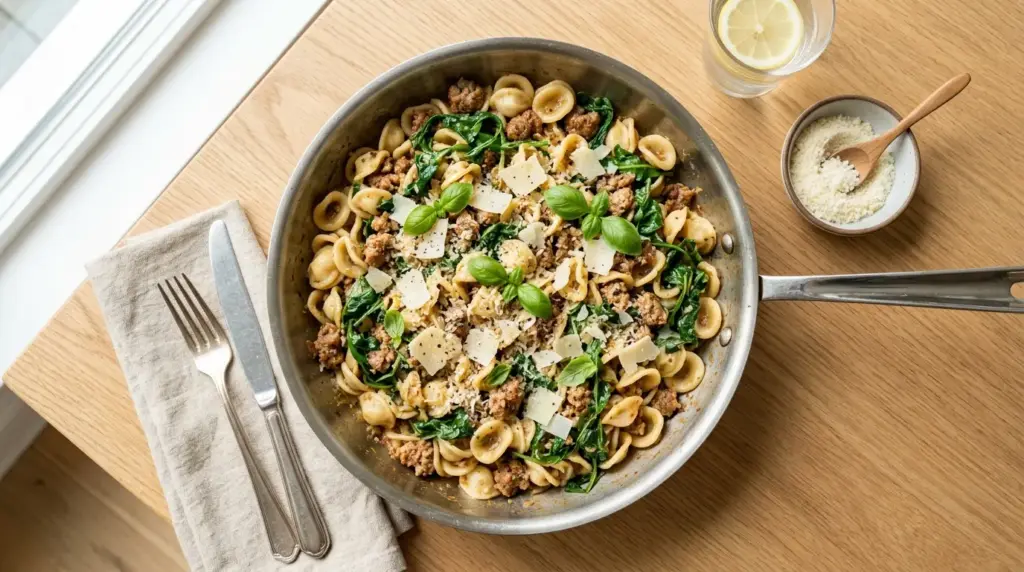
This pasta is hearty enough to stand completely on its own, but a few simple sides can round it out into a full spread.
Crusty bread is always a welcome companion for scooping up any remaining sauce in the bowl. A slice of Cheesy Garlic Bread alongside this pasta is genuinely unbeatable.
A simple green salad with a sharp vinaigrette provides a refreshing contrast to the richness of the sausage and cheese.
- Classic Bruschetta — the bright, herby tomato topping pairs perfectly with the savory pasta
- Roasted Broccoli — adding extra vegetables to the meal is always a good idea and roasted broccoli’s charred edges complement the Italian flavors
- A glass of Italian white wine such as Pinot Grigio or Vermentino — the acidity cuts through the richness of the sausage beautifully
- Simple green salad dressed with lemon and extra-virgin olive oil for a light, bright contrast
- Homemade Garlic Bread — ideal for mopping up every bit of that glossy pan sauce
Variations to Try
One of the best things about this recipe is how flexible the base method is. Once you understand the technique — brown the protein, deglaze with broth, cook the pasta in the liquid — you can riff on it endlessly.
- Sausage and broccolini version: Add broccolini florets to the pan about 4 minutes before the pasta finishes cooking. The broccolini turns tender-crisp and adds color and extra nutrition.
- Sun-dried tomato and spinach: Skip the sausage for a vegetarian version and add ¼ cup of chopped sun-dried tomatoes and a large handful of baby spinach. Use vegetable broth instead of chicken broth.
- Creamy version: Stir in 2 to 3 tablespoons of heavy cream or cream cheese along with the Parmesan at the end for a richer, more indulgent sauce.
- Lemon-forward variation: Add the zest of one lemon along with the Parmesan and a squeeze of fresh juice at the end. The brightness cuts through the fat and lifts the entire dish.
- Spicy sausage and rapini: Use hot Italian sausage and substitute broccoli rabe (rapini) for the arugula. Rapini is a classic pairing with orecchiette in Southern Italian cooking.
- Chicken sausage version: For a lighter dish, swap pork Italian sausage for chicken or turkey Italian sausage. The method stays the same and the results are still delicious.
Read Also: Stuffed Shells Recipe
Storage and Reheating
One-pan pasta is best fresh, but it does store well if you have leftovers. Keep in mind that the pasta will continue absorbing the sauce as it sits, so stored leftovers will be thicker and more compact than the freshly made version.
- Refrigerator: Transfer cooled leftovers to an airtight container and refrigerate for up to 3 days.
- Freezer: This pasta can be frozen for up to 2 months in a freezer-safe container. Thaw overnight in the refrigerator before reheating.
- Stovetop reheating (recommended): Place the pasta in a skillet over medium-low heat and add a splash of chicken broth or water (about 2 to 3 tablespoons). Stir gently as it heats, adding more liquid as needed until the sauce loosens and the pasta is warmed through, about 3 to 5 minutes.
- Microwave reheating: Place a portion in a microwave-safe bowl, add a tablespoon of broth or water, cover loosely, and heat in 60-second intervals, stirring between each, until hot.
Another pasta dish worth making on repeat: Easy Lasagna Recipe.
Nutritional Facts
The following is an approximate per-serving breakdown based on this recipe serving 4 people, using mild Italian sausage and the full amount of Parmesan.
| Nutrient | Amount Per Serving |
|---|---|
| Calories | ~620 kcal |
| Total Fat | 36 g |
| Saturated Fat | 12 g |
| Cholesterol | 75 mg |
| Sodium | 870 mg |
| Total Carbohydrates | 48 g |
| Dietary Fiber | 2 g |
| Sugars | 3 g |
| Protein | 28 g |
Nutritional values are estimates and will vary based on the specific brands and products used. Using chicken or turkey sausage in place of pork sausage will meaningfully reduce fat and calorie content.
For a comforting, protein-rich pasta the whole family enjoys, also check out the Chicken Gnocchi Soup Recipe.
Health Benefits of Key Ingredients
This dish isn’t just delicious — several of its core ingredients bring meaningful nutritional value to the table.
Orecchiette pasta, made from durum wheat semolina, provides complex carbohydrates that offer sustained energy without a rapid blood sugar spike. It also contributes a solid amount of protein compared to refined grain alternatives.
Italian sausage is a significant source of protein and iron. Choosing a lower-fat chicken or turkey Italian sausage is an easy swap that reduces overall fat content while preserving the flavor profile of the dish.
- Garlic is well-studied for its anti-inflammatory and immune-supporting properties, due largely to allicin, the compound released when garlic is crushed or minced.
- Arugula is a nutrient-dense leafy green with vitamin K, vitamin C, and folate. Its peppery bite adds flavor without adding calories, fat, or sodium.
- Parmigiano-Reggiano is a natural source of calcium and phosphorus, both important for bone health. Because it has such an intense, concentrated flavor, a small amount goes a long way — meaning you don’t need to pile it on to taste it.
- Olive oil provides heart-healthy monounsaturated fats and antioxidants, including vitamin E, that support cardiovascular health.
- Chicken broth (low-sodium) serves as the cooking liquid and adds mineral content without the high sodium load of regular broth. It contributes a depth of flavor that water alone cannot replicate.
The Zuppa Toscana Recipe uses many of the same healthy, Italian-inspired ingredients if you’re looking for a warming soup with similar flavors.
Frequently Asked Questions
1. Can I use a different pasta shape if I can’t find orecchiette?
Yes, absolutely. Orecchiette works best because its cup shape holds the sauce so well, but other short pasta shapes like farfalle, cavatappi, fusilli, or rotini will work with this method. Avoid long pasta shapes like spaghetti or linguine — they don’t cook as evenly in a shallow skillet and tend to clump.
2. Do I need to pre-cook the pasta before adding it to the pan?
No — and that’s the beauty of this recipe. The dry pasta goes directly into the broth in the skillet and cooks right there, absorbing all the savory liquid and flavor as it tenderizes. This is what makes it a true one-pan recipe and also what creates the rich, starchy sauce.
3. My sauce dried out before the pasta was cooked. What happened?
The heat was likely too high, causing the broth to evaporate faster than the pasta could absorb it. Keep the heat at a steady medium — a gentle, active simmer rather than a rolling boil. Also, have extra broth on hand to add as needed. Different stovetops and pan materials vary in heat retention, so you may need slightly more or less liquid than specified.
4. Can I make this dish ahead of time?
You can prepare all the components ahead — brown the sausage, dice the onion, mince the garlic, and grate the cheese — and refrigerate them separately. However, the pasta is best cooked fresh just before serving, since it continues absorbing the sauce as it sits. If you do cook it ahead, reheat it on the stovetop with a splash of broth to loosen the sauce.
5. Is this recipe gluten-free?
As written, no — orecchiette is made from wheat. However, many brands now make gluten-free orecchiette or similar pasta shapes using chickpea, lentil, or rice flour. These work with the same method but may require slightly less cooking time, so check frequently as the pasta approaches the end of the cooking window. Also verify that your chicken broth is certified gluten-free, as some contain additives with trace gluten.
Read Also: Chicken Piccata Recipe with Pasta

One Pan Orecchiette Pasta with Sausage and Arugula

Equipment
- Large Deep Skillet or Sauté Pan - At least 12 inches / 30 cm wide and 3 inches deep
- Wooden spoon or silicone spatula - For stirring and scraping up browned bits
- Sharp chef's knife - For dicing onion and mincing garlic
- Cutting board
- Measuring cups and spoons
- Box grater or microplane - For grating Parmesan cheese
- Ladle or tongs - For serving
Ingredients
- 2 tbsp olive oil - 30 ml
- ½ medium yellow onion - about ¾ cup or 115 g, finely diced
- 8 oz Italian sausage - 225 g, casings removed, mild or spicy
- 4 cloves garlic - minced
- ½ tsp red pepper flakes - optional, reduce or omit for mild heat
- 3½ cups low-sodium chicken broth - 830 ml, divided
- 1¼ cups orecchiette pasta - 225 g, dry
- ½ tsp salt - plus more to taste
- ¼ tsp black pepper
- ½ cup fresh arugula - 15 g, loosely packed
- ¼ cup Parmigiano-Reggiano cheese - 25 g, freshly grated, plus more for serving
- fresh basil - or flat-leaf parsley, for garnish (optional)
Instructions
- Finely dice the onion, mince the garlic, and remove sausage from casings. Measure broth in two portions (1½ cups and 2 cups) and grate the cheese.
- Heat olive oil in a large deep skillet over medium heat. Add diced onion with a pinch of salt and cook for 4-5 minutes until translucent and softened.
- Add Italian sausage to the pan, breaking it apart with a wooden spoon. Cook for 5-7 minutes, letting it brown without stirring for 1-2 minutes at a time, until fully browned and cooked through.
- Push sausage to one side, add minced garlic to cleared space and cook for 30-60 seconds until fragrant. Add red pepper flakes if using and stir to combine.
- Pour 1½ cups of broth into the pan and scrape up all browned bits from the bottom. Bring to a boil, then add dry orecchiette pasta and stir to submerge.
- Reduce heat to a steady simmer and cook pasta for about 10 minutes, stirring every 1-2 minutes. Gradually add remaining 2 cups broth in ½-cup increments as liquid absorbs, until pasta is al dente.
- Once pasta is al dente with about 3-4 tablespoons of liquid remaining, reduce heat to low. Add arugula and stir until wilted (30-60 seconds). Remove from heat, stir in grated Parmesan, and season with salt and pepper to taste.
- Spoon pasta into warm bowls, top with additional grated Parmesan and fresh basil or parsley if using. Serve immediately while sauce is loose and pasta is al dente.
Notes
- Don’t skip properly browning the sausage – the golden bits (fond) on the pan bottom dissolve into the broth and create the sauce’s flavor foundation.
- Stir the pasta frequently (every 1-2 minutes) as it cooks in the shallow liquid to prevent sticking to the bottom of the pan.
- Add the broth gradually rather than all at once – this gives you more control and builds a better, silkier sauce as the pasta releases its starches.
- Always taste before adding salt – Italian sausage and chicken broth both contain sodium, so you may need less than you think.
- Pull the pan from heat slightly before the pasta is fully cooked – residual heat will continue cooking it when you add the cheese and arugula.
- Use freshly grated Parmigiano-Reggiano – pre-shredded cheese contains anti-caking agents that prevent smooth melting and a cohesive sauce.
- For a spicy version, use hot Italian sausage and keep the red pepper flakes. For a milder dish, use sweet sausage and omit the flakes entirely.
- Store leftovers in an airtight container in the refrigerator for up to 3 days. Reheat on the stovetop with a splash of broth or water to loosen the sauce.
- This pasta can be frozen for up to 2 months – thaw overnight in the refrigerator before reheating gently on the stovetop with extra liquid.
- Substitute chicken or turkey Italian sausage for a lighter version – the cooking method remains exactly the same.
Final Thoughts
This One Pan Orecchiette Pasta Recipe is proof that a genuinely satisfying dinner doesn’t require a long ingredient list, an hour of your time, or a pile of dishes afterward.
The combination of golden Italian sausage, savory broth, peppery arugula, and freshly grated Parmesan creates a dish that feels far more special than the effort it takes to make it. And because everything happens in one skillet, the cleanup is almost as easy as the cooking.
Give it a try on your next busy weeknight, and don’t be surprised when it becomes a permanent fixture in your dinner rotation. Drop a comment below and let me know how it turned out — or what variation you tried. Sharing your experience helps other home cooks find their footing with this recipe, and it always makes my day to hear from you.
Recommended:
- Italian Meatballs Recipe
- Spaghetti Sauce Recipe
- Chicken Cacciatore Recipe
- Chicken Scampi Recipe
- Marinara Sauce Recipe
- Vodka Sauce Recipe
- Easy Pesto Recipe
- Homemade Ravioli Recipe
- Chicken Francese Recipe
- Classic Chicken Parmesan Recipe