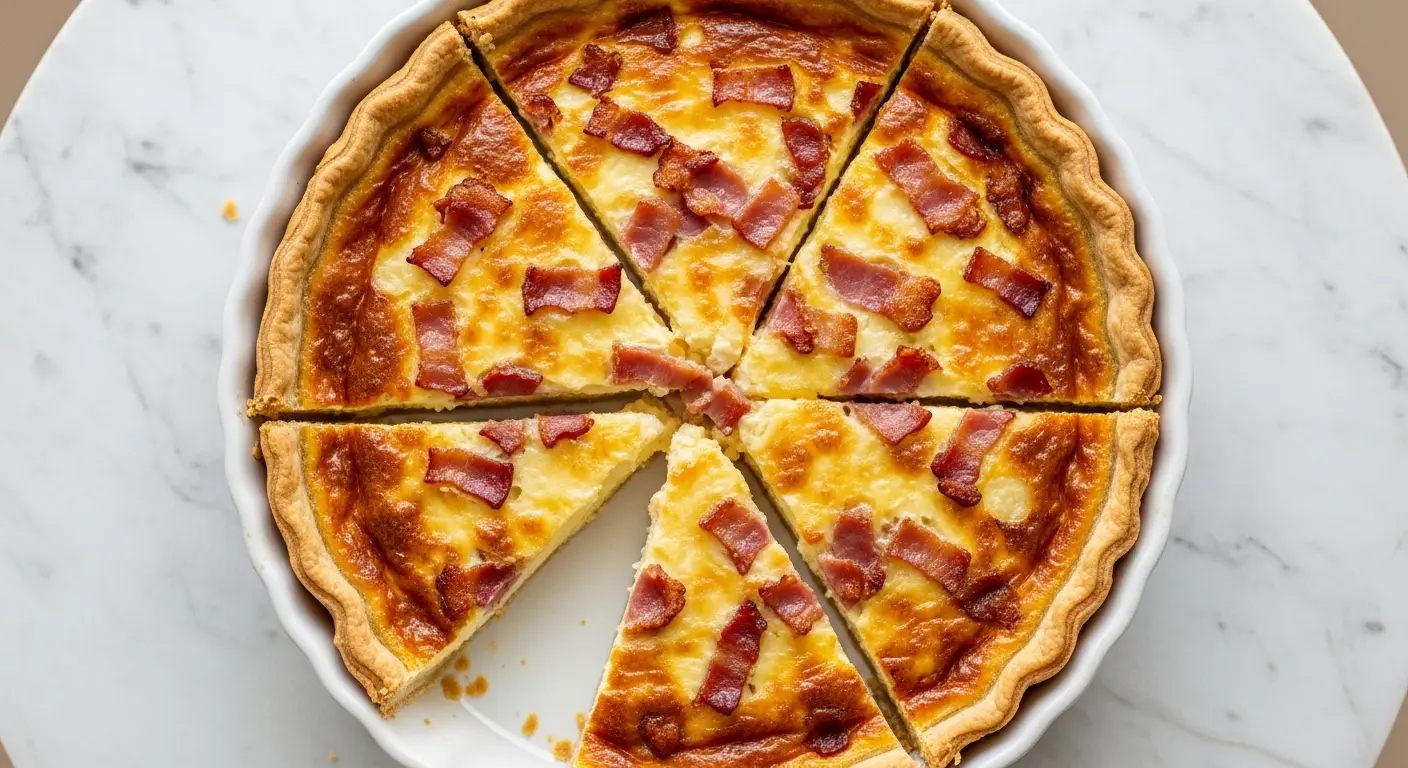
A perfectly made quiche lorraine recipe is one of those dishes that feels effortlessly elegant but is actually very achievable at home. This classic French tart combines a buttery, flaky shortcrust pastry shell with a rich, silky custard filling loaded with crispy bacon and nutty Gruyère cheese. Every single bite delivers that creamy, savory satisfaction that has made this dish a timeless favorite across the world.
What makes quiche Lorraine so special is how a handful of simple, quality ingredients come together into something truly extraordinary. The eggs and heavy cream form that signature custardy center, while the bacon adds a smoky depth and the Gruyère brings a distinctive nuttiness that you simply cannot replicate with any other cheese.
This recipe follows the classic, traditional approach. The crust is blind-baked first to keep it crisp, the custard is seasoned with a pinch of nutmeg for warmth, and the whole thing bakes until it has just the right gentle wobble in the center.
It is perfect for brunch, lunch, or an easy weeknight dinner. Serve it warm, at room temperature, or even cold the next day straight from the fridge.
You might also enjoy this Air Fryer Quiche if you want a faster, hands-off version with the same delicious flavors.
Why You’ll Love This Quiche Lorraine Recipe
This recipe truly checks every box for a satisfying, crowd-pleasing dish.
The custard filling is impossibly creamy and smooth, with just enough richness to feel indulgent without being heavy. Blind-baking the crust ensures it stays flaky and crisp, never soggy, even under all that luscious filling.
It is a brilliant make-ahead recipe. You can bake it a day ahead, refrigerate it, and simply reheat it before serving without losing any of that beautiful texture.
The flavor combination of smoky bacon, nutty Gruyère, and warm nutmeg is truly classic. It is the kind of recipe that tastes like it came from a proper French bistro.
- It uses simple, widely available ingredients
- The recipe is very forgiving for beginners
- It works as a brunch, lunch, or light dinner option
- It slices cleanly and looks stunning on the table
- It stores and reheats beautifully
- The filling can be customized with your favorite add-ins
- It impresses guests every single time
Read Also: Egg Bake Recipe
Ingredients
Before you start, gather everything together so the process flows smoothly. The key here is using quality ingredients, especially the cream and cheese, because in a recipe this simple, every ingredient truly matters.
- 1 unbaked 9-inch (23 cm) pie crust / shortcrust pastry (store-bought or homemade)
- 6 strips (about 170 g / 6 oz) thick-cut bacon, cut into small pieces (lardons)
- 1 medium yellow onion, finely diced
- 1 shallot, finely minced
- 3 large eggs
- 1 egg yolk
- 1 cup (240 ml) heavy cream
- ½ cup (120 ml) whole milk
- 4 oz (113 g) Gruyère cheese, finely shredded
- ½ tsp fine sea salt
- ¼ tsp black pepper
- ¼ tsp ground nutmeg
- Pinch of cayenne pepper (optional but recommended)
- 1 tbsp unsalted butter (for sautéing the onion)
This recipe also pairs wonderfully as a French-inspired brunch alongside a classic egg salad.
Kitchen Equipment Needed
Having the right tools on hand makes the process much more enjoyable, especially when working with pastry dough and delicate custard fillings.
- 9-inch tart pan or pie dish (a tart pan with a removable bottom is ideal)
- Pastry weights or dried beans (for blind-baking)
- Parchment paper
- Large mixing bowl
- Whisk
- Large skillet or frying pan
- Wooden spoon or silicone spatula
- Box grater or cheese grater
- Sharp knife and cutting board
- Measuring cups and spoons
- Rimmed baking sheet (to place the tart pan on)
- Cooling rack
Read Also: Hollandaise Sauce Recipe
Recommended Products for This Recipe
These are products chosen based on their quality, performance, and how much of a difference they genuinely make when making a classic quiche lorraine.
1. Emile Henry Ceramic Tart Pan
A high-quality ceramic tart pan distributes heat evenly, which is critical for a custard-based quiche that needs consistent, gentle heat to set properly without curdling. The glazed ceramic surface releases the quiche cleanly and makes cleanup effortless. It also transitions beautifully from oven to table.
2. Imported Swiss Gruyère Cheese (AOP Certified)
The quality of Gruyère makes a significant difference in quiche Lorraine. An AOP-certified Swiss Gruyère has that signature complex, nutty, slightly sweet flavor that elevates the entire dish. Pre-shredded domestic alternatives simply do not melt or taste the same way.
3. Norpro Ceramic Pie Weights
Proper pie weights are essential for a perfectly blind-baked crust that does not puff or shrink during baking. Ceramic weights retain and distribute heat evenly, helping the crust bake uniformly. They are reusable, easy to store, and far better than using dried beans.
4. OXO Good Grips Box Grater
Finely grating your Gruyère fresh makes a noticeable difference in how evenly it melts into the custard. The OXO box grater is sturdy, sharp, and has a comfortable non-slip base that makes grating firm cheese quick and easy. It also works perfectly for other cheeses and vegetables.
5. Thick-Cut Applewood Smoked Bacon
Using a premium thick-cut applewood smoked bacon rather than regular thin-cut slices makes a big difference in quiche Lorraine. The bacon pieces hold their shape, render beautifully, and add a distinct smoky sweetness that complements the Gruyère perfectly. Thin bacon tends to disappear into the custard.
The Egg Bites Recipe uses some of these same tools and ingredients if you want another egg-based dish to explore.
Step-by-Step Instructions
1. Prepare and Chill the Pie Crust
- If using store-bought refrigerated pie crust, remove it from the refrigerator about 10 minutes before you plan to use it so it becomes pliable without cracking.
- If making homemade shortcrust pastry, combine 1¼ cups (155 g) of all-purpose flour, ½ tsp of salt, and ½ cup (115 g) of cold unsalted butter cut into small cubes in a food processor. Pulse until the mixture resembles coarse breadcrumbs.
- Add 2–3 tbsp of ice-cold water, one tablespoon at a time, pulsing after each addition, until the dough just begins to come together. Do not over-mix.
- Turn the dough out onto a lightly floured surface and gently press it into a disk shape. Wrap it tightly in plastic wrap and refrigerate for at least 30 minutes. Cold dough is much easier to roll and handles better.
2. Blind-Bake the Crust
- Preheat your oven to 375°F (190°C). Place a rimmed baking sheet on the center rack while the oven heats up. Starting the quiche on a pre-heated baking sheet helps crisp the bottom crust.
- Lightly flour your work surface and roll the chilled dough out into a circle about 12 inches (30 cm) in diameter, or large enough to line your 9-inch (23 cm) tart pan with some overhang.
- Carefully drape the dough over your rolling pin, then lay it over the tart pan and gently press it into the bottom and sides. Do not stretch the dough or it will shrink back during baking. Fold the overhanging edges inward and press them to reinforce the sides.
- Trim away any excess dough using a sharp knife or by rolling your rolling pin across the top of the pan. Prick the bottom of the crust all over with a fork. This helps prevent large air bubbles.
- Press a piece of parchment paper snugly into the crust, making sure it covers the sides as well. Fill the parchment with pie weights or dried beans.
- Slide the tart pan onto the pre-heated baking sheet and bake for 20 minutes, until the edges are just starting to turn golden.
- Remove the parchment and weights. Return the crust to the oven and bake for an additional 5–8 minutes, until the bottom looks dry and very lightly golden. This step is important because an underbaked crust will become soggy once the custard is added.
- Remove from the oven and set aside to cool slightly. Keep the oven at 375°F (190°C).
3. Cook the Bacon and Onion
- Place a large skillet over medium-high heat. Add the bacon pieces and cook, stirring occasionally, for about 6–8 minutes until the bacon is fully cooked and golden but not too crispy. You want it browned with some texture, not hard and overdone.
- Use a slotted spoon to transfer the cooked bacon to a paper towel-lined plate. Leave about 1 tablespoon of bacon fat in the pan and discard the rest.
- Reduce the heat to medium. Add 1 tablespoon of unsalted butter to the reserved bacon fat.
- Once the butter melts and starts to foam, add the finely diced onion and minced shallot. Cook, stirring often, for about 8–10 minutes until softened and translucent. The shallot adds a subtle sweetness that balances the smoky bacon perfectly.
- Season lightly with a small pinch of salt and remove the pan from the heat. Set the bacon and onion mixture aside to cool slightly before adding it to the custard.
4. Make the Custard
- In a large mixing bowl, crack in the 3 whole eggs plus the additional egg yolk. The extra yolk adds richness and helps the custard set with a smoother, more velvety texture.
- Pour in the heavy cream and whole milk. Using a heavy cream and milk combination gives you a custard that is rich and creamy without being overly dense or stodgy.
- Add the fine sea salt, freshly ground black pepper, ground nutmeg, and optional pinch of cayenne.
- Whisk everything together until the mixture is completely uniform and smooth. You should not see any streaks of egg yolk. Whisking for about 30 seconds to a full minute is usually sufficient.
- Taste the custard. It should be well-seasoned but not salty, since the bacon and Gruyère will both add more salt.
5. Assemble the Quiche
- Scatter the cooked, cooled bacon and onion mixture evenly across the bottom of the blind-baked crust. Spreading it out evenly ensures every slice gets a good amount of filling.
- Sprinkle the finely shredded Gruyère cheese over the bacon and onion layer. The cheese should be spread as evenly as possible. Finely shredding it yourself (rather than using pre-shredded) ensures it melts smoothly into the custard.
- Slowly and carefully pour the custard mixture over the cheese and bacon. Pour it gently and steadily to avoid disturbing the layered filling underneath. Fill the crust almost to the brim, leaving about ¼ inch (6 mm) of space at the top to prevent overflow during baking.
- If you see any pieces of cheese or bacon floating unevenly on top, gently push them back down with a spoon so the surface is level.
6. Bake the Quiche
- Carefully transfer the assembled quiche (still on the baking sheet) to the preheated oven.
- Bake at 375°F (190°C) for 35–45 minutes. The exact timing will depend on your oven.
- The quiche is done when the edges are set and golden, and the center has a gentle, slight jiggle when you nudge the pan. It should not slosh around, but it should not be completely firm either. Think of it like a perfectly baked cheesecake: mostly set with a small, wobbly center.
- If the crust edges start to brown too quickly before the center is set, loosely tent the edges with small strips of aluminum foil.
- Remove the quiche from the oven and place it on a wire cooling rack.
7. Cool and Serve
- This is the hardest step: do not cut into the quiche immediately. Allow it to cool on the rack for at least 20–30 minutes before slicing. Cutting too soon will cause the custard to run, since it continues to set as it cools.
- Run a thin knife around the edge of the tart pan if the crust seems to be sticking before removing the ring (if using a pan with a removable bottom).
- Slice with a sharp knife, wiping the blade clean between cuts for neat, presentable slices.
- Serve warm or at room temperature for the best flavor and texture. Quiche Lorraine is genuinely excellent at room temperature and does not need to be piping hot.
This quiche pairs naturally with light soup options. A bowl of potato leek soup alongside a slice of quiche makes an effortlessly elegant lunch.
Tips for Success
Getting quiche Lorraine right is all about respecting a few key techniques. These tips will help you nail it on your very first try.
- Always blind-bake the crust. Skipping this step is the number one reason quiche crusts turn out soggy and underdone. Even 20 minutes of blind-baking makes an enormous difference.
- Use room temperature eggs. Cold eggs straight from the fridge do not blend as smoothly into the cream. Take them out 15–20 minutes before you start.
- Finely shred your own Gruyère. Pre-shredded cheese is coated with anti-caking agents that interfere with melting. Freshly grated cheese melts far more smoothly.
- Do not overbake. A slightly underdone-looking center is actually correct. The quiche will continue to set as it cools.
- Season the custard well. Taste the custard before pouring it in. It should taste pleasantly seasoned since the filling is generous.
- Let it rest. At least 20 minutes of resting time is non-negotiable for clean slices.
- Pour the custard slowly. Rushing this step can displace the cheese and bacon from the bottom of the crust.
For another brunch-worthy dish, check out this Shakshuka Recipe that shares some of the same egg-and-flavour magic.
Serving Suggestions
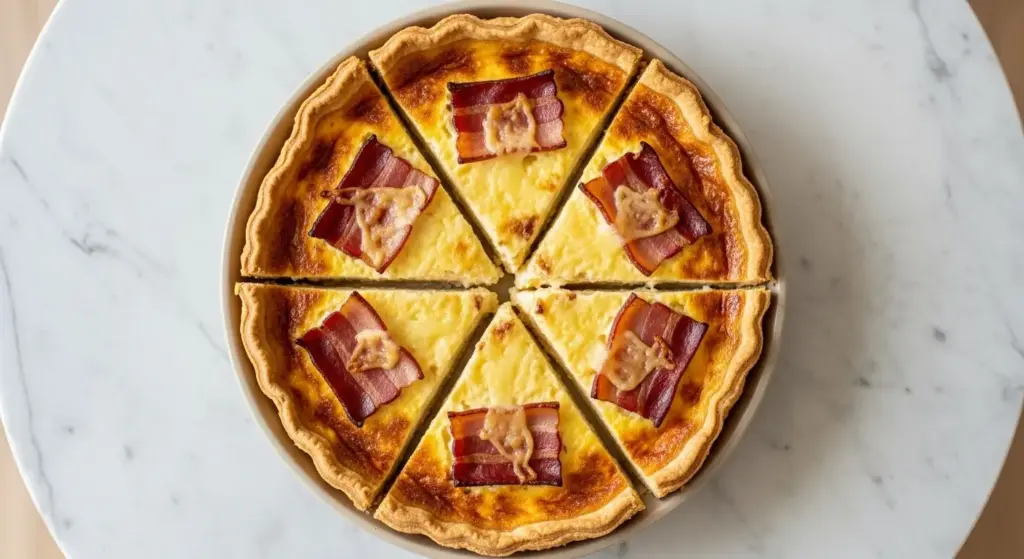
Quiche Lorraine is wonderfully versatile when it comes to serving. A simple green salad is the most classic pairing, but there are plenty of other beautiful options.
A lightly dressed arugula or mixed greens salad with a Dijon vinaigrette is the most traditional and complementary side. The slightly bitter, peppery greens cut through the richness of the custard in the best way.
For a proper brunch spread, quiche Lorraine looks stunning alongside a broccoli salad, a platter of fresh fruit, or some crusty French bread.
- Classic Deviled Eggs as an elegant appetizer before the main event
- French Toast Casserole for a sweet balance to the savory quiche
- Fruit Salad for a fresh, light complement
- A glass of chilled white wine, such as Chardonnay or Sauvignon Blanc, for a proper French-style meal
- Creamy Coleslaw for a casual, satisfying pairing
- Roasted Broccoli as a simple, nutritious side dish
Variations to Try
Once you have mastered the classic version, quiche Lorraine is the perfect canvas for creativity. The custard base stays the same, and you can swap or add fillings to your heart’s content.
The beauty of this recipe is that the custard-to-filling ratio works with almost any savory combination you can imagine.
- Ham and Cheese Quiche: Swap the bacon for diced cooked ham for a milder, slightly sweeter flavor profile
- Spinach and Mushroom Quiche: Replace the bacon with sautéed spinach and sliced mushrooms for a vegetarian version that is equally satisfying
- Leek and Bacon Quiche: Add thinly sliced, sautéed leeks alongside the onion for a deeper, more complex savory flavor
- Swiss Cheese Substitution: If Gruyère is not available, a good-quality Swiss cheese or even sharp white cheddar works beautifully
- Caramelized Onion Quiche: Double the onion and cook them low and slow for 25–30 minutes until deeply caramelized for a sweeter, more intense filling
- Mini Quiche Lorraine: Divide the crust and filling between a 12-cup muffin tin for individual-sized quiches, perfect for parties or meal prep
- Crustless Quiche Lorraine: Butter your tart pan generously, skip the pastry entirely, and pour the filling straight in for a gluten-free version
For a related French-inspired baked dish, the Tartiflette Recipe brings the same rustic French comfort food energy with potatoes, bacon, and melted cheese.
Storage and Reheating
Quiche Lorraine stores and reheats wonderfully, making it a brilliant option for meal prepping and entertaining ahead of time.
Allow the quiche to cool completely before storing or covering, as trapping steam will make the crust go soft.
- Refrigerator: Cover loosely with plastic wrap or aluminum foil and refrigerate for up to 3–4 days
- Freezer: Cool completely, then wrap tightly in plastic wrap followed by a layer of foil. Freeze for up to 3 months. Thaw overnight in the refrigerator before reheating
- Reheating in the oven (recommended): Place the quiche on a baking sheet and warm at 325°F (165°C) for 15–20 minutes, or until heated through. This method preserves the crust’s crispness far better than the microwave
- Reheating from frozen: Cover with foil and bake at 325°F (165°C) for 30–35 minutes, removing the foil for the last 5 minutes to crisp up the crust
- Microwave: While not ideal, a single slice can be microwaved on medium power for 1–2 minutes. Expect a slightly softer crust
The Breakfast Casserole Recipe is another make-ahead egg dish that stores and reheats just as well if you love prepping brunch in advance.
Nutritional Facts
The following nutrition information is for one standard slice (1/8 of the quiche, including crust), based on the recipe as written.
- Calories: Approximately 380–420 kcal
- Protein: 14–16 g
- Total Fat: 28–32 g
- Saturated Fat: 14–16 g
- Carbohydrates: 18–22 g
- Dietary Fiber: 0.5–1 g
- Sugar: 2–3 g
- Cholesterol: 175–195 mg
- Sodium: 480–540 mg
- Calcium: 15–18% of Daily Value
- Iron: 6–8% of Daily Value
These values are estimates and will vary based on specific brands and portion sizes used.
Another egg-forward recipe with its own impressive nutritional profile is the Cloud Eggs Recipe, which is worth a look if you are experimenting with protein-rich egg dishes.
Health Benefits of Key Ingredients
Despite its indulgent reputation, quiche Lorraine contains several ingredients that offer genuine nutritional value when eaten as part of a balanced diet.
Every ingredient in this recipe plays both a culinary and a nutritional role.
- Eggs: One of the most nutrient-dense foods available, eggs provide high-quality complete protein, vitamins B12 and D, choline (essential for brain health), and the antioxidants lutein and zeaxanthin, which support eye health.
- Gruyère cheese: A rich source of calcium and phosphorus for bone health, Gruyère also provides a good amount of complete protein per serving. Its high fat content contributes to satiety and helps keep you full longer after a meal.
- Heavy cream: While calorie-dense, heavy cream provides fat-soluble vitamins A, D, E, and K, and the fat helps your body absorb these vitamins efficiently.
- Bacon: A good source of protein and B vitamins, including B1, B3, and B12. Choosing high-quality, minimally processed bacon and using it in moderate amounts keeps the recipe balanced.
- Onion and shallot: Both are members of the allium family, which provides sulfur compounds linked to cardiovascular support, as well as prebiotic fiber that supports gut health.
- Nutmeg: Though used in a small amount, nutmeg contains anti-inflammatory compounds and has traditionally been used to support digestion.
Read Also: Egg Skillet Recipe
Frequently Asked Questions
1. Can I make quiche Lorraine ahead of time?
Yes, and it is actually one of the best recipes to make ahead. You can bake the quiche up to 24 hours in advance, refrigerate it covered, and reheat it gently in the oven at 325°F (165°C) for 15–20 minutes before serving. It tastes just as good the next day.
2. Can I use milk instead of heavy cream?
You can substitute whole milk for some or all of the heavy cream, but the texture will be noticeably less rich and creamy. Using half heavy cream and half whole milk is a good compromise that produces a lighter custard while still maintaining a pleasant, silky consistency.
3. What is the best cheese for quiche Lorraine?
Gruyère is the most traditional and recommended choice, offering a distinct nutty, slightly sweet flavor that complements the bacon perfectly. Good substitutes include Comté, Emmental, or a sharp white cheddar. Avoid pre-shredded cheese, which does not melt as smoothly.
4. How do I know when the quiche is done baking?
The quiche is ready when the edges are fully set and golden, and the center has only a very slight jiggle when you gently nudge the pan. Think of the same test used for a baked cheesecake. The center will continue to firm up as the quiche cools on the rack.
5. Can I make quiche Lorraine without a crust?
Absolutely. A crustless quiche (sometimes called a frittata-style quiche) works beautifully with this same filling. Simply butter your baking dish generously, pour in the custard with the bacon and cheese, and bake at the same temperature for a slightly shorter time (usually 30–35 minutes). It is also naturally gluten-free.
You might also enjoy: Air Fryer Egg Cups for another crustless, protein-rich egg dish that is just as satisfying.
Final Thoughts
Quiche Lorraine is one of those recipes that rewards you every single time you make it. Once you nail the blind-baked crust and get a feel for when the custard is perfectly set, this dish becomes second nature.
It is endlessly elegant, surprisingly simple, and deeply satisfying in a way that few recipes manage to be.
Give this classic quiche lorraine recipe a try for your next brunch, holiday gathering, or weeknight dinner. I promise it will earn a permanent spot in your recipe rotation.
If you make it, leave a comment below and let me know how it turned out. Tag your photos and share your experience with the community.
Recommended:
- Starbucks Egg Bites Recipe
- Scrambled Eggs Recipe
- Breakfast Burrito Recipe
- Sausage Balls Recipe
- Dutch Baby Recipe
- Avocado Toast Recipe
- Baked Oatmeal Recipe
- Yorkshire Pudding Recipe
- Hashbrown Casserole Recipe
- Classic Stuffed Bell Peppers Recipe