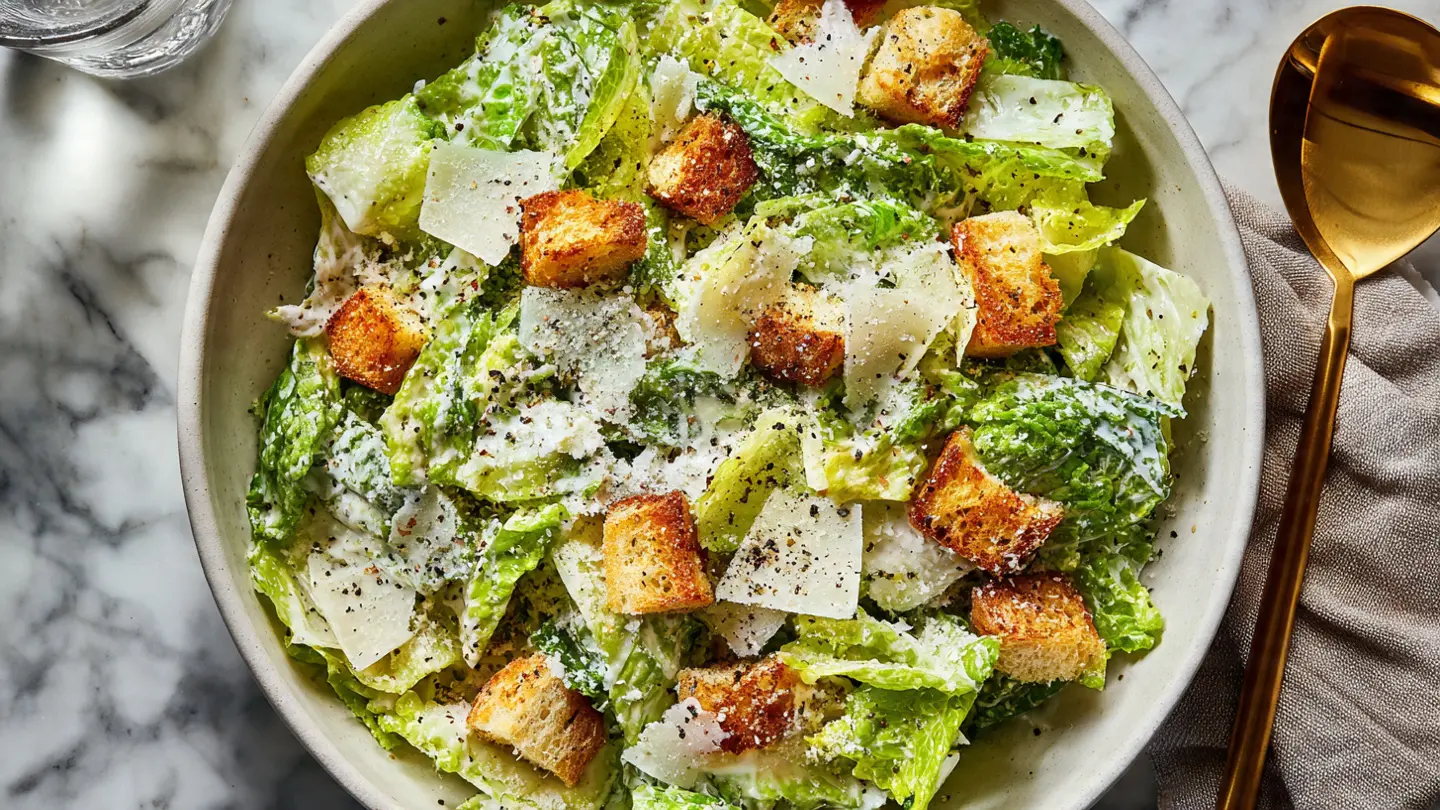
If you’ve been searching for the original Caesar salad dressing recipe, you’ve come to exactly the right place. This is the real deal — the tangy, savory, deeply umami dressing that made Caesar salads famous in the first place.
The original version, credited to Caesar Cardini and his restaurant in Tijuana, Mexico, circa 1924, is a beautifully balanced emulsion of egg yolk, lemon juice, garlic, Worcestershire sauce, anchovy, Dijon mustard, Parmesan, and olive oil. It’s nothing like the bottled stuff you find at the grocery store.
Made from scratch, this dressing is creamy without being heavy, punchy without being overwhelming, and savory in a way that keeps you coming back for one more forkful. The anchovies — even if you think you don’t like them — are the backbone of that complex, salty, deeply satisfying flavor.
Once you make this from scratch, you’ll never reach for a bottle again. It takes about 10 minutes and uses pantry staples you probably already have on hand.
You might also enjoy: Homemade Caesar Salad Dressing
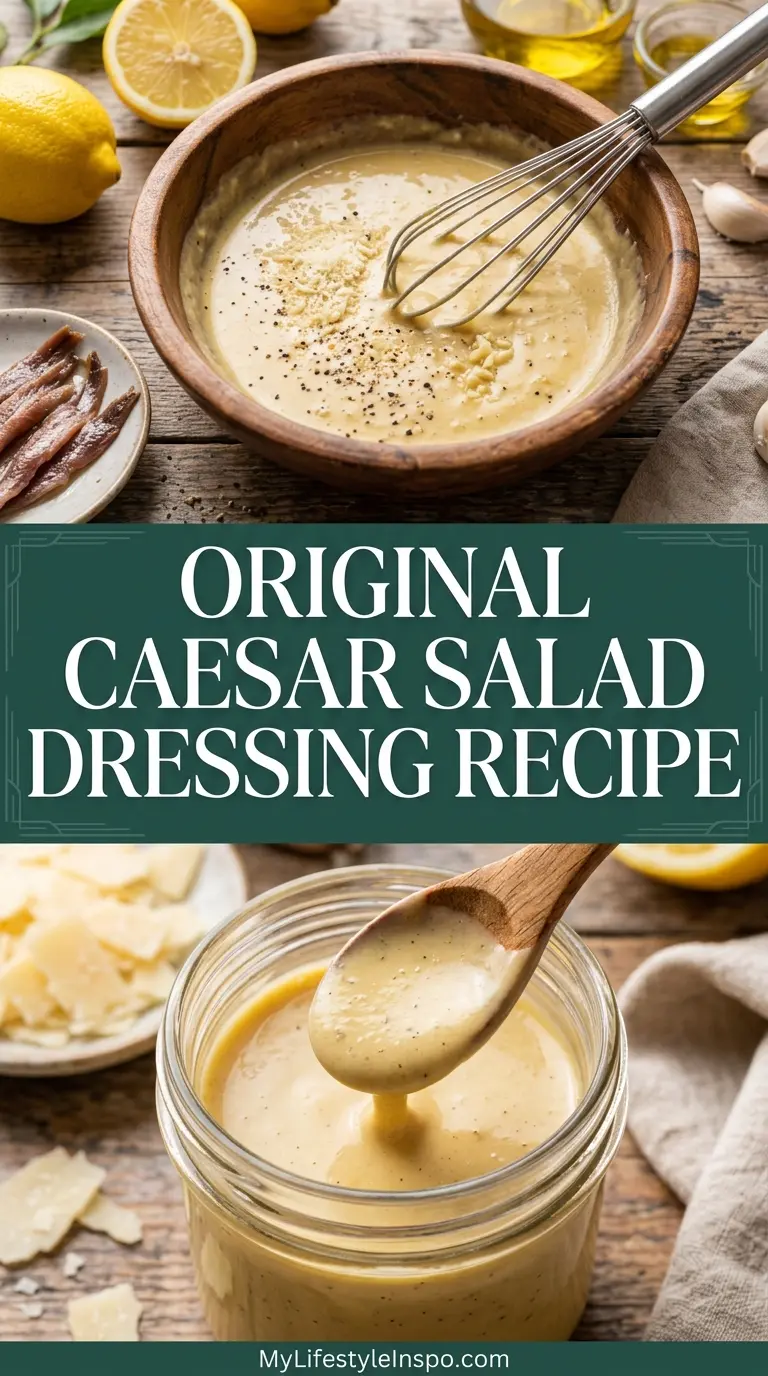
Why You’ll Love This Original Caesar Salad Dressing Recipe
This dressing punches well above its weight for a recipe with such a short ingredient list.
Every element plays a specific role — the egg yolk emulsifies the oil into a silky, cohesive sauce; the lemon adds brightness; the anchovy and Worcestershire deliver that deeply savory, almost addictive quality known as umami.
What sets the original apart from most modern versions is the technique. Emulsifying the oil in slowly while whisking creates a consistency that clings to every leaf rather than pooling at the bottom of the bowl.
It’s also incredibly versatile. You can thin it out for a pourable dressing, keep it thick as a dip, or use it as a spread on wraps and sandwiches.
Here’s what makes this version special:
- Authentic flavor — Follows the original Cardini-style recipe closely, with anchovies, egg yolk, and freshly grated Parmesan
- Creamy, clingy texture — The slow emulsification technique creates a dressing that actually coats your greens
- No raw garlic bitterness — The garlic is mashed into a paste, which distributes the flavor evenly without harsh, sharp pockets
- Deeply savory umami — Anchovy and Worcestershire work together without making the dressing taste “fishy”
- Ready in 10 minutes — No cooking, no blender required (though you can use one)
- Completely customizable — Adjust anchovy, lemon, and garlic to your exact preference
- Better than bottled — Far fresher, cleaner, and more complex than anything from a bottle
This same bold, from-scratch approach works brilliantly with other classic sauces too — the Classic Tuna Salad uses a similar technique of balancing acid, fat, and umami.
Ingredients
The magic of this recipe is that it uses just a handful of quality ingredients. Each one is essential, so try to use the best you can find — especially the Parmesan and anchovies.
Here’s everything you’ll need:
- 1 large egg yolk (room temperature)
- 2 tablespoons (30 ml) fresh lemon juice, plus more to taste
- 1 teaspoon (5 ml) Worcestershire sauce
- 1 teaspoon (5 ml) Dijon mustard
- 2–4 anchovy fillets (packed in oil), or 1 teaspoon anchovy paste
- 2 small garlic cloves, peeled
- 1/4 teaspoon (1.25 ml) kosher salt, plus more to taste
- 1/4 teaspoon (0.5 g) freshly ground black pepper, plus more to taste
- 1/2 cup (120 ml) extra-virgin olive oil (or a mix of 1/4 cup olive oil + 1/4 cup neutral oil for a milder flavor)
- 1/2 cup (50 g) freshly grated Parmigiano-Reggiano, plus extra for serving
- 1 tablespoon (15 ml) cold water (to thin if needed)
Read Also: Vegan Caesar Salad Dressing Recipe
Kitchen Equipment Needed
You don’t need any special equipment to make this dressing — just a cutting board, a bowl, and a whisk. That said, a few tools will make the job smoother.
Here’s what to have ready:
- A medium mixing bowl (large enough to whisk vigorously)
- A flat cutting board
- A chef’s knife
- A fork or the flat side of your knife (for mashing garlic into paste)
- A fine grater or microplane zester (for Parmesan and garlic)
- A whisk
- Measuring spoons and measuring cups
- A small glass jar with lid (for storing leftovers)
- Optional: a salad spinner for drying your romaine
Another favorite dressing technique: Tzatziki Sauce
Recommended Products for This Recipe
These are products I genuinely recommend based on quality and performance. They’ll help you make this dressing at the highest possible level.
1. Microplane Premium Classic Zester Grater
A microplane zester produces incredibly fine, fluffy Parmesan that melts seamlessly into the dressing rather than clumping. It also makes grating garlic directly into the bowl a breeze. This is one kitchen tool that earns its counter space every single time.
2. Ortiz Anchovy Fillets in Olive Oil
Not all anchovies are equal. Ortiz anchovies are consistently rated among the best in the world — meatier, less fishy, and packed in quality olive oil. Using a good-quality anchovy is the single biggest upgrade you can make to this recipe.
3. Parmigiano-Reggiano Cheese Wedge
Pre-grated Parmesan from a shaker can’t compete with freshly grated Parmigiano-Reggiano for this dressing. The real thing has a sharp, complex, nutty flavor that dissolves into the emulsion beautifully. Buy a small wedge and grate it yourself — you’ll taste the difference immediately.
4. OXO Good Grips Salad Spinner
Wet lettuce is the enemy of great Caesar salad. A good salad spinner dries your romaine leaves thoroughly so the dressing clings to the greens instead of sliding off into a watery puddle at the bottom of the bowl.
5. Weck Tulip Jar (Small Glass Storage Jar)
These airtight glass jars are ideal for storing leftover dressing in the refrigerator. The straight sides make whisking any separated dressing back together super easy, and they’re beautiful enough to put right on the table.
You might also enjoy: Hollandaise Sauce Recipe
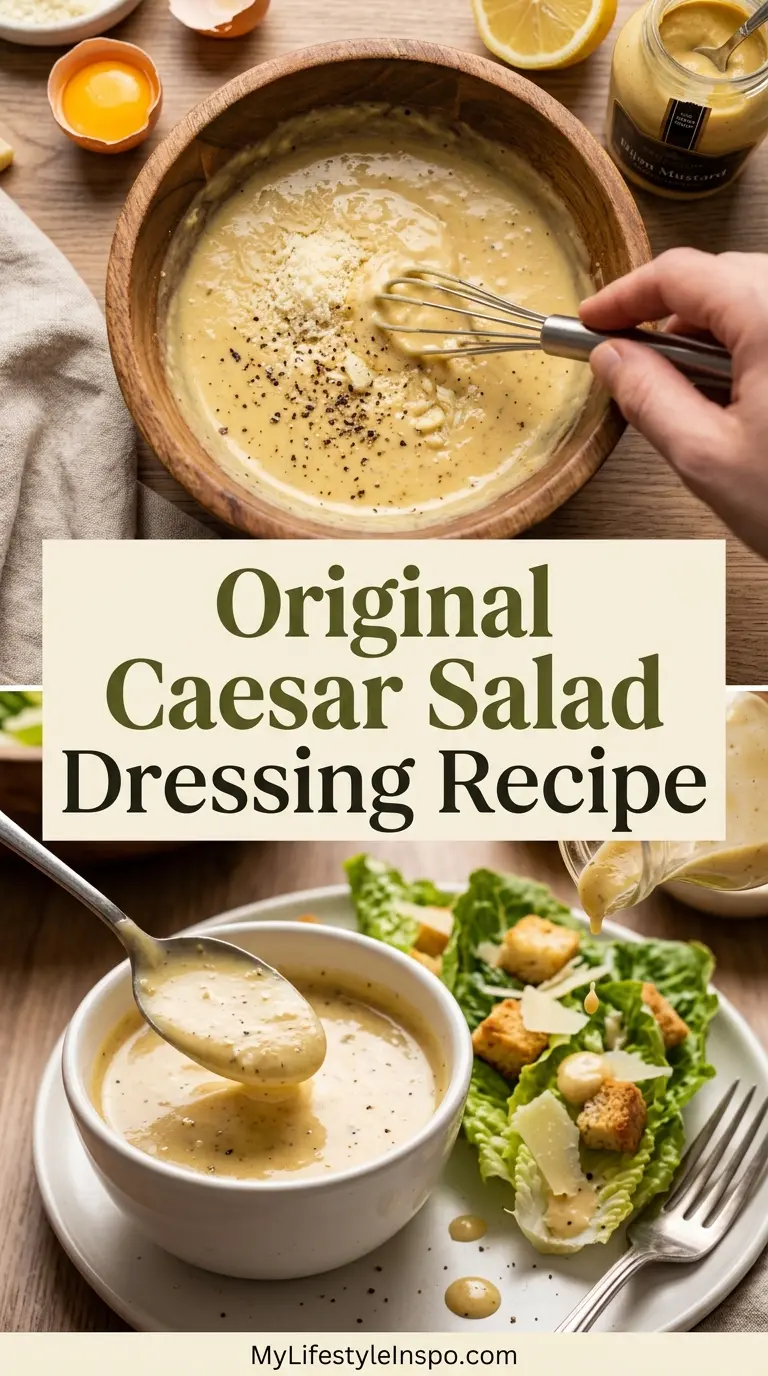
Step-by-Step Instructions
Step 1: Make the Garlic Paste
- Place 2 peeled garlic cloves on your cutting board.
- Sprinkle a small pinch of kosher salt over the garlic — this acts as an abrasive that helps break down the garlic fibers.
- Using the flat side of a chef’s knife or the back of a fork, press down on the garlic cloves firmly and drag them forward across the cutting board repeatedly.
- Continue mashing and scraping for about 60–90 seconds until the garlic becomes a smooth, fine paste with no chunky pieces remaining.
- The paste should look almost like a thick gel. This step is key — it ensures the garlic distributes evenly throughout the dressing without any sharp, bitter bites of raw garlic.
- Scoop the paste to the side of the cutting board and set aside.
Step 2: Mash the Anchovy Fillets
- Place 2–4 anchovy fillets (depending on how bold you want the flavor) on the same cutting board.
- Using the flat side of a knife or the back of a fork, press and drag the anchovies back and forth until they become a smooth, uniform paste.
- The anchovies should break down very easily — this only takes about 30–45 seconds.
- Add the anchovy paste to the garlic paste and mash them together briefly to combine.
- If you’re using anchovy paste from a tube, simply measure out 1 teaspoon and add it directly to your bowl in Step 3.
Step 3: Build the Base in Your Mixing Bowl
- Transfer the garlic-anchovy paste into a medium mixing bowl.
- Add the egg yolk, 2 tablespoons (30 ml) of fresh lemon juice, 1 teaspoon (5 ml) of Worcestershire sauce, and 1 teaspoon (5 ml) of Dijon mustard.
- Whisk everything together vigorously until the mixture is smooth and slightly thickened — about 30–45 seconds of steady whisking.
- At this point, the mixture should look cohesive and slightly creamy. The Dijon mustard acts as an emulsifier, helping the oil integrate smoothly in the next step.
- Season with 1/4 teaspoon (1.25 ml) of kosher salt and 1/4 teaspoon (0.5 g) of freshly ground black pepper. Whisk again to combine.
Step 4: Emulsify the Olive Oil
- This is the most critical step for achieving a creamy, well-emulsified dressing rather than a broken, oily one.
- With one hand holding your bowl steady (rest it on a damp towel to keep it from sliding), use your other hand to pour the olive oil in a very slow, thin, steady stream — literally drop by drop at first.
- While you pour, whisk continuously and vigorously. The mixture will begin to thicken and turn opaque as the oil emulsifies into the egg yolk base.
- Once you’ve added about 2 tablespoons (30 ml) of oil and the mixture looks thick and creamy, you can increase the flow of oil slightly to a thin, steady stream.
- Continue whisking and pouring until all 1/2 cup (120 ml) of olive oil has been incorporated. The finished dressing should be thick, creamy, and pale yellow.
- If the dressing looks too thick at this point, whisk in 1 tablespoon (15 ml) of cold water to loosen it to your preferred consistency.
Step 5: Fold in the Parmesan
- Add the freshly grated Parmigiano-Reggiano to the bowl.
- Use a rubber spatula or whisk to fold the Parmesan into the dressing until fully incorporated and smooth.
- The Parmesan will thicken the dressing slightly and add a rich, salty, nutty flavor that ties everything together.
- If the dressing is thicker than you’d like after adding the cheese, add another teaspoon or two of cold water and whisk until smooth.
Step 6: Taste and Adjust Seasoning
- Dip a clean spoon or a leaf of romaine into the dressing and taste it carefully.
- Adjust seasoning as needed: Add more lemon juice for brightness, more Worcestershire for depth, more anchovy paste for saltiness and umami, or more black pepper for heat.
- If the dressing tastes flat, a tiny extra pinch of salt almost always fixes it.
- If it tastes too sharp or acidic, a tiny drizzle more olive oil will mellow it out.
- The ideal dressing should taste bold, savory, slightly tangy, and deeply complex — not fishy, not too tart, not too oily.
Step 7: Dress Your Salad
- To make a classic Caesar, tear 2–3 large heads of romaine lettuce into bite-size pieces. Make sure the leaves are thoroughly dried — wet leaves will dilute the dressing.
- Add the romaine to a large salad bowl. Drizzle the dressing over the leaves, starting with about half of the batch.
- Using clean hands or two large forks, toss the romaine gently but thoroughly so every leaf is coated with dressing.
- Taste a leaf. Add more dressing if needed. You want every piece of lettuce to have a light, even coat — not soaking wet, but not dry.
- Top with freshly shaved or grated Parmesan and homemade or store-bought croutons.
- Serve immediately.
This dressing pairs wonderfully alongside Classic Chicken Parmesan for a restaurant-quality dinner at home.
Tips for Success
Small details make a big difference with this recipe. Here are the most important ones to keep in mind.
Follow these tips for the best results:
- Use room temperature egg yolk — Cold egg yolks don’t emulsify as smoothly. Take the egg out of the fridge 20–30 minutes before you start.
- Add the oil SLOWLY — The number one mistake people make is adding oil too fast, which causes the emulsion to break. Start drop by drop, then increase once the mixture looks thick.
- Use fresh lemon juice — Bottled lemon juice has a flat, slightly chemical taste. Fresh lemons make an enormous difference here.
- Grate the Parmesan yourself — Pre-grated Parmesan contains anti-caking agents that prevent it from integrating smoothly into the dressing.
- Mash the garlic into paste — Minced garlic leaves sharp, harsh pieces in the dressing. Paste distributes the flavor evenly.
- Don’t skip the anchovy — Even anchovy-haters are often surprised that they can’t taste “fish” in the finished dressing. The anchovy provides deep umami, not fishiness. If you’re concerned, start with 2 fillets instead of 4.
- Taste before serving — This dressing is highly adjustable. Always taste and fine-tune before dressing your salad.
Read Also: Worcestershire Sauce Recipe
Serving Suggestions
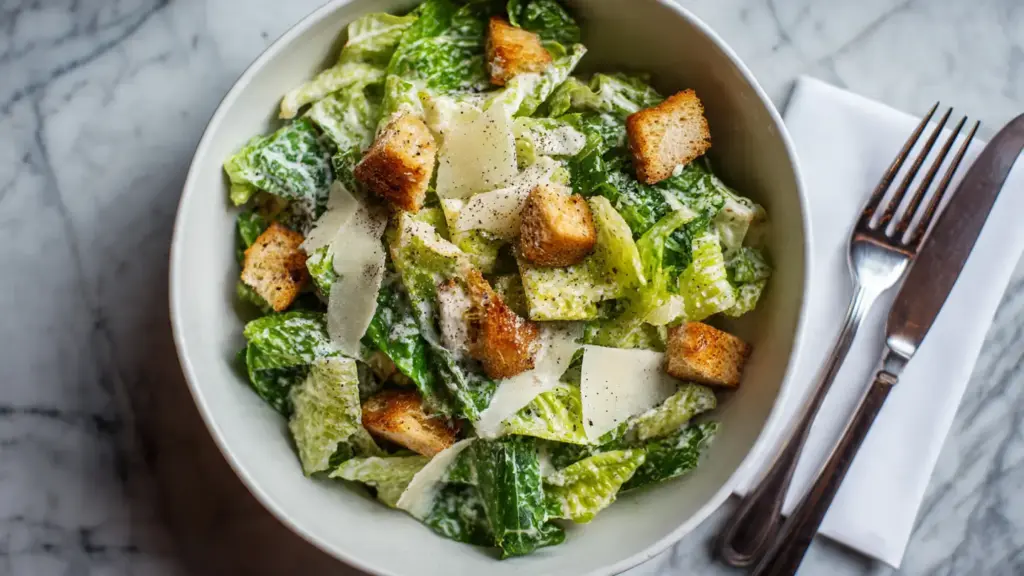
This original Caesar salad dressing is the star of the classic Caesar salad, but it works brilliantly in many other ways too.
The traditional presentation is over crisp romaine hearts, tossed tableside and topped with shaved Parmesan and crunchy croutons — but there’s no reason to stop there.
Here are some great ways to serve it:
- Classic Caesar Salad — Toss with chopped romaine hearts, croutons, and extra Parmesan. Add grilled chicken or shrimp to make it a full meal.
- With garlic bread — Serve alongside Cheesy Garlic Bread for the ultimate Italian-inspired spread.
- As a wrap or sandwich spread — Use it in place of mayo on wraps, paninis, or chicken sandwiches.
- With roasted vegetables — Drizzle over Roasted Broccoli or roasted asparagus as a warm side dish dressing.
- On pasta — Toss a few tablespoons with warm pasta and Parmesan for a quick Caesar pasta salad.
- With grilled fish — Use as a sauce for Baked Salmon or grilled cod.
- As a veggie dip — Serve thick alongside crudités for an impressive appetizer.
- On pizza — Spread a thin layer on flatbread or pizza crust before adding toppings.
Variations to Try
The original recipe is a perfect baseline, and there’s plenty of room to adapt it based on your taste preferences or dietary needs.
Here are some tested variations worth trying:
- Vegan Caesar Dressing — Substitute the egg yolk with a tablespoon of tahini or silken tofu, replace anchovies with capers, and use nutritional yeast instead of Parmesan for a fully plant-based version.
- Extra Anchovy Version — Use 5–6 anchovy fillets and increase the Worcestershire slightly for a deeply bold, umami-forward dressing.
- Creamy Avocado Caesar — Blend half a ripe avocado into the dressing for extra creaminess and a beautiful pale green color.
- Lemon-Forward Bright Caesar — Increase the lemon juice to 3 tablespoons (45 ml) and add 1/2 teaspoon (2.5 ml) of lemon zest for a sunnier, more acidic dressing.
- Herb Caesar — Add 1 tablespoon (5 g) of finely chopped fresh parsley or chives to the finished dressing for a fresh herbal note.
- Spicy Caesar — Add 1/2 teaspoon (2.5 ml) of your favorite hot sauce or a small pinch of red pepper flakes to the base.
- Blender Caesar — Combine all ingredients except the oil in a blender, then drizzle in the oil with the motor running for a very smooth, emulsified dressing with zero effort.
For another homemade sauce that pairs beautifully with salads and dipping, try the Easy Pesto Recipe.
Storage and Reheating
This dressing stores well and is actually often better the next day after the flavors have had time to meld together overnight.
Keep these storage guidelines in mind:
- Refrigerator storage — Store the dressing in an airtight jar or container in the refrigerator for up to 4–5 days. The egg yolk makes it perishable, so don’t push beyond 5 days.
- Glass is best — Store in a glass jar rather than plastic for better preservation of flavor.
- Stir before using — The dressing will separate slightly in the fridge. Whisk or shake it vigorously before each use to re-emulsify.
- Do not freeze — Freezing will break the emulsion and ruin the texture. This dressing does not freeze well.
- Make ahead for parties — You can make this dressing up to 2 days in advance for stress-free entertaining.
- Keep it separate — Do not dress salad ahead of time. Dress the lettuce only right before serving to prevent wilting.
This salad also pairs wonderfully as a starter before a hearty main like Easy Lasagna.
Nutritional Facts
These values are approximate and based on a 2-tablespoon (30 ml) serving size. The full batch makes approximately 8 servings.
| Nutrient | Per Serving (2 tbsp) |
|---|---|
| Calories | ~150 |
| Total Fat | 15 g |
| Saturated Fat | 2.5 g |
| Cholesterol | 30 mg |
| Sodium | 230 mg |
| Total Carbohydrates | 1 g |
| Dietary Fiber | 0 g |
| Sugars | 0 g |
| Protein | 2 g |
| Vitamin C | 3% DV |
| Calcium | 5% DV |
| Iron | 2% DV |
Nutrition values are estimates. Exact values will vary depending on specific brands and measurements used.
Another great salad to pair with this dressing: Asian Chicken Salad
Health Benefits of Key Ingredients
This dressing isn’t just delicious — several of its core ingredients offer meaningful nutritional value.
You’re getting real food with real benefits in every serving.
Here’s a closer look at what the key ingredients bring to the table:
- Olive oil — Rich in heart-healthy monounsaturated fats and polyphenol antioxidants. Research consistently links extra-virgin olive oil consumption to reduced inflammation and improved cardiovascular markers.
- Egg yolk — Provides choline (important for brain function), fat-soluble vitamins A, D, E, and K, as well as lutein and zeaxanthin for eye health. One egg yolk is a nutritional powerhouse.
- Garlic — Contains allicin, a compound with antimicrobial and anti-inflammatory properties. Regular garlic consumption has been linked to improved blood pressure and immune function.
- Anchovy — A small but surprisingly rich source of omega-3 fatty acids, calcium, selenium, and vitamin B12. Anchovies pack more nutrition per gram than most people expect.
- Lemon juice — Provides vitamin C and flavonoids. It also helps with iron absorption and adds brightness that may reduce the need for added salt.
- Parmigiano-Reggiano — A natural source of calcium, protein, and phosphorus. Aged cheeses like Parmigiano are also low in lactose and contain beneficial probiotics.
- Dijon mustard — Contains glucosinolates, which are compounds studied for their potential anti-cancer properties. It also provides selenium and a small amount of omega-3s.
For another nutritious and satisfying salad, the Broccoli Salad is a crowd-pleasing option with great health benefits.
Frequently Asked Questions
1. Is the original Caesar salad dressing supposed to have raw egg?
Yes, the original recipe uses a raw egg yolk as the base of the emulsion. The egg yolk is what creates the creamy, cohesive texture that makes Caesar dressing so distinctive.
If you’re concerned about consuming raw eggs, you can use a pasteurized egg, which has been heat-treated to eliminate bacteria while remaining functionally raw. You can also substitute the egg yolk with 1 tablespoon (15 ml) of mayonnaise, which is made from cooked/pasteurized eggs and mimics the emulsifying role of the yolk well.
2. Does Caesar dressing have anchovies in the original recipe?
The original Cardini recipe actually used Worcestershire sauce for umami rather than whole anchovy fillets. However, anchovies became a standard addition in later versions and are now considered traditional by most chefs and food historians.
If you don’t like anchovies, you can substitute 1 teaspoon (5 ml) of extra Worcestershire sauce or 1 teaspoon (5 ml) of soy sauce for a similar depth of flavor without any fish.
3. Why is my Caesar dressing too thin or broken?
A thin or broken dressing usually means the oil was added too quickly. If the dressing breaks (meaning the oil separates out and looks greasy rather than creamy), you can rescue it by starting fresh with a new egg yolk in a clean bowl, then slowly whisking in the broken dressing as if it were the oil.
If it’s just too thin, whisk in another tablespoon of freshly grated Parmesan, which will thicken it naturally without changing the flavor.
4. Can I make this Caesar dressing without a whisk?
Yes. The whisking method is classic and works well, but you can also make this dressing in a small blender, a food processor, or even a mason jar.
For the mason jar method: add all ingredients except the oil to the jar, seal it, and shake vigorously. Then open the lid slightly and slowly drizzle in the olive oil while shaking continuously. It won’t be quite as perfectly emulsified as the whisked version, but it works well enough for everyday use.
5. How long does homemade Caesar dressing last in the fridge?
Homemade Caesar dressing with a raw egg yolk lasts up to 4–5 days in the refrigerator when stored in a sealed container. Because it contains fresh egg and anchovy, it’s best to use it within 3 days for the freshest flavor.
Always store it in a clean glass jar with an airtight lid, and always give it a good shake or stir before each use since the dressing naturally separates as it sits.
Read Also: Buffalo Chicken Salad Recipe
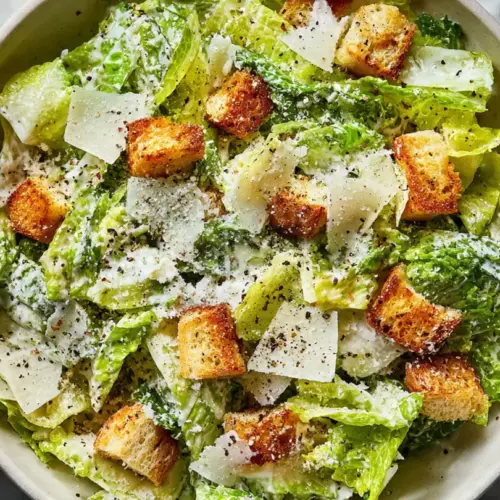
Original Caesar Salad Dressing

Equipment
- Cutting board - flat cutting board
- Chef’s knife
- Fork - or flat side of chef’s knife for mashing garlic
- Microplane zester - for Parmesan and garlic (optional but recommended)
- Whisk
- Measuring cups and spoons
- Medium mixing bowl - large enough to whisk vigorously
- Small glass jar with lid - for storing leftovers
- Salad spinner - for drying romaine (optional)
Ingredients
- 1 large egg yolk - room temperature
- 2 tablespoons fresh lemon juice - 30ml, plus more to taste
- 1 teaspoon Worcestershire sauce - 5ml
- 1 teaspoon Dijon mustard - 5ml
- 2 whole anchovy fillets - packed in oil, or 1 teaspoon anchovy paste; use 4 fillets for bolder flavor
- 2 small garlic cloves - peeled
- 1/4 teaspoon kosher salt - 1.25ml, plus more to taste
- 1/4 teaspoon black pepper - 0.5g, freshly ground, plus more to taste
- 1/2 cup extra-virgin olive oil - 120ml, or use a mix of 1/4 cup olive oil + 1/4 cup neutral oil for milder flavor
- 1/2 cup Parmigiano-Reggiano - 50g, freshly grated, plus extra for serving
- 1 tablespoon cold water - 15ml, to thin if needed
For Serving
- romaine hearts - 2-3 large heads, torn into bite-size pieces, thoroughly dried
- croutons - homemade or store-bought
- Parmigiano-Reggiano - shaved or freshly grated, for topping
Instructions
- Place garlic cloves on a cutting board with a pinch of salt. Mash into a smooth paste using the flat side of a chef’s knife or fork, about 60-90 seconds.
- Using the same method, mash anchovy fillets into a smooth paste, about 30-45 seconds. Combine with the garlic paste.
- Transfer paste to a medium bowl. Add egg yolk, lemon juice, Worcestershire, Dijon mustard, salt, and pepper. Whisk vigorously until smooth and thickened, about 45 seconds.
- While whisking continuously, add olive oil in a very slow, thin stream — starting drop by drop. Once mixture thickens, increase to a thin steady stream until all oil is incorporated and dressing is creamy.
- Fold in freshly grated Parmesan using a rubber spatula or whisk until fully incorporated and smooth.
- If dressing is too thick, whisk in cold water 1 teaspoon at a time to reach desired consistency.
- Taste and adjust with more lemon, Worcestershire, anchovy, salt, or pepper to your preference.
- Toss with dried romaine leaves, starting with half the dressing and adding more as needed. Top with croutons and shaved Parmesan. Serve immediately.
Notes
- Room temperature egg yolk: Take the egg out of the fridge 20-30 minutes before starting — cold yolks don’t emulsify as smoothly.
- Emulsify slowly: Adding oil too fast is the #1 mistake. Start drop by drop, then increase gradually once the mixture looks thick and creamy.
- Use fresh lemon juice: Bottled lemon juice has a flat, chemical taste. Fresh lemons make an enormous difference here.
- Grate your own Parmesan: Pre-grated cheese contains anti-caking agents that prevent it from integrating smoothly into the dressing.
- Don’t skip the anchovy: Even if you think you don’t like them, they provide deep umami — not fishiness. Start with 2 fillets if you’re cautious.
- Mash garlic into a paste: Minced garlic leaves harsh pockets. A smooth paste distributes the flavor evenly without bitterness.
- Storage: Store in an airtight glass jar in the refrigerator for up to 4-5 days. Shake or whisk before each use as it separates naturally.
- Vegan option: Substitute egg yolk with 1 tablespoon tahini or silken tofu, replace anchovies with capers, and use nutritional yeast instead of Parmesan.
- Make ahead: The dressing can be made up to 2 days in advance — the flavors actually meld and improve overnight.
- Never dress ahead: Dress lettuce only right before serving to prevent wilting and sogginess.
Final Thoughts
Making the original Caesar salad dressing from scratch is one of those small kitchen skills that genuinely transforms what you can put on the table. It takes less than 10 minutes, requires no special equipment, and produces a result that is miles ahead of anything from a bottle.
The key is patience during the emulsification step and quality ingredients — especially the Parmesan and anchovy. Once you’ve made it a few times, it becomes second nature.
Give this recipe a try this week and taste the difference for yourself. If you make it, leave a comment below telling me how it turned out — or share a photo on social media and tag the blog. I love seeing your creations!
Recommended:
- Chinese Chicken Salad
- Classic Chicken Salad
- Healthy Chicken Salad
- Fruit Salad
- Potato Salad
- Tuna Salad with Egg
- Easy Tuna Salad
- Easy Garlic Bread
- Comeback Sauce
- Bang Bang Sauce