
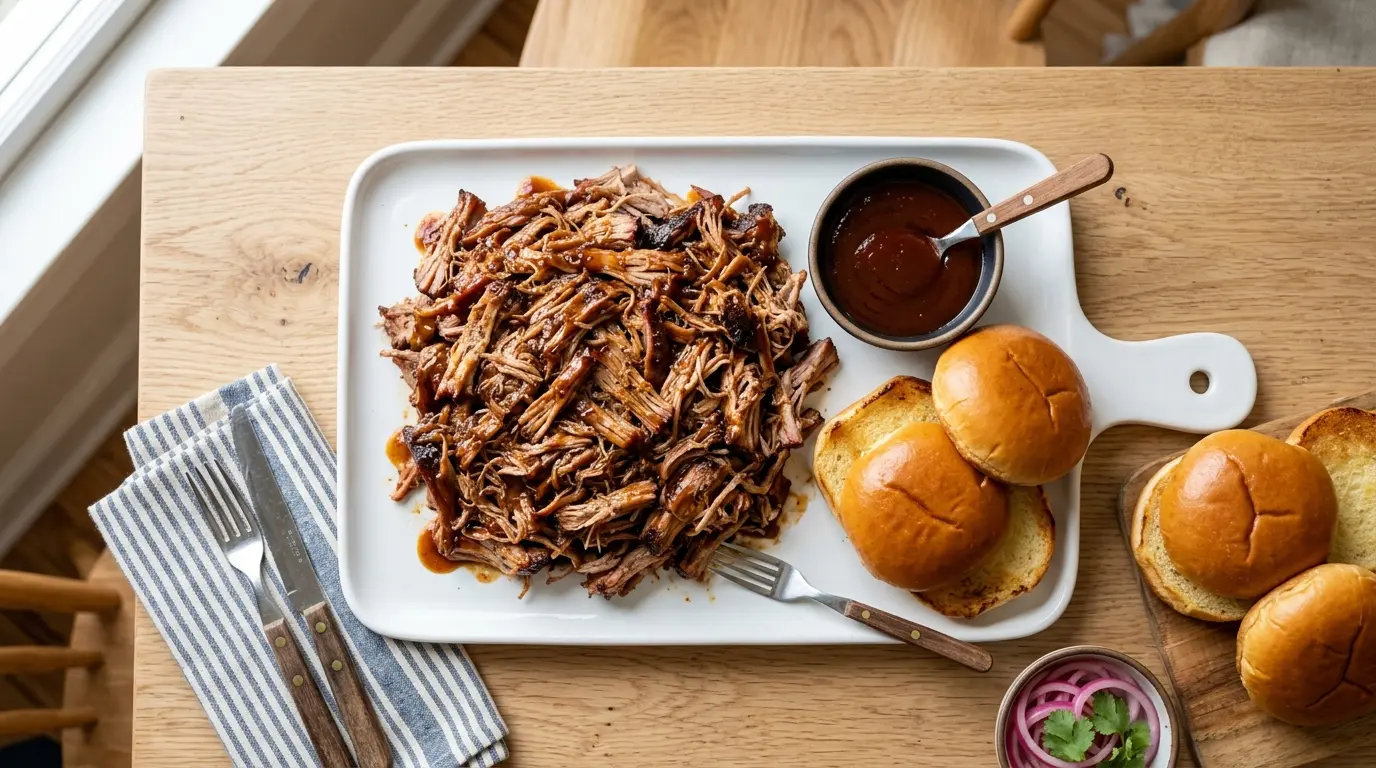
If you’ve ever wanted to make a proper smoked BBQ pulled pork recipe at home, this is the guide you’ve been waiting for. We’re talking fall-apart tender pork shoulder, rubbed in a smoky spice blend, slow-smoked for hours until it practically shreds itself, then finished with a glossy, tangy BBQ sauce. It’s the kind of cook that fills your backyard with an aroma that makes the neighbors ask what’s going on, and rewards your patience with one of the best bites of pork you’ll ever eat.
This isn’t a shortcut recipe. Real smoked pulled pork takes time, and that time is exactly what gives it that deep, layered flavor and the bark that every pitmaster chases. But it’s also not complicated. Once you understand the basics of low-and-slow smoking, the process becomes surprisingly hands-off.
Cooking for a weekend cookout, a game day crowd, or just a family dinner that deserves something special, this recipe delivers every single time.
For a bold, saucy spin on how to use the leftovers, try this BBQ Chicken Wrap for inspiration on building great BBQ sandwiches with similar flavors.

Why You’ll Love This Smoked BBQ Pulled Pork Recipe
Pulled pork made on a smoker is genuinely in a different league from oven-cooked or slow cooker versions. The smoke ring, the bark, the concentrated porky flavor. You simply cannot fake those with indoor cooking.
What makes this recipe especially satisfying is how versatile it is once it’s done. You can pile it on buns, tuck it into tacos, stir it into mac and cheese, or eat it straight from the board with a fork.
Here’s why this recipe earns a permanent spot in your rotation:
- Rich smoke flavor from hours of slow cooking over wood creates a depth that no liquid smoke substitute can match
- An incredible bark forms on the exterior, giving you a crunchy, flavorful crust with every bite
- Pull-apart texture that comes from properly breaking down the connective tissue in the pork shoulder
- Feeds a crowd because a single pork butt yields enough meat for 12 to 16 generous servings
- Great for meal prep since pulled pork freezes beautifully and reheats perfectly
- Minimal hands-on work once the pork is in the smoker, you mostly just maintain temperature and wait
- Crowd-pleasing flavor that appeals to nearly everyone, from picky kids to serious BBQ fans
You’ll also love that this recipe is forgiving. Pork shoulder is a tough, fatty cut that actually benefits from extended heat, so there’s a wide margin for success even for first-time smokers.
Another favorite for a crowd-pleasing BBQ spread: Brunswick Stew.
Ingredients
The key to great smoked pulled pork starts with a quality dry rub and a generously marbled pork shoulder (also called pork butt or Boston butt). The fat content in this cut is what keeps the meat moist and flavorful throughout the long cook. Here’s everything you’ll need:
For the Pork:
- 8 lbs (3.6 kg) bone-in pork shoulder (Boston butt)
- 2 tbsp yellow mustard (acts as a binder for the rub)
For the Dry Rub:
- 3 tbsp brown sugar, packed
- 2 tbsp smoked paprika
- 1 tbsp kosher salt
- 1 tbsp black pepper, coarsely ground
- 2 tsp garlic powder
- 2 tsp onion powder
- 1 tsp cayenne pepper (adjust to taste)
- 1 tsp dry mustard powder
- 1 tsp cumin
For the Smoke:
- Wood chips or chunks (hickory, apple, or cherry wood work beautifully with pork)
For Spritzing (optional but recommended):
- 1/2 cup (120 ml) apple cider vinegar
- 1/2 cup (120 ml) apple juice
For Finishing:
- 1 to 1.5 cups (240-360 ml) of your favorite BBQ sauce (or homemade)
For the BBQ sauce component, you might want to check out this BBQ Sauce Recipe to make it completely from scratch.
Kitchen Equipment Needed
You don’t need a professional smoker to make this recipe, but you do need a few key tools to do it properly. Here’s what to gather before you start:
- Offset smoker, kettle grill, or pellet smoker set up for indirect heat
- Instant-read meat thermometer (absolutely essential for this recipe)
- Wireless leave-in probe thermometer to monitor temperature without lifting the lid
- Spray bottle for the apple cider vinegar spritz
- Large rimmed baking sheet or aluminum pan for resting the pork
- Heavy-duty aluminum foil or pink butcher paper for wrapping
- Meat claws or bear claws for shredding
- Large mixing bowl for shredding and saucing the meat
- Long-handled tongs for managing the pork on the smoker
Read Also: Smoked Beef Short Ribs Recipe
Recommended Products for This Recipe
These are products that genuinely make a difference when smoking pulled pork, chosen based on quality and how much they improve the final result.
1. Hickory Wood Chunks for Smoking
Hickory is the classic wood pairing for pork, delivering a bold, bacon-like smokiness that complements the richness of pork shoulder beautifully. Chunks burn more slowly than chips and are ideal for long cooks like this one, giving you steady, consistent smoke throughout. Look for kiln-dried chunks for the cleanest flavor and least ash.
2. Wireless Dual-Probe BBQ Thermometer
Monitoring both the pit temperature and the internal temperature of the pork without constantly opening the smoker makes a tremendous difference on long cooks. A dual-probe wireless thermometer lets you track both readings from inside the house, eliminating the guesswork and preventing temperature swings from frequent lid lifts. It’s one of the most useful investments a backyard pitmaster can make.
3. Pink Butcher Paper Roll
Once the pork hits the stall (usually around 160-170°F/71-77°C), wrapping it in pink butcher paper instead of foil allows the bark to remain crispy while still speeding up the cook. Foil creates steam and can soften the bark, but butcher paper breathes just enough to preserve that beautiful crust. It’s a technique used by top pitmasters and makes a noticeable difference.
4. Bear Claw Meat Shredders
Pulling 8 pounds of hot pork apart with forks is slow, tiring work. Bear claw meat shredders let you shred an entire pork shoulder in under two minutes, and they handle the hot meat without burning your hands. A small tool that saves a lot of effort at the end of a long cook.
5. Pork Shoulder Dry Rub Seasoning Blend
If you’d like a pre-mixed rub as a baseline before customizing, a high-quality commercial pork rub can be a great starting point. Look for blends that lead with brown sugar, smoked paprika, and salt without too many fillers or MSG-heavy additives.
Another great low-and-slow cook worth trying: Mississippi Pot Roast.

Step-by-Step Instructions
1. Prepare the Dry Rub
- In a small bowl, combine 3 tbsp brown sugar, 2 tbsp smoked paprika, 1 tbsp kosher salt, 1 tbsp coarsely ground black pepper, 2 tsp garlic powder, 2 tsp onion powder, 1 tsp cayenne pepper, 1 tsp dry mustard powder, and 1 tsp cumin.
- Mix everything together thoroughly until evenly combined. The brown sugar should be broken up and fully incorporated into the other spices.
- Set the rub aside. You can make this up to a week in advance and store it in an airtight jar at room temperature.
2. Trim and Prep the Pork Shoulder
- Remove the pork shoulder from its packaging and pat it completely dry with paper towels. Moisture on the surface works against bark formation, so be thorough.
- Inspect the fat cap (the thick layer of fat on top of the shoulder). Trim it down to about 1/4 inch (6 mm) thick. You want to leave enough fat to baste the meat as it cooks, but too much thick fat won’t render properly and can insulate the rub from the meat.
- Check for any large, loose pieces of fat on the sides and trim those off as well.
- If the pork shoulder has a bone, leave it in. Bone-in pork butt cooks more evenly and the bone is a natural indicator of doneness (when it wiggles freely, the meat is done).
3. Apply the Mustard Binder and Dry Rub
- Rub the entire surface of the pork shoulder with 2 tbsp of yellow mustard. This acts as a binder to help the dry rub adhere to the meat. Don’t worry, you won’t taste the mustard at all after the long cook.
- Once the mustard is evenly applied, generously coat all sides of the pork with the dry rub. Press the rub firmly into the surface so it sticks rather than falling off.
- Be especially generous on the fat cap and any exterior surfaces. Don’t skip the sides and underside of the pork butt.
- Once rubbed, place the pork shoulder on a wire rack set over a baking sheet. You can cook it immediately or let it rest uncovered in the refrigerator for 8 to 24 hours. Resting allows the rub to penetrate and the surface to dry slightly, which promotes better bark formation.
4. Set Up and Preheat Your Smoker
- Set up your smoker for indirect cooking at a target temperature of 225°F to 250°F (107°C to 121°C). This low-and-slow temperature range is critical. Too hot and the exterior overcooks before the interior reaches the right temperature; too low and the cook drags on too long without proper bark development.
- If using a charcoal smoker, set up a two-zone fire with coals on one side and the pork on the other. Place your wood chunks directly on the coals.
- If using a pellet smoker, fill the hopper with your pellets and preheat to 225°F (107°C). Use hickory, apple, or cherry pellets for pork.
- For a kettle grill, use the “snake method” by arranging charcoal in a C-shape around the perimeter of the grill, with wood chunks placed along the snake. Place the pork over the open center.
- Once the smoker holds a steady temperature for at least 20 minutes, you’re ready to cook.
5. Place the Pork on the Smoker
- Place the pork shoulder fat-side up on the smoker grate, positioned in the coolest zone away from direct heat. Fat-side up allows the rendering fat to baste the top of the pork as it cooks.
- Insert a leave-in probe thermometer into the thickest part of the meat, making sure it doesn’t touch the bone (which would give you an inaccurately high reading).
- Close the smoker lid and resist the urge to open it frequently. Every time you lift the lid, you lose heat and smoke, adding time to your cook.
- For the first 3 hours, let the pork cook undisturbed and take on smoke.
6. Spritz the Pork (Optional but Recommended)
- After the first 3 hours, combine 1/2 cup (120 ml) apple cider vinegar and 1/2 cup (120 ml) apple juice in a food-safe spray bottle.
- Open the smoker and lightly spritz all exposed surfaces of the pork with the apple cider vinegar and apple juice mixture. This moisture helps keep the bark from getting too hard and adds a subtle tang that complements the richness of the pork.
- Spritz every 45 to 60 minutes from this point forward, working quickly each time to minimize heat loss.
- Keep adding wood chunks or chips throughout the cook to maintain steady smoke until the pork wraps.
7. Power Through the Stall
- Sometime between 150°F and 170°F (66°C and 77°C) internal temperature, the pork will enter what’s called “the stall.” During the stall, the internal temperature stops rising and may stay flat for 2 to 4 hours. This is completely normal and is caused by evaporative cooling from the surface of the meat.
- Do not panic and do not increase the smoker temperature. Simply maintain your 225-250°F (107-121°C) range and wait it out.
- If you need to speed things up, you can wrap the pork when it hits around 165°F (74°C). Wrapping in pink butcher paper or heavy-duty aluminum foil traps heat and shortens the stall dramatically.
- If using foil, be aware the bark will soften slightly from the steam. Pink butcher paper preserves the bark better and is the preferred method for most serious BBQ enthusiasts.
8. Continue Cooking to Probe Tenderness
- After wrapping, return the pork to the smoker and continue cooking. The target internal temperature is 200°F to 205°F (93°C to 96°C), but the real test of doneness is probe tenderness.
- When the pork is truly done, a probe or skewer inserted into the thickest part of the shoulder should glide in with zero resistance, like pushing it into room-temperature butter. If there’s any resistance at all, continue cooking and check again in 30 minutes.
- Bone-in shoulders are done when the bone wiggles freely with minimal effort. This is an extremely reliable indicator of full collagen breakdown.
- Total cook time for an 8 lb (3.6 kg) pork shoulder at 225°F (107°C) is approximately 10 to 14 hours. Budget accordingly and plan for the longer end.
9. Rest the Pork
- Once probe tender, remove the pork shoulder from the smoker. This rest period is non-negotiable and makes a significant difference in moisture and texture.
- If time allows, place the wrapped pork in an insulated cooler (a good quality cooler works perfectly for this) and stuff the remaining space with folded towels. This holds the temperature safely for 2 to 4 hours while the juices redistribute throughout the meat.
- If you’re short on time, rest on a cutting board for a minimum of 30 to 45 minutes before shredding.
10. Shred and Sauce the Pork
- Carefully open the wrapping over a large rimmed pan or bowl to capture all the juices. These drippings are liquid gold and will be added back to the pulled pork.
- Remove the bone (it should slide out with no resistance). Discard any large pieces of hard fat or connective tissue that didn’t fully render.
- Using meat claws, two forks, or your hands (protected by food-safe gloves), shred the pork into your desired size. Some people prefer chunky pulls, others like finer strands. Mix the shredded bark pieces throughout so every serving gets some of that crunchy exterior.
- Pour the reserved cooking juices back over the shredded pork and toss to combine. This dramatically improves moisture and flavor.
- Add 1 to 1.5 cups (240-360 ml) of your favorite BBQ sauce and toss well, or serve the sauce on the side for guests to add to their preference.
- Taste and adjust salt if needed before serving.
For a deeper dive into the world of low-and-slow BBQ cooking, this Alabama White Sauce Recipe is a fantastic, tangy alternative finishing sauce to try with your pulled pork.
Tips for Success
Smoking pulled pork is as much about patience and process as it is about ingredients. These tips will help you avoid common mistakes and get the best possible result:
- Don’t skip the rest period. Resting isn’t optional. The muscle fibers need time to relax and reabsorb the juices. Cutting this short means drier, less flavorful pork.
- Buy bone-in when possible. The bone adds flavor and acts as a built-in doneness indicator. When it wiggles freely, the meat is ready.
- Manage your temperature, not your time. Every pork shoulder is different. Cook to probe tenderness, not to a clock. Time estimates are guides only.
- Use a reliable thermometer. An accurate leave-in probe takes the guesswork out of long cooks. Do not rely on a cheap bi-metal thermometer, as these can be significantly off.
- Keep the lid closed. Every time you open the smoker, you add 15 to 30 minutes to your total cook time. Only open to spritz, check for bark, or add fuel.
- Wood type matters. Hickory is the classic choice for pork. Apple and cherry are milder and slightly sweet, which pairs beautifully with the pork and brown sugar in the rub. Avoid mesquite for long cooks as it can become harsh and bitter over extended smoking times.
- Start the night before. For midday service, start your cook at midnight or 2 a.m. and hold the finished pork in an insulated cooler until ready to serve.
- Season generously. Pork shoulder is a thick, dense piece of meat. The rub only penetrates the outer layers, so a heavy-handed application is appropriate.
Another comfort food classic worth having in your rotation: Classic Sloppy Joe.
Serving Suggestions
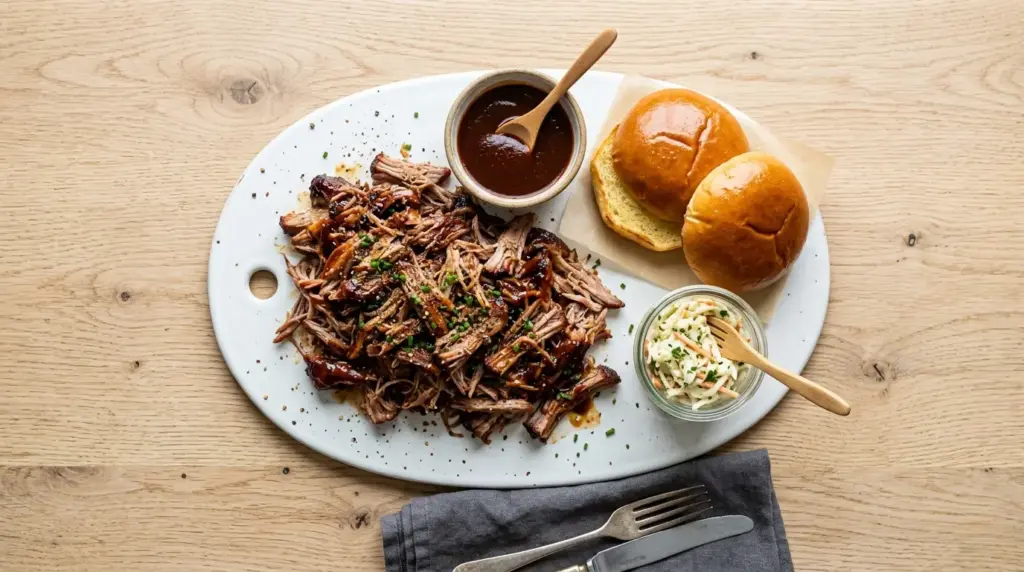
Pulled pork is one of the most versatile proteins you can make, and it works in nearly every format from a straightforward sandwich to a loaded bowl. Here are some of the best ways to serve it:
The most classic presentation is a heaping pile of pulled pork on a soft brioche bun or a pillowy potato roll, topped with a spoonful of tangy Vinegar Coleslaw. The contrast of the rich, smoky pork against the crisp, acidic slaw is a textbook combination.
Here are more great ways to build your plate and pair your pulled pork:
- On brioche buns with creamy coleslaw and extra BBQ sauce for a classic sandwich
- Alongside Baked Beans for the quintessential Southern BBQ side pairing
- With Potato Salad as a creamy, crowd-pleasing side
- Served over Cilantro Lime Rice for a bowl-style serving that works beautifully for weeknight dinners
- Loaded onto nachos with pickled jalapenos, shredded cheese, sour cream, and guacamole
- In tacos with quick pickled onions, fresh cilantro, and a drizzle of hot sauce
- Stuffed into a Baked Potato with cheese and sour cream for a fully loaded, over-the-top meal
- Alongside sweet Corn on the Cob for a backyard cookout spread
- Stirred into mac and cheese for a smoky, meaty upgrade
Read Also: Creamy Coleslaw Recipe
Variations to Try
Once you’ve mastered the classic version of this smoked BBQ pulled pork recipe, there’s a world of variations to explore. The pork butt is a forgiving base that accepts a wide range of flavor profiles:
Here are some popular directions you can take with your next cook:
- Carolina-style: Replace the brown sugar rub with a more savory blend and finish the pulled pork with a vinegar-based sauce rather than a sweet tomato-based BBQ sauce. Apple cider vinegar, red pepper flakes, and a touch of sugar is the traditional East Carolina formula.
- Hawaiian-style: Add pineapple juice to your spritz and finish the pulled pork with a teriyaki-influenced glaze. Serve over rice with fresh pineapple for a tropical twist.
- Spicy chipotle: Add 2 teaspoons of chipotle powder and 1 teaspoon of ancho chili powder to the base rub, and finish with a smoky chipotle BBQ sauce.
- Memphis dry rub style: Skip the sauce entirely and double down on the rub, including more celery salt and a higher ratio of paprika. Memphis dry ribs are legendary, and the same philosophy works beautifully on pulled pork.
- Texas-style: Strip the rub back to just kosher salt and black pepper (in equal parts) for a bold, beefy bark with nothing to distract from the pure pork flavor and wood smoke.
- Oven-roasted pulled pork: No smoker? Rub the pork the same way and roast it in a covered Dutch oven at 300°F (150°C) for 6 to 7 hours. Add a few drops of liquid smoke to the rub to approximate the flavor. It won’t have the same bark or smoke ring, but it will be deeply tender and flavorful.
- Slow cooker version: Place the rubbed pork in a slow cooker with 1/4 cup (60 ml) of apple cider vinegar and cook on low for 8 to 10 hours. Finish under the broiler for 10 minutes to crisp up the exterior.
For a completely different take on pulled meats in a slow cooker, this Crockpot Chicken Birria is a fantastic recipe to try next.
Storage and Reheating
Pulled pork stores exceptionally well, making it ideal for batch cooking and meal prep. Proper storage keeps it moist and flavorful for days or even months:
Here’s how to handle your leftovers:
- Refrigerator: Store in an airtight container with any reserved juices mixed in for up to 4 days. The juices prevent the pork from drying out in the fridge.
- Freezer: Freeze in zip-lock freezer bags or vacuum-sealed portions for up to 3 months. Portion into meal-sized amounts before freezing for easy thawing. Press as much air as possible from the bags before sealing.
- To reheat from the fridge: Place in a covered skillet or saucepan with a splash of apple juice or chicken broth and warm over medium-low heat, stirring occasionally until heated through. Alternatively, reheat in a 325°F (163°C) oven in a covered baking dish with a little liquid added for 20 to 25 minutes.
- To reheat from frozen: Thaw overnight in the refrigerator, then reheat using one of the methods above. For a quicker option, place the sealed bag in a bowl of warm water for 30 to 45 minutes, then reheat on the stovetop.
- Avoid the microwave when possible, as it reheats unevenly and can dry out the pork. If you must use a microwave, add a tablespoon of liquid, cover with a damp paper towel, and heat in 30-second intervals, stirring in between.
Another recipe that reheats and stores beautifully for easy weeknight meals: Crockpot Beef Stew.
Nutritional Facts
The following nutritional information is an approximate estimate per serving (approximately 4 oz/113 g of pulled pork without a bun), based on an 8 lb bone-in pork shoulder that yields roughly 5 lbs of cooked, shredded meat serving 16 people. Actual values will vary based on the fat content of the specific cut, the amount of BBQ sauce added, and how much fat is trimmed before or after cooking.
- Calories: 280 kcal
- Protein: 28 g
- Total Fat: 16 g
- Saturated Fat: 5 g
- Unsaturated Fat: 9 g
- Carbohydrates: 6 g (primarily from the brown sugar in the rub)
- Fiber: 0 g
- Sugars: 5 g
- Sodium: 480 mg
- Cholesterol: 95 mg
- Iron: 1.5 mg (approximately 8% DV)
Note: Adding BBQ sauce will increase the sugar and carbohydrate content. A typical tablespoon of BBQ sauce adds approximately 15 to 25 calories and 4 to 6 g of sugar, depending on the brand.
For more hearty, protein-forward dinner ideas, this Prime Rib Recipe is another excellent option for special occasion cooking.
Health Benefits of Key Ingredients
While smoked pulled pork is undeniably a treat rather than a health food, several of its core ingredients offer genuine nutritional value worth acknowledging.
Pork shoulder, when trimmed well, is an excellent source of complete protein. Protein is essential for muscle repair, immune function, and satiety, and a single serving of pulled pork delivers a meaningful amount.
Here’s a closer look at the key ingredients and what they bring to the table:
- Pork shoulder is rich in B vitamins, particularly B12, B6, and niacin, which support energy metabolism and nervous system function. It also provides zinc and selenium, both of which play roles in immune health.
- Smoked paprika contains antioxidants including capsaicin and carotenoids that have been linked to anti-inflammatory properties and eye health.
- Garlic powder carries many of the same benefits as fresh garlic, including allicin precursors that support cardiovascular health and immune function.
- Black pepper contains piperine, a compound that has been studied for its role in enhancing the absorption of other nutrients, including curcumin from turmeric.
- Cayenne pepper supports circulation and has a mild thermogenic effect, which may contribute to calorie burning after meals.
- Apple cider vinegar (used in the spritz) contains acetic acid, which some studies suggest may support blood sugar regulation and digestive health.
- Brown sugar contributes to the bark and adds flavor, and while it’s sugar, the small amount used per serving is minimal when spread across 16 portions.
You might also enjoy: Collard Greens Recipe
Frequently Asked Questions
1. What is the best cut of pork for pulled pork?
Pork shoulder, specifically the Boston butt (the upper portion of the shoulder), is the gold standard for pulled pork. It has an ideal ratio of fat to muscle and a significant amount of connective tissue that breaks down into gelatin during long, slow cooking. This gelatin is what gives pulled pork its rich, unctuous, moist texture. The picnic shoulder (the lower portion) also works but has more skin and bone to manage. Pork loin can technically be pulled, but because it’s so lean, it dries out quickly and lacks the fat and collagen needed for proper texture.
2. How long does it take to smoke a pork shoulder?
Count on approximately 1.25 to 1.5 hours per pound (0.45 kg) of pork shoulder at 225°F (107°C). An 8-pound shoulder typically takes 10 to 14 hours total, including the stall. Every piece of meat is different, so cook to probe tenderness rather than time. If you’re short on time, bumping the temperature to 275°F (135°C) will speed things up without significantly compromising quality, bringing a similar-sized shoulder in closer to 7 to 9 hours.
3. What temperature should pulled pork be when it’s done?
The target internal temperature for pulled pork is 200°F to 205°F (93°C to 96°C), but the more reliable indicator is probe tenderness. When a probe or skewer inserts into the thickest part of the shoulder with zero resistance, like pushing into soft butter, the pork is ready to come off the smoker. At this temperature, the collagen has fully broken down into gelatin and the muscle fibers will separate easily. If you pull it too early (even at 195°F/91°C), the meat may still be slightly tough and difficult to shred cleanly.
4. Can I make smoked pulled pork without a smoker?
Yes, and you can get very good results with an oven or slow cooker, though you’ll miss the smoke ring and bark that a proper smoker produces. For oven-pulled pork, rub the shoulder the same way, add a teaspoon of liquid smoke to the rub, place it on a rack in a roasting pan, and roast covered at 300°F (150°C) for 6 to 7 hours. For slow cooker pulled pork, place the rubbed shoulder in the slow cooker with 1/4 cup (60 ml) of apple cider vinegar and cook on low for 8 to 10 hours. Both methods yield deeply tender, flavorful pork that shreds beautifully.
5. Why is my pulled pork dry?
Dry pulled pork usually comes down to one of three causes: pulling it too early before the collagen fully breaks down, skipping or cutting short the rest period, or not adding the cooking juices back into the shredded meat. Make sure the pork reaches probe tender (not just a target temperature), rest it for at least 45 minutes (ideally 2 hours in an insulated cooler), and always mix the collected pan drippings back into the shredded pork before serving. If the pork is still a bit dry after shredding, a splash of apple juice and a drizzle of melted butter stirred through can rescue it.
You might also enjoy: Bourbon Chicken Recipe
Smoked BBQ Pulled Pork

Equipment
- Offset Smoker, Kettle Grill, or Pellet Smoker - Set up for indirect heat
- Instant-read meat thermometer - Absolutely essential for this recipe
- Wireless Leave-in Probe Thermometer - To monitor temperature without lifting the lid
- Spray Bottle - For the apple cider vinegar spritz
- Large Rimmed Baking Sheet or Aluminum Pan - For resting the pork
- Heavy-Duty Aluminum Foil or Pink Butcher Paper - For wrapping during the stall
- Meat Claws or Bear Claws - For shredding
- Large mixing bowl - For shredding and saucing the meat
- Long-Handled Tongs - For managing the pork on the smoker
- Wire Rack Set Over Baking Sheet - For resting the rubbed pork
Ingredients
- 8 lbs bone-in pork shoulder (Boston butt) - 3.6 kg
- 2 tbsp yellow mustard - Acts as a binder for the rub
For the Dry Rub
- 3 tbsp brown sugar - Packed
- 2 tbsp smoked paprika
- 1 tbsp kosher salt
- 1 tbsp black pepper - Coarsely ground
- 2 tsp garlic powder
- 2 tsp onion powder
- 1 tsp cayenne pepper - Adjust to taste
- 1 tsp dry mustard powder
- 1 tsp cumin
For the Smoke
- wood chips or chunks - Hickory, apple, or cherry wood
For Spritzing (Optional but Recommended)
- 0.5 cup apple cider vinegar - 120 ml
- 0.5 cup apple juice - 120 ml
For Finishing
- 1 to 1.5 cups BBQ sauce - 240-360 ml, your favorite or homemade
Instructions
- Combine brown sugar, smoked paprika, salt, black pepper, garlic powder, onion powder, cayenne, mustard powder, and cumin in a small bowl. Mix thoroughly and set aside.
- Pat the pork shoulder completely dry with paper towels. Trim the fat cap to about 1/4 inch thick and remove any large, loose pieces of fat from the sides.
- Rub the entire surface with yellow mustard. Generously coat all sides with the dry rub, pressing firmly to adhere. Refrigerate uncovered on a wire rack for 8-24 hours for best results.
- Set up your smoker for indirect cooking at 225°F to 250°F (107-121°C). For charcoal, use a two-zone fire; for pellet, fill the hopper and preheat; for a kettle, use the snake method.
- Place the pork fat-side up on the smoker grate, away from direct heat. Insert a leave-in probe thermometer into the thickest part, avoiding the bone. Close the lid and cook undisturbed for the first 3 hours.
- Combine apple cider vinegar and apple juice in a spray bottle. After 3 hours, lightly spritz the pork every 45-60 minutes, working quickly to minimize heat loss. Add wood chunks as needed to maintain steady smoke.
- When the internal temperature stalls around 150-170°F (66-77°C), maintain your smoker temperature and wait it out. To speed things up, wrap the pork in pink butcher paper or foil at about 165°F (74°C) to push through the stall.
- After wrapping, continue cooking until the internal temperature reaches 200-205°F (93-96°C) and a probe slides in with zero resistance, like butter. The bone should wiggle freely when done.
- Remove the pork from the smoker and rest it wrapped in an insulated cooler for 2-4 hours, or on a cutting board for a minimum of 30-45 minutes to allow the juices to redistribute.
- Carefully unwrap the pork over a pan to catch the juices. Remove the bone, discard any unrendered fat, and shred the meat using claws or forks. Pour the reserved juices and BBQ sauce over the pork, toss to combine, and serve.
Notes
- Don’t skip the rest period: Resting allows the muscle fibers to relax and reabsorb the juices, which is critical for moist, flavorful pulled pork.
- Buy bone-in when possible: The bone adds flavor and acts as a built-in doneness indicator—when it wiggles freely, the meat is perfectly tender.
- Manage your temperature, not your time: Every pork shoulder is different. Cook to probe tenderness, not to a clock. Time estimates are just guidelines.
- Use a reliable thermometer: An accurate leave-in probe takes the guesswork out of long cooks. Do not rely on a cheap bi-metal thermometer.
- Keep the lid closed: Every time you open the smoker, you add 15 to 30 minutes to your total cook time. Only open to spritz, check for bark, or add fuel.
- Wood type matters: Hickory is the classic choice for pork. Apple and cherry are milder and slightly sweet, pairing beautifully with the pork and brown sugar. Avoid mesquite for long cooks as it can become bitter.
- Start the night before: For midday service, start your cook at midnight or 2 a.m. and hold the finished pork in an insulated cooler until ready to serve.
- Season generously: Pork shoulder is a thick, dense piece of meat. The rub only penetrates the outer layers, so a heavy-handed application is appropriate.
- Refrigerator storage: Store leftovers in an airtight container with reserved juices for up to 4 days. Add a splash of apple juice when reheating to maintain moisture.
- Freezer storage: Freeze in zip-lock freezer bags or vacuum-sealed portions for up to 3 months. Thaw overnight in the refrigerator before reheating.
Final Thoughts
Smoked BBQ pulled pork is the kind of cook that turns a regular afternoon into an event. There’s real satisfaction in tending a fire, watching the bark develop, and eventually pulling that steaming shoulder off the smoker knowing you’ve put real time and care into it.
The recipe rewards patience more than skill. Follow the process, trust the thermometer over the clock, and don’t rush the rest. Do those things and you’ll have pulled pork that rivals anything you’d get from a dedicated BBQ joint.
If you give this recipe a try, leave a comment below and let us know how it went. What wood did you use? Did you go classic hickory, or try something like apple or cherry? Share your photos and tips too. The BBQ community is always better for it.
Recommended:
- BBQ Sauce Recipe
- Creamy Coleslaw Recipe
- Baked Beans Recipe
- Potato Salad Recipe
- Sweet Cornbread Recipe
- Corn on the Cob Recipe
- Classic Baked Mac and Cheese Recipe
- Dinner Rolls Recipe
- Green Beans Recipe
- Pork Chop Stir Fry Recipe