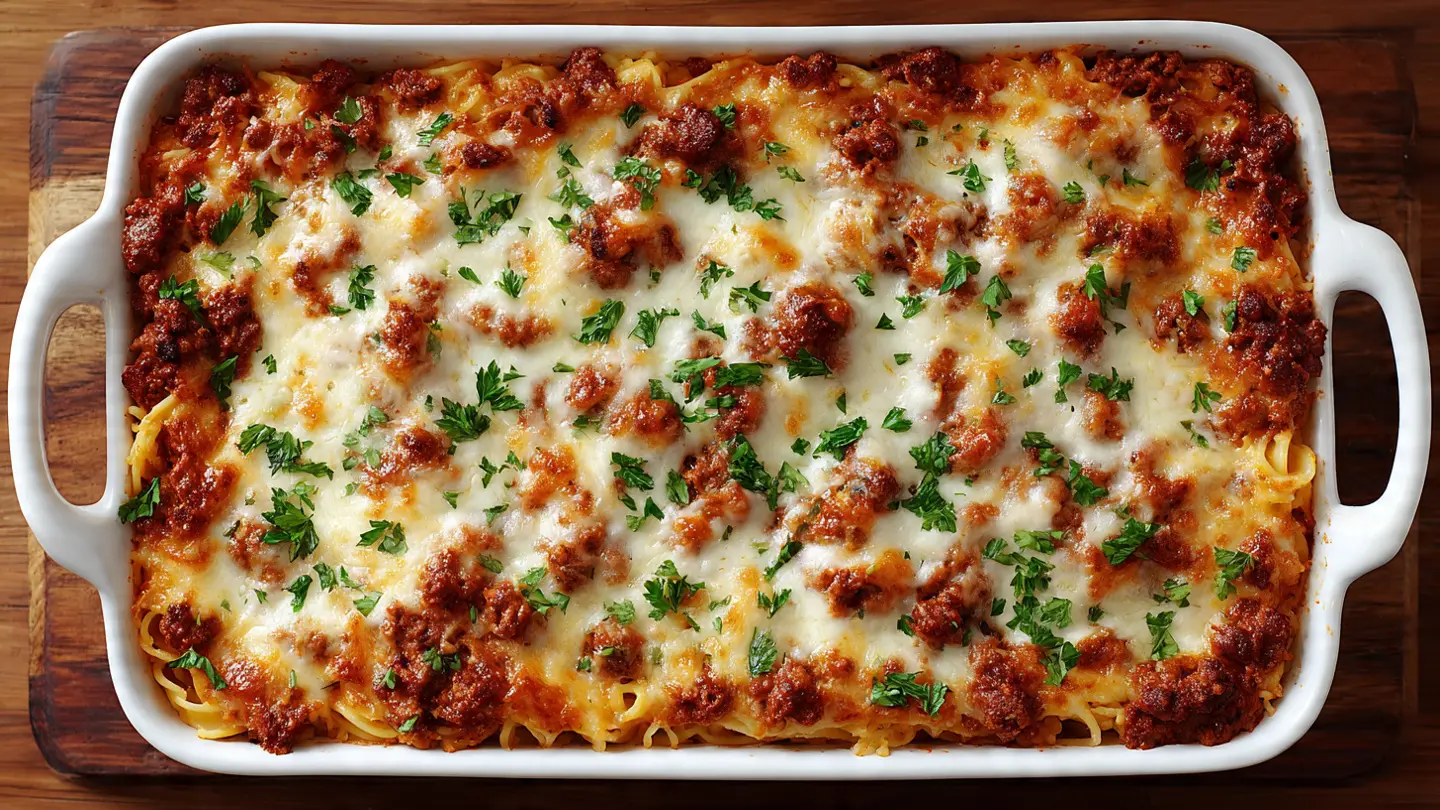
If you haven’t made a twice baked spaghetti recipe yet, you’re in for a serious treat. This dish takes everything you love about a classic spaghetti dinner and transforms it into a bubbling, golden-edged casserole that tastes like it took all day to make.
The secret is right there in the name: the pasta gets baked once with a creamy, egg-enriched base that holds everything together, then finished with a thick blanket of melted mozzarella that browns beautifully in the oven.
Think of it as the love child between lasagna and baked spaghetti. It slices into neat, satisfying squares, holds together perfectly on a plate, and delivers that irresistible combination of tender pasta, savory meat sauce, and gooey cheese in every single bite.
The base layer is what really sets this recipe apart. Mixing the cooked spaghetti with eggs, butter, and Parmesan creates a firm pasta “crust” that soaks up all the flavors from the layers above it. That technique is the whole reason this casserole has such great structure and depth of flavor.
It’s also one of those recipes that somehow tastes even better the next day, making it an excellent meal prep option for busy weeknights.
If you love cheesy baked pasta casseroles as much as we do, you’ll want to bookmark this Baked Spaghetti Recipe with Ground Beef for your weekly dinner rotation too.
Why You’ll Love This Twice Baked Spaghetti Recipe
This dish checks every box a great weeknight dinner should hit.
It’s hearty, cheesy, deeply comforting, and surprisingly easy to throw together on a weeknight. Once you’ve made it once, it will absolutely become a household staple.
It feeds a crowd without breaking the bank. A 9×13 baking dish serves 8 to 10 people generously, which makes it a go-to option for family dinners, potlucks, and casual gatherings.
The make-ahead potential alone is reason enough to fall in love with this recipe. You can fully assemble the casserole, cover it tightly, and refrigerate it for up to 24 hours before baking.
Here’s a quick look at why readers love this twice baked spaghetti:
- It has incredible structure. The egg-and-butter pasta base sets up firmly, so it slices cleanly like lasagna rather than falling apart into a loose, messy pile.
- Layers of flavor. Each component, from the creamy pasta base to the seasoned meat sauce to the bubbling cheese topping, adds its own distinct flavor and texture to every bite.
- Kid-approved and crowd-pleasing. Pasta, meat sauce, and melted cheese are three things most people will never say no to.
- Freezer-friendly. This casserole freezes beautifully, making it a smart choice for batch cooking.
- Endlessly customizable. Swap the protein, change up the cheese blend, or add vegetables to the sauce without missing a beat.
Another delicious baked pasta option worth exploring is this Million Dollar Baked Spaghetti Recipe, which adds a luscious cream cheese layer for extra richness.
Ingredients
This recipe uses pantry-friendly ingredients you can find at any grocery store. The combination of a creamy pasta base, seasoned meat sauce, and a three-cheese topping is what makes this particular version so satisfying.
Here’s everything you’ll need to serve 8 to 10:
For the Pasta Base:
- 1 lb (450g) dry spaghetti
- 2 large eggs
- 1/3 cup (75g) unsalted butter, melted
- 2/3 cup (65g) grated Parmesan cheese
- 1/2 tsp salt
- 1/4 tsp black pepper
For the Meat Sauce:
- 1 lb (450g) ground beef (80/20 recommended) or Italian sausage
- 1 medium onion, diced
- 3 cloves garlic, minced
- 1 tsp Italian seasoning
- 1/2 tsp garlic powder
- 1/2 tsp onion powder
- 1/4 tsp red pepper flakes (optional)
- 1 jar (24 oz / 680g) marinara sauce
- Salt and pepper to taste
For the Cheese Layer:
- 8 oz (225g) cream cheese, softened
- 1/2 cup (120g) sour cream
- 1 tsp Italian seasoning
For the Topping:
- 2 cups (225g) shredded mozzarella cheese
- 1/3 cup (30g) grated Parmesan cheese
- Fresh parsley or basil, for garnish
This recipe uses a cream cheese and sour cream layer between the pasta base and the meat sauce, which adds a tangy richness that’s hard to replicate with any other ingredient. Don’t skip it!
Looking for a creamy pasta bake with a slightly different approach? Check out this Baked Spaghetti Recipe with Cream Cheese for another take on the cream cheese method.
Kitchen Equipment Needed
You don’t need any specialty equipment for this recipe. Standard kitchen tools will handle everything just fine.
Here’s a complete list of what you’ll need:
- 9×13 inch baking dish (glass or ceramic preferred)
- Large pot for boiling pasta
- Large skillet or saute pan
- Large mixing bowl
- Wooden spoon or silicone spatula
- Colander for draining pasta
- Whisk
- Knife and cutting board
- Aluminum foil
- Cooking spray or butter for greasing the dish
- Box grater (for grating fresh Parmesan)
A glass or ceramic baking dish is recommended over metal here because it holds heat more evenly and distributes it gently throughout the casserole, which helps the pasta base set up properly without overbrowning on the bottom.
Read Also: Baked Ziti Recipe
Recommended Products for This Recipe
These are products chosen based on quality and real-world performance for this specific recipe. Any of them will make the cooking process smoother and the final result even better.
1. Rao’s Homemade Marinara Sauce
Rao’s is widely considered the gold standard of jarred marinara, and for good reason. It uses simple, high-quality ingredients without added sugar, which means the sauce has a clean, authentic tomato flavor that really shines in a baked casserole like this. It’s worth the extra dollar or two.
2. Le Creuset Enameled Baking Dish
This baking dish distributes heat beautifully and evenly, preventing hot spots that can cause uneven cooking in pasta casseroles. The enameled interior makes cleanup far easier after that cheesy bake, and it’s elegant enough to go straight from the oven to the table. A genuine investment piece that lasts decades.
3. Microplane Premium Zester/Grater
Freshly grated Parmesan melts into the pasta base in a way that pre-shredded bagged Parmesan simply can’t match. A Microplane produces ultra-fine shreds that integrate seamlessly and pack in a ton of flavor. This small tool makes a noticeable difference in the final result.
4. OXO Good Grips Colander
A sturdy colander is essential here, especially for draining a full pound of pasta cleanly. OXO’s colander has a stable base, comfortable handles, and fine enough holes to prevent any spaghetti from slipping through. A reliable kitchen staple.
You might also enjoy: Baked Spaghetti Recipe with Ricotta Cheese
Step-by-Step Instructions
Follow these detailed steps and you’ll end up with a perfectly layered, golden-topped casserole that’s every bit as impressive as it sounds.
Step 1: Preheat Your Oven and Prepare Your Baking Dish
- Preheat your oven to 350°F (175°C). Position the oven rack in the center of the oven for even heat distribution.
- Grease your 9×13 inch (23x33cm) baking dish thoroughly with cooking spray or a thin layer of softened butter. Make sure to coat the sides as well as the bottom to prevent the pasta base from sticking.
- Set the prepared dish aside on the counter while you prepare the other components.
Step 2: Cook the Spaghetti
- Bring a large pot of water to a rolling boil over high heat. Add a generous pinch of salt (about 1 tablespoon) to the water before adding the pasta. Salting the pasta water is essential because it’s one of the few chances you have to season the pasta itself.
- Add 1 lb (450g) of dry spaghetti to the boiling water and cook it for 1 to 2 minutes less than the package directions indicate. You want the pasta to be just slightly underdone (al dente) because it will continue cooking in the oven. If you fully cook it here, it may become mushy after baking.
- Reserve about 1/2 cup (120ml) of pasta water before draining. This starchy water can be used to loosen the meat sauce if it gets too thick.
- Drain the spaghetti in a colander and set it aside. Do not rinse the pasta, as the surface starch helps the egg mixture adhere properly.
Step 3: Make the Seasoned Pasta Base
- In a large mixing bowl, whisk together 2 large eggs, 1/3 cup (75g) melted butter, 2/3 cup (65g) grated Parmesan cheese, 1/2 tsp salt, and 1/4 tsp black pepper until fully combined. The eggs act as a binder, the butter adds richness, and the Parmesan brings a salty, savory depth that infuses the entire pasta layer.
- Add the warm, drained spaghetti to the bowl while it’s still hot. Toss everything together quickly and thoroughly using tongs or a large fork, making sure every strand is coated with the egg mixture. Working while the pasta is still warm helps the egg mixture adhere evenly.
- Transfer the coated spaghetti to your prepared baking dish. Spread it out in an even layer, pressing it gently with the back of a spoon to create a flat, compact base. This layer will set up during baking to create the firm pasta “crust” that makes this dish so satisfying to slice.
Step 4: Brown the Meat and Make the Sauce
- Heat a large skillet over medium-high heat. Add 1 lb (450g) of ground beef and break it up using a wooden spoon or spatula.
- Cook the beef, stirring occasionally, for about 5 minutes until it’s mostly browned.
- Add the diced onion to the skillet and continue cooking for another 3 to 4 minutes, stirring frequently, until the onion becomes soft and translucent and the beef is fully cooked through with no remaining pink.
- Add the 3 minced garlic cloves and stir for about 30 seconds until fragrant. Garlic burns quickly, so don’t walk away during this step.
- Drain off any excess grease from the skillet. Leaving too much grease in the pan will make the sauce greasy and can affect the texture of the finished casserole.
- Sprinkle in 1 tsp Italian seasoning, 1/2 tsp garlic powder, 1/2 tsp onion powder, and 1/4 tsp red pepper flakes (if using). Stir to coat the meat evenly with the spices.
- Pour in the entire 24 oz (680g) jar of marinara sauce. Stir to combine everything thoroughly. If the sauce seems very thick, add a splash of the reserved pasta water to loosen it slightly.
- Reduce heat to low and let the sauce simmer for 5 minutes, stirring occasionally. This allows the flavors to meld together. Season with salt and pepper to taste, then remove from heat.
Step 5: Prepare the Cream Cheese Layer
- In a medium bowl, add 8 oz (225g) of softened cream cheese, 1/2 cup (120g) of sour cream, and 1 tsp Italian seasoning.
- Stir vigorously with a fork or spoon until the mixture is completely smooth and creamy with no lumps. If your cream cheese isn’t fully softened, you can microwave it in 15-second increments until it’s pliable and easy to mix.
- This layer adds a tangy, creamy richness to the casserole and acts as a flavor bridge between the hearty pasta base and the savory meat sauce above it.
Step 6: Layer the Casserole
- Spread the cream cheese mixture evenly over the pasta layer in the baking dish. Use a spatula to spread it as evenly as possible, getting it all the way to the edges. This layer doesn’t need to be perfectly smooth, but even coverage ensures you get a little of that creaminess in every bite.
- Spoon the meat sauce evenly over the top of the cream cheese layer. Use the back of a spoon to spread it out gently and evenly, covering the cream cheese layer completely.
- Sprinkle 2 cups (225g) of shredded mozzarella cheese evenly over the top of the meat sauce layer.
- Finish by scattering 1/3 cup (30g) of grated Parmesan cheese evenly over the mozzarella. The Parmesan adds a sharper, nuttier flavor that complements the mild, stretchy mozzarella beautifully.
Step 7: First Bake
- Cover the baking dish tightly with aluminum foil. If using non-coated foil, lightly spray the underside of the foil with cooking spray so it doesn’t stick to the cheese.
- Place the covered dish in the preheated 350°F (175°C) oven. Bake for 35 minutes. This first bake cooks everything through, heats the casserole from the inside out, and begins to melt the cheese.
- After 35 minutes, remove the dish from the oven. Carefully peel back the foil (watch out for steam) to check that the edges are hot and bubbly.
Step 8: Second Bake (The Finale)
- Remove the foil completely from the baking dish. This is the “second bake” that gives this recipe its name, and it’s the step that creates the golden, slightly crispy cheese crust on top.
- Return the uncovered dish to the oven and bake for an additional 15 to 20 minutes, until the cheese on top is fully melted, lightly golden in spots, and bubbling around the edges. Keep an eye on it during this final stretch because oven temperatures can vary.
- For extra browning on the cheese, you can switch the oven to broil for the final 2 to 3 minutes. If you do this, stay close to the oven and watch carefully, as the cheese can go from golden to burnt in under a minute under the broiler.
Step 9: Rest and Serve
- Remove the casserole from the oven and let it rest on the counter for at least 10 minutes before slicing. This resting time is important because it allows the layers to firm up slightly, making the casserole much easier to cut into clean squares.
- Scatter freshly chopped parsley or torn basil leaves over the top just before serving for a pop of color and a fresh herbal note.
- Slice into generous squares and serve directly from the dish using a wide spatula.
This Easy Baked Spaghetti Recipe is another great weeknight option if you’re looking for a streamlined version of this dish.
Tips for Success
A few small adjustments can make a big difference in how this casserole turns out. Keep these tips in mind before you start cooking.
Here are the most helpful tips for making the best twice baked spaghetti:
- Always undercook the pasta. Pull it from the water 1 to 2 minutes early, because it will finish cooking in the oven. Overcooked pasta going into the oven equals mushy pasta coming out.
- Use room temperature cream cheese. Cold cream cheese is difficult to mix smoothly. Pull it from the fridge at least 30 minutes before you need it, or it will leave lumps in the cream layer.
- Don’t skip the resting time. Cutting into the casserole before it has had 10 minutes to rest will cause the layers to slide and the slices to fall apart. Patience pays off here.
- Season every layer. Season the pasta water, the meat sauce, and the cream cheese mixture individually. Casseroles that taste flat usually have one or more underseasoned components.
- Drain the pasta well. Excess water on the pasta will make the base soggy rather than firm. Shake the colander a few extra times after draining.
- Freshly grated Parmesan makes a difference. Pre-shredded Parmesan contains anti-caking agents that prevent it from melting smoothly. Fresh Parmesan grated right before use creates a silkier, more flavorful result.
- Cover tightly for the first bake. A tight foil cover traps steam and ensures the casserole heats through evenly before the cheese browns.
This technique also works wonderfully in a Homemade Baked Spaghetti Recipe if you prefer building your own sauce from scratch.
Serving Suggestions
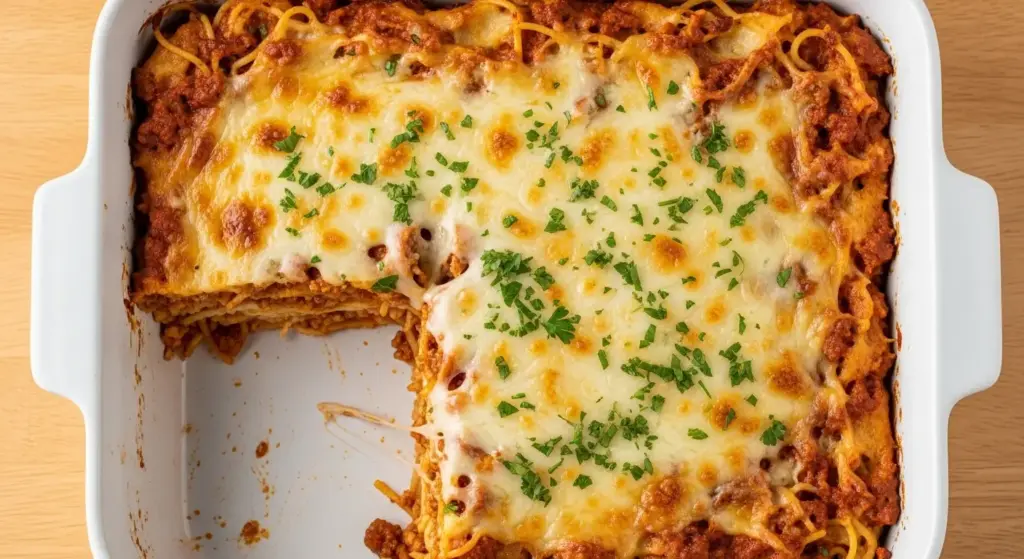
Twice baked spaghetti is rich and filling, so it pairs best with lighter sides that complement rather than compete with it.
A bright, crunchy salad or a simple vegetable dish alongside this casserole is all you need for a complete, satisfying meal.
Here are some great options to serve alongside this casserole:
- Cheesy Garlic Bread for soaking up extra sauce
- Broccoli Salad for a fresh, crunchy contrast
- Roasted Broccoli with a squeeze of lemon for a light vegetable side
- Classic Deviled Eggs as a fun, crowd-pleasing starter
- A simple green salad dressed with Italian vinaigrette
- Crusty bread for mopping up any remaining sauce in the dish
For a larger gathering, you might also enjoy pairing this with this Turkey Tetrazzini as a second main dish option that feeds a crowd.
Variations to Try
This recipe is a solid base that you can customize in so many directions. Feel free to adapt it based on what you have on hand or what your family loves.
Here are some popular and delicious variations to experiment with:
- Italian sausage version: Swap the ground beef for sweet or hot Italian sausage for a deeper, more complex meat flavor with notes of fennel and herbs.
- Chicken version: Use cooked, shredded rotisserie chicken in place of ground beef and swap the marinara for Alfredo sauce for a completely different but equally delicious result. Try the Baked Chicken Spaghetti Recipe for inspiration.
- Vegetarian version: Skip the meat entirely and load the sauce with sauteed mushrooms, zucchini, bell peppers, and spinach instead. See the Vegetarian Baked Spaghetti Recipe for a fully meatless take.
- Southern style: Add a layer of creamy cheddar cheese sauce and top with crumbled crackers for a southern-inspired twist. This Southern Baked Spaghetti Recipe is a great reference.
- Extra cheesy (million dollar style): Double the cream cheese layer and add a cup of ricotta to create an ultra-rich, decadent version.
- Alfredo version: Replace the marinara sauce with a jar of Alfredo sauce and use grilled chicken for a white pasta casserole. The Baked Spaghetti Recipe with Alfredo Sauce is a fan favorite.
- Spicy kick: Add 1/2 teaspoon of crushed red pepper flakes to the sauce and use pepper jack cheese in the topping for a spicy, bold casserole.
- Cottage cheese swap: Replace the cream cheese layer with seasoned cottage cheese for a lighter, higher-protein version. See Baked Spaghetti Recipe with Cottage Cheese for the full approach.
Read Also: Stuffed Shells Recipe
Storage and Reheating
This casserole stores exceptionally well, which makes it one of the best recipes to batch cook or prepare ahead.
Follow these guidelines to keep leftovers fresh and tasting great:
- Refrigerator: Allow the casserole to cool completely before storing. Cover the dish tightly with plastic wrap or foil, or transfer leftovers to an airtight container. It keeps well in the refrigerator for up to 4 days.
- Freezer: Wrap the baking dish (or individual portions) tightly in plastic wrap followed by a layer of aluminum foil. Freeze for up to 3 months. For best results, freeze the casserole before the second (uncovered) bake, then thaw and do the second bake fresh.
- Reheating from refrigerator: Cover the dish with foil and reheat in a 350°F (175°C) oven for 20 to 25 minutes, or until heated through. Individual portions can be microwaved on medium power for 2 to 3 minutes.
- Reheating from frozen: Thaw overnight in the refrigerator before reheating. Do not attempt to reheat directly from frozen in a glass baking dish, as the thermal shock can cause the dish to crack.
- Make-ahead instructions: Assemble the casserole up to 24 hours ahead, cover tightly, and refrigerate. When ready to bake, add about 10 to 15 extra minutes to the covered bake time since the casserole will be starting from cold.
Read Also: Fazoli’s Baked Spaghetti Recipe
Nutritional Facts
The following nutritional information is an estimate based on one serving (approximately 1/10th of the casserole using the ingredients listed above). Actual values will vary depending on specific brands and any modifications you make to the recipe.
| Nutrient | Per Serving (approx.) |
|---|---|
| Calories | ~560 kcal |
| Total Fat | 32g |
| Saturated Fat | 16g |
| Cholesterol | 135mg |
| Sodium | 720mg |
| Total Carbohydrates | 42g |
| Dietary Fiber | 3g |
| Sugars | 6g |
| Protein | 28g |
| Calcium | 280mg |
| Iron | 3mg |
These values are based on using 80/20 ground beef, whole milk cream cheese, full-fat sour cream, and a standard jarred marinara sauce. Using a leaner ground beef or reduced-fat dairy products will lower the fat and calorie content noticeably.
This Lasagna Recipe with Ricotta has a similar nutritional profile and is another satisfying, layered pasta dinner worth knowing.
Health Benefits of Key Ingredients
While this is certainly a comfort food recipe, several of its core ingredients offer real nutritional value worth highlighting.
Here’s a closer look at the nutritional benefits of the key components in this dish:
- Ground beef: A rich source of complete protein, iron, zinc, and B vitamins including B12. These nutrients are essential for energy metabolism, immune function, and maintaining healthy red blood cells. Using 80/20 ground beef provides a good balance of flavor and protein density.
- Eggs: The eggs in the pasta base provide high-quality protein and are one of the best dietary sources of choline, which supports brain health and cognitive function. They also contain fat-soluble vitamins A, D, E, and K.
- Parmesan cheese: Parmesan is surprisingly high in calcium and phosphorus relative to many other cheeses, and it delivers a significant amount of protein per ounce. It’s also a concentrated source of flavor, meaning a little goes a long way.
- Garlic: Beyond its obvious flavor benefits, fresh garlic contains allicin, a sulfur compound associated with cardiovascular health benefits and natural antimicrobial properties.
- Marinara sauce (tomato base): Cooked tomatoes are an excellent source of lycopene, a powerful antioxidant that may help reduce the risk of certain chronic diseases. Cooking tomatoes actually increases lycopene bioavailability compared to raw tomatoes.
- Spaghetti (pasta): Pasta is a good source of complex carbohydrates that provide sustained energy. Whole wheat pasta, which can easily be substituted here, adds extra fiber and micronutrients.
This Spaghetti Sauce Recipe is a fantastic homemade option if you want to maximize the fresh tomato benefits in this dish.
Frequently Asked Questions
1. What is twice baked spaghetti?
Twice baked spaghetti is a pasta casserole in which cooked spaghetti is first baked covered (the first bake) to heat through and set the layers, and then baked a second time uncovered (the second bake) to brown and crisp the cheese on top.
The result is a dish that has a firm, sliceable structure similar to lasagna but with the familiar flavor profile of traditional spaghetti.
2. Can I make this recipe ahead of time?
Yes, this casserole is an excellent make-ahead meal. Assemble it completely, cover it tightly with plastic wrap or foil, and refrigerate for up to 24 hours before baking.
When you’re ready to bake it, remove it from the refrigerator about 20 to 30 minutes before placing it in the oven, and add an extra 10 to 15 minutes to the covered bake time to account for the chilled starting temperature.
3. Can I use a different type of pasta?
Absolutely. While spaghetti is the classic and most traditional choice for this dish, you can substitute penne, rigatoni, ziti, or linguine without any significant change to the recipe.
Keep in mind that shorter, tube-shaped pasta like penne or ziti will give the finished casserole a slightly different texture and slice a little more cleanly than long noodles.
4. What can I use instead of ground beef?
Ground Italian sausage is the most popular substitute and adds a wonderful depth of flavor with fennel and herb notes. Ground turkey or ground chicken work well as leaner alternatives.
For a completely meatless version, use a generous mixture of sauteed mushrooms, bell peppers, zucchini, and spinach in place of the meat. The mushrooms in particular add a hearty, savory quality that helps fill the flavor gap left by removing the meat.
5. How do I prevent the bottom layer from getting soggy?
The key to a firm, non-soggy pasta base is making sure your cooked spaghetti is well drained before mixing it with the egg and butter. Any excess water on the pasta will thin out the egg mixture and prevent it from setting properly.
Also, slightly undercooking the pasta before it goes into the oven gives it less residual moisture and helps it maintain a firmer texture after baking. Pressing the pasta layer down gently and firmly before adding the other layers also encourages better structure.
Read Also: Lasagna Soup Recipe
Final Thoughts
This twice baked spaghetti recipe is the kind of dish that earns a permanent place in your regular rotation. It’s satisfying, deeply flavorful, and makes enough to feed a crowd or keep you well-fed for several days.
The layered construction and the double bake method are absolutely worth the small amount of extra effort they require. You end up with a casserole that’s far more impressive than a basic pasta bake, and every single slice holds together beautifully on the plate.
If you’ve been looking for a pasta casserole that truly delivers, this is it. Try it once, and we think you’ll understand why twice baked spaghetti has such a devoted following.
We’d love to hear how yours turns out! Drop a comment below and let us know if you made any delicious variations, or share a photo on social media and tag us. Happy cooking!
Recommended:
- Easy Lasagna Recipe
- Classic Lasagna with Ricotta Recipe
- Italian Meatballs Recipe
- Marinara Sauce Recipe
- Easy Garlic Bread Recipe
- San Giorgio Lasagna Recipe
- Pasta Fagioli Recipe
- Tuna Noodle Casserole Recipe
- Chicken Casserole Recipe
- Creamy Mac and Cheese Recipe