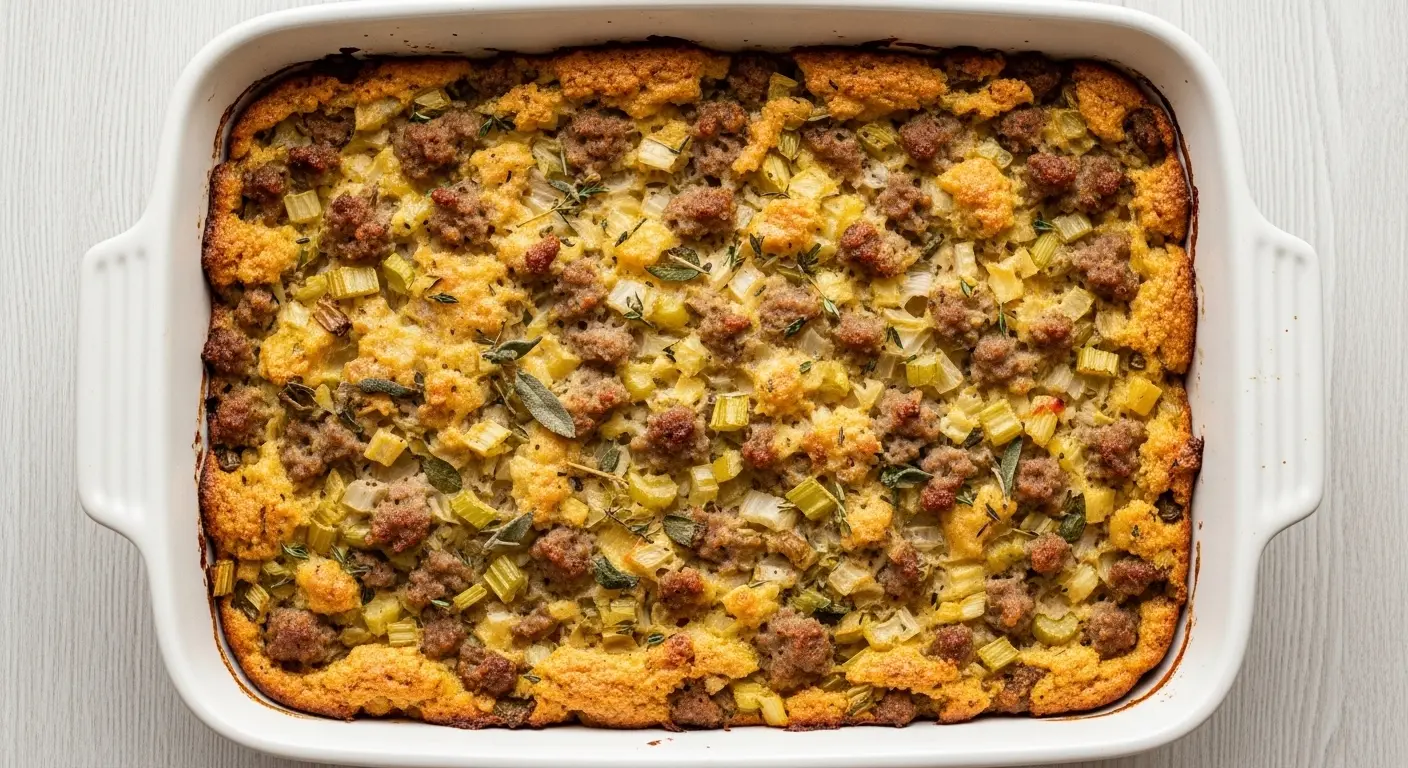
Every Thanksgiving table needs a sausage stuffing recipe that delivers the perfect contrast: a golden, slightly crispy top with a soft, buttery, deeply savory center underneath. This is that recipe.
It comes together with simple, classic ingredients. Day-old bread, bulk pork sausage, celery, onion, fresh herbs, chicken broth, and butter. These are the building blocks of a stuffing that has graced holiday tables across America for generations, and for good reason.
The magic is in the technique. Drying out the bread properly ensures it soaks up all those savory juices without turning to mush. Cooking the vegetables in the sausage drippings layers flavor into every bite. And baking it covered, then uncovered, gives you that irresistible texture contrast.
This recipe works beautifully as a standalone side dish baked in a casserole pan, which means no worrying about safe turkey-stuffing temperatures. It is just as flavorful and satisfying made this way, and it frees up space in the bird.
If you have been searching for a foolproof, crowd-pleasing stuffing that tastes like it came from a seasoned holiday cook, you have found it. Make it for Thanksgiving, Christmas, or honestly any time a cozy, hearty side dish sounds right.
For another holiday classic you can make alongside this dish, check out this Sausage Gravy Recipe for a rich, comforting pour-over that the whole table will love.
Why You’ll Love This Sausage Stuffing Recipe
This stuffing hits every note that makes a holiday side dish unforgettable. It is hearty, herbaceous, and packed with savory flavor in a way that boxed mixes simply cannot replicate.
The bulk pork sausage brings deep, meaty richness and seasons the dish from the inside out. Its fat and drippings also help sauté the aromatics, adding another layer of flavor you simply do not get any other way.
Fresh herbs like sage and thyme give the stuffing that unmistakable classic scent that fills the kitchen and signals that the holiday meal is almost ready.
Day-old bread, properly dried, absorbs the broth and buttery vegetable mixture without turning soggy. You get that signature custardy interior with golden edges on top.
- Crowd-pleasing flavor that appeals to picky eaters and food lovers alike
- Uses pantry staples and a single loaf of bread with no fancy shopping required
- Bakes in a standard 9×13 casserole dish for easy serving and cleanup
- Can be assembled a day ahead to save precious oven time on the big day
- The top gets perfectly golden and crispy in the oven
- Reheats beautifully with a splash of extra broth
For another must-have holiday side that pairs with this dish perfectly, try this Thanksgiving Turkey Recipe for a centerpiece the whole family will gather around.
Ingredients
The ingredient list for a great sausage stuffing is short but each element matters. Using good bread, quality sausage, and fresh herbs makes the final dish notably more flavorful than shortcuts would allow.
- 1 large loaf (about 1 lb / 450g) white sandwich bread, sourdough, or French bread, cut into 1-inch cubes (roughly 10 to 12 cups)
- 1 lb (450g) bulk pork sausage (plain or mild Italian)
- 4 tablespoons (60g) unsalted butter
- 1 large yellow onion, diced (about 1½ cups / 225g)
- 4 stalks celery, diced (about 1½ cups / 150g)
- 4 cloves garlic, minced
- 2 tablespoons fresh sage, finely chopped (or 2 teaspoons dried)
- 1 tablespoon fresh thyme leaves (or 1 teaspoon dried)
- 1 tablespoon fresh flat-leaf parsley, chopped
- 1½ teaspoons poultry seasoning
- 1 teaspoon kosher salt
- ½ teaspoon black pepper
- 2 to 2½ cups (480 to 600ml) low-sodium chicken broth, divided
- 2 large eggs, lightly beaten
You might also love this Sweet Potato Casserole Recipe as a complementary side dish to serve alongside this stuffing at your holiday table.
Kitchen Equipment Needed
Having the right equipment makes this stuffing easier to pull off and helps achieve the right texture. The 9×13 baking dish is essential for even cooking and getting that golden top.
- Large rimmed baking sheet (for drying the bread)
- 9×13-inch baking dish (ceramic or glass preferred for even heat distribution)
- Large skillet or sauté pan (at least 12 inches wide)
- Large mixing bowl
- Wooden spoon or silicone spatula
- Sharp knife and cutting board
- Measuring cups and spoons
- Aluminum foil
Read Also: Green Bean Casserole Recipe
Recommended Products for This Recipe
These are products I genuinely recommend based on quality and how well they perform for this specific dish. Investing in the right tools and ingredients here makes a real difference in the final result.
1. Le Creuset Enameled Baking Dish
A high-quality baking dish distributes heat evenly across the bottom and sides of the stuffing, which means no burnt patches and a consistently golden top. The enamel interior also releases the stuffing cleanly and makes cleanup fast even after baking at high heat. It is a kitchen investment that will outlast countless holiday seasons.
2. Jimmy Dean Premium Pork Sausage Roll
A reliable, well-seasoned bulk pork sausage with just the right fat content is what makes this stuffing taste truly classic. Jimmy Dean Premium pork sausage provides the savory depth and drippings that make the entire dish come together without the need for additional seasonings. It is easy to find at most grocery stores year-round.
3. Nordic Ware Natural Aluminum Baker’s Half Sheet
Drying the bread properly before mixing is one of the most important steps in stuffing, and a sturdy, warp-resistant baking sheet ensures even drying without hot spots. Nordic Ware’s commercial-grade half sheet conducts heat reliably and holds up beautifully under repeated holiday use. It is also perfect for roasting vegetables and baking cookies year-round.
4. OXO Good Grips Large Stainless Steel Mixing Bowl
A large, deep mixing bowl is essential when tossing all the stuffing components together without spillage. OXO’s stainless steel mixing bowl has a non-slip base and a pour spout that makes adding broth gradually much easier. It is one of those kitchen tools that earns its place with every single use.
Another favorite: Dinner Rolls Recipe
Step-by-Step Instructions
1. Dry Out the Bread
Getting your bread properly dried is the single most important step in making stuffing that has body and texture rather than a mushy, dense interior.
- Cut the bread loaf into roughly 1-inch (2.5cm) cubes. You should end up with approximately 10 to 12 cups of cubed bread.
- Spread the cubes in a single layer across one or two large rimmed baking sheets. Do not pile them up — they need airflow to dry evenly.
- To dry overnight (preferred method): Leave the sheet pans out uncovered at room temperature for 8 to 12 hours. The cubes should feel firm and stale to the touch by morning.
- To dry in the oven (same-day method): Preheat your oven to 300°F (150°C). Spread the cubes in a single layer and bake for 20 to 25 minutes, stirring once halfway through, until they feel completely dry and just beginning to turn light golden at the edges. They should not be browned — just thoroughly dry throughout.
- Remove the dried bread cubes from the oven and transfer them to a large mixing bowl. Set the bowl aside.
- Increase the oven temperature to 350°F (175°C) and allow it to fully preheat before baking the stuffing.
2. Cook the Sausage
Browning the sausage properly builds a savory, caramelized base flavor that runs through the entire finished dish.
- Heat a large skillet over medium-high heat. There is no need to add oil since the sausage contains enough fat on its own.
- Add the 1 lb (450g) bulk pork sausage to the skillet. Break it apart immediately into crumbles using a wooden spoon or spatula.
- Cook, stirring and breaking up any large clumps, for 7 to 9 minutes until the sausage is fully cooked through with no pink remaining and some pieces are nicely browned at the edges. Those browned bits carry enormous flavor.
- Using a slotted spoon, transfer the cooked sausage directly to the mixing bowl with the dried bread cubes. Do not drain the skillet — leave all the drippings behind in the pan. Those flavorful drippings are the base for cooking the vegetables and should not be wasted.
3. Sauté the Aromatics
Cooking the vegetables in the sausage drippings is what gives this stuffing its layered, savory depth that you simply cannot get from starting with clean butter alone.
- Return the skillet with the sausage drippings to medium heat. Add the 4 tablespoons (60g) of unsalted butter and let it melt completely into the drippings.
- Add the diced onion and diced celery to the skillet. Stir to coat everything evenly in the butter and drippings.
- Cook, stirring occasionally, for 8 to 10 minutes until the onion has become soft and translucent and the celery is tender but not mushy.
- Add the 4 cloves of minced garlic and cook for 1 more minute, stirring frequently to prevent burning. The garlic should smell fragrant and look slightly golden at the edges.
- Add the 2 tablespoons of fresh chopped sage, 1 tablespoon of fresh thyme leaves, 1 tablespoon of fresh parsley, and 1½ teaspoons of poultry seasoning directly to the skillet. Stir everything together and cook for about 30 seconds to let the herbs bloom and release their aroma into the butter.
- Season with 1 teaspoon kosher salt and ½ teaspoon black pepper, stir to combine, then remove the skillet from heat.
- Scrape the entire vegetable and herb mixture, along with every bit of the remaining butter and drippings from the pan, into the large mixing bowl with the bread and sausage.
4. Add the Broth and Eggs
This is the step that brings the stuffing mixture together into a cohesive dish and gives it the right moisture level without making it wet or gummy.
- In a small bowl or liquid measuring cup, lightly whisk the 2 large eggs with a fork until the yolks and whites are just combined.
- Add 2 cups (480ml) of the low-sodium chicken broth to the beaten eggs and whisk together to combine.
- Pour the broth and egg mixture gradually over the bread, sausage, and vegetable mixture in the large bowl. Pour in a slow, steady stream while gently tossing and folding with a large spatula or spoon.
- Gently fold and toss everything together until the bread has absorbed the liquid and the mixture is evenly moistened throughout. Do not overmix or mash the bread — you want the cubes to remain somewhat intact so the texture stays varied and interesting.
- Let the mixture sit for 2 to 3 minutes, then check the consistency. The stuffing should feel moist and cohesive but not wet or sloppy. If any bread cubes still feel completely dry, add the remaining ½ cup (120ml) of broth a little at a time, tossing gently after each addition, until the texture is right.
5. Transfer to Baking Dish and Bake
The two-stage baking process — covered first, then uncovered — is the key to achieving that classic stuffing texture: moist and custardy on the inside with a golden, slightly crispy top that everyone fights over.
- Grease a 9×13-inch (23x33cm) baking dish generously with butter or nonstick cooking spray.
- Transfer the stuffing mixture to the prepared baking dish. Spread it out evenly but do not press or compact it down. A lightly mounded, loosely filled surface crisps up much better during baking.
- Cover the baking dish tightly with aluminum foil, making sure the edges are sealed to trap steam.
- Place the dish in the preheated 350°F (175°C) oven. Bake covered for 30 minutes. The steam trapped inside ensures the stuffing heats through completely and stays moist in the center.
- After 30 minutes, carefully remove the foil — watch for a burst of hot steam when you peel it back. Return the dish to the oven, uncovered.
- Continue baking for an additional 25 to 30 minutes until the top is golden brown, the edges are slightly crispy, and the stuffing has pulled slightly away from the sides of the pan.
- Remove from oven and let rest for 5 minutes before serving. This brief rest allows the stuffing to firm up slightly so it scoops cleanly.
This stuffing pairs wonderfully with Cranberry Sauce for a complete, classic holiday spread.
Tips for Success
Small techniques make a significant difference in the final quality of your sausage stuffing. These tips come from what consistently separates a great stuffing from a forgettable one.
- Dry your bread completely. Undercooked or still-moist bread absorbs liquid unevenly and makes the stuffing heavy and gummy. When in doubt, leave it in the oven a few extra minutes.
- Do not skip the drippings. The fat left in the pan after browning the sausage is packed with flavor. Cooking the vegetables in it rather than plain butter makes the entire dish taste noticeably richer.
- Use fresh herbs when possible. Dried herbs work in a pinch, but fresh sage and thyme give the stuffing a vibrant, aromatic quality that fills your entire kitchen while it bakes.
- Add broth gradually. Every loaf of bread absorbs liquid differently. Adding the broth slowly lets you control the final moisture level and prevents an overly wet or soggy result.
- Do not pack the baking dish. Loosely filling the dish allows the top to dry out and crisp during the final uncovered baking phase. A compacted surface traps steam and results in a soft, pale top instead of a golden crust.
- Taste before baking. Take a small spoonful of the raw mixture, microwave it for about 20 seconds to cook it through quickly, and taste it for seasoning. Adjust salt and pepper before the dish goes into the oven.
Read Also: Sausage Balls Recipe
Serving Suggestions
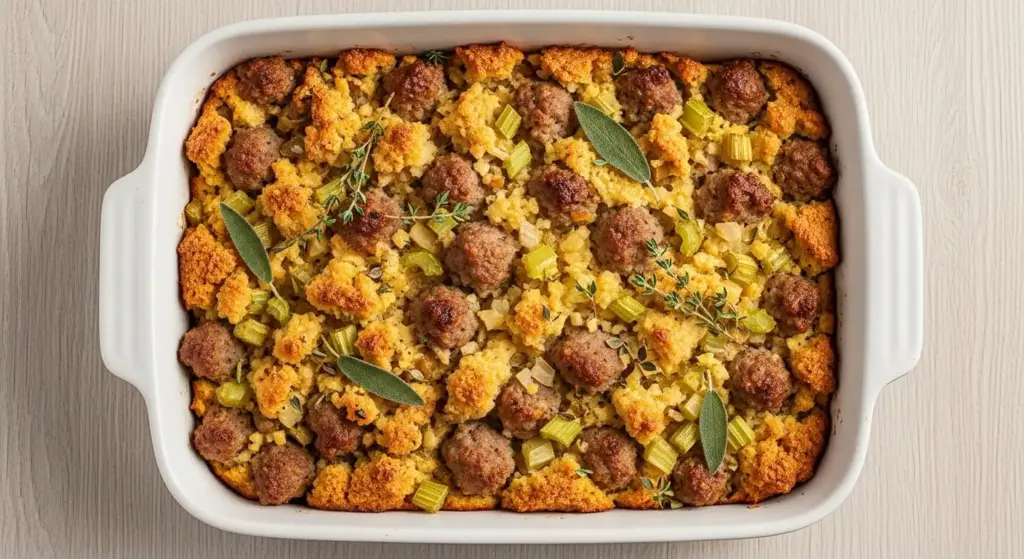
Sausage stuffing is a natural centerpiece side dish for any major holiday spread and pairs beautifully with a wide range of classic accompaniments.
Serve it alongside a perfectly roasted bird and a generous ladle of Turkey Gravy poured over the top, which is genuinely the most comforting combination on the plate. The gravy seeps into the stuffing and makes each bite even more satisfying.
- Garlic Mashed Potatoes for a creamy, comforting contrast alongside the heartier stuffing
- Cranberry Sauce for a bright, tart counterpoint to the rich sausage flavors
- Green Bean Casserole as a classic pairing that completes the holiday table
- Sweet Potato Casserole for a touch of sweetness alongside the savory stuffing
- Roasted Brussels Sprouts with Bacon for a caramelized, slightly bitter vegetable that balances the richness
- Dinner Rolls for soaking up every last drop of gravy on the plate
- Prime Rib as a show-stopping alternative protein centerpiece at Christmas dinner
Another favorite: Creamy Mashed Potatoes
Variations to Try
The classic recipe is the gold standard, but stuffing is wonderfully adaptable. These variations all maintain the spirit of a great sausage stuffing while adding different textures and flavors.
- Apple Sausage Stuffing: Dice one tart apple such as Granny Smith and sauté it with the onion and celery. The apple adds subtle sweetness and a fruity depth that plays beautifully against the savory pork sausage.
- Mushroom Sausage Stuffing: Add 8 oz (225g) of sliced cremini or shiitake mushrooms to the skillet after the onions and celery soften. Cook until the mushrooms have browned and their liquid has evaporated for a deeply earthy, umami-forward stuffing.
- Spicy Italian Sausage Stuffing: Swap plain pork sausage for hot Italian sausage to add a pleasant heat throughout. A pinch of red pepper flakes stirred into the vegetable sauté reinforces the spice even further.
- Cranberry Pecan Stuffing: Fold ½ cup (75g) of dried cranberries and ½ cup (55g) of roughly chopped toasted pecans into the mixture just before transferring to the baking dish. The cranberries add pops of tartness and the pecans give a satisfying crunch.
- Sourdough Sausage Stuffing: Replace the white bread with a day-old sourdough loaf for a slightly tangy, chewier stuffing with more complex flavor. Sourdough absorbs liquid a bit more slowly, so add the broth gradually and let the mixture rest for five minutes before assessing moisture.
- Cornbread Sausage Stuffing: Use crumbled cornbread in place of white bread for a Southern-style stuffing with a slightly sweet, tender crumb. Reduce the broth slightly since cornbread absorbs liquid faster than regular sandwich bread.
You might also love this How to Make Bread Stuffing Balls 1940s Recipe for a retro, individual-portion twist on classic stuffing.
Storage and Reheating
Sausage stuffing stores very well and is one of the best Thanksgiving leftovers. Proper storage keeps it moist and flavorful for days after the holiday.
- Refrigerator: Store cooled leftover stuffing in an airtight container or tightly wrap the baking dish with plastic wrap. It keeps well in the refrigerator for up to 4 days.
- Freezer: Transfer completely cooled stuffing to a freezer-safe airtight container or heavy-duty zip-top bag. It freezes well for up to 3 months. Thaw overnight in the refrigerator before reheating.
- Oven reheating (best method): Transfer stuffing to a baking dish, add a splash of chicken broth (about 2 to 3 tablespoons) to help restore moisture, cover tightly with foil, and bake at 350°F (175°C) for 20 to 25 minutes until heated through. Remove the foil for the final 5 minutes to re-crisp the top.
- Microwave reheating: Place a portion in a microwave-safe dish, add a small splash of broth, cover loosely with a damp paper towel, and heat in 60-second intervals, stirring between each, until warmed through.
- Make-ahead tip: Assemble the entire unbaked stuffing up to 24 hours in advance, cover it tightly, and refrigerate it. When ready to bake, remove it from the refrigerator while the oven preheats and add 10 to 15 minutes to the covered baking time since it is starting cold.
Read Also: Turkey Soup Recipe
Nutritional Facts
The following is an approximate nutritional breakdown per serving based on 10 servings from the recipe as written. Exact values will vary based on the specific type of bread, sausage, and broth you use.
| Nutrient | Amount Per Serving |
|---|---|
| Calories | ~320 kcal |
| Total Fat | 18g |
| Saturated Fat | 7g |
| Cholesterol | 75mg |
| Sodium | 580mg |
| Total Carbohydrates | 28g |
| Dietary Fiber | 2g |
| Sugars | 3g |
| Protein | 13g |
This nutritional information is provided as an estimate and is intended for general guidance only. Choosing reduced-fat sausage, low-sodium broth, or whole wheat bread will impact the final numbers.
For a lighter holiday side idea, try: Turkey Pot Pie Recipe
Health Benefits of Key Ingredients
While stuffing is undeniably a comfort food, several of its core ingredients bring genuine nutritional value alongside all that deliciousness.
Pork sausage is a significant source of protein and iron, two nutrients that support energy, muscle maintenance, and immune function. Choosing a minimally processed bulk pork sausage with a simple ingredient list maximizes those benefits without unnecessary additives.
- Celery is low in calories and high in vitamin K, folate, and antioxidants. It also contains apigenin, a plant compound studied for its anti-inflammatory properties.
- Onions are rich in quercetin, a flavonoid antioxidant linked to reduced inflammation. They also provide vitamin C, B vitamins, and prebiotic fiber that supports digestive health.
- Garlic contains allicin, a sulfur compound well-documented for its immune-supporting and antimicrobial properties. It also contributes manganese and vitamin B6.
- Fresh sage has been used in traditional medicine for centuries and contains rosmarinic acid, an antioxidant with documented anti-inflammatory benefits. It also provides meaningful amounts of vitamin K.
- Fresh thyme is packed with thymol, a natural compound recognized for its antiseptic and antifungal properties. It also delivers vitamin C and iron relative to its small serving size.
- Eggs add essential binding structure to the stuffing and contribute high-quality complete protein, choline for brain health, and the fat-soluble vitamins D and A.
This recipe pairs nicely alongside Corn Casserole for a warming, well-rounded holiday spread.
Frequently Asked Questions
1. Can I make sausage stuffing ahead of time?
Yes, this is one of the best make-ahead dishes on the holiday menu. Assemble the entire stuffing mixture, transfer it to the greased baking dish, cover it tightly with plastic wrap or foil, and refrigerate for up to 24 hours before baking.
When ready to bake, remove it from the refrigerator while the oven preheats, then follow the same baking instructions, adding about 10 to 15 minutes to the covered baking time since it is starting cold.
2. What type of bread works best for sausage stuffing?
A sturdy, neutral-flavored bread works best. Classic options include white sandwich bread, French bread, sourdough, or a rustic country loaf.
Avoid very soft or enriched breads like brioche or honey white that turn too mushy when they absorb liquid. The key is getting the bread completely dried out before mixing, regardless of which variety you choose.
3. Should I use fresh or dried herbs?
Fresh herbs are strongly preferred because they contribute a brighter, more aromatic flavor that makes the dish smell incredible as it bakes. If substituting dried herbs, use about one-third the amount called for in the recipe since dried herbs are considerably more concentrated.
For example, substitute the 2 tablespoons of fresh sage with 2 teaspoons of dried sage.
4. Can sausage stuffing be frozen?
Yes, sausage stuffing freezes very well both baked and unbaked. For baked stuffing, let it cool completely, transfer to airtight freezer-safe containers, and freeze for up to 3 months.
Thaw overnight in the refrigerator, then reheat covered in a 350°F (175°C) oven with a splash of chicken broth to restore moisture, uncovering it for the last few minutes to re-crisp the top.
5. How do I keep stuffing from getting soggy?
The two most critical factors are properly dried bread and adding broth gradually. If the bread is still moist when it goes into the mix, it will absorb liquid unevenly and produce a dense, gummy result instead of a fluffy, varied texture.
Pour your broth in a slow stream while tossing, stop when the mixture feels moist but not wet, and always bake covered first to steam through before uncovering to let the top dry out and develop a golden crust.
Read Also: Turkey Chili Recipe
Final Thoughts
A great sausage stuffing recipe is one of those dishes that earns its place on every holiday table year after year. It is comforting, deeply savory, endlessly adaptable, and just as exciting as the main course.
This version keeps things classic and approachable without skipping any of the steps that truly matter. Dry your bread, brown the sausage well, use those flavorful drippings for the aromatics, and let the oven handle the rest.
Once you make it from scratch, the boxed version will feel like a very distant memory. The difference is that noticeable.
I hope this becomes a new holiday tradition in your home. If you try it, please leave a comment below and let me know how it turned out. I would love to hear what variations you tried or what you served it with!
Recommended:
- Squash Casserole Recipe
- Broccoli Casserole Recipe
- Hashbrown Casserole Recipe
- Tater Tot Casserole Recipe
- Chicken Broccoli Rice Casserole Recipe
- Cornish Hen Recipe
- Turkey Tetrazzini Recipe
- Collard Greens Recipe
- Creamed Spinach Recipe
- Corn Pudding Recipe