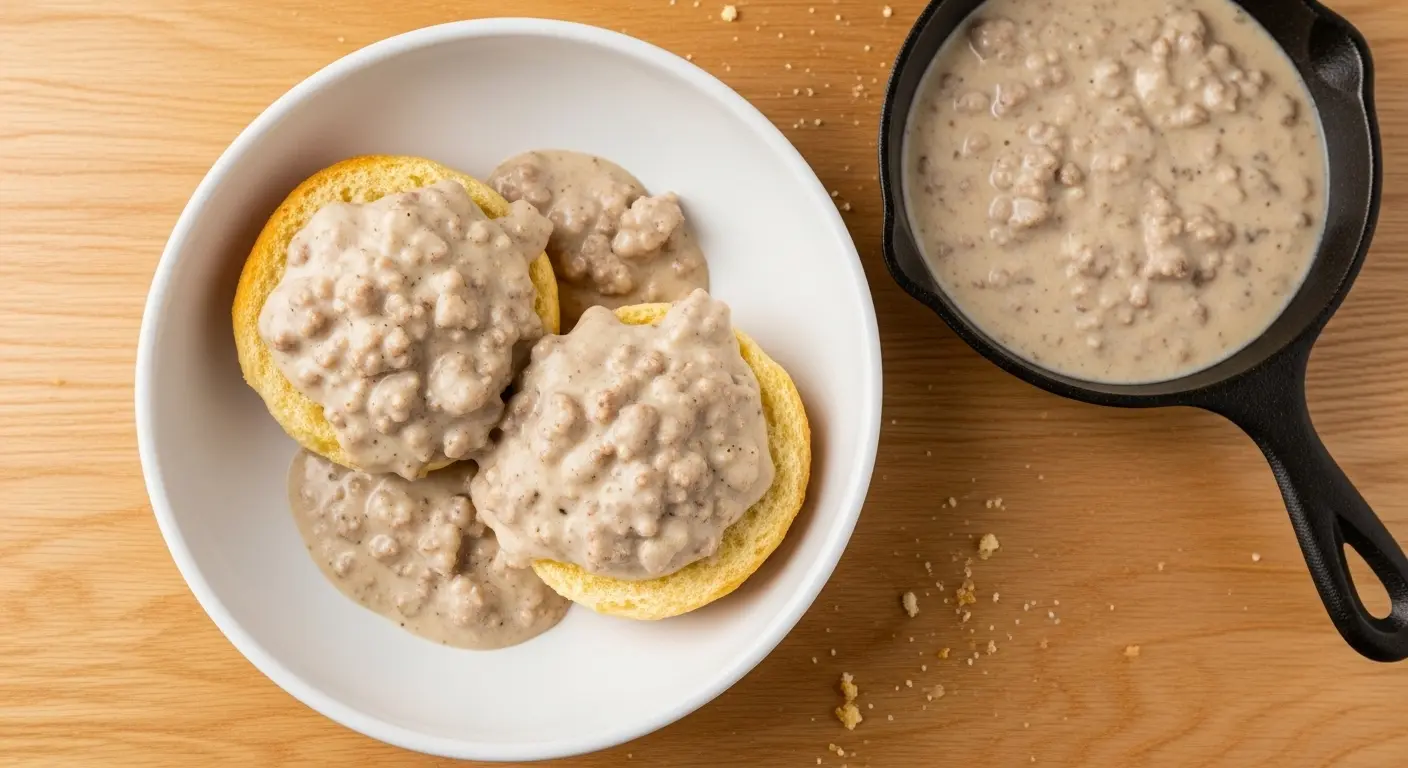
Few things say “good morning” quite like a skillet of bubbling, creamy sausage gravy ready to be ladled over a pile of warm biscuits. This sausage gravy recipe is a true Southern staple, built on just a handful of pantry ingredients: bulk breakfast sausage, all-purpose flour, whole milk, and plenty of cracked black pepper.
What makes this version stand out is attention to the small details. Keeping the rendered sausage fat in the pan, cooking the flour long enough to lose its raw taste, and adding the milk slowly so it incorporates into a silky, lump-free sauce.
The result is deeply savory, warmly spiced, and thick enough to coat every nook of a fluffy biscuit without running off the plate.
This is the kind of breakfast that turns a slow Saturday morning into a genuine event.
If you love cozy Southern breakfasts, you’ll also want to bookmark this Homemade Biscuit Recipe to serve alongside.
Why You’ll Love This Sausage Gravy Recipe
This recipe comes together in about 20 minutes using ingredients you almost certainly already have on hand.
It’s forgiving, endlessly versatile, and tastes like the real deal you’d find at a classic Southern diner.
- Fast and easy: From skillet to table in under 20 minutes, even on a lazy morning.
- Simple ingredients: Just five core ingredients, most of which live in your pantry permanently.
- Rich and creamy: Whole milk and the natural fat from the sausage create a velvety, full-bodied gravy without any need for heavy cream.
- Deeply flavorful: Browning the sausage properly builds a savory, caramelized base that flavors the entire sauce.
- Crowd pleaser: Kids and adults alike go back for seconds every single time.
- Completely customizable: Easy to dial up the heat with hot sausage or red pepper flakes, or keep it mild for picky eaters.
You might also enjoy: Breakfast Skillet Recipe
Ingredients
Getting the ingredient ratios right is the secret to sausage gravy that’s thick but not gluey, and creamy but not thin. Here’s exactly what you need.
- 1 pound (450 g) bulk pork breakfast sausage (mild or hot)
- 2 tablespoons (28 g) unsalted butter (only if sausage renders less than 2 tablespoons of fat)
- ¼ cup (30 g) all-purpose flour
- 2½ cups (600 ml) whole milk, warmed slightly
- ½ teaspoon fine sea salt, plus more to taste
- 1 teaspoon freshly cracked black pepper, plus more to taste
- ¼ teaspoon garlic powder (optional, but adds a subtle depth)
- Pinch of cayenne pepper or red pepper flakes (optional, for heat)
Note on the sausage: Bulk breakfast sausage, sold in a tube or roll, is what you want here. Avoid Italian sausage, bratwurst, or any cured variety. Brands like Jimmy Dean or Bob Evans work great. A sage-seasoned variety will give the gravy extra dimension.
Note on the milk: Whole milk is strongly recommended. It emulsifies with the fat better than low-fat milk, giving you that classic thick, creamy consistency. Using 2% will produce a slightly thinner result and may need a few extra minutes of simmering to tighten up.
Read Also: Breakfast Casserole Recipe
Kitchen Equipment Needed
You don’t need anything specialized for this recipe, but the right pan makes a real difference.
- Cast iron skillet (10–12 inches / 25–30 cm), or a heavy-bottomed stainless steel or nonstick skillet
- Wooden spoon or heat-safe silicone spatula
- Whisk (a flat-edged whisk is especially helpful for getting into skillet corners)
- Liquid measuring cup
- Ladle for serving
Why cast iron? A cast iron skillet holds and distributes heat evenly, which helps the sausage brown uniformly rather than steam. It also gives the flour a chance to cook properly against the hot surface before the milk goes in, which is key to flavor and texture. That said, any wide, heavy skillet will do the job.
For a beautifully balanced, well-seasoned cast iron, a Lodge Cast Iron Skillet is a reliable choice that holds up for decades.
Read Also: Loaded Breakfast Skillet Recipe
Recommended Products for This Recipe
These are products chosen for quality and performance that genuinely improve the experience of making this recipe.
1. Lodge Cast Iron Skillet (12-inch)
A properly seasoned cast iron skillet is the gold standard for making sausage gravy. It creates even heat distribution that helps the sausage brown without burning, and the retained heat keeps the gravy at a perfect simmer as it thickens. It’s an investment piece that gets better with every use.
2. Jimmy Dean Premium Pork Sausage Roll
The sausage you choose is the foundation of the entire dish. A high-quality bulk pork breakfast sausage like Jimmy Dean delivers the right fat content, seasoning, and texture to produce a deeply flavorful, creamy gravy. It renders beautifully in the pan and provides just enough natural fat for a proper roux.
3. Flat-Edge Whisk
A flat-edge or roux whisk is a game changer when making pan gravies. The angled head reaches into the corners and edges of the skillet to prevent lumps, which is the number one issue home cooks run into with sausage gravy. It pays for itself the first time you use it.
4. Silicone Spatula Set
A heat-resistant silicone spatula lets you break up the sausage, stir the roux, and scrape up every bit of flavorful browned bits from the bottom of the skillet without damaging the surface. They’re flexible enough to get under the sausage pieces for even browning.
5. OXO Good Grips Ladle
Serving sausage gravy neatly requires a good ladle that controls pour and portion. The OXO Good Grips version has a comfortable handle, a drip-free rim, and is easy to clean. It’s a kitchen workhorse you’ll reach for constantly beyond just this recipe.
This sausage gravy also pairs wonderfully with a side of Scrambled Eggs for a complete Southern-style breakfast spread.
Step-by-Step Instructions
1. Gather and Prep Your Ingredients
- Pull all your ingredients out before you start. Sausage gravy moves quickly once it gets going, so having everything within reach prevents the gravy from over-thickening or burning while you scramble for the pepper.
- Measure out your flour and set it aside in a small bowl.
- Pour your whole milk into a liquid measuring cup. If you have time, let it sit at room temperature for 5–10 minutes or give it 20 seconds in the microwave. Cold milk added to a hot roux can cause temporary lumping and slows down the thickening process.
- Crack your black pepper fresh if possible. Pre-ground pepper works, but freshly cracked has a more vibrant, floral heat that really shines in this recipe.
2. Brown the Sausage
- Place your skillet over medium-high heat and let it preheat for about 1–2 minutes before adding anything. A properly heated pan promotes browning instead of steaming.
- Add the 1 pound (450 g) of bulk pork breakfast sausage to the hot skillet. Do not add any oil; the sausage will release its own fat.
- Use your wooden spoon or silicone spatula to break the sausage into small, rough crumbles as it cooks. Aim for pieces no larger than a pea for even distribution throughout the gravy.
- Spread the sausage out into an even layer and resist the urge to stir constantly. Let it sit for 60–90 seconds at a time so the edges develop golden brown color. That browning is pure flavor.
- Continue cooking and breaking up the sausage until no pink remains and you can see golden-brown edges on the crumbles, about 6–8 minutes total.
3. Check Your Fat and Add Butter If Needed
- Once the sausage is fully browned, take a look at the bottom of the skillet. You should see a pool of rendered fat around the sausage. You’re looking for about 2 tablespoons (30 ml) of fat.
- If your sausage was very lean and rendered little fat, add the 2 tablespoons (28 g) of unsalted butter now and stir it in until fully melted. The fat is essential for making the roux that thickens the gravy.
- Reduce the heat to medium before moving to the next step.
4. Make the Roux
- Sprinkle the ¼ cup (30 g) of all-purpose flour evenly over the cooked sausage and rendered fat in the skillet.
- Stir immediately and thoroughly, making sure every bit of flour gets coated in the fat. The flour will clump at first; keep stirring until it forms a paste that coats the sausage pieces and the bottom of the skillet.
- Cook the flour-and-sausage mixture over medium heat, stirring continuously, for 1–2 minutes. This step is critical: it cooks out the raw flour taste and develops a very light, toasted note. The mixture will look thick and dry, almost like a paste. That is exactly what you want.
- If you’re using garlic powder (¼ teaspoon), add it now along with the flour. The heat will bloom the spice and integrate it into the roux.
5. Add the Milk Slowly
- Now comes the most important technique in the whole recipe: adding the milk gradually while whisking constantly.
- Pour in about ½ cup (120 ml) of the warm whole milk first. Whisk vigorously and immediately, scraping the bottom and corners of the skillet to incorporate the roux into the liquid. It will look thick and almost paste-like at first; that’s normal.
- Once the first addition is fully smooth, pour in another ½ cup (120 ml) and whisk again until incorporated.
- Continue adding the remaining milk in a slow, steady stream while whisking constantly. Adding all the milk at once risks lumping, so patience here pays off.
- Once all 2½ cups (600 ml) of milk have been added and the mixture is smooth, switch to your wooden spoon or spatula for the simmering phase.
6. Simmer and Thicken
- Raise the heat slightly to medium-high, stirring frequently, until the gravy comes to a gentle boil. You’ll see the liquid start to bubble and thicken noticeably as it heats.
- Once it reaches a boil, reduce the heat to medium-low and let the gravy simmer for 3–5 minutes, stirring every minute or so, until it reaches your desired consistency. It should be thick enough to coat the back of a spoon and fall from the ladle in slow, steady ribbons.
- Keep in mind the gravy will continue to thicken slightly as it cools. If it gets too thick, stir in a splash of warm milk and simmer for another 30 seconds to loosen it up.
7. Season and Taste
- Add the ½ teaspoon of fine sea salt and 1 teaspoon of freshly cracked black pepper to the gravy. Stir well.
- If you’re using cayenne or red pepper flakes (a pinch goes a long way), add them now.
- Taste the gravy and adjust seasoning as needed. Sausage brands vary in their salt content, so always season to taste at the end rather than at the beginning. A properly seasoned sausage gravy should taste savory, creamy, and pepper-forward with no floury or flat notes.
- If the gravy tastes a bit flat, it almost certainly needs more salt. Add it in small pinches, stirring and tasting between additions.
8. Serve Immediately
- Ladle the hot sausage gravy generously over split, warm biscuits. For best results, split the biscuits open and lay them cut-side up so the gravy soaks in rather than just sitting on top.
- Serve right away; sausage gravy is best fresh off the stove when it’s at peak creaminess and temperature.
Read Also: Buttermilk Biscuit Recipe
Tips for Success
Even a simple recipe has its pitfalls. These tips cover the most common issues home cooks run into and how to avoid them.
- Don’t drain the fat after browning the sausage. That rendered fat is what you use to make the roux. Drain it and you lose the flavor base and the thickening agent all at once.
- Cook the roux for the full 1–2 minutes. Undercooking the flour leaves a starchy, raw taste in the finished gravy. It should smell slightly nutty and look dry before you add the milk.
- Add the milk warm, not cold. Cold milk hitting a hot roux can cause the starch to seize unevenly and create lumps. Even just 20 seconds in the microwave makes a difference.
- Whisk, don’t stir, when adding milk. A whisk breaks up clumps far more effectively than a wooden spoon, especially during the first few additions.
- Season at the end, not the beginning. The saltiness of breakfast sausage varies a lot by brand. Wait until the gravy is fully cooked before adjusting salt so you don’t over-season.
- If lumps form, use an immersion blender. A quick 10-second blend with an immersion blender will smooth out stubborn lumps without straining the whole pan.
Another fantastic use for this gravy is spooning it over a Breakfast Casserole for a hearty crowd-friendly brunch.
Serving Suggestions

Sausage gravy is endlessly versatile, and while biscuits are the classic home base, there are plenty of other delicious ways to enjoy it.
Serve the gravy generously and hot; it thickens as it sits, so err on the side of slightly loose if you’re feeding a group and plating takes a minute.
- Biscuits: The classic. Flaky homemade biscuits are the ideal vessel. Lay them open-faced on the plate so the gravy soaks into the layers.
- Breakfast Potatoes: Crispy skillet potatoes topped with a ladle of gravy make a hearty and satisfying alternative.
- Hashbrown Casserole: Sausage gravy poured over a hashbrown casserole is pure Southern comfort food at its finest.
- Toast: A quick weekday option when you don’t have biscuits made. Thick-cut toast holds up well under the weight of the gravy.
- Grits: A wonderful Southern pairing, especially if you add a little cheese to the grits before ladling the gravy on top.
- Scrambled Eggs: Serve the gravy alongside or right over softly scrambled eggs for a protein-packed plate.
- French Toast: For a sweet-savory combination that sounds unusual but tastes incredible, spoon a small amount of sausage gravy over thick French toast.
Variations to Try
The classic recipe is hard to beat, but here are some fun and delicious twists worth exploring once you’ve nailed the original.
This base recipe is incredibly adaptable, so feel free to experiment after you’re comfortable with the technique.
- Spicy sausage gravy: Use hot bulk pork sausage and add ½ teaspoon cayenne and ½ teaspoon red pepper flakes along with the black pepper. It’s fiery and addictive.
- Sage and herb gravy: Add ½ teaspoon dried sage, ¼ teaspoon dried thyme, and a small pinch of rosemary when you add the flour. Use a sage-seasoned sausage for an even more pronounced herby flavor.
- Peppered gravy: Double the black pepper to 2 teaspoons for a boldly seasoned, diner-style version. Use coarsely cracked pepper rather than fine-ground for the best results.
- Turkey sausage gravy: Swap the pork sausage for bulk turkey breakfast sausage. Since turkey sausage renders less fat, add the full 2 tablespoons of butter regardless.
- Mushroom sausage gravy: Add 1 cup (75 g) of finely sliced cremini mushrooms to the skillet after the sausage is browned and cook them down for 3–4 minutes before adding the flour. The mushrooms add an earthy, savory richness.
- Cheese gravy: Stir in ½ cup (55 g) of shredded sharp cheddar at the very end of cooking until melted through. Great over biscuits or grits.
For even more Southern breakfast inspiration, try making these with a side of Breakfast Potatoes.
Storage and Reheating
Sausage gravy stores well and reheats beautifully, making it a great candidate for meal prepping a big breakfast batch ahead of time.
Store and reheat correctly and the texture stays just as creamy as fresh.
- Refrigerator: Transfer cooled gravy to an airtight container and refrigerate for up to 4 days.
- Freezer: Sausage gravy can be frozen for up to 3 months. Let it cool completely, portion it into freezer-safe containers or zip-lock bags, and lay flat to freeze. Thaw overnight in the refrigerator before reheating.
- Reheating on the stovetop: Pour the gravy into a small saucepan over medium-low heat. Stir frequently and add a splash of whole milk (2–4 tablespoons) to loosen it up, as the gravy will have thickened considerably in the fridge. Heat slowly and gently; rushing with high heat can cause separation.
- Reheating in the microwave: Transfer to a microwave-safe bowl, add a splash of milk, and cover loosely with a paper towel. Heat in 30-second intervals, stirring between each, until warmed through.
- Do not boil when reheating. Boiling leftover milk-based gravy can cause the proteins to break down and the sauce to become grainy or separated.
Read Also: Sausage Balls Recipe
Nutritional Facts
The following is an approximate nutritional breakdown per serving, based on this recipe making 4 servings. Values will vary depending on the sausage brand and fat content used.
| Nutrient | Per Serving |
|---|---|
| Calories | ~380 kcal |
| Total Fat | ~27 g |
| Saturated Fat | ~10 g |
| Cholesterol | ~70 mg |
| Sodium | ~680 mg |
| Total Carbohydrates | ~14 g |
| Dietary Fiber | ~0.5 g |
| Total Sugars | ~6 g |
| Protein | ~18 g |
| Calcium | ~180 mg |
| Iron | ~1.5 mg |
Note: Nutritional values are estimates only. Biscuits and other serving accompaniments are not included in these calculations.
For a lighter breakfast to balance your plate, pair this with a fresh Fruit Salad.
Health Benefits of Key Ingredients
While sausage gravy is certainly an indulgent dish, a few of its core ingredients do bring some meaningful nutritional value to the table.
Enjoy it as part of a balanced diet rather than an everyday staple, and it fits just fine.
- Pork breakfast sausage: Provides a solid source of protein and B vitamins, particularly B12, niacin, and thiamine, which support energy metabolism and nervous system function. It also delivers zinc and selenium, two minerals that support immune health.
- Whole milk: Rich in calcium and vitamin D for strong bones. Whole milk also contains conjugated linoleic acid (CLA), a naturally occurring fatty acid associated with various health benefits. It provides phosphorus, potassium, and riboflavin as well.
- All-purpose flour: Contributes small amounts of B vitamins and iron. When used in the quantities called for here (¼ cup for the whole pot), its contribution is modest but it serves as the structure of the sauce.
- Black pepper: More than a simple seasoning, black pepper contains piperine, a bioactive compound with antioxidant and anti-inflammatory properties. It also enhances the absorption of other nutrients, particularly curcumin if you’re adding turmeric to anything on the plate.
- Garlic powder (optional): Even in small amounts, garlic delivers allicin and other organosulfur compounds associated with cardiovascular support and immune function.
Another protein-rich, comforting meal worth bookmarking is this classic Meatloaf Recipe.
Frequently Asked Questions
1. Why is my sausage gravy lumpy?
Lumps in sausage gravy are almost always the result of adding milk too quickly or adding cold milk to a hot roux.
To fix lumpy gravy mid-cook, use a whisk and stir vigorously over medium heat. If the lumps won’t break down, an immersion blender run for 10–15 seconds will smooth everything out quickly. Prevention is easier: add the milk slowly in stages and warm it slightly before adding.
2. How do I make sausage gravy thicker?
If your gravy is too thin after simmering for 5 minutes, the most likely culprit is too much milk or not enough roux.
To thicken it, let it simmer on low heat for a few more minutes, stirring frequently. Alternatively, mix 1 tablespoon of flour with 2 tablespoons of cold milk in a small bowl until smooth, then stir the slurry into the simmering gravy and cook for another 2 minutes.
3. Can I make sausage gravy ahead of time?
Yes. Make the gravy completely, let it cool, and store it in an airtight container in the refrigerator for up to 4 days.
When reheating, add a splash of whole milk to loosen the gravy (it will thicken significantly when cold) and warm it gently over medium-low heat, stirring frequently until hot throughout.
4. Can I freeze sausage gravy?
Absolutely. Let the gravy cool completely before transferring it to a freezer-safe airtight container or zip-lock bag.
It will keep in the freezer for up to 3 months. Thaw it overnight in the refrigerator, then reheat gently on the stovetop with a splash of whole milk to restore the creamy consistency.
5. What can I serve with sausage gravy besides biscuits?
Sausage gravy is incredibly versatile. Beyond biscuits, it’s fantastic over crispy breakfast potatoes, creamy grits, buttered toast, and even over a hashbrown casserole.
It can also be spooned over scrambled eggs or alongside a full breakfast plate. Some people even enjoy it over rice in a pinch, which works surprisingly well.
Read Also: Collard Greens Recipe
Final Thoughts
This sausage gravy recipe is the kind of recipe that doesn’t need much convincing. It’s deeply comforting, impossibly easy, and made from ingredients you probably already own.
Once you make it from scratch, the canned or packet versions just don’t compare.
The technique is simple: brown the sausage well, cook the roux properly, and add the milk slowly. Those three steps are all that separate a great, creamy, Southern-style gravy from a mediocre one.
Give this recipe a try on your next slow weekend morning and pour it generously over the best biscuits you can make.
If you try it, leave a comment below and tell me how it went! Share it with a friend who could use a proper Southern breakfast in their life.
Recommended:
- Homemade Biscuit Recipe
- Buttermilk Biscuit Recipe
- Sausage Stuffing Recipe
- Breakfast Burrito Recipe
- French Toast Casserole Recipe
- Egg Bake Recipe
- Baked Oatmeal Recipe
- Quiche Lorraine Recipe
- Pumpkin Pancake Recipe
- Old Fashioned Pancake Recipe