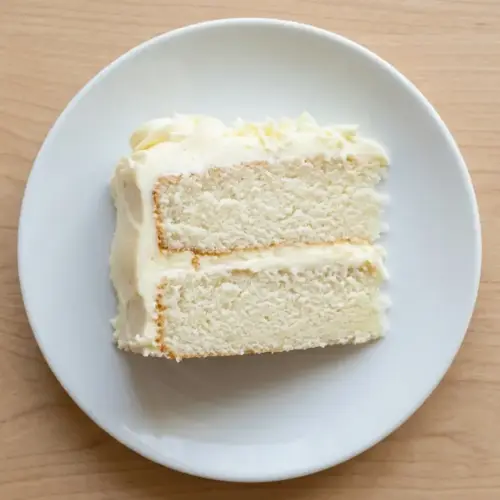
White Velvet Cake

This elegant, snow-white cousin of classic red velvet cake delivers a tender, impossibly soft crumb without any food coloring. The reverse creaming method, buttermilk, and egg whites create a fine, melt-in-your-mouth texture that's lighter than a standard white cake and more flavorful than plain vanilla.
Equipment
- Stand mixer with paddle attachment
- Hand Mixer - alternative to stand mixer
- 8-inch Round Cake Pans - two pans, at least 2 inches deep
- Parchment Paper Rounds
- Large mixing bowls
- Small mixing bowl
- Kitchen scale - recommended for accuracy
- Whisk
- Rubber spatula
- Offset spatula - for frosting
- Wire cooling racks
- cake turntable - optional but helpful for frosting
- Sieve or Fine Mesh Strainer - for sifting
- Measuring cups and spoons
Ingredients
- 2 1/2 cups cake flour - 300g
- 1 1/2 cups granulated sugar - 300g
- 1 tablespoon baking powder
- 1/2 teaspoon baking soda
- 1/2 teaspoon salt
- 1/2 cup unsalted butter - 115g, softened to room temperature
- 1 cup buttermilk - 240ml, room temperature, divided (3/4 cup + 1/4 cup)
- 1/4 cup neutral oil - 60ml, vegetable or canola
- 4 large egg whites - room temperature
- 2 teaspoons pure vanilla extract
- 1/2 teaspoon almond extract
- 1 teaspoon white vinegar
For the Cream Cheese Frosting
- 8 oz cream cheese - 225g, full-fat, softened
- 1/2 cup unsalted butter - 115g, softened
- 3 1/2 cups powdered sugar - 420g, sifted
- 1 teaspoon pure vanilla extract
- 1-2 tablespoons heavy cream - to adjust consistency
Instructions
- Preheat oven to 335°F (168°C). Grease two 8-inch round cake pans with butter or baking spray, line bottoms with parchment paper, and grease the parchment.
- In stand mixer bowl, whisk together cake flour, granulated sugar, baking powder, baking soda, and salt until evenly distributed.
- Add softened butter and mix on low with paddle attachment until mixture resembles coarse, damp sand, about 1-2 minutes.
- In a separate bowl, combine 3/4 cup buttermilk, oil, vanilla, almond extract, and vinegar. Whisk egg whites until frothy and stir into buttermilk mixture.
- With mixer on low, pour remaining 1/4 cup buttermilk into butter-flour mixture. Increase to medium and mix for 1 minute until batter thickens.
- Gradually pour in buttermilk-egg white mixture with mixer on low. Scrape bowl, increase to medium, and beat for 2 full minutes. Scrape and mix briefly.
- Divide batter evenly between prepared pans (about 650-700g each). Tap pans on counter to release air bubbles. Bake 28-35 minutes until toothpick comes clean.
- Cool cakes in pans on wire racks for 15 minutes. Run a thin spatula around edges, invert onto racks, peel off parchment, and cool completely (at least 1 hour).
- Beat softened cream cheese and butter on medium-high until smooth and fluffy, about 2 minutes. Gradually add sifted powdered sugar, then vanilla and heavy cream. Beat until light and spreadable.
- Place first cake layer flat side down. Spread 3/4-1 cup frosting evenly to edges. Top with second layer, flat side up. Apply thin crumb coat, refrigerate 15-20 minutes, then apply final frosting layer.
Notes
- Room temperature ingredients are essential - cold butter, eggs, or buttermilk won't incorporate properly and will result in a dense, uneven crumb. Pull everything out of the fridge at least 1 hour before baking.
- Measure flour correctly - spoon flour into your measuring cup and level it off rather than scooping directly from the bag. For best accuracy, use a kitchen scale (300g cake flour).
- Don't skip the 2-minute beating - this is critical for developing structure in reverse-creamed batters. It creates the smooth, emulsified texture and fine crumb that defines velvet cake.
- Avoid opening the oven early - wait until at least the 25-minute mark to check the cake. Opening the door too early can cause the layers to sink in the middle.
- Cool completely before frosting - even slightly warm cake layers will cause the frosting to melt and slide. If short on time, pop the layers in the fridge for 30 minutes to speed up cooling.
- Use a crumb coat - this thin first layer of frosting traps crumbs and gives you a clean, professional finish on the final coat. Refrigerate 15-20 minutes to set.
- Substituting all-purpose flour - if you don't have cake flour, substitute with 3/4 cup + 2 tablespoons all-purpose flour combined with 2 tablespoons cornstarch per 1 cup needed. Sift together before using.
- Buttermilk substitute - add 1 tablespoon white vinegar or lemon juice to 1 cup whole milk and let sit for 5 minutes until curdled slightly. Full-fat plain yogurt thinned with milk also works.
- Storage - store frosted cake at room temperature for up to 2 days in a cake dome, or refrigerate tightly covered for up to 5 days. Unfrosted layers can be frozen for up to 3 months.
- Bring to room temperature before serving - cold cake tastes denser and drier than it actually is. Pull it out 30-45 minutes before slicing for the best texture and flavor.