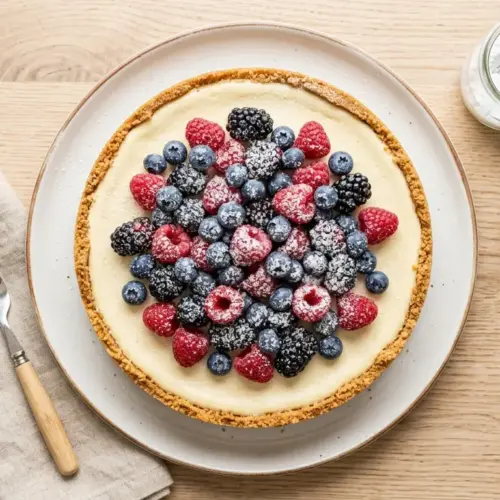
Lactose Free Cheesecake

Rich, velvety, and impossibly smooth, this lactose free cheesecake delivers all the classic tangy creaminess of a traditional baked cheesecake without any of the digestive discomfort. A buttery graham cracker crust and a perfectly set vanilla filling make this dessert impossible to tell apart from the original.
Equipment
- 9-inch springform pan - essential for easy release
- Electric hand mixer - or stand mixer
- Large mixing bowl
- Medium mixing bowl - for the crust
- Large roasting pan - for the water bath
- Rubber spatula
- Measuring cups and spoons
- Kitchen scale - recommended for accuracy
- Aluminum foil - heavy-duty, to wrap the springform pan
- Offset spatula - optional, for smoothing the top
- Wire cooling rack
Ingredients
- For the Graham Cracker Crust:
- 210 g graham cracker crumbs - 1 and 3/4 cups
- 50 g granulated white sugar - 1/4 cup
- 113 g lactose free butter - 1/2 cup or 1 stick, melted (or plant-based butter)
- For the Cheesecake Filling:
- 900 g lactose free cream cheese - 32 oz / 4 blocks, at room temperature
- 200 g granulated white sugar - 1 cup
- 120 g lactose free sour cream - 1/2 cup, at room temperature
- 3 large eggs - at room temperature
- 2 teaspoons pure vanilla extract
- 1 tablespoon fresh lemon juice
- 1 tablespoon cornstarch
Instructions
- Bring lactose free cream cheese, sour cream, and eggs to room temperature for at least 60 minutes before mixing.
- Position oven racks in the center and lowest positions. Preheat oven to 160°C (325°F). Wrap the outside of a 9-inch springform pan tightly with 2-3 layers of heavy-duty aluminum foil to prevent water from seeping in.
- Combine graham cracker crumbs and sugar in a medium bowl. Pour in melted lactose free butter and mix until every crumb is evenly coated. Press firmly into the bottom and 2cm up the sides of the foil-wrapped pan.
- Bake crust for 10 minutes until lightly toasty. Remove and set aside on a wire rack to cool while preparing the filling.
- In a large bowl, beat room temperature lactose free cream cheese on medium speed for 2 minutes until completely smooth. Scrape down the sides and bottom frequently.
- Add granulated sugar and continue beating on medium speed for 1-2 minutes until light and creamy.
- Add lactose free sour cream, vanilla extract, lemon juice, and cornstarch. Mix on low speed until fully combined, scraping down the bowl.
- Add eggs one at a time, mixing on the lowest speed after each addition just until the yolk disappears. Stop immediately to avoid overmixing.
- Pour the filling over the cooled crust and smooth the top with an offset spatula. Tap the pan gently on the counter 3-4 times to release air bubbles.
- Place the foil-wrapped cheesecake pan into a large roasting pan. Carefully pour hot water into the roasting pan until it reaches about 2.5cm (1 inch) up the sides of the springform pan.
- Bake for 55-65 minutes until the edges are set and the center still has a slight wobble when gently shaken.
- Turn off the oven and crack the door open about 5cm (2 inches). Leave the cheesecake inside to cool slowly for 1 hour.
- Remove the pan from the water bath and remove the foil. Run a thin knife around the edge of the cheesecake to loosen it from the sides. Let cool completely at room temperature for 1-2 hours.
- Cover loosely with plastic wrap and refrigerate for a minimum of 4 hours, but ideally overnight (8-12 hours) for the best texture and flavor.
- Release the springform latch and carefully remove the outer ring. Slice with a sharp knife, wiping the blade clean between each cut for perfect slices. Serve cold or at cool room temperature.
Notes
- Room temperature is essential: Cold cream cheese will not blend smoothly and will leave lumps in your batter. Remove dairy and eggs from the fridge at least 60 minutes before starting.
- Do not overmix after adding eggs: Overmixing incorporates too much air, which leads to cracking during baking. Mix on the lowest speed and stop as soon as each egg is incorporated.
- Water bath is non-negotiable: The steam creates a gentle, humid baking environment that prevents cracking and ensures even baking. Double-wrap your springform pan with heavy-duty foil to prevent leaks.
- Cool gradually: The slow oven cool, followed by a room temperature rest, followed by refrigeration is the correct sequence. Rushing any of these steps will cause cracks.
- Make-ahead friendly: This cheesecake actually tastes better the next day. Make it up to 2 days ahead and store covered in the refrigerator for the best flavor and texture.
- Freezing instructions: Wrap the whole cheesecake or individual slices tightly in plastic wrap, then in foil, and freeze for up to 2 months. Thaw overnight in the refrigerator.
- No water bath alternative: If you skip the water bath, reduce oven temperature to 150°C (300°F) and place a separate pan of hot water on the rack below the cheesecake as a compromise.
- Topping ideas: Fresh berries, warm fruit compote, lemon curd, or lactose free caramel sauce all pair beautifully with the tangy filling. Add toppings just before serving.
- Dairy free substitute: For a fully dairy free version, use a firm block-style dairy free cream cheese alternative like Kite Hill. The texture may be slightly softer but still delicious.
- Slicing tip: For clean, picture-perfect slices, use a sharp knife dipped in hot water and wiped clean between each cut. This prevents the filling from sticking to the blade.