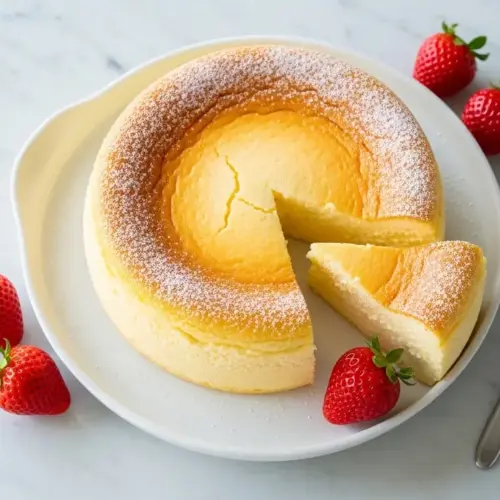
Japanese Cheesecake

This impossibly light and cloud-soft Japanese Cheesecake, also known as cotton or soufflé cheesecake, sits between a sponge cake and a classic baked cheesecake. A silky cream cheese batter folded into stiffly whipped meringue and baked in a water bath creates a tall, pillowy cake with a smooth golden top and an airy crumb that melts on your tongue.
Equipment
- 9-inch springform pan - 3-4 inches deep; a taller pan is ideal
- Stand mixer or electric hand mixer
- Large roasting pan or deep baking dish - For the water bath
- Kitchen scale - Strongly recommended for accuracy
- Medium saucepan or double boiler
- Rubber spatula
- Large metal spoon - For folding
- Sieve or Fine Mesh Strainer - For sifting flour
- Parchment paper
- Heavy-duty aluminum foil - For wrapping the pan
- Instant-read thermometer - Optional but helpful
- Cooling rack
Ingredients
- 8 oz full-fat cream cheese - 225g, softened to room temperature
- 4 tbsp unsalted butter - 57g, softened to room temperature
- 0.5 cup whole milk - 120ml
- 6 large eggs - Separated (yolks and whites in separate bowls)
- 0.75 cup caster sugar - 150g, divided (¼ cup for batter, ½ cup for meringue)
- 0.67 cup cake flour - 80g, sifted
- 2 tbsp cornstarch - 15g
- 1 tbsp fresh lemon juice
- 1 tsp lemon zest
- 0.25 tsp cream of tartar - Optional, helps stabilize egg whites
- 0.25 tsp fine salt
- powdered sugar - For dusting (optional)
Instructions
- Preheat oven to 325°F (163°C). Line bottom of 9-inch springform pan with parchment paper and cut a strip to line the inside walls, extending 2 inches above the rim. Lightly grease the pan, press parchment in place, wrap outside tightly with 2-3 layers of foil, and fill a large roasting pan with 1 inch of hot water set on the lowest oven rack.
- Combine softened cream cheese, butter, and ¼ cup sugar in a medium saucepan over barely simmering water. Stir constantly over low heat until completely smooth and lump-free. Remove from heat, pour in whole milk and stir until smooth, then add egg yolks one at a time, stirring well after each. Stir in lemon juice and zest.
- Sift together cake flour, cornstarch, and salt directly into the cream cheese mixture. Whisk gently until no dry streaks remain and batter is smooth. Set aside at room temperature while preparing meringue.
- Place 6 egg whites and cream of tartar (if using) in a clean, dry mixing bowl. Beat on medium speed until foamy. Gradually add remaining ½ cup sugar, one tablespoon at a time, beating on medium-high until stiff peaks form. Peaks should stand straight up without curling over.
- Scoop one-third of the meringue into the cream cheese batter and gently fold using a rubber spatula until combined. Add remaining meringue in two additions, folding with a gentle motion (down the center, along the bottom, and up and over) just until no white streaks remain. Batter should be smooth, creamy, and slightly airy.
- Pour batter gently into prepared springform pan and tap lightly on the counter to release air bubbles. Smooth the top with a spatula if needed. Carefully place foil-wrapped pan into the water bath in the oven.
- Bake at 325°F (163°C) for 25 minutes, then reduce temperature to 300°F (150°C) and continue baking for another 50-55 minutes. Do not open the oven during the first 25 minutes. Cake is done when top is deep golden brown and center still has a very slight jiggle when shaken.
- Turn the oven off but leave the cake inside with the door slightly ajar for 30 minutes. This gradual cooling prevents cracking and collapsing.
- Remove springform pan from water bath and cool completely on a wire rack at room temperature for 1-2 hours. Once cooled, run a thin knife around the inside edge before releasing the springform latch. Carefully peel away parchment paper.
- Transfer cheesecake to a serving plate and refrigerate for at least 4-6 hours, or overnight. This firms the texture and develops the flavors fully. Dust with powdered sugar just before serving.
Notes
- Bring dairy ingredients to room temperature at least 2 hours before starting. Cold cream cheese and butter will not blend smoothly.
- Separate eggs while cold, then let whites come to room temperature for better whipping volume.
- Do not over-beat the meringue. Stop at stiff peaks before it becomes dry and grainy.
- Fold gently and patiently. Rushing this step and deflating the meringue is the number one cause of a flat cheesecake.
- The water bath is essential and not optional. The steam prevents cracking and ensures an evenly set interior.
- Cool the cake gradually. Sudden temperature changes cause collapse. The slow oven cool-down is built into the timing.
- Chill before serving. Freshly baked Japanese cheesecake is fragile and warm; chilling allows clean slicing and the best texture.
- Store covered loosely with plastic wrap in the refrigerator for up to 4 days. Freeze individual slices wrapped tightly for up to 1 month.
- Remove from fridge 15-20 minutes before serving for best texture. Avoid microwaving as the delicate structure breaks down quickly.
- For matcha variation, sift 2 tablespoons of matcha powder in with the dry ingredients. For chocolate, replace 2 tablespoons of flour with cocoa powder and omit the lemon.