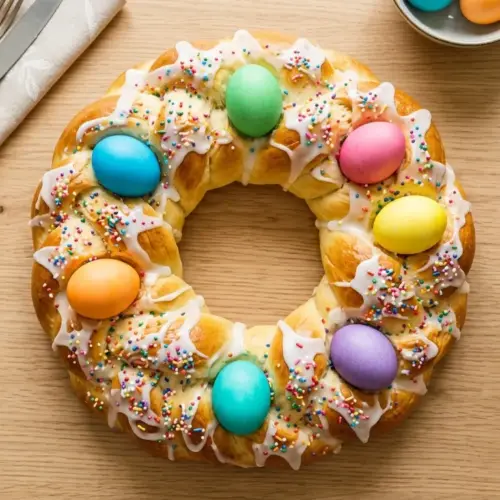
Italian Easter Bread (Pane di Pasqua)

This classic Italian Easter bread is a beautifully braided, brioche-style loaf nestled with colorful dyed eggs. Finished with a simple vanilla glaze and rainbow sprinkles, it's a showstopping centerpiece that's surprisingly approachable for home bakers.
Equipment
- Stand mixer - with dough hook attachment (or large mixing bowl and hands)
- Large mixing bowl - for proofing the dough
- Measuring cups and spoons
- Kitchen scale - recommended for accuracy
- Instant-read thermometer - for checking milk temperature and dough doneness
- Large baking sheet - lined with parchment paper
- Parchment paper
- Plastic wrap - or clean kitchen towel
- Pastry brush - for egg wash and glaze
- Wire cooling rack
- Microplane or fine grater - for orange zest
- Small bowl - for egg wash and glaze mixing
- Bench scraper - optional, for dividing dough
Ingredients
For the Dough
- 4 cups all-purpose flour - 500g, plus more for kneading
- 2 1/4 teaspoons active dry yeast - 7g, 1 standard packet
- 1/2 cup whole milk - 120ml, warmed to 110°F (43°C)
- 1/3 cup granulated sugar - 67g
- 1/4 teaspoon salt
- 3 large eggs - room temperature
- 4 tablespoons unsalted butter - 57g, softened
- 1 teaspoon pure vanilla extract
- 1 large orange - zest only (about 1 tablespoon), organic if possible
For Assembly
- 5 raw eggs - dyed with Easter egg dye (or left undyed)
- 1 egg - beaten for egg wash
- 1 tablespoon whole milk - for egg wash
For the Glaze
- 1 cup powdered sugar - 120g
- 2-3 tablespoons whole milk - for glaze consistency
- 1/2 teaspoon pure vanilla extract
For Decoration
- rainbow nonpareil sprinkles - for topping
Instructions
- Dye 5 raw eggs using a store-bought kit with cold or room-temperature water. Let them dry completely before using.
- Warm milk to 110°F (43°C), then combine with sugar and yeast. Let rest for 5-10 minutes until foamy.
- Add the 3 room-temperature eggs, vanilla, orange zest, softened butter, and salt to the yeast mixture. Gradually add flour, mixing until a shaggy ball forms.
- Knead the dough with a dough hook on medium speed for 8-10 minutes until smooth, elastic, and slightly tacky.
- Place the dough in a greased bowl, cover, and let rise in a warm place until doubled in size, about 1 to 1.5 hours.
- Punch down the dough and divide it into 6 equal pieces. Roll each piece into a 16-18 inch rope.
- Take 3 ropes, pinch the ends together, and braid loosely. Form into a ring by bringing the sealed ends together. Repeat with the remaining 3 ropes.
- Place rings on a parchment-lined baking sheet. Gently tuck dyed eggs into the gaps of each braid.
- Cover and let rise again until puffed, about 45 minutes to 1 hour. Meanwhile, preheat oven to 350°F (175°C).
- Whisk together the beaten egg and 1 tablespoon of milk. Brush the egg wash over the exposed dough, avoiding the dyed eggs.
- Bake for 25-30 minutes until deep golden brown and the internal temperature reaches 190°F (88°C). Tent with foil if browning too quickly.
- Let cool on the baking sheet for 10 minutes, then transfer to a wire cooling rack to cool completely.
- Whisk together powdered sugar, 2-3 tablespoons of milk, and vanilla until smooth. Drizzle over the cooled bread and immediately top with sprinkles.
- Allow the glaze to set for 10-15 minutes before slicing and serving.
Notes
- Room-temperature ingredients: Take eggs, butter, and milk out of the fridge 30-60 minutes before starting. Cold ingredients slow yeast activity and make the dough hard to work with.
- Yeast temperature: Milk must be between 100°F and 110°F (38°C-43°C). Above 120°F (49°C) will kill the yeast. Use an instant-read thermometer for accuracy.
- Check your yeast: If the yeast doesn't foam during the activation step, discard and start with a fresh packet. This is the most common reason for dough failure.
- Braid loosely: A tight braid has no room for the dough to expand during the second rise and baking, which can cause cracking or the eggs to pop out.
- Don't rush the rises: Both rises are essential for flavor development and a light, airy texture. Cutting them short leads to dense bread.
- Raw eggs in the bread: The dyed eggs are raw when placed in the braid. They cook completely during the 25-30 minute bake time and are safe to eat.
- Cool before glazing: Glazing warm bread will cause the glaze to melt and soak into the crust. Let it cool completely for a picture-perfect finish.
- Make-ahead option: Complete the first rise, shape the braids, then cover and refrigerate overnight. Let sit at room temperature for 45-60 minutes before baking.
- Lemon variation: Swap orange zest for lemon zest and add 1 tablespoon of lemon juice to the glaze for a brighter, tangier flavor.
- Storage: Store unglazed bread wrapped tightly at room temperature for up to 2 days or in the refrigerator for up to 5 days. Freeze unglazed for up to 2 months.