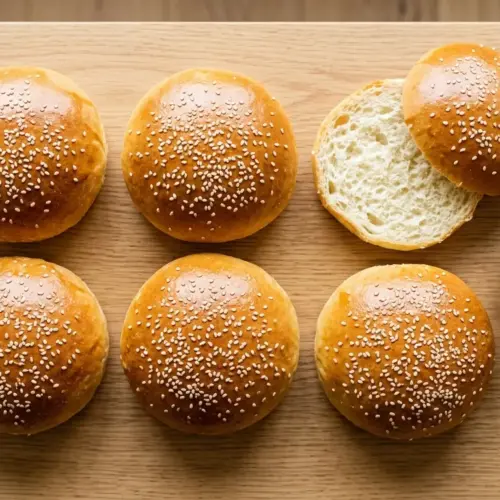
Homemade Burger Buns

These burger buns come out pillowy-soft on the inside with a light golden crust on the outside, holding up beautifully to even the juiciest, messiest burgers without going soggy or falling apart. Once you pull a batch out of the oven, you'll wonder why you ever settled for the packaged kind.
Equipment
- Stand mixer with dough hook attachment - or a large bowl for hand-kneading
- Large mixing bowl - for the first rise
- Baking sheet - rimmed half-sheet pan works best
- Parchment paper
- Kitchen scale - highly recommended for accurate flour measurement
- Instant-read thermometer - to check water temperature
- Pastry brush - for applying the egg wash
- Plastic wrap - or a clean kitchen towel for covering the dough during rises
- Wire cooling rack
Ingredients
- 3 cups all-purpose flour - 360g, plus more for dusting
- 2¼ teaspoons active dry yeast - 7g, 1 standard packet
- ¾ cup warm water - 180ml, 105°F to 110°F / 40°C to 43°C
- ¼ cup whole milk - 60ml, warmed to room temperature
- 2 tablespoons granulated white sugar - 25g
- 1½ teaspoons fine salt - 9g
- 1 large egg - at room temperature, for the dough
- 3 tablespoons unsalted butter - 42g, softened to room temperature
For the Egg Wash
- 1 large egg
- 1 tablespoon water
For Topping (Optional)
- 1 tablespoon sesame seeds - optional, but classic
Instructions
- Measure ¾ cup (180ml) of warm water between 105°F and 110°F (40°C to 43°C). Pour into stand mixer bowl, add 2 tablespoons sugar and 2¼ teaspoons yeast. Stir briefly and let sit for 7-10 minutes until foamy.
- Once yeast is foamy, add ¼ cup room-temperature whole milk, 1 large egg, and 3 tablespoons softened unsalted butter cut into pieces. Stir briefly to combine.
- Whisk together 3 cups all-purpose flour and 1½ teaspoons fine salt. With mixer on lowest speed, gradually add flour mixture about ½ cup at a time until all is incorporated and dough comes together.
- Increase mixer speed to medium and knead for 6-8 minutes until smooth, slightly elastic, and just barely tacky. Add flour 1 tablespoon at a time if dough is excessively sticky (maximum 2-3 extra tablespoons).
- Lightly grease a large bowl with oil. Transfer dough to bowl, turn to coat all sides. Cover tightly with plastic wrap and let rise in a warm, draft-free spot until doubled in size, about 1 to 1½ hours.
- Punch down dough and turn out onto lightly floured surface. Divide into 8 equal pieces (about 90g-100g each) using a kitchen scale. Shape each piece by folding edges inward and rolling under tension to create smooth, round balls. Flatten slightly to about 3 inches in diameter.
- Line a baking sheet with parchment paper. Place shaped buns on parchment, spacing them at least 2 to 2.5 inches apart. Cover loosely with plastic wrap and let rise again for 45 minutes to 1 hour until puffy and soft.
- Preheat oven to 375°F (190°C). Whisk together 1 large egg and 1 tablespoon water for egg wash. Gently brush tops and slightly down sides of each risen bun with egg wash. Sprinkle with sesame seeds if using.
- Bake on center rack for 15-18 minutes until deeply golden brown. If browning too quickly, tent loosely with foil. Internal temperature should reach 190°F to 200°F (88°C to 93°C).
- Transfer buns to a wire cooling rack immediately. Cool for at least 20-30 minutes before slicing to prevent gummy texture. Slice horizontally with a serrated bread knife and toast cut sides before serving.
Notes
- Weigh your flour: A kitchen scale is the most reliable way to measure flour. Packing flour into a measuring cup can add 20% to 30% more flour than intended, leading to dry, dense buns.
- Check your yeast: If your yeast does not foam within 10 minutes, it's dead and needs to be replaced. This is the most common reason bread doesn't rise.
- Don't rush the rises: Cold dough rises slowly, and that's okay. Flavors develop during rising time. If your kitchen is cold, the dough may need an extra 30 minutes.
- Keep the dough tacky: The finished dough should feel very slightly sticky. If you keep adding flour to get a completely non-sticky dough, the buns will be too dry after baking.
- Use room-temperature ingredients: Cold butter doesn't incorporate evenly and can leave streaks in the dough. Cold eggs can lower the temperature of your yeast mixture, slowing activation.
- Toast the cut sides: Before loading up your burger, toast the sliced buns cut-side-down in a hot dry skillet for 60 to 90 seconds. It adds flavor and creates a barrier that prevents the bun from going soggy.
- Storage: Store fully cooled buns in an airtight container at room temperature for up to 3 to 4 days. Avoid refrigerating as cold causes bread to stale faster.
- Freezing: Wrap each cooled bun individually in plastic wrap, then place in a freezer-safe bag. Freeze for up to 2 to 3 months. Thaw at room temperature for 1-2 hours or warm in a 350°F oven for 8-10 minutes.
- Make-ahead option: After the first rise, cover the punched-down dough tightly and refrigerate for up to 24 hours. Bring to room temperature for 30 minutes, then shape and proceed with the second rise.
- No stand mixer? You can make these buns by hand. Combine wet and dry ingredients in a bowl, stir until a rough dough forms, then knead on a floured surface for 10-12 minutes until smooth and elastic.